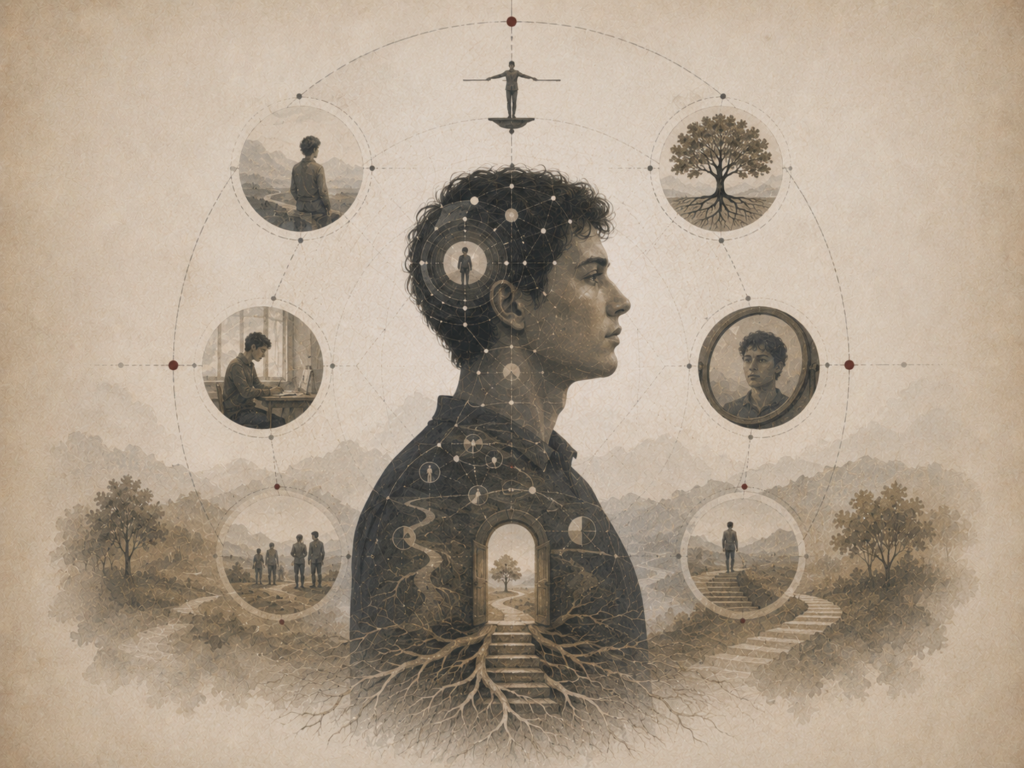
Restrained institutional illustration of a human profile surrounded by life-stage figures, pathways, trees, and developmental diagrams representing personality development across the lifespan.

Personality Development Across the Lifespan

Personality development across the lifespan is one of the central questions of personality psychology because it forces the field to confront two truths at once: people remain recognizably themselves, and people also change. This article examines how continuity and development coexist across childhood, adolescence, adulthood, and later life, distinguishing rank-order stability from mean-level change and showing why both matter. It explores maturation, role investment, identity development, social context, and the mechanisms through which personality evolves over time. The result is a more serious account of lifespan development as neither static character nor unlimited reinvention, but an ongoing pattern of continuity, adaptation, and change shaped by age, roles, institutions, and the unequal worlds through which persons move.


Restrained institutional illustration of a human profile surrounded by symbolic pathways, roots, doors, scales, and life-context diagrams representing selfhood, agency, and personal identity.

Selfhood, Agency, and Personal Identity in Personality Psychology

Selfhood, agency, and personal identity bring personality psychology to one of its deepest questions: what makes a life feel like one person’s life across time, change, conflict, and action? This article examines how personality is shaped not only by traits and motives, but by selfhood as lived ownership, agency as authorship of action, and personal identity as continuity across past, present, and future selves. It explores memory, commitment, identity disturbance, social recognition, and the developmental formation of personal identity while arguing that personality becomes more complete when it is understood as both patterned and owned. The result is a more serious view of the person as a self-organizing agent rather than merely a profile of enduring traits.

Restrained institutional illustration of a human profile filled with symbolic pathways, memory scenes, circular story fragments, and connected diagrams representing narrative identity and the storied self.

Narrative Identity and the Storied Self

Narrative identity describes the internalized and evolving life story through which a person interprets the past, understands the present, and imagines the future. This article examines narrative identity as a core layer of personality, showing how autobiographical memory, self-continuity, meaning-making, and culturally available story forms shape the storied self. It explains how people organize lives through themes such as redemption, contamination, agency, and coherence, and why life stories matter alongside traits and motives in a full account of personality. The result is a more serious view of selfhood as temporal and interpretive: not only a pattern of dispositions, but an ongoing narrative effort to make a life intelligible, morally meaningful, and continuous across change.

Restrained institutional illustration of a human profile surrounded by mirrors, roots, pathways, social scenes, and abstract diagrams representing self-concept, self-esteem, and self-knowledge.

Self-Concept, Self-Esteem, and Self-Knowledge

Self-concept, self-esteem, and self-knowledge are often treated as interchangeable, but they name different layers of personality. This article explains how people represent themselves, evaluate themselves, and attempt to know themselves with varying degrees of accuracy. It examines self-concept as an organized structure of identity, self-esteem as the evaluative dimension of selfhood, and self-knowledge as the problem of insight, blindness, and correspondence with reality. It also explores self-discrepancy, self-continuity, and the role of others in reflecting or distorting the self. The result is a more serious account of personality as reflexive and self-interpreting: shaped not only by traits and motives, but by how the person understands, judges, and narrates who they are.

Restrained institutional illustration of a human profile surrounded by pathways, compass forms, roots, social scenes, and symbolic value markers representing values, strivings, and personality direction.

Values, Strivings, and the Direction of Personality

Personality is not only a matter of stable traits. It is also a matter of direction: what a person values, what they repeatedly strive for, and how their commitments organize conduct across time. This article examines values and personal strivings as central components of personality architecture, showing how broad evaluative priorities, recurring goals, and conflicts among them help explain the direction of a life. It draws on value theory, personal-strivings research, and self-determination theory to clarify how people differ not only in style, but in what they take to matter. The result is a more complete account of personality as purposive and morally organized, shaped by commitment, tradeoff, social context, and the patterned pursuit of what one judges worth seeking.

Restrained institutional illustration of a human profile surrounded by pathways, compass forms, goal symbols, mountains, roots, and circular diagrams representing motivation, goals, and desire.

Motivation, Goals, and the Architecture of Desire

Personality is not only a matter of traits. It is also a matter of direction: what a person wants, fears, pursues, delays, protects, and organizes life around. This article examines motivation, goals, and desire as central components of personality architecture, showing how enduring individuality is shaped not only by stable traits but by needs, goal systems, self-regulation, values, and identity. It explores Self-Determination Theory, goal hierarchy, motivational conflict, and the social shaping of desire, while arguing that personality becomes far more intelligible when its directed structure is taken seriously. The result is a more complete view of personality as not only patterned, but purposeful—organized through striving, tradeoff, and the moral and social worlds that teach people what to want.

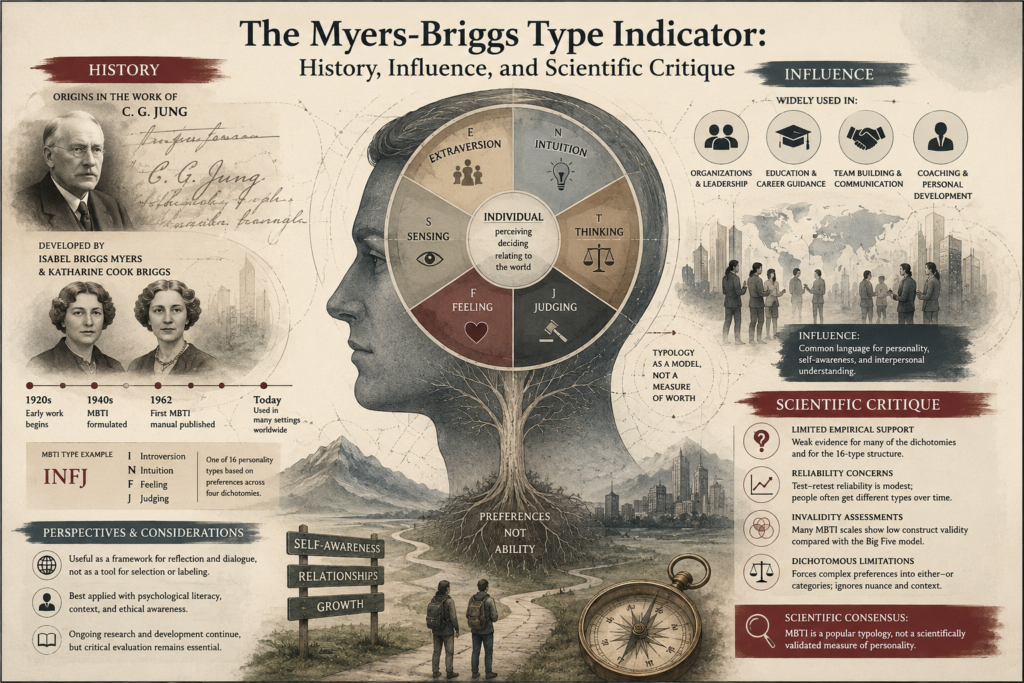
Infographic-style institutional illustration of the Myers-Briggs Type Indicator with a central human profile, typology wheel, historical figures, timeline elements, workplace influence symbols, and scientific critique panels.

The Myers-Briggs Type Indicator: History, Influence, and Scientific Critique

The Myers-Briggs Type Indicator is one of the most influential personality instruments ever created, yet also one of the most scientifically contested. This article examines the MBTI as both a historical phenomenon and a psychological framework, tracing its roots in Jungian typology through the work of Katharine Briggs and Isabel Briggs Myers and explaining why its four-letter system became so culturally durable. It also addresses the central scientific critique: that the MBTI’s typological structure, forced dichotomies, and uneven psychometric standing make it less defensible than dimensional trait models. The result is a balanced account of the instrument’s history, practical appeal, institutional influence, and scientific limits, without reducing either its cultural power or its methodological weaknesses to caricature.

Restrained institutional illustration of a human profile between categorical personality type groupings and dimensional trait distributions, representing different models of personality structure.

Personality Types and Personality Traits: Categorical and Dimensional Models Compared

Personality types promise clarity by sorting people into recognizable kinds, while personality traits describe graded differences across continuous dimensions. This article compares these two major ways of modeling individuality, explaining why categorical approaches remain psychologically appealing even as dimensional trait models dominate modern personality science. It examines what types gain in memorability and narrative force, what they lose in precision, why traits better preserve variation and psychometric structure, and how person-centered profile methods partly bridge the divide. The result is a more serious account of the issue: not a simple rejection of type thinking, but a careful comparison of categorical and dimensional models as competing ways of representing personality, each useful for some purposes but not equally faithful to the graded nature of most human variation.

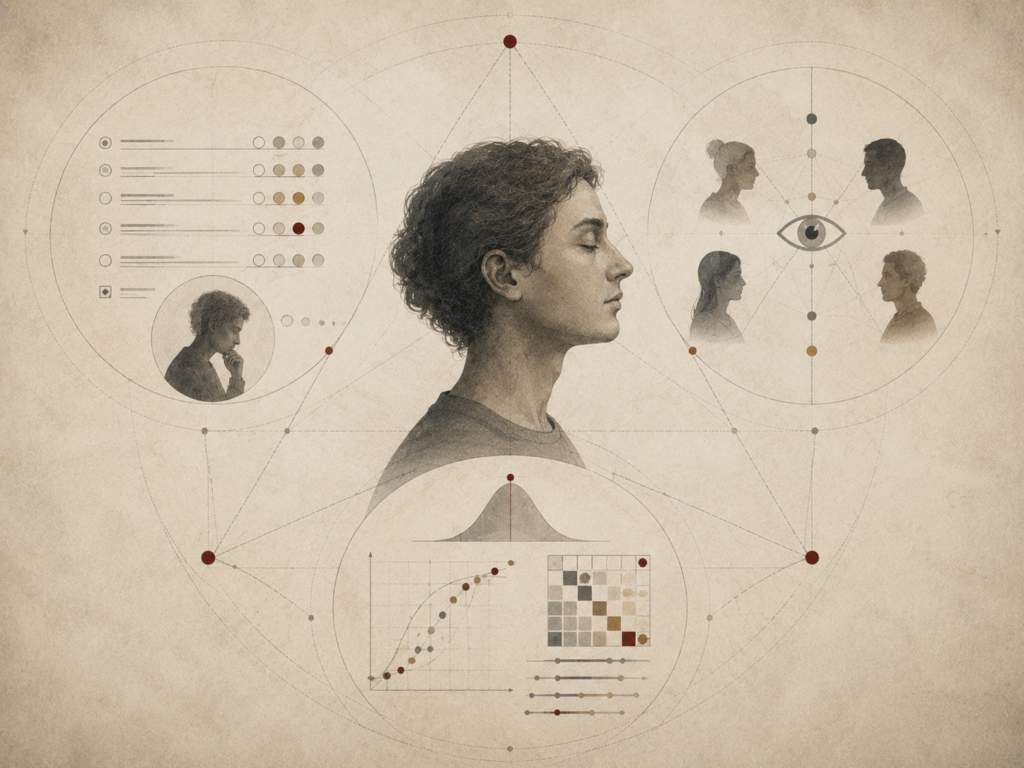
Restrained institutional illustration of a human profile surrounded by self-report forms, observer-rating diagrams, statistical charts, and psychometric measurement symbols.

Measurement in Personality Psychology: Self-Report, Observer Ratings, and Psychometrics

Measurement is one of the deepest problems in personality psychology because the field is always trying to infer enduring psychological structure from imperfect indicators. This article explains how personality is assessed through self-report inventories, observer ratings, and psychometric models, and why none of these methods can be treated as transparent by default. It examines the strengths and limits of self-knowledge, the value and bias of informant reports, the meaning of reliability and validity, the problem of faking and method effects, and the importance of measurement invariance across groups and contexts. The result is a more serious account of personality assessment as a fundamentally inferential practice—one that depends on conceptual precision, methodological discipline, and psychometric evidence rather than the mere existence of a questionnaire.

Scroll to Top