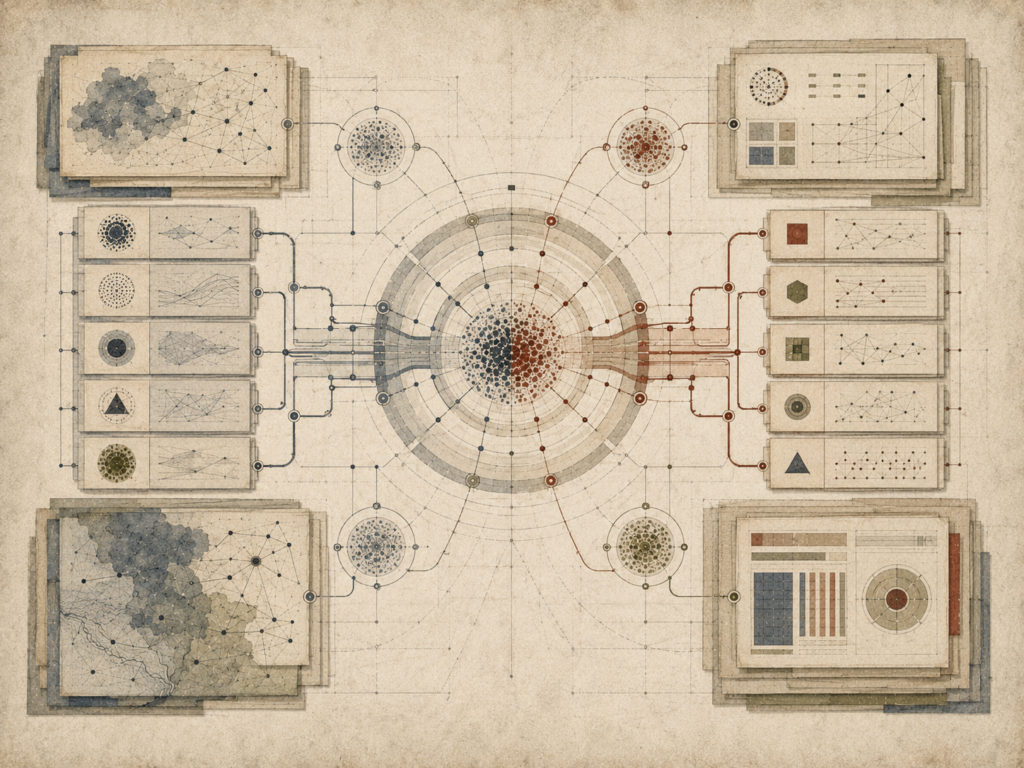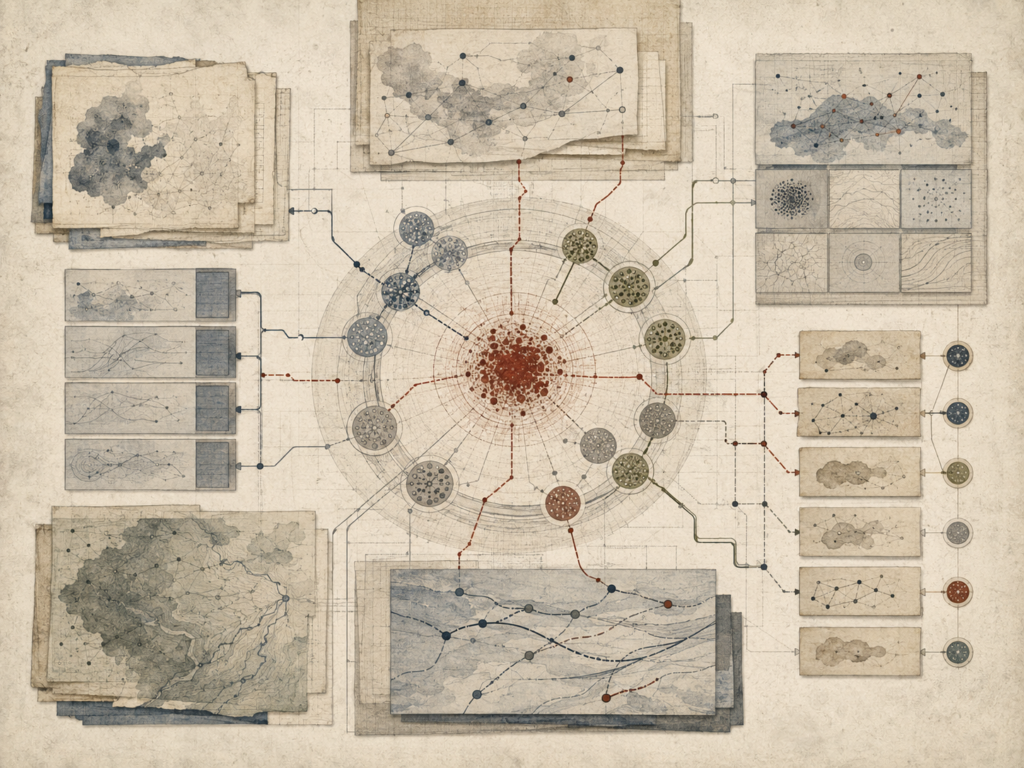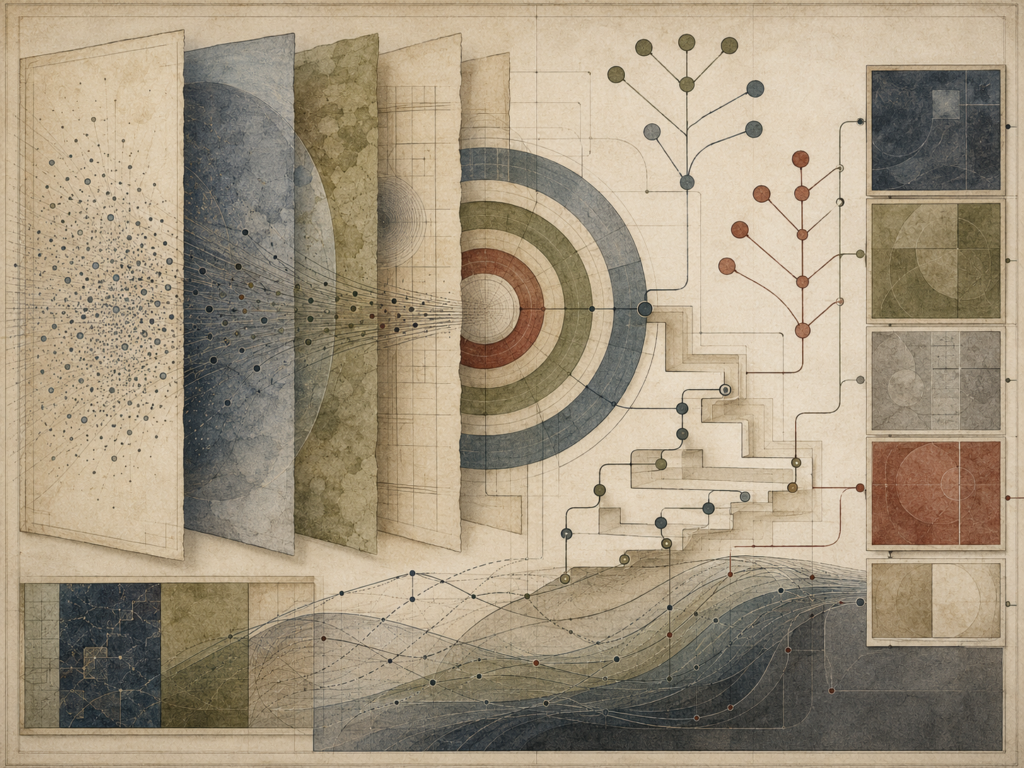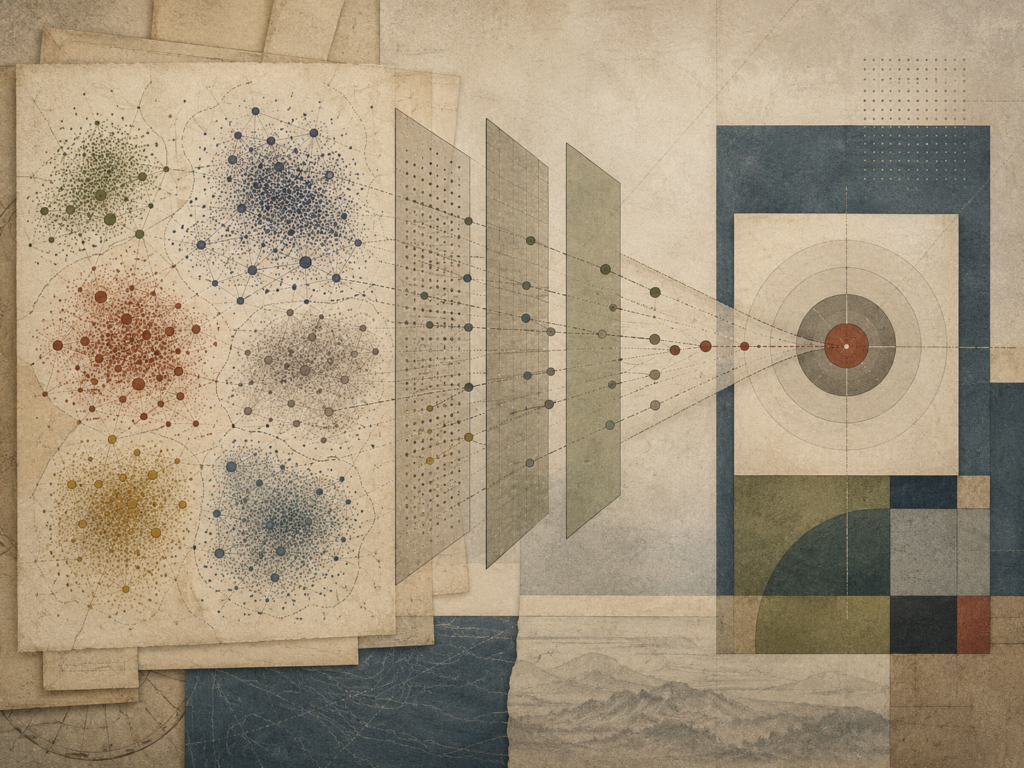
Editorial scientific illustration showing matter changing phase across ordered and disordered regions, lattice-like spin patterns, symmetry-breaking forms, branching critical fluctuations, coarse-graining blocks, and renormalization-flow pathways in black, cream, white, and deep red.

Phase Transitions, Critical Phenomena, and the Renormalization Group

Phase transitions, critical phenomena, and the renormalization group reveal how macroscopic order emerges from microscopic interactions, why different physical systems can share the same critical behavior, and how physics changes with scale. This article examines phases, order parameters, symmetry breaking, first-order and continuous transitions, free-energy landscapes, Landau theory, the Ising model, fluctuations, correlation functions, correlation length, susceptibility, critical exponents, scaling relations, finite-size scaling, universality classes, coarse graining, fixed points, relevant and irrelevant operators, effective theory, and computational modeling of critical behavior. Selected R and Python workflows model Landau free-energy landscapes and 2D Ising Monte Carlo simulation, while the linked GitHub repository expands the article with reproducible critical-phenomena workflows.

Editorial scientific illustration showing layered quantum field surfaces, particle-like excitations, propagator arcs, scattering pathways, Fock-space-like stacked states, and vacuum fluctuation textures.

Quantum Field Theory I: Fields, Particles, and Second Quantization

Quantum field theory is the framework in which fields are quantized, particles emerge as excitations of those fields, and creation and annihilation operators organize the many-particle states of relativistic and condensed-matter systems. This article examines why relativistic quantum theory requires fields, how classical fields become quantum fields, how harmonic-oscillator quantization leads to second quantization, how Fock space organizes particle states, how scalar fields are quantized, how commutation and anticommutation relations encode bosonic and fermionic statistics, how propagators describe correlations, how interactions produce scattering, and how renormalization enters as a scale problem. Selected R and Python workflows model Bose occupation and ladder operators, while the linked GitHub repository expands the article with reproducible QFT workflows.

Editorial scientific illustration showing curved spacetime grids bending around massive objects, geodesic paths, light bending, black-hole horizon geometry, gravitational-wave ripples, and cosmological curvature forms.

General Relativity: Geometry, Gravity, and Spacetime Curvature

General relativity redefines gravity as the geometry of spacetime: matter and energy curve spacetime, and free-falling bodies move along the natural paths of that curved geometry. This article examines the equivalence principle, spacetime intervals, Lorentzian geometry, metric tensors, proper time, geodesics, covariant derivatives, parallel transport, curvature, the Riemann tensor, Ricci curvature, scalar curvature, Einstein’s field equation, stress-energy, the Newtonian limit, Schwarzschild geometry, gravitational time dilation, redshift, light bending, black holes, horizons, gravitational waves, cosmology, experimental tests, numerical relativity, and the unresolved problem of quantum gravity. Selected R and Python workflows model Schwarzschild scales, gravitational redshift, and weak-field orbital precession, while the linked GitHub repository expands the article with reproducible computational relativity workflows.

Editorial scientific illustration showing mirrored geometric structures, rotational arcs, conserved orbital pathways, phase-space curves, field-line patterns, and manifold-like surfaces.

Symmetry, Conservation, and Noether’s Theorem

Symmetry, conservation, and Noether’s theorem reveal one of the deepest organizing principles in physics: when the action of a physical system is invariant under a continuous transformation, there is a corresponding conserved quantity. This article examines invariance, transformation groups, continuous and discrete symmetries, action principles, cyclic coordinates, canonical momenta, Noether charges, conserved currents, spacetime symmetries, internal symmetries, gauge symmetries, Noether’s first theorem, Noether’s second theorem, symmetry breaking, quantum generators, field-theoretic currents, conservation laws, constraints, and computational verification. Selected R and Python workflows map symmetries to conserved quantities and test angular momentum conservation, while the linked GitHub repository expands the article with advanced computational scaffolding for reproducible symmetry-analysis workflows.

Editorial scientific illustration showing protein-folding structures, lipid membrane layers, ion channels, molecular particles, cytoskeletal fibers, motor-like protein movement, and soft biological material textures.

Biophysics and the Physical Principles of Life

Biophysics studies life through the principles of physics: energy, entropy, force, diffusion, transport, mechanics, electrostatics, molecular structure, information, and nonequilibrium dynamics. This article examines thermal energy, Brownian motion, diffusion, free energy, entropy, molecular forces, protein folding, molecular recognition, binding equilibria, membranes, electrochemical gradients, ion channels, membrane excitability, molecular motors, cytoskeletal mechanics, soft matter, biomechanics, biological fluid flow, biophysical imaging, measurement, systems biophysics, and computational modeling. Selected R and Python workflows model diffusion time scales, Brownian motion, and mean squared displacement, while the linked GitHub repository expands the article with advanced computational scaffolding for reproducible biophysics workflows.

Editorial scientific illustration showing luminous plasma filaments, charged particle trajectories, magnetic field arcs, fusion confinement geometry, wavefronts, aurora-like plasma, and turbulent electromagnetic structures.

Plasma Physics and the Fourth State of Matter

Plasma physics studies ionized matter whose charged particles move collectively under electric and magnetic fields, creating waves, shielding, currents, instabilities, turbulence, confinement behavior, radiation, and nonlinear dynamics that do not appear in ordinary neutral gases. This article examines ionization, quasi-neutrality, Debye shielding, plasma frequency, charged-particle motion, gyrofrequency, gyroradius, drifts, fluid plasma models, kinetic plasma models, magnetohydrodynamics, plasma waves, Alfvén waves, Langmuir waves, instabilities, turbulence, fusion plasmas, magnetic confinement, inertial confinement, space plasmas, astrophysical plasmas, low-temperature plasmas, plasma diagnostics, and computational plasma modeling. Selected R and Python workflows model plasma parameter sensitivity and charged-particle gyration, while the linked GitHub repository expands the article with advanced computational scaffolding for reproducible plasma-physics workflows.

Editorial scientific illustration showing crystal lattice structures, layered semiconductor materials, band-structure energy surfaces, p–n junction regions, carrier flow pathways, transistor gate geometry, doped gradients, and circuit-like traces.

Semiconductor Physics and Electronic Materials

Semiconductor physics and electronic materials explain how quantum band structure, carrier statistics, doping, defects, interfaces, electric fields, and transport processes make modern electronics possible. This article examines crystal lattices, periodic potentials, energy bands, band gaps, effective mass, density of states, Fermi–Dirac statistics, intrinsic and extrinsic semiconductors, doping, carrier concentration, mobility, conductivity, drift, diffusion, recombination, p–n junctions, depletion regions, built-in potential, diode current, metal–semiconductor contacts, MOS capacitors, MOSFET physics, heterostructures, compound semiconductors, wide-bandgap materials, optoelectronic materials, semiconductor metrology, and computational device modeling. Selected R and Python workflows model conductivity sensitivity and diode current–voltage behavior, while the linked GitHub repository expands the article with advanced computational scaffolding for reproducible semiconductor-physics workflows.

Editorial scientific illustration showing abstract qubits, entangled particles, Bloch-sphere geometry, branching measurement paths, fading coherence waves, matrix-like textures, and lattice structures.

Quantum Information, Decoherence, and Measurement

Quantum information, decoherence, and measurement explain how physical systems can store information in quantum states, how measurement turns amplitudes into outcomes, and how interaction with the environment destroys fragile quantum coherence. This article examines qubits, superposition, Hilbert space, density matrices, pure and mixed states, entanglement, the Born rule, projective measurement, generalized measurement, quantum channels, decoherence, dephasing, relaxation, entropy, no-cloning, teleportation, quantum error correction, fault tolerance, quantum algorithms, quantum communication, and the measurement problem. Selected R and Python workflows model binary entropy, measurement uncertainty, density-matrix dephasing, purity, and von Neumann entropy, while the linked GitHub repository expands the article with advanced computational scaffolding for reproducible quantum-information workflows.

Editorial scientific illustration showing abstract atoms, molecular structures, photon beams, spectral light bands, laser paths, optical interference patterns, and cold-atom trap forms.

Atomic, Molecular, and Optical Physics

Atomic, molecular, and optical physics studies the quantum structure of matter and light: atoms, molecules, photons, spectra, lasers, optical transitions, precision measurement, cold gases, and controlled light–matter interaction. This article examines atomic structure, electronic energy levels, the Schrödinger equation, hydrogen spectra, the Rydberg formula, angular momentum, selection rules, fine and hyperfine structure, Zeeman and Stark effects, molecular rotation and vibration, spectroscopy, spontaneous and stimulated emission, lasers, Rabi oscillations, quantum optics, cold atoms, optical traps, precision clocks, and quantum technologies. Selected R and Python workflows model Boltzmann rotational populations and hydrogen spectral lines, while the linked GitHub repository expands the article with advanced computational scaffolding for reproducible AMO-physics workflows.

Scroll to Top