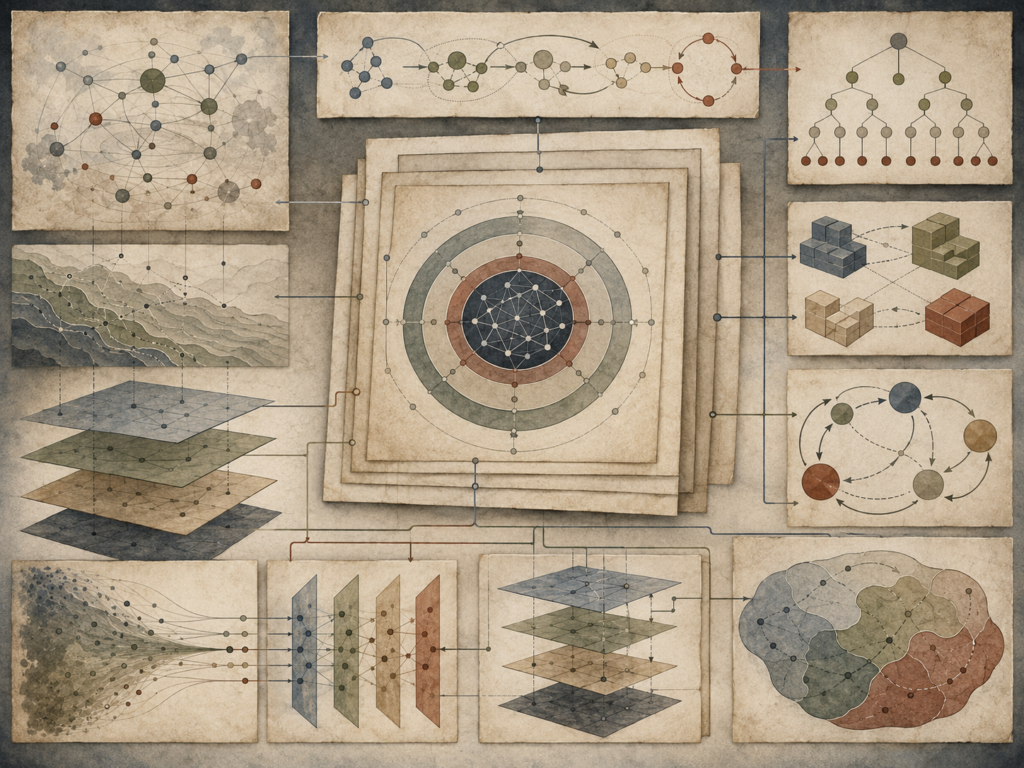
Editorial scientific illustration showing an incoming wave beam scattering from an abstract target potential into angular paths, detector-array arcs, resonance peaks, partial-wave rings, event-count patterns, and inference textures.

Scattering Theory, Cross Sections, and Physical Inference

Scattering theory is one of the central inference engines of physics: it translates invisible interactions into measurable angular distributions, energy spectra, event counts, cross sections, resonances, and outgoing states. This article examines incoming and outgoing states, scattering amplitudes, differential and total cross sections, probability current, flux, the S-matrix, T-matrix, Born approximation, partial-wave expansion, phase shifts, optical theorem, resonances, Breit–Wigner forms, inelastic scattering, coupled channels, Rutherford scattering, quantum field theory scattering, Feynman amplitudes, luminosity, event rates, detector efficiency, acceptance, unfolding, likelihood inference, uncertainty, and inverse scattering. Selected R and Python workflows model angular integration and resonance fitting, while the linked GitHub repository expands the article with reproducible scattering workflows.

Editorial scientific illustration showing abstract band-structure surfaces, Berry-curvature textures, winding geometries, protected boundary channels, quantum Hall edge pathways, Majorana-like end states, anyonic braids, and layered quantum material structures.

Topological Matter and Quantum Phases

Topological matter and quantum phases show that matter can be classified not only by symmetry, order parameters, and local microscopic structure, but also by global properties of quantum states that remain stable under continuous deformation. This article examines topology in physics, adiabatic deformation, energy gaps, Berry phase, Berry curvature, Chern numbers, quantum Hall effects, fractional quantum Hall fluids, anyons, topological insulators, topological superconductors, Majorana modes, symmetry-protected topological phases, intrinsic topological order, bulk-boundary correspondence, edge and surface states, topological phase transitions, disorder, entanglement, experimental signatures, and computational band-topology workflows. Selected R and Python examples model SSH winding numbers and two-band Chern models, while the linked GitHub repository expands the article with reproducible topological-matter workflows.

Editorial scientific illustration showing coherent quantum flow, paired-particle condensates, superconducting current loops, magnetic-field expulsion, quantized vortices, superfluid vortex lines, Josephson-junction structures, and many-body quantum order.

Superconductivity, Superfluidity, and Macroscopic Quantum Order

Superconductivity and superfluidity are macroscopic quantum states in which quantum coherence becomes visible at the scale of matter itself. This article examines superconductivity, superfluidity, broken U(1) symmetry, complex order parameters, phase coherence, Cooper pairing, BCS theory, Ginzburg–Landau theory, London equations, Meissner effect, penetration depth, coherence length, type-I and type-II superconductivity, Abrikosov vortices, flux quantization, Josephson effects, SQUIDs, Bose–Einstein condensation, helium-4 superfluidity, helium-3 paired-fermion superfluidity, Landau’s criterion, quantized circulation, two-fluid behavior, unconventional superconductivity, quantum fluids, and macroscopic quantum devices. Selected R and Python workflows model Ginzburg–Landau free energy and Josephson phase dynamics, while the linked GitHub repository expands the article with reproducible macroscopic-quantum-order workflows.

Editorial scientific illustration showing an expansive cosmic web of galaxies, clusters, filaments, voids, dark matter halo structures, cosmic microwave background texture, redshift-depth geometry, lensing arcs, and survey-map forms.

Cosmology and the Large-Scale Structure of the Universe

Cosmology studies the universe as a physical system: its origin, expansion, composition, geometry, thermal history, structure formation, and large-scale distribution of matter. This article examines the cosmological principle, FLRW spacetime, scale factor, redshift, Hubble expansion, Friedmann equations, ΛCDM, radiation, baryons, cold dark matter, dark energy, inflation, primordial perturbations, the cosmic microwave background, acoustic peaks, baryon acoustic oscillations, galaxy surveys, weak lensing, cosmic web morphology, linear perturbation growth, transfer functions, matter power spectra, halo formation, N-body simulations, hydrodynamic simulations, observational tensions, DESI-era dark-energy questions, and the future of survey cosmology. Selected R and Python workflows model FLRW expansion, distance-redshift relations, linear growth, and toy matter power spectra, while the linked GitHub repository expands the article with reproducible cosmology workflows.

Editorial scientific illustration showing branching quantum paths, layered spacetime histories, action-like surface landscapes, lattice grids, propagator arcs, and Monte Carlo sampling structures in black, cream, white, and deep red.

Path Integrals and the Functional Formulation of Physics

Path integrals and the functional formulation of physics recast dynamics as a sum over histories, assigning amplitudes or statistical weights to entire paths, fields, and configurations. This article examines propagators, quantum amplitudes, classical action, stationary phase, time slicing, configuration-space and phase-space path integrals, Euclidean continuation, partition functions, Gaussian functional integrals, generating functionals, source terms, correlation functions, Wick’s theorem, perturbation theory, Feynman diagrams, effective actions, saddle-point methods, instantons, fermionic Grassmann integrals, gauge fixing, lattice path integrals, Monte Carlo sampling, stochastic path integrals, and the conceptual limits of functional methods. Selected R and Python workflows model discretized Euclidean actions and harmonic oscillator path sampling, while the linked GitHub repository expands the article with reproducible path-integral workflows.

Editorial scientific illustration showing abstract symmetry transformations, rotating geometric structures, group-orbit paths, representation spaces, angular-momentum spheres, spinor-like geometry, crystal symmetry patterns, gauge-field arcs, and tensor-network-like structures.

Group Theory and Representation Theory in Physics

Group theory and representation theory provide the mathematical language of symmetry in physics, explaining how rotations, translations, spin, crystals, tensors, conservation laws, selection rules, gauge fields, and particle states are organized. This article examines groups, subgroups, conjugacy classes, group actions, representations, irreducible representations, characters, Schur’s lemma, tensor products, Lie groups, Lie algebras, generators, SO(3), SU(2), angular momentum, spinors, Lorentz and Poincaré symmetry, internal symmetries, gauge groups, particle multiplets, point groups, space groups, Bloch theory, tensors, spectroscopy, and computational representation workflows. Selected R and Python examples model character orthogonality and SU(2) angular-momentum matrices, while the linked GitHub repository expands the article with reproducible symmetry workflows.

Editorial scientific illustration showing dense interacting particle fields, lattice structures, quasiparticle-like excitations, collective wave modes, spin-chain patterns, coherent flow, correlation networks, and emergent large-scale order.

Many-Body Physics and Emergent Collective Behavior

Many-body physics studies how large collections of interacting particles produce collective behavior that cannot be understood by simply multiplying one-particle physics. This article examines interacting particles, quantum statistics, identical particles, Hilbert-space growth, second quantization, Fock space, correlation functions, entanglement, quasiparticles, phonons, magnons, Fermi liquids, Bose condensation, superfluidity, superconductivity, magnetism, the Hubbard model, strongly correlated systems, topological order, nonequilibrium many-body dynamics, numerical methods, and emergence in physical science. Selected R and Python workflows model Bose/Fermi occupation statistics and exact diagonalization of a transverse-field Ising chain, while the linked GitHub repository expands the article with reproducible many-body physics workflows.

Editorial scientific illustration showing a precision laboratory measurement system with sensor probes, optical instruments, waveform noise patterns, calibration-like curves, uncertainty bands, branching inference distributions, and layered data/provenance structures.

Experimental Physics: Measurement, Noise, Calibration, and Inference

Experimental physics is the discipline of making physical claims accountable to measurement: designing instruments, controlling noise, calibrating sensors, estimating uncertainty, testing models, and deciding what can legitimately be inferred from data. This article examines measurement models, measurands, instruments, calibration, traceability, precision, accuracy, repeatability, reproducibility, Type A and Type B uncertainty, systematic effects, random noise, Gaussian and non-Gaussian error, uncertainty propagation, least-squares fitting, calibration curves, signal-to-noise ratio, filtering, Fourier analysis, Bayesian inference, residual diagnostics, experimental design, blind analysis, replication, open data, and reproducible laboratory computation. Selected R and Python workflows model calibration diagnostics, noise, SNR, and uncertainty propagation, while the linked GitHub repository expands the article with reproducible experimental-physics workflows.

Editorial scientific illustration showing matter changing phase across ordered and disordered regions, lattice-like spin patterns, symmetry-breaking forms, branching critical fluctuations, coarse-graining blocks, and renormalization-flow pathways in black, cream, white, and deep red.

Phase Transitions, Critical Phenomena, and the Renormalization Group

Phase transitions, critical phenomena, and the renormalization group reveal how macroscopic order emerges from microscopic interactions, why different physical systems can share the same critical behavior, and how physics changes with scale. This article examines phases, order parameters, symmetry breaking, first-order and continuous transitions, free-energy landscapes, Landau theory, the Ising model, fluctuations, correlation functions, correlation length, susceptibility, critical exponents, scaling relations, finite-size scaling, universality classes, coarse graining, fixed points, relevant and irrelevant operators, effective theory, and computational modeling of critical behavior. Selected R and Python workflows model Landau free-energy landscapes and 2D Ising Monte Carlo simulation, while the linked GitHub repository expands the article with reproducible critical-phenomena workflows.

Scroll to Top