Restrained classical terrace scene with figures writing, conversing, walking, and reflecting beside a quiet landscape, symbolizing subjective well-being and life satisfaction.

Subjective Well-Being and Life Satisfaction

Subjective well-being is one of the foundational constructs in modern positive psychology because it asks how people evaluate the quality of their own lives through both emotional experience and cognitive judgment. This article examines the conceptual structure of SWB, its three classic components of life satisfaction, positive affect, and negative affect, and the psychometric tools that made happiness scientifically measurable. It also explores cross-cultural comparison, the role of SWB in economics and public policy, and the limitations of self-report-based well-being research. The result is a clearer account of subjective well-being as an essential but incomplete dimension of flourishing within a broader science of human development.


Restrained institutional illustration of researchers mapping well-being science across psychology, ecology, health, governance, and community life.

The Future of Well-Being Science

The future of well-being science lies in its transformation from a narrow study of happiness into a broader interdisciplinary inquiry into the conditions of human flourishing. This article examines how psychology, economics, public health, sustainability science, policy analysis, and data-intensive research are converging to reshape the field. It explores advances in measurement, the growing role of well-being frameworks in governance, the integration of flourishing with sustainable development, and the ethical challenges that arise when well-being becomes a target of institutional design. The result is a more expansive view of well-being science as a systems-oriented field concerned not only with how life feels, but with the social, ecological, and institutional conditions that make durable flourishing possible.

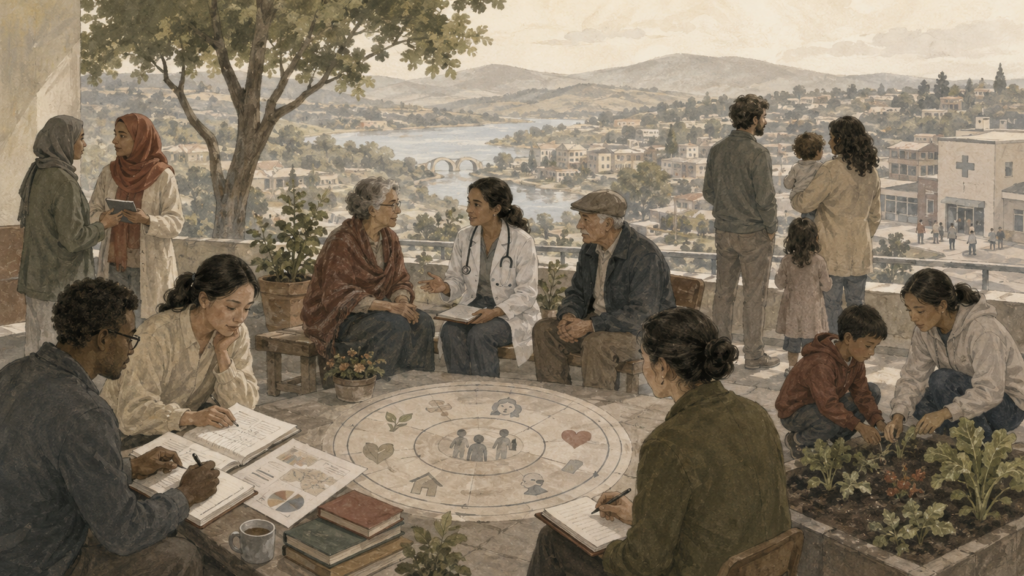
Restrained institutional illustration of a multicultural group gathered in dialogue around a circular floor diagram, symbolizing cultural perspectives on well-being and human flourishing.

Cultural Perspectives on Well-Being: Flourishing Across Societies

Human well-being may be a universal aspiration, but the ways societies define happiness, dignity, meaning, and flourishing vary widely across cultures. This article examines how cultural context shapes both the experience and measurement of well-being, moving beyond narrow assumptions that equate flourishing with individual autonomy or emotional satisfaction alone. It explores Western models of well-being, collectivist and relational conceptions of flourishing, philosophical traditions beyond modern psychology, and the methodological challenges of measuring happiness across societies. It also connects cultural well-being to development, public policy, and global measurement frameworks, arguing that a mature science of flourishing must be both empirically rigorous and culturally plural.

Restrained institutional illustration of a diverse intergenerational group gathered in a civic garden, studying sustainability, human flourishing, ecology, and development.

Well-Being and Sustainable Development: Human Flourishing in the Age of Sustainability

Sustainable development raises a deeper question than economic growth alone can answer: what does it mean for societies to truly thrive? This article examines how well-being science, human development theory, capabilities thinking, and sustainability research have converged around a broader account of progress. It explores the move from output-centered development to people-centered development, the role of capabilities and institutional quality, the significance of the Sustainable Development Goals, and the importance of resilience, social trust, and ecological stability for long-term flourishing. The result is a more serious understanding of development as the expansion of human possibilities under conditions that remain socially just, institutionally durable, and ecologically viable.

Restrained institutional illustration of a diverse group studying economic diagrams, community life, ecology, and human flourishing around a circular table map.

The Economics of Well-Being: Rethinking Growth, Happiness, and Human Flourishing

The economics of well-being rethinks economic progress by asking not only how much societies produce, but whether that production actually enlarges the conditions for human flourishing. This article examines the limits of GDP, the rise of happiness economics, the capabilities approach, and the growing use of well-being indicators in public policy. It also connects behavioral economics and positive psychology to broader questions of trust, health, inequality, institutional quality, and sustainable development. The result is a more serious account of economic life: one in which prosperity is judged not by output alone, but by whether societies create the durable material, social, and institutional conditions under which people can genuinely live well.

Restrained institutional illustration of public health workers, families, elders, and researchers gathered in a community health setting, symbolizing well-being, resilience, and population health.

Positive Psychology in Public Health: Well-Being, Resilience, and Population Health

Public health is increasingly moving beyond a narrow focus on disease prevention toward a broader concern with population well-being, resilience, and the social conditions that make healthy life possible. This article examines how positive psychology contributes to that shift by clarifying the roles of flourishing, meaning, trust, and resilience in public health research. It also explores population well-being surveys, prevention and protective factors, the social determinants of health, and the growing use of well-being metrics in policy. The result is a more expansive account of health—one that includes illness prevention but also recognizes that communities thrive when institutions, environments, and relationships support human functioning, dignity, and long-term flourishing.

Restrained institutional illustration of scholars debating well-being research around a table with papers, diagrams, and a balance scale symbolizing tensions in the science of human flourishing.

Critiques of Positive Psychology: Debates About the Science of Human Flourishing

Positive psychology emerged as an important correction to psychology’s long emphasis on pathology, but its rise has also generated serious criticism. This article examines the major critiques of positive psychology, including concerns about individualism, structural inequality, measurement, commercialization, and cultural bias. It argues that these critiques are not merely oppositional; they have helped clarify what a more mature science of flourishing must look like. By bringing institutions, inequality, culture, and public use into the discussion, the article reframes critique as part of the field’s development rather than a rejection of it. The result is a more serious understanding of flourishing as a psychological, social, institutional, and cultural question.

Restrained institutional illustration of an intergenerational group gathered around a circular sustainability diagram, linking well-being, community, ecology, and human flourishing in a finite world.

Positive Psychology and Sustainability: Human Flourishing in a Finite World

Positive psychology and sustainability converge around a shared question: what conditions allow individuals and societies to flourish over time? This article reframes that relationship by showing that flourishing is not simply a private psychological state, but a systems-level outcome shaped by institutions, public health, education, community trust, and ecological stability. It explores why sustainability needs a theory of well-being, how the SDGs and WHO already embed well-being in global policy, and why resilience, meaning, and adaptive capacity matter under conditions of climate strain and institutional stress. The result is a more serious understanding of flourishing as a durable relationship among persons, communities, and the social and ecological systems that sustain life.

Restrained institutional illustration of scholars examining a circular diagram contrasting pleasure, meaning, virtue, care, and flourishing across two traditions of well-being science.

Hedonic vs Eudaimonic Well-Being: Two Traditions in the Science of Human Flourishing

One of the most important debates in well-being research concerns whether living well is best understood as happiness or as flourishing. This article examines the distinction between hedonic well-being, centered on life satisfaction and emotional experience, and eudaimonic well-being, centered on meaning, virtue, growth, and psychological functioning. Drawing on philosophy, modern psychology, and current well-being science, it shows why both traditions remain essential to understanding human flourishing. It also explores how the debate shapes measurement, public policy, and sustainability, arguing that a mature science of well-being must remain attentive both to how life feels from within and to the deeper developmental quality of the life being lived.

Scroll to Top