Perception in Cognitive Psychology: How the Mind Interprets Sensory Information
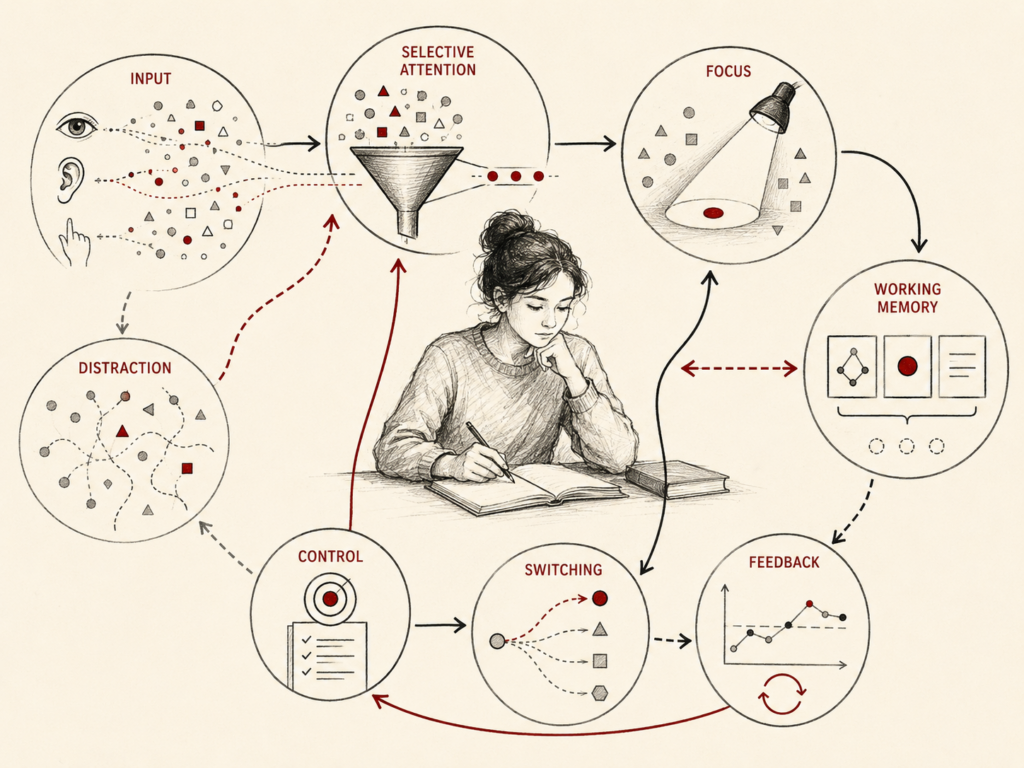
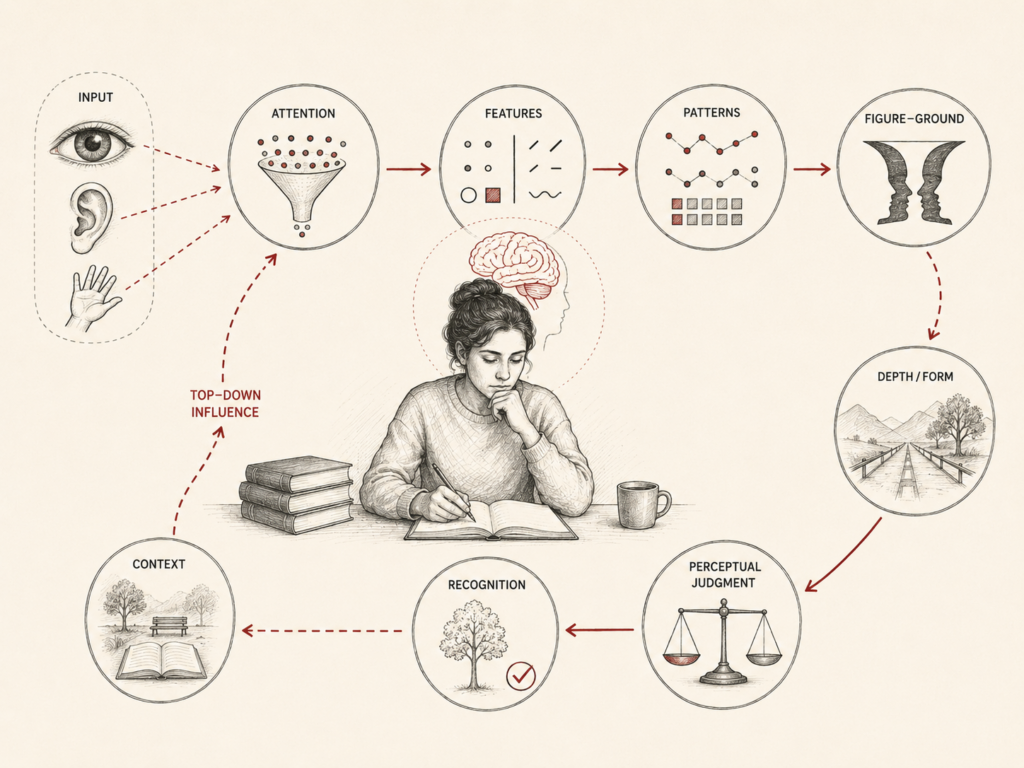
Perception is the process through which the mind organizes, interprets, and stabilizes sensory information into a usable world. Sensory systems register light, sound, motion, pressure, and other forms of stimulation, but perception is what transforms those unstable signals into objects, surfaces, voices, events, and environments that can be meaningfully navigated. In cognitive psychology, perception is therefore not treated as a passive recording of reality. It is understood as an active process of organization, inference, prediction, and context-sensitive interpretation. Because raw sensory input is incomplete, noisy, and often ambiguous, the mind must construct relatively stable experience from uncertain evidence, drawing not only on incoming stimulation but also on attention, memory, working memory, prior knowledge, and expectation. This gives perception a foundational place within cognition as a whole, since reasoning, learning, judgment, and action all depend on what is first perceived and how it is organized. To understand cognition more broadly, one must first understand how the mind constructs the world it takes itself to be encountering.