
Last Updated May 20, 2026
Perception is the cognitive process through which sensory information is organized, interpreted, stabilized, and transformed into a usable world. Sensory systems register light, sound, pressure, motion, temperature, bodily position, and other forms of stimulation, but perception is what turns those signals into objects, surfaces, voices, events, scenes, spaces, bodies, hazards, tools, and environments. In cognitive psychology, perception is therefore not treated as a passive recording of reality. It is understood as an active process of organization, inference, prediction, correction, and context-sensitive interpretation.
Human perceptual systems operate in environments saturated with information. Light reaches the retina in changing patterns. Sound arrives in overlapping streams. Touch, proprioception, and bodily signals unfold across time and position. Yet raw sensory input is incomplete, noisy, unstable, and often ambiguous. The mind must therefore transform changing data into relatively stable experience. That transformation depends not only on incoming stimulation but also on attention, memory, working memory, expectation, prior knowledge, action goals, emotional salience, and contextual interpretation.
Perception occupies a foundational position within cognitive psychology because almost every higher cognitive process depends on what is first perceived and how it is organized. Reasoning, learning, judgment, planning, language, memory, and action are all constrained by perceptual structure. For this reason, perception connects directly to decision making, problem solving, mental models, human-computer interaction, and artificial intelligence systems. To understand cognition more broadly, one must first understand how the mind constructs the world it takes itself to be encountering.
Main Library
Publications
Article Map
Cognitive Psychology
Related Topic
Behavioral Economics
Related Topic
Artificial Intelligence Systems
Related Topic
Data Systems & Analytics
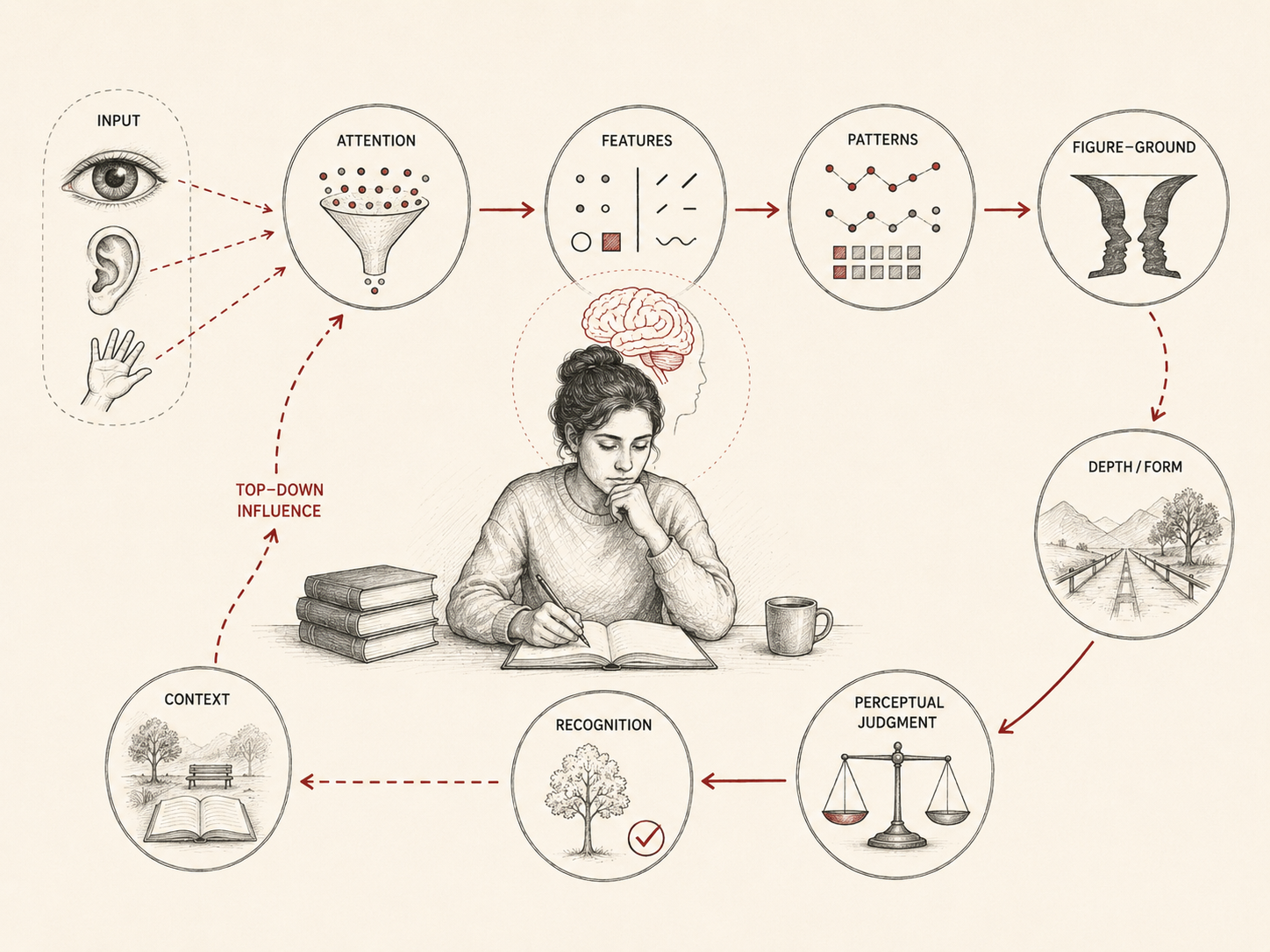
Perception matters because cognition begins not with an objective copy of the world, but with an organized interpretation of sensory evidence. What people notice, miss, recognize, misperceive, or treat as meaningful shapes later memory, judgment, action, and belief. Perception is therefore not a peripheral process. It is one of the first points at which the world becomes cognitively available.
What is perception?
Perception refers to the set of processes through which the mind organizes sensory input into structured and meaningful representations. Sensation detects stimulation. Perception interprets it. That distinction matters because the world as perceived is not identical to the world as physically measured. Perception depends on selection, grouping, feature integration, temporal binding, contextual interpretation, and inferential reconstruction.
Perception therefore involves several overlapping operations:
- registering sensory information from the environment;
- detecting features such as edges, tones, movement, contrast, texture, pitch, pressure, and orientation;
- organizing incoming signals into coherent objects, events, and scenes;
- separating figure from ground;
- integrating information across time, location, and modality;
- interpreting ambiguous input in light of prior knowledge and expectations;
- constructing stable representations from incomplete, noisy, or changing data;
- guiding attention, memory, judgment, and action.
This is why cognitive psychology treats perception as constructive rather than merely reactive. The mind does not simply mirror the world. It generates working interpretations of what sensory evidence most likely indicates. That constructive power makes perception efficient and adaptive, but it also makes it vulnerable to bias, distortion, omission, and illusion.
Perception is also selective. People do not perceive everything available in the environment with equal depth. Attention, goals, expertise, expectation, fatigue, emotional state, and task demands shape what becomes salient. A driver, radiologist, musician, athlete, engineer, child, patient, or interface user may perceive different structures in the same physical environment because their perceptual systems are tuned by different goals, histories, and constraints.
For this reason, perception should be understood as world-directed but not world-identical. It is anchored in sensory evidence, but organized by cognitive systems that interpret, prioritize, and stabilize that evidence for action.
Historical foundations of perception research
Scientific research on perception draws from philosophy, physiology, psychophysics, and early experimental psychology. One of the most influential early figures was Hermann von Helmholtz, who argued that perception involves unconscious inference. On this view, the mind uses learned assumptions and prior experience to infer the most likely causes of sensory stimulation. Helmholtz’s approach was decisive because it treated perception as an inferential problem rather than a simple mechanical consequence of sensation.
Psychophysics also played a foundational role. Researchers such as Gustav Fechner developed methods for relating physical stimulus intensity to subjective experience. This made perception measurable. Thresholds, discrimination, just-noticeable differences, response curves, and signal detection all emerged from the broader effort to connect external stimulation with perceptual judgment.
In the early twentieth century, Gestalt psychologists challenged atomistic models that tried to build perception out of isolated fragments. Instead, they argued that perception is inherently organized. The mind tends to grasp structured wholes, relational form, and patterned continuity rather than an unconnected collection of parts. Gestalt theory remains important because it showed that perceptual organization cannot be reduced to the sum of local sensations.
Later work in cognitive science and neuroscience added computational, Bayesian, ecological, embodied, and predictive accounts. David Marr’s computational theory of vision argued that perception should be understood at multiple levels: the computational problem being solved, the algorithmic representations and processes used, and the physical implementation in neural systems. This framework helped connect psychology, neuroscience, and artificial intelligence.
Contemporary perception research now integrates psychophysics, neural coding, Bayesian inference, predictive processing, machine vision, human factors, multisensory integration, and philosophical debates about experience. The central question remains remarkably stable: how does an organism construct a usable world from incomplete, changing, and uncertain sensory input?
Gestalt principles of perceptual organization
Gestalt psychology introduced some of the most influential ideas in the study of perceptual structure. These principles do not imply that perception is arbitrary. Rather, they describe systematic tendencies through which perceptual systems organize input into forms that are simpler, more stable, and more coherent.
Among the most influential principles are:
- Proximity — elements near one another tend to be grouped together.
- Similarity — elements sharing visible properties tend to be perceived as belonging together.
- Continuity — the mind tends to favor smooth continuation over abrupt fragmentation.
- Closure — incomplete forms tend to be perceived as completed wholes.
- Common fate — elements moving together tend to be grouped as a unit.
- Symmetry — symmetrical elements are often perceived as belonging together.
- Figure-ground separation — perceptual systems distinguish focal objects from background fields.
- Prägnanz — perception tends toward simple, stable, and organized forms where possible.
These principles remain influential because they show that perceptual organization is not an afterthought layered on top of sensation. It is part of how perception works from the outset. People perceive forms, objects, surfaces, and relations, not merely isolated points of stimulation.
Gestalt principles are also practically important in visual communication, interface design, architecture, cartography, typography, medical imaging, dashboard design, and human-computer interaction. When elements are arranged poorly, users may group the wrong things, miss key information, or perceive relationships that were not intended. When elements are arranged well, perceptual organization supports comprehension.
Gestalt theory also offers an important caution: clarity does not depend only on the amount of information shown. It depends on the structure through which information is perceptually organized. More data can make a system less understandable when organization fails.
Bottom-up and top-down processing
One of the most important distinctions in cognitive psychology is between bottom-up and top-down processing.
Bottom-up processing refers to perceptual organization driven primarily by incoming sensory information. Processing begins with the stimulus and proceeds toward higher-order interpretation. A bright flash, loud sound, sharp edge, moving object, or sudden tactile signal may capture perception because of its sensory properties.
Top-down processing refers to perception shaped by prior knowledge, expectations, goals, context, and task demands. In this mode, the mind uses what it already knows to interpret ambiguous input more efficiently. Reading degraded text, recognizing an object in shadow, or understanding speech in a noisy room often depends on top-down support.
Most real-world perception depends on the interaction of these two processes. Sensory evidence constrains what can plausibly be perceived, but context and prior structure help determine which interpretation is most likely. A physician interpreting an image, a mechanic hearing an engine, a musician recognizing a chord, or a user scanning an interface is not relying only on raw input. Perception is shaped by expertise, expectation, and task structure.
This interaction is adaptive because it allows perception to be fast and efficient in uncertain environments. But it can also produce error. Expectations may help people detect what is likely, but they may also cause people to miss what is unexpected. Prior knowledge may support expertise, but it may also reinforce bias or premature closure.
Bottom-up and top-down processing should therefore be understood as complementary forces. Perception is constrained by sensory evidence, but guided by what the cognitive system expects, needs, and already knows.
Formalizing perception: inference, uncertainty, and prediction
Perception is often described verbally, but many of its core dynamics can be expressed formally. At a basic level, perceptual systems must infer the hidden causes of sensory input from incomplete evidence. Let \(x\) represent sensory data and \(h\) a hypothesis about the world that generated it. Perception can then be framed as inference over competing hypotheses:
P(h \mid x)=\frac{P(x \mid h)P(h)}{P(x)}
\]
Interpretation: The probability of perceptual hypothesis \(h\) given sensory data \(x\) depends on sensory evidence \(P(x \mid h)\), prior expectation \(P(h)\), and the overall probability of the observed data \(P(x)\).
This Bayesian form captures a central fact of perception: interpretation depends both on evidence and prior structure. In plain terms, what is perceived depends not only on what arrives at the senses, but also on what the system already expects or has learned.
Selection among competing perceptual interpretations can also be represented with normalized weights. If the strength of candidate interpretation \(i\) is determined by sensory evidence \(E_i\), prior expectation \(Q_i\), attentional gain \(A_i\), and contextual compatibility \(C_i\), one can write:
w_i=\exp(\lambda_1E_i+\lambda_2Q_i+\lambda_3A_i+\lambda_4C_i)
\]
Interpretation: Each candidate interpretation receives weight from sensory evidence, prior expectation, attention, and contextual compatibility.
The probability of selecting interpretation \(i\) can then be expressed as:
Pr(i)=\frac{w_i}{\sum_{j=1}^{n}w_j}
\]
Interpretation: A softmax-style selection rule turns competing perceptual weights into probabilities.
Perceptual constancy can likewise be framed as a correction problem. Let the raw sensory signal be \(s\), distorted by illumination, distance, angle, or environmental transformation \(d\). A simplified perceptual estimate \(\hat{o}\) of object property \(o\) can be written as:
\hat{o}=f(s,d,k)
\]
Interpretation: Perceptual estimates depend on sensory input \(s\), environmental distortion \(d\), and stored assumptions or learned structure \(k\).
These equations do not reduce perception to simple calculation. Rather, they make explicit the problem perception must solve: sensory input is uncertain, and the mind must infer a stable world from incomplete evidence.
Predictive processing and perceptual inference
Recent theoretical work increasingly treats perception as a predictive process in which the brain continuously anticipates incoming sensory information and revises those expectations when prediction errors arise. Rather than waiting passively for the world to impose itself, the system actively generates expectations about what sensory input is likely to occur. Perception then emerges from the interaction between those expectations and the error signals generated when incoming input does not fully match them.
A simplified prediction-error formulation is:
\delta_t=x_t-\hat{x}_t
\]
Interpretation: Prediction error \(\delta_t\) is the difference between incoming sensory input \(x_t\) and predicted input \(\hat{x}_t\).
Internal models can then be updated as:
M_{t+1}=M_t+\alpha\delta_t
\]
Interpretation: The internal model \(M_t\) is updated according to prediction error and learning rate \(\alpha\).
This is helpful because it expresses perception as an ongoing adjustment process rather than a one-way stream from sensation to awareness. The system predicts, compares, corrects, and learns.
Predictive approaches are especially useful because they connect perception to learning, mental models, and artificial intelligence systems, where updating internal representations in light of error is a central problem. Predictive coding models also help explain why perception may be efficient: the system does not need to process every signal as novel if much of incoming stimulation can be predicted from prior structure.
However, predictive approaches also raise important questions. If perception is strongly shaped by expectation, then perceptual systems must balance stability against openness to surprise. Too little prediction would make perception inefficient. Too much prediction could make perception rigid or biased. Perception must therefore manage a tension between expectation and correction.
Perceptual constancies
One of the most remarkable features of perception is that it produces relatively stable experience under constantly changing sensory conditions. The physical signal reaching the eyes or ears varies dramatically with distance, angle, illumination, motion, and environmental interference. Yet objects remain roughly the same size, shape, and color in experience.
This stability depends on perceptual constancies, including:
- Size constancy — objects appear similar in size despite retinal changes caused by distance.
- Shape constancy — objects maintain perceived shape despite changes in viewing angle.
- Color constancy — colors remain relatively stable under varying illumination.
- Lightness constancy — surfaces are perceived as having stable brightness despite lighting changes.
- Object constancy — objects remain identifiable across changes in orientation, scale, occlusion, or viewpoint.
- Auditory constancy — voices and sounds remain recognizable despite changes in volume, noise, or environment.
These constancies show that perception is not a direct copy of stimulation. Instead, the mind interprets sensory signals relative to assumptions about lighting, depth, geometry, motion, surface structure, and object persistence. Stability is achieved through correction, not passive registration.
Constancy mechanisms are essential for action. A person must recognize that a car approaching from a distance is the same object even as its retinal image expands. A reader must recognize a letter across fonts and sizes. A clinician must recognize anatomical structure across imaging conditions. A user must recognize an interface element across screen sizes. Perceptual constancy allows the world to remain usable despite constant sensory change.
Perceptual illusions and the limits of experience
Perceptual illusions provide some of the clearest evidence that perception is constructive. Illusions occur when perceptual interpretation diverges from physical measurement, making the system’s assumptions visible.
Classic examples include:
- the Müller-Lyer illusion;
- the Ponzo illusion;
- the Ebbinghaus illusion;
- the checker-shadow illusion;
- ambiguous figures such as the Necker cube;
- motion aftereffects;
- auditory illusions such as the McGurk effect;
- change blindness and inattentional blindness.
These are not trivial curiosities. They are useful because they reveal how perception normally solves the problems of depth, scale, grouping, continuity, ambiguity, motion, and multisensory integration. If the system produces a stable but inaccurate interpretation under certain conditions, that tells us something about the rules it ordinarily relies on.
Illusions also show that perceptual experience can feel immediate and obvious even when it is constructed. This has philosophical and practical importance. People often trust perception because it feels direct. But perceptual experience is shaped by context, inference, expectation, attention, and bodily position before later reasoning ever begins.
In applied settings, perceptual illusions and attentional failures matter because they can affect safety, diagnosis, design, and testimony. A pilot may miss a warning, a driver may misjudge speed, a radiologist may overlook a subtle signal, a user may misread an interface, or a witness may misperceive an event. Perception is powerful, but it is not infallible.
Psychophysics, thresholds, and signal detection
Psychophysics studies the relation between physical stimulation and perceptual experience. It asks how changes in intensity, contrast, duration, frequency, coherence, or signal strength affect detection, discrimination, confidence, and response time.
Key concepts include:
- Absolute threshold — the minimum stimulus intensity needed for detection under specified conditions.
- Difference threshold — the smallest detectable difference between stimuli.
- Just-noticeable difference — the perceptual boundary at which a difference becomes detectable.
- Psychometric function — the relationship between stimulus level and response probability.
- Sensitivity — ability to distinguish signal from noise.
- Criterion — the response tendency or bias used when deciding whether a signal is present.
Signal-detection theory is especially important because it separates perceptual sensitivity from response bias. A person may say “yes” often because they are highly sensitive, but they may also say “yes” often because they use a liberal criterion. Conversely, a person may miss signals because sensitivity is low, or because they use a conservative criterion.
In a yes/no detection task, sensitivity can be estimated as:
d’=z(H)-z(F)
\]
Interpretation: Sensitivity \(d’\) is the standardized difference between the hit rate \(H\) and false-alarm rate \(F\).
Response criterion can be estimated as:
c=-\frac{1}{2}\left[z(H)+z(F)\right]
\]
Interpretation: Criterion \(c\) estimates whether responses are liberal or conservative after separating bias from sensitivity.
These tools matter across research and practice. They are useful in medical image perception, auditory detection, safety monitoring, interface alerts, sensory accessibility, visual search, and AI-assisted detection tasks. In many applied settings, the crucial issue is not simply whether people are accurate, but whether errors arise from low signal strength, high noise, poor attention, misleading context, or decision bias.
Neuroscience of perception
Advances in neuroscience have greatly expanded our understanding of perceptual systems. Visual perception, for example, depends on distributed cortical pathways rather than a single unified processor. A widely used distinction separates:
- The ventral stream — associated with object recognition and identification.
- The dorsal stream — associated with spatial guidance, movement, and visually guided action.
This distinction reinforces a broader point: perception is functionally differentiated. The brain does not simply construct one internal picture of the world. It processes information through multiple interacting systems specialized for different tasks, such as recognizing objects, tracking motion, guiding action, detecting faces, parsing speech, and integrating multisensory input.
Modern work also shows that perception depends on recurrent processing, attentional modulation, predictive signaling, and interactions between sensory and higher-order cortical systems. Perception is not merely a feedforward cascade from sense organs to consciousness. Higher-level expectations, task goals, and attention can influence how sensory information is processed.
One simplified normalization-style formulation for neural response \(R_i\) to stimulus \(i\) is:
R_i=\frac{G_iE_i}{\sigma+\sum_jE_j}
\]
Interpretation: Neural response \(R_i\) depends on gain \(G_i\), excitatory input \(E_i\), and normalization by competing input.
This form helps explain how perceptual systems enhance relevant signals without assuming unlimited amplification. Attention can increase gain, but signals still compete within a limited processing system.
Neuroscience also supports the view that perception is deeply embodied. The brain does not perceive for detached inspection alone. Perception supports action, orientation, navigation, threat detection, social interaction, and bodily regulation. It is a system for living in a world, not merely representing one.
Perception and attention
Perception is inseparable from attention. Sensory environments contain far more information than can be fully processed at once, so attentional systems help determine which signals receive priority, which interpretations are stabilized, and what enters awareness.
Attention shapes perception by:
- enhancing selected signals;
- suppressing irrelevant or competing input;
- guiding search and orienting;
- stabilizing ambiguous interpretations;
- prioritizing task-relevant features;
- allocating processing resources across space, time, objects, and modalities;
- shaping conscious awareness of scenes and events.
This means perception is never purely stimulus-driven. What is seen, heard, or noticed depends partly on how attention is configured. This relationship is central to visual search, scene understanding, selective noticing, and failures of awareness under overload.
Attention also explains why perception can fail even when sensory information is available. Inattentional blindness and change blindness show that visible information may not be consciously perceived if attention is elsewhere or if the task does not prioritize it. A signal can be physically present yet cognitively unavailable.
This is especially important in high-stakes environments. Pilots, clinicians, drivers, security operators, emergency responders, and interface users often operate in information-rich settings where attention must prioritize some signals over others. Perceptual design must therefore support attention rather than assuming that important information will automatically be noticed.
Perception, memory, and learning
Perception provides the initial organization through which information enters broader cognitive systems. What is perceived — and how it is structured — strongly influences what will later be remembered, learned, and used in reasoning.
Information that receives richer perceptual organization is more likely to be encoded effectively into memory. At the same time, existing memories shape how new information is perceived, producing a recursive relationship between perception and prior knowledge. This interaction is central to learning, where perception does not simply deliver raw input but helps determine what becomes meaningful enough to acquire.
Perceptual learning is especially important. Practice and experience can alter discrimination thresholds, feature sensitivity, category boundaries, and the efficiency with which relevant structure is detected. A radiologist learns to perceive medically meaningful patterns in images. A musician learns to hear harmonic structure. A mechanic learns to detect subtle changes in sound. A scientist learns to see structure in data. Expertise often begins with refined perception.
Perception and memory also interact through expectation. Stored knowledge can help resolve ambiguity, but it can also distort what is perceived. People may see what they expect, overlook anomalies, or interpret ambiguous evidence through familiar schemas. Learning therefore requires a balance between using prior knowledge and remaining open to perceptual error.
In education and training, this means that instruction should not only teach concepts. It should train learners to perceive relevant structure: patterns, differences, signals, categories, and anomalies that experts notice but novices miss.
Multisensory perception
Perception rarely occurs through one sensory channel alone. The mind integrates information from vision, hearing, touch, proprioception, vestibular signals, smell, taste, and interoception. Multisensory perception allows people to perceive coherent events rather than disconnected streams of stimulation.
Examples include:
- combining lip movements and speech sounds during conversation;
- using vision and touch to identify objects;
- integrating balance and visual flow while walking;
- combining sound and motion when locating an event;
- using bodily signals to interpret effort, pain, fatigue, or emotion;
- perceiving tools through both touch and visual guidance;
- monitoring alerts that combine visual, auditory, and haptic signals.
Multisensory integration is useful because different senses provide different kinds of evidence. Vision may provide spatial detail, hearing may provide temporal structure, touch may provide surface and pressure information, and proprioception may provide bodily position. When these sources agree, perception becomes more reliable. When they conflict, perception must determine which source to trust or how to reconcile them.
This has direct implications for design and accessibility. Multimodal systems can support users by providing redundant cues, but poorly coordinated multimodal signals can create confusion. Alerts, interfaces, vehicles, medical devices, learning systems, and assistive technologies should be designed with multisensory integration in mind.
Perception, action, and embodied cognition
Perception is not only for recognition. It is also for action. Organisms perceive in order to move, reach, avoid, navigate, manipulate, communicate, and regulate behavior. This action-oriented view has been influential in ecological psychology, embodied cognition, motor control, and human factors.
Perception for action emphasizes affordances: opportunities for action offered by the environment. A chair affords sitting, a handle affords pulling, a path affords walking, a button affords pressing, and a warning sign affords caution. These affordances are not only physical properties. They are perceived relative to the body, skill, context, and goal of the perceiver.
Action-oriented perception helps explain why two people may perceive the same environment differently. A staircase means something different to a child, an athlete, an older adult, a wheelchair user, or someone carrying heavy equipment. A dashboard means something different to a novice and an expert operator. Perception is shaped by bodily possibility as well as sensory evidence.
This view matters for interface design, architecture, transportation, safety, accessibility, and robotics. Good environments make appropriate actions perceptually available. Poor environments hide affordances, create misleading cues, or require users to infer what should have been perceivable.
Perception, interfaces, and human-computer interaction
Perception research has direct importance for human-computer interaction. Interfaces are perceptual environments. They shape what users notice, ignore, group, misunderstand, remember, and act upon.
Good interface design supports perception by:
- making important signals visually salient without creating clutter;
- using proximity and grouping to show relationships;
- maintaining consistent labels and visual patterns;
- supporting figure-ground clarity;
- reducing unnecessary visual noise;
- using contrast responsibly;
- making system status visible;
- supporting recognition rather than forcing memory-heavy recall;
- aligning feedback with user action;
- designing for accessibility across visual, auditory, motor, and cognitive differences.
Bad interface design creates perceptual burden. It hides state, fragments attention, buries important information, makes unrelated items look related, uses low-contrast text, overloads dashboards, or presents warnings that compete with too many other signals. In these cases, user error may reflect design failure rather than individual incompetence.
Perception research is therefore central to responsible design. The question is not simply whether information is technically present. The question is whether it is perceptually available, interpretable, distinguishable, and actionable under realistic conditions of attention, stress, fatigue, distraction, and time pressure.
Perception and artificial intelligence systems
Perception is also central to artificial intelligence systems. Computer vision, speech recognition, sensor fusion, robotics, medical image analysis, autonomous vehicles, and edge sensing all attempt, in different ways, to transform sensory data into usable representations.
AI perception systems face problems similar to biological perception:
- noisy input;
- ambiguous signals;
- changing environments;
- occlusion;
- context dependence;
- uncertainty;
- classification under limited evidence;
- integration across modalities;
- trade-offs between sensitivity and false alarms;
- failure under distribution shift.
But there are also differences. Human perception is embodied, developmental, affectively shaped, socially situated, and action-oriented. AI perception systems may perform well on benchmarks while failing in unusual or marginalized contexts. A model trained on limited visual data may misclassify darker skin, unusual environments, assistive devices, non-standard lighting, or culturally specific artifacts. Perception is therefore not only technical. It is also social and institutional.
Cognitive psychology can help AI research by clarifying that perception is not just classification. It involves attention, uncertainty, context, prediction, error correction, embodiment, and action. Conversely, AI systems can help cognitive psychology by providing computational models that make perceptual assumptions explicit and testable.
Responsible AI perception systems should therefore expose uncertainty, support human review, preserve context, monitor performance across populations and environments, and avoid treating perceptual output as unquestionable truth.
Perception, accessibility, and unequal environments
Perception is not socially neutral. Environments are designed around assumptions about who can see, hear, move, read, detect, interpret, and respond under standard conditions. Those assumptions often exclude people with visual, auditory, motor, cognitive, sensory-processing, language, or neurodivergent differences.
Perceptual environments can create unequal burdens through:
- low-contrast text;
- small fonts;
- audio-only alerts;
- visual-only instructions;
- cluttered forms and dashboards;
- ambiguous icons;
- poor lighting;
- inaccessible signage;
- unlabeled interface states;
- overloaded warning systems;
- assumptions about color vision, hearing, reading speed, or motor response.
In these cases, perceptual failure is not merely individual. It is environmental. A system that makes important information difficult to perceive creates risk and then may misattribute that risk to the user.
Perception research therefore has ethical significance. It can help build environments that are clearer, safer, more accessible, and more accountable. A responsible system should make critical information perceptually available across a range of bodies, abilities, languages, contexts, devices, and stress conditions.
This is especially important in medicine, law, public services, transportation, education, finance, safety, and AI systems, where perceptual barriers can produce unequal consequences. Perceptual design is part of justice because access begins with what people can notice, interpret, and act upon.
R code for perceptual data
The following R workflow illustrates analyses relevant to perceptual experiments, including psychometric curves, signal detection, threshold estimation, attention effects, prediction-error effects, visual search, response time, and confidence.
# Install packages if needed:
# pak::pak(c("tidyverse", "lme4", "lmerTest", "emmeans", "broom.mixed"))

library(tidyverse)
library(lme4)
library(lmerTest)
library(emmeans)
library(broom.mixed)

# Expected columns:
# participant, condition, domain, trial, stimulus_id, modality,
# stimulus_level, signal_present, response_yes, correct,
# sensory_evidence, prior_expectation, cue_quality, attention_gain,
# context_strength, noise_level, prediction_error,
# perceptual_threshold, confidence, response_time_ms,
# multisensory_congruence, visual_search_set_size,
# distractor_similarity, perceptual_learning_block, interface_salience

dat <- read_csv("perception_trials.csv") %>%
  mutate(
    participant = factor(participant),
    condition = factor(condition),
    domain = factor(domain),
    stimulus_id = factor(stimulus_id),
    modality = factor(modality),
    signal_present = as.integer(signal_present),
    response_yes = as.integer(response_yes),
    correct = as.integer(correct),
    log_rt = log(response_time_ms)
  )

# -----------------------------
# 1. Signal-detection metrics
# -----------------------------

sdt <- dat %>%
  group_by(participant, condition) %>%
  summarise(
    hits = sum(signal_present == 1 & response_yes == 1, na.rm = TRUE),
    misses = sum(signal_present == 1 & response_yes == 0, na.rm = TRUE),
    false_alarms = sum(signal_present == 0 & response_yes == 1, na.rm = TRUE),
    correct_rejections = sum(signal_present == 0 & response_yes == 0, na.rm = TRUE),
    .groups = "drop"
  ) %>%
  mutate(
    hit_rate = (hits + 0.5) / (hits + misses + 1),
    false_alarm_rate = (false_alarms + 0.5) / (false_alarms + correct_rejections + 1),
    dprime = qnorm(hit_rate) - qnorm(false_alarm_rate),
    criterion = -0.5 * (qnorm(hit_rate) + qnorm(false_alarm_rate))
  )

print(sdt)

# -----------------------------
# 2. Condition summary
# -----------------------------

condition_summary <- dat %>%
  group_by(condition) %>%
  summarise(
    n_trials = n(),
    participants = n_distinct(participant),
    correct_rate = mean(correct, na.rm = TRUE),
    yes_rate = mean(response_yes, na.rm = TRUE),
    mean_confidence = mean(confidence, na.rm = TRUE),
    mean_response_time_ms = mean(response_time_ms, na.rm = TRUE),
    mean_sensory_evidence = mean(sensory_evidence, na.rm = TRUE),
    mean_prediction_error = mean(prediction_error, na.rm = TRUE),
    mean_threshold = mean(perceptual_threshold, na.rm = TRUE),
    mean_noise = mean(noise_level, na.rm = TRUE),
    mean_attention_gain = mean(attention_gain, na.rm = TRUE),
    mean_context_strength = mean(context_strength, na.rm = TRUE),
    .groups = "drop"
  )

print(condition_summary)

# -----------------------------
# 3. Psychometric curve
# -----------------------------

psychometric_summary <- dat %>%
  group_by(condition, stimulus_level) %>%
  summarise(
    p_yes = mean(response_yes, na.rm = TRUE),
    correct_rate = mean(correct, na.rm = TRUE),
    n = n(),
    .groups = "drop"
  )

ggplot(psychometric_summary, aes(x = stimulus_level, y = p_yes, color = condition)) +
  geom_point(alpha = 0.75) +
  geom_smooth(method = "glm", method.args = list(family = "binomial"), se = FALSE) +
  labs(
    title = "Psychometric response function",
    x = "Stimulus level",
    y = "P(response = yes)"
  ) +
  theme_minimal()

# -----------------------------
# 4. Perceptual response model
# -----------------------------

response_model <- glmer(
  response_yes ~
    condition +
    modality +
    stimulus_level +
    signal_present +
    sensory_evidence +
    prior_expectation +
    cue_quality +
    attention_gain +
    context_strength +
    noise_level +
    prediction_error +
    multisensory_congruence +
    interface_salience +
    (1 + stimulus_level | participant) +
    (1 | stimulus_id),
  data = dat,
  family = binomial(),
  control = glmerControl(optimizer = "bobyqa")
)

summary(response_model)
emmeans(response_model, ~ condition, type = "response")

# -----------------------------
# 5. Accuracy model
# -----------------------------

accuracy_model <- glmer(
  correct ~
    condition +
    modality +
    stimulus_level +
    sensory_evidence +
    cue_quality +
    attention_gain +
    context_strength +
    noise_level +
    prediction_error +
    perceptual_threshold +
    visual_search_set_size +
    distractor_similarity +
    perceptual_learning_block +
    interface_salience +
    (1 + stimulus_level | participant) +
    (1 | stimulus_id),
  data = dat,
  family = binomial(),
  control = glmerControl(optimizer = "bobyqa")
)

summary(accuracy_model)
emmeans(accuracy_model, ~ condition, type = "response")

# -----------------------------
# 6. Threshold model
# -----------------------------

threshold_model <- lmer(
  perceptual_threshold ~
    condition +
    modality +
    noise_level +
    attention_gain +
    cue_quality +
    context_strength +
    visual_search_set_size +
    distractor_similarity +
    perceptual_learning_block +
    (1 | participant),
  data = dat,
  REML = FALSE
)

summary(threshold_model)

# -----------------------------
# 7. Prediction-error model
# -----------------------------

prediction_model <- lmer(
  prediction_error ~
    condition +
    modality +
    stimulus_level +
    prior_expectation +
    cue_quality +
    context_strength +
    noise_level +
    multisensory_congruence +
    (1 | participant) +
    (1 | stimulus_id),
  data = dat,
  REML = FALSE
)

summary(prediction_model)

# -----------------------------
# 8. Response-time model
# -----------------------------

rt_model <- lmer(
  log_rt ~
    condition +
    modality +
    correct +
    confidence +
    sensory_evidence +
    noise_level +
    attention_gain +
    prediction_error +
    visual_search_set_size +
    distractor_similarity +
    interface_salience +
    (1 + stimulus_level | participant) +
    (1 | stimulus_id),
  data = dat,
  REML = FALSE
)

summary(rt_model)
This workflow can be adapted for psychophysics, signal detection, visual search, auditory detection, multisensory integration, perceptual learning, interface salience, medical image perception, safety alerts, and AI-supported perception studies. Researchers should model participant and stimulus effects whenever possible because perceptual performance varies across individuals, materials, modalities, and contexts.
Python code for perceptual data
The Python examples below parallel the R workflow and are useful for psychometric analysis, signal detection, threshold estimation, prediction-error modeling, visual-search analysis, and perceptual response-time studies.
import numpy as np
import pandas as pd
from scipy.stats import norm
import statsmodels.formula.api as smf
import statsmodels.api as sm
import matplotlib.pyplot as plt

# Expected columns:
# participant, condition, domain, trial, stimulus_id, modality,
# stimulus_level, signal_present, response_yes, correct,
# sensory_evidence, prior_expectation, cue_quality, attention_gain,
# context_strength, noise_level, prediction_error,
# perceptual_threshold, confidence, response_time_ms,
# multisensory_congruence, visual_search_set_size,
# distractor_similarity, perceptual_learning_block, interface_salience

df = pd.read_csv("perception_trials.csv")

categorical_cols = [
    "participant", "condition", "domain", "stimulus_id", "modality"
]

for col in categorical_cols:
    df[col] = df[col].astype("category")

df["signal_present"] = df["signal_present"].astype(int)
df["response_yes"] = df["response_yes"].astype(int)
df["correct"] = df["correct"].astype(int)
df["log_rt"] = np.log(df["response_time_ms"])

# -----------------------------
# 1. Signal-detection metrics
# -----------------------------

def hautus_rate(k, n):
    return (k + 0.5) / (n + 1)

rows = []

for (participant, condition), g in df.groupby(["participant", "condition"], observed=True):
    hits = ((g["signal_present"] == 1) & (g["response_yes"] == 1)).sum()
    misses = ((g["signal_present"] == 1) & (g["response_yes"] == 0)).sum()
    false_alarms = ((g["signal_present"] == 0) & (g["response_yes"] == 1)).sum()
    correct_rejections = ((g["signal_present"] == 0) & (g["response_yes"] == 0)).sum()

    hit_rate = hautus_rate(hits, hits + misses)
    false_alarm_rate = hautus_rate(false_alarms, false_alarms + correct_rejections)

    rows.append({
        "participant": participant,
        "condition": condition,
        "hits": hits,
        "misses": misses,
        "false_alarms": false_alarms,
        "correct_rejections": correct_rejections,
        "hit_rate": hit_rate,
        "false_alarm_rate": false_alarm_rate,
        "dprime": norm.ppf(hit_rate) - norm.ppf(false_alarm_rate),
        "criterion": -0.5 * (norm.ppf(hit_rate) + norm.ppf(false_alarm_rate)),
    })

sdt = pd.DataFrame(rows)
print(sdt.groupby("condition", observed=True)[["dprime", "criterion"]].agg(["mean", "std"]))

# -----------------------------
# 2. Condition summary
# -----------------------------

condition_summary = (
    df.groupby("condition", observed=True)
    .agg(
        n_trials=("correct", "size"),
        participants=("participant", "nunique"),
        correct_rate=("correct", "mean"),
        yes_rate=("response_yes", "mean"),
        mean_confidence=("confidence", "mean"),
        mean_response_time_ms=("response_time_ms", "mean"),
        mean_sensory_evidence=("sensory_evidence", "mean"),
        mean_prediction_error=("prediction_error", "mean"),
        mean_threshold=("perceptual_threshold", "mean"),
        mean_noise=("noise_level", "mean"),
        mean_attention_gain=("attention_gain", "mean"),
        mean_context_strength=("context_strength", "mean"),
    )
    .reset_index()
)

print(condition_summary)

# -----------------------------
# 3. Psychometric curve
# -----------------------------

psychometric_summary = (
    df.groupby(["condition", "stimulus_level"], observed=True)
    .agg(
        p_yes=("response_yes", "mean"),
        correct_rate=("correct", "mean"),
        n=("response_yes", "size"),
    )
    .reset_index()
)

fig, ax = plt.subplots(figsize=(8, 5))

for condition, group in psychometric_summary.groupby("condition", observed=True):
    ax.plot(group["stimulus_level"], group["p_yes"], marker="o", label=str(condition))

ax.set_xlabel("Stimulus level")
ax.set_ylabel("P(response = yes)")
ax.set_title("Psychometric response function")
ax.legend(title="Condition")
plt.tight_layout()
plt.show()

# -----------------------------
# 4. Perceptual response model
# -----------------------------

response_model = smf.glm(
    "response_yes ~ condition + modality + stimulus_level + signal_present "
    "+ sensory_evidence + prior_expectation + cue_quality + attention_gain "
    "+ context_strength + noise_level + prediction_error "
    "+ multisensory_congruence + interface_salience",
    data=df,
    family=sm.families.Binomial(),
)

response_result = response_model.fit(
    cov_type="cluster",
    cov_kwds={"groups": df["participant"]},
)

print(response_result.summary())

# -----------------------------
# 5. Accuracy model
# -----------------------------

accuracy_model = smf.glm(
    "correct ~ condition + modality + stimulus_level "
    "+ sensory_evidence + cue_quality + attention_gain "
    "+ context_strength + noise_level + prediction_error "
    "+ perceptual_threshold + visual_search_set_size "
    "+ distractor_similarity + perceptual_learning_block "
    "+ interface_salience",
    data=df,
    family=sm.families.Binomial(),
)

accuracy_result = accuracy_model.fit(
    cov_type="cluster",
    cov_kwds={"groups": df["participant"]},
)

print(accuracy_result.summary())

# -----------------------------
# 6. Threshold model
# -----------------------------

threshold_model = smf.ols(
    "perceptual_threshold ~ condition + modality + noise_level "
    "+ attention_gain + cue_quality + context_strength "
    "+ visual_search_set_size + distractor_similarity "
    "+ perceptual_learning_block",
    data=df,
)

threshold_result = threshold_model.fit(
    cov_type="cluster",
    cov_kwds={"groups": df["participant"]},
)

print(threshold_result.summary())

# -----------------------------
# 7. Prediction-error model
# -----------------------------

prediction_model = smf.ols(
    "prediction_error ~ condition + modality + stimulus_level "
    "+ prior_expectation + cue_quality + context_strength "
    "+ noise_level + multisensory_congruence",
    data=df,
)

prediction_result = prediction_model.fit(
    cov_type="cluster",
    cov_kwds={"groups": df["participant"]},
)

print(prediction_result.summary())

# -----------------------------
# 8. Response-time model
# -----------------------------

rt_model = smf.ols(
    "log_rt ~ condition + modality + correct + confidence "
    "+ sensory_evidence + noise_level + attention_gain "
    "+ prediction_error + visual_search_set_size "
    "+ distractor_similarity + interface_salience",
    data=df,
)

rt_result = rt_model.fit(
    cov_type="cluster",
    cov_kwds={"groups": df["participant"]},
)

print(rt_result.summary())

# -----------------------------
# 9. Approximate threshold estimate
# -----------------------------

grid = np.linspace(df["stimulus_level"].min(), df["stimulus_level"].max(), 300)
threshold_rows = []

for condition in df["condition"].cat.categories:
    template = pd.DataFrame({
        "condition": condition,
        "modality": df["modality"].mode()[0],
        "stimulus_level": grid,
        "signal_present": 1,
        "sensory_evidence": grid,
        "prior_expectation": df["prior_expectation"].mean(),
        "cue_quality": df["cue_quality"].mean(),
        "attention_gain": df["attention_gain"].mean(),
        "context_strength": df["context_strength"].mean(),
        "noise_level": df["noise_level"].mean(),
        "prediction_error": df["prediction_error"].mean(),
        "multisensory_congruence": df["multisensory_congruence"].mean(),
        "interface_salience": df["interface_salience"].mean(),
    })

    pred = response_result.predict(template)
    idx = np.argmin(np.abs(pred - 0.5))
    threshold_rows.append({
        "condition": condition,
        "threshold_approx": grid[idx],
    })

thresholds = pd.DataFrame(threshold_rows)
print(thresholds)

# -----------------------------
# 10. Export summaries
# -----------------------------

condition_summary.to_csv("perception_condition_summary.csv", index=False)
sdt.to_csv("perception_signal_detection_summary.csv", index=False)
thresholds.to_csv("perception_threshold_estimates.csv", index=False)
The Python workflow is intentionally transparent and extensible. It can be expanded with Bayesian psychometric models, hierarchical drift-diffusion models, signal-detection variants, visual-search slope estimation, eye-tracking features, perceptual-learning curves, multisensory causal-inference models, interface-salience testing, medical image perception, and human-AI perception-support evaluation.
GitHub Repository
The companion repository provides reusable code and research scaffolding for studying perception in cognitive psychology, including workflows for psychophysics, signal detection, perceptual thresholds, visual search, attention gain, cue quality, prediction error, multisensory congruence, interface salience, response time, confidence, and perceptual learning.
Complete Code Repository
Access the full companion repository for this article, including reproducible analysis materials and multi-language code workflows for perception research.
Applications of perception research
Research on perception has major practical implications across many domains. In design and HCI, perceptual principles help shape interface structure, visual hierarchy, feedback, salience, and readability. In medicine, perception research informs radiology, pathology, neuropsychology, rehabilitation, diagnostic error, and clinical training. In transportation and safety, it helps explain how operators detect hazards, read environments, and respond under changing conditions.
In education, perception research supports diagrams, worked examples, visual explanations, perceptual learning modules, and training systems that help learners detect meaningful structure. In law and public safety, perception research informs eyewitness testimony, lighting conditions, stress effects, attention, and the limits of visual certainty.
In AI and computer vision, perceptual research informs object recognition, scene parsing, depth inference, sensor fusion, anomaly detection, multimodal learning, and representational robustness. Marr’s computational framework remains important because it shows how visual perception can be studied at the levels of problem, representation, algorithm, and implementation.
These applications matter because systems can either align with human perceptual capacities or work against them. Good systems reduce ambiguity, support pattern recognition, preserve uncertainty, and make relevant structure easier to detect. Poor systems overload, fragment, obscure, or mislead the user.
Perception research therefore has practical importance wherever people must detect signals, interpret evidence, navigate environments, read systems, diagnose conditions, or act under uncertainty.
Debates and limitations
Despite extensive research, perception remains one of the most theoretically contested areas of cognitive science. Several debates continue to shape the field:
- the relative importance of bottom-up and top-down processing;
- whether predictive processing should be treated as a unifying framework;
- how perception relates to consciousness;
- whether perceptual experience gives direct access to the world or only mediated representations of it;
- how perceptual content should be described philosophically;
- how perception differs across bodies, cultures, developmental histories, and trained expertise;
- how much perception is shaped by action possibilities;
- how to connect computational, neural, phenomenological, and behavioral accounts.
These are not merely technical disagreements. They concern the nature of experience, world-directedness, knowledge, embodiment, and the relation between perception and reality.
There are also methodological limits. Laboratory perceptual tasks often simplify environments in ways that improve experimental control but reduce ecological realism. Real-world perception involves motion, uncertainty, fatigue, emotion, expertise, social meaning, multiple modalities, and action. A mature science of perception must therefore combine controlled experiments with realistic tasks, computational models, neuroscience, field studies, accessibility research, and philosophical clarity.
Perception research is strongest when it avoids two extremes: treating perception as a transparent mirror of the world, or treating it as arbitrary construction. Perception is constrained by sensory evidence, but actively organized by cognitive systems. Both sides of that relation matter.
Conclusion
Perception is the process through which sensory signals become meaningful experience. By organizing, interpreting, and stabilizing incoming information, perceptual systems allow individuals to recognize objects, navigate environments, communicate with others, detect danger, use tools, interpret interfaces, and act in the world.
Cognitive psychology shows that perception is not a passive mirror of external reality but an active process of organization, inference, prediction, and constraint. Through grouping, feature detection, context-sensitive interpretation, predictive updating, constancy mechanisms, attentional modulation, and multisensory integration, the mind constructs relatively coherent representations from incomplete and changing input.
Understanding perception therefore provides essential insight into cognition more broadly. It reveals how the mind transforms sensory stimulation into usable structure, how experience is shaped before it reaches memory and reasoning, and why intelligent action depends not only on thought, but on how the world is first organized in experience.
Perception also has ethical and institutional significance. Environments, interfaces, alerts, records, images, tools, and AI systems can either support human perception or distort it. A responsible perceptual environment makes important information visible, audible, distinguishable, interpretable, accessible, and reviewable across a wide range of bodies, contexts, and abilities.
Related articles
- Cognitive Psychology
- Attention in Cognitive Psychology
- Memory in Cognitive Psychology
- Working Memory in Cognitive Psychology
- Sensory Memory in Cognitive Psychology
- Mental Models in Cognitive Psychology
- Decision Making in Cognitive Psychology
- Cognition and Human-Computer Interaction
- Visual Cognition
- Artificial Intelligence Systems
Further reading
- American Psychological Association (n.d.) Perception. APA Dictionary of Psychology. Available at: https://dictionary.apa.org/perception.
- Albright, T.D. (2015) ‘Perceiving’, Daedalus, 144(1), pp. 22–41. Available at: https://pmc.ncbi.nlm.nih.gov/articles/PMC6329607/.
- Crane, T. and French, C. (2026) ‘The problem of perception’, Stanford Encyclopedia of Philosophy. Available at: https://plato.stanford.edu/archives/spr2026/entries/perception-problem/.
- Friston, K. and Kiebel, S. (2009) ‘Predictive coding under the free-energy principle’, Philosophical Transactions of the Royal Society B: Biological Sciences, 364(1521), pp. 1211–1221. Available at: https://pmc.ncbi.nlm.nih.gov/articles/PMC2666703/.
- Goldstein, E.B. (2019) Sensation and Perception. 10th edn. Boston, MA: Cengage.
- Gregory, R.L. (1997) ‘Knowledge in perception and illusion’, Philosophical Transactions of the Royal Society B, 352(1358), pp. 1121–1127. Available at: https://royalsocietypublishing.org/doi/10.1098/rstb.1997.0114.
- Helmholtz, H. von (1867) Handbook of Physiological Optics.
- Koffka, K. (1935) Principles of Gestalt Psychology. London: Routledge & Kegan Paul.
- Marr, D. (1982) Vision: A Computational Investigation into the Human Representation and Processing of Visual Information. Cambridge, MA: MIT Press. Available at: https://mitpress.mit.edu/9780262288989/vision/.
- Noppeney, U. (2021) ‘Perceptual inference, learning, and attention in a multisensory world’, Annual Review of Neuroscience, 44, pp. 449–473. Available at: https://www.annualreviews.org/doi/10.1146/annurev-neuro-100120-085519.
- Palmer, S.E. (1999) Vision Science: Photons to Phenomenology. Cambridge, MA: MIT Press.
- Rao, R.P.N. and Ballard, D.H. (1999) ‘Predictive coding in the visual cortex: A functional interpretation of some extra-classical receptive-field effects’, Nature Neuroscience, 2, pp. 79–87. PubMed record available at: https://pubmed.ncbi.nlm.nih.gov/10195184/.
- Wolfe, J.M., Vo, M.L.-H., Evans, K.K. and Greene, M.R. (2011) ‘Visual search in scenes involves selective and nonselective pathways’, Trends in Cognitive Sciences, 15(2), pp. 77–84.
References
- American Psychological Association (n.d.) Perception. APA Dictionary of Psychology. Available at: https://dictionary.apa.org/perception.
- Albright, T.D. (2015) ‘Perceiving’, Daedalus, 144(1), pp. 22–41. Available at: https://pmc.ncbi.nlm.nih.gov/articles/PMC6329607/.
- Crane, T. and French, C. (2026) ‘The problem of perception’, Stanford Encyclopedia of Philosophy. Available at: https://plato.stanford.edu/archives/spr2026/entries/perception-problem/.
- Friston, K. and Kiebel, S. (2009) ‘Predictive coding under the free-energy principle’, Philosophical Transactions of the Royal Society B: Biological Sciences, 364(1521), pp. 1211–1221. Available at: https://pmc.ncbi.nlm.nih.gov/articles/PMC2666703/.
- Goldstein, E.B. (2019) Sensation and Perception. 10th edn. Boston, MA: Cengage.
- Gregory, R.L. (1997) ‘Knowledge in perception and illusion’, Philosophical Transactions of the Royal Society B, 352(1358), pp. 1121–1127. Available at: https://royalsocietypublishing.org/doi/10.1098/rstb.1997.0114.
- Helmholtz, H. von (1867) Handbook of Physiological Optics.
- Koffka, K. (1935) Principles of Gestalt Psychology. London: Routledge & Kegan Paul.
- Marr, D. (1982) Vision: A Computational Investigation into the Human Representation and Processing of Visual Information. Cambridge, MA: MIT Press. Available at: https://mitpress.mit.edu/9780262288989/vision/.
- Noppeney, U. (2021) ‘Perceptual inference, learning, and attention in a multisensory world’, Annual Review of Neuroscience, 44, pp. 449–473. Available at: https://www.annualreviews.org/doi/10.1146/annurev-neuro-100120-085519.
- Palmer, S.E. (1999) Vision Science: Photons to Phenomenology. Cambridge, MA: MIT Press.
- Rao, R.P.N. and Ballard, D.H. (1999) ‘Predictive coding in the visual cortex: A functional interpretation of some extra-classical receptive-field effects’, Nature Neuroscience, 2, pp. 79–87. PubMed record available at: https://pubmed.ncbi.nlm.nih.gov/10195184/.
- Wolfe, J.M., Vo, M.L.-H., Evans, K.K. and Greene, M.R. (2011) ‘Visual search in scenes involves selective and nonselective pathways’, Trends in Cognitive Sciences, 15(2), pp. 77–84.