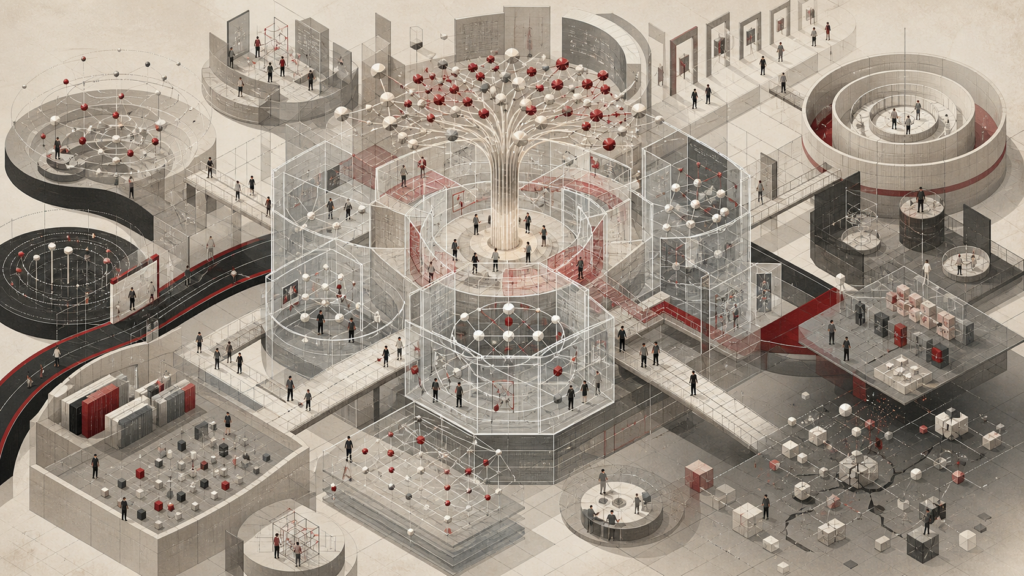
Editorial scientific illustration of futures thinking as an anticipatory reasoning systems architecture, showing branching future pathways, scenario planning, strategic foresight, horizon scanning, weak signals, uncertainty, backcasting, decision readiness, technology foresight, climate futures, institutional adaptation, sustainability transitions, and long-horizon responsibility.

Futures Thinking: Strategic Foresight for Complex Systems

Futures Thinking explores how individuals, organizations, and societies prepare for uncertainty by examining multiple possible futures rather than relying on a single forecast. The article argues that the future is not fixed or singular, but shaped by the interaction of human choices, institutions, technologies, ecological systems, and geopolitical forces. It develops this through the practical importance of long-range thinking, the distinction between prediction and preparation, the role of assumptions, major foresight methods, and the relationship between futures thinking, strategy, sustainability, and complex systems. The article also serves as the central architecture page for the wider knowledge series, organizing its methods, applications, governance themes, and strategic synthesis.

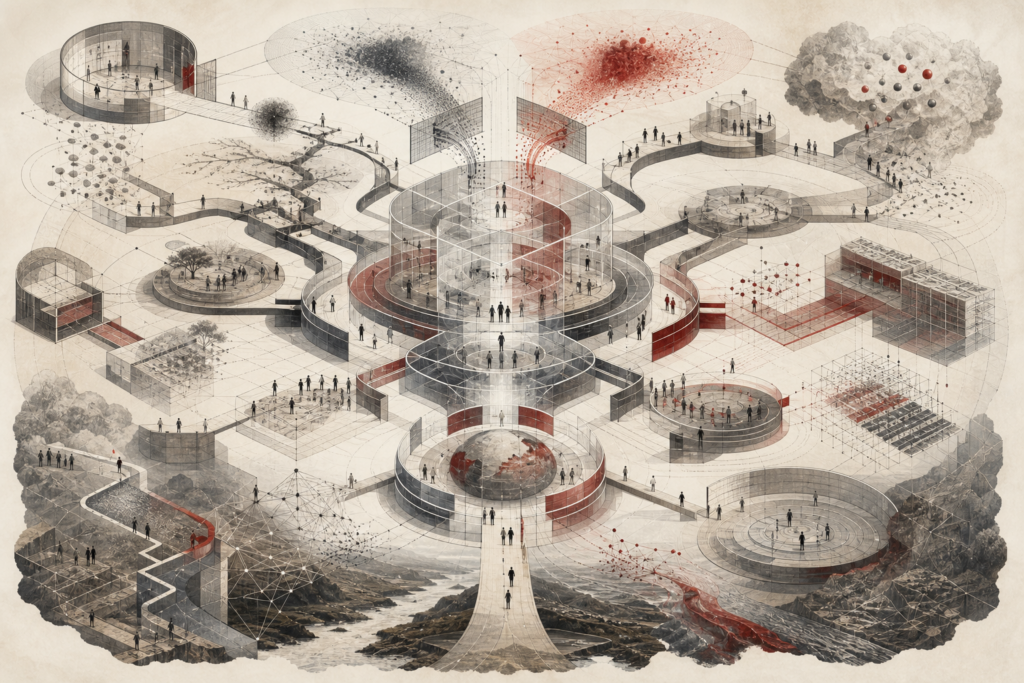
Editorial scientific illustration of resilience thinking as a viability-under-disturbance systems architecture, showing shocks, stress, adaptive capacity, recovery, transformation, thresholds, feedback loops, redundancy, diversity, infrastructure resilience, community resilience, governance capacity, vulnerability, equity, and long-term viability.

Resilience Thinking: Adaptation, Disturbance, and Transformation in Complex Systems

Resilience Thinking introduces resilience as a systems-oriented framework for understanding how ecological, social, economic, and institutional systems absorb disturbance, adapt to change, and reorganize while maintaining or renegotiating core functions under uncertainty. The article argues that disturbance, volatility, and structural disruption are not exceptions to normal system behavior but ordinary conditions of life in complex systems. It develops the field through adaptive capacity, thresholds, feedback loops, diversity, redundancy, modularity, transformation, and learning, while showing how resilience differs from equilibrium-based models of stability and from narrower ideas of recovery. The article also situates resilience within sustainability, governance, disaster risk reduction, and strategic decision-making, emphasizing that long-term viability depends not only on efficiency or continuity, but on the capacity to adapt, reorganize, and judge when transformation is necessary. It includes an evergreen mathematical lens, along with advanced R and Python workflows for mapping resilience dimensions and simulating viability under repeated disturbance.

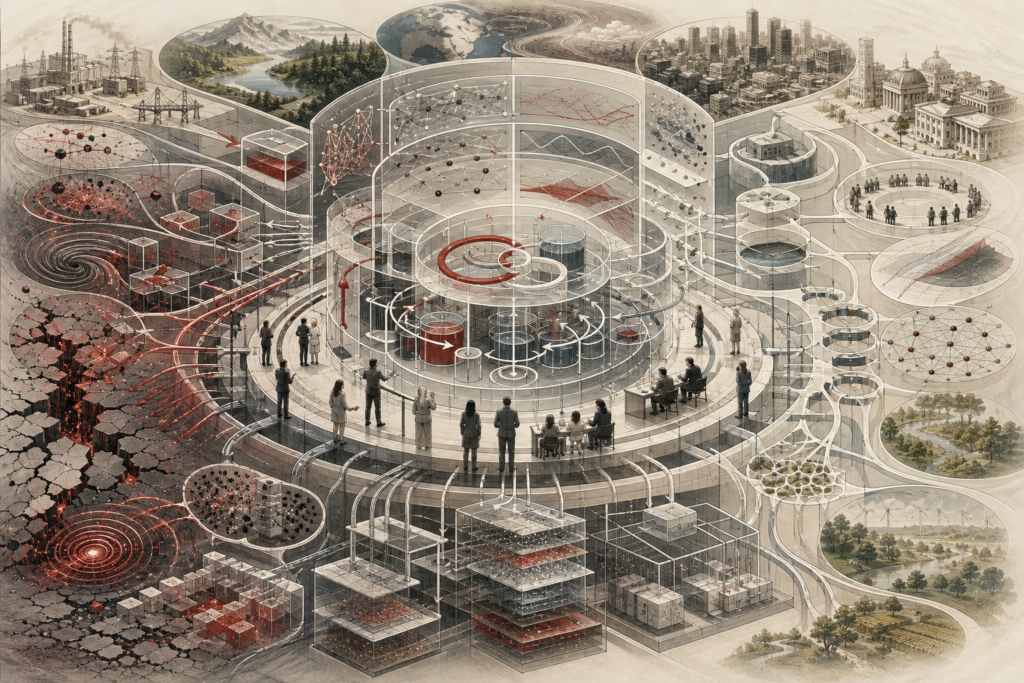
Editorial scientific illustration of systems modeling as a formal-systems architecture, showing system boundaries, feedback loops, stock-and-flow reservoirs, scenario pathways, network dependencies, calibration and validation structures, infrastructure systems, ecological systems, climate feedback, public-policy corridors, governance institutions, shock propagation, cascading failure, resilience buffers, and responsible model interpretation.

Systems Modeling: Formal Methods for Understanding Complex Systems

Systems modeling examines how formal models are used to understand, simulate, and analyze complex systems composed of interacting components. Rather than focusing on isolated variables, it studies how feedback loops, nonlinear relationships, time delays, and structural dependencies generate behavior across time. This pillar introduces the field as a whole, explaining why systems modeling matters, what major methods it includes, and how it supports analysis in sustainability, governance, infrastructure, economics, and technology. It emphasizes that models do not eliminate uncertainty, but help make it more explicit, structured, and usable for decision-making. By clarifying how system structure produces outcomes, systems modeling allows researchers and policymakers to compare interventions, explore plausible futures, identify leverage points, and reason more carefully about long-term change in dynamic, interconnected worlds.

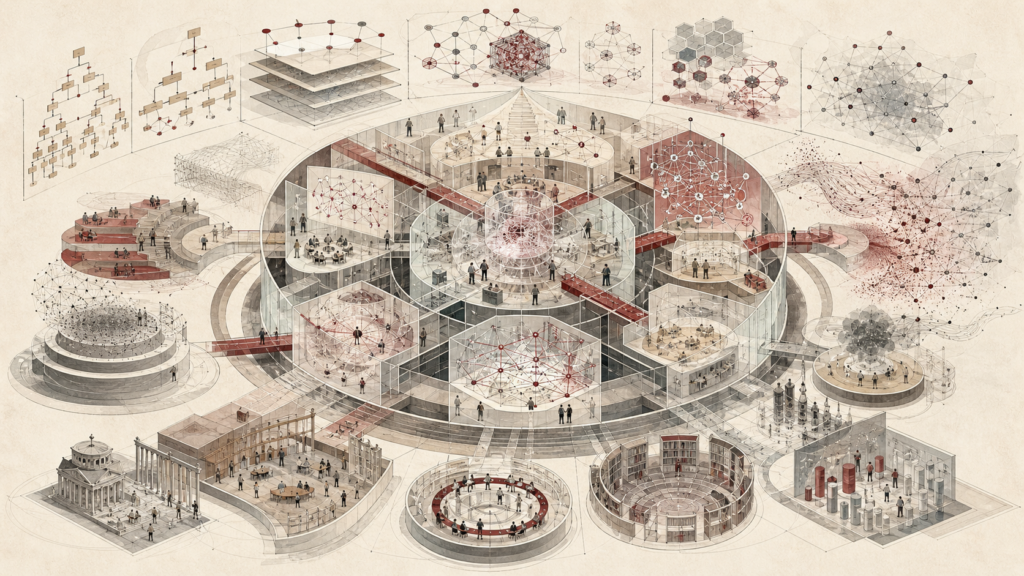
Editorial scientific illustration of knowledge architecture as an intellectual infrastructure system, showing taxonomies, hierarchies, ontologies, semantic networks, knowledge graphs, metadata layers, research pathways, digital libraries, AI-assisted organization, governance structures, and decision-support pathways.

Knowledge Architecture: Structuring Frameworks for Complex Knowledge Systems

The Knowledge Architecture article map organizes a full knowledge series around the structures that make complex information navigable, cumulative, and coherent. It introduces knowledge architecture as the design of intellectual infrastructure: frameworks, taxonomies, hierarchies, ontologies, semantic networks, knowledge graphs, metadata systems, research pathways, digital libraries, AI-assisted organization, governance structures, and scalable knowledge platforms. The map moves from foundations and core concepts into taxonomy design, information architecture, interdisciplinary research, sustainability science, policy frameworks, systems thinking, education, scientific collaboration, and future knowledge platforms. It also connects conceptual organization with computational practice, including Python, R, Julia, SQL, C, C++, Rust, Go, Fortran, notebooks, synthetic datasets, and reproducible code. Together, the series treats knowledge architecture as a strategic discipline for organizing meaning, preserving context, supporting inquiry, and maintaining coherence across expanding intellectual systems as the platform grows into a more durable research environment.

Editorial scientific illustration of strategic ideation as an architecture-of-ideas systems framework, showing problem framing, divergent and convergent thinking, mental models, systems thinking, design inquiry, prototyping, scenario planning, decision pathways, tradeoffs, strategic fit, implementation pathways, adaptive learning, knowledge architecture, institutional memory, ethics, power, and long-term action.

Strategic Ideation: Generating Ideas for Complex Problem-Solving

Strategic Ideation examines how ideas become durable structures for judgment rather than remaining isolated acts of creativity. The article argues that serious ideation is not equivalent to casual brainstorming, because its real task is to transform fragmented information, uncertainty, and competing priorities into conceptual frameworks that can guide long-term thinking and coherent action. It develops this through the functions of problem definition, frame construction, option generation, conceptual structuring, strategic evaluation, and translation into implementation, while situating the field within cognition, systems thinking, design, foresight, and decision-making. The article emphasizes that strategic ideation matters because strong strategy depends on strong idea architecture: the capacity to build conceptual systems that remain structurally clear, cognitively aware, systemically grounded, and usable under real conditions of complexity.

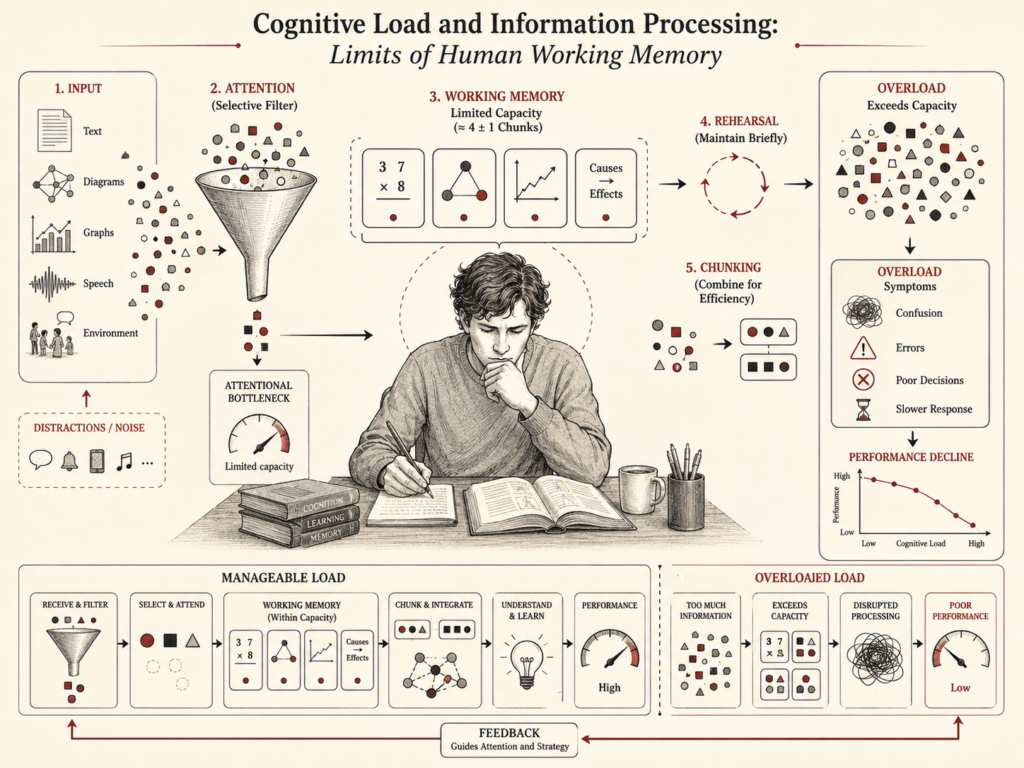
Research-grade cognitive psychology diagram showing cognitive load and working memory limits through input, attention, selective filtering, limited-capacity working memory, rehearsal, chunking, overload, symptoms, performance decline, and feedback.

Cognitive Load and Information Processing: Limits of Human Working Memory

Cognitive load refers to the mental effort required to process information within the limits of working memory, and for that reason it is one of the clearest ways of understanding cognition under constraint. Human beings do not think in an unlimited space. Attention can only select a fraction of what is available, working memory can only maintain a small amount of novel information at once, and learning depends on whether that limited workspace is being used productively or overwhelmed by unnecessary demands. Cognitive load theory emerged from this basic architecture and asks a deceptively simple question: how much of the mind’s limited capacity is being consumed, and by what? The answer helps explain why some forms of instruction, design, and problem presentation support understanding while others produce confusion, fatigue, and error. Not all mental effort is the same. Some effort is inherent to the complexity of the material itself, some is wasted through poor presentation, and some contributes directly to meaningful learning.

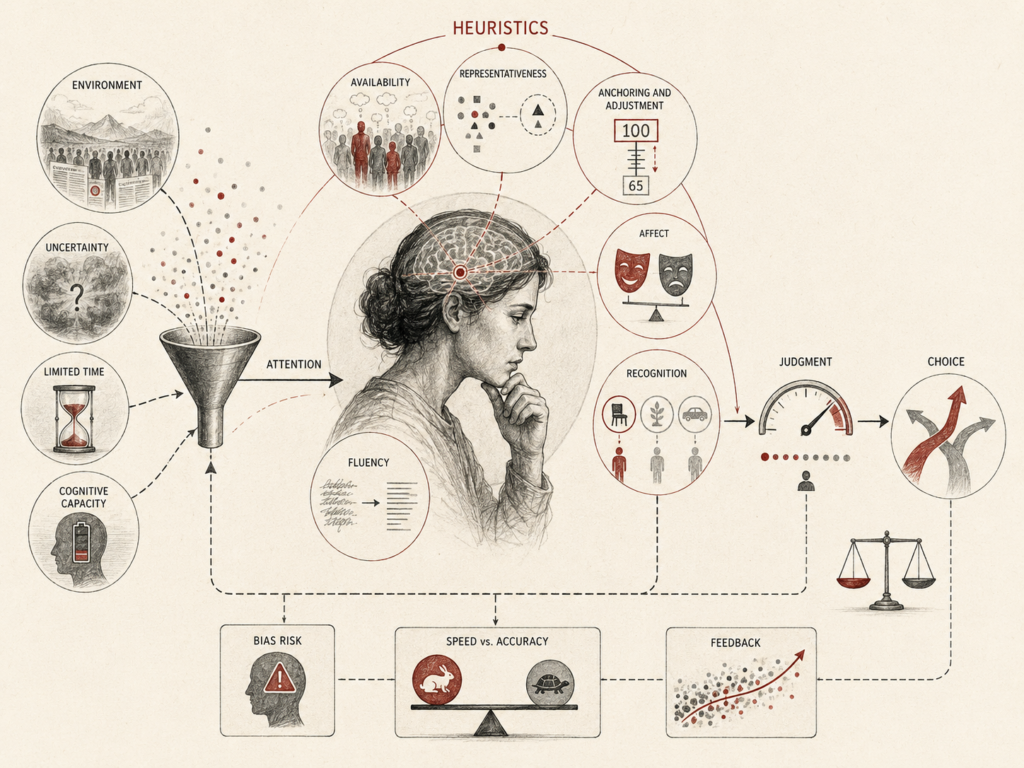
Restrained institutional research illustration showing heuristics as mental shortcuts that filter information through attention, uncertainty, limited time, cognitive capacity, availability, representativeness, anchoring, affect, recognition, fluency, judgment, choice, bias risk, speed-accuracy tradeoffs, and feedback.

Heuristics in Cognitive Psychology: Mental Shortcuts in Human Judgment

Heuristics are the mental shortcuts that allow people to make judgments quickly when time, attention, information, or certainty is limited. In cognitive psychology, heuristics are not simply errors or signs of irrationality; they are adaptive tools for navigating complexity with bounded cognitive resources. Availability, representativeness, anchoring, affect, recognition, and fluency all help simplify judgment by reducing the amount of information that must be processed. Yet these same shortcuts can also distort reasoning, especially when vivid examples, emotional reactions, familiar patterns, initial anchors, or easy-to-process information are mistaken for reliable evidence. Understanding heuristics reveals how human judgment balances efficiency and accuracy, why bias emerges under uncertainty, and how better feedback, reflection, and decision environments can improve reasoning.

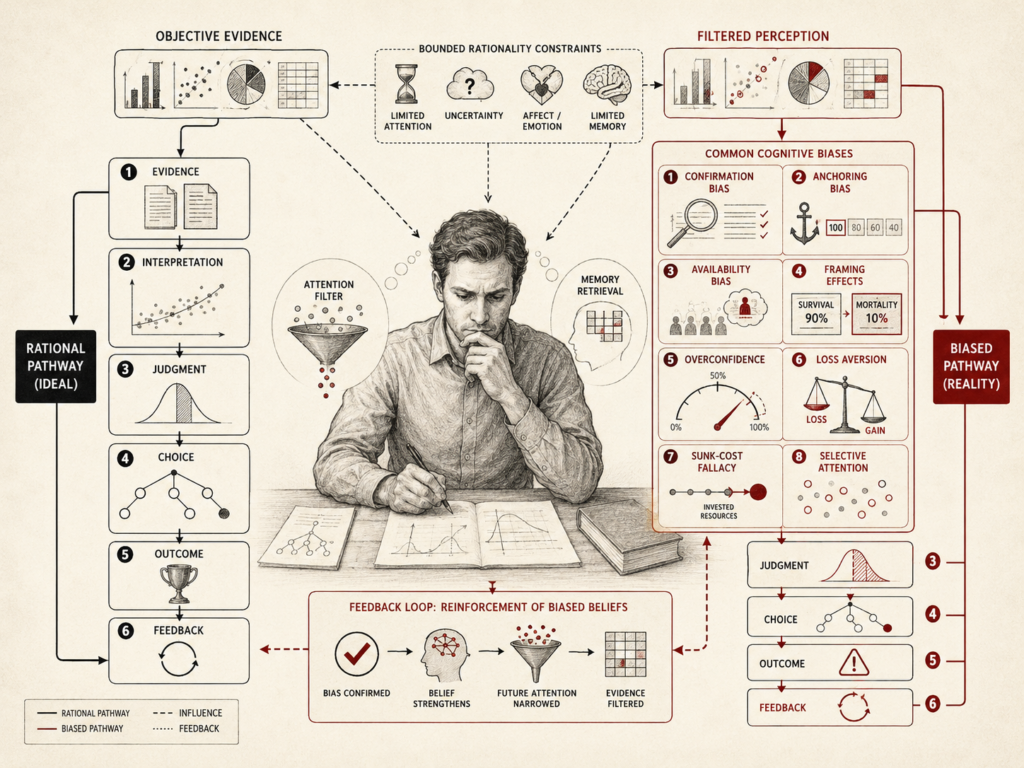
Research-grade cognitive psychology diagram showing how objective evidence becomes filtered by attention, uncertainty, emotion, memory, and common cognitive biases, leading human judgment away from an ideal rational pathway.

Cognitive Biases in Decision Making: Why Human Judgment Deviates from Rationality

Cognitive biases are systematic patterns of deviation from formal standards of reasoning that arise from the ordinary structure and limits of human cognition. In cognitive psychology, they are not treated as random mistakes or isolated lapses in judgment, but as predictable outcomes of the same mechanisms that make thought efficient under uncertainty. Attention filters what is noticed, memory reconstructs and prioritizes experience, working memory limits how much can be processed at once, and decision systems rely on heuristics to act without exhaustive computation. Because cognition must operate under pressure, ambiguity, and incomplete information, it often favors speed, tractability, and usable approximation over perfect accuracy. Biases therefore reveal something fundamental about how the mind works: they are not external to intelligence but emerge from the adaptive strategies that make intelligence possible in complex environments. This is why the study of cognitive bias became so influential across psychology, behavioral economics, neuroscience, and public policy. It shows that judgment is systematically shaped by the architecture of cognition itself, and that understanding those distortions is essential for understanding how people interpret information, evaluate risk, and make decisions in the real world.

Scroll to Top