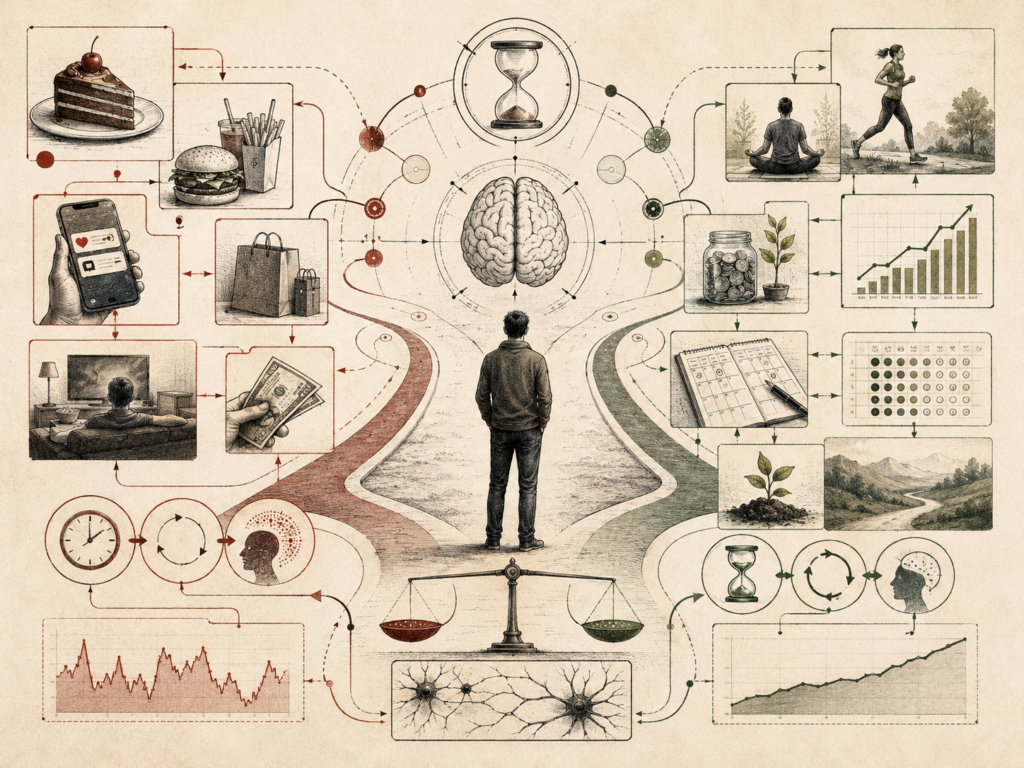
Editorial systems illustration showing present bias through immediate rewards, delayed goals, time pressure, temptation, savings, habit formation, self-control, and long-term decision pathways.

Present Bias and the Psychology of Immediate Reward

Present bias refers to the tendency to assign disproportionately greater weight to immediate rewards than to larger future benefits, making the present moment behaviorally distinct from all later periods in economic choice. This article explains how present bias shapes intertemporal decision-making through present-focused valuation, hyperbolic discounting, and time-inconsistent preferences, and why it helps explain under-saving, procrastination, debt persistence, and short-termism in both private and public life. It also examines the role of commitment devices, institutional design, and long-horizon sustainability policy, while developing a formal analytical framework and including substantial R and Python sections with fully commented code. The broader argument is that present bias is not merely impatience, but a structural feature of human decision-making that institutions must account for if they are to support long-term welfare.
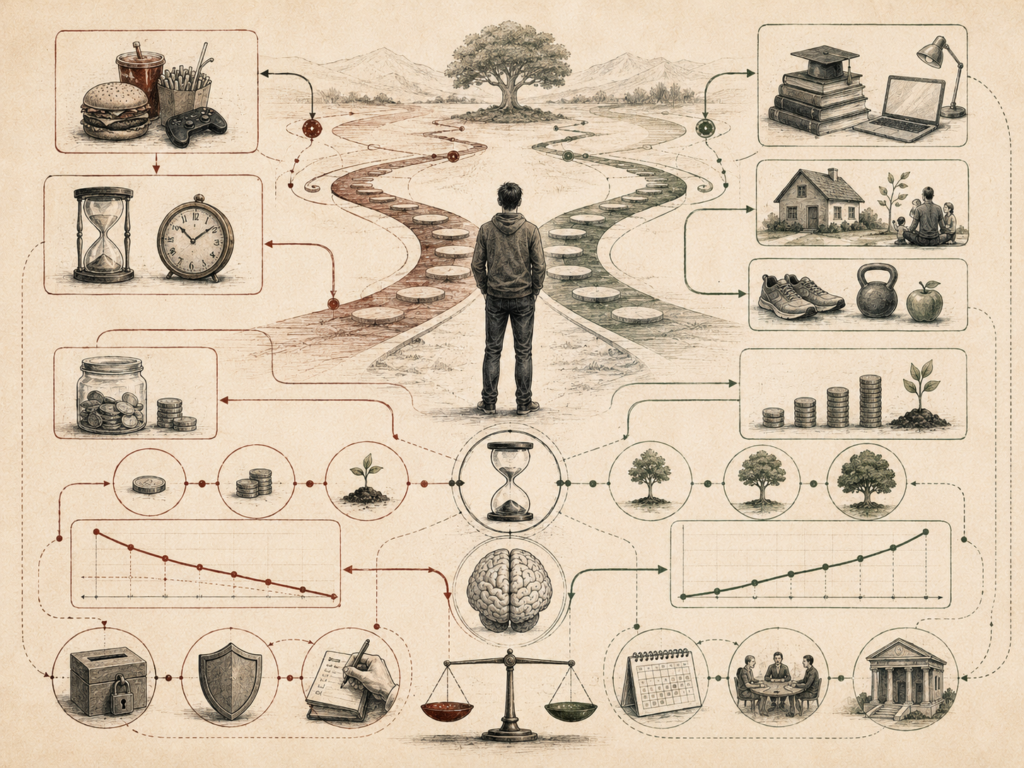

Editorial systems illustration showing time discounting through short-term rewards, long-term goals, delayed benefits, savings, education, health, planning, and future-oriented decision pathways.

Time Discounting and Long-Term Decision-Making

Time discounting refers to the tendency to value present rewards more highly than equivalent rewards in the future, shaping how individuals make choices across savings, consumption, education, health, and long-term planning. This article explains how behavioral economics expands the standard concept of discounting by showing that real people often discount the future more steeply and less consistently than classical models assume, especially when immediate rewards become available. It explores the distinction between standard discounting, hyperbolic discounting, and present bias, while also examining the implications for economic behavior, sustainability, and policy design. The broader argument is that time discounting is not just a technical matter of present value calculation, but a central behavioral mechanism through which short-term incentives repeatedly undermine long-run welfare.

Editorial systems illustration showing status quo bias and institutional inertia through locked institutions, bureaucratic pathways, routines, queues, hierarchy, path dependence, and resistance to change.

Status Quo Bias and Institutional Inertia

Status quo bias refers to the tendency for individuals and institutions to favor existing arrangements over alternatives, even when change would produce objectively better outcomes. This article explains how behavioral economics understands that preference through loss aversion, uncertainty avoidance, cognitive effort, regret avoidance, and the special psychological privilege given to default conditions. It explores the concept’s origins, its role in consumer behavior, institutional inertia, sustainability transitions, and behavioral policy design, while also developing a formal analytical framework for default retention and switching. The broader argument is that status quo bias is not simply passive resistance to change, but a structural feature of human and organizational decision-making that shapes markets, institutions, and long-run transitions.

Editorial systems illustration showing framing effects in consumer choice through product placement, visual emphasis, comparison sets, pricing cues, attention, anchors, labels, and shopping decisions.

Framing Effects in Consumer Choice

Framing effects describe how the presentation of information influences decision-making even when the underlying facts remain unchanged. This article explains how behavioral economics uses framing to show that choices are shaped not only by probabilities and payoffs, but also by language, context, reference points, and the broader design of decision environments. It explores the origins of framing in the work of Tversky and Kahneman, the main types of framing, its role in consumer markets, risk perception, public policy, choice architecture, and sustainability governance, while also developing a formal analytical framework and including substantial R and Python sections with fully commented code. The broader argument is that framing is not a minor linguistic effect, but one of the central mechanisms through which economic choices become behaviorally structured.

Editorial systems illustration showing availability bias shaping economic perception through vivid news events, market charts, price concerns, memory, risk perception, household finance, and public anxiety.

Availability Bias and Economic Perception

Availability bias refers to the tendency to judge the likelihood of events by how easily examples come to mind, causing vivid, recent, and emotionally salient cases to appear more probable than they actually are. This article explains how behavioral economics uses the availability heuristic to account for distorted risk perception in finance, consumer choice, media-driven economic judgment, market dynamics, policy communication, and sustainability governance. It also shows how availability bias interacts with framing, anchoring, and the broader architecture of attention, while developing a formal analytical framework and including substantial R and Python sections with fully commented code. The broader argument is that economic judgment is shaped not only by objective probability, but by cognitive accessibility and the salience structure of the information environment.

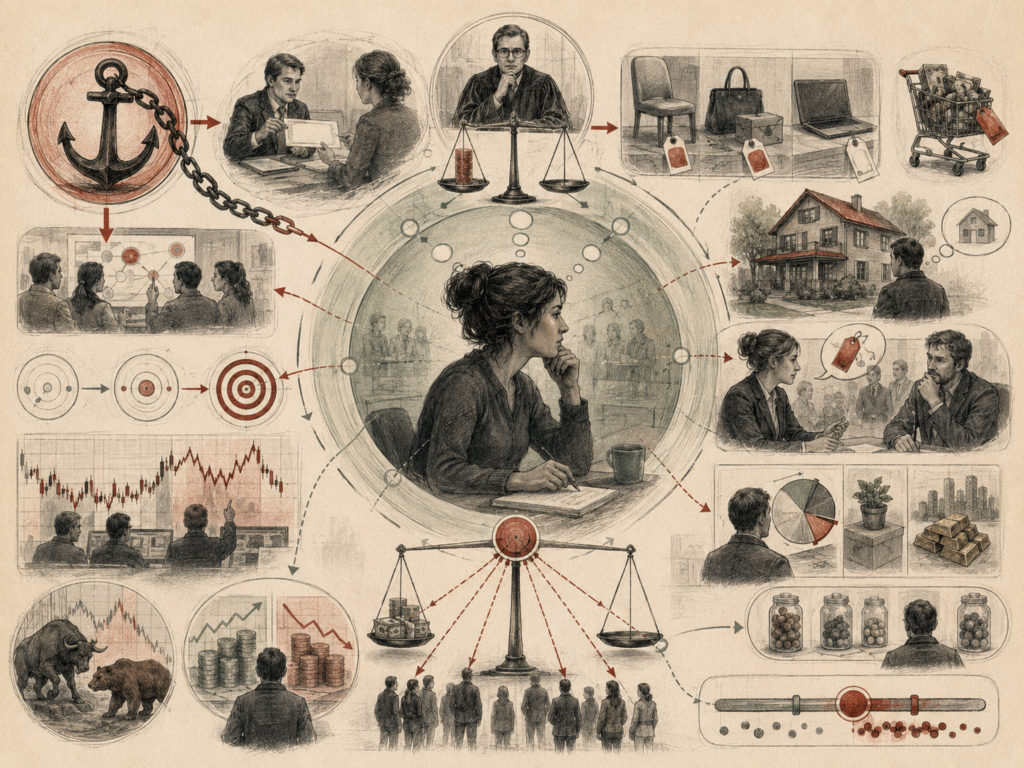
Editorial systems illustration showing anchoring bias in economic judgment through reference points, price comparisons, negotiations, market signals, housing values, investment decisions, and consumer choices.

Anchoring Bias in Economic Judgment

Anchoring bias refers to the tendency to rely heavily on an initial reference point when making judgments, causing later estimates to remain biased toward that starting value even when it is arbitrary or weakly informative. This article explains how behavioral economics uses anchoring to understand economic judgment in pricing, markets, negotiation, policy design, and sustainability assessment, showing that decisions are shaped not only by evidence but by where reasoning begins. It also develops a formal analytical framework based on incomplete adjustment and includes substantial R and Python sections with fully commented code for simulating anchor effects under different reference conditions. The broader argument is that economic judgment is not formed from a neutral baseline, but through reference points that structure valuation, estimation, and perceived plausibility.

Editorial systems illustration showing heuristics and biases in economic decision-making through anchors, risk perception, framing, overconfidence, social influence, status quo bias, household finance, markets, and public institutions.

Heuristics and Biases in Economic Decision-Making

Heuristics and biases describe the mental shortcuts people use to make judgments under uncertainty and the systematic errors those shortcuts can produce in economic decision-making. This article explains how behavioral economics treats heuristics not as random irrationality, but as structured responses to limited cognition that can become biased under the wrong conditions. It explores the foundations of the heuristics-and-biases research program, the transition from useful shortcut to systematic distortion, the major heuristics identified by Kahneman and Tversky, their influence across markets, policy, and sustainability decisions, and a formal analytical framework for modeling judgment error. The broader argument is that real economic behavior emerges not from perfect calculation, but from the interaction of uncertainty, cognition, context, and institutional design.

Editorial decision-theory illustration showing expected utility through probability trees, scales, dice, charts, branching choices, wealth outcomes, risk, and rational evaluation.

Expected Utility Theory: The Classical Model of Rational Choice

Expected utility theory is one of the foundational formal models of rational decision-making under uncertainty, proposing that individuals choose among risky options by maximizing probability-weighted utility rather than monetary value alone. This article explains the theory’s origins in von Neumann and Morgenstern, its core axioms, its treatment of risk preferences through utility curvature, its major empirical limits, and the behavioral critique that gave rise to prospect theory and related alternatives. It also develops a formal analytical framework and includes substantial R and Python sections with fully commented code for simulating utility, risk aversion, and choice under uncertainty. The broader argument is that expected utility theory remains indispensable not because it perfectly describes human behavior, but because it provides the benchmark against which behavioral economics defines, measures, and explains systematic deviation.

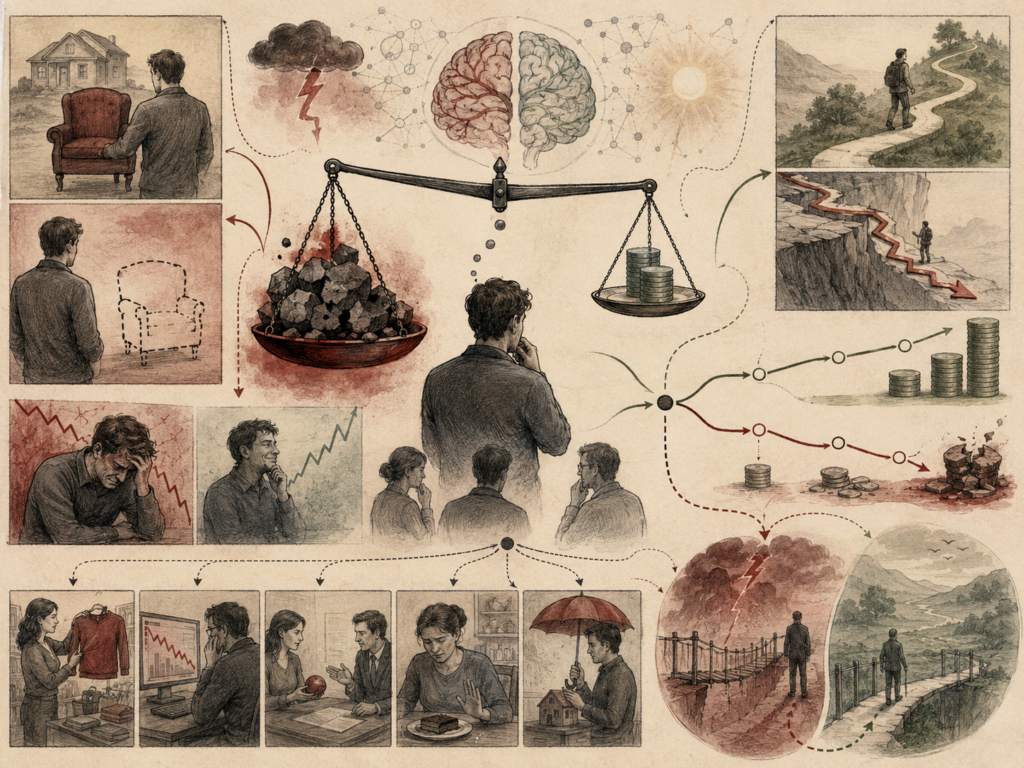
Editorial systems illustration showing loss aversion through unequal emotional responses to losses and gains, risk perception, decision paths, financial choices, fear, regret, and behavioral tradeoffs.

Loss Aversion: Why Losses Matter More Than Gains

Loss aversion describes the tendency to experience losses more intensely than equivalent gains, making negative outcomes psychologically heavier and more behaviorally decisive than symmetrical positive ones. This article explains how behavioral economics uses loss aversion to understand reference-dependent judgment, risk-taking in gains versus losses, investor behavior, consumer response, public policy, and sustainability resistance, while also developing a formal prospect-theory framework and including substantial R and Python sections with fully commented code. The broader argument is that economic behavior is often organized less around maximizing utility in the abstract than around avoiding declines from what people already have, expect, or feel entitled to keep.

Scroll to Top