Thinking

Thinking refers to the frameworks through which complexity is interpreted, uncertainty is framed, and change is understood across time. Contemporary thought increasingly recognizes that many real-world conditions are dynamic, adaptive, and interconnected, requiring approaches that move beyond linear analysis toward more relational and systems-oriented ways of understanding.

Modern approaches to thinking draw from multiple disciplines, including systems theory, design research, ecology, futures studies, and organizational learning. These frameworks help individuals and institutions make sense of patterns, feedback, resilience, emergence, and long-term change, while providing more structured ways to engage with uncertainty.

Effective thinking is central to research, governance, innovation, and strategy. In rapidly changing environments, organizations increasingly rely on interdisciplinary thinking frameworks to strengthen sense-making, support adaptive learning, and improve the quality of judgment in complex settings.

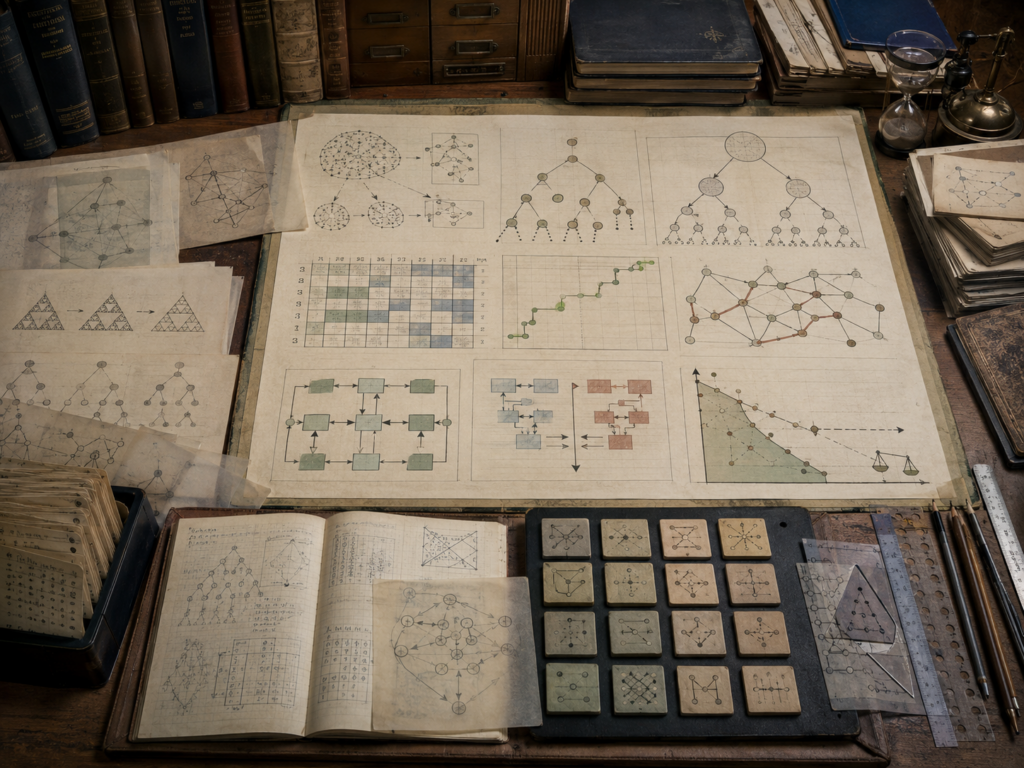
Scholarly editorial illustration of quantities, grids, balance scales, mappings, networks, variable-like structures, and transformation diagrams on aged parchment, representing algebraic thinking as relational and structural reasoning.

What Makes Algebraic Thinking Distinct?

What Makes Algebraic Thinking Distinct? examines algebra as a shift from calculation to reasoning about relationships, structures, variables, equivalence, transformation, and generality. The article explains that algebra is not simply arithmetic with letters; it is a way of seeing expressions as objects, equations as relations, variables as flexible symbols, and functions as structures of dependence. It explores generalized arithmetic, variable roles, symbolic expressions, equivalence-preserving transformations, equations, functions, patterns, algebraic systems, proof, computational algebra, Haskell algebraic data types, and responsible interpretation of symbolic models. By connecting school algebra to broader mathematical structures, the article shows how algebraic thinking prepares learners for proof, modeling, calculus, data science, computer science, formal reasoning, and abstract mathematics. It also addresses common misconceptions, including treating equals as an answer signal or variables only as unknowns in learning.

Scholarly editorial illustration of open notebooks, branching geometric diagrams, exploratory pathways, networks, spirals, books, instruments, and architectural forms on textured parchment.

Non-Algorithmic Reasoning and the Future of Mathematics Learning

Non-Algorithmic Reasoning and the Future of Mathematics Learning examines why mathematical thinking cannot be reduced to procedure, formula use, or algorithm execution. The article argues that students need fluency with methods, but also judgment about when methods apply, what assumptions they require, which representations reveal structure, and whether an answer is meaningful. It explores problem framing, conceptual understanding, representation choice, conjecture, proof, metacognition, creativity, assessment, AI-output verification, Haskell algebraic data types, and responsible tool-assisted learning. By distinguishing procedural performance from mathematical reasoning, the article frames the future of mathematics education around the ability to notice, frame, represent, reason, justify, and reflect. It also addresses equity and agency, arguing that learners should be taught not merely to execute instructions but to interpret, question, verify, and communicate mathematical ideas in a computational world.

Scholarly editorial illustration of open notebooks, hand-drawn geometric diagrams, branching conjectures, spirals, networks, tessellations, and abstract mathematical forms on aged parchment.

Conjecture, Creativity, and Mathematical Discovery

Conjecture, Creativity, and Mathematical Discovery examines how mathematics moves from observation to theorem through disciplined imagination. The article explains that conjectures are not random guesses, but structured proposals shaped by examples, patterns, analogy, diagrams, computation, partial arguments, and the search for proof. It explores pattern recognition, special cases, counterexamples, abstraction, visualization, experimental mathematics, graph invariants, proof-status tracking, Haskell algebraic data types, and the creative tension between freedom and constraint in mathematical work. By showing how conjectures are tested, revised, refuted, proved, or generalized, the article frames mathematical discovery as an iterative process rather than a finished product. It also addresses the responsible use of AI and computation in mathematical exploration, where generated patterns, simulations, and finite evidence must be clearly distinguished from proof, theorem, and verified mathematical knowledge in research, education, technology, and public reasoning.

Scholarly editorial illustration showing objects, counting marks, grids, diagrams, symbolic notations, networks, and geometric forms moving from concrete representation toward abstract mathematical language.

Symbols, Language, and Mathematical Representation

Symbols, Language, and Mathematical Representation examines how mathematics becomes thinkable, shareable, and rigorous through systems of notation, symbol, diagram, formula, graph, formal language, and computational encoding. The article argues that symbols are not decorative marks added after reasoning is complete; they shape what can be seen, manipulated, generalized, proved, and communicated. It explores variables, quantifiers, equality, equivalence, functions, diagrams, notation, translation between representations, formal languages, proof systems, symbolic computation, Haskell algebraic data types, and representation audits. By distinguishing mathematical objects from the signs that express them, the article shows why every representation preserves selected structure while omitting other detail. It also addresses the ethical responsibility of mathematical modeling, where metrics, graphs, algorithms, and symbolic systems can clarify complex realities but can also distort context, uncertainty, meaning, and human consequence in research, education, AI, policy, and technical decision-making globally today.

Scholarly editorial illustration of branching logical diagrams, geometric constructions, inference pathways, circular proof structures, architectural forms, and a hand drawing on textured parchment.

Logic and the Structure of Formal Inference

Logic and the Structure of Formal Inference examines logic as the architecture that makes mathematical reasoning explicit, inspectable, and accountable. The article introduces propositions, predicates, quantifiers, connectives, implication, equivalence, validity, soundness, proof systems, derivation trees, sequent reasoning, and the relationship between formal inference and proof. It explains why logical form matters: a theorem’s meaning depends on its assumptions, quantifier order, inference rules, and the distinction between implication, converse, inverse, and contrapositive. By connecting truth tables, quantifier logic, counterexamples, proof-system metadata, derivation graphs, formal verification, and proof assistants, the article frames logic as both a foundational discipline and a practical tool for modern mathematical work. It also addresses the limits of formal systems and the ethical responsibilities of using formal reasoning in AI, software, institutional rules, risk models, and public decision-making across research, education, technology, governance, and responsible civic systems.

Scholarly editorial illustration of geometric proof diagrams, logical branching structures, arrows, constructions, architectural forms, and a hand sketching mathematical reasoning on aged parchment.

Proof and the Logic of Mathematical Justification

Proof and the Logic of Mathematical Justification examines proof as the central standard by which mathematics turns patterns, conjectures, and examples into justified knowledge. The article explains why proof is more than persuasion: it is accountable reasoning that names assumptions, applies definitions, traces inference, and establishes conclusions under stated conditions. It explores direct proof, contradiction, induction, construction, counterexample, invariance, proof architecture, formalization, proof assistants, and the distinction between finite evidence and universal justification. By treating proofs as dependency structures, the article connects classical mathematical reasoning with modern computational workflows for theorem metadata, proof graphs, induction audits, counterexample records, and formalization planning. It also considers the ethical limits of mathematical justification in modeling, AI, economics, risk systems, and public decision-making, where a formally valid result may still depend on assumptions that require empirical, institutional, moral scrutiny, and careful public accountability.

Scholarly editorial illustration of natural, geometric, biological, architectural, and cosmic patterns on textured parchment, including spirals, tessellations, waves, networks, fractals, honeycomb forms, and branching structures.

Mathematics as the Science of Patterns

Mathematics as the Science of Patterns examines mathematics as the disciplined study of order across number, space, structure, logic, change, uncertainty, and computation. The article moves beyond the simple idea of pattern as repetition and shows how mathematical patterns become knowledge only when they are represented, abstracted, generalized, tested, and proved. It explores numerical sequences, spatial symmetry, graph structures, logical proof patterns, dynamic systems, probabilistic regularities, computational discovery, and the dangers of false pattern recognition. By connecting pattern to structure, invariant, proof, and counterexample, the article frames mathematics as both a creative and critical science of form. It also addresses the ethical responsibilities of pattern use in modeling, AI, economics, environmental monitoring, and institutional decision-making, where detected regularities can shape real-world judgments and consequences across research, education, scientific modeling, and public reasoning in high-stakes technical and civic contexts today.

Scholarly editorial illustration showing natural forms, architectural fragments, geometric diagrams, networks, and abstract shapes moving from concrete examples toward generalized mathematical structures.

Abstraction and the Power of Generalization

Abstraction and the Power of Generalization explains how mathematics moves from particular examples to durable structures, transferable methods, and justified claims. The article treats abstraction as the disciplined selection of what matters: cardinality instead of apples, adjacency instead of a transportation system, operation structure instead of a familiar calculation. It then shows how generalization extends insight across classes of objects, but only when domains, assumptions, definitions, invariants, and counterexamples are handled carefully. Through examples from arithmetic, algebra, topology, graph theory, functions, proof, equivalence relations, and structure-preserving maps, the article frames abstraction as one of the deepest engines of mathematical thought. It also addresses the ethical responsibilities of abstraction in modeling, AI, economics, environmental systems, and public decision-making, where what gets omitted can matter as much as what gets preserved across research, teaching, formalization, scientific modeling, and responsible systems analysis.

Scholarly editorial illustration of geometric patterns, tessellations, spirals, networks, fractal forms, and a classical contemplative figure on textured parchment, representing mathematical imagination through structure and abstraction.

Patterns, Structure, and the Mathematical Imagination

Patterns, Structure, and the Mathematical Imagination explores how mathematics begins in noticed regularities but matures into disciplined structural reasoning. The article shows how patterns in sequences, shapes, graphs, symmetries, and transformations become mathematical knowledge only when they are clarified through abstraction, invariance, representation, counterexample, and proof. It treats mathematical imagination not as fantasy, but as the capacity to see hidden form, transfer insight across domains, and ask what remains stable beneath change. From odd-number sums and graph invariants to analogy, symmetry, and counterexample discipline, the article frames mathematics as a creative practice governed by rigorous constraint. It also connects classical mathematical insight with computational workflows for pattern detection, graph reasoning, invariant analysis, and structural metadata. The result is a serious introduction to how imagination and proof work together in mathematical thought across research, education, modeling, and formal verification contexts.

Scroll to Top