Thinking

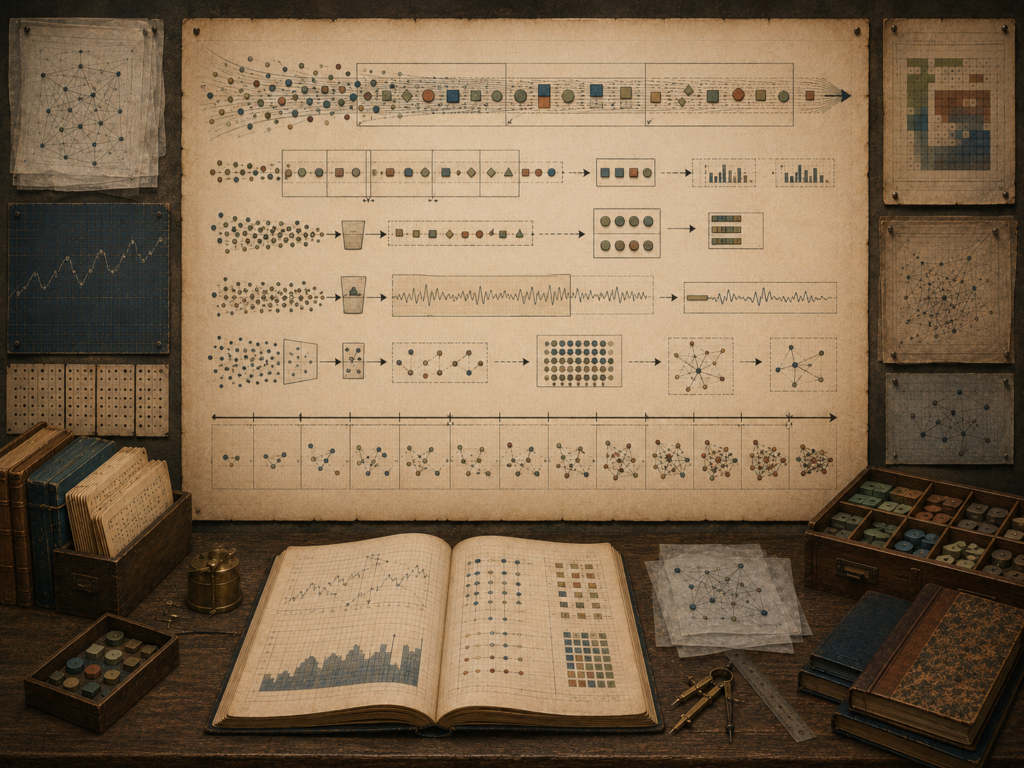
Thinking refers to the frameworks through which complexity is interpreted, uncertainty is framed, and change is understood across time. Contemporary thought increasingly recognizes that many real-world conditions are dynamic, adaptive, and interconnected, requiring approaches that move beyond linear analysis toward more relational and systems-oriented ways of understanding.

Modern approaches to thinking draw from multiple disciplines, including systems theory, design research, ecology, futures studies, and organizational learning. These frameworks help individuals and institutions make sense of patterns, feedback, resilience, emergence, and long-term change, while providing more structured ways to engage with uncertainty.

Effective thinking is central to research, governance, innovation, and strategy. In rapidly changing environments, organizations increasingly rely on interdisciplinary thinking frameworks to strengthen sense-making, support adaptive learning, and improve the quality of judgment in complex settings.

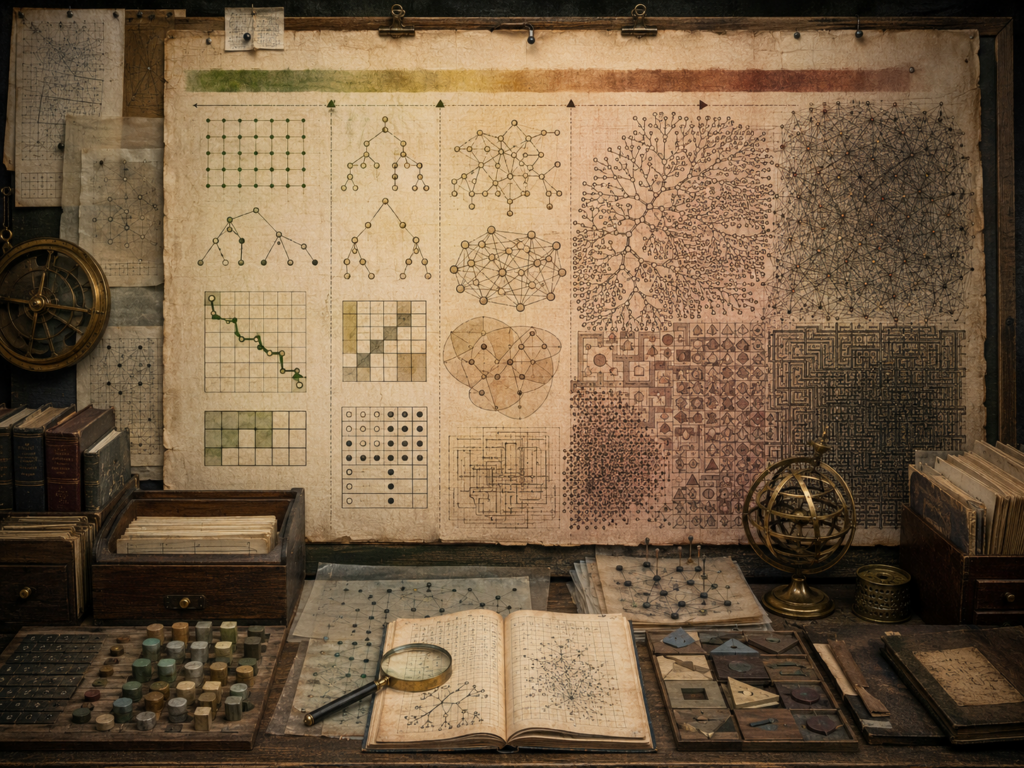
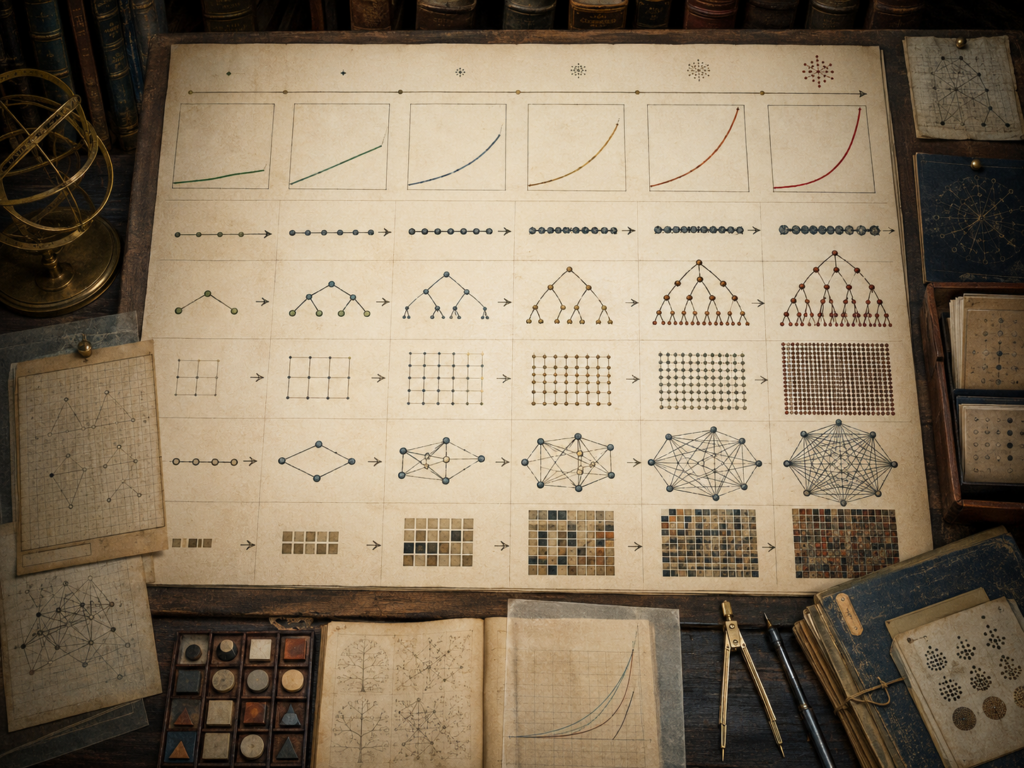
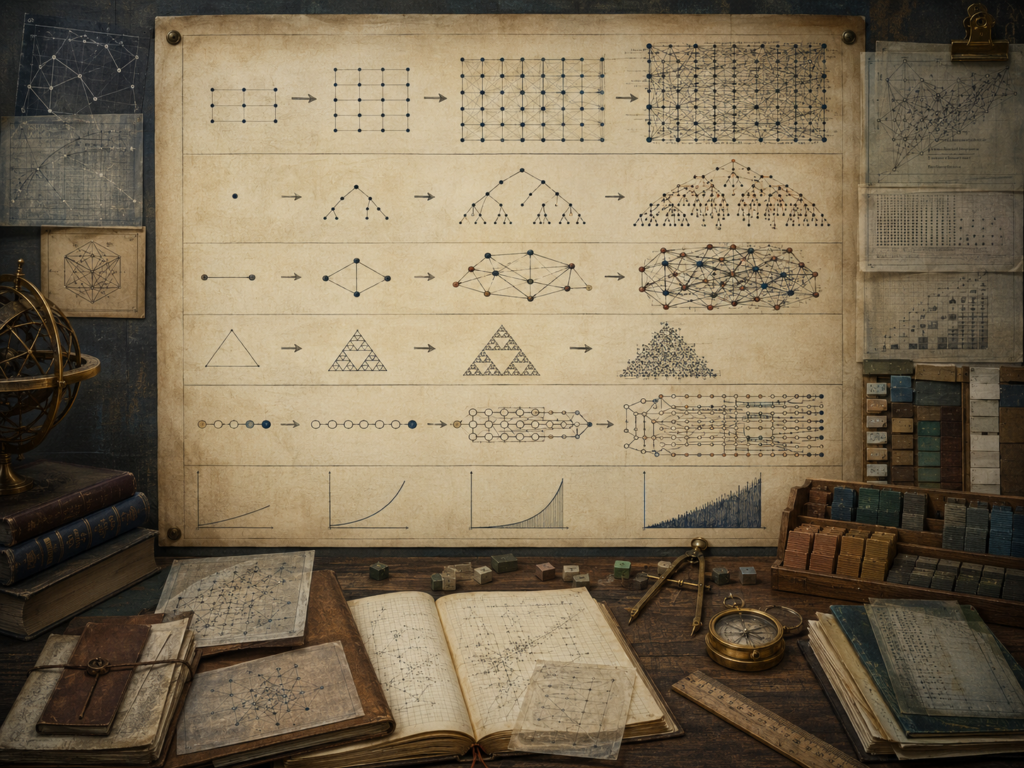
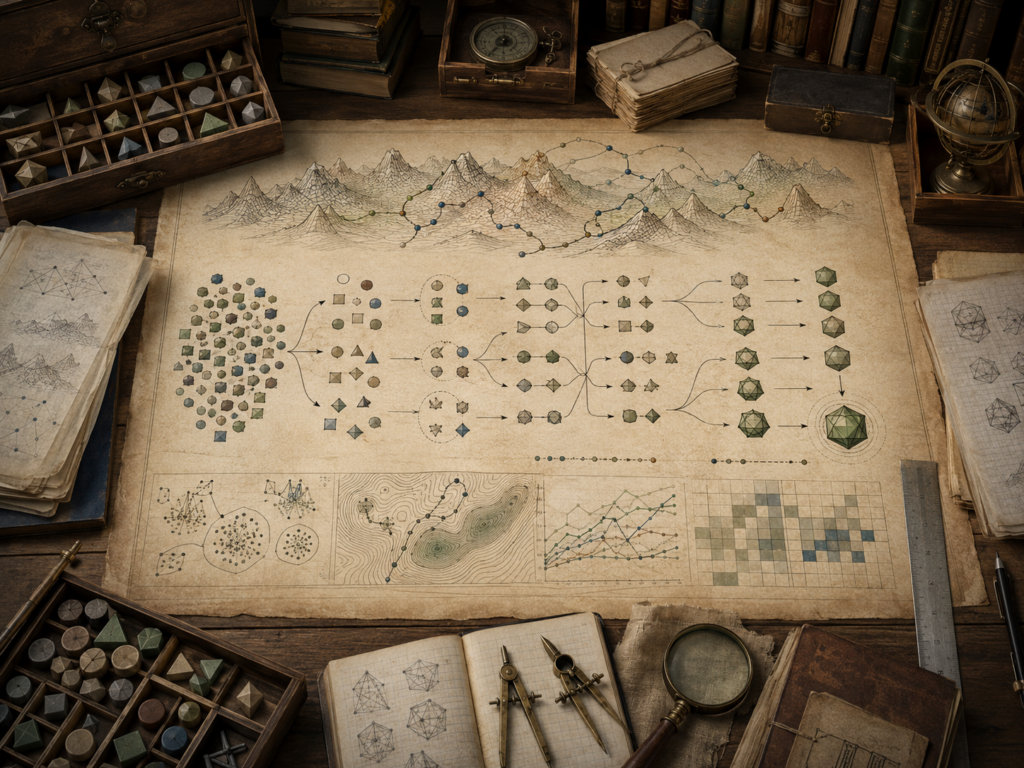
Scholarly editorial illustration of open mathematical notebooks, hand-drawn networks, abstract structures, data clusters, topological forms, and branching diagrams representing human reasoning and AI-assisted mathematical discovery.

Mathematical Thinking and AI-Assisted Discovery

Mathematical Thinking and AI-Assisted Discovery examines how artificial intelligence is changing the exploratory side of mathematics. The article frames AI as a discovery amplifier rather than a source of mathematical authority, showing how systems can generate examples, suggest conjectures, write candidate programs, search large spaces, propose proof strategies, assist formalization, and connect ideas across domains. It distinguishes AI-generated output from mathematical knowledge by emphasizing verification through counterexample search, evaluator design, proof, formal checking, and human interpretation. The article also explores program search, geometric reasoning, proof assistants, education, credit, reproducibility, and the ethics of AI-assisted discovery. Rather than treating AI as a replacement for mathematicians, it argues that human judgment becomes more important: framing problems, choosing representations, testing claims, recognizing significance, documenting workflows, and deciding what a discovery means within the broader structure of mathematics.

Scholarly editorial illustration of mathematical notebooks, proof diagrams, historical scholars, mechanical computation, algorithmic flowcharts, and a proof-assistant interface representing human reasoning and machine-checked proof.

Mathematical Thinking and Proof Assistants

Mathematical Thinking and Proof Assistants examines how machine-checkable proof is changing the medium of mathematical reasoning. The article explains proof assistants as formal environments where definitions, theorem statements, proof steps, libraries, kernels, axioms, and trust boundaries must be made explicit. It distinguishes informal proof from formal proof, showing why human mathematical insight remains essential even when machines can verify derivations. The article explores type theory, higher-order logic, constructive reasoning, formal libraries, proof automation, AI-assisted formalization, theorem-statement audits, and the role of proof assistants in mathematical education. It also emphasizes responsible verification: a machine-checked proof establishes a formal statement within a system, but humans must still review meaning, assumptions, scope, application, and consequence. The result is a deeper account of proof assistants as mathematical infrastructure that strengthens rigor while making definition, interpretation, and judgment more visible within contemporary mathematical culture.

Scholarly editorial illustration of mathematical notebooks, formal diagrams, algorithmic flowcharts, mechanical computation, punched-card machinery, and a hand drawing structured reasoning on aged paper.

Mathematical Thinking in an Age of Automation

Mathematical Thinking in an Age of Automation examines how calculators, computer algebra systems, numerical simulation, proof assistants, AI-assisted reasoning, and automated verification are changing what it means to think mathematically. The article argues that automation does not eliminate mathematics; it shifts human responsibility toward specification, representation choice, assumption tracking, verification, interpretation, and ethical judgment. It distinguishes calculation, symbolic manipulation, simulation, AI-generated explanation, and formal proof as different forms of mathematical output requiring different evidence standards. The article also explores how education must change when routine procedures can be automated, emphasizing conceptual understanding, tool literacy, counterexample thinking, proof literacy, model validation, and responsible use. By framing automation as both historical continuity and new mathematical infrastructure, the article shows why human mathematical agency becomes more important, not less, when machines can compute, search, generate, simulate, and check.

Scholarly editorial illustration of mathematicians across cultures and eras, surrounded by manuscripts, geometric diagrams, instruments, architecture, graphs, networks, and abstract mathematical structures on textured parchment.

The Historical Understanding of Mathematics

The Historical Understanding of Mathematics examines mathematics as both timeless in proof and historical in practice. The article explains how mathematical ideas become thinkable, writable, teachable, transferable, authoritative, and usable through changing media, methods, institutions, and interpretations. It traces mathematics from counting, measurement, administration, astronomy, and geometry through deductive proof, notation, translation, global traditions, canon formation, foundations, structural abstraction, mathematical modeling, computation, and proof assistants. Rather than reducing mathematics to culture or treating it as historyless truth, the article distinguishes formal validity from the historical conditions through which mathematics is represented, transmitted, taught, and applied. It also foregrounds responsible historiography, including the risks of presentism, Eurocentrism, notation anachronism, textual bias, canon exclusion, and formal overconfidence. The result is a deeper view of mathematics as durable reasoning shaped by human practice across cultures, technologies, schools, archives, models, and public institutions.

Scholarly editorial illustration of mathematicians across cultures and eras, surrounded by geometric diagrams, manuscripts, instruments, networks, topology, graphs, and abstract mathematical structures on textured parchment.

Historical Development and the Unity of Mathematical Ideas

Historical Development and the Unity of Mathematical Ideas examines how mathematics becomes coherent across seemingly separate fields. The article traces recurring ideas from ancient counting, measurement, geometry, astronomy, and procedural calculation through Greek proof, Indian and Chinese algorithmic traditions, Islamic algebra, Renaissance symbolism, analytic geometry, calculus, nineteenth-century rigor, structural mathematics, logic, probability, computation, modeling, category theory, and formal verification. It shows that mathematics is unified not by reducing every field to one subject, but by the movement of patterns across representations: quantity becomes relation, geometry becomes equation, proof becomes formal system, algorithms become reasoning, and structures become maps, invariants, and transformations. The article also emphasizes responsible generalization, showing why formal similarity must not be confused with contextual sameness when mathematical ideas move across history, science, technology, data systems, models, institutions, and public decision-making.

Scholarly editorial illustration of mathematical foundations across history, showing geometric diagrams, networks, manuscripts, scholars, instruments, abstract structures, and modern relational forms on textured parchment.

Foundations, Structure, and the Reimagining of Mathematics

Foundations, Structure, and the Reimagining of Mathematics examines how modern mathematics transformed from a discipline of number, space, and calculation into an evolving architecture of formal systems, structural relations, models, computation, and proof. The article traces foundational questions through non-Euclidean geometry, set theory, logicism, formalism, intuitionism, Gödelian limits, structuralism, category-level abstraction, mathematical modeling, computation, and machine-checked proof. It argues that mathematics is not only a body of formulas, but a disciplined practice for creating and interpreting formal worlds under explicit assumptions. The article also distinguishes formal correctness from ethical adequacy, showing why models, optimization systems, metrics, proof assistants, and abstractions require human judgment. By connecting foundations, structure, computation, education, and responsible abstraction, the article frames mathematics as a living intellectual practice that continually reimagines what reason can make visible, testable, transformable, and accountable across science, technology, and public life.

Scholarly editorial illustration of ancient counting systems, geometric diagrams, manuscripts, classical and Islamic architecture, scientific instruments, graphs, networks, open books, and a hand drawing mathematical forms on textured parchment.

The History of Mathematical Thinking from Antiquity to Modernity

The History of Mathematical Thinking from Antiquity to Modernity traces mathematics as a changing human discipline of pattern, representation, proof, structure, and computation. The article follows mathematical thought from ancient counting, measurement, administration, astronomy, and construction through Mesopotamian tables, Egyptian measurement, Greek deductive geometry, Euclid, Archimedes, Indian place-value numeration and astronomy, Chinese procedural systems, Islamic algebra and trigonometry, medieval logic, Renaissance symbolism, early modern analytic geometry and calculus, nineteenth-century rigor, non-Euclidean geometry, set theory, mathematical logic, modern structural abstraction, algorithms, computer algebra, simulation, and machine-checked proof. It emphasizes that mathematics is not only a sequence of discoveries but a history of intellectual tools: numerals, diagrams, tables, symbols, functions, matrices, axioms, proofs, models, programs, and formal languages. The article also foregrounds global traditions, historiographic justice, and responsible interpretation of mathematics in modern technical society.

Scholarly editorial illustration of ancient tablets, abacus forms, manuscripts, symbolic marks, algebraic diagrams, balance scales, graphs, open books, and a hand writing notation on textured parchment.

The Evolution of Algebraic Notation

The Evolution of Algebraic Notation examines notation as intellectual infrastructure rather than mathematical decoration. The article traces algebraic expression from ancient procedural mathematics, rhetorical problem statements, and syncopated abbreviation through Diophantus, Indian and Islamic algebraic traditions, European cossic notation, Viète’s symbolic breakthrough, Descartes’ exponent notation and analytic geometry, Leibnizian and Eulerian standardization, function notation, matrix notation, symbolic logic, set theory, abstract algebra, computer algebra, and formal languages. It shows how symbols made unknowns, parameters, operations, powers, equations, mappings, structures, and transformations visible enough to manipulate, generalize, prove, and compute. The article also emphasizes notation’s ethical and pedagogical dimensions: compact symbols can empower experts while excluding learners, hiding assumptions, or erasing older traditions. Understanding algebraic notation historically reveals how mathematical thought became increasingly abstract, portable, structural, computational, and culturally standardized across classrooms, research, software, and public mathematical communication globally today.

Scholarly editorial illustration of ancient tablets, geometric manuscripts, classical architecture, compass tools, proof diagrams, timelines, open books, and a hand drawing mathematical constructions on textured parchment.

The Historical Development of Proof

The Historical Development of Proof traces proof as a changing human practice of mathematical justification, not a fixed ritual that appeared fully formed. The article follows proof from ancient rule-based calculation, measurement, and scribal procedure through Greek deductive geometry, Euclid’s axiomatic architecture, Aristotelian demonstration, Hellenistic exhaustion, Indian algorithmic and astronomical traditions, Chinese procedural verification, Islamic algebraic-geometric synthesis, medieval scholastic reasoning, early modern symbolism, calculus, nineteenth-century rigor, non-Euclidean geometry, set theory, logic, Gödelian limits, twentieth-century abstraction, and machine-checked proof. It emphasizes that proof standards depend on notation, medium, institution, culture, pedagogy, and community judgment. By foregrounding global traditions and historiographic risks such as Eurocentrism, presentism, canon bias, and technological triumphalism, the article frames proof as both a logical discipline and an ethical practice of intellectual accountability across mathematics, history, education, computation, and responsible public reasoning in modern knowledge systems today.

Scroll to Top