Numerical Methods and Algorithmic Approximation: How Algorithms Make Problems Computable
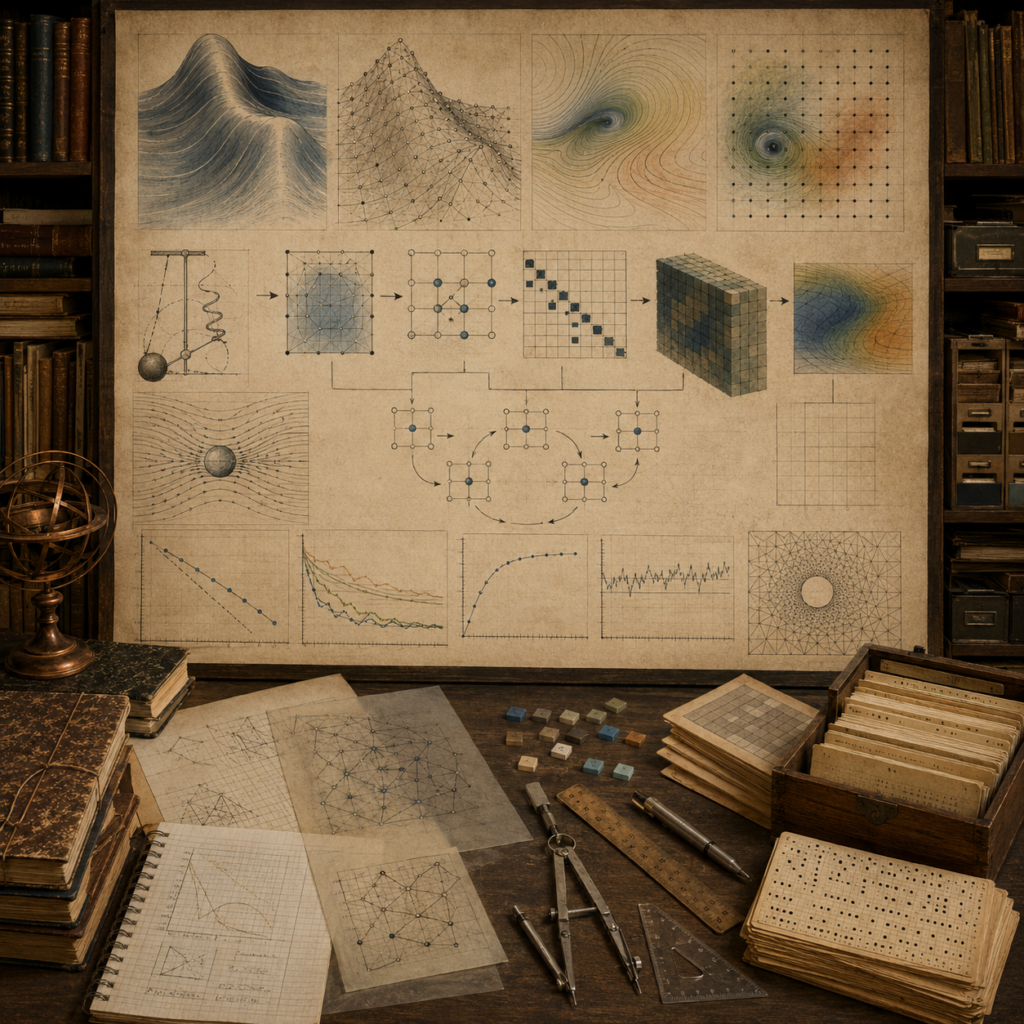
Numerical methods and algorithmic approximation explain how continuous, complex, or analytically difficult problems become computable through finite procedures. Many mathematical and scientific problems cannot be solved exactly, symbolically, or directly, so algorithms approximate derivatives, integrals, roots, trajectories, equations, optimizations, probabilities, and model outputs using discretization, iteration, sampling, and tolerance. Approximation is not weak reasoning. It is disciplined computational reasoning under constraint. Numerical methods replace continuous quantities with finite steps, infinite processes with stopping conditions, exact values with error estimates, and ideal mathematics with executable procedures. Responsible approximation documents method choice, assumptions, step size, grid resolution, floating-point limits, truncation error, roundoff error, residuals, convergence, stability, validation, reproducibility, sensitivity, uncertainty, and interpretation boundaries so numerical outputs remain useful, auditable, and accountable rather than mistaken for exact truth, neutral calculation, or unwarranted certainty in research, engineering, policy, science, and institutional decision contexts.