
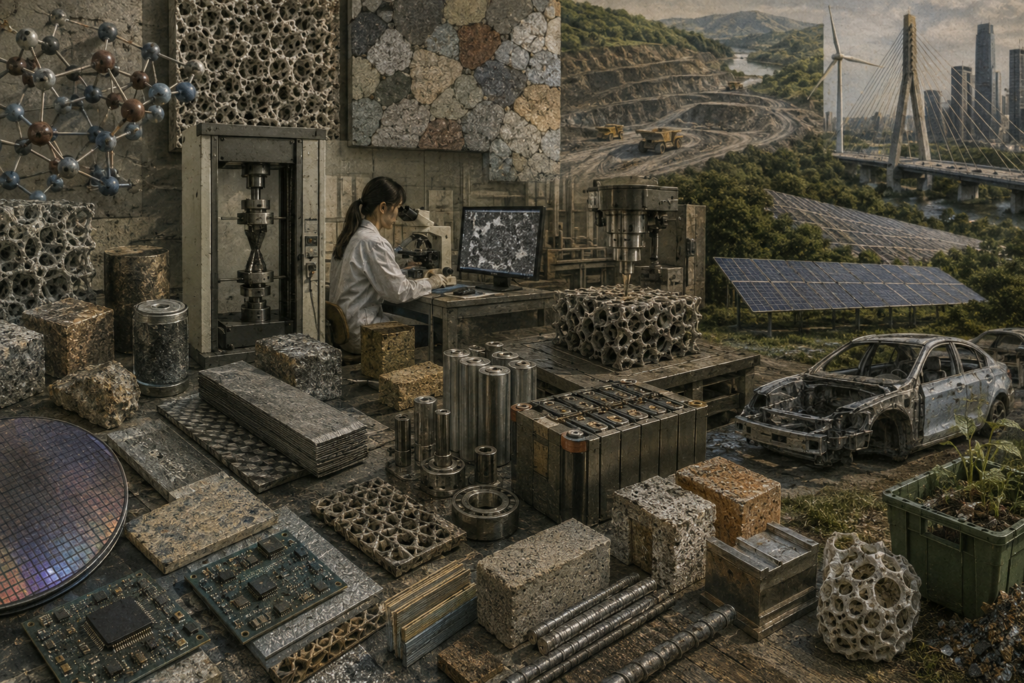
Materials Science: Structure, Properties, Sustainability, and Technological Systems
Materials Science examines the substances, structures, properties, processes, and design principles that make modern technology, infrastructure, energy systems, medicine, electronics, manufacturing, transportation, and environmental transition possible. This article map organizes the series across atomic structure, bonding, crystallography, defects, thermodynamics, phase behavior, mechanical properties, diffusion, thermal transport, electrical properties, semiconductors, metals, ceramics, polymers, composites, biomaterials, nanomaterials, energy materials, degradation, corrosion, lifecycle assessment, circularity, and computational materials science. The series treats materials not as passive inputs, but as active foundations of technological capability, industrial strategy, ecological responsibility, and long-term social development. It provides a structured pathway for planned articles, mathematical models, scientific code, reproducible datasets, engineering examples, and sustainability analysis across the material foundations of contemporary systems.