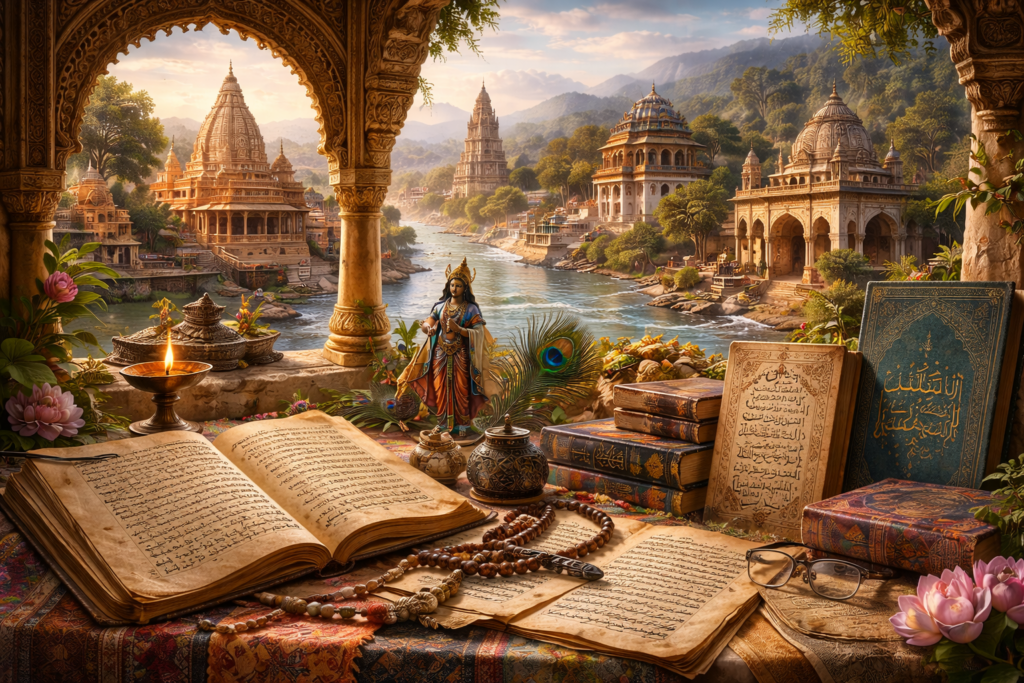
South Asian Literature and Sacred Memory
South Asian Literature and Sacred Memory explores the literary traditions through which the cultures of South Asia have preserved epic worlds, devotional inheritance, philosophical reflection, poetic refinement, ritual imagination, and the layered memory of civilization. Across Sanskrit, Pali, Prakrit, Tamil, Persian, Urdu, Bengali, Hindi, and many other languages, South Asian literary culture has long served as a medium for carrying sacred story, ethical teaching, political imagination, mystical longing, social commentary, and the memory of place. In this world, literature is deeply entangled with religion, ritual, cosmology, performance, kingship, and the transmission of civilizational meaning across vast stretches of time.
This category examines epics, devotional poetry, classical drama, courtly literature, bhakti and Sufi traditions, philosophical verse, narrative retellings, vernacular literatures, and modern writings shaped by colonialism, nationalism, partition, and the afterlives of empire. It considers how literary traditions preserve sacred memory through repetition, commentary, recitation, and adaptation, and how they mediate between scriptural authority and lived experience, local language and cosmopolitan form, inherited order and social critique. It also explores the continuing life of literary memory across temple culture, storytelling traditions, oral performance, manuscript transmission, and print modernity.
South Asian Literature and Sacred Memory is therefore concerned with literature as a mode of civilizational continuity that is at once spiritual, emotional, historical, and aesthetic. It studies how literary traditions in South Asia carry the memory of gods, kingdoms, pilgrims, saints, lovers, teachers, and communities through forms that remain open to reinterpretation. By linking literature to sacred geography, ritual life, philosophical inquiry, plural religious worlds, and historical upheaval, this category illuminates one of the richest and most enduring complexes of literary memory in the world.