
Global Governance

Global governance refers to the institutions, norms, and cooperative arrangements through which international actors manage collective problems at the global scale. Unlike traditional government structures, global governance operates through networks of states, international organizations, private actors, and civil society institutions.

Institutions such as the United Nations, World Bank, International Monetary Fund, and World Trade Organization play central roles in coordinating economic policy, humanitarian assistance, environmental protection, and conflict resolution. Informal networks and multilateral agreements also contribute to global governance structures.

The effectiveness of global governance systems depends on institutional legitimacy, coordination capacity, and the ability of actors to negotiate shared solutions to transnational challenges. As issues such as climate change, financial stability, and technological regulation increasingly require global cooperation, the study of global governance has become central to international relations and sustainable development.

Scholarly illustration of a parchment legal map with overlapping regional jurisdictions, court chambers, council tables, treaty files, scales, maps, seals, and archival materials representing pluralism in international law.

Regional Organizations, Regional Courts, and Pluralism in International Law

Regional organizations and regional courts have become essential parts of international law’s plural order. They interpret treaties, settle disputes, supervise human-rights obligations, coordinate security, regulate trade, manage migration, support democratic governance, and give communities voice within a global system centered on states and universal institutions. This article explains how regional arrangements operate under the UN Charter, how regional courts develop distinctive jurisprudence, and how institutions such as the European Court of Human Rights, Court of Justice of the European Union, Inter-American Court of Human Rights, African Court, ECOWAS Court, African Union, ASEAN, and regional economic communities shape legal authority. It also examines the risks of fragmentation, forum shopping, uneven compliance, democratic deficits, and regional power asymmetry. By connecting doctrine, institutions, and practice, the article shows how regional pluralism can deepen international law while complicating global coherence, universality, and enforcement.
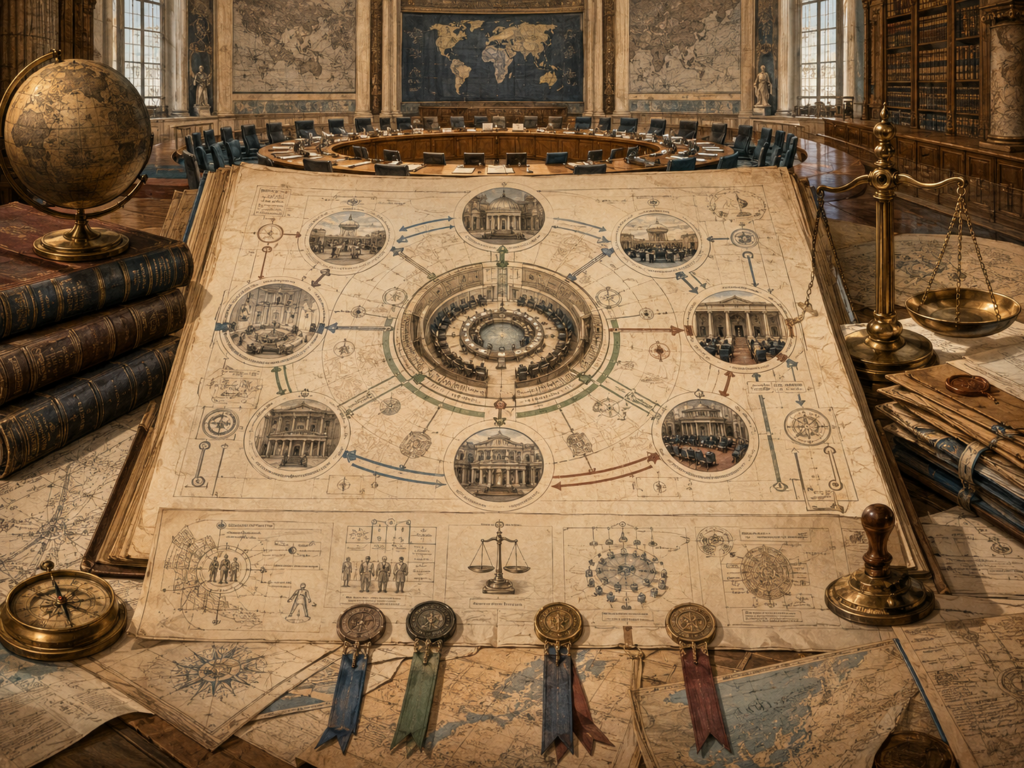

Scholarly illustration of a grand international governance chamber with a circular council table, archival legal diagrams, maps, treaty materials, scales, and institutional symbols representing the authority of global organizations.

International Organizations and the Legal Authority of Global Institutions

International organizations are among the most important legal actors in modern global governance. They administer treaties, coordinate technical systems, issue decisions, develop standards, supervise compliance, support development, manage crises, and shape the practical meaning of international law across fields such as peace and security, health, labor, trade, finance, aviation, food, climate, and human rights. This article explains how global institutions acquire legal authority through constituent instruments, delegated powers, implied powers, institutional practice, legal personality, privileges and immunities, voting rules, treaty mandates, and specialized expertise. It also examines the limits of institutional authority: accountability gaps, democratic deficits, unequal influence, technocratic power, responsibility for harm, and the tension between legal mandate and political legitimacy. By connecting doctrine, institutions, case law, and lawyer-facing workflows, the article shows how international organizations make law operational while remaining constrained by states, power, and institutional design.

Scholarly illustration of an international judicial chamber with legal case files, treaty volumes, maps, scales, a gavel, and archival diagrams representing the International Court of Justice and peaceful dispute settlement.

The International Court of Justice and the Judicial Settlement of Disputes

The International Court of Justice is the central judicial forum of the United Nations and one of the most important institutions for the peaceful settlement of international disputes. This article explains how the ICJ hears contentious cases between states, issues advisory opinions for authorized UN organs, interprets treaties, clarifies customary international law, orders provisional measures, manages jurisdictional objections, and shapes legal consequences in disputes involving territory, use of force, genocide, self-determination, occupation, maritime boundaries, diplomatic relations, and state responsibility. It also examines the Court’s limits: consent-based jurisdiction, political non-compliance, Security Council dependence, evidentiary burdens, and the gap between legal authority and enforcement. By connecting doctrine, procedure, leading cases, and lawyer-facing analytical workflows, the article shows how judicial settlement can clarify law while remaining constrained by sovereignty, power, and institutional design in the modern international legal order globally and institutionally.

Editorial illustration of mixed legal systems and legal pluralism shown through layered legal maps, constitutional documents, civil-law codes, common-law records, customary-law materials, treaty papers, religious legal documents, archival files, and overlapping jurisdictional diagrams.

Mixed Legal Systems and Legal Pluralism: Hybrid Law, Overlapping Authority, and Global Governance

Mixed Legal Systems and Legal Pluralism examines how legal orders are layered, hybrid, and shaped by overlapping traditions, jurisdictions, institutions, communities, and governance authorities. The article map studies mixed jurisdictions, civil-law and common-law hybrids, customary law, Indigenous legal orders, religious personal law, socialist law, colonial legal inheritance, postcolonial reform, federalism, legal transplants, conflict of laws, transnational arbitration, international organizations, human rights, environmental governance, corporate standards, digital-platform governance, and private regulatory systems. It shows how multiple legal orders can claim authority over the same dispute, person, territory, resource, or relationship. By treating legal pluralism as a governance problem rather than an exception, the series explains how institutions coordinate plural authority, protect rights, preserve community autonomy, manage conflict, and design accountable systems for global governance beyond legal purity across courts, communities, markets, states, platforms, and international institutions in complex modern societies.

Editorial illustration of socialist and post-socialist legal traditions shown through archival legal files, constitutional documents, planning records, reform papers, administrative ledgers, institutional offices, and legal research materials.

Socialist and Post-Socialist Legal Traditions: Law, Planning, Transition, and Reform

Socialist and Post-Socialist Legal Traditions examines law as a system shaped by revolution, party-state authority, socialist legality, public ownership, planned economies, social rights, privatization, market transition, and institutional reform. The article map studies Marxist legal theory, Soviet law, democratic centralism, procuracies, courts, constitutional form, state enterprises, labor law, family reform, Eastern European socialist law, Chinese and Vietnamese socialist-market systems, Cuban law, North Korean legal institutions, and post-Soviet transformation. It follows post-socialist transition through property reform, privatization, restitution, lustration, constitutional courts, judicial independence, corruption, oligarchy, Europeanization, commercial law, and state capacity. By treating socialist law as more than ideology or legal absence, the series shows how political economy, public authority, planning, markets, rights, administration, and hybrid governance shaped one of the most important comparative legal traditions of the modern world today across regimes, transitions, institutions, economies, courts, and societies worldwide.

Editorial illustration of Chinese and East Asian legal traditions shown through imperial law codes, administrative registers, magistrate records, civil-service documents, regional maps, legal commentaries, reform-era files, and modern governance materials.

Chinese and East Asian Legal Traditions: Confucian Governance, Imperial Codes, and State Capacity

Chinese and East Asian Legal Traditions examines a major regional legal tradition shaped by moral governance, imperial codes, bureaucracy, family order, regional transmission, legal modernization, socialist legality, and developmental statecraft. The article map begins with China as the historical anchor while tracing Confucian governance, Legalist statecraft, Tang and Qing codes, magistrates, civil service institutions, local mediation, land records, family responsibility, and administrative authority. It then follows legal adaptation across Japan, Korea, Vietnam, Taiwan, Hong Kong, Singapore, colonial systems, Meiji reform, postwar constitutionalism, socialist legality, market reform, and East Asian developmental states. By treating East Asian law as more than a single static system, the series shows how law, morality, hierarchy, courts, rights, markets, regulation, bureaucracy, political authority, and state capacity shaped comparative governance across one of the world’s most influential legal regions today.

Editorial illustration of religious legal traditions shown through manuscripts, legal commentaries, communal registers, religious court records, institutional archives, scholars, clergy, jurists, monks, and comparative legal materials.

Religious Legal Traditions: Sacred Authority, Interpretation, and Legal Pluralism

Religious Legal Traditions examines how sacred texts, interpretation, communal authority, institutional memory, personal law, moral obligation, and legal pluralism shape governance across cultures. The article map studies Jewish law, Christian canon law, Hindu dharma, Buddhist monastic discipline, Islamic law in comparative context, Sikh community authority, Jain ethical obligation, Zoroastrian communal records, and broader religion-state relations. It explores how religious communities organize marriage, inheritance, property, charity, education, discipline, courts, councils, endowments, clergy, scholars, ritual practice, and membership. By treating religious law as more than private belief, the series shows how religious legal traditions create durable systems of authority, interpretation, obligation, identity, reform, and institutional governance. It also examines secularism, religious freedom, human rights, arbitration, constitutional recognition, diaspora communities, and the challenges of plural legal authority in modern comparative global governance today across states, communities, courts, traditions, and public institutions worldwide.

Editorial illustration of customary and Indigenous legal orders shown through a circular council table, layered land maps, treaty records, archival folders, ecological stewardship materials, community deliberation, and land-based governance imagery.

Customary and Indigenous Legal Orders: Land, Sovereignty, Memory, and Legal Pluralism

Customary and Indigenous Legal Orders examines law beyond the modern state, showing how communities govern through land, memory, kinship, treaty obligation, ecological responsibility, restorative justice, and living legal practice. The article map distinguishes customary law from Indigenous legal orders while exploring oral law, elders, councils, customary courts, tribal courts, land as jurisdiction, treaty rights, Indigenous sovereignty, sacred sites, resource governance, colonial disruption, constitutional recognition, legal pluralism, Indigenous data sovereignty, and legal revitalization. It treats these legal orders as serious systems of authority, responsibility, repair, and public order rather than informal customs or historical remnants. By connecting customary and Indigenous law to global governance, the series shows how plural legal systems shape land stewardship, human rights, environmental protection, community authority, institutional design, sovereignty, historical repair, and the future of governance beyond state-centered legal imagination across regions, generations, institutions, and cultures.

Editorial illustration of Islamic law and governance shown through manuscripts, legal commentaries, court records, waqf documents, sealed registers, scholarly study circles, qadi court scenes, and institutional archives.

Islamic Law and Governance: Sharia, Fiqh, Institutions, and Legal Pluralism

Islamic Law and Governance examines one of the world’s major legal traditions as a layered system of revelation, juristic reasoning, institutions, public authority, and legal pluralism. The article map distinguishes sharia from fiqh while exploring Qur’an, Sunnah, ijma, qiyas, usul al-fiqh, madhhabs, qadis, muftis, fatwas, siyasa, qanun, waqf, zakat, courts, commerce, family law, taxation, empire, colonial codification, and modern constitutional governance. It follows Islamic law across Ottoman, Mughal, African, Southeast Asian, Persianate, Central Asian, colonial, and postcolonial contexts. By treating Islamic law as governance infrastructure rather than a single fixed code, the series shows how interpretation, legal schools, courts, custom, institutions, public order, finance, community status, and state authority shaped one of the most important legal traditions in comparative global governance today across regions, empires, markets, households, archives, reform movements, constitutional systems, and modern plural legal orders worldwide today.

Scroll to Top