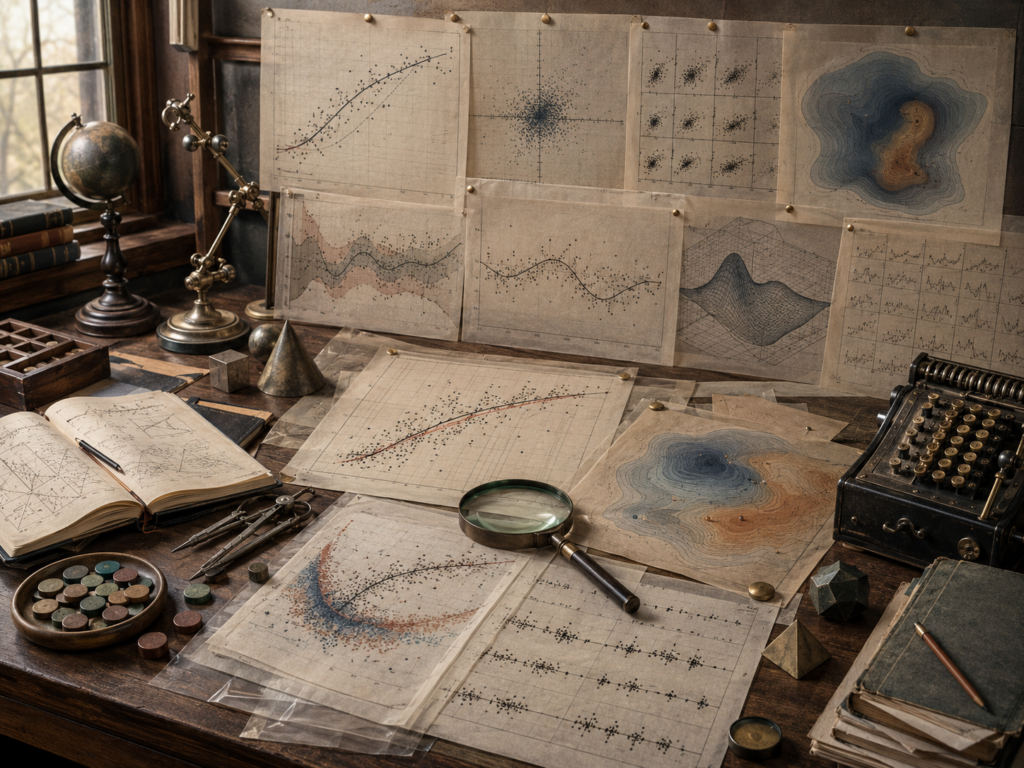
Mathematical Modeling in Science: How Models Explain, Predict, and Test the Natural World
Mathematical modeling in science uses formal representations to explain phenomena, test hypotheses, connect theory with observation, estimate hidden mechanisms, simulate complex systems, and make conditional predictions. Scientific models do not simply reproduce reality; they simplify, idealize, measure, compare, and reason about selected features of the world. This article explains how mathematical models support scientific inquiry across physics, chemistry, biology, ecology, earth systems, climate science, epidemiology, neuroscience, astronomy, and interdisciplinary research. It examines model purpose, abstraction, measurement, theory, mechanism, simulation, calibration, validation, uncertainty, sensitivity analysis, reproducibility, and responsible interpretation. It also shows why scientific models are strongest when their assumptions, domains of validity, evidence, and limits are explicit. Used responsibly, mathematical modeling helps scientists clarify mechanisms, organize evidence, identify gaps, compare explanations, design experiments, communicate uncertainty, and reason carefully about complex natural systems.