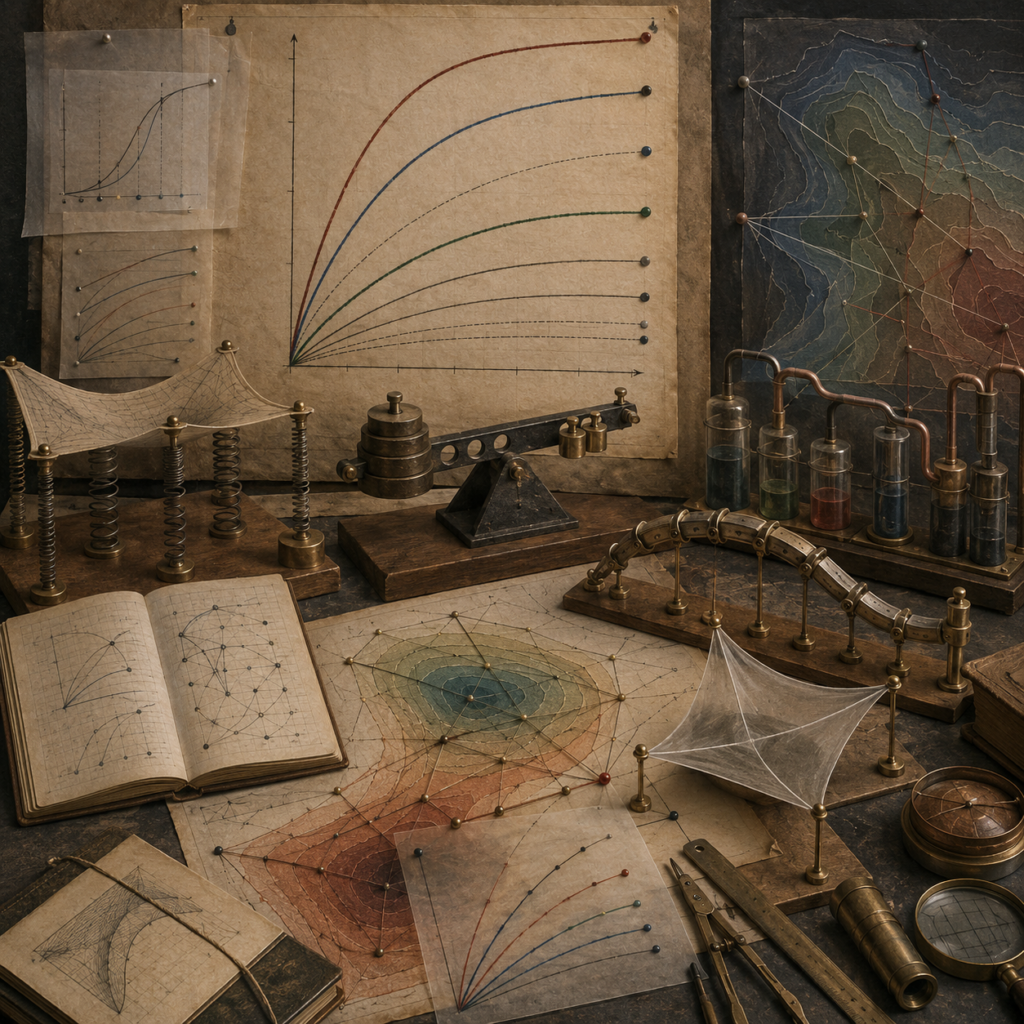
Sequences, Series, and the Logic of Convergence: How Calculus Tests Infinite Processes
Sequences, series, and convergence explain how repeated steps, partial sums, iterative calculations, and limiting processes become stable mathematical claims. This article treats convergence as a modeling principle for judging whether simulations settle, cumulative approximations remain finite, feedback effects decay, and numerical workflows produce reliable results. It explains the difference between sequence limits, series totals, partial sums, truncation error, geometric decay, divergence, absolute convergence, conditional convergence, and stopping rules. In systems modeling, these ideas help interpret discrete-time states, discounted future values, iterative solvers, cumulative error, scenario ensembles, and feedback adjustment. The article emphasizes that a computation ending is not the same as convergence, that small terms do not always imply small tails, and that finite approximations require explicit error logic before they can support responsible long-run or cumulative conclusions across policy, science, infrastructure, finance, ecology, education, and computational governance workflows.