Author name: Tariq Ahmad

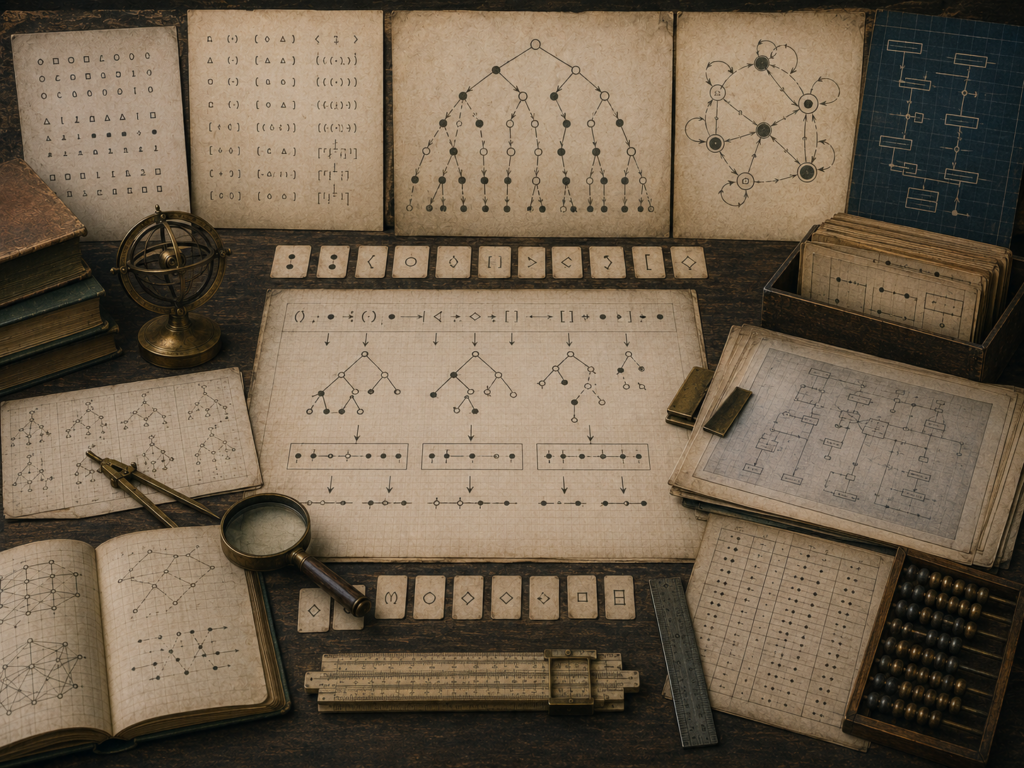
A restrained scholarly illustration of an archival research table covered with logic diagrams, flowcharts, graph structures, tokens, notes, and computational sketches contrasting algorithmic thinking with computational reasoning.

Algorithmic Thinking vs. Computational Reasoning

Algorithmic thinking and computational reasoning are closely related, but they are not identical. Algorithmic thinking emphasizes step-by-step procedure: decomposition, sequencing, conditions, loops, recursion, testing, and debugging. Computational reasoning includes those procedural skills while expanding the frame to representation, abstraction, data structures, model assumptions, complexity, interpretation, uncertainty, ethics, and governance. This article explains why the distinction matters for modern technical and institutional systems. A procedure can be correct and efficient while still formalizing the wrong problem, using a weak proxy, hiding uncertainty, or producing outputs that are misunderstood. Computational reasoning asks what is being represented, what is excluded, how resources scale, how evidence is evaluated, who is affected, and when automation should be constrained. The article provides examples across search, databases, public policy, scientific modeling, machine learning, education, platforms, and organizational workflows.

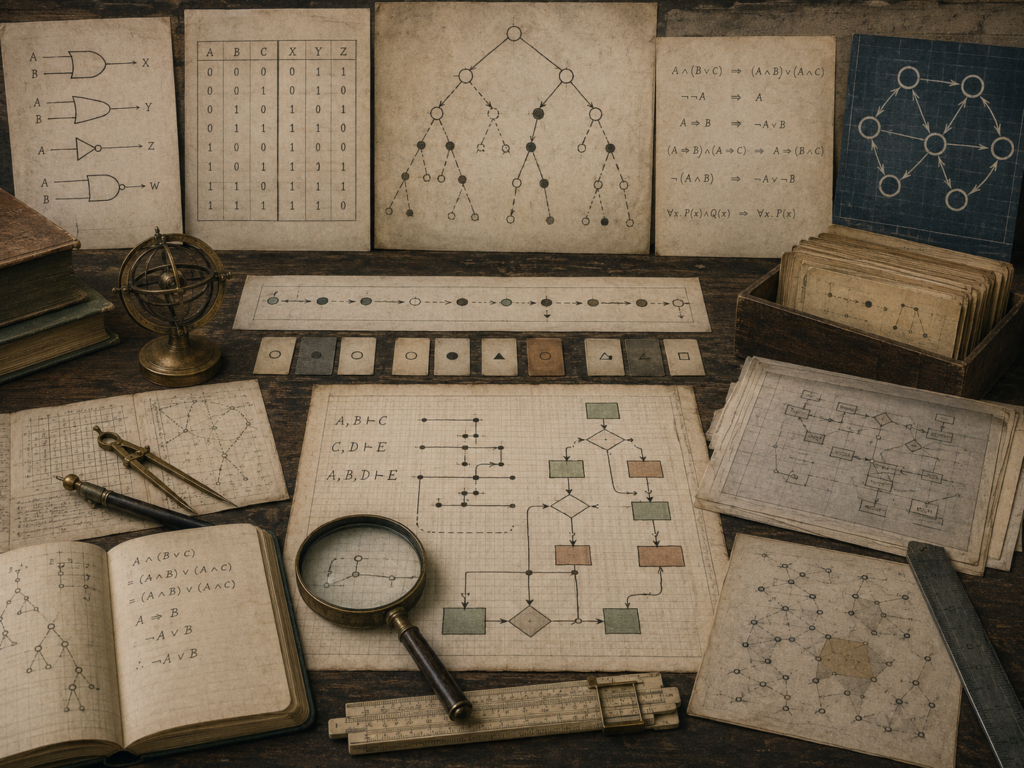
A restrained scholarly illustration of a worn institutional table covered with notebooks, diagrams, graph networks, flowcharts, index cards, drafting tools, and archival papers representing algorithms and computational reasoning.

What Is Algorithms & Computational Reasoning?

Algorithms are structured procedures for solving problems, transforming inputs into outputs through explicit representations, operations, decisions, and constraints. Computational reasoning is the broader discipline that asks how problems should be represented, what steps are required, how resources grow with scale, how correctness is tested, and how algorithmic systems should be interpreted responsibly. This article introduces algorithms as formalized reasoning rather than code alone. It examines problem formulation, inputs and outputs, data structures, control flow, correctness, proof, complexity, search, sorting, optimization, computational limits, knowledge systems, ethics, and governance. It also explains why algorithmic thinking matters beyond computer science: modern institutions use procedures to rank information, allocate resources, model systems, automate workflows, and support decisions. The article emphasizes clarity, verification, efficiency, accountability, and responsible use in computational systems. Readers gain a foundation for evaluating algorithms as tools for disciplined public reasoning.

Archival systems modeling workspace with typed record cards, modular tokens, functional workflow diagrams, network structures, notebooks, translucent overlays, and drafting tools representing Haskell-style functional modeling without labels or text.

Typed Model Records and Functional Workflows in Haskell

Typed model records and functional workflows in Haskell help make mathematical models explicit, auditable, reusable, and harder to misuse. This article introduces typed records for calculus-based systems modeling, including parameter records, state records, solver settings, diagnostic outputs, algebraic data types, pure functions, validated inputs, structured exports, governance queues, and responsible interpretation. It shows why typed workflows matter: population dynamics, epidemiological models, climate feedback, resource systems, infrastructure stress, calibration studies, solver workflows, and model-governance pipelines often fail through ambiguous parameters, missing units, hidden assumptions, mutable state, or disconnected diagnostics. In computational workflows, Haskell typed records support validation rules, pure transformations, solver-status records, CSV/JSON/Markdown exports, SQL governance registries, calculator scripts, and generated reports. The article emphasizes documenting assumptions, parameter sources, units, solver settings, warnings, diagnostics, output scope, and claim boundaries, so results remain reviewable across languages, repositories, and future governed workflows.

Archival systems modeling workspace with a detailed river-basin diorama, forests, farms, settlements, industry, dams, maps, network diagrams, field samples, notebooks, and drafting tools representing coupled human-natural systems.

Coupled Human-Natural Systems

Coupled Human-Natural Systems shows how calculus turns population, ecosystems, resources, infrastructure, climate, behavior, feedback, and governance into a structured systems model. This article introduces coupled-systems reasoning for calculus-based systems modeling, including coupled stocks and flows, human-natural feedback, renewable resource extraction and regeneration, demand, livelihoods, land-use change, ecosystem services, climate stress, environmental pressure, thresholds, adaptation, resilience, vulnerability, governance, equity, distributional burden, calibration, uncertainty, sensitivity, and responsible interpretation. It shows why human systems and natural systems should not be modeled as separate worlds when decisions, ecosystems, infrastructure, risk, and values coevolve over time. Computational workflows support coupled resource scenarios, regeneration and extraction calculators, adaptive response records, SQL governance registries, Haskell typed coupled-system records, calculator scripts, Canvas artifacts, and generated reports that keep ecological assumptions, social assumptions, governance limits, threshold risk, uncertainty, distributional burden, and claim boundaries explicitly visible together for review.

Archival urban planning workspace with a detailed city model, congested roads, rail lines, bridges, rivers, network maps, capacity charts, notebooks, balances, and drafting tools representing urban dynamics and congestion.

Urban Dynamics and Congestion

Urban Dynamics and Congestion shows how calculus turns movement, density, flow, delay, capacity, feedback, accessibility, and infrastructure stress into a structured systems model. This article introduces urban congestion reasoning for calculus-based systems modeling, including urban stocks and flows, density-speed-flow relationships, traffic flow, bottlenecks, queues, travel time, generalized cost, route choice, network equilibrium, induced demand, public transit, multimodal access, land-use interaction, freight, curbside dynamics, environmental effects, distributional burden, calibration, uncertainty, sensitivity, and responsible interpretation. It shows why congestion is not merely too many vehicles, but a dynamic interaction among demand, capacity, behavior, land use, institutions, and alternatives. Computational workflows support queue scenarios, BPR travel-time functions, accessibility calculators, induced-demand adjustment, SQL governance registries, Haskell typed urban records, calculator scripts, Canvas artifacts, and generated reports that keep model boundaries, uncertainty, equity, scenario assumptions, and claim limits visible throughout review and publication workflows.

Archival epidemiology modeling workspace with epidemic curves, population groups, transmission networks, regional maps, laboratory glassware, microscope, notebooks, and drafting tools representing continuous-time disease models.

Continuous-Time Epidemiological Models

Continuous-Time Epidemiological Models shows how calculus turns infection, recovery, exposure, immunity, contact, intervention, and population movement into a structured systems model. This article introduces continuous-time compartment models for calculus-based systems modeling, including SIR models, SEIR models, susceptible populations, exposed states, infectious prevalence, recovery flows, force of infection, incidence, prevalence, early exponential growth, doubling time, basic and effective reproduction numbers, herd-immunity thresholds, vaccination, waning immunity, time-varying transmission, behavior change, contact structure, calibration, uncertainty, sensitivity, and responsible interpretation. It shows why epidemiological models are useful for mechanism and scenario reasoning but dangerous when simplified outputs are detached from data quality, reporting processes, biology, heterogeneity, equity, and public-health context. Computational workflows support SIR and SEIR scenarios, reproduction-number calculators, SQL governance registries, typed records, Canvas artifacts, and generated reports that keep assumptions, uncertainty, reporting limits, interventions, and claim boundaries explicitly visible during review.

Archival climate modeling workspace with Earth system energy arrows, sunlight, outgoing radiation, oceans, ice, clouds, maps, balances, glass vessels, notebooks, and drafting tools representing energy balance models.

Energy Balance Models

Energy Balance Models shows how calculus turns heat, radiation, storage, transfer, feedback, equilibrium, and thermal response into a structured systems model. This article introduces energy balance reasoning for calculus-based systems modeling, including energy stocks and flows, conservation, heat capacity, incoming radiation, outgoing radiation, albedo, radiative balance, forcing, feedback, equilibrium temperature, transient response, adjustment time, ocean heat uptake, layered reservoirs, surface energy partitioning, building thermal balance, urban heat, calibration, uncertainty, sensitivity, and responsible interpretation. It shows why energy imbalance produces continuous change and why equilibrium should not be confused with immediate response. In computational workflows, energy balance audits support parameter records, one-layer and two-layer scenarios, equilibrium calculators, forcing and feedback sensitivity, SQL governance registries, Haskell typed energy records, calculator scripts, Canvas artifacts, and generated reports that keep boundaries, storage, uncertainty, and claim limits visible.

Archival financial modeling workspace with compounding curves, coin stacks, circular flow models, ledgers, balances, clocks, water channels, notebooks, and drafting tools representing financial dynamics and continuous compounding.

Financial Dynamics and Continuous Compounding

Financial Dynamics and Continuous Compounding shows how calculus turns interest, growth, discounting, investment, debt, risk, volatility, cash flow, and time value into a structured systems model. This article introduces financial dynamics for calculus-based systems modeling, including simple interest, compound interest, continuous compounding, exponential accumulation, variable-rate compounding, discount factors, present value, future value, net present value, annuities, debt dynamics, amortization, inflation adjustment, real rates, asset returns, volatility, geometric growth, leverage, liquidity, sensitivity, calibration, uncertainty, and responsible interpretation. It shows why small rate differences can compound into large long-term effects and why financial formulas require clear rate conventions, timing, and risk assumptions. In computational workflows, financial audits support parameter records, compounding scenarios, discounting calculations, debt schedules, SQL governance registries, Haskell typed financial records, calculator scripts, Canvas artifacts, and generated reports.

Archival economic modeling workspace with a detailed industrial city model, farms, ports, factories, transport routes, network diagrams, growth curves, stacked indicators, notebooks, balances, and drafting tools.

Economic Growth and Adjustment Models

Economic Growth and Adjustment Models shows how calculus turns output, capital accumulation, productivity, investment, depreciation, demand, supply, adjustment, shocks, and long-term change into a structured systems model. This article introduces economic dynamics for calculus-based systems modeling, including growth rates, exponential growth, logistic constraints, capital accumulation, investment, depreciation, production functions, productivity, labor growth, adjustment toward equilibrium, demand and supply response, shocks, delays, overshoot, capacity constraints, resource constraints, infrastructure limits, distribution, welfare, calibration, uncertainty, sensitivity, and responsible interpretation. It shows why output growth is not the same as welfare and why growth assumptions compound strongly over time. In computational workflows, economic growth audits support parameter records, growth scenarios, capital stock-flow models, productivity assumptions, adjustment equations, SQL governance registries, Haskell typed economic records, calculator scripts, Canvas artifacts, and generated reports that keep mechanisms, constraints, uncertainty, distribution, and claim boundaries explicitly visible together.

Scroll to Top