Author name: Tariq Ahmad

Scholarly archival studio wall and worktable with sketches, drafts, layered manuscripts, compositional studies, visual frames, folded study panels, abstract revision marks, craft materials, symbolic fragments, and interpretive diagrams representing creative form and meaning-making.

Creative Form, Composition, and Interpretation: Studio Practice and Meaning-Making

This article map explores creative form, composition, and interpretation as a study of how works are made, structured, revised, performed, received, and understood. It treats creativity as disciplined meaning-making rather than inspiration alone, emphasizing medium, material, constraint, process, craft, revision, audience, context, performance, and responsibility. The map moves from foundations of creative form into composition, unity, contrast, rhythm, framing, scale, openness, drafts, technique, practice, failure, reception, ambiguity, genre, embodiment, improvisation, collaboration, authorship, creative credit, technology, and agency. It helps readers understand making as a form of thinking and interpretation as part of a work’s continuing life. The series also addresses influence, cultural responsibility, audience care, AI-assisted creation, archives, adaptation, collaboration, and the ethics of responsible form-making across media, institutions, communities, and traditions. that keep works meaningful through drafts, performances, archives, adaptations, tools, and interpretive afterlives. across public life. responsibly.

Scholarly archival research table with symbolic objects, masks, textile motifs, ritual patterns, public emblems, monument fragments, cultural artifacts, animal and plant motifs, labyrinth forms, and interpretive diagrams representing symbolism, style, and cultural meaning.

Symbolism, Style, and Cultural Meaning: Icons, Motifs, and Public Memory

This article map examines symbolism, style, and cultural meaning as a study of how signs, images, motifs, objects, rituals, public symbols, and visual traditions carry memory, identity, power, and interpretation. It treats symbols as more than decorative signs, showing how they condense belief, conflict, belonging, sacredness, authority, grief, resistance, and collective memory. The map moves from foundations of symbolic meaning into iconography, sacred art, mythic imagery, archetypes, natural symbols, masks, journeys, style, genre, ornament, fashion, monuments, propaganda, memes, public memory, ambiguity, and responsible interpretation. It helps readers read symbols without reducing them to fixed definitions. The series also emphasizes context, cultural authority, appropriation, symbolic harm, misreading, layered meanings, public spaces, media environments, communities, institutions, and the ethical responsibilities involved in interpreting powerful forms. across traditions where signs remain contested, emotionally charged, and historically alive. in public life today. responsibly.

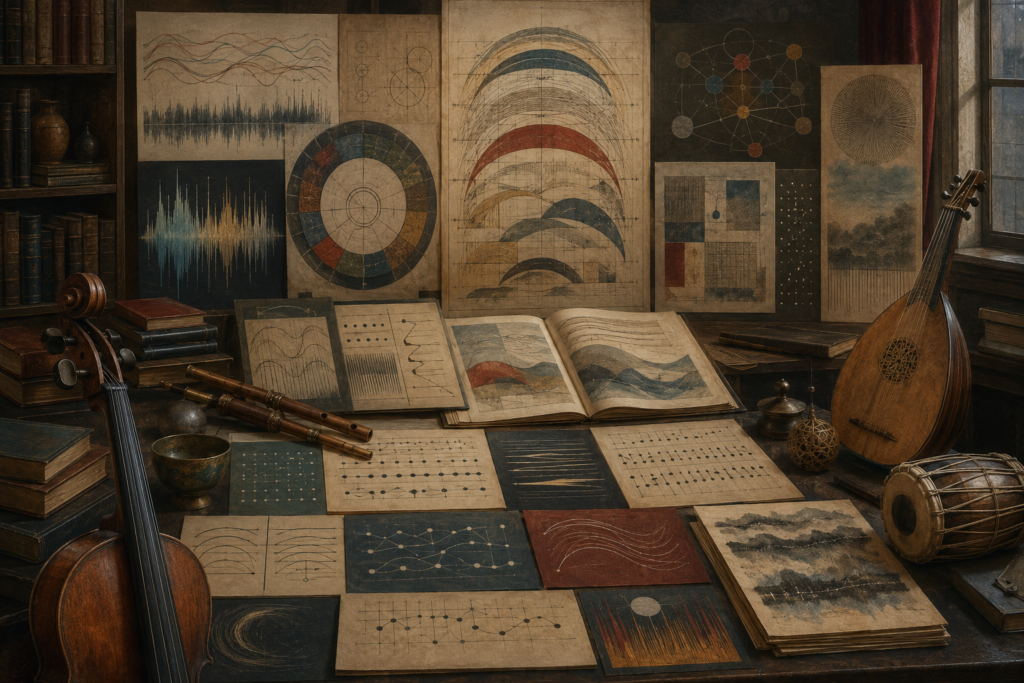
Scholarly archival studio table with geometric studies, spirals, tessellations, rhythm grids, waveform diagrams, abstract musical structures, color blocks, proportional layouts, and branching patterns representing mathematics, art, music, and pattern.

Mathematics, Art, Music, and Pattern: Geometry, Rhythm, and Aesthetic Structure

This article map explores mathematics, art, music, and pattern as overlapping ways of studying proportion, symmetry, rhythm, geometry, repetition, variation, tuning, complexity, and aesthetic meaning. It treats mathematics not only as calculation, but as a language of relation, transformation, structure, emergence, and formal beauty. The map moves from foundations of pattern and aesthetic order into geometry, visual form, musical ratios, tuning systems, rhythm, cycles, Fourier thinking, algorithmic art, generative design, cellular automata, randomness, perception, complexity, and AI-generated form. It helps readers understand why patterns feel meaningful and how formal structures shape visual and musical experience. The series also warns against reducing art or music to formulas, emphasizing cultural context, authorship, interpretation, embodied perception, history, human judgment, and responsible computational exploration across traditions, media, and creative systems. while preserving aesthetic ambiguity, cultural depth, and interpretive care across contexts. today. responsibly.

Scholarly archival design studio table with muted color palettes, grid systems, layout studies, typographic blocks, contrast swatches, accessibility symbols, geometric diagrams, and editorial design materials representing visual communication and responsible design.

Color Theory, Typography, and Design: Visual Systems of Meaning

This article map examines color theory, typography, and design as visual systems through which knowledge becomes readable, recognizable, accessible, and meaningful. It treats design as more than surface style, showing how color, type, layout, grids, hierarchy, spacing, identity, interfaces, and accessibility shape attention, trust, comprehension, and public interpretation. The map moves from foundations of visual communication into color perception, palette systems, typographic form, readability, editorial layout, information architecture, branding, interface aesthetics, design systems, data visualization, and responsible visual communication. It gives readers a framework for understanding how visual choices organize meaning before content is fully read. The series also emphasizes design ethics, inclusive access, dark patterns, and the responsibility to make information clear without oversimplifying complexity or excluding audiences from shared knowledge, public research, civic life, websites, dashboards, archives, and digital institutions. where clarity, trust, and access matter. online.

Scholarly illustration of a museum-like study space with abstract paintings, classical sculpture fragments, symbolic frames, sketch studies, geometric diagrams, and muted color studies representing beauty, judgment, form, expression, and interpretation.

Aesthetics and the Philosophy of Art: Beauty, Judgment, and Meaning

This article map introduces aesthetics and the philosophy of art as a focused inquiry into beauty, taste, judgment, artistic value, representation, expression, interpretation, medium, and cultural authority. It frames art as more than decoration or entertainment, treating works as forms through which human beings perceive, feel, question, remember, and understand. The map moves from foundational questions about beauty, art, and aesthetic experience into classical theories, modern judgment, theories of art, interpretation, medium, ethics, museums, canons, and contemporary practice. It helps readers understand why aesthetic disagreement matters, how works invite meaning, and why art remains central to human self-understanding. The series also supports responsible interpretation across cultures, showing how beauty, form, power, memory, and meaning interact in historical, institutional, and public life while preparing readers for deeper studies of design, music, symbolism, and creative form. within a wider Meaning architecture.

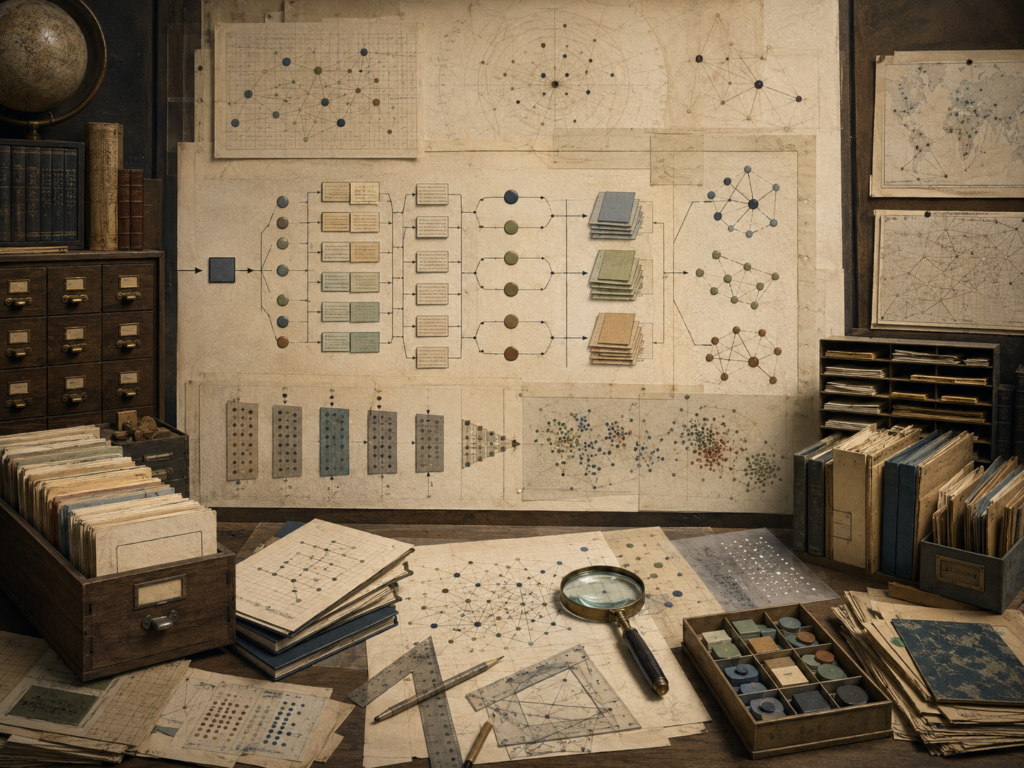
A restrained scholarly illustration of a vintage computational workspace with expanding memory grids, stacked records, dense matrices, branching structures, queues, punched cards, notebooks, and archival tools representing space complexity and resource constraints.

Space Complexity, Memory, and Resource Constraints

Space complexity asks how much memory an algorithm requires as input size grows. Time complexity tells us how long a computation may take. Space complexity tells us how much must be stored, remembered, buffered, indexed, cached, copied, transmitted, or retained while computation is happening. Memory is not a secondary concern. Many systems fail not because they perform too many operations, but because they require too much space. A model may be fast enough but too large to fit in memory. A graph algorithm may be theoretically efficient but impossible to run on a dense network. A recursive method may be elegant but overflow the call stack. Space complexity connects algorithm design to infrastructure, cost, energy, latency, reliability, governance, access, and responsible communication of computational limits. It clarifies what fits, what fails, and what must be redesigned carefully at scale.

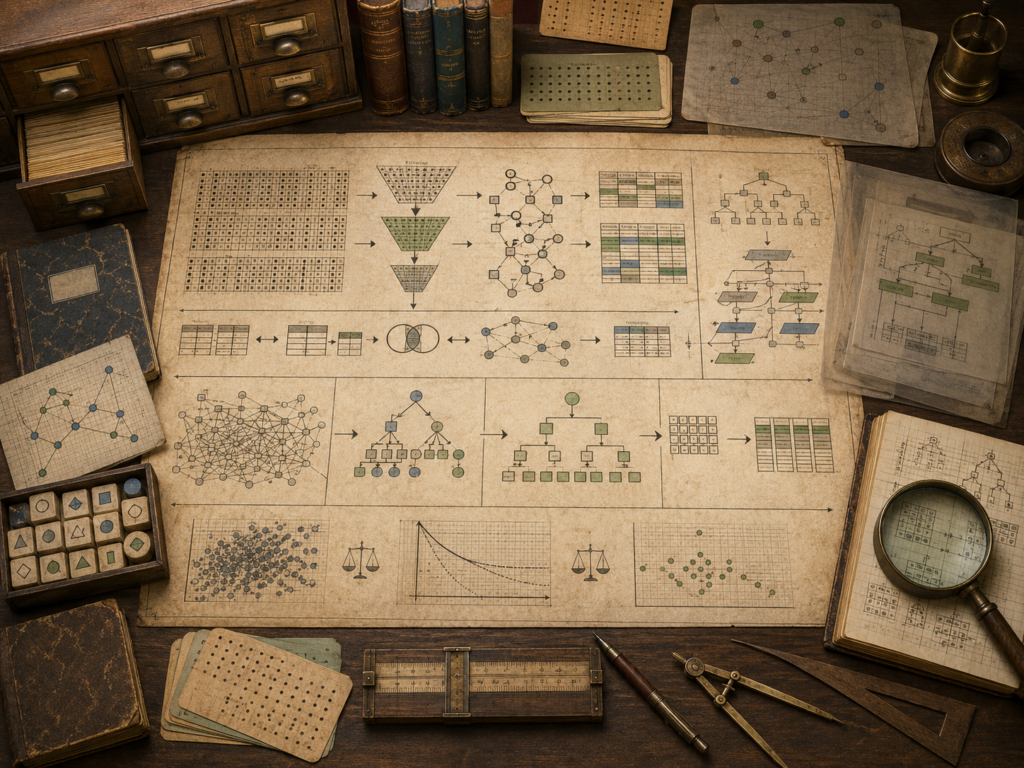
A restrained scholarly illustration of a vintage mathematical workspace with a large parchment board showing manageable paths, structured trees, verification-like diagrams, dense networks, and crowded search spaces representing P, NP, and the boundaries of efficient computation.

P, NP, and the Boundaries of Efficient Computation

P, NP, and the boundaries of efficient computation sit at the center of computational complexity theory. The question is not merely whether a problem can be solved in principle, but whether it can be solved efficiently, checked efficiently, transformed into another problem, or shown to belong to a family of problems that appear resistant to efficient general solution. The famous P versus NP question asks whether every problem whose solution can be verified efficiently can also be solved efficiently. It remains one of the most important open problems in mathematics and computer science. But even without resolving it, the distinction between P, NP, NP-hard, and NP-complete shapes practical algorithm design, verification, reductions, hardness evidence, approximation, heuristics, parameterized methods, and responsible communication about what automation can and cannot promise.

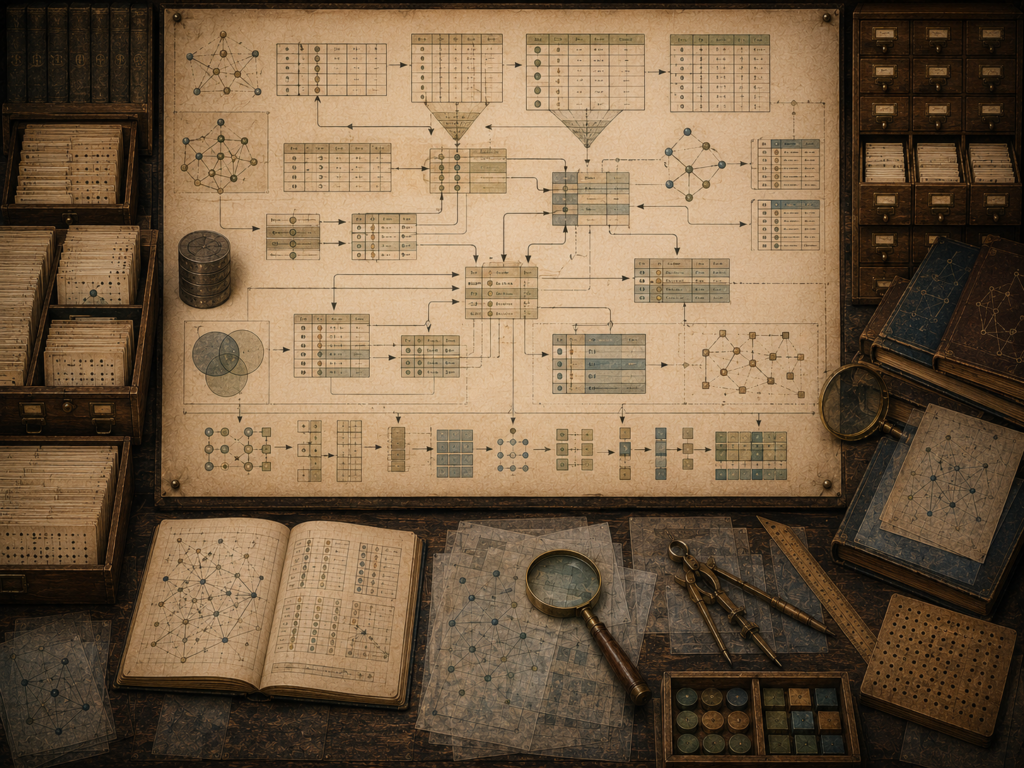
A restrained scholarly illustration of a vintage research workspace with diagrams progressing from simple grids and paths to dense networks, tangled mazes, branching trees, crowded matrices, notebooks, and archival tools representing tractability and hard computational problems.

Tractability, Intractability, and Hard Problems: What Can Be Solved

Tractability asks whether a problem can be solved within practical resource limits. Intractability asks when a problem becomes too expensive to solve exactly at useful scale. Hard problems sit at the boundary between what is theoretically definable and what is practically computable. This distinction is central to computational reasoning. Some problems are easy to state but extraordinarily difficult to solve. Others become difficult only when input size grows. Some have efficient algorithms for special cases but no known efficient solution in general. Some can be checked quickly once a solution is given, yet seem difficult to solve from scratch. Understanding tractability helps explain why algorithm designers use approximation, heuristics, randomized methods, dynamic programming, pruning, relaxation, parallelism, and problem reformulation. It also helps prevent misleading promises about automation, perfect optimization, and computational certainty in real systems.

A restrained scholarly illustration of an antique worktable with growth curves, expanding sequences, branching trees, dense grids, network diagrams, symbolic tiles, notebooks, and drafting tools representing Big-O notation and algorithmic growth rates.

Big-O Notation and Growth Rates: Understanding Algorithmic Scale

Big-O notation is the language computer scientists use to describe how algorithmic cost grows as input size grows. It does not usually tell us the exact number of seconds an algorithm will take. Instead, it describes the dominant growth pattern: constant, logarithmic, linear, linearithmic, quadratic, cubic, exponential, factorial, or something else. Growth rates matter because scale changes computation. Two algorithms may look similar on ten inputs and behave completely differently on ten million. A method that is elegant on a small example may become unusable at production scale. A procedure that seems inefficient for tiny data may become preferable once inputs grow large enough. Big-O is therefore not only a notation system. It is a way of thinking about limits, feasibility, scalability, resource growth, practical solvability, and design trade-offs. It also supports clearer communication about computational promises and constraints.

Scroll to Top