Author name: Tariq Ahmad

Origins of sustainable development illustration showing the relationship between environment, economy, and society in global development.

Origins of Sustainable Development

The concept of sustainable development emerged from the growing recognition that economic progress, environmental stability, and social wellbeing are deeply […]

Editorial sustainability illustration showing demographic transition, age structure, education, healthcare, labor markets, migration, urbanization, care systems, infrastructure, and ecological pressure across connected development pathways.

Population Growth and the Global Economy

Population Growth, Demographic Transition, and the Global Economy examines how demographic change reshapes labor supply, age structure, urbanization, migration, public finance, and ecological demand across the development process. The article argues that population growth should not be treated as a standalone cause of either prosperity or environmental crisis, but as a systems variable whose effects depend on institutions, gender equality, human-capital investment, labor absorption, infrastructure, and patterns of consumption. It explores demographic transition, dependency ratios, the demographic dividend, urban concentration, reproductive autonomy, aging, and global inequality, showing that the real development question is not simply how many people there are, but whether societies can convert demographic change into inclusive human development without intensifying long-run ecological and institutional fragility.

Editorial sustainability illustration showing economic growth being translated through institutions, public services, infrastructure, education, healthcare, decent work, and ecological resilience into human progress.

Economic Growth & Human Progress

Economic Growth and Human Progress examines the historical relationship between rising output and expanding human wellbeing, arguing that growth has been one of the great engines of modern progress without ever being an adequate measure of progress by itself. The article explores productivity, industrialization, technological change, life expectancy, education, inequality, ecological cost, and public-goods provision, showing that economic growth enlarges the material possibilities of development but does not automatically translate into healthier, freer, or more inclusive societies. Its central claim is that growth matters most when it is understood not as the final definition of development, but as a historically powerful means whose value depends on distribution, institutional quality, human-capability expansion, and long-run social and ecological viability.

Editorial sustainability illustration showing global poverty as a spatial condition shaped by rural vulnerability, informal settlements, infrastructure gaps, disease burden, climate exposure, conflict displacement, and unequal public-service reach.

Geography of Global Poverty

Geography of Global Poverty examines how deprivation is distributed unevenly across rural regions, informal urban settlements, ecologically vulnerable zones, and territorially marginalized communities rather than appearing as a uniform global condition. The article argues that poverty is not only a question of low income, but a spatial condition shaped by infrastructure gaps, disease burdens, regional isolation, weak public systems, conflict exposure, and unequal access to health, education, sanitation, housing, and mobility. It explores rural precarity, urban informality, regional concentration, multidimensional poverty, and territorial exclusion, showing that the persistence of global poverty cannot be understood through national averages alone. Its central claim is that ending extreme poverty requires geographically literate development strategies capable of extending public goods, resilience, and human capability into the landscapes of exclusion that markets and aggregate growth too often leave behind.

Business as usual vs sustainable development comparison showing unsustainable growth, carbon emissions, and inequality contrasted with renewable energy, environmental protection, and inclusive prosperity.

Business as Usual vs Sustainable Development

Business as Usual vs Sustainable Development examines the conflict between two models of growth: one that extends familiar patterns of fossil dependence, resource throughput, unequal distribution, and ecological strain, and another that seeks to redesign development around inclusion, resilience, and long-run viability. The article argues that business as usual remains politically attractive because it is associated with the real achievements of modern growth, yet it becomes increasingly self-undermining when the same systems that raise output also intensify climate risk, biodiversity loss, social fracture, and institutional stress. Its central claim is that sustainable development is not a softer moral gloss on the status quo, but a more demanding framework for restructuring energy, cities, infrastructure, governance, and distribution so that prosperity can endure under ecological and social constraint.

Editorial illustration of Earth surrounded by threshold rings and connected planetary systems, showing climate change, biodiversity, land-system change, freshwater stress, ocean acidification, nutrient cycles, novel entities, atmospheric pollution, and ozone recovery.

Anthropocene and Planetary Boundaries

Anthropocene and Planetary Boundaries examines how human activity has become powerful enough to alter the regulating systems of the Earth itself, transforming sustainable development from a question of local environmental management into a question of planetary stability. The article argues that the Anthropocene names a new historical condition in which climate, biodiversity, freshwater, land systems, nutrient cycles, ocean chemistry, and pollution are being reshaped by human economic activity, while the planetary boundaries framework provides a scientific way of judging how far those pressures can extend before the risk of destabilization rises sharply. Its central claim is that development can no longer be assessed only by output, welfare, or poverty reduction in isolation, but must also be judged by whether it preserves a safe operating space for humanity within the Earth system.

Conceptual illustration of sustainable development as an interconnected systems framework linking human wellbeing, inclusive economies, education and health, institutions and governance, ecosystems, water security, clean energy, resilience, and long-run viability.

The Four Dimensions of Sustainable Development

The Four Dimensions of Sustainable Development explains sustainable development as a systems framework built around four interacting conditions: economic prosperity, social inclusion, environmental sustainability, and good governance. The article argues that sustainable development is best understood not as a vague balance among competing goals, but as a structured way of thinking about how societies endure over time, since prosperity without inclusion can produce instability, inclusion without material capacity can remain fragile, environmental protection without institutions can remain rhetorical, and governance without justice or ecological viability can preserve unsustainable systems. Its central claim is that these four dimensions provide one of the clearest conceptual maps for understanding the wider field of sustainable development and for organizing the deeper articles across the knowledge series.

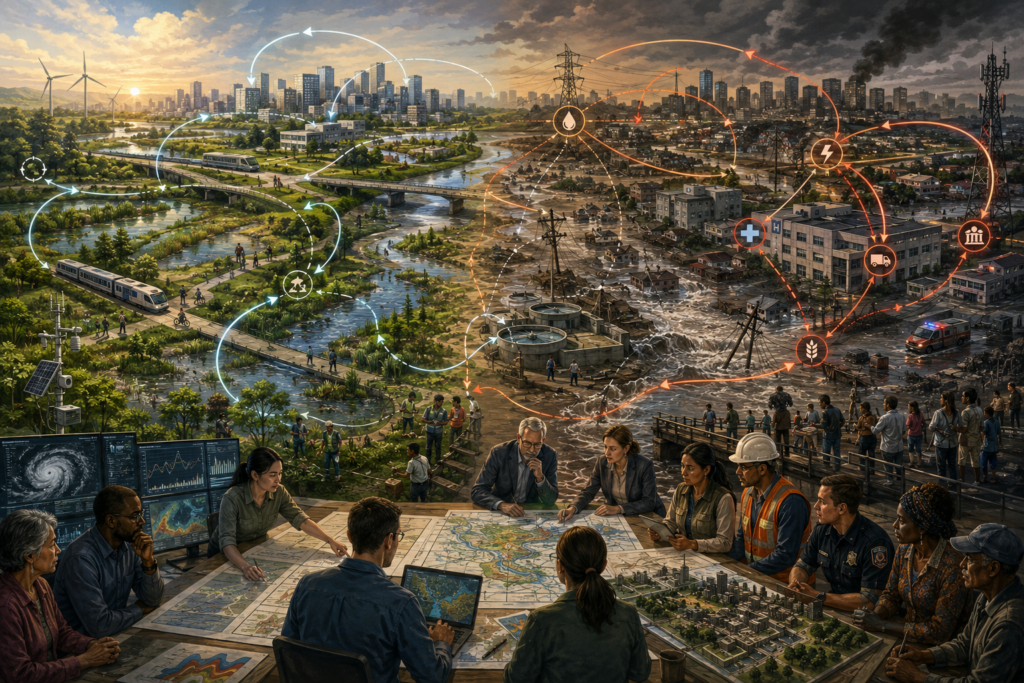
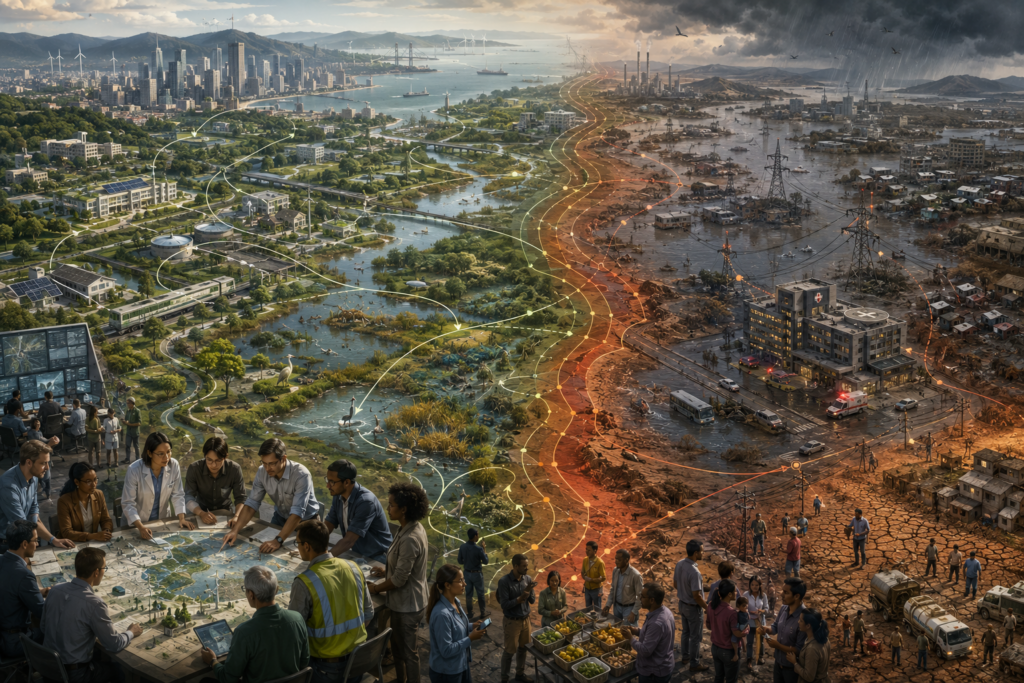
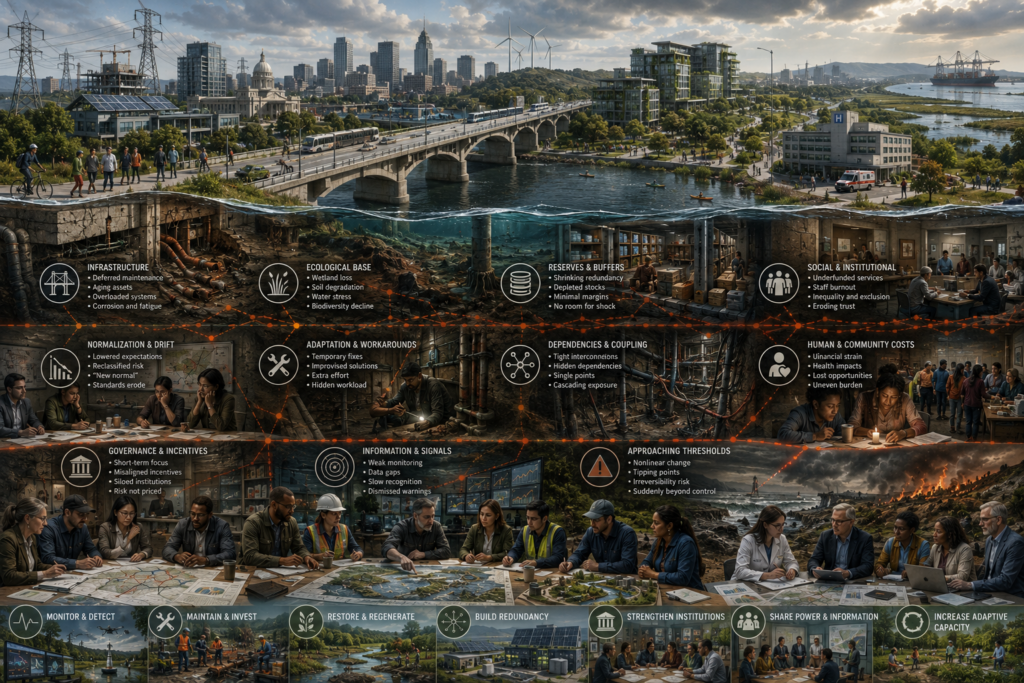
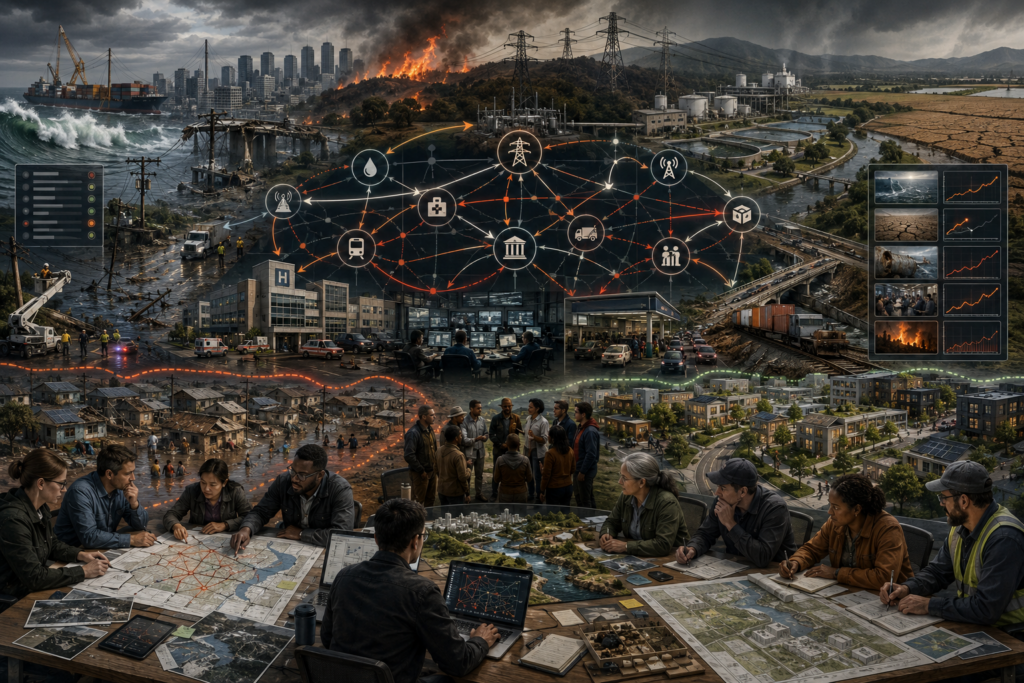
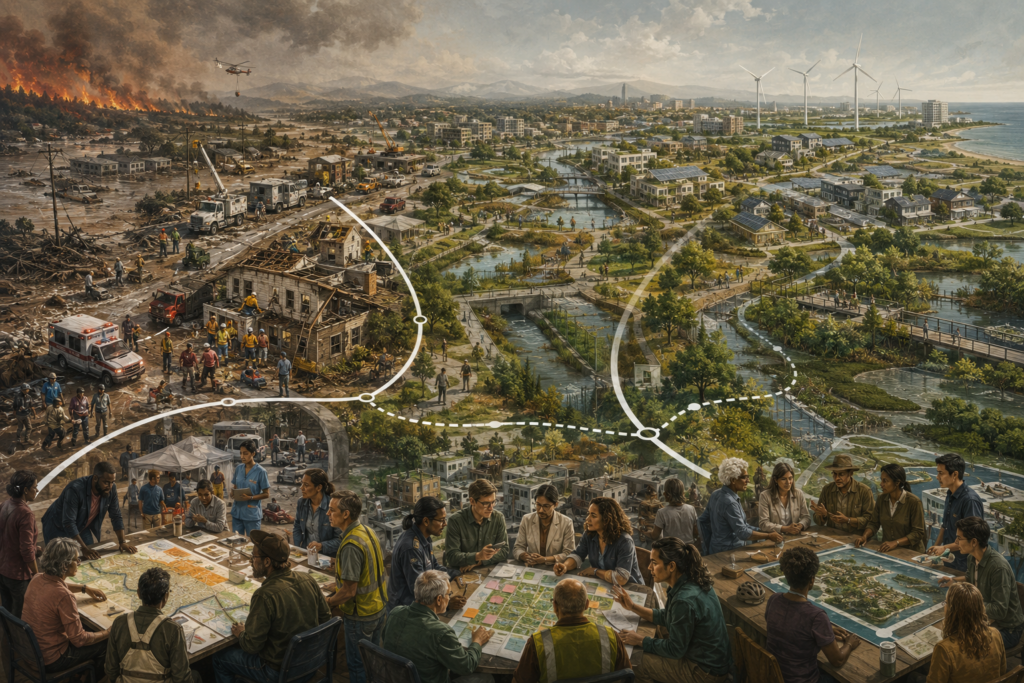
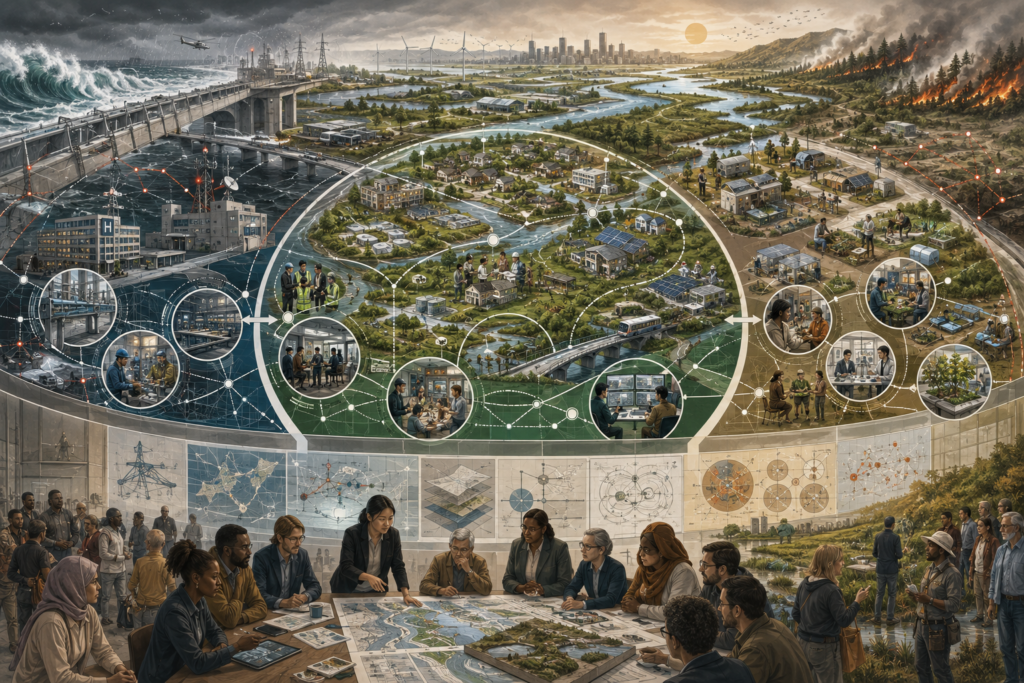
Resilience Thinking in the Anthropocene

Resilience Thinking in the Anthropocene explains how resilience thinking helps societies manage uncertainty, thresholds, adaptation, and transformation under planetary pressure. The article connects social-ecological resilience to the planetary boundaries framework, showing why sustainability cannot rely only on optimization, prediction, and control. It examines the shift from stability to resilience, the dangers of brittle efficiency, nonlinear change, adaptive management, social learning, governance cooperation, surprise, transformation, trade-offs, justice, and maladaptive resilience. The article argues that resilience is not simply the ability to bounce back, but the capacity to sustain life-supporting functions, learn under uncertainty, and transform systems that drive ecological destabilization or social injustice. It also includes mathematical, Python, and R workflows for modeling boundary pressure, adaptive capacity, ecological buffering, lock-in pressure, and transformation need.

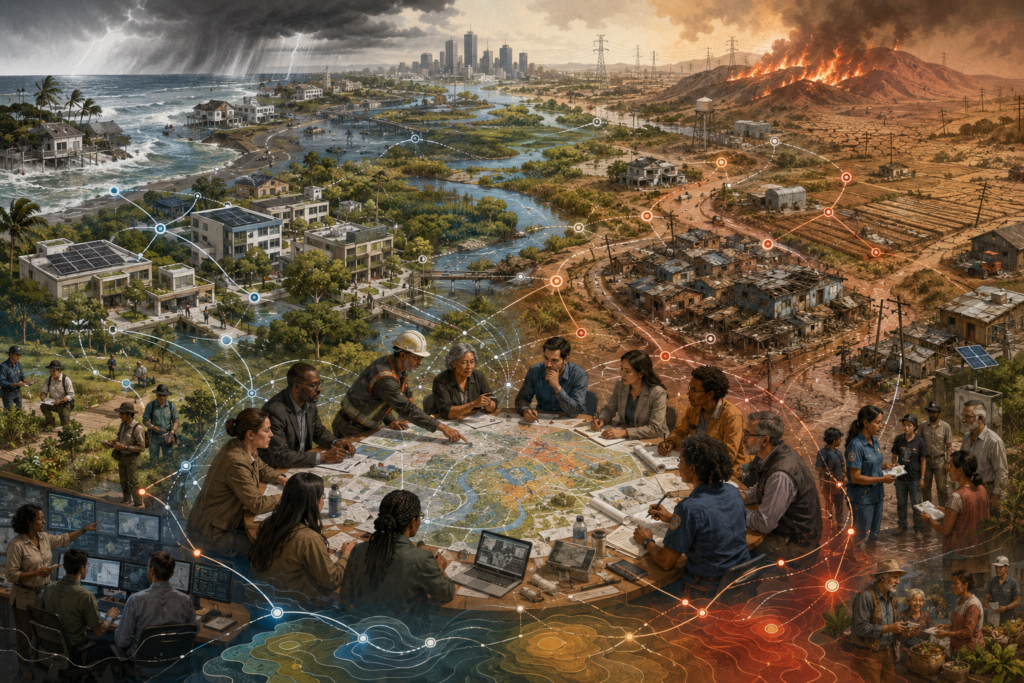
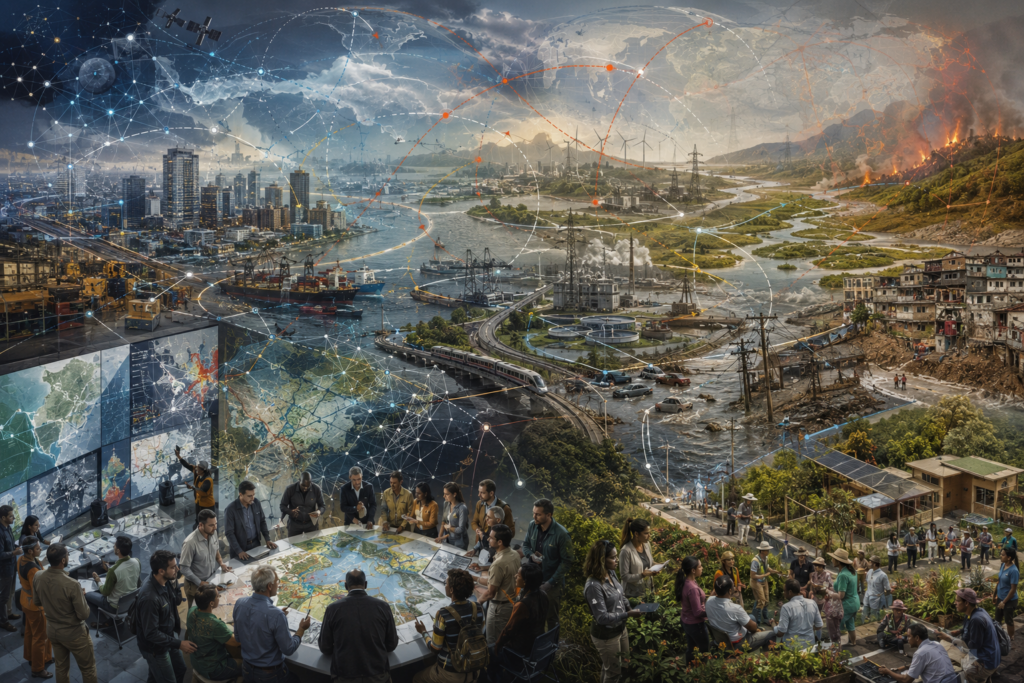
Editorial illustration of Anthropocene planetary risk showing climate warming, biodiversity loss, development demand, infrastructure, ecosystems, and unequal exposure within Earth-system limits.

Navigating the Anthropocene: Sustainable Development in a 3–6–9 World

Navigating the Anthropocene: Sustainable Development in a 3–6–9 World explains how sustainable development changes when human activity becomes a planetary force. The article uses the 3–6–9 framing—roughly 3°C warming risk under inadequate mitigation, the sixth mass extinction or broader biodiversity crisis, and the demographic-development scale of a world moving through 9 billion people—as a heuristic for understanding Anthropocene planetary risk. It connects this framing to Holocene stability, Earth system science, planetary boundaries, tipping points, resilience thinking, justice, and governance. The article argues that development can no longer be understood apart from climate stability, biosphere integrity, freshwater systems, land use, nutrient cycles, and ecological limits. It also includes mathematical, Python, and R workflows for modeling climate pressure, biosphere pressure, development demand, boundary transgression, governance capacity, and transformation urgency.

Scroll to Top