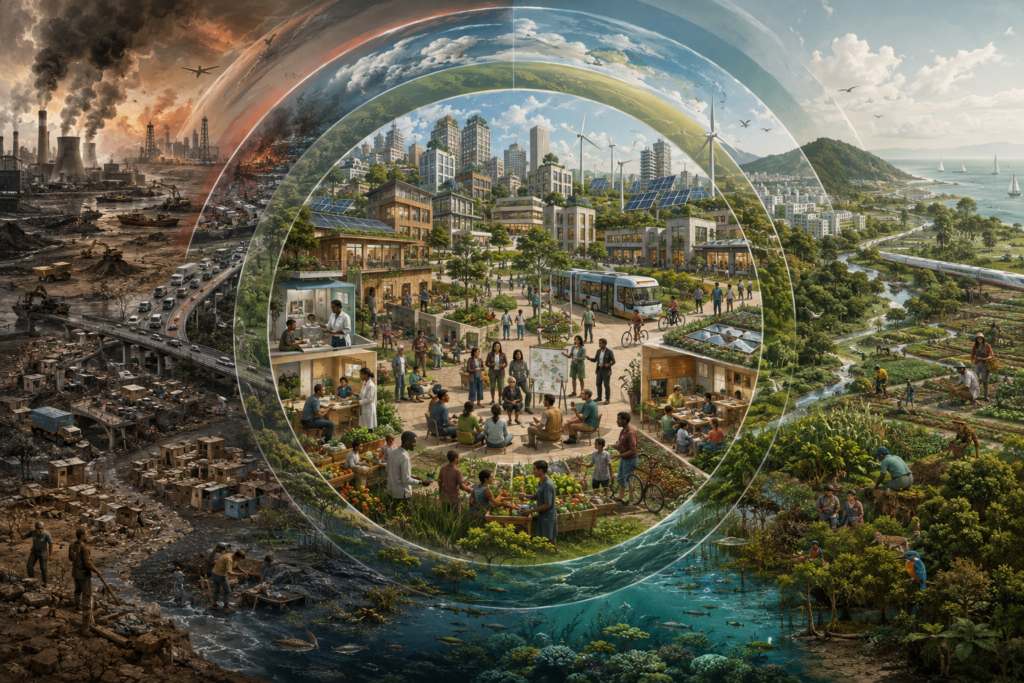
Editorial sustainability illustration showing human prosperity, community life, and resilient infrastructure nested within planetary boundaries, contrasted with ecological overshoot and regenerative development.

Anthropocene Sustainable Development: Rethinking Prosperity on a Finite Plane

Anthropocene Sustainable Development: Rethinking Prosperity on a Finite Planet explains why sustainable development must be reframed for an era in which human activity shapes the Earth system. The article argues that prosperity can no longer be measured only through economic growth or GDP, because durable human wellbeing depends on climate stability, biosphere integrity, freshwater systems, soils, oceans, nutrient cycles, and ecological resilience. It connects Anthropocene development to Holocene stability, the Great Acceleration, the planetary squeeze, planetary boundaries, Doughnut Economics, justice, governance, and planetary stewardship. The article also includes mathematical, Python, and R workflows for modeling social foundation achievement, wellbeing, ecological pressure, boundary pressure, governance capacity, justice capacity, resilience capacity, sustainable prosperity, and transition urgency.

Painterly illustration of the IS–LM model, showing intersecting macroeconomic curves, fiscal policy, monetary policy, public institutions, central banking, infrastructure, labor, households, firms, and economic equilibrium.

The IS–LM Model: Fiscal Policy, Monetary Policy, and Macroeconomic Equilibrium

The IS–LM model explains how fiscal policy, monetary policy, interest rates, and aggregate demand interact to determine short-run macroeconomic equilibrium. This article examines the goods-market logic of the IS curve, the money-market logic of the LM curve, and the way their intersection determines output and interest rates when prices adjust slowly. It explores how fiscal expansion shifts aggregate demand, how monetary expansion changes liquidity and borrowing conditions, why crowding out can weaken stimulus, and how curve slopes affect policy effectiveness. By connecting Keynesian theory with Python, R, Stata, SQL, and Julia research workflows, the article turns a classic macroeconomic diagram into a reproducible modeling framework for equilibrium solving, comparative statics, policy multipliers, liquidity-trap scenarios, and fiscal-monetary policy analysis.

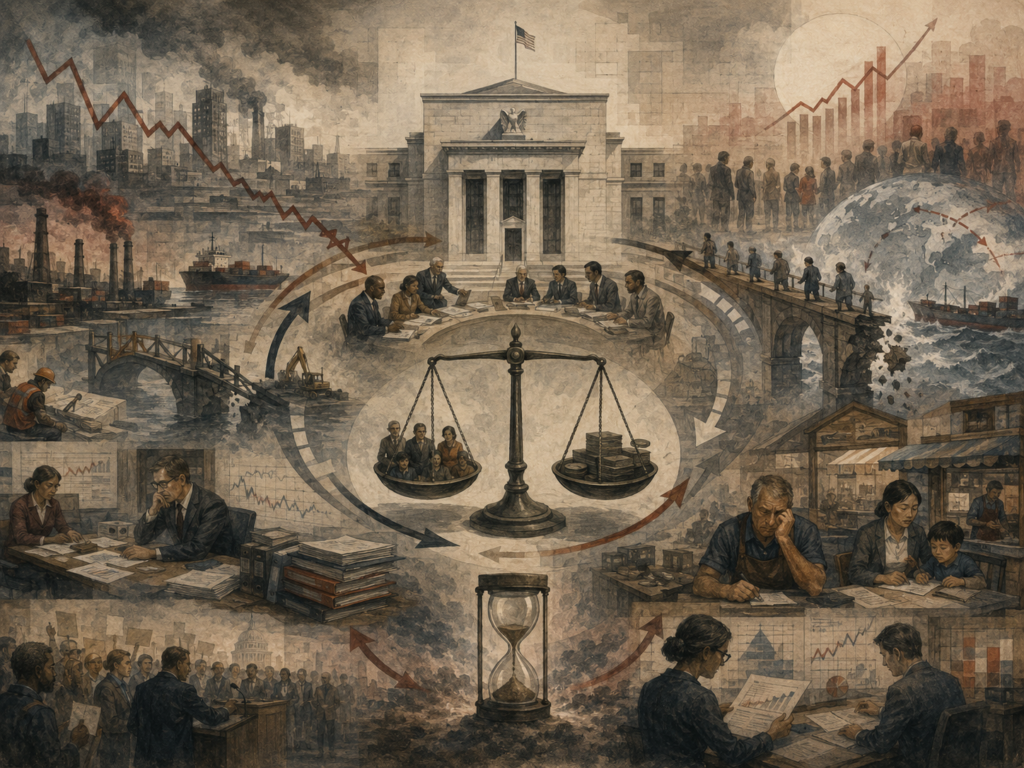
Painterly illustration of stabilization policy constraints, showing central banks, fiscal decision-making, economic shocks, strained households, supply chains, public debt, inflation pressures, and policy tradeoffs.

Limits of Stabilization Policy: Fiscal Policy, Monetary Policy, and Macroeconomic Constraints

Stabilization policy can reduce recession damage, support demand, and protect employment, but fiscal and monetary tools face real macroeconomic constraints. This article examines why stimulus may fail to raise spending, how Ricardian-equivalence arguments and private saving can weaken fiscal policy, when public borrowing may crowd out private investment, and why inflation can turn expansionary policy into a source of price pressure rather than real growth. It also explores monetary-policy limits, including lower-bound constraints, weak credit transmission, supply-side shocks, debt sustainability, fiscal space, policy lags, and the tension between short-term crisis response and long-term institutional credibility. By connecting these debates with Python, R, Stata, SQL, and Julia research workflows, the article frames stabilization-policy limits as essential to designing resilient, credible, and sustainable economic systems.

Painterly illustration of stabilization policy, showing public institutions, fiscal planning, monetary tools, workers, households, cities, factories, balance scales, circular arrows, and economic recovery pathways.

Stabilization Policy: Fiscal and Monetary Tools for Managing Economic Fluctuations

Stabilization policy refers to the fiscal, monetary, and institutional tools used to manage economic fluctuations, support employment, stabilize demand, and prevent recessions from becoming deeper social crises. This article explains how governments and central banks respond when aggregate demand weakens, output falls below potential, unemployment rises, or financial conditions threaten recovery. It examines Keynesian foundations, aggregate demand, fiscal stimulus, automatic stabilizers, monetary policy, exchange rates, credit conditions, policy timing, public debt, inflation risks, and debates over intervention. By connecting stabilization theory with Python, R, Stata, SQL, and Julia research workflows, the article frames stabilization policy as both a macroeconomic toolkit and a public-capacity challenge: the ability of institutions to act quickly, fairly, and credibly when private demand, confidence, and credit break down.

Painterly illustration of business cycles, showing economic expansion, recession, factories, cities, shuttered storefronts, public institutions, policy meetings, workers, households, and cyclical economic pathways.

Business Cycles: Economic Expansions, Recessions, and Macroeconomic Stability

Business cycles describe the recurring movement of economies through expansion, peak, recession, trough, and recovery. This article explains why economic growth rarely follows a smooth path, how short-run fluctuations differ from long-run development, and why downturns can spread through employment, income, credit, investment, production, and public confidence. It examines demand shocks, supply disruptions, expectations, financial cycles, business-cycle dating, stabilization policy, monetary policy, fiscal policy, and economic resilience. By connecting macroeconomic theory with Python, R, Stata, SQL, and Julia research workflows, the article frames business cycles as both measurable economic patterns and institutional stress tests. A resilient economy is not one that avoids every downturn, but one that can absorb shocks, protect households, stabilize demand, preserve productive capacity, and support broad-based recovery.

Painterly illustration of economic resilience, showing a divided economic landscape with recession, unemployment, shuttered businesses, broken supply chains, public institutions, rebuilding, worker cooperation, and gradual recovery.

Economic Resilience: Why Recessions Occur and How Economies Recover

Economic resilience explains why recessions occur, why economies can contract even when productive capacity remains intact, and how recovery depends on institutions capable of stabilizing demand, employment, credit, and public confidence. This article examines recessions through Keynesian macroeconomics, aggregate demand, involuntary unemployment, expectations, financial fragility, automatic stabilizers, monetary policy, fiscal policy, and recovery quality. It frames downturns not only as declines in GDP, but as social and institutional stress events that affect workers, households, firms, communities, and public systems unevenly. By connecting recession theory with Python, R, Stata, SQL, and Julia companion workflows, the article introduces economic resilience as both a macroeconomic concept and a practical research framework for measuring shocks, recovery paths, output gaps, unemployment dynamics, and the institutional foundations of durable economic stability.

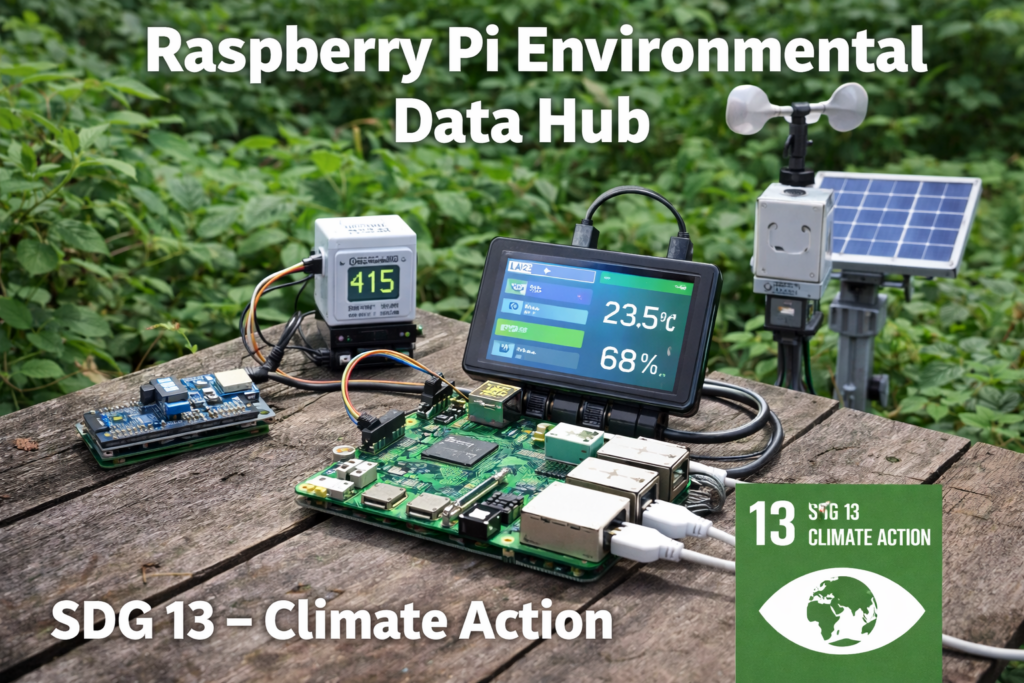
Raspberry Pi environmental data hub with climate and air quality sensors collecting local environmental data to support UN Sustainable Development Goal 13 Climate Action.

Building a Raspberry Pi Environmental Data Hub for Climate Monitoring (SDG 13: Climate Action)

A Raspberry Pi environmental data hub demonstrates how edge computing and low-cost sensing can support local climate monitoring, urban resilience, and SDG-aligned environmental intelligence. This project combines a Raspberry Pi with sensors such as the BME280 and optional particulate monitors to collect temperature, humidity, pressure, and air-quality data, store observations locally, and optionally integrate with broader climate datasets. While the prototype is not a certified scientific or regulatory monitoring station, it shows how distributed sensing can expand environmental visibility at neighborhood, classroom, field-lab, and community scales. The article connects the build to environmental monitoring systems, intelligent infrastructure, climate change as a planetary boundary, atmospheric aerosol risk, and sustainable development, showing how local data infrastructure can support better climate adaptation, public awareness, and environmental decision-making.

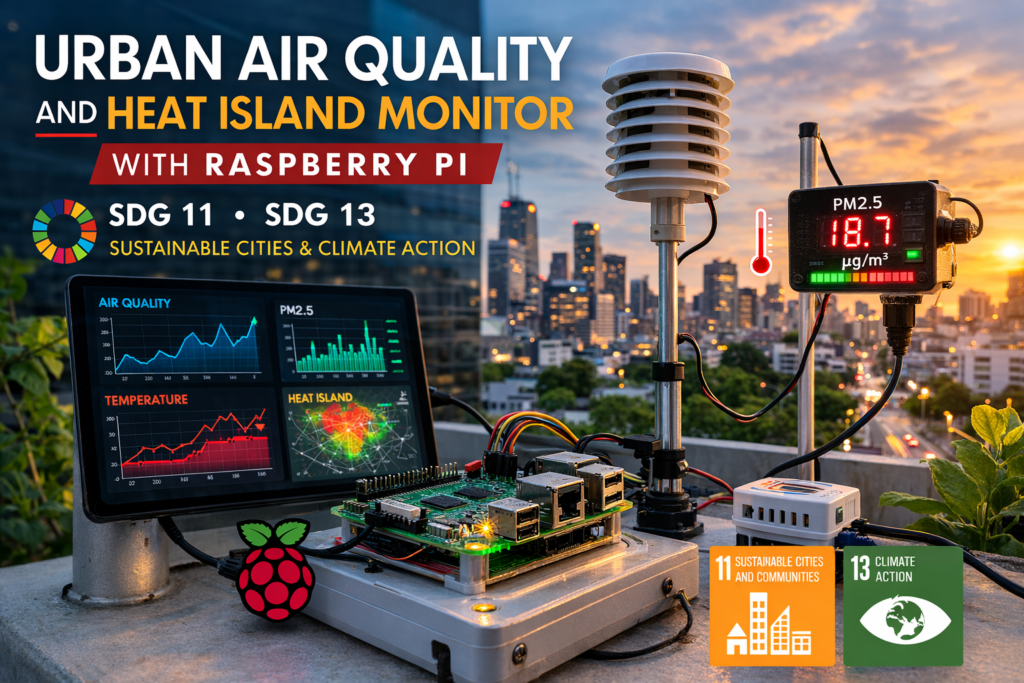
Raspberry Pi urban air quality and heat island monitoring station measuring PM2.5 pollution and temperature to support SDG 11 Sustainable Cities and SDG 13 Climate Action.

Urban Air Quality and Heat Island Monitor (SDG 11 / SDG 13)

A Raspberry Pi urban air quality monitor demonstrates how edge computing and low-cost environmental sensing can support neighborhood-scale climate adaptation, pollution awareness, and SDG 11: Sustainable Cities and Communities. This project combines a Raspberry Pi with a BME280 atmospheric sensor and PMS5003 particulate matter sensor to measure temperature, humidity, pressure, PM1.0, PM2.5, and PM10 while storing observations for later analysis. While the prototype is not a certified regulatory air-quality station, it shows how distributed monitoring can make urban heat islands, particulate pollution, and uneven environmental exposure more visible. The article connects the build to environmental monitoring systems, intelligent infrastructure, atmospheric aerosol risk, climate change, planetary boundaries, and sustainable development, showing how local data infrastructure can support healthier, more resilient cities.

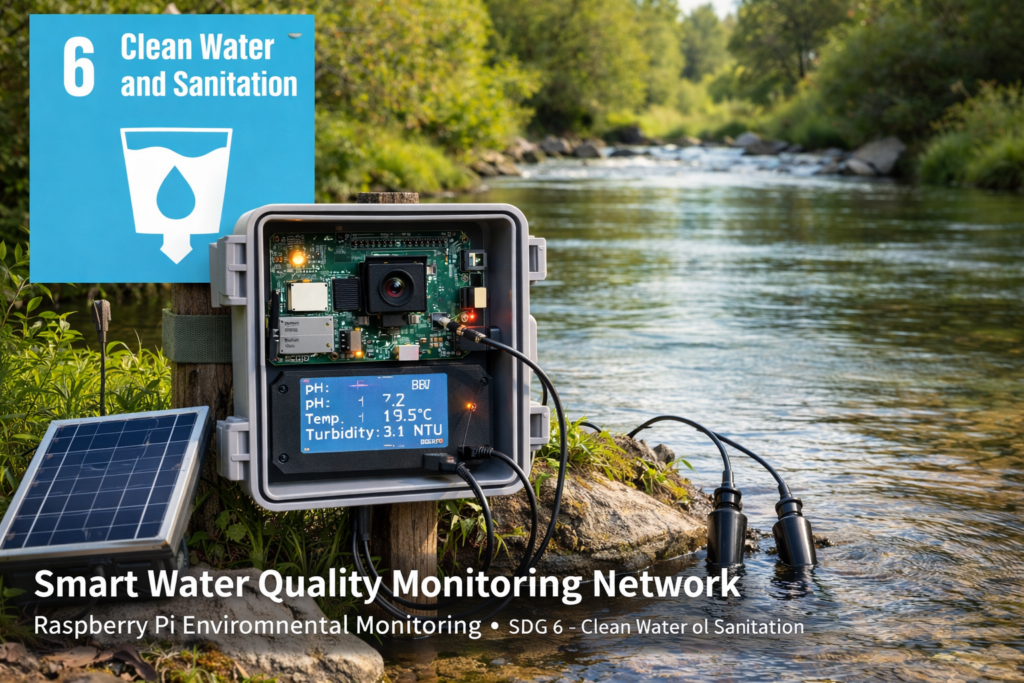
Raspberry Pi water quality monitoring station measuring pH and turbidity in a river to support SDG 6 Clean Water and Sanitation.

Smart Water Quality Monitoring Network with Raspberry Pi (SDG 6 – Clean Water and Sanitation)

A Raspberry Pi water quality monitoring system demonstrates how low-cost sensing, local logging, and edge computing can support freshwater stewardship, watershed monitoring, and SDG 6: Clean Water and Sanitation. This project combines a Raspberry Pi with sensors for pH, turbidity, and water temperature, using an ADS1115 analog-to-digital converter to collect readings that can be stored locally, exported to dashboards, or extended with anomaly detection. While the prototype is not a certified water-quality instrument or substitute for laboratory testing, it shows how distributed monitoring can make freshwater conditions more visible over time. The article connects the build to environmental monitoring systems, intelligent infrastructure, freshwater change, biogeochemical flows, planetary boundaries, and sustainable development, showing how practical data infrastructure can support better water governance and environmental decision-making.

Scroll to Top