
Last Updated May 7, 2026
Anthropocene sustainable development describes the challenge of achieving human prosperity within the limits of the Earth system. It begins from a simple but transformative recognition: modern development now operates at planetary scale. Energy systems, food production, global trade, urbanization, infrastructure, finance, material extraction, chemical production, digital systems, and technological networks no longer interact with nature as an external background. They reshape climate, biodiversity, land systems, freshwater, oceans, atmospheric chemistry, nutrient cycles, material flows, and the resilience of life-support systems.
The Anthropocene is not currently recognized as an official geological epoch in formal stratigraphy. In 2024, the International Union of Geological Sciences and the International Commission on Stratigraphy approved the rejection of the proposal to define an Anthropocene Epoch as a formal unit of the Geologic Time Scale. Yet the term remains analytically powerful as an Earth-system, historical, and governance concept. It names a real condition: human activity has become powerful enough to alter planetary processes that once seemed external to society. Whether or not the Anthropocene is formally codified as a geological time unit, the development challenge it identifies remains unavoidable.
Main Library
Publications
Article Map
Planetary Boundaries
Related Topic
Sustainable Development
Related Topic
Earth Science
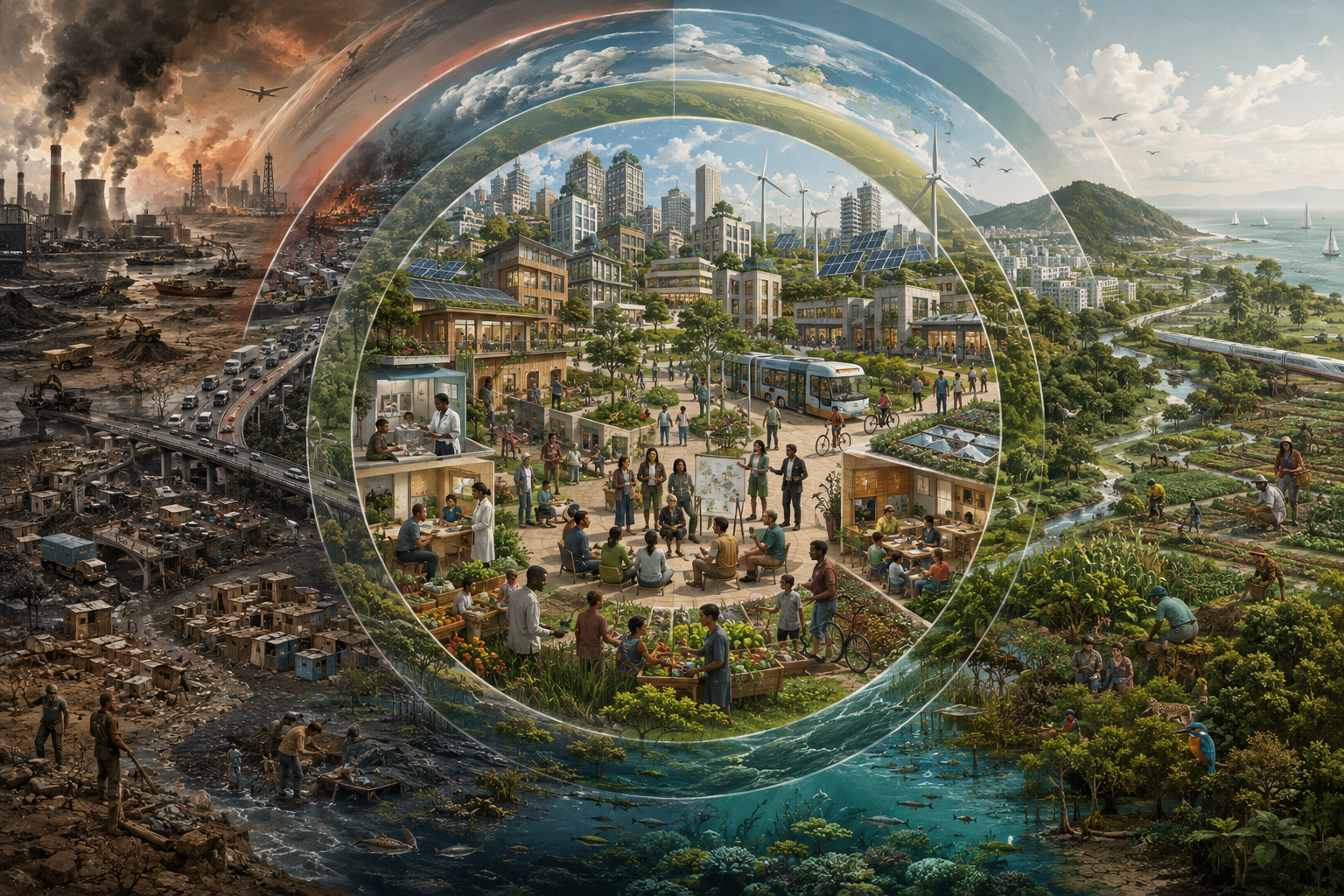
Traditional sustainable development is often described through three pillars: economic development, social progress, and environmental protection. The Anthropocene challenges that framework. If climate stability, biosphere integrity, freshwater systems, soils, oceans, and nutrient cycles are the operating conditions of civilization, then the environment is not simply one pillar beside society and economy. It is the foundation on which social and economic systems depend. Sustainable development must therefore be reframed as the pursuit of human wellbeing within a safe, just, and resilient Earth system.
This article deepens Anthropocene sustainable development as a capstone prosperity article within the planetary-boundaries framework. It explains why development must be understood at planetary scale, how the Great Acceleration reshaped the human-Earth relationship, why prosperity must be measured beyond GDP, how planetary boundaries define safe operating space, why environmental change now affects social stability and institutional resilience, why justice must be central to any boundary-aware development model, and how prosperity-within-limits can be modeled using mathematical, Python, R, and Go workflows.
What Is Anthropocene Sustainable Development?
Anthropocene sustainable development is the effort to secure human wellbeing while maintaining the stability, resilience, and life-support functions of the Earth system. It differs from older sustainability frameworks because it does not treat environmental protection as an external constraint on development. Instead, it treats Earth-system stability as the enabling condition of development itself.
This shift matters because modern societies now influence planetary processes. Carbon emissions change atmospheric composition and global temperature. Land conversion alters habitats, soil stability, carbon storage, hydrological cycles, and regional rainfall. Fertilizer use changes nitrogen and phosphorus cycles. Freshwater extraction changes rivers, groundwater, wetlands, food systems, and aquatic ecosystems. Plastic, synthetic chemicals, pesticides, pharmaceuticals, industrial compounds, and other novel entities enter ecosystems faster than governance systems can evaluate, monitor, or regulate them. Development now operates within feedback loops that connect economy, ecology, infrastructure, politics, technology, and future risk.
Anthropocene sustainable development therefore asks a deeper question than how to balance economic, social, and environmental priorities. It asks how prosperity can be designed so that human systems remain compatible with the planetary systems that sustain them. That means moving from a growth-first model toward a resilience-aware model of development: one that measures wellbeing, protects social foundations, reduces inequality, restores ecosystems, decarbonizes energy, limits destructive material throughput, and respects planetary boundaries.
In this sense, Anthropocene sustainable development is not anti-development. It is a more serious account of development under real planetary conditions. It recognizes that poverty, inequality, ecological breakdown, climate instability, and institutional fragility are connected problems. Durable prosperity requires addressing them together.
The concept is also important because it resists two inadequate responses. The first is technological optimism without boundary discipline: the belief that innovation alone will solve planetary risk without changing institutions, consumption systems, infrastructure, law, finance, land use, and power. The second is ecological austerity without justice: the belief that planetary limits can be defended while leaving large populations without secure access to food, water, housing, energy, health, education, and political voice. Anthropocene sustainable development requires both ecological realism and human dignity.
Why Anthropocene Sustainable Development Matters
Anthropocene sustainable development matters because the basic conditions of development have changed. The development problem of the twentieth century was often framed as how to increase production, income, infrastructure, industrial capacity, and national growth. Those aims remain important where deprivation persists. But the twenty-first-century development problem is more complex: how can societies expand human capability without destabilizing the Earth-system conditions that make long-term capability possible?
This matters because ecological disruption increasingly becomes social disruption. Climate change affects heat exposure, crop yields, water availability, disaster risk, disease ecology, migration, insurance systems, food prices, infrastructure costs, and public budgets. Biodiversity loss weakens pollination, pest control, fisheries, soil resilience, disease regulation, and ecosystem recovery. Freshwater stress affects agriculture, cities, energy systems, sanitation, public health, and conflict risk. Chemical pollution and novel entities create health and ecological risks that are often difficult to detect until harm is widespread.
The framework also matters because it clarifies that sustainable development cannot be reduced to climate policy alone. Climate change is central, but it is embedded in a wider Earth-system crisis involving land, water, biodiversity, oceans, nutrients, atmospheric aerosols, ozone, synthetic chemicals, extraction, waste, and governance failure. A low-carbon transition that destroys ecosystems, displaces communities, expands toxic extraction, or reproduces unequal development would not be a fully sustainable transition.
Anthropocene sustainable development also exposes a tension between legitimate human need and destructive excess. Many communities need more infrastructure, more energy access, more public health capacity, more housing, more clean water, more transport, more education, and more economic security. At the same time, high-consuming societies and wealthy groups already use far more than a fair share of ecological space. The central question is not whether people should flourish. They should. The question is what forms of prosperity can be universalized without breaching planetary limits.
That is why the Anthropocene belongs inside the planetary-boundaries framework. The boundaries identify ecological ceilings. Sustainable development identifies social foundations. Anthropocene sustainable development asks how to protect both: enough for everyone, without overshooting the Earth system.
Human Development at Planetary Scale
For most of human history, societies operated within what might be described as a small world on a large planet. Human communities transformed local and regional environments, but the atmosphere, oceans, forests, soils, freshwater systems, and biodiversity systems still appeared vast relative to the scale of human activity. That relationship has changed. Economic production, fossil energy use, global trade, urbanization, infrastructure, industrial agriculture, chemical manufacturing, and material extraction now operate at such scale that they influence planetary processes themselves.
Carbon emissions generated in one region influence climate systems across the world. Deforestation affects regional rainfall patterns, global carbon storage, Indigenous lands, biodiversity, and river systems. Ocean warming and acidification affect marine ecosystems, fisheries, food webs, and coastal livelihoods. Agricultural systems reshape land, water, nitrogen, phosphorus, biodiversity, greenhouse gas emissions, rural labor, and public health. Global supply chains connect consumption in one region to mining, land conversion, labor conditions, pollution, waste, and ecological risk in another.
These connections reveal a central feature of Anthropocene sustainable development: human progress and planetary stability are now inseparable. Economic decisions have ecological consequences, and ecological disruptions have economic, political, and social consequences. A drought can affect food prices, migration, energy production, public finance, conflict risk, and health. A flood can damage infrastructure, housing, insurance systems, transport networks, and public trust. Biodiversity loss can weaken agriculture, disease regulation, fisheries, water quality, and ecosystem recovery.
Development at planetary scale therefore requires planetary literacy. Cities, firms, governments, investors, engineers, farmers, public-health systems, communities, and educational institutions all need to understand that prosperity depends on Earth-system conditions. The question is not whether human societies can dominate nature. It is whether human systems can remain viable within the living systems they depend on.
Planetary-scale development also changes the ethics of distance. Consumption that appears clean in one place may rely on extraction, pollution, land displacement, or labor exploitation elsewhere. Wealth can be spatially separated from harm, but the Earth system reconnects what supply chains attempt to hide. Anthropocene development must therefore make distant ecological and social costs visible, measurable, and governable.
From Holocene Stability to Anthropocene Risk
The Holocene, the relatively stable climate state of the past 11,700 years, provided the environmental context within which agriculture, cities, infrastructure, trade, states, legal systems, markets, writing systems, religious institutions, and industrial economies developed. Its importance lies not in perfect stability, but in comparative stability. Growing seasons, rainfall patterns, coastlines, river systems, ecological zones, and disease environments were predictable enough to support long-term settlement and institutional development.
Anthropocene sustainable development begins by recognizing that this stability can no longer be taken for granted. Human activity is pushing climate, biosphere integrity, land systems, freshwater, nutrient cycles, ocean chemistry, atmospheric processes, and novel entities beyond safer historical ranges. The problem is not that the planet will disappear. The problem is that the conditions under which civilization developed may become less stable, less predictable, and less favorable for human flourishing.
This distinction is crucial. Environmental change is not only an ethical concern for the nonhuman world, though it is certainly that. It is also a development concern. Food systems, health systems, water systems, infrastructure, insurance, finance, trade, migration, public budgets, and political stability all depend on climate and ecological regularity. When those foundations weaken, development becomes more fragile and more unequal.
The Holocene-to-Anthropocene transition therefore reframes sustainability as a problem of operating conditions. The issue is not how to add environmental considerations to development after the fact. The issue is how to design development so that it does not destabilize the Earth-system conditions it requires.
The 2024 decision not to formalize the Anthropocene as an official geological epoch does not erase this development problem. Formal stratigraphy asks a specific geological classification question. Anthropocene sustainable development asks a broader Earth-system and governance question: how should societies organize prosperity when human activity has become a planetary force?
The Great Acceleration and Anthropocene Development
The emergence of Anthropocene development is closely associated with the Great Acceleration: the rapid post-1950 expansion of human activity and Earth-system pressure. During this period, population, GDP, energy use, water use, fertilizer consumption, transport, telecommunications, urbanization, trade, and material extraction increased dramatically. Earth-system indicators moved with them, including atmospheric carbon dioxide, methane, nitrous oxide, global temperature, ocean acidification, tropical forest loss, nitrogen loading, biodiversity decline, and coastal ecosystem degradation.
The Great Acceleration produced extraordinary gains. Life expectancy rose. Education expanded. Food production increased. Technologies improved communication, mobility, health, and productivity. Many people escaped extreme poverty. Public institutions, infrastructure, sanitation, medicine, and agricultural productivity improved lives in ways that should not be dismissed. A credible sustainability framework must acknowledge the real human benefits created by modern development.
At the same time, the Great Acceleration tied prosperity to fossil energy, material throughput, land conversion, industrial agriculture, extractive supply chains, chemical pollution, and waste. The dominant development model improved living standards for many while pushing planetary systems toward dangerous thresholds. This is the core contradiction Anthropocene sustainable development must confront.
The task is not to deny the achievements of modern development. It is to decouple human wellbeing from the forms of production and consumption that destabilize the Earth system. Development must become less dependent on fossil carbon, virgin material extraction, ecological simplification, nutrient overload, synthetic chemical proliferation, and the unequal externalization of harm.
This is where the Great Acceleration becomes more than a historical description. It becomes a warning about path dependency. Energy grids, highways, housing systems, food systems, building materials, industrial supply chains, financial models, and consumer expectations were built around assumptions of cheap fossil energy, expanding extraction, and ecological externalization. Anthropocene sustainable development requires redesigning those systems before accumulated pressure produces deeper instability.
Why Sustainable Development Must Be Reframed
Traditional sustainability frameworks often describe three pillars: economy, society, and environment. This model is useful as a starting point because it reminds decision-makers that development is multidimensional. But in the Anthropocene, the three-pillar model can be misleading if it implies that economy, society, and environment are equal, separable domains.
Earth-system stability is not one sector among others. It is the foundation on which social and economic systems depend. There is no durable economy without climate stability, water security, soils, pollination, oceans, biodiversity, energy systems, public health, and ecological resilience. There is no durable social progress if environmental destabilization undermines food, shelter, safety, livelihoods, health, and political stability.
This does not mean environmental goals automatically override all social goals. A just sustainability framework must protect human dignity, especially for people historically denied development opportunities. But it does mean that economic growth cannot be treated as successful if it erodes the life-support systems that make future prosperity possible.
Anthropocene sustainable development therefore requires a nested model: the economy exists within society, and society exists within the Earth system. Development should be judged not only by output, income, or consumption, but by whether it strengthens the social foundations of human wellbeing while remaining within ecological ceilings.
This reframing changes policy priorities. Industrial policy must ask not only how to increase productivity, but how to reduce emissions, material intensity, toxic burden, ecological damage, and unequal exposure. Urban policy must ask not only how to grow cities, but how to build resilient, affordable, low-carbon, water-sensitive, heat-safe, and ecologically integrated settlements. Food policy must ask not only how to produce calories, but how to nourish people while protecting soils, biodiversity, water systems, climate, and rural livelihoods.
The old model treated environmental repair as something that could follow development. The Anthropocene model recognizes that some forms of environmental harm involve thresholds, time lags, irreversible losses, and cascading risks. A development model that damages its own operating conditions is not merely incomplete. It is self-undermining.
Rethinking Prosperity Beyond GDP
Prosperity on a finite planet cannot be reduced to gross domestic product. GDP measures monetary production, not wellbeing, resilience, justice, ecological integrity, or long-term security. A country can increase GDP while degrading soils, polluting rivers, increasing emissions, destroying biodiversity, expanding inequality, weakening public health, and increasing vulnerability to climate shocks. Such growth may look successful in the short term while creating deferred risk.
Anthropocene prosperity should instead be understood as the capacity for people and communities to live healthy, dignified, meaningful, and secure lives within planetary limits. This includes income and material sufficiency, but it also includes health, education, housing, clean water, sanitation, energy access, safety, social trust, political voice, cultural life, ecological quality, and resilience to shocks.
This reframing aligns with the human development tradition, Doughnut Economics, wellbeing economics, ecological economics, capability theory, and planetary-boundary science. These approaches differ in emphasis, but they share a concern that conventional growth metrics are too narrow for the twenty-first century. The central question becomes: how can societies improve human capabilities while reducing planetary pressure?
Rethinking prosperity also changes the meaning of innovation. Innovation is not only faster computation, new products, financial instruments, or industrial efficiency. It also includes regenerative agriculture, public-health systems, clean energy, affordable housing, low-carbon mobility, ecological restoration, circular materials, responsible chemistry, public infrastructure, cooperative governance, and institutions capable of protecting future generations.
Prosperity must also be separated from status consumption. Many high-pressure forms of consumption do little to improve wellbeing after basic needs and social foundations are secure. Luxury emissions, wasteful material turnover, destructive extraction, disposable goods, excessive land and energy use, and unequal access to ecological space are not signs of durable prosperity. They are signs of a development model that confuses throughput with flourishing.
A boundary-aware prosperity framework therefore asks a sharper question: which forms of economic activity increase human dignity and resilience, and which forms merely convert ecological stability into short-term private gain?
Planetary Boundaries and Earth-System Limits
One of the most influential scientific responses to Anthropocene risk is the planetary-boundaries framework. Proposed by Earth-system scientists in 2009 and developed further in subsequent assessments, the framework identifies critical Earth-system processes that should remain within safer operating ranges if humanity is to avoid destabilizing the planetary conditions that support civilization.
The nine planetary boundaries are climate change, biosphere integrity, land-system change, freshwater change, biogeochemical flows, ocean acidification, stratospheric ozone depletion, atmospheric aerosol loading, and novel entities. Together, they form a systems map of planetary stability. They show that sustainable development cannot be reduced to climate change alone, even though climate is central. Development must also address biodiversity, land, water, nutrients, oceans, atmospheric processes, ozone, synthetic chemicals, and material systems.
The current boundary status makes the issue urgent. The 2023 global assessment concluded that six of the nine planetary boundaries had been transgressed. The 2025 Planetary Health Check reports that seven of nine are now breached, with ocean acidification newly crossing the boundary. This does not mean collapse is inevitable, but it does mean that humanity is operating deeper within a high-risk zone.
Planetary boundaries give Anthropocene sustainable development a scientific architecture. They define the ecological ceilings within which prosperity must be pursued. They also reveal the inadequacy of development strategies that improve one metric while worsening Earth-system risk elsewhere.
The boundaries also expose the interdependence of risk. Climate change can worsen biosphere degradation. Ecosystem degradation can weaken climate regulation. Nutrient pollution can damage freshwater and coastal systems. Land conversion can alter carbon storage, biodiversity, regional rainfall, and hydrology. Novel entities can affect organisms, food webs, endocrine systems, soils, water quality, and human health in ways that governance systems often understand too late. A serious development framework must therefore evaluate progress across the system, not one indicator at a time.
For Anthropocene sustainable development, the planetary-boundaries framework is not a policy checklist. It is a discipline of humility. It reminds societies that prosperity depends on biophysical processes that cannot be replaced by money once they are destabilized beyond recovery.
Safe and Just Space for Humanity
A safe operating space is not enough if it ignores justice. A world that remains within ecological limits while leaving large populations in poverty, insecurity, exclusion, or exploitation would not be a defensible model of development. Conversely, a world that expands consumption while breaching planetary boundaries would undermine the conditions of future wellbeing. Anthropocene sustainable development must therefore be both safe and just.
The language of a safe and just space connects planetary boundaries with social foundations. The ecological ceiling asks what Earth-system pressures must not be exceeded. The social foundation asks what minimum conditions people need for dignity and flourishing. These include food, water, health, education, housing, energy, income, equity, political voice, peace, and social inclusion.
This framing is powerful because it avoids two failures. It avoids ecological austerity that protects nature while ignoring human deprivation. It also avoids growth-first development that improves material conditions by shifting ecological costs onto vulnerable communities, future generations, and nonhuman life. The goal is not simply lower impact. The goal is wellbeing within limits.
This is why Anthropocene sustainable development is inseparable from Planetary Boundaries and Doughnut Economics. Prosperity must be redefined as living well within the ecological and social conditions that make durable human flourishing possible.
The safe-and-just framing also clarifies the moral difference between sufficiency and deprivation. Asking high-consuming systems to reduce destructive excess is not the same as asking poor communities to accept scarcity. A justice-centered boundary framework must expand access where basic capabilities are missing and reduce pressure where consumption is excessive, extractive, or ecologically damaging.
Safe and just space is therefore not a static zone on a diagram. It is a governance challenge. It requires institutions capable of protecting ecosystems, expanding social foundations, redistributing risk, financing adaptation, reducing inequality, monitoring indicators, resolving trade-offs, and responding to feedback before crisis becomes irreversible.
Environmental Change and Social Stability
Anthropocene research emphasizes that environmental change is not distant, abstract, or purely ecological. It increasingly influences economic systems, political stability, public health, food security, infrastructure, migration, financial risk, and institutional trust. Climate variability can affect crop yields and food prices. Droughts can disrupt agriculture, hydropower, water systems, and rural livelihoods. Extreme weather events can damage housing, roads, ports, utilities, insurance systems, and public budgets.
Ecosystem degradation can also destabilize social systems. Soil degradation reduces agricultural resilience. Biodiversity loss weakens pollination, pest control, fisheries, and ecosystem recovery. Wetland destruction increases flood exposure. Deforestation affects rainfall and carbon storage. Ocean warming and acidification affect fisheries, coastal economies, and food webs. Pollution affects health, labor productivity, and community wellbeing.
These dynamics show why sustainable development cannot be treated as a narrow environmental policy agenda. Environmental disruption increasingly becomes macroeconomic risk, public-health risk, geopolitical risk, infrastructure risk, and governance risk. It affects business cycles, public finance, disaster recovery, migration pressures, insurance markets, and social cohesion.
Anthropocene sustainable development therefore requires institutional resilience. Societies need monitoring systems, early-warning indicators, fiscal buffers, adaptive infrastructure, public-health capacity, food-system resilience, social protection, ecological restoration, and governance systems capable of responding before crisis becomes irreversible.
The social-stability dimension also helps explain why environmental harm is often politically explosive. A heat wave is not only a meteorological event when it overwhelms hospitals, shuts down work, raises electricity demand, and harms elderly residents in poorly insulated housing. A drought is not only a hydrological event when it affects food prices, rural debt, migration, and political trust. A flood is not only a natural hazard when it reveals failures of zoning, infrastructure, drainage, insurance, and social protection.
In the Anthropocene, environmental change becomes a test of public capacity. Institutions that cannot anticipate, absorb, and respond to ecological stress will struggle to maintain legitimacy. Development must therefore be evaluated not only by growth outcomes, but by whether it strengthens the capacity of societies to withstand and reduce Earth-system risk.
Justice, Responsibility, and Unequal Development Space
Anthropocene sustainable development must confront unequal responsibility. High-income countries, wealthy households, fossil-fuel-intensive industries, extractive corporations, and high-consuming lifestyles have contributed disproportionately to greenhouse gas emissions, resource extraction, land conversion, chemical pollution, and waste. Meanwhile, many low-income communities, Indigenous peoples, small island states, dryland farmers, informal settlements, coastal populations, and future generations face disproportionate exposure to the resulting risks.
This inequality complicates any simple call for limits. Limits are necessary, but limits must be applied with attention to responsibility, need, and capability. A family gaining first access to electricity is not the same as luxury emissions from frequent private aviation. A low-income country building basic infrastructure is not the same as wasteful material throughput in already affluent economies. A just planetary-boundary framework must distinguish between survival needs, development rights, and excessive consumption.
Justice also affects legitimacy. Sustainability transitions that ignore workers, communities, energy access, food affordability, housing, land rights, and historical responsibility can generate backlash or reproduce harm. Climate policy, conservation policy, land restoration, mining transitions, agricultural reform, and circular-economy strategies all require attention to distribution, participation, rights, and reparative responsibility.
Anthropocene sustainable development is therefore not only about keeping humanity within planetary limits. It is about doing so in a way that expands dignity, reduces inequality, protects marginalized communities, recognizes Indigenous stewardship, and preserves development space for those historically denied it.
This justice framing also rejects the idea that planetary limits should become a new language of exclusion. The communities least responsible for overshoot must not be asked to bear the heaviest costs of repair. Boundary-aware development must reduce destructive excess at the top while expanding secure foundations below. It must also recognize that many communities have already protected ecosystems through land stewardship, traditional ecological knowledge, collective governance, and low-throughput lifeways that were marginalized by colonial, extractive, and growth-first systems.
Justice is therefore both moral and practical. Without justice, transition politics becomes fragile. With justice, planetary-boundary governance becomes more legitimate, more durable, and more capable of mobilizing collective action.
From Economic Management to Planetary Stewardship
The Anthropocene implies an expanded responsibility for governance. Economic management can no longer be separated from planetary stability. Fiscal policy, industrial policy, trade policy, infrastructure planning, land policy, agricultural policy, energy policy, financial regulation, and urban planning all shape Earth-system pressure. Governance must therefore move from short-term economic management toward planetary stewardship.
Planetary stewardship does not mean centralized control over the planet. It means designing institutions that can protect life-support systems, reduce systemic risk, preserve ecological resilience, and support human wellbeing across generations. It requires humility because Earth systems are complex. It requires science because risks must be understood. It requires democratic accountability and participatory legitimacy because choices about development, land, energy, water, and resources affect people unequally. It requires justice because powerful actors often benefit from externalizing ecological costs.
Stewardship also requires long-term thinking. Many planetary pressures accumulate slowly before producing visible crises. Carbon dioxide accumulates in the atmosphere-ocean-land system. Biodiversity loss can reduce resilience before collapse is obvious. Chemical pollutants can persist and accumulate. Groundwater depletion may remain hidden until wells fail. Soil degradation can undermine productivity gradually. Governance must therefore act before damage becomes unmistakable.
In practical terms, planetary stewardship means building systems that can monitor boundary pressure, disclose risk, revise assumptions, learn from feedback, protect vulnerable communities, and align development with safe operating space. It is the institutional expression of Anthropocene sustainable development.
Stewardship also requires institutional memory. Societies must track what has been extracted, emitted, polluted, degraded, restored, repaired, and compensated. They must know which communities are exposed, which systems are vulnerable, which actors benefit from risk, and which interventions actually reduce pressure. Without memory, governance becomes reactive. With memory, stewardship can become cumulative, accountable, and adaptive.
Governance for Prosperity on a Finite Planet
Governance for prosperity on a finite planet must be integrated, adaptive, precautionary, and justice-centered. Integrated governance recognizes that climate, biodiversity, land, water, food, energy, materials, finance, trade, public health, and infrastructure are connected. Adaptive governance learns from feedback and revises policies as conditions change. Precautionary governance acts before irreversible thresholds are crossed. Justice-centered governance protects those most exposed and least responsible.
This governance challenge cannot be solved by national governments alone. Cities, Indigenous institutions, courts, firms, investors, international organizations, civil society, scientific bodies, and local communities all shape outcomes. Polycentric governance can support experimentation, learning, and local responsiveness. But coordination must be paired with accountability, or complexity becomes an excuse for inaction.
Financial systems also matter. Investment decisions shape energy systems, infrastructure, land use, housing, mining, agriculture, technology, and industrial production. If financial institutions ignore physical climate risk, biodiversity dependency, transition risk, and ecological limits, they will misprice danger and reinforce unsustainable pathways. Sustainable finance must therefore move beyond disclosure toward alignment with real Earth-system resilience.
Ultimately, governance for Anthropocene sustainable development asks whether institutions can support prosperity without breaching planetary boundaries. That requires transforming incentives, standards, infrastructure, laws, public investment, measurement systems, and cultural expectations. The aim is not to manage decline. It is to build a more durable form of prosperity.
Governance must also become more transparent about trade-offs. No society can avoid difficult choices about land, energy, food, housing, transport, conservation, extraction, adaptation, and public finance. But trade-offs become more legitimate when assumptions are visible, affected communities have voice, burdens are not shifted onto the vulnerable, and decisions are evaluated against both ecological ceilings and social foundations.
Anthropocene governance is therefore not only about better indicators. It is about public responsibility under constraint. It asks whether institutions can tell the truth about risk, protect people from avoidable harm, reduce overshoot, repair ecosystems, and create prosperity that does not depend on sacrificing the future.
Common Misunderstandings
A common misunderstanding is that Anthropocene sustainable development depends on the Anthropocene being formally recognized as a geological epoch. It does not. The term remains useful as an Earth-system and sustainability concept even though it is not currently an official epoch in formal stratigraphy.
Another misunderstanding is that planetary limits are anti-development. In fact, planetary-boundary thinking is about protecting the conditions that make durable development possible. Climate stability, freshwater, soils, biodiversity, public health, and resilient infrastructure are development foundations.
A third misunderstanding is that prosperity is the same as GDP growth. GDP can increase while wellbeing stagnates, inequality rises, ecosystems degrade, and future risk accumulates. Anthropocene prosperity must be measured through human capabilities, ecological integrity, resilience, justice, and long-term security.
A fourth misunderstanding is that sustainability is mainly about individual lifestyle choices. Individual choices matter, but the deeper drivers are energy systems, infrastructure, food systems, urban design, finance, law, industrial production, trade, governance, and political power. Anthropocene sustainable development requires system change as well as personal responsibility.
A fifth misunderstanding is that technology alone can resolve overshoot. Technological innovation is essential, but technology operates inside institutions, markets, supply chains, land systems, energy systems, and cultural expectations. Without governance, justice, and material realism, technology can reduce one pressure while increasing another.
A final misunderstanding is that ecological limits require a politics of despair. They do not. Limits make transformation more urgent, but they also clarify the purpose of development: to build societies capable of lasting wellbeing rather than temporary expansion built on ecological debt.
Why This Matters for Planetary Boundaries
Anthropocene sustainable development matters because it translates planetary-boundary science into a development problem. Boundary transgression is not only a scientific status report. It is the result of energy systems, land systems, food systems, water systems, material extraction, chemical production, infrastructure, finance, trade, consumption, inequality, and governance decisions. The boundaries show where Earth-system risk is rising. Anthropocene sustainable development asks what kind of prosperity can reduce that risk while expanding human dignity.
It also matters because it places development inside safe operating space. Poverty reduction, infrastructure expansion, health, education, housing, energy access, mobility, and economic opportunity remain essential. But they must be delivered through systems that reduce emissions, protect ecosystems, restore land and water, lower toxic burden, reduce material intensity, and build resilience.
The issue is also one of justice. The benefits of high-throughput development have been unevenly distributed, while the harms of overshoot often fall on communities with the least responsibility and least capacity to adapt. A serious response must reduce destructive excess while expanding secure foundations for those still denied basic capabilities.
To understand Anthropocene sustainable development is to understand the central design problem of the twenty-first century: human dignity must expand while planetary pressure declines. That is not a call for despair. It is a call for transformation.
Development becomes credible under Anthropocene conditions when food, water, energy, housing, mobility, public health, infrastructure, technology, finance, and economic opportunity are reorganized around safe operating space, ecological repair, resilience, and justice.
Mathematical Lens: Prosperity Within Planetary Limits
Anthropocene sustainable development can be modeled as a relationship between wellbeing, social foundations, ecological pressure, planetary-boundary status, governance capacity, justice capacity, and resilience capacity. These models do not claim to predict the full Earth system. Their purpose is to make assumptions explicit, support scenario comparison, and help translate conceptual sustainability frameworks into reproducible diagnostics.
A simple prosperity-within-limits score can be written as:
P_t = W_t \times S_t \times (1 – B_t)
\]
Interpretation: Prosperity rises with wellbeing and social foundation achievement, but is weakened when planetary-boundary pressure rises.
Here, \(P_t\) represents sustainable prosperity at time \(t\), \(W_t\) represents human wellbeing, \(S_t\) represents social foundation achievement, and \(B_t\) represents planetary-boundary pressure. A society with high income but severe ecological overshoot is not fully prosperous in a durable sense because it is undermining future wellbeing.
Boundary pressure can be modeled by comparing Earth-system control variables \(X_i(t)\) to boundary values \(L_i\):
B_i(t) = \frac{X_i(t)}{L_i}
\]
Interpretation: A value greater than 1 indicates that an Earth-system process exceeds its boundary value.
A composite ecological pressure score can then be written as:
B_t = \frac{1}{n}\sum_{i=1}^{n} w_i B_i(t)
\]
Interpretation: Composite boundary pressure combines multiple Earth-system processes using transparent weights.
Because Earth-system pressures interact, an interaction-adjusted overshoot score can include cross-boundary effects:
O_t = B_t\left(1 + \sum_{i \neq j} w_{ij}B_i(t)B_j(t)\right)
\]
Interpretation: Interaction-adjusted overshoot rises when boundary pressures reinforce one another, such as climate stress worsening biosphere degradation or land-system change affecting freshwater resilience.
Human development can be represented through social foundation achievement. Let \(s_k(t)\) represent achievement on social foundation dimension \(k\), such as health, education, housing, food, water, energy, income, safety, or political voice:
S_t = \frac{1}{m}\sum_{k=1}^{m} s_k(t)
\]
Interpretation: Social foundation achievement measures whether the basic conditions for human dignity are being met across multiple dimensions.
A governance-adjusted sustainable development score can then be written as:
D_t = S_t(1 – O_t)(G_t + J_t + R_t)
\]
Interpretation: Sustainable development is strongest when social foundations are met, overshoot is reduced, governance is capable, justice is protected, and resilience is strengthened.
| Term | Meaning | Interpretive role |
|---|---|---|
| \(W_t\) | Wellbeing | Represents health, security, dignity, capability, and quality of life. |
| \(S_t\) | Social foundation achievement | Represents whether basic needs and rights are secured across food, water, health, housing, energy, education, income, and voice. |
| \(B_i(t)\) | Boundary pressure ratio | Compares an Earth-system control variable to a boundary value. |
| \(B_t\) | Composite boundary pressure | Aggregates multiple boundary pressures into a transparent diagnostic score. |
| \(O_t\) | Interaction-adjusted overshoot | Represents the additional risk created when Earth-system pressures amplify one another. |
| \(G_t\) | Governance capacity | Represents institutional ability to regulate, coordinate, invest, monitor, enforce, and learn. |
| \(J_t\) | Justice capacity | Represents the ability to distribute benefits and burdens fairly, protect rights, and account for historical responsibility. |
| \(R_t\) | Resilience capacity | Represents the ability to absorb shocks, adapt, recover, and prevent cascading failure. |
| \(D_t\) | Governance-adjusted sustainable development | Represents development performance under planetary-boundary conditions. |
This simplified formulation is not a substitute for detailed Earth-system modeling, integrated assessment, local knowledge, or democratic deliberation. Its value is interpretive. It shows that development cannot be scored only by income or output. It must be evaluated through social achievement, ecological pressure, interaction effects, governance capacity, justice, and resilience.
Advanced Python Workflow: Anthropocene Development Diagnostics
The following Python workflow models Anthropocene sustainable development as a prosperity-within-limits diagnostic. It separates wellbeing, social foundations, ecological pressure, planetary-boundary pressure, governance capacity, justice capacity, resilience capacity, material efficiency, mitigation capacity, restoration capacity, sustainable prosperity scores, transition urgency, and development classification. The values are illustrative, but the structure can be adapted for dashboards, planetary-boundary reporting, policy analysis, institutional strategy, and scenario testing.
"""
Anthropocene sustainable development diagnostics.

This workflow models prosperity on a finite planet using:
- wellbeing
- social foundation achievement
- ecological pressure
- planetary-boundary pressure
- governance capacity
- justice capacity
- resilience capacity
- material efficiency
- mitigation capacity
- restoration capacity
- sustainable prosperity scoring
- transition urgency classification

The values are illustrative. Replace them with documented indicators,
transparent assumptions, uncertainty intervals, source provenance,
and audit metadata before applied use.
"""

from __future__ import annotations

from dataclasses import dataclass
from pathlib import Path
from typing import Literal

import numpy as np
import pandas as pd


DevelopmentClass = Literal[
    "safe_and_just_development",
    "social_shortfall",
    "ecological_overshoot",
    "double_challenge",
    "transformation_urgent",
]


@dataclass(frozen=True)
class DevelopmentScenario:
    """Anthropocene sustainable development scenario profile."""

    scenario: str
    wellbeing: float
    social_foundation: float
    ecological_pressure: float
    boundary_pressure: float
    governance_capacity: float
    justice_capacity: float
    resilience_capacity: float
    material_efficiency: float
    mitigation_capacity: float
    restoration_capacity: float


def build_development_scenarios() -> pd.DataFrame:
    """Create illustrative Anthropocene development scenarios."""
    scenarios = [
        DevelopmentScenario(
            scenario="high_growth_high_overshoot",
            wellbeing=0.78,
            social_foundation=0.72,
            ecological_pressure=0.88,
            boundary_pressure=7 / 9,
            governance_capacity=0.48,
            justice_capacity=0.38,
            resilience_capacity=0.44,
            material_efficiency=0.42,
            mitigation_capacity=0.46,
            restoration_capacity=0.36,
        ),
        DevelopmentScenario(
            scenario="poverty_reduction_with_fossil_lock_in",
            wellbeing=0.62,
            social_foundation=0.58,
            ecological_pressure=0.74,
            boundary_pressure=6 / 9,
            governance_capacity=0.46,
            justice_capacity=0.44,
            resilience_capacity=0.42,
            material_efficiency=0.40,
            mitigation_capacity=0.38,
            restoration_capacity=0.34,
        ),
        DevelopmentScenario(
            scenario="green_growth_with_material_pressure",
            wellbeing=0.76,
            social_foundation=0.74,
            ecological_pressure=0.70,
            boundary_pressure=6 / 9,
            governance_capacity=0.60,
            justice_capacity=0.50,
            resilience_capacity=0.56,
            material_efficiency=0.62,
            mitigation_capacity=0.68,
            restoration_capacity=0.50,
        ),
        DevelopmentScenario(
            scenario="planetary_boundary_aligned_development",
            wellbeing=0.78,
            social_foundation=0.80,
            ecological_pressure=0.48,
            boundary_pressure=4 / 9,
            governance_capacity=0.72,
            justice_capacity=0.68,
            resilience_capacity=0.70,
            material_efficiency=0.74,
            mitigation_capacity=0.76,
            restoration_capacity=0.72,
        ),
        DevelopmentScenario(
            scenario="safe_and_just_prosperity",
            wellbeing=0.84,
            social_foundation=0.86,
            ecological_pressure=0.36,
            boundary_pressure=3 / 9,
            governance_capacity=0.82,
            justice_capacity=0.80,
            resilience_capacity=0.78,
            material_efficiency=0.82,
            mitigation_capacity=0.84,
            restoration_capacity=0.82,
        ),
    ]

    return pd.DataFrame([scenario.__dict__ for scenario in scenarios])


def classify_development(row: pd.Series) -> DevelopmentClass:
    """Classify Anthropocene development condition."""
    social_shortfall = row["social_foundation"] < 0.70
    overshoot = row["boundary_adjusted_pressure"] > 0.70
    urgent = row["transition_urgency"] > 0.55

    if urgent and social_shortfall and overshoot:
        return "transformation_urgent"
    if social_shortfall and overshoot:
        return "double_challenge"
    if overshoot:
        return "ecological_overshoot"
    if social_shortfall:
        return "social_shortfall"
    return "safe_and_just_development"


def score_anthropocene_development(data: pd.DataFrame) -> pd.DataFrame:
    """Calculate Anthropocene sustainable development diagnostics."""
    scored = data.copy()

    scored["response_capacity"] = (
        0.18 * scored["governance_capacity"]
        + 0.18 * scored["justice_capacity"]
        + 0.18 * scored["resilience_capacity"]
        + 0.16 * scored["material_efficiency"]
        + 0.16 * scored["mitigation_capacity"]
        + 0.14 * scored["restoration_capacity"]
    )

    scored["boundary_adjusted_pressure"] = (
        0.55 * scored["ecological_pressure"]
        + 0.45 * scored["boundary_pressure"]
    )

    scored["sustainable_prosperity_score"] = (
        scored["wellbeing"]
        * scored["social_foundation"]
        * (1 - 0.65 * scored["boundary_adjusted_pressure"])
        * (1 + 0.45 * scored["response_capacity"])
    )

    scored["social_foundation_gap"] = np.maximum(
        0,
        0.70 - scored["social_foundation"],
    )

    scored["overshoot_gap"] = np.maximum(
        0,
        scored["boundary_adjusted_pressure"] - 0.55,
    )

    scored["transition_urgency"] = (
        (scored["social_foundation_gap"] + scored["overshoot_gap"])
        * (1 - scored["response_capacity"])
        * (1 + scored["boundary_pressure"])
    )

    scored["development_class"] = scored.apply(classify_development, axis=1)

    scored["priority"] = np.select(
        [
            scored["development_class"] == "transformation_urgent",
            scored["development_class"] == "double_challenge",
            scored["development_class"] == "ecological_overshoot",
            scored["development_class"] == "social_shortfall",
            scored["justice_capacity"] < 0.50,
        ],
        [
            "system_transformation",
            "meet_needs_while_reducing_overshoot",
            "reduce_ecological_pressure",
            "strengthen_social_foundations",
            "justice_centered_development",
        ],
        default="maintain_safe_and_just_development",
    )

    return scored.sort_values(
        "transition_urgency",
        ascending=False,
    ).reset_index(drop=True)


def main() -> None:
    """Run Anthropocene sustainable development diagnostics."""
    output_dir = Path(
        "articles/anthropocene-sustainable-development-rethinking-prosperity-finite-planet/outputs"
    )
    output_dir.mkdir(parents=True, exist_ok=True)

    scenarios = build_development_scenarios()
    scored = score_anthropocene_development(scenarios)

    output_path = output_dir / "anthropocene_development_diagnostics.csv"
    scored.to_csv(output_path, index=False)

    display_columns = [
        "scenario",
        "sustainable_prosperity_score",
        "boundary_adjusted_pressure",
        "response_capacity",
        "transition_urgency",
        "development_class",
        "priority",
    ]

    print(scored[display_columns].round(3).to_string(index=False))
    print(f"\nSaved diagnostics to: {output_path}")


if __name__ == "__main__":
    main()
This workflow is intentionally transparent. Each score is decomposable. Each assumption can be changed. Each scenario can be traced. That matters because Anthropocene sustainable development is not only a conceptual framework. It is also a measurement, audit, and governance problem.
A more complete version would include uncertainty intervals, regional disaggregation, historical responsibility weights, differentiated development thresholds, public-finance constraints, adaptation capacity, Indigenous land stewardship indicators, ecological restoration potential, and source provenance. The point is not to create a universal score. The point is to build a reproducible framework for asking better questions.
Advanced R Workflow: Prosperity Within Limits Dashboarding
The following R workflow prepares a compact dashboard-oriented version of the same logic. It is useful for policy reporting, comparative scenario summaries, institutional dashboards, and reproducible communication. The workflow calculates response capacity, boundary-adjusted pressure, sustainable prosperity, and transition urgency, then creates a simple scenario table and plot-ready data frame.
# Anthropocene sustainable development dashboard workflow.
#
# This example models prosperity within planetary limits using:
# - wellbeing
# - social foundation achievement
# - ecological pressure
# - planetary-boundary pressure
# - governance capacity
# - justice capacity
# - resilience capacity
# - material efficiency
# - mitigation capacity
# - restoration capacity
#
# Values are illustrative. Replace them with documented indicators,
# transparent assumptions, and source provenance before applied use.

library(dplyr)
library(readr)
library(tibble)

development_scenarios <- tribble(
  ~scenario, ~wellbeing, ~social_foundation, ~ecological_pressure, ~boundary_pressure,
  ~governance_capacity, ~justice_capacity, ~resilience_capacity,
  ~material_efficiency, ~mitigation_capacity, ~restoration_capacity,
  "high_growth_high_overshoot", 0.78, 0.72, 0.88, 7/9, 0.48, 0.38, 0.44, 0.42, 0.46, 0.36,
  "poverty_reduction_with_fossil_lock_in", 0.62, 0.58, 0.74, 6/9, 0.46, 0.44, 0.42, 0.40, 0.38, 0.34,
  "green_growth_with_material_pressure", 0.76, 0.74, 0.70, 6/9, 0.60, 0.50, 0.56, 0.62, 0.68, 0.50,
  "planetary_boundary_aligned_development", 0.78, 0.80, 0.48, 4/9, 0.72, 0.68, 0.70, 0.74, 0.76, 0.72,
  "safe_and_just_prosperity", 0.84, 0.86, 0.36, 3/9, 0.82, 0.80, 0.78, 0.82, 0.84, 0.82
)

classify_development <- function(social_foundation, boundary_adjusted_pressure, transition_urgency) {
  social_shortfall <- social_foundation < 0.70
  overshoot <- boundary_adjusted_pressure > 0.70
  urgent <- transition_urgency > 0.55

  case_when(
    urgent & social_shortfall & overshoot ~ "transformation_urgent",
    social_shortfall & overshoot ~ "double_challenge",
    overshoot ~ "ecological_overshoot",
    social_shortfall ~ "social_shortfall",
    TRUE ~ "safe_and_just_development"
  )
}

scored <- development_scenarios %>%
  mutate(
    response_capacity =
      0.18 * governance_capacity +
      0.18 * justice_capacity +
      0.18 * resilience_capacity +
      0.16 * material_efficiency +
      0.16 * mitigation_capacity +
      0.14 * restoration_capacity,

    boundary_adjusted_pressure =
      0.55 * ecological_pressure +
      0.45 * boundary_pressure,

    sustainable_prosperity_score =
      wellbeing *
      social_foundation *
      (1 - 0.65 * boundary_adjusted_pressure) *
      (1 + 0.45 * response_capacity),

    social_foundation_gap = pmax(0, 0.70 - social_foundation),
    overshoot_gap = pmax(0, boundary_adjusted_pressure - 0.55),

    transition_urgency =
      (social_foundation_gap + overshoot_gap) *
      (1 - response_capacity) *
      (1 + boundary_pressure),

    development_class = classify_development(
      social_foundation,
      boundary_adjusted_pressure,
      transition_urgency
    ),

    priority = case_when(
      development_class == "transformation_urgent" ~ "system_transformation",
      development_class == "double_challenge" ~ "meet_needs_while_reducing_overshoot",
      development_class == "ecological_overshoot" ~ "reduce_ecological_pressure",
      development_class == "social_shortfall" ~ "strengthen_social_foundations",
      justice_capacity < 0.50 ~ "justice_centered_development",
      TRUE ~ "maintain_safe_and_just_development"
    )
  ) %>%
  arrange(desc(transition_urgency))

dashboard_table <- scored %>%
  select(
    scenario,
    sustainable_prosperity_score,
    boundary_adjusted_pressure,
    response_capacity,
    transition_urgency,
    development_class,
    priority
  )

print(dashboard_table)

output_dir <- "articles/anthropocene-sustainable-development-rethinking-prosperity-finite-planet/outputs"
dir.create(output_dir, recursive = TRUE, showWarnings = FALSE)

write_csv(
  scored,
  file.path(output_dir, "anthropocene_development_dashboard.csv")
)
The R workflow is designed for clear reporting. It can be connected to Quarto, R Markdown, Shiny, or a static dashboarding pipeline. In a full repository implementation, each scenario should include metadata: source, year, geography, indicator definition, uncertainty, normalization method, and reviewer notes. That turns the dashboard from a visualization into an auditable governance tool.
The same structure can also support comparative analysis. A policy team could compare fossil-lock-in development, green-growth scenarios, sufficiency-oriented pathways, restoration-heavy pathways, or just-transition pathways. The value of the model lies not in pretending to calculate a final answer, but in making trade-offs visible enough to debate responsibly.
Advanced Go Workflow: Lightweight Development Scoring Service
The following Go workflow shows how the same diagnostic logic can be translated into a compact scoring service. Go is useful for lightweight APIs, command-line tools, reproducible scoring engines, and integration with dashboards or data pipelines. This example reads scenario records from a CSV file and calculates prosperity, pressure, response capacity, transition urgency, and classification.
package main

import (
	"encoding/csv"
	"errors"
	"fmt"
	"os"
	"strconv"
)

type Scenario struct {
	Name                string
	Wellbeing           float64
	SocialFoundation    float64
	EcologicalPressure  float64
	BoundaryPressure    float64
	GovernanceCapacity  float64
	JusticeCapacity     float64
	ResilienceCapacity  float64
	MaterialEfficiency  float64
	MitigationCapacity  float64
	RestorationCapacity float64
}

func parseFloat(value string) (float64, error) {
	parsed, err := strconv.ParseFloat(value, 64)
	if err != nil {
		return 0, fmt.Errorf("invalid numeric value %q: %w", value, err)
	}
	return parsed, nil
}

func parseScenario(row []string) (Scenario, error) {
	if len(row) < 11 {
		return Scenario{}, errors.New("expected 11 columns")
	}

	values := make([]float64, 10)
	for i := 1; i < 11; i++ {
		parsed, err := parseFloat(row[i])
		if err != nil {
			return Scenario{}, err
		}
		values[i-1] = parsed
	}

	return Scenario{
		Name:                row[0],
		Wellbeing:           values[0],
		SocialFoundation:    values[1],
		EcologicalPressure:  values[2],
		BoundaryPressure:    values[3],
		GovernanceCapacity:  values[4],
		JusticeCapacity:     values[5],
		ResilienceCapacity:  values[6],
		MaterialEfficiency:  values[7],
		MitigationCapacity:  values[8],
		RestorationCapacity: values[9],
	}, nil
}

func responseCapacity(s Scenario) float64 {
	return 0.18*s.GovernanceCapacity +
		0.18*s.JusticeCapacity +
		0.18*s.ResilienceCapacity +
		0.16*s.MaterialEfficiency +
		0.16*s.MitigationCapacity +
		0.14*s.RestorationCapacity
}

func boundaryAdjustedPressure(s Scenario) float64 {
	return 0.55*s.EcologicalPressure + 0.45*s.BoundaryPressure
}

func sustainableProsperityScore(s Scenario) float64 {
	pressure := boundaryAdjustedPressure(s)
	response := responseCapacity(s)

	return s.Wellbeing *
		s.SocialFoundation *
		(1 - 0.65*pressure) *
		(1 + 0.45*response)
}

func transitionUrgency(s Scenario) float64 {
	socialGap := max(0, 0.70-s.SocialFoundation)
	overshootGap := max(0, boundaryAdjustedPressure(s)-0.55)

	return (socialGap + overshootGap) *
		(1 - responseCapacity(s)) *
		(1 + s.BoundaryPressure)
}

func classifyDevelopment(s Scenario) string {
	socialShortfall := s.SocialFoundation < 0.70
	overshoot := boundaryAdjustedPressure(s) > 0.70
	urgent := transitionUrgency(s) > 0.55

	switch {
	case urgent && socialShortfall && overshoot:
		return "transformation_urgent"
	case socialShortfall && overshoot:
		return "double_challenge"
	case overshoot:
		return "ecological_overshoot"
	case socialShortfall:
		return "social_shortfall"
	default:
		return "safe_and_just_development"
	}
}

func max(a, b float64) float64 {
	if a > b {
		return a
	}
	return b
}

func main() {
	if len(os.Args) < 2 {
		fmt.Println("usage: anthropocene-score scenarios.csv")
		os.Exit(1)
	}

	file, err := os.Open(os.Args[1])
	if err != nil {
		fmt.Println("error opening file:", err)
		os.Exit(1)
	}
	defer file.Close()

	reader := csv.NewReader(file)
	rows, err := reader.ReadAll()
	if err != nil {
		fmt.Println("error reading CSV:", err)
		os.Exit(1)
	}

	for i, row := range rows {
		if i == 0 {
			continue
		}

		scenario, err := parseScenario(row)
		if err != nil {
			fmt.Println("parse error:", err)
			continue
		}

		fmt.Printf(
			"scenario=%s prosperity=%.3f pressure=%.3f response=%.3f urgency=%.3f class=%s\n",
			scenario.Name,
			sustainableProsperityScore(scenario),
			boundaryAdjustedPressure(scenario),
			responseCapacity(scenario),
			transitionUrgency(scenario),
			classifyDevelopment(scenario),
		)
	}
}
The point is not to build a complete planetary-boundary governance platform inside the article. The point is to show how the logic of wellbeing, social foundations, ecological pressure, boundary status, governance capacity, justice capacity, resilience capacity, and transition urgency can be operationalized in a compact and auditable service layer. That makes the article’s conceptual framework easier to translate into dashboards, APIs, institutional risk registers, reproducible reports, and policy-support tools.
Engineering Extensions in the GitHub Repository
The accompanying GitHub repository extends the article workflow beyond Python, R, and Go into a broader engineering scaffold. The article body keeps Python and R visible because they are accessible tools for analytics, dashboard preparation, scenario testing, and reproducible reporting. Go provides a compact service layer. The repository, however, is structured for readers who want to translate Anthropocene sustainable development analysis into more technical systems: auditable databases, scenario-scoring engines, APIs, embedded monitoring, edge anomaly detection, and accelerator-aware environmental or development telemetry workflows.
The SQL scaffold is intended for development scenarios, wellbeing indicators, social foundation indicators, ecological pressure, planetary-boundary pressure, governance capacity, justice capacity, resilience capacity, material efficiency, mitigation capacity, restoration capacity, sustainable prosperity scores, transition urgency, source provenance, and audit trails. Rust can support reliable prosperity-within-limits scoring where type safety and reproducibility matter. Go can support lightweight diagnostic APIs. C and C++ can support embedded threshold alerts and high-performance scenario simulation. TinyML can support low-power anomaly detection at the edge, while PYNQ-oriented scaffolding can support accelerated preprocessing of environmental or development telemetry.
This engineering layer matters because Anthropocene sustainable development is not only a concept. It is also a measurement, governance, and decision-support problem. A serious technical architecture should make assumptions visible, uncertainty explicit, data provenance auditable, and response logic reproducible.
A mature repository implementation should also include documentation for indicator choice, normalization methods, boundary values, social foundation thresholds, uncertainty handling, missing data, equity weighting, scenario provenance, and audit review. Without this layer, sustainability analytics can become performative. With it, the technical system becomes a form of accountable knowledge infrastructure.
GitHub Repository
Complete Code Repository
The full code distribution for this article, including Anthropocene sustainable development diagnostics, prosperity-within-limits scoring, boundary-adjusted development analysis, SQL materials, and optional edge-side tooling, is available on GitHub.
Related Articles
- The Holocene: The Stable Climate State That Enabled Human Civilization
- The Great Acceleration: How Human Activity Reshaped the Earth System
- The Planetary Squeeze: Four Forces Driving the Sustainability Crisis
- What Are Planetary Boundaries? Earth System Limits Explained
- Sustainable Development Goals Within Planetary Boundaries
- Safe Operating Space and the Logic of Thresholds
- Planetary Boundaries and Doughnut Economics
- Climate Change as a Planetary Boundary
- Biosphere Integrity and the Stability of Life Systems
Further Reading
- Sustainable Development
- Earth Science
- Environmental Science
- Economic Growth and Human Progress
- Beyond GDP: Development, Wellbeing, and Social Progress
- Risk & Resilience
- Stewardship & Ethics
References
- Crutzen, P.J. (2002) ‘Geology of mankind’, Nature, 415, p. 23. Available at: https://www.nature.com/articles/415023a.
- International Commission on Stratigraphy (2024) Joint statement by the IUGS and ICS on the vote by the ICS Subcommission on Quaternary Stratigraphy. Available at: https://quaternary.stratigraphy.org/working-groups/anthropocene.
- IPBES (2019) Global Assessment Report on Biodiversity and Ecosystem Services. Bonn: Intergovernmental Science-Policy Platform on Biodiversity and Ecosystem Services. Available at: https://ipbes.net/global-assessment.
- IPCC (2023) Climate Change 2023: Synthesis Report. Geneva: Intergovernmental Panel on Climate Change. Available at: https://www.ipcc.ch/report/ar6/syr/.
- Kitzmann, N. et al. (2025) Planetary Health Check 2025: A Scientific Assessment of the State of the Planet. Potsdam: Potsdam Institute for Climate Impact Research. Available at: https://www.planetaryhealthcheck.org/.
- Raworth, K. (2012) A Safe and Just Space for Humanity: Can We Live Within the Doughnut? Oxford: Oxfam. Available at: https://policy-practice.oxfam.org/resources/a-safe-and-just-space-for-humanity-can-we-live-within-the-doughnut-210490/.
- Richardson, K. et al. (2023) ‘Earth beyond six of nine planetary boundaries’, Science Advances, 9(37), eadh2458. Available at: https://www.science.org/doi/10.1126/sciadv.adh2458.
- Rockström, J. et al. (2009) ‘A safe operating space for humanity’, Nature, 461, pp. 472–475. Available at: https://www.nature.com/articles/461472a.
- Steffen, W. et al. (2015) ‘Planetary boundaries: Guiding human development on a changing planet’, Science, 347(6223), 1259855. Available at: https://www.science.org/doi/10.1126/science.1259855.
- Steffen, W. et al. (2015) ‘The trajectory of the Anthropocene: The Great Acceleration’, The Anthropocene Review, 2(1), pp. 81–98. Available at: https://journals.sagepub.com/doi/10.1177/2053019614564785.
- UNDP (1990) Human Development Report 1990: Concept and Measurement of Human Development. New York: United Nations Development Programme. Available at: https://hdr.undp.org/content/human-development-report-1990.
- UNEP International Resource Panel (2024) Global Resources Outlook 2024. Nairobi: United Nations Environment Programme. Available at: https://www.unep.org/resources/Global-Resource-Outlook-2024.
- World Commission on Environment and Development (1987) Our Common Future. Oxford: Oxford University Press. Available at: https://sustainabledevelopment.un.org/content/documents/5987our-common-future.pdf.