Restrained academic illustration of a central figure facing branching pathways, goal markers, obstacles, scaffolding, and growth forms representing hope theory.

Hope Theory in Positive Psychology

Hope Theory is one of the most important motivational frameworks in positive psychology because it explains hope as a structured form of goal-directed thinking rather than as passive optimism. This article examines C. R. Snyder’s model of hope through its two core components, agency and pathways, and shows how the theory helps explain persistence, strategic flexibility, resilience, and the pursuit of meaningful goals. It also explores the measurement of hope, its distinction from optimism, and its applications across education, health, and counseling. The result is a stronger account of hope as a practical psychological resource that helps individuals continue moving toward valued futures under conditions of uncertainty and difficulty.


Restrained academic illustration of a solitary figure standing on fractured ground, with repaired pathways, scaffolding, rooted trees, and social connection markers representing post-traumatic growth.

Post-Traumatic Growth in Positive Psychology

Post-traumatic growth examines the possibility that profound adversity can sometimes lead to lasting psychological transformation rather than mere recovery. This article explores how trauma can disrupt core assumptions about the world, why meaning-making becomes central after crisis, and how growth may appear in domains such as life appreciation, relationships, personal strength, new possibilities, and existential depth. It also distinguishes post-traumatic growth from resilience, addresses the measurement debates surrounding perceived versus corroborated change, and emphasizes that growth is a possibility rather than a moral requirement. The result is a more serious account of post-traumatic growth as a theory of transformation through struggle, not a romanticization of trauma.

Restrained academic illustration of a solitary figure facing branching paths, a compass diagram, rooted trees, bridges, social networks, and civic structures representing meaning and purpose.

Meaning and Purpose in Positive Psychology

Meaning and purpose are central to flourishing because they connect well-being to direction, value, responsibility, and contribution rather than to pleasure alone. This article examines why meaning matters within positive psychology, how it relates to eudaimonic well-being and the PERMA model, and why thinkers such as Viktor Frankl remain important to its modern study. It also explores how meaning is measured scientifically, how purpose supports identity and persistence, and why meaning becomes especially important in the context of adversity, leadership, work, and education. The result is a stronger account of meaning as one of the deepest psychological and existential foundations of human flourishing.

Editorial scientific illustration of positive psychology as a flourishing systems architecture, showing well-being, resilience, meaning, hope, relationships, public health, education, work, institutions, social trust, recovery, and sustainable development.

Positive Psychology: The Science of Human Flourishing

Positive psychology is the scientific study of the conditions under which individuals, relationships, institutions, and communities are able to flourish. Properly understood, it is not a shallow discourse of happiness, but a serious interdisciplinary field concerned with resilience, meaning, strengths, motivation, health, prosociality, and long-term human development. This pillar article situates positive psychology within its philosophical roots, modern empirical foundations, and wider institutional significance. It also examines measurement, formal modeling, intervention design, and the structural conditions that shape well-being across schools, workplaces, public health systems, and sustainable societies. The result is a broader account of flourishing as a developmental, relational, and system-level problem rather than a matter of mood alone.

Restrained academic illustration of a seated figure facing a central flow pathway between chaotic complexity and under-stimulating flatness, with skill, attention, feedback, and mastery diagrams.

Flow and Optimal Experience: Attention, Skill, and the Architecture of Human Engagement

Flow and optimal experience describe a state of deep engagement in which attention, challenge, skill, and intrinsic motivation become tightly aligned. This article examines Mihaly Csikszentmihalyi’s theory of flow as a framework for understanding why some of the most rewarding moments in human life arise not from comfort, but from absorbed involvement in meaningful activity. It explores the role of attention, the challenge-skill balance, the links between flow and expertise, creativity, and intrinsic motivation, and the institutional conditions that support or disrupt deep engagement. The result is a stronger account of flow as a core dimension of flourishing, especially in a culture increasingly shaped by distraction and fragmented attention.

Restrained academic illustration of a central human figure surrounded by six interconnected virtue domains, symbolic scenes, civic structures, botanical motifs, and character-strength networks.

Character Strengths and Virtues in Positive Psychology

Character strengths and virtues form one of the central moral-psychological frameworks in positive psychology because they provide a systematic way to study what is best in human beings rather than only what is disordered. This article examines the VIA classification of six virtues and twenty-four character strengths, the measurement of strengths through the VIA Survey, the role of signature strengths in flourishing, and the broader relationship between character, moral life, and institutional context. It also addresses key debates about universality, psychometric structure, and the limits of self-report. The result is a stronger account of character strengths as psychological capacities that matter for meaning, resilience, ethical action, and human flourishing.

Restrained academic illustration of a central figure, storm event, branching interpretive pathways, blocked routes, regrowth, social connection, and cognitive reappraisal diagrams representing explanatory style and optimism.

Explanatory Style and Optimism in Positive Psychology

Explanatory style is one of the most important concepts in positive psychology because it explains how habitual interpretations of success and failure shape resilience, motivation, and persistence. This article examines the origins of explanatory style in learned helplessness research, the three core dimensions of permanence, pervasiveness, and personalization, and the difference between optimistic and pessimistic attributional patterns. It also explores explanatory style’s role in learned optimism, performance, and resilience, while addressing the conceptual and contextual limits of the framework. The result is a stronger account of explanatory style as a bridge between the psychology of discouragement and the science of human flourishing.

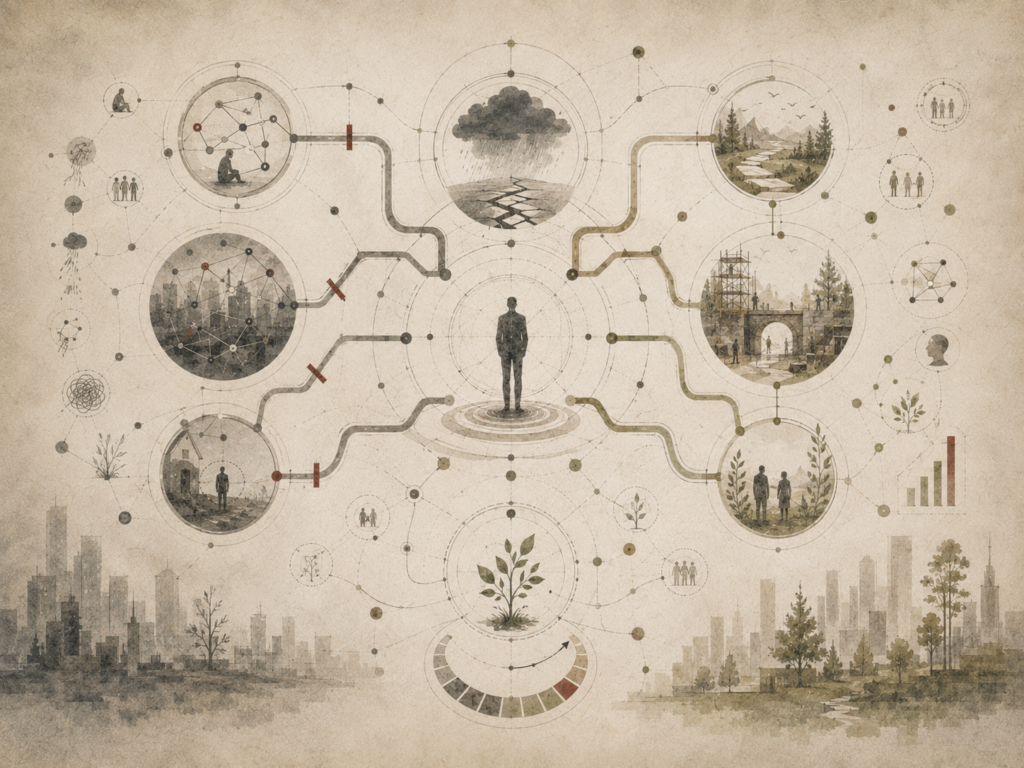
Restrained academic illustration of a central figure between blocked pathways, storm imagery, enclosed spaces, tangled networks, and emerging routes of agency and regrowth.

Learned Helplessness and Depression: The Psychological Roots of Positive Psychology

Learned helplessness is one of the most important theories in modern psychology because it explains how repeated exposure to uncontrollable adversity can weaken motivation, alter expectations about agency, and contribute to patterns associated with depression. This article examines the origins of the theory, its role in depression research, the attributional reformulation, and its importance for optimism, resilience, and prevention. It also adds a related articles section linking learned helplessness to explanatory style, hope, post-traumatic growth, strengths, flourishing measurement, public health, and the future of well-being science. The result is a stronger account of learned helplessness as both a theory of suffering and a foundational precursor to positive psychology.

Restrained academic illustration of a central human figure surrounded by five interconnected well-being domains representing positive emotion, engagement, relationships, meaning, and accomplishment.

The PERMA Model of Well-Being: A Framework for Human Flourishing

The PERMA model of well-being is one of the central frameworks in positive psychology because it reconceives flourishing as a multidimensional structure rather than a single emotional state. This article examines Martin Seligman’s five-part model of positive emotion, engagement, relationships, meaning, and accomplishment, while also exploring its measurement, institutional applications, and relationship to subjective well-being and eudaimonic traditions. It adds a related articles section linking PERMA to flourishing measurement, meaning, flow, self-determination, education, public health, sustainability, and the future of well-being science. The result is a stronger account of PERMA as a serious framework for understanding how flourishing is built across personal, social, and institutional life.

Scroll to Top