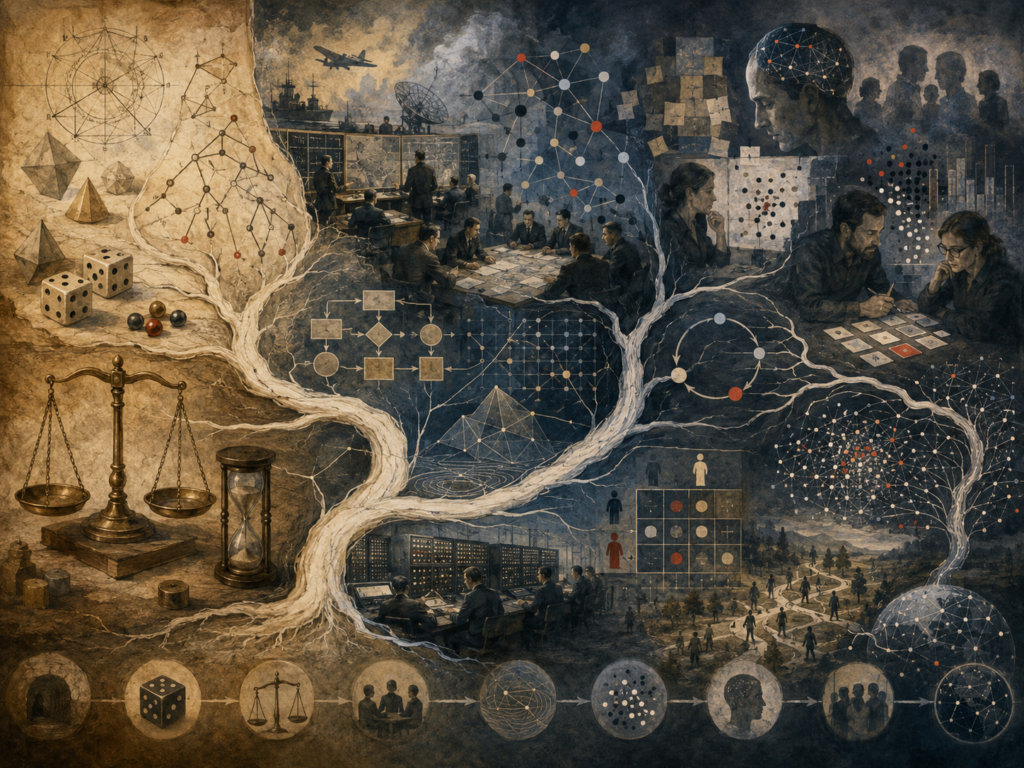
Painterly editorial illustration of structured decision-making with branching decision-tree pathways, weighted nodes, outcome clusters, tradeoff scales, evidence fragments, and a reflective figure studying possible choices.

Decision Trees and Structured Choice: How to Map Decisions, Uncertainty, and Consequences

Decision Trees and Structured Choice examines how complex decisions can be mapped as sequences of actions, uncertainties, and outcomes rather than treated as isolated one-step choices. The article argues that decision trees strengthen judgment by making the architecture of choice explicit: what is decided, what is uncertain, what follows from each branch, and how consequences are valued across time. It develops this through the foundations of tree structure, expected value and backward induction, sequential decision-making, uncertainty representation, the value of information, practical strengths and limitations, and decision-tree-specific mathematical and computational workflows. The article emphasizes that stronger decision-making depends not only on choosing between options, but on structuring contingent choices clearly enough that assumptions, probabilities, payoffs, and future flexibility can be examined, compared, and revised with discipline.


Painterly editorial illustration of expected value and expected utility with dice, weighted outcomes, branching probability paths, tradeoff scales, curved value forms, and reflective decision-makers.

Expected Value and Expected Utility: How to Compare Decisions Under Risk and Uncertainty

Expected Value and Expected Utility examines the formal foundations of choice under uncertainty. The article argues that expected value provides a clear probabilistic benchmark by weighting outcomes by their likelihood, but that expected utility becomes necessary when decision-makers value outcomes subjectively and respond differently to risk. It develops this through the logic of expected value, utility functions, Bernoulli’s response to the St. Petersburg paradox, the role of risk aversion, the limits of these models under behavioral distortion and deep uncertainty, and their extension into modern decision science through scenario analysis, robustness, and adaptive frameworks. The article emphasizes that these concepts remain essential not because they deliver automatic answers, but because they clarify how probability, consequence, and preference are being combined when decisions are made under uncertainty.

Painterly editorial illustration showing the core principles of decision science through evidence fragments, uncertainty symbols, weighted nodes, tradeoff scales, behavioral judgment, constraints, feedback loops, ripple effects, and adaptive learning.

Core Principles of Decision Science

Core Principles of Decision Science examines the foundational commitments that make disciplined choice possible under uncertainty. The article argues that good decision-making depends not on one preferred method, but on a coherent set of practices: structured framing, explicit treatment of uncertainty, evaluation of trade-offs, integration of normative analysis with behavioral realism, sensitivity testing, system-level awareness, robustness, and iterative learning. It develops these principles as mutually reinforcing rather than isolated tools, showing how each corrects a common failure in judgment, from hidden assumptions and brittle forecasts to narrow optimization and poor feedback. The article emphasizes that stronger decisions emerge when objectives, uncertainties, values, and system effects are made visible enough to be questioned, compared, and revised over time rather than treated as fixed or self-evident.

Painterly editorial illustration showing the historical evolution of decision science through probability diagrams, scales, decision trees, operations research, systems analysis, behavioral judgment, data networks, and complex adaptive systems.

The History of Decision Science

Decision science emerged through the convergence of probability theory, economics, psychology, operations research, and systems thinking into a field devoted to improving choice under uncertainty. What began with early efforts to model chance and rational valuation expanded through expected utility, Knight’s distinction between risk and uncertainty, the rise of operations research during World War II, and the formalization of decision analysis at Stanford. Later developments in bounded rationality, heuristics and biases, behavioral economics, and systems modeling challenged narrow optimization-based views of human choice. More recently, robust decision-making has extended the field further by emphasizing resilience across uncertain futures rather than precision under fragile assumptions. The history of decision science therefore reveals a gradual shift from abstract rational choice toward a broader, more realistic framework for judgment, adaptation, and structured decision-making in complex worlds.

Painterly editorial illustration of a thoughtful figure facing branching paths, fog, storm clouds, risk markers, weighted choices, feedback loops, and scattered evidence under uncertain conditions.

Why Uncertainty Changes Decision-Making

Uncertainty changes decision-making by undermining the assumptions of predictability, stable probabilities, and fully specified outcomes that support classical optimization. Rather than simply making choices harder, uncertainty changes the structure of the problem itself. Decision-makers must often act without knowing whether the relevant variables, probabilities, or models are fully reliable, especially in complex systems shaped by feedback, delay, and interdependence. This shifts attention from narrow optimization toward robustness, adaptability, and structured judgment under incomplete knowledge. The article explains the distinction between risk and uncertainty, examines ambiguity and cognitive bias, and shows why bounded rationality, scenario thinking, and robust decision-making become essential when the future cannot be known with confidence. Under such conditions, good decisions are less about perfect prediction than about resilience, transparency, and defensible action across plausible futures.

Painterly editorial illustration contrasting applied decision science with formal decision theory through human judgment, messy systems, abstract geometries, networks, tradeoffs, and symbolic uncertainty.

Decision Science vs. Decision Theory

Decision theory and decision science are closely related but serve different purposes in the study of choice under uncertainty. Decision theory provides the formal, mathematical foundations of rational choice, using concepts such as expected utility, Bayesian updating, and probabilistic consistency to define how decisions should be made under ideal conditions. Decision science builds on those foundations but extends them into real-world settings, where information is incomplete, uncertainty is often deep, preferences may conflict, and decision-makers face cognitive and institutional constraints. The article argues that decision science does not replace decision theory but broadens it by integrating behavioral research, organizational context, systems thinking, and practical decision methods. Together, the two fields form a more complete framework for understanding and improving judgment in complex environments where formal optimization alone is rarely sufficient.

Painterly editorial illustration of decision science with branching pathways, weighted nodes, uncertainty symbols, evidence fragments, and a contemplative figure studying choices under uncertainty.

What Is Decision Science?

Decision science is the interdisciplinary study of how choices are structured, evaluated, and improved under uncertainty, complexity, and competing objectives. Drawing on economics, statistics, operations research, psychology, and organizational research, it combines formal analytical methods with empirical insight into how real people and institutions actually make decisions. Rather than assuming ideal conditions of complete information and perfect rationality, decision science focuses on how judgment can be made more transparent, systematic, and defensible when knowledge is incomplete and trade-offs are unavoidable. The field links normative models of rational choice with descriptive research on cognitive bias, bounded rationality, and institutional constraint. It also emphasizes scenario analysis, sensitivity analysis, and robust decision-making in complex systems. In practice, decision science helps decision-makers reason more clearly when certainty is impossible and consequences are significant.

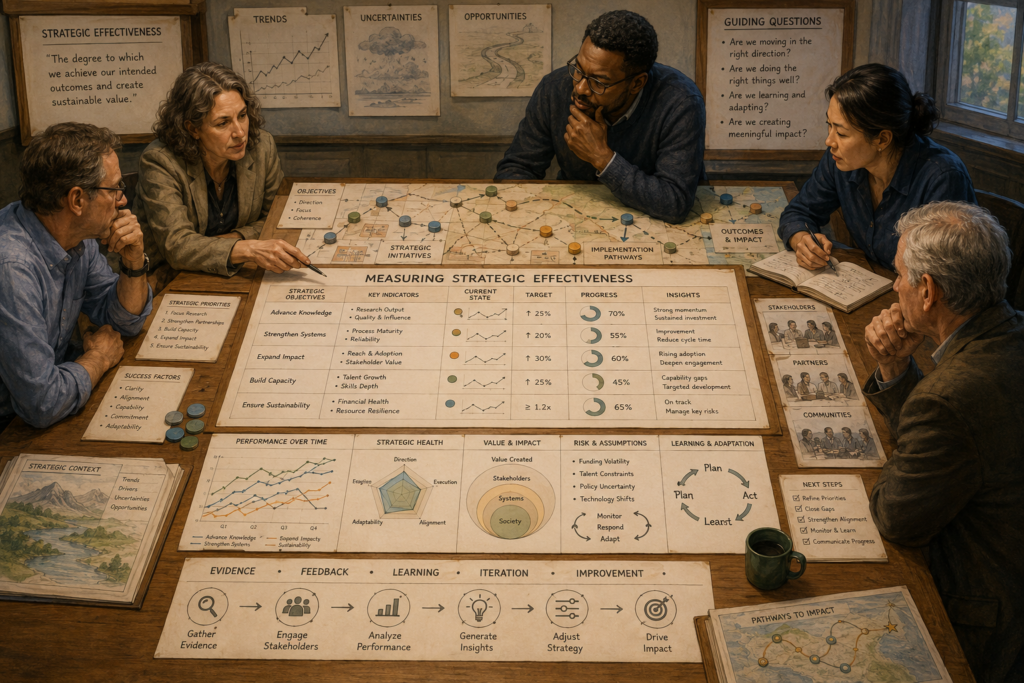
Strategists examine performance indicators, progress charts, outcome pathways, feedback loops, and implementation maps on a large planning table

Measuring Strategic Effectiveness: KPIs, Feedback Loops, and Strategic Learning

Measuring Strategic Effectiveness examines how organizations evaluate whether a strategy is actually working under real-world conditions rather than merely appearing successful on a dashboard. The article argues that strategic effectiveness is inherently multidimensional, involving not only performance, but also alignment, resilience, adaptability, impact, and learning across time. It develops this through the limits of single KPIs, the value of balanced measurement systems, the distinction between leading and lagging indicators, the challenge of attribution and causality, and the role of feedback loops in adaptive strategy. The article emphasizes that measurement is not simply a control function but a learning system that helps institutions refine strategy under uncertainty, especially in complex environments where outcomes are delayed, indirect, and difficult to trace cleanly.

Strategists revise interconnected planning maps, pathway routes, feedback loops, action cards, and tokens across a large institutional table.

Adaptive Strategy and Iteration: How Organizations Learn and Adjust Under Uncertainty

Adaptive Strategy and Iteration explains why strategy must function as a living process rather than a fixed plan in environments shaped by uncertainty, feedback, and change. The article argues that effective strategy depends on continuous learning: decisions are treated as hypotheses, outcomes are read through feedback loops, and strategic direction is repeatedly refined through evidence, experimentation, and structured revision. It develops this through the limits of static planning, strategy as a learning system, the role of iteration, exploration versus exploitation, path dependence, timing, organizational capabilities, leadership, and the risks of over-adaptation. The article emphasizes that adaptation is not endless improvisation but disciplined adjustment in service of coherent purpose.

Scroll to Top