
Painterly editorial illustration of multi-criteria decision analysis with a reflective analyst, weighted criteria, decision matrices, tradeoff scales, alternative options, and structured comparison diagrams.

Multi-Criteria Decision Analysis: How to Weigh Options, Values, and Trade-Offs

Multi-Criteria Decision Analysis examines how decisions can be structured when multiple, often conflicting criteria must be evaluated at the same time. The article argues that many important choices cannot be reduced to a single metric because they involve competing priorities such as cost, equity, resilience, risk, sustainability, and long-term value. It develops this through the foundations of MCDA, explicit trade-offs and value judgments, major methods such as weighted scoring and outranking, the integration of quantitative and qualitative criteria, uncertainty and sensitivity analysis, behavioral influences, and MCDA-specific mathematical and computational workflows. The article emphasizes that stronger decision-making depends on making criteria, weights, assumptions, and trade-offs explicit so alternatives can be compared in a way that is transparent, defensible, and responsive to plural forms of value.

Painterly editorial illustration of behavioral decision theory with a reflective analyst, cognitive pathways, social silhouettes, branching choices, distorted perception, tradeoff scales, and uncertainty markers.

Behavioral Decision Theory: How Psychology Shapes Judgment, Risk, and Choice

Behavioral Decision Theory examines how real human choice departs from idealized rational models under uncertainty. The article argues that decisions are shaped not only by formal probabilities and stable preferences, but by heuristics, loss aversion, framing, reference points, and the cognitive limits of bounded rationality. It develops this through the origins of the field in Simon, Kahneman, and Tversky, key concepts such as bias and reference dependence, prospect theory, behavioral process design, uncertainty, ethical questions around choice architecture, and behavioral mathematical and computational workflows. The article emphasizes that stronger decision science depends on integrating formal rigor with psychological realism, so decision frameworks reflect how people actually perceive risk, interpret options, and respond to uncertainty in practice.

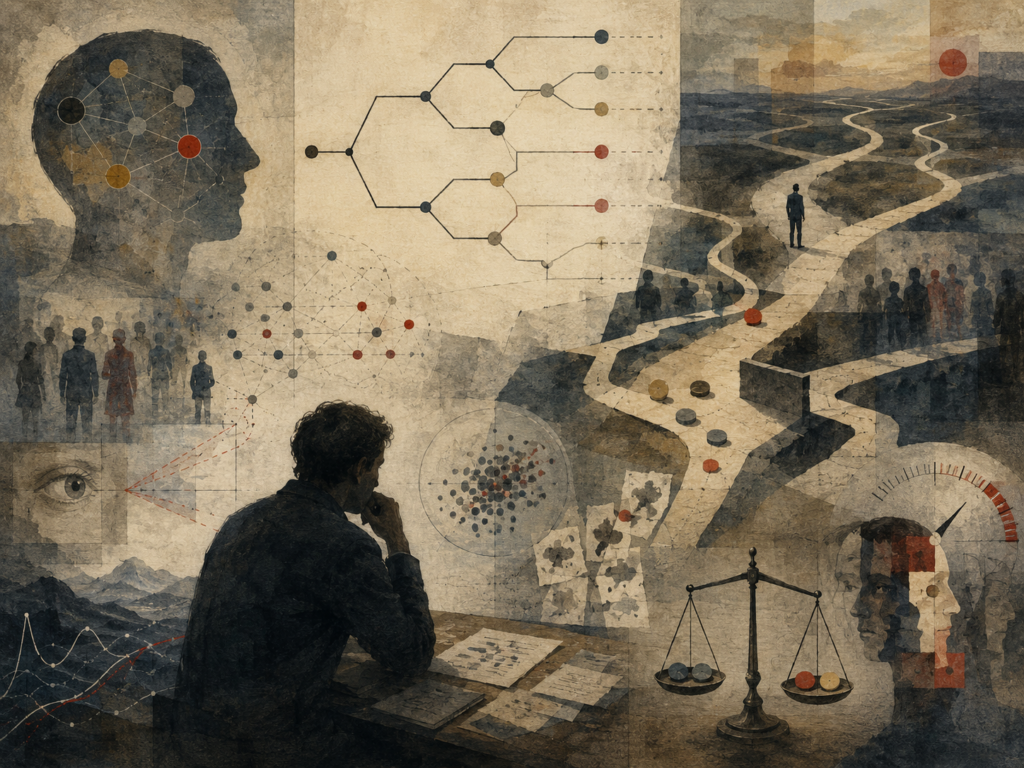
Painterly editorial illustration of a reflective figure facing uncertain terrain, branching pathways, probability networks, evidence fragments, social silhouettes, and risk markers under shifting light.

Judgment Under Uncertainty: How to Turn Incomplete Evidence Into Accountable Decisions

Judgment Under Uncertainty examines how people form beliefs, make estimates, and choose actions when probabilities are unclear, information is incomplete, and outcomes are difficult to predict. The article argues that real judgment often departs from idealized rational models because people rely on heuristics, intuitive reasoning, and context-sensitive inference rather than formal probability alone. It develops this through the distinction between risk and uncertainty, key heuristics and biases, Bayesian updating, complex-system judgment, expertise, learning, and judgment-specific mathematical and computational workflows. The article emphasizes that stronger decision-making does not come from eliminating uncertainty, but from improving calibration, probabilistic reasoning, bias awareness, and institutional processes that help people revise beliefs, test assumptions, and respond more intelligently when evidence remains incomplete.

Painterly editorial illustration of bounded rationality with a reflective decision-maker, filtered information, constrained pathways, cognitive limits, uncertainty, social context, and branching choices.

Bounded Rationality: How Real Decisions Work Under Limits

Bounded Rationality examines how real decisions are made under limits of time, information, attention, and computational capacity rather than under the ideal conditions assumed by classical rational-choice models. The article argues that in most serious settings, decision-makers cannot search all alternatives or calculate all consequences, so rationality takes the form of satisficing, search, aspiration levels, and adaptive judgment under constraint. It develops this through Herbert Simon’s critique of optimization, the contrast between satisficing and maximizing, cognitive and informational limits, uncertainty, organizational and institutional context, decision-support tools, later behavioral extensions, and bounded-rationality-specific mathematical and computational workflows. The article emphasizes that stronger decision-making depends not on pretending constraints do not exist, but on designing processes, tools, and institutions that fit the real capacities of human and organizational reasoning.

Painterly editorial illustration of framing effects with an abstract decision structure, layered evidence surfaces, shifting light, weighted nodes, tradeoff forms, social silhouettes, and multiple perspectives around the same problem.

Framing Effects in Decision-Making: How Presentation Shapes Judgment and Choice

Framing Effects in Decision-Making examines how choices shift when equivalent information is presented in different ways. The article argues that decisions are influenced not only by objective outcomes, but by how those outcomes are described, whether as gains or losses, and by the reference points through which people interpret them. It develops this through the logic of framing, gain versus loss framing, reference dependence, decision architecture, interactions with heuristics and biases, uncertainty, ethical concerns, and framing-specific mathematical and computational workflows. The article emphasizes that stronger decision-making depends on recognizing that preferences are often constructed in context, then building processes that make presentation effects visible so choices become more consistent, transparent, and less vulnerable to manipulation or avoidable cognitive distortion.

Painterly editorial illustration of heuristics and cognitive biases with a contemplative figure, branching paths, distorted judgment symbols, dice, mirrors, social silhouettes, targets, and fragmented mental networks.

Heuristics and Cognitive Biases: How to Recognize and Reduce Judgment Error

Heuristics and Cognitive Biases examines how people simplify complex decisions through mental shortcuts and how those shortcuts can also produce systematic errors in judgment. The article argues that real decision-making cannot be understood through idealized rational-choice models alone, because human beings rely on fast, efficient, and often adaptive rules of thumb when information is incomplete and time is limited. It develops this through core heuristics such as availability, representativeness, and anchoring, major biases including overconfidence, confirmation bias, framing, and loss aversion, the behavioral foundations laid by Tversky, Kahneman, and Simon, and the role of structured decision processes in reducing avoidable distortion. The article emphasizes that better decision-making depends not on eliminating heuristics altogether, but on understanding when they help, when they mislead, and how decision environments can support more accurate judgment.

Painterly editorial illustration of sensitivity analysis and scenario comparison with branching pathways, weighted nodes, contour maps, alternative landscapes, uncertainty paths, and a reflective analyst.

Sensitivity Analysis and Scenario Comparison: How to Test Assumptions and Make Better Decisions

Sensitivity Analysis and Scenario Comparison examines how decisions should be tested against changing assumptions, uncertain inputs, and alternative futures rather than judged under a single fixed model. The article argues that many decisions appear strong only because their underlying assumptions are left unchallenged, and that better decision-making requires systematic examination of how outcomes shift when probabilities, costs, constraints, or broader environmental conditions change. It develops this through one-way, multi-way, threshold, and probabilistic sensitivity analysis, coherent scenario comparison, robustness, key-driver identification, integration with decision trees and probabilistic models, and scenario-specific mathematical and computational workflows. The article emphasizes that stronger decisions depend less on confidence in one forecast than on understanding vulnerability, identifying decisive assumptions, and choosing strategies that remain credible across a wider range of plausible conditions.

Painterly editorial illustration of Bayesian decision-making with evolving probability clouds, evidence fragments, weighted nodes, branching belief structures, and a reflective analyst updating judgments under uncertainty.

Bayesian Decision-Making: How to Update Beliefs and Choose Under Uncertainty

Bayesian Decision-Making examines how decisions can improve as beliefs are updated in light of new evidence. The article argues that uncertainty is often not static: in many real settings, information arrives over time, and good judgment depends on learning systematically rather than treating probabilities as fixed from the outset. It develops this through Bayes’ theorem, prior and posterior beliefs, expected utility under updated probabilities, sequential learning, applications in healthcare, finance, machine learning, and public policy, as well as the role of priors, model assumptions, and Bayesian networks in complex systems. The article emphasizes that stronger decision-making depends not only on choosing well with current knowledge, but on revising beliefs coherently as evidence accumulates, so action remains adaptive, analytically grounded, and responsive to uncertainty as it unfolds.

Painterly editorial illustration of risk analysis with probability networks, branching uncertainty paths, contour maps, outcome clusters, dice, risk landscapes, and a reflective analyst.

Risk Analysis and Probabilistic Reasoning: How to Evaluate Uncertainty, Consequences, and Tail Risk

Risk Analysis and Probabilistic Reasoning examines how uncertainty can be evaluated through structured estimates of likelihood, consequence, variability, and extreme outcomes. The article argues that strong decisions require more than intuition or average-case thinking, because uncertainty must be analyzed not only in terms of what is likely, but also in terms of what is possible, how severe outcomes may be, and how risk can propagate through complex systems. It develops this through the foundations of probabilistic reasoning, formal risk-analysis frameworks, distributional thinking, tail risk, behavioral distortions in risk perception, system-level vulnerability, and risk-specific mathematical and computational workflows. The article emphasizes that better decision-making depends on representing uncertainty explicitly, identifying critical exposures, and integrating probabilistic analysis with judgment, resilience, and strategic choice.

Scroll to Top