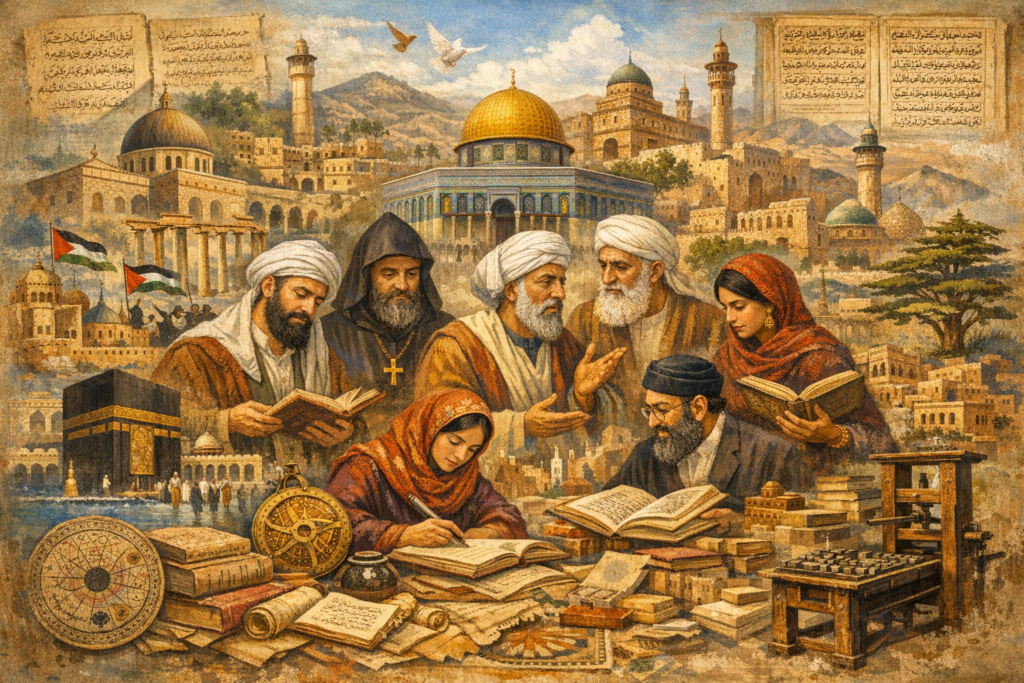
Editorial collage of Arabian and Levantine intellectual life showing scholars, manuscripts, books, sacred architecture, printing technology, and symbolic cityscapes associated with Palestine, Lebanon, Syria, Iraq, and the wider Arab East

Arabian and Levantine Thought: Revelation, Language, Memory, and Renewal

Arabian and Levantine thought preserves one of the world’s great intellectual traditions: a vast and internally diverse field in which revelation, grammar, law, theology, poetry, philosophy, reform, memory, and exile have shaped reflection across the Arabian Peninsula, the Levant, and Iraq. From pre-Islamic poetry and Qur’anic revelation to Arabic grammar, jurisprudence, kalām, adab, Christian and Jewish Arabic thought, Nahda reformism, Palestinian intellectual life, Lebanese and Syrian public culture, Iraqi philosophical and literary worlds, Yemeni scholarship, and Omani Ibāḍī traditions, this article explores how language, faith, historical vulnerability, and the struggle for dignity formed a dense and enduring civilizational web. By treating Palestine, Lebanon, Syria, Iraq, Yemen, Oman, the Hijaz, and Najd as constitutive rather than peripheral, it presents the Arab East as a polycentric zone of thought in which scripture, literary form, political conflict, and cultural renewal remain inseparably linked.
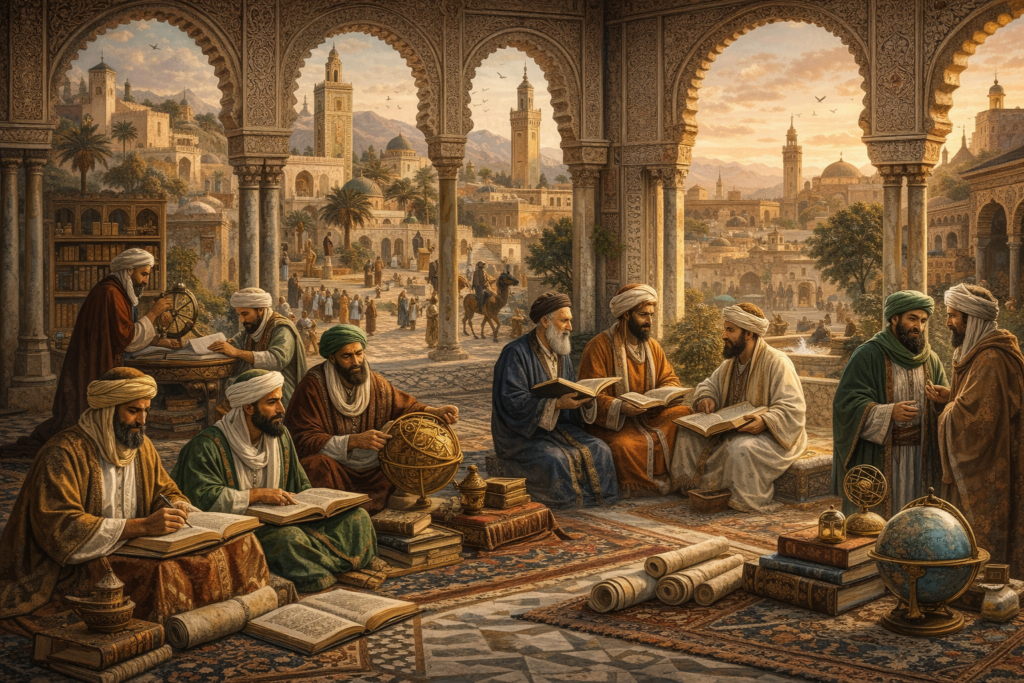
Editorial illustration of Maghrebi and Andalusi intellectual life featuring scholars in a North African and Andalusi courtyard, manuscripts, astronomical instruments, books, arches, and a layered urban landscape of domes, towers, and gardens

Maghrebi and Andalusi Thought: Law, Reason, Mysticism, and Civilization in the Western Islamic World

Maghrebi and Andalusi thought preserves one of the great intellectual traditions of the western Islamic world: a world in which law, theology, philosophy, mysticism, literature, science, and history developed together across North Africa and al-Andalus. Shaped by Amazigh, Arab, Islamic, Jewish, African, and Mediterranean inheritances, this tradition reveals how thinkers in cities such as Kairouan, Fez, Marrakesh, Cordoba, Seville, and Granada reflected on reason and revelation, legal authority, political legitimacy, spiritual discipline, social order, and the rise and fall of civilization. This article explores Maghrebi and Andalusi thought in its full civilizational range, from Maliki jurisprudence, Ashʿari theology, falsafa, and Sufism to Jewish-Arabic philosophy, scientific inquiry, dynastic statecraft, post-Andalusi exile, and historical reflection on urban life, decline, and collective memory, showing how the western Islamic world became a major center of philosophical, legal, and civilizational thought.

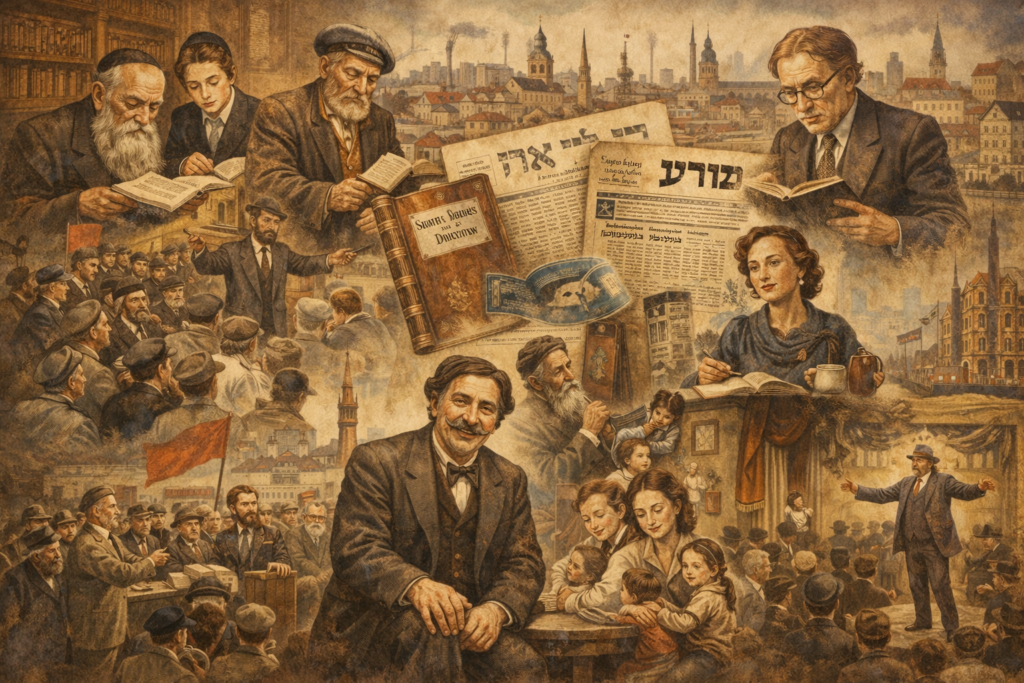
Editorial illustration of Yiddish intellectual worlds featuring scholars reading, Yiddish newspapers, labor meetings, theater and public speaking, women writing and reading, family life, and layered urban diasporic cityscapes

Yiddish Thought: Exile, Memory, Humor, and Human Dignity in a Vernacular Intellectual Tradition

Yiddish thought preserves one of the most distinctive vernacular traditions of reflection in modern intellectual history: a world in which exile, faith, humor, labor, language, memory, and human dignity are thought through not only in theology or formal philosophy, but in stories, journalism, theater, political argument, memoir, and everyday speech. Shaped by rabbinic ethics, Hasidic spirituality, Musar discipline, the Haskalah, urban modernity, socialism, migration, and postwar witness, this tradition reveals how Yiddish-speaking communities reflected on justice, suffering, class, doubt, communal obligation, and the struggle to remain human under unstable historical conditions. This article explores Yiddish thought in its full civilizational range, from sacred inheritance and vernacular moral worlds to literature, labor politics, public debate, postwar memory, and the philosophy of diaspora itself, showing how a language of ordinary life became a language of extraordinary moral seriousness.

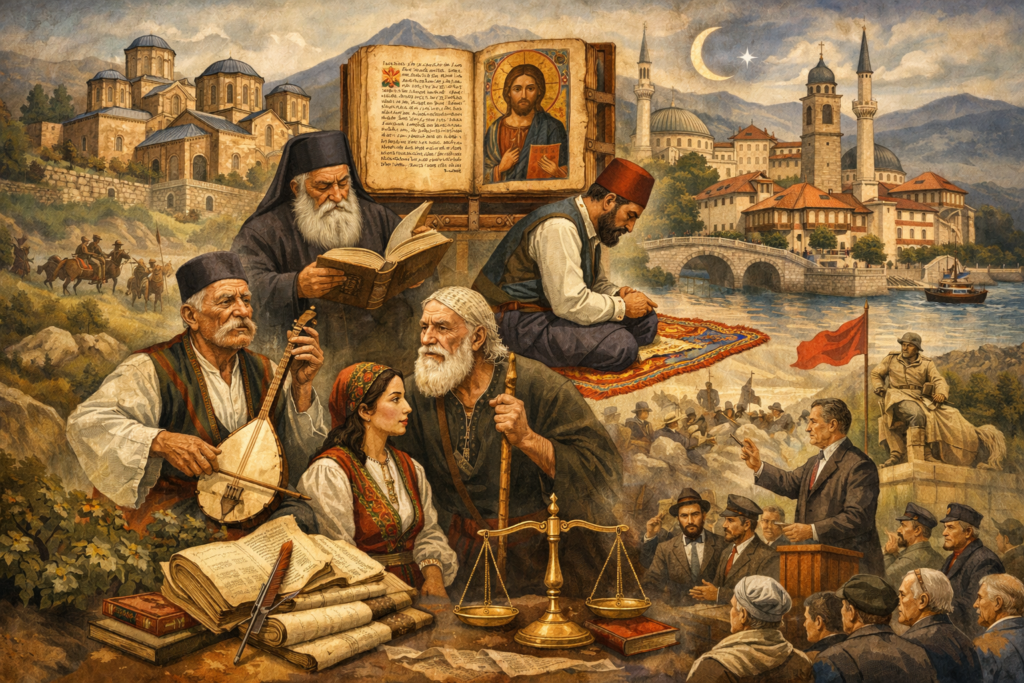
Editorial illustration of South Slavic intellectual worlds featuring monasteries, manuscripts, an icon, a Muslim scholar at prayer, an epic singer, village and urban Balkan architecture, a political assembly, scales of justice, and layered mountain and Adriatic landscapes

South Slavic Thought: Memory, Faith, Empire, and Identity

South Slavic thought preserves one of Europe’s most historically layered traditions of reflection on faith, empire, memory, justice, and collective identity. Shaped by pre-Christian Slavic inheritances, Orthodox and Catholic Christianity, Islamic and Ottoman influence, oral epic culture, monastic writing, vernacular literature, legal and political struggle, and the long contact histories of the Balkans, this tradition reveals how communities in southeastern Europe thought through sovereignty, suffering, plural coexistence, language, law, and the burdens of historical memory. This article explores South Slavic thought in its full civilizational range, from sacred and customary worlds to theological writing, epic memory, national awakening, Yugoslavism, socialism, and post-socialist reflection, showing how philosophy in the Balkan world has often been carried through poetry, history, religion, law, and political imagination as much as through formal philosophical systems.

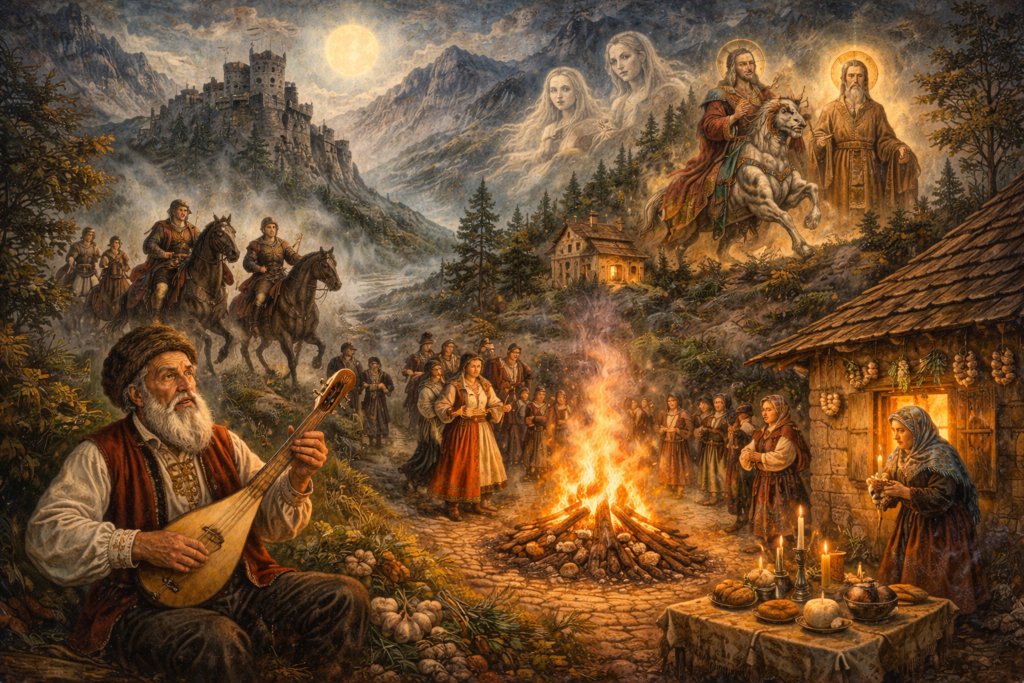
Editorial illustration of South Slavic mythic and folkloric worlds featuring a guslar with a stringed instrument, heroic riders in the Balkan mountains, village ritual around a fire, candlelit household devotion, saintly figures above a mountain monastery, and spectral female spirits in the mist

South Slavic Myth, Epic, and Folklore: Heroic Memory, Sacred Tradition, and the Moral Imagination of the Balkans

South Slavic myth, epic, and folklore preserve one of Europe’s richest narrative worlds: a world of heroic song, sacred mountains, saints, vampires, vila, outlaw memory, women’s lament, seasonal ritual, and the long moral pressure of kinship, empire, and survival. Shaped by pre-Christian Slavic inheritances, Orthodox and Catholic sacred traditions, Ottoman and Muslim frontier worlds, village custom, pastoral life, and oral performance, these traditions reveal how Balkan communities imagined nature, fate, honor, supernatural danger, communal obligation, and the burden of historical memory. This article explores South Slavic folklore in its full civilizational range, from ancient symbolic survivals and guslar epic to household ritual, healing practice, sacred geography, confessional contact zones, and the literary and political afterlives of oral tradition, showing how myth, legend, and song became enduring vehicles of moral imagination across the Balkans.

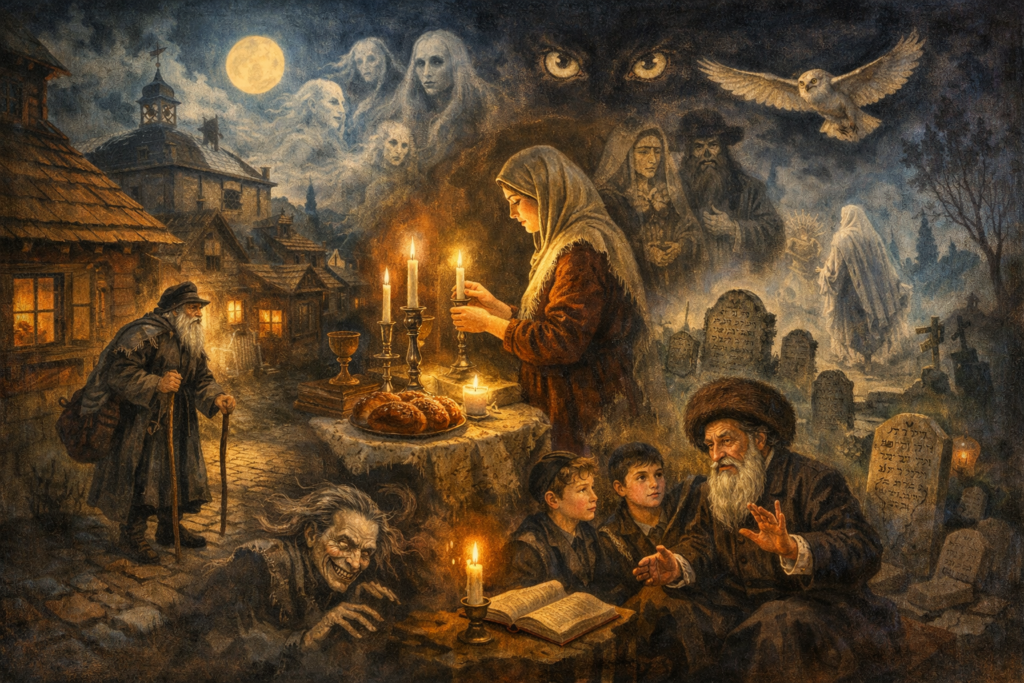
Editorial illustration of Yiddish folkloric and sacred worlds featuring a shtetl at dusk, a wandering holy figure, candlelit domestic ritual, a Hasidic storyteller with children, ghostly spirits, cemetery gravestones, and an atmosphere of exile, wonder, and hidden holiness

Yiddish Legend, Folklore, and Sacred Imagination: Exile, Hidden Holiness, and the Vernacular Life of the Unseen

Yiddish legend, folklore, and sacred imagination preserve one of the most intricate vernacular sacred worlds in Jewish history: a world of dybbuks and demons, hidden righteous figures, miracle-working rebbes, wandering souls, women’s ritual life, comic wisdom, messianic longing, and the moral pressures of diaspora. Shaped by medieval Ashkenazi piety, rabbinic and mystical tradition, Hasidic storytelling, domestic custom, communal memory, and the lived realities of exile, these traditions reveal how Yiddish-speaking communities imagined divine hiddenness, spiritual danger, blessing, suffering, and the unseen dimensions of everyday life. This article explores the field in its full historical range, from premodern Ashkenazi origins and the shtetl world to modern literary transformation, wartime rupture, postwar witness, archival rescue, performance, and continuing Yiddish cultural life, showing how folklore became one of the central ways a people preserved meaning, fear, humor, and sacred endurance across historical change.

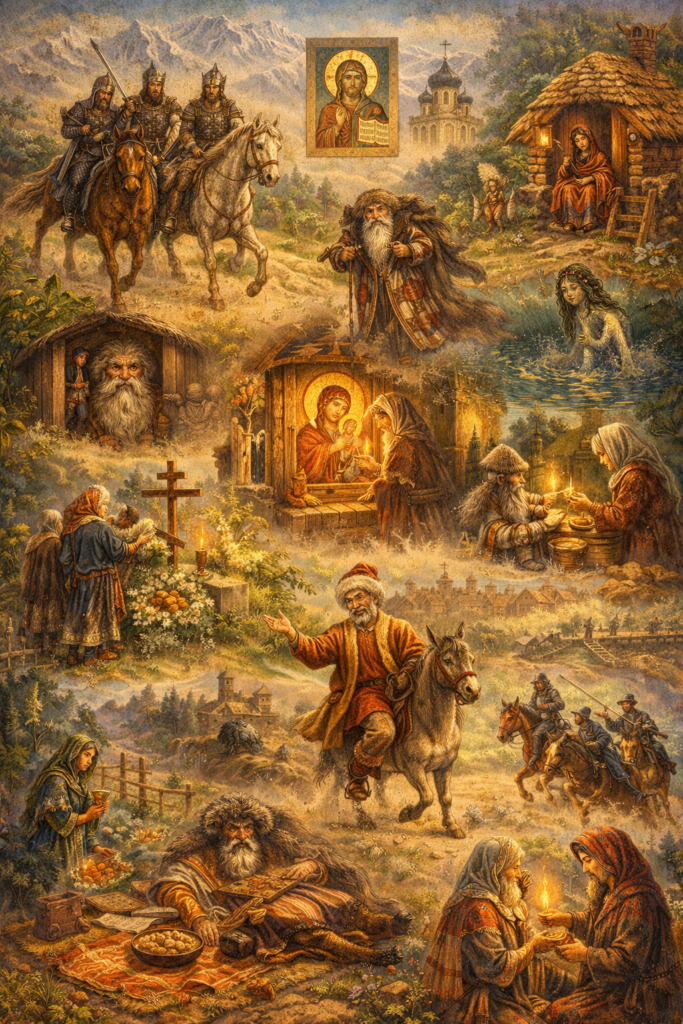
Editorial illustration of Russian mythic and folkloric worlds featuring bogatyr horsemen, a saint icon, a forest elder, a rusalka in the water, a domovoi at a cottage threshold, women in ritual and domestic scenes, a wandering fool on a donkey, and layered village, grave, and wilderness landscapes

Russian Myth, Epic, and Folklore: Nature, Sanctity, Suffering, and Moral Imagination

Russian myth, epic, and folklore preserve one of Europe’s most layered narrative worlds: a world of forests, rivers, saints, spirits, heroes, witches, domestic rites, village memory, and the returning dead, all held within a shared symbolic order. Rather than surviving as a single canonical mythology, these traditions endure through pre-Christian East Slavic belief, heroic oral epic, fairy tale, vernacular demonology, folk Christianity, monastic legend, women’s ritual song, seasonal custom, and later literary and artistic reworkings of folkloric form. Here, nature is never inert, suffering is rarely meaningless, and the boundary between visible and invisible life remains morally charged. This article approaches Russian myth, epic, and folklore as a civilizational archive rather than a loose body of old tales. It traces the interplay of pagan inheritance and Christian transformation; the world of the bogatyrs and the byliny; the supernatural ecology of household and wilderness spirits; the symbolic force of Baba Yaga and other wonder-tale figures; the role of saints, icons, pilgrimage, and holy fools; and the ritual year of Maslenitsa and Ivan Kupala.

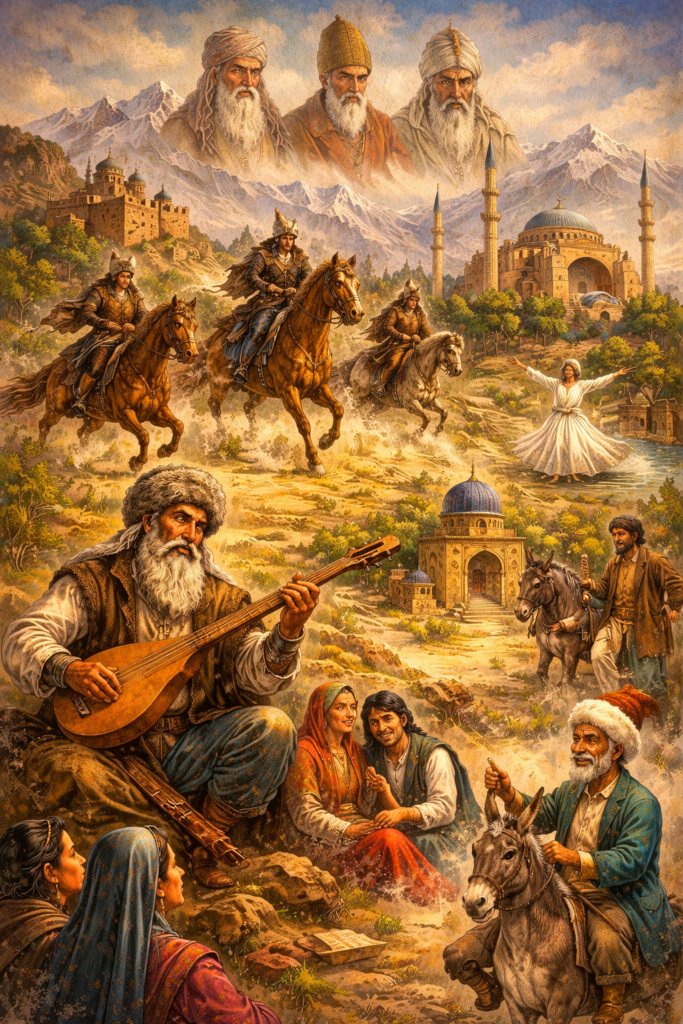
Editorial illustration of Turkic and Ottoman mythic worlds featuring steppe horsemen, an epic bard with a saz, saints and sages above the mountains, Ottoman and Central Asian architecture, whirling devotion, lovers, and Nasreddin Hodja on his donkey in a layered Eurasian landscape

Turkic and Ottoman Myth, Epic, and Folklore

Turkic and Ottoman myth, epic, and folklore preserve one of the great narrative worlds of Eurasia, joining Inner Asian cosmology, heroic memory, sacred charisma, frontier legend, and imperial imagination across centuries of transformation. From wolves, horses, mountains, and ancestral lineages to bardic epics, saint legends, dervish lore, Ottoman founding myths, trickster tales, and regional folk traditions, these story worlds reveal how Turkic-speaking peoples and Ottoman societies understood sovereignty, migration, sanctity, justice, longing, and communal survival. This article explores the field as a layered civilizational archive rather than a single canon, tracing the interplay of steppe inheritance, Islamicate transformation, Anatolian and Ottoman synthesis, oral performance, sacred geography, and popular narrative across a vast transregional world.

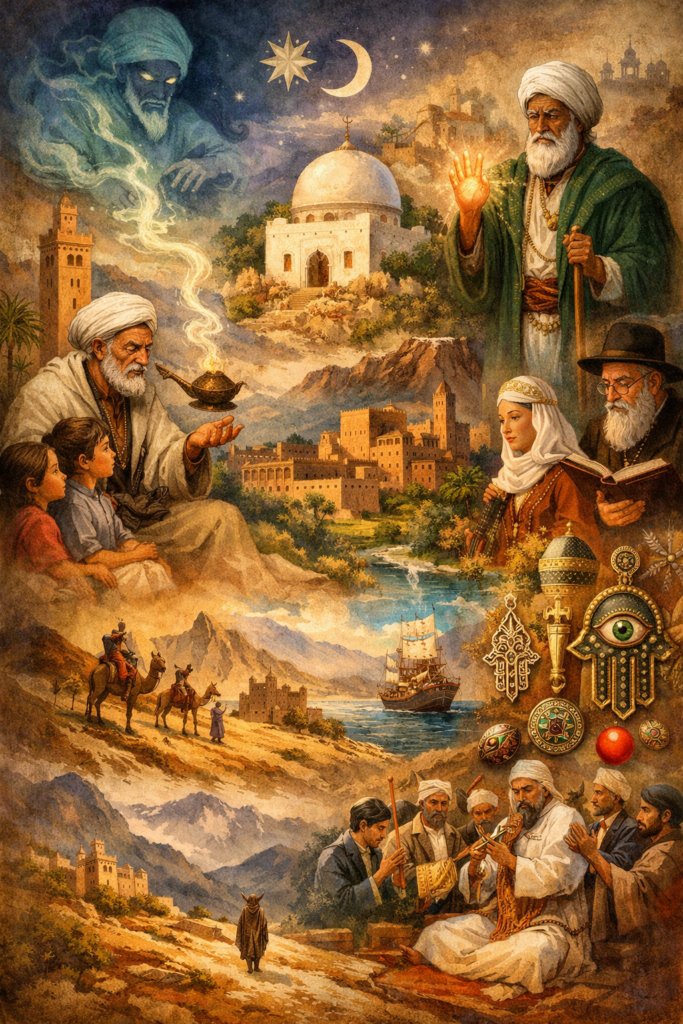
Illustration of Maghrebi and Andalusi sacred imagination featuring a storyteller, saintly figures, shrine architecture, desert and coastal travel, a jinn-like presence, Andalusi palaces, Jewish and Muslim memory, and ritual musicians across North Africa and al-Andalus.

Maghrebi and Andalusi Legend, Folklore, and Sacred Imagination

Maghrebi and Andalusi legend, folklore, and sacred imagination explore the legendary, devotional, and symbolic worlds through which North Africa and al-Andalus imagined sanctity, baraka, exile, memory, spiritual danger, and the hidden life of the world. This tradition is not organized around a single mythological canon, but around layered sacred narratives shaped by Amazigh oral inheritance, Arab and Islamic expansion, Jewish and Muslim folklore, shrine culture, healing ritual, pilgrimage, jinn lore, and the remembered afterlives of al-Andalus. At its core lies a defining question: how do communities preserve blessing, belonging, and civilizational memory through story when worlds are fractured by migration, loss, reform, and historical change? This content pillar explores saints, shrines, marabouts, zawiyas, sacred cities, desert and mountain imaginaries, protective folklore, Gnawa and confraternal ritual traditions, Andalusi and Morisco memory, Sephardi afterlives, and the sacred Mediterranean, showing why Maghrebi and Andalusi sacred imagination remains one of the richest regional traditions of folklore, devotion, and place-based memory.

Scroll to Top