Editorial illustration of physics and the philosophy of reality featuring a warped spacetime structure, quantum-like interference patterns, geometric relational networks, observatory-style instruments, and computational analysis displays.

Physics and the Philosophy of Reality

Physics and the philosophy of reality explores what modern physical theory implies about the nature of the world, asking whether fields, particles, spacetime, wavefunctions, laws, and symmetries are best understood as real features of nature, structural descriptions, or theory-dependent models of an underlying reality. This article examines scientific realism, structural realism, laws of nature, causation, determinism, spacetime ontology, quantum interpretation, gauge structure, holism, and the limits of current physical explanation to show how physics does more than describe measurable phenomena: it also reshapes how reality itself can be conceived. It brings together mechanics, relativity, quantum theory, field theory, and philosophy of science to show that modern physics is not only a technical account of the universe but also a profound challenge to common-sense metaphysics and a continuing source of philosophical humility.
Editorial illustration of physics, technology, and the modern world featuring a semiconductor chip, robotic automation, medical imaging systems, renewable energy infrastructure, satellites, communication networks, and advanced computational displays.

Physics, Technology, and the Modern World

Physics, technology, and the modern world explores how physical law is translated into the systems that shape contemporary life, from semiconductors, photonics, and computation to medical imaging, navigation, energy infrastructure, advanced materials, and space-based observation. This article examines how measurement, standards, instrumentation, and materials science turn physical principles into reliable devices and large-scale technical systems, showing that the modern world is deeply structured by electromagnetism, quantum mechanics, thermodynamics, nuclear physics, and precision metrology. It also considers how physics continues to drive emerging technologies through semiconductors, quantum systems, photonic devices, advanced manufacturing, and large scientific infrastructures, while raising broader questions about power, governance, ethics, and the unequal distribution of technological benefit and risk.

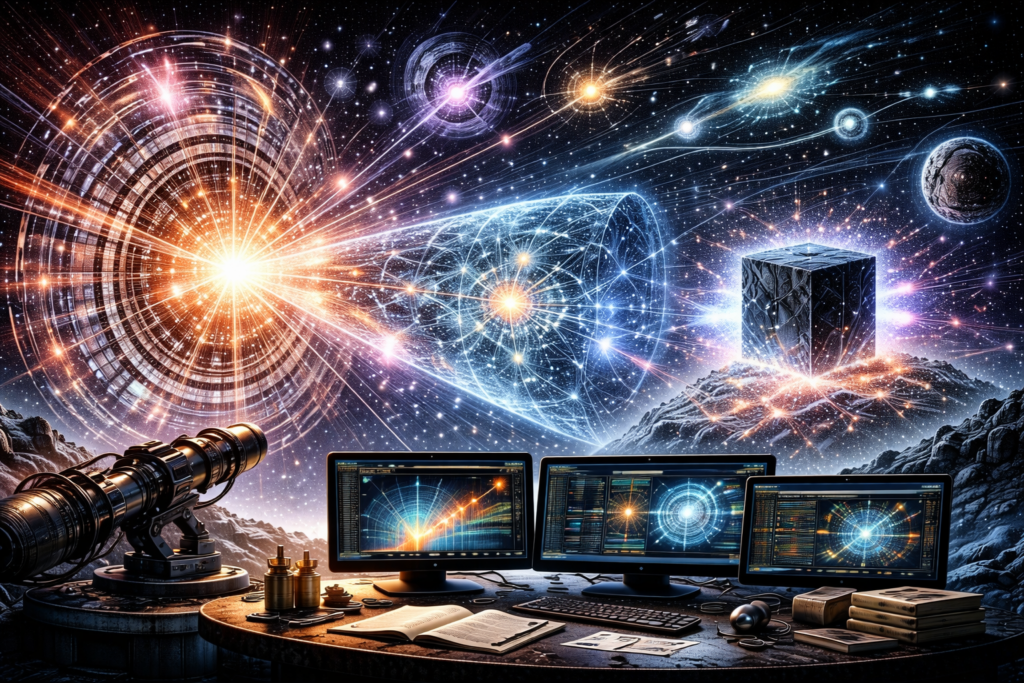
Editorial illustration of physics beyond the Standard Model featuring collider-style detector geometry, dark-sector inspired structures, neutrino-like streams, cosmic components, and computational analysis displays.

Physics Beyond the Standard Model

Physics beyond the Standard Model explores why the most successful theory in particle physics is still incomplete and why new physics is required to explain some of the deepest unresolved features of the universe. This article examines dark matter, neutrino mass, matter–antimatter asymmetry, hidden sectors, axions, dark photons, unification, quantum gravity, and cosmological evidence to show how the search for new particles, new forces, and new symmetries extends beyond the known framework of quarks, leptons, gauge bosons, and the Higgs field. It also explains how modern experiments at colliders, neutrino facilities, underground detectors, and cosmological surveys are reshaping the frontier of fundamental physics by testing where the Standard Model succeeds, where it fails, and where the next layer of physical law may begin.

Editorial illustration of cosmology and the history of the universe featuring early-universe expansion, cosmic background-like structure, galaxy formation, large-scale filaments, telescopic observation, and cosmological data-analysis displays.

Cosmology and the History of the Universe

Cosmology and the history of the universe explores how the universe evolved from an extremely hot, dense, and nearly uniform early state into a vast structured cosmos of radiation, dark matter, galaxies, clusters, filaments, and expanding spacetime. This article examines the major eras of cosmic history, including early-universe cooling, recombination, the release of the cosmic microwave background, the growth of structure under gravity, the role of dark matter in building the cosmic web, and the late-time expansion history shaped by dark energy. It also explains how modern cosmology reconstructs this history through redshift surveys, background-radiation measurements, distance indicators, and large-scale observational mapping, showing how the universe became transparent, formed stars and galaxies, and continues to evolve across billions of years of cosmic time.

Editorial illustration of galaxies, black holes, and the large-scale universe featuring spiral galaxies, a luminous accretion disk around a black hole, cosmic web-like filaments, distant planetary bodies, telescopic observation, and astronomical data-analysis screens.

Galaxies, Black Holes, and the Large-Scale Universe

Galaxies, black holes, and the large-scale universe explores how stars, gas, dust, dark matter, and supermassive black holes are organized into galaxies, groups, clusters, filaments, and the cosmic web that structures the observable cosmos. This article examines galactic morphology, dark matter halos, supermassive black holes, active galactic nuclei, galaxy mergers, clustering, redshift, and cosmic expansion to show how gravity shapes matter across immense scales and over billions of years of cosmic history. It also explains how modern astronomy reconstructs this large-scale architecture through telescopes, black-hole imaging, redshift surveys, and multiwavelength observation, revealing the deep connections among galactic evolution, black-hole growth, dark matter scaffolding, and the evolving structure of the universe as a whole.

Editorial illustration of astrophysics and the life of stars featuring a stellar nebula, a main-sequence star, red giant expansion, supernova-like stellar death, planetary bodies, telescopic observation, and spectral analysis displays.

Astrophysics and the Life of Stars

Astrophysics and the life of stars explores how stars form from collapsing clouds of gas, settle into long-lived equilibrium through the balance of gravity and pressure, generate energy through nuclear fusion, and evolve into red giants, supernovae, white dwarfs, neutron stars, or black holes depending primarily on mass. This article examines stellar birth, hydrostatic equilibrium, main-sequence fusion, the Hertzsprung–Russell diagram, late-stage stellar evolution, nucleosynthesis, and compact remnants to show how stars connect gravity, thermodynamics, nuclear physics, radiation, and the chemical enrichment of the universe. It also explains how astronomers reconstruct stellar life cycles through spectra, luminosity, temperature, distance measurement, and population analysis, revealing that stars are evolving physical systems whose births, transformations, and deaths shape galaxies and cosmic history.

Editorial illustration of experimental physics featuring laboratory instruments, detector-style geometry, calibration displays, a scientific notebook, measuring tools, and computational analysis screens.

Experiment, Instruments, and the Material Practice of Physics

Experiment, instruments, and the material practice of physics explores how physical knowledge is produced through measurement, apparatus, calibration, uncertainty analysis, documentation, and reproducible interpretation rather than through theory alone. This article examines the role of scientific instruments as structured mediators between physical events and measurable quantities, showing how detectors, sensors, calibration chains, standards, notebooks, and data pipelines make it possible to transform raw signals into defensible scientific results. It also explains why uncertainty, traceability, laboratory discipline, detector architecture, and computational analysis are central to experimental physics at every scale, from bench-top measurements and student laboratories to large collider experiments and institutional metrology systems.

Editorial illustration of symmetry, law, and physical order featuring a radiant geometric mandala, mirrored orbital forms, symmetry-breaking landscape imagery, and computational analysis displays.

Symmetry, Law, and the Search for Physical Order

Symmetry, law, and the search for physical order examines one of the deepest organizing ideas in physics: that the structure of physical law is often best understood through invariance under transformation rather than through isolated equations alone. This article explains how symmetry in physics extends far beyond visual balance to include time translation, spatial translation, rotation, gauge invariance, and the broader mathematical structures that govern conservation laws, field theory, and phase behavior. It also explores Noether’s theorem, spontaneous symmetry breaking, gauge symmetry in particle physics, and the role of symmetry in condensed matter and many-body systems to show how invariance, transformation, and broken order help reveal the deeper architecture of modern physical explanation.

Editorial illustration of condensed matter and materials physics featuring a crystal lattice, flowing band-like light structures, semiconductor-inspired components, detector-style geometry, and computational materials analysis displays.

Condensed Matter and the Physics of Materials

Condensed matter physics explains how the collective organization of atoms, electrons, lattices, defects, and quantum excitations gives rise to the measurable properties of real materials. This article examines crystal structure, band theory, metals, insulators, semiconductors, phonons, disorder, magnetism, superconductivity, and modern quantum materials to show how conductivity, heat transport, magnetic order, band gaps, and phase behavior emerge from many-body structure rather than from isolated atoms alone. It also clarifies why condensed matter sits at the center of both modern physics and materials science, linking quantum theory, symmetry, excitation, transport, and measurement to the practical behavior of semiconductors, magnetic materials, superconductors, and engineered solids.

Scroll to Top