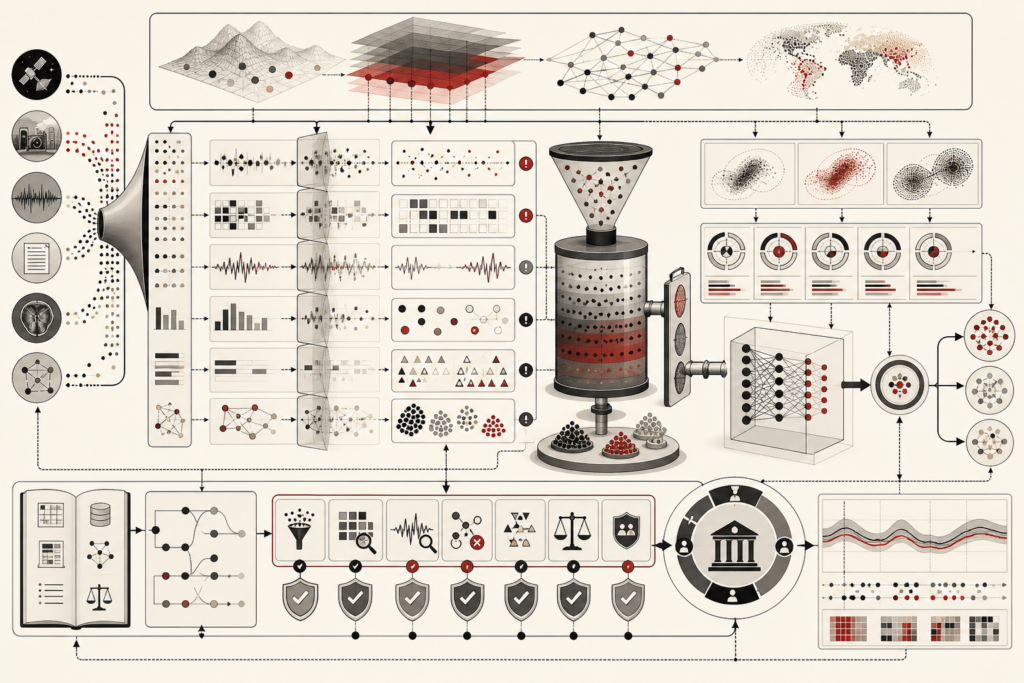
Data Quality, Bias, and Measurement in Machine Learning
Data quality, bias, and measurement in machine learning examine how datasets shape what AI systems can validly learn, predict, and justify. This article explains measurement theory, construct validity, proxy variables, bias-variance tradeoffs, data-quality dimensions, measurement error, label noise, missingness, representation bias, lifecycle sources of harm, distribution shift, fairness criteria, impossibility results, evaluation bias, dataset documentation, data governance, and institutional accountability. It shows why AI systems do not learn objective reality directly, but learn from imperfect measurements, labels, samples, proxies, and records shaped by technical and social systems. The article also introduces mathematical lenses for measurement error, label noise, missingness, distribution shift, statistical parity, equalized odds, and data-quality scoring, alongside Python and R workflows for missingness diagnostics, subgroup representation audits, label-noise simulation, fairness metrics, and bias-governance documentation.