
Last Updated May 28, 2026
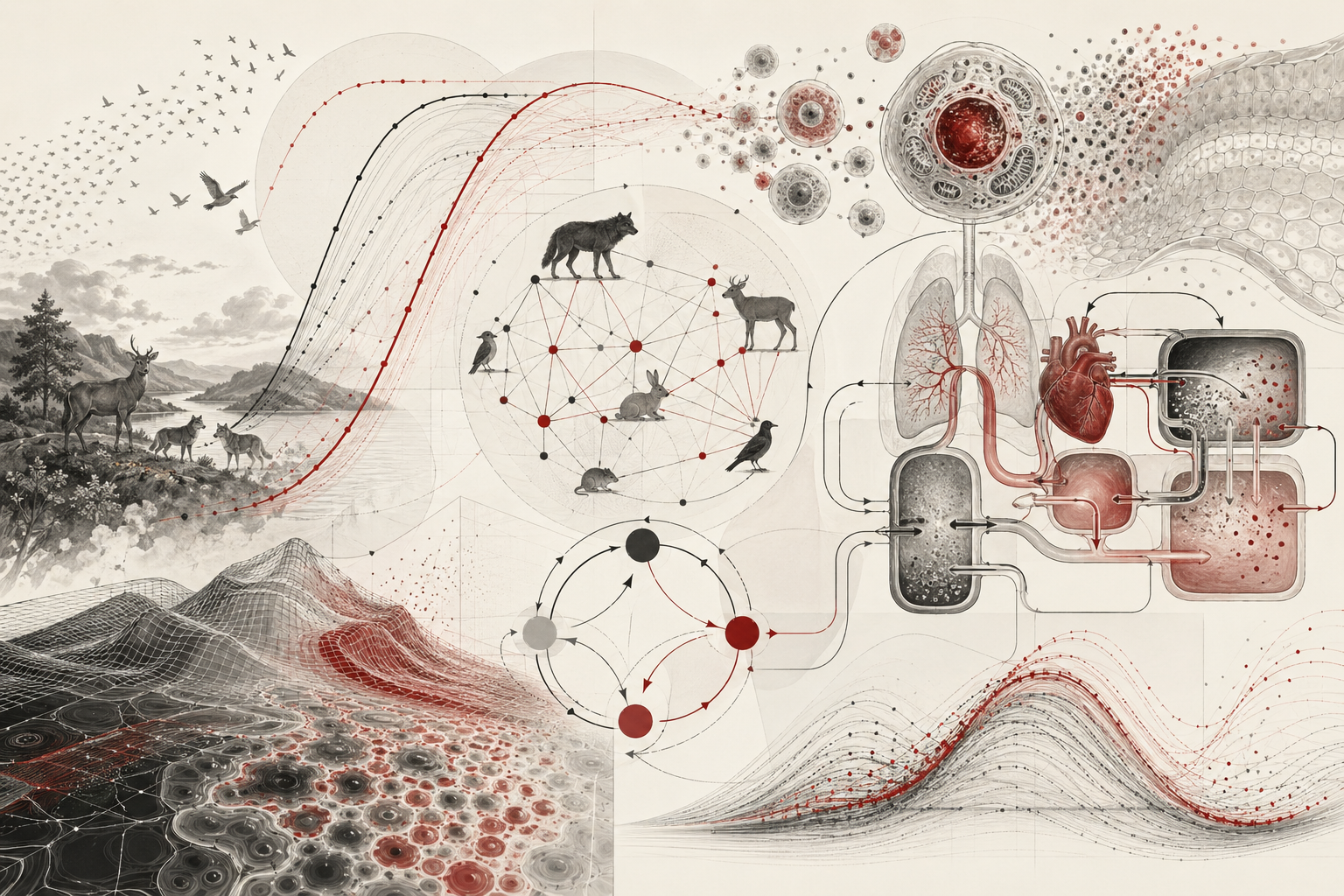
Differential equations in population and physiological modeling provide biology with a formal language for studying change: growth, decline, regulation, feedback, disease transmission, drug concentration, metabolic control, neural activity, ecological interaction, and the dynamic maintenance of living systems. Biology is not static. Populations expand or collapse. Hormones rise and fall. Cells divide, differentiate, and die. Pathogens spread. Drugs enter and leave tissues. Oxygen, glucose, nutrients, temperature, pressure, and signal molecules are regulated through time. Differential equations help scientists represent these changing processes as systems of rates, states, parameters, feedbacks, thresholds, and constraints.
This article introduces differential equations as one of the central mathematical tools of modern biology. It explains why rate-based models are essential for population biology, ecology, physiology, pharmacology, epidemiology, systems biology, neuroscience, biotechnology, and environmental science. It also distinguishes ordinary differential equations, partial differential equations, delay differential equations, stochastic differential equations, and compartmental models, showing how each becomes useful when biological systems change through time, space, interaction, and uncertainty.
Main Library
Publications
Article Map
Biology
Related Topic
Mathematical Modeling
Related Topic
Physics
Related Topic
Environmental Science
The article is written for biologists, ecologists, marine biologists, biomedical researchers, physiologists, biotechnology scientists, computational biologists, engineers, applied mathematicians, environmental scientists, epidemiologists, and scientific readers who need a rigorous but usable framework for modeling living systems dynamically. It treats differential equations not as abstract mathematics removed from biology, but as a disciplined way to make biological assumptions explicit, simulate mechanisms, estimate parameters, test hypotheses, and reason about stability, resilience, control, and uncertainty.
The article also extends the discussion into reproducible computational practice through exponential and logistic growth, Lotka-Volterra predator-prey systems, SIR epidemic models, pharmacokinetic compartment models, glucose-insulin regulation, chemostat dynamics, physiological feedback loops, numerical integration, stability analysis, sensitivity analysis, R workflows, Python workflows, SQL provenance structures, and a linked full-stack GitHub repository containing Python, R, Julia, Fortran, Rust, Go, C, C++, SQL, notebooks, data files, validation notes, and reproducibility documentation.
Why differential equations belong in biology
Differential equations belong in biology because living systems change through time. A population grows according to births, deaths, immigration, emigration, competition, predation, and resource constraint. A physiological system regulates glucose, oxygen, temperature, pressure, pH, hormones, and neural signals through feedback loops. A pathogen spreads through contact, replication, immunity, and recovery. A drug concentration rises after administration and declines through metabolism and clearance. A microbial culture grows, consumes substrate, and produces metabolites. These are all rate processes.
A differential equation describes how a quantity changes. In biology, the quantity might be population size, cell density, pathogen load, hormone concentration, drug amount, nutrient concentration, membrane voltage, tumor volume, immune-cell abundance, or biomass. The equation does not claim to contain the whole living system. It states a disciplined hypothesis about the rates that drive change.
This is why differential equations are powerful. They force biological assumptions into explicit form. What increases the state variable? What decreases it? Which feedbacks matter? Which processes are nonlinear? Which parameters represent growth, mortality, clearance, predation, transmission, sensitivity, saturation, or delay? What happens if the initial condition changes? What happens if a parameter shifts? Does the system stabilize, oscillate, collapse, or move toward a new state?
Biology often needs this kind of reasoning because intuition fails in dynamic systems. A feedback loop may stabilize a physiological variable until a threshold is crossed. A predator-prey system may oscillate. A drug dose may produce nonlinear concentration profiles. An epidemic may grow quickly at first and then slow as susceptible individuals decline. A population may appear stable but become vulnerable under small changes in mortality. Differential equations help reveal these dynamic consequences.
Rates, states, and biological change
A differential-equation model begins with state variables and rates. A state variable describes the current condition of the system. In a population model, the state may be abundance \(N(t)\). In a disease model, states may include susceptible, infected, and recovered compartments. In physiology, states may include glucose concentration, insulin concentration, blood pressure, temperature, or drug amount. In ecology, states may include prey, predator, nutrient, biomass, and detritus pools.
Rates describe how these states change. Birth increases population size. Death decreases it. Infection moves individuals from susceptible to infected compartments. Recovery moves individuals from infected to recovered compartments. Clearance removes drug from plasma. Feedback reduces deviation from a physiological set point. Predation decreases prey and may increase predators. Nutrient uptake decreases substrate and increases biomass.
The structure of a differential equation therefore reflects biological reasoning. A term such as \(rN\) represents growth proportional to population size. A term such as \(-cN\) represents loss proportional to abundance. A term such as \(-\beta SI\) represents interaction between susceptible and infected individuals. A term such as \(V_{\max}S/(K_m+S)\) represents saturating uptake or enzyme kinetics. These terms are not arbitrary. They encode assumptions about mechanism.
This also means the quality of a differential-equation model depends on biological interpretation. A mathematically elegant equation can be biologically poor if its terms do not correspond to plausible processes. A simple equation can be biologically useful if it captures the dominant mechanism for the question being asked.
Ordinary differential equations in living systems
Ordinary differential equations, or ODEs, model change over one independent variable, usually time. They are common in biology because many biological questions ask how a system evolves: how a population changes, how a concentration changes, how a disease spreads, how a physiological variable returns to baseline, or how a biochemical pathway responds to perturbation.
An ODE model may contain one equation or many coupled equations. A single equation can model exponential or logistic population growth. A system of equations can model predator-prey interaction, epidemic dynamics, glucose-insulin regulation, pharmacokinetics, immune response, neural activity, or metabolic networks. Coupled equations are especially important because living systems are interactive. One state variable changes another, which may feed back into the first.
ODEs are not limited to theoretical biology. They are used in pharmacology, physiology, epidemiology, microbial biotechnology, cancer modeling, immunology, ecology, neuroscience, synthetic biology, and systems biology. Their value lies in their ability to connect mechanism, parameter, state, time, and outcome.
A well-built ODE model should define variables, units, parameter meanings, initial conditions, assumptions, and limitations. It should also be compared with data when used for inference or prediction. In research settings, ODE models often require parameter estimation, sensitivity analysis, uncertainty quantification, and validation against independent observations.
Population growth and density dependence
Population growth is one of the classic uses of differential equations in biology. The simplest model assumes that the rate of change in population size is proportional to the current population. This model produces exponential growth. It can be useful for early growth phases, microbial cultures, invasive population expansion, or idealized reproductive processes. But it cannot continue indefinitely because real populations face limits.
The logistic equation adds density dependence. When population size is small relative to carrying capacity, growth approximates exponential growth. As population size approaches carrying capacity, growth slows. This model is useful because it introduces resource limitation, crowding, competition, waste accumulation, or habitat constraint in a simple form.
Population models can become much richer. They may include age structure, stage structure, spatial dispersal, stochasticity, harvesting, Allee effects, seasonal forcing, density-dependent mortality, immigration, emigration, or environmental variation.
Still, the basic insight remains: population biology often concerns rates of change, and differential equations provide a language for those rates.
Predator-prey and ecological interaction
Ecological systems are shaped by interactions among organisms. Predator-prey dynamics are a foundational example because the abundance of one population affects the growth or decline of another. Coupled differential equations can show how prey growth and predator mortality interact with predation and conversion efficiency.
This kind of model shows how coupled biological interactions can produce oscillations. Prey increase when predators are rare. Predators increase when prey are abundant. As predators increase, prey decline. As prey decline, predators later decline. The cycle can repeat under certain assumptions.
Real ecosystems are more complex. Predation may saturate. Prey may have refuges. Predators may switch prey. Environments may vary. Populations may be spatially structured. Still, the differential-equation framework helps biologists ask structured questions: which interaction terms matter, what stabilizes the system, what destabilizes it, and how changes in parameters affect ecological outcomes.
This is especially important in fisheries, conservation biology, invasive species management, restoration ecology, marine food webs, and climate-ecology interactions.
Epidemic and host-pathogen dynamics
Epidemic models are another major area where differential equations are central. A simple SIR model divides a population into susceptible, infected, and recovered compartments. The model tracks flows among compartments: susceptible individuals become infected, infected individuals recover or are removed, and recovered individuals no longer participate in the same transmission process under the model’s assumptions.
This model is simplified, but it captures an important dynamic: infection grows when transmission from susceptible to infected exceeds recovery. As susceptible individuals decline, transmission slows. The epidemic peak depends on parameters, initial conditions, and population structure.
More advanced models include exposed compartments, asymptomatic infection, waning immunity, vaccination, age structure, spatial movement, network contacts, stochastic outbreak extinction, pathogen evolution, vector transmission, within-host dynamics, and behavioral feedback. Host-pathogen models can also link population-level transmission to physiological or immunological processes within individuals.
Differential equations are useful here because disease is a dynamic process. Static summaries cannot show how timing, transmission, recovery, immunity, intervention, and feedback shape outbreak trajectories.
Physiological regulation and homeostasis
Physiology depends on regulation through time. Organisms maintain internal conditions within viable ranges despite changing external and internal conditions. Differential equations help model this because regulation is a dynamic process involving feedback, delay, sensitivity, and response.
A simple homeostatic model can represent a variable returning toward a set point. This logic appears in many biological contexts: temperature regulation, hormone return to baseline, chemical concentration control, or recovery from perturbation.
Physiological systems are usually more complex. Glucose regulation involves food intake, insulin secretion, tissue uptake, liver production, and feedback. Cardiovascular regulation involves pressure, resistance, heart rate, vessel tone, neural control, and hormones. Respiratory regulation involves oxygen, carbon dioxide, ventilation, blood chemistry, and neural feedback. Neural systems involve membrane potentials, ion channels, synapses, oscillations, and excitability.
Differential equations make it possible to study how these systems behave dynamically. They can reveal whether a physiological system returns to baseline, overshoots, oscillates, destabilizes, or fails under stress. This makes them valuable for physiology, medicine, biomedical engineering, pharmacology, and systems biology.
Pharmacokinetics and biomedical compartment models
Pharmacokinetics studies how drug concentrations change in the body through absorption, distribution, metabolism, and elimination. Differential equations are central because these processes involve rates. A simple one-compartment intravenous bolus model represents drug concentration declining through elimination. The solution is exponential decay.
A two-compartment model can represent transfer between central and peripheral compartments. These models are used in drug development, dosing design, therapeutic monitoring, toxicology, pharmacodynamics, and biomedical engineering. More advanced models may include nonlinear elimination, saturable binding, time-varying clearance, tissue compartments, population variability, and drug-response models.
The same compartmental logic appears beyond pharmacology: tracer studies, hormone kinetics, nutrient transport, infection models, immune dynamics, and ecological flow models. Compartments are a general way to represent quantities moving among biological states.
Biomedical compartment modeling is powerful because it connects physiological interpretation with rate structure. It asks where a substance is, where it moves, how quickly it moves, how it is cleared, and how those processes shape biological or clinical response.
Chemostats, microbial growth, and biotechnology
Chemostats and bioreactors are important examples of differential-equation modeling in biotechnology and microbiology. In a chemostat, fresh medium enters and culture leaves at a controlled dilution rate. Microbes consume substrate and grow. The system couples biomass growth, substrate consumption, dilution, and input concentration.
Chemostat models help scientists and engineers analyze washout, steady state, nutrient limitation, productivity, growth efficiency, and process control. They also show why biotechnology is not simply biological manipulation. It is dynamic system design under living constraints.
Growth-rate functions such as Monod kinetics can represent substrate-dependent microbial growth. At low substrate, growth depends strongly on resource availability. At high substrate, growth approaches a maximum rate. This mirrors the broader logic of saturation throughout biology.
Chemostat logic can also inform ecology, microbial competition, synthetic biology, fermentation, wastewater treatment, bioremediation, and microbial community engineering.
Partial, delay, and stochastic differential equations
Ordinary differential equations model change through time without explicit spatial structure. But many biological systems require richer mathematical forms.
Partial differential equations, or PDEs, model change across time and space. They are useful for diffusion, transport, wave propagation, spatial pattern formation, tumor invasion, wound healing, morphogen gradients, population spread, plankton dynamics, oxygen diffusion, and environmental dispersal. Reaction-diffusion equations can represent the combined effects of local growth or reaction and spatial movement.
Delay differential equations represent processes where effects occur after a time delay. Delays are common in biology: gestation, maturation, immune response, transcriptional regulation, hormonal feedback, disease incubation, and developmental timing. A delayed feedback model may behave very differently from an instantaneous feedback model.
Stochastic differential equations include random fluctuations. They are useful when noise matters: gene expression, small populations, neural systems, environmental variability, demographic stochasticity, or uncertain physiological perturbations. Biology often needs stochastic models because living systems are variable and finite.
Choosing among ODEs, PDEs, delay equations, and stochastic equations depends on the biological question. Time, space, delay, and noise are not mathematical details. They are biological features.
Stability, equilibria, and biological resilience
Differential equations allow scientists to study equilibrium and stability. An equilibrium occurs when rates of change are zero. In biological terms, this might represent a stable population size, steady drug concentration, disease-free state, endemic infection level, physiological set point, or chemostat steady state.
Stability asks what happens after perturbation. If a system returns to equilibrium, the equilibrium is stable. If it moves away, the equilibrium is unstable. This is biologically important because living systems are constantly perturbed. A resilient ecosystem may recover after disturbance. A healthy physiological system may restore homeostasis after stress. A disease system may return to low prevalence or move toward outbreak. A bioreactor may recover from fluctuation or fail.
Stability analysis can reveal thresholds. A disease may invade only when transmission exceeds recovery. A chemostat may wash out if dilution rate exceeds growth capacity. A population may collapse if mortality crosses a threshold. A physiological feedback loop may oscillate if delay or gain is too high.
These insights are central to ecology, medicine, physiology, conservation, biotechnology, and environmental systems. Differential equations do not merely simulate change; they help identify the conditions under which systems persist, fail, or transform.
Numerical integration and computational modeling
Many biological differential equations cannot be solved analytically in simple closed form. Computational methods are therefore essential. Numerical integration approximates system behavior step by step. Simple methods such as Euler integration are useful for teaching and transparent demonstrations, while research-grade work often uses more accurate and stable solvers such as Runge-Kutta methods, adaptive solvers, stiff solvers, PDE solvers, or stochastic simulation algorithms.
Computational modeling requires more than code. A reproducible model should define variables, units, parameters, initial conditions, equations, solver settings, data sources, random seeds, outputs, and limitations. It should also support validation, sensitivity analysis, uncertainty propagation, and transparent provenance.
The choice of solver matters. Some physiological and biochemical systems are stiff, meaning they contain processes operating on very different time scales. Some ecological systems are sensitive to parameter changes. Some stochastic systems require many simulations. Some PDE models require stability conditions related to time step and spatial grid. Numerical artifacts can be mistaken for biological behavior if the computation is not checked.
For this reason, differential-equation modeling in biology is both mathematical and computational. The model is the equation, but the scientific result depends on implementation, validation, and interpretation.
Mathematical lens: core equations
Several differential-equation structures appear repeatedly in biological modeling. These expressions do not replace empirical biology, field observation, laboratory measurement, physiological interpretation, or clinical judgment. They help clarify how growth, feedback, interaction, transmission, clearance, resource limitation, and spatial spread can be represented formally.
Exponential growth
\frac{dN}{dt}=rN
\]
Interpretation: Population size \(N\) changes at a rate proportional to its current size. The parameter \(r\) represents per-capita growth under the assumptions of the model.
N(t)=N_0e^{rt}
\]
Interpretation: The exponential-growth solution shows how population size changes from initial condition \(N_0\) when growth rate \(r\) remains constant.
Logistic growth
\frac{dN}{dt}=rN\left(1-\frac{N}{K}\right)
\]
Interpretation: Logistic growth adds carrying capacity \(K\). Growth slows as the population approaches environmental limits.
Predator-prey system
\frac{dX}{dt}=\alpha X-\beta XY
\]
Interpretation: Prey population \(X\) grows at rate \(\alpha\) and declines through interaction with predator population \(Y\).
\frac{dY}{dt}=\delta XY-\gamma Y
\]
Interpretation: Predator population \(Y\) grows through predation-mediated conversion and declines through mortality rate \(\gamma\).
SIR epidemic model
\frac{dS}{dt}=-\beta SI
\]
Interpretation: The susceptible population \(S\) declines through transmission involving infected individuals \(I\).
\frac{dI}{dt}=\beta SI-\gamma I
\]
Interpretation: The infected population \(I\) grows through new infection and declines through recovery or removal at rate \(\gamma\).
\frac{dR}{dt}=\gamma I
\]
Interpretation: The recovered or removed population \(R\) grows as infected individuals leave the infectious state.
Homeostatic return to set point
\frac{dx}{dt}=-k(x-x^*)
\]
Interpretation: Variable \(x\) returns toward set point \(x^*\) at return rate \(k\). This captures a simple negative-feedback control logic.
One-compartment pharmacokinetic model
\frac{dC}{dt}=-kC
\]
Interpretation: Drug concentration \(C\) declines through elimination rate \(k\). This produces exponential decay under the model’s assumptions.
Chemostat model
\frac{dX}{dt}=\mu(S)X-DX
\]
Interpretation: Biomass \(X\) grows according to substrate-dependent growth rate \(\mu(S)\) and is removed by dilution rate \(D\).
\frac{dS}{dt}=D(S_{in}-S)-\frac{1}{Y}\mu(S)X
\]
Interpretation: Substrate \(S\) changes through inflow, dilution, and microbial consumption. The yield coefficient \(Y\) links substrate consumption to biomass growth.
Reaction-diffusion model
\frac{\partial u}{\partial t}=D\nabla^2u+f(u)
\]
Interpretation: Spatially distributed state \(u\) changes through diffusion and local reaction or growth. This structure is useful for spatial patterning, dispersal, transport, and morphogen dynamics.
R and Python workflows
The following examples are compact article-level workflows. The full GitHub repository expands them into richer multi-language implementations with SQL provenance, validation notes, simulations, sensitivity analysis, solver comparisons, and reproducible scaffolding.
R example: logistic growth by Euler integration
# Logistic growth model using Euler integration.
#
# Example uses:
# microbial growth, population biology, conservation biology,
# cell culture expansion, or resource-limited biological systems.

simulate_logistic <- function(N0, r, K, dt = 0.05, t_end = 40) {
  time <- seq(0, t_end, by = dt)
  N <- numeric(length(time))
  N[1] <- N0

  for (i in 2:length(time)) {
    dN <- r * N[i - 1] * (1 - N[i - 1] / K)
    N[i] <- max(N[i - 1] + dN * dt, 0)
  }

  data.frame(time = time, population = N)
}

trajectory <- simulate_logistic(
  N0 = 100,
  r = 0.30,
  K = 2000,
  dt = 0.05,
  t_end = 40
)

summary_df <- data.frame(
  initial_population = trajectory$population[1],
  final_population = tail(trajectory$population, 1),
  carrying_capacity = 2000,
  fraction_of_capacity = tail(trajectory$population, 1) / 2000
)

print(round(summary_df, 4))
R example: physiological homeostasis
# Simple homeostatic return-to-set-point model.
#
# Example uses:
# hormone recovery, temperature regulation, biomarker return,
# pressure regulation, or physiological perturbation response.

simulate_homeostasis <- function(x0, set_point, k, dt = 0.05, t_end = 30) {
  time <- seq(0, t_end, by = dt)
  x <- numeric(length(time))
  x[1] <- x0

  for (i in 2:length(time)) {
    dx <- -k * (x[i - 1] - set_point)
    x[i] <- x[i - 1] + dx * dt
  }

  data.frame(time = time, state = x)
}

trajectory <- simulate_homeostasis(
  x0 = 180,
  set_point = 100,
  k = 0.18,
  dt = 0.05,
  t_end = 30
)

summary_df <- data.frame(
  initial_state = trajectory$state[1],
  final_state = tail(trajectory$state, 1),
  set_point = 100,
  absolute_error_final = abs(tail(trajectory$state, 1) - 100)
)

print(round(summary_df, 4))
Python example: predator-prey dynamics
import numpy as np
import pandas as pd

def simulate_predator_prey(
    prey0,
    predator0,
    alpha,
    beta,
    delta,
    gamma,
    dt=0.01,
    t_end=80,
):
    """Simulate Lotka-Volterra predator-prey dynamics."""
    time = np.arange(0, t_end + dt, dt)
    prey = np.zeros_like(time)
    predator = np.zeros_like(time)

    prey[0] = prey0
    predator[0] = predator0

    for i in range(1, len(time)):
        dprey = alpha * prey[i - 1] - beta * prey[i - 1] * predator[i - 1]
        dpredator = delta * prey[i - 1] * predator[i - 1] - gamma * predator[i - 1]

        prey[i] = max(prey[i - 1] + dprey * dt, 0.0)
        predator[i] = max(predator[i - 1] + dpredator * dt, 0.0)

    return pd.DataFrame(
        {
            "time": time,
            "prey": prey,
            "predator": predator,
        }
    )

trajectory = simulate_predator_prey(
    prey0=40,
    predator0=9,
    alpha=0.60,
    beta=0.025,
    delta=0.018,
    gamma=0.35,
)

summary = pd.DataFrame(
    {
        "final_prey": [trajectory["prey"].iloc[-1]],
        "final_predator": [trajectory["predator"].iloc[-1]],
        "max_prey": [trajectory["prey"].max()],
        "max_predator": [trajectory["predator"].max()],
        "mean_prey": [trajectory["prey"].mean()],
        "mean_predator": [trajectory["predator"].mean()],
    }
)

print(summary.round(4).to_string(index=False))
Python example: pharmacokinetic one-compartment model
import numpy as np
import pandas as pd

def simulate_one_compartment(C0, elimination_rate, dt=0.05, t_end=48):
    """Simulate one-compartment exponential drug elimination."""
    time = np.arange(0, t_end + dt, dt)
    concentration = np.zeros_like(time)
    concentration[0] = C0

    for i in range(1, len(time)):
        dC = -elimination_rate * concentration[i - 1]
        concentration[i] = max(concentration[i - 1] + dC * dt, 0.0)

    return pd.DataFrame(
        {
            "time": time,
            "concentration": concentration,
        }
    )

trajectory = simulate_one_compartment(
    C0=20.0,
    elimination_rate=0.12,
    dt=0.05,
    t_end=48,
)

half_life = np.log(2) / 0.12

summary = pd.DataFrame(
    {
        "initial_concentration": [trajectory["concentration"].iloc[0]],
        "final_concentration": [trajectory["concentration"].iloc[-1]],
        "elimination_rate": [0.12],
        "half_life": [half_life],
    }
)

print(summary.round(4).to_string(index=False))
Python example: chemostat dynamics
import numpy as np
import pandas as pd

def monod_growth(substrate, mu_max, K_s):
    return mu_max * substrate / (K_s + substrate)

def simulate_chemostat(
    X0,
    S0,
    S_in,
    dilution_rate,
    yield_coefficient,
    mu_max,
    K_s,
    dt=0.01,
    t_end=80,
):
    """Simulate simple chemostat biomass-substrate dynamics."""
    time = np.arange(0, t_end + dt, dt)
    biomass = np.zeros_like(time)
    substrate = np.zeros_like(time)

    biomass[0] = X0
    substrate[0] = S0

    for i in range(1, len(time)):
        mu = monod_growth(substrate[i - 1], mu_max, K_s)

        dX = mu * biomass[i - 1] - dilution_rate * biomass[i - 1]
        dS = dilution_rate * (S_in - substrate[i - 1]) - (1 / yield_coefficient) * mu * biomass[i - 1]

        biomass[i] = max(biomass[i - 1] + dX * dt, 0.0)
        substrate[i] = max(substrate[i - 1] + dS * dt, 0.0)

    return pd.DataFrame(
        {
            "time": time,
            "biomass": biomass,
            "substrate": substrate,
        }
    )

trajectory = simulate_chemostat(
    X0=0.1,
    S0=10.0,
    S_in=20.0,
    dilution_rate=0.20,
    yield_coefficient=0.50,
    mu_max=0.80,
    K_s=2.0,
)

summary = pd.DataFrame(
    {
        "final_biomass": [trajectory["biomass"].iloc[-1]],
        "final_substrate": [trajectory["substrate"].iloc[-1]],
        "max_biomass": [trajectory["biomass"].max()],
        "min_substrate": [trajectory["substrate"].min()],
    }
)

print(summary.round(4).to_string(index=False))GitHub repository
The article body includes compact R and Python examples so the scientific argument remains readable. The full repository expands those examples into a rigorous differential-equation modeling workflow, including exponential and logistic population growth, predator-prey systems, SIR epidemic dynamics, homeostatic physiological regulation, one- and two-compartment pharmacokinetic models, chemostat dynamics, reaction-diffusion scaffolds, numerical integration, equilibrium and stability summaries, sensitivity analysis, SQL provenance structures, validation notes, reproducible data files, and full-stack scientific-computing examples across Python, R, Julia, Fortran, Rust, Go, C, C++, SQL, and notebooks.
Limits, validation, and responsible modeling
Differential-equation models can clarify biological dynamics, but they can also mislead when assumptions are hidden or validation is weak. A model may reproduce one dataset while failing under new conditions. A parameter may appear precise but be poorly identifiable. A numerical solver may introduce artifacts. A model may omit critical biology, such as spatial structure, stochasticity, time delay, age structure, immune memory, tissue heterogeneity, or behavioral feedback.
Responsible modeling requires clear variables, units, assumptions, initial conditions, parameter sources, solver choices, sensitivity analysis, uncertainty quantification, and validation against empirical observations. It also requires humility. A differential equation is not the living system. It is a structured representation of selected processes.
The ethical stakes can be high. Differential-equation models can inform public health, drug dosing, ecological management, biotechnology control, conservation planning, and physiological interpretation. Overconfident models can cause harm. Transparent uncertainty, reproducible code, and careful interpretation are therefore part of responsible biological modeling.
Why differential-equation modeling matters
Differential-equation modeling matters because biology is dynamic. Many of the most important biological questions are questions of change: how fast does a population grow, how does an epidemic spread, how does a physiological variable return to baseline, how does a drug clear, how does a microbial culture respond to nutrient supply, how does a predator-prey system oscillate, and how does a system fail when regulation breaks down?
It also matters because modern biology increasingly connects mechanism with computation. Differential equations allow scientists to simulate mechanisms, compare hypotheses, estimate parameters, test interventions, explore thresholds, and understand feedback. They help bridge observation and prediction.
Finally, differential equations matter because they connect biology to engineering. Physiological control, bioreactor design, biosensors, pharmacokinetics, synthetic biology, environmental monitoring, and ecological management all require models of dynamic systems under constraint. Differential equations provide one of the major languages through which living systems become analyzable, controllable, and responsibly interpretable.
Conclusion
Differential equations in population and physiological modeling give biology a formal language for change. They allow scientists to represent growth, regulation, feedback, interaction, disease transmission, drug clearance, microbial dynamics, ecological systems, and physiological homeostasis as explicit rate processes. They do not replace empirical biology. They make biological assumptions visible, testable, computable, and revisable.
The power of differential equations lies in their ability to connect states, rates, parameters, time, and mechanism. A good model asks what changes, why it changes, how fast it changes, what constrains it, and what happens when conditions shift. These are biological questions before they are mathematical ones.
To understand living systems rigorously, biology must understand dynamics. Differential equations provide one of the most important tools for that task.
Related articles
- Biology
- What Is Biology? Life, Evolution, and Living Systems
- Mathematical Biology and the Logic of Living Systems
- Probability, Variation, and Biological Inference
- Statistics, Uncertainty, and Measurement in Biology
- Biostatistics and Experimental Design in Biology
- Population Dynamics and Ecological Modeling
- Physiology and the Regulation of Living Systems
- Systems Biology and the Logic of Biological Integration
- Ecology and the Interdependence of Life
- Microbiology and the Hidden Majority of Life
Further reading
- OpenStax (2018) ‘Environmental Limits to Population Growth’, in Biology 2e. Available at: https://openstax.org/books/biology-2e/pages/45-3-environmental-limits-to-population-growth
- OpenStax (2016) ‘The Logistic Equation’, in Calculus Volume 2. Available at: https://openstax.org/books/calculus-volume-2/pages/4-4-the-logistic-equation
- NCBI Bookshelf (2005) ‘Modeling Processes Within the Cell’, in Mathematics and 21st Century Biology. Available at: https://www.ncbi.nlm.nih.gov/books/NBK220541/
- NCBI Bookshelf (2017) ‘Biophysical Mechanistic Modeling: Choosing the Right Model Equations’. Available at: https://www.ncbi.nlm.nih.gov/books/NBK544602/
- NIGMS (2026) ‘Bioinformatics and Computational Biology’. Available at: https://www.nigms.nih.gov/about/overview/BBCB/bioinfocomp/Pages/default
- Society for Mathematical Biology (n.d.) ‘Population Dynamics, Ecology & Evolution’. Available at: https://smb.org/Population-Dynamics-Ecology-%26-Evolution
- Daun, S. et al. (2008) ‘Equation-based models of dynamic biological systems’, Journal of Critical Care. Available at: https://pmc.ncbi.nlm.nih.gov/articles/PMC6698907/
- Qu, Z. et al. (2011) ‘Multi-scale modeling in biology: how to bridge the gaps between scales?’, Progress in Biophysics and Molecular Biology. Available at: https://pmc.ncbi.nlm.nih.gov/articles/PMC3190585/
- Murray, J.D. (2002) Mathematical Biology I: An Introduction. 3rd edn. New York: Springer.
- Keener, J. and Sneyd, J. (2009) Mathematical Physiology. 2nd edn. New York: Springer.
References
- Daun, S. et al. (2008) ‘Equation-based models of dynamic biological systems’, Journal of Critical Care. Available at: https://pmc.ncbi.nlm.nih.gov/articles/PMC6698907/
- Keener, J. and Sneyd, J. (2009) Mathematical Physiology. 2nd edn. New York: Springer.
- Murray, J.D. (2002) Mathematical Biology I: An Introduction. 3rd edn. New York: Springer.
- NCBI Bookshelf (2005) ‘Modeling Processes Within the Cell’, in Mathematics and 21st Century Biology. Available at: https://www.ncbi.nlm.nih.gov/books/NBK220541/
- NCBI Bookshelf (2017) ‘Biophysical Mechanistic Modeling: Choosing the Right Model Equations’. Available at: https://www.ncbi.nlm.nih.gov/books/NBK544602/
- NIGMS (2026) ‘Bioinformatics and Computational Biology’. Available at: https://www.nigms.nih.gov/about/overview/BBCB/bioinfocomp/Pages/default
- OpenStax (2016) ‘The Logistic Equation’, in Calculus Volume 2. Available at: https://openstax.org/books/calculus-volume-2/pages/4-4-the-logistic-equation
- OpenStax (2018) ‘Environmental Limits to Population Growth’, in Biology 2e. Available at: https://openstax.org/books/biology-2e/pages/45-3-environmental-limits-to-population-growth
- Qu, Z. et al. (2011) ‘Multi-scale modeling in biology: how to bridge the gaps between scales?’, Progress in Biophysics and Molecular Biology. Available at: https://pmc.ncbi.nlm.nih.gov/articles/PMC3190585/
- Society for Mathematical Biology (n.d.) ‘Population Dynamics, Ecology & Evolution’. Available at: https://smb.org/Population-Dynamics-Ecology-%26-Evolution