
Last Updated August 4, 2026
Biotechnology gives human beings an unprecedented capacity to intervene in living systems: to edit genomes, redesign cells, engineer microbes, alter crops, manufacture biological therapies, redirect metabolic pathways, and reshape ecological possibilities. This power is neither inherently liberating nor inherently dangerous. It is a form of biological agency that must be understood scientifically, ethically, politically, and institutionally. Biotechnology does not simply study life. It increasingly changes what life can become.
This article examines biotechnology as a field of intervention. It explains how tools such as recombinant DNA, CRISPR-Cas systems, base editing, prime editing, RNA technologies, synthetic biology, cell therapy, gene therapy, metabolic engineering, agricultural biotechnology, environmental biotechnology, and gene drives create new possibilities for medicine, food systems, conservation, climate resilience, manufacturing, and ecological repair. It also examines why these possibilities require biosafety, biosecurity, justice, public accountability, and careful governance.
Main Library
Publications
Article Map
Biology
Related Topic
Chemistry
Related Topic
Environmental Science
Related Topic
Earth Science
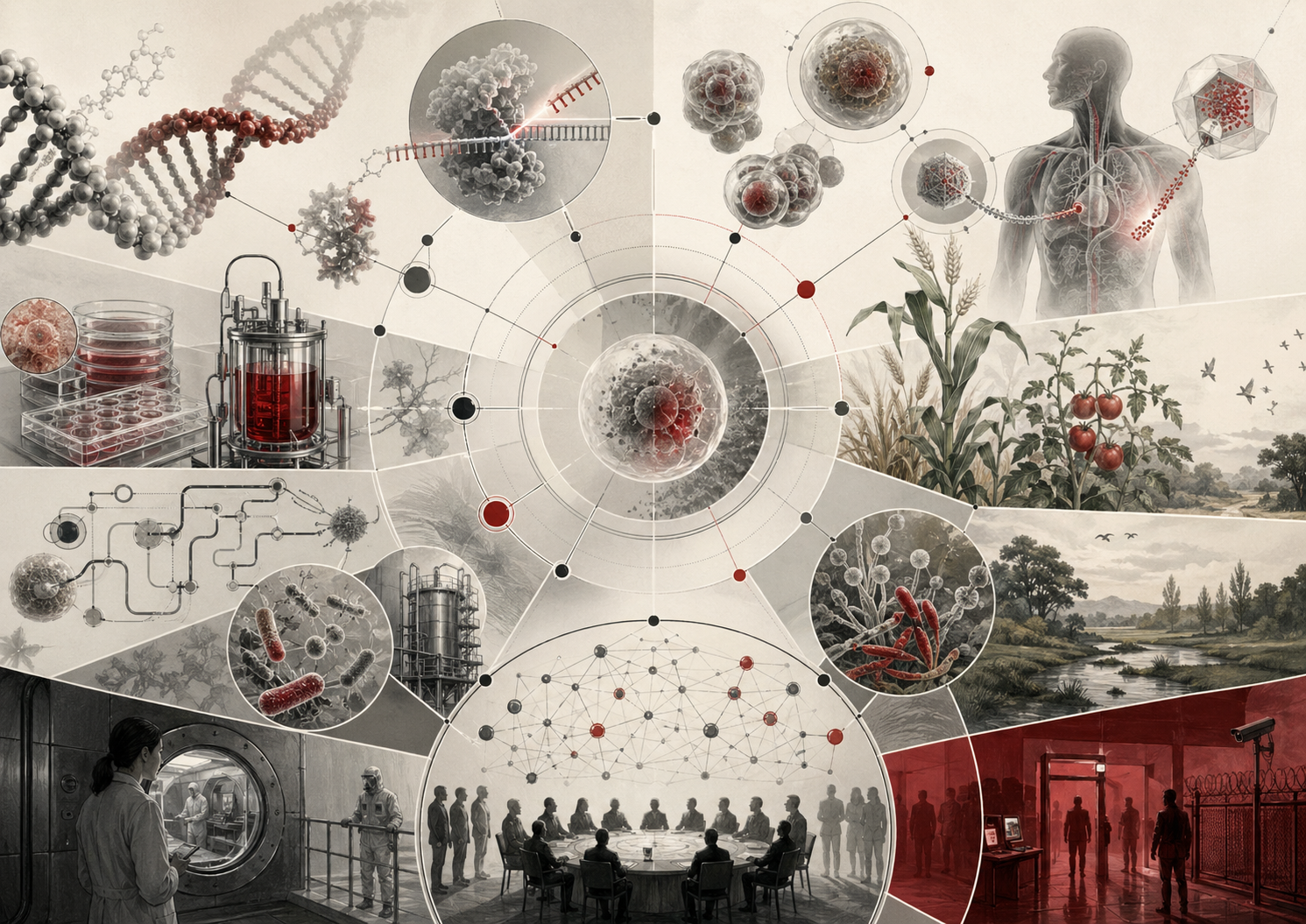
The central argument is that biotechnology should not be understood only as technical capability. It is also a system of responsibility. The power to alter life raises questions about uncertainty, consent, equity, ecological spillover, reversibility, access, dual use, ownership, indigenous and community rights, clinical risk, environmental release, and intergenerational consequence.
The article is written for biologists, molecular biologists, bioengineers, ecologists, environmental-health researchers, computational biologists, biodiversity scientists, biomedical researchers, policy readers, and scientific software developers interested in the relationship between biological knowledge, intervention, and responsible innovation.
Why biotechnology matters
Biotechnology matters because it converts biological knowledge into biological capability. A gene can be cloned, edited, silenced, inserted, synthesized, regulated, or redesigned. A cell can be reprogrammed, expanded, selected, engineered, or delivered as therapy. A microbe can be altered to produce enzymes, fuels, medicines, materials, or metabolic products. A crop can be modified for resistance, nutrition, productivity, or environmental tolerance. A biological system can become an object of design.
This makes biotechnology one of the most consequential scientific fields of the modern era. It connects medicine, agriculture, ecology, manufacturing, conservation, data science, public health, and environmental governance. It also connects laboratories to society in unusually direct ways. A biotechnology intervention may enter a patient’s body, a food supply, a field, a forest, a river, a microbial community, or a future lineage.
Biotechnology therefore raises a deeper question: what does it mean to intervene responsibly in living systems?
The answer cannot be found in technical performance alone. A therapy that works may still be inaccessible. A crop that improves yield may alter seed sovereignty. A gene drive that reduces disease vectors may change ecosystems. A synthetic organism that performs a useful function may create containment concerns. A genome-editing tool that cures disease may also invite enhancement, surveillance, or inequality.
Biotechnology is powerful because life is programmable only in limited, contextual, and uncertain ways. Living systems are not machines. They evolve, interact, adapt, mutate, reproduce, exchange genes, and respond to environments. Intervention in life is therefore intervention in dynamic systems.
Biotechnology in 2026: capability, translation, and uneven maturity
By 2026, biotechnology is no longer defined by a single platform or laboratory technique. It is an interconnected field spanning approved cell and gene therapies, early-stage genome-editing trials, programmable RNA systems, engineered immune cells, industrial fermentation, precision agriculture, environmental biosensing, synthetic nucleic-acid services, automated laboratories, and computational tools that help propose sequences, proteins, pathways, and experimental designs. The field’s maturity is uneven. Some interventions are licensed products with manufacturing controls and long-term follow-up obligations. Others remain preclinical, exploratory, or highly uncertain. Still others operate in policy environments that were designed for earlier generations of technology.
The clinical transition is especially visible. The U.S. Food and Drug Administration lists a growing portfolio of licensed cellular and gene-therapy products. CASGEVY became the first FDA-approved treatment using CRISPR/Cas9 genome editing in 2023, and in July 2026 the FDA expanded its indication for sickle cell disease and transfusion-dependent beta-thalassemia to patients aged two years and older. This is scientifically significant, but it should not be read as evidence that genome editing has become routine. CASGEVY requires collection of a patient’s own blood-forming stem cells, ex vivo editing, centralized manufacturing, myeloablative conditioning, transplantation, specialized clinical capacity, and monitoring for serious risks. The therapy illustrates both the power of genome editing and the infrastructure required to translate it responsibly.
Prime editing has also moved from a conceptual platform into early human research. A registered Phase 1/2 study is evaluating prime-edited autologous blood-forming stem cells for a rare form of chronic granulomatous disease. Early clinical reporting has made the transition historically important, but the evidence base remains small. The correct interpretation is not that prime editing is proven broadly. It is that a new class of precise editing has entered clinical testing, bringing delivery, manufacturing, durability, off-target assessment, conditioning, patient selection, and long-term follow-up into the center of evaluation.
Biotechnology’s industrial and environmental reach is expanding at the same time. The OECD describes synthetic biology as a foundational platform linking engineering, biology, computation, chemistry, automation, and artificial intelligence across health, agriculture, manufacturing, and environmental applications. Its 2026 work on anticipatory governance emphasizes guiding values, strategic intelligence, sustained stakeholder engagement, agile regulation, and international cooperation. This is an important shift. Governance is moving from a narrow question—whether a product passes a safety review—toward a lifecycle question: whether institutions can understand an evolving technology, identify cross-sector effects, revise controls, and remain accountable after deployment.
| Technology state | Typical evidence | Primary governance need |
|---|---|---|
| Established contained production | Validated process controls, batch records, quality testing, operating history | Manufacturing consistency, worker safety, waste control, supply-chain integrity |
| Licensed clinical product | Clinical evidence, product characterization, regulatory review, post-market obligations | Patient selection, affordability, long-term follow-up, manufacturing comparability |
| Early clinical editing | Small trials, mechanistic data, evolving assay methods | Uncertainty disclosure, independent review, adverse-event learning, cautious claims |
| Agricultural field deployment | Trait data, field trials, environmental and food-safety assessment | Resistance management, gene flow, farmer impacts, monitoring, regional fit |
| Environmental release | Models, contained studies, phased trials, ecological baseline data | Transboundary governance, reversibility, ecological monitoring, community authority |
| AI-enabled biological design | Benchmarking, validation experiments, model documentation, security testing | Access controls, provenance, sequence screening, misuse analysis, human oversight |
The central challenge in 2026 is therefore not a lack of biotechnology. It is a mismatch between rapidly increasing capability and uneven institutional capacity. Responsible development requires distinguishing what is technically possible, what is empirically supported, what is operationally scalable, what is socially legitimate, and what remains too uncertain or irreversible for deployment.
Biotechnology as intervention
Biotechnology differs from observational biology because it intentionally changes living matter. It does not only ask what genes do, how cells signal, how organisms develop, or how ecosystems function. It asks how biological systems can be modified to produce desired outcomes.
This intervention can occur at many scales:
- Molecular: editing DNA, modifying RNA, engineering proteins, or altering metabolic reactions.
- Cellular: reprogramming immune cells, stem cells, microbial cells, or synthetic circuits.
- Organismal: modifying crops, livestock, insects, laboratory animals, or disease models.
- Population: altering inheritance, vector competence, fertility, resistance, or selection pressures.
- Ecosystem: releasing engineered organisms, restoring degraded environments, or changing ecological interactions.
- Industrial: using cells as manufacturing platforms for medicines, materials, enzymes, fuels, and chemicals.
Intervention creates design choices. What trait should be modified? Which system should be targeted? What counts as success? How should uncertainty be measured? Who benefits? Who bears risk? What happens if the intervention spreads, fails, mutates, or becomes inaccessible to those who need it most?
Biotechnology therefore requires a dual literacy: biological precision and institutional judgment.
Intervention boundaries and deployment context
The same molecular edit can represent very different interventions depending on where it occurs and how it is deployed. Editing a cell line in a contained laboratory is not equivalent to editing autologous stem cells for reinfusion. Modifying a microbe inside a closed fermenter is not equivalent to releasing it into soil. Editing a crop trait inside a controlled breeding program is not equivalent to introducing the trait across landscapes with wild relatives. Biotechnology assessment must therefore begin with a deployment boundary rather than a tool name.
A useful boundary description includes the biological target, physical setting, intended recipients, pathways of exposure, duration, scale, replication potential, mobility, and institutional controls. It should also identify whether the intervention is self-limiting, self-propagating, vertically inherited, horizontally transferable, repeatedly administered, or recoverable after use. These properties determine which evidence matters.
| Deployment boundary | Dominant uncertainties | Monitoring horizon |
|---|---|---|
| Contained laboratory | Operator error, material identification, containment failure, waste handling | Experiment and facility lifecycle |
| Contained industrial bioprocess | Process drift, contamination, scale-up behavior, supply-chain substitution | Batch, campaign, and facility lifecycle |
| Ex vivo patient-specific therapy | Cell identity, edit distribution, conditioning toxicity, engraftment, durability | Years to potentially lifelong follow-up |
| In vivo therapy | Delivery distribution, tissue specificity, immune response, redosing, off-target effects | Clinical and post-market lifecycle |
| Agricultural release | Gene flow, resistance evolution, non-target effects, management dependence | Multiple seasons and landscapes |
| Ecological or self-propagating release | Spread, evolution, ecological interaction, governance across borders | Multigenerational and potentially indefinite |
Boundary analysis also prevents a common mistake: importing evidence from one context into another without justification. A kill switch validated in a laboratory strain under controlled conditions may not behave identically in a heterogeneous environment. An off-target assay in one cell type may not capture tissue-specific effects after in vivo delivery. A crop trait assessed in one ecological region may interact differently with local pests, climate, farming practice, and genetic diversity elsewhere.
Responsible biotechnology therefore treats context as part of the intervention. The product is not merely the edited sequence or engineered organism. The product is the sequence or organism plus its delivery system, manufacturing process, receiving environment, operating institutions, monitoring architecture, and rules for response when conditions change.
From recombinant DNA to genome editing
Modern biotechnology grew from the ability to manipulate DNA. Recombinant DNA made it possible to combine genetic material from different sources, clone genes, express proteins, and create genetically modified organisms. This opened pathways to insulin production, molecular biology research, transgenic models, agricultural biotechnology, and industrial biomanufacturing.
The recombinant DNA era also established a pattern that still matters: scientific possibility moved faster than social consensus. Early debates about recombinant DNA led to biosafety guidelines, containment practices, institutional biosafety committees, and an enduring recognition that molecular biology could create risks requiring oversight.
Genome editing intensified this pattern. Instead of inserting or manipulating genes through earlier recombinant methods, genome-editing tools allow targeted changes at specific genomic sites. CRISPR-Cas systems made genome editing more accessible, flexible, and scalable. What was once technically difficult became routine in many laboratories.
This accessibility is scientifically powerful, but it changes the governance problem. When tools become cheaper, faster, and more distributed, oversight cannot rely only on a small number of elite laboratories. Responsibility must extend across universities, companies, community laboratories, digital sequence providers, cloud laboratories, automated platforms, and international supply chains.
CRISPR, base editing, and prime editing
CRISPR-Cas systems use guide RNAs to direct molecular machinery to specific nucleic acid sequences. In genome editing, these systems can cut DNA, disrupt genes, insert sequences, or support precise edits when paired with cellular repair pathways. CRISPR has transformed functional genomics, disease modeling, agriculture, microbial engineering, and therapeutic development.
Base editing and prime editing extend the genome-editing toolkit. Base editing can chemically convert one DNA base into another without requiring a double-strand break. Prime editing uses a modified guide RNA and reverse transcriptase-like mechanism to install more precise edits. These tools reduce some risks associated with double-strand breaks, but they introduce their own questions about off-target activity, delivery, efficiency, mosaicism, immune response, and long-term effects.
In medicine, genome editing can target somatic cells, where changes affect the treated individual, or germline cells and embryos, where changes may be inherited. This distinction is ethically crucial. Somatic editing raises serious safety, access, and consent issues. Heritable editing raises additional questions about future persons, intergenerational effects, social pressure, disability justice, enhancement, and governance across borders.
In ecology and agriculture, genome editing raises different but equally important questions. A plant edit may affect land systems, markets, biodiversity, pesticide use, or farmer autonomy. An insect edit may affect food webs, disease transmission, or species interactions. A microbial edit may affect containment, horizontal gene transfer, or biogeochemical cycles.
The power of CRISPR is not only that it can edit DNA. It is that it makes biological intervention scalable.
Delivery, specificity, durability, and long-term follow-up
Genome editing is often described through the chemistry of the editor, but clinical and ecological performance frequently depends on delivery. An editor must reach the right cells, in sufficient quantity, for an appropriate duration, while limiting exposure elsewhere. Ex vivo approaches make some aspects of delivery more controllable because cells can be collected, edited, tested, selected, and returned. They also create complex manufacturing and conditioning burdens. In vivo approaches may avoid cell collection but must solve tissue targeting, biodistribution, immune response, intracellular delivery, and the possibility that the delivery vehicle itself affects safety.
Specificity has several layers. Sequence specificity concerns whether the editor acts at unintended genomic sites. Cell specificity concerns whether the intervention reaches unintended cell types. Tissue specificity concerns biodistribution. Functional specificity concerns whether the intended molecular change produces only the desired phenotype. A perfectly on-target edit can still create an unwanted biological effect if the target has multiple functions, if dosage changes are excessive, or if the edited cells behave differently over time.
Durability is similarly ambiguous. A transient RNA therapy may require repeated dosing but be easier to discontinue. A permanent genome edit may offer one-time benefit while creating a much longer monitoring obligation. Durable cell therapies can expand, contract, migrate, differentiate, or be selected by the body. Edited stem cells may generate descendant lineages for years. Environmental organisms can reproduce and evolve. The more durable an intervention, the less adequate a short pre-deployment observation window becomes.
Long-term follow-up should therefore be designed around plausible mechanisms rather than a generic calendar. Relevant outcomes may include clonal expansion, malignancy, immune effects, loss of efficacy, delayed off-target consequences, reproductive effects, ecological persistence, resistance evolution, horizontal gene transfer, and changes in community structure. Monitoring plans should specify who collects data, who pays, what thresholds trigger action, how participants or communities receive information, and what happens when the original sponsor no longer exists.
The scientific lesson is that precision at the molecular target does not eliminate system uncertainty. Responsible assessment connects molecular specificity to delivery, phenotype, time, and institutional capacity.
Heritable editing, enhancement, and future persons
Heritable human genome editing differs ethically and institutionally from somatic treatment because the intervention may affect descendants who cannot consent and may alter the human germline. The distinction is not only technical. Somatic editing can still create serious risks and inequities, but its intended effects are generally limited to the treated person. Heritable editing creates multigenerational consequences, reproductive implications, cross-border governance problems, and pressure to define which traits should be changed.
The scientific barriers remain substantial. Embryo editing can produce mosaicism, unintended changes, large genomic alterations, uncertain developmental effects, and outcomes that cannot be adequately studied before a pregnancy is established. Long-term consequences would unfold across development and potentially across generations. Preimplantation testing and established reproductive options may address some disease risks without editing embryos, although those alternatives have their own limits and ethical questions.
WHO’s governance framework distinguishes somatic, germline research not intended for reproduction, and heritable applications. WHO continues to state that it would be irresponsible to proceed with clinical applications of human germline genome editing at this time. The governance concern includes unsafe or unregistered research, medical travel, intellectual property, registries, international coordination, and mechanisms for reporting concerns.
Enhancement complicates the line between treatment and social preference. Traits such as cognition, height, appearance, athletic performance, behavior, or resistance to common conditions are polygenic, developmentally complex, and environmentally shaped. Attempts to optimize them can reinforce ableism, racism, class hierarchy, gender norms, and eugenic reasoning. Even a technically safe intervention could create coercive expectations if access is unequal or if parents, schools, militaries, employers, or insurers reward edited traits.
Disability perspectives are essential. Preventing suffering is not the same as treating disabled lives as undesirable. Communities differ in how they understand disease, identity, variation, and cure. Responsible governance should include people living with the conditions under discussion and should distinguish support for persons from efforts to eliminate traits or populations.
Future persons also raise a representation problem. No committee can obtain their consent. Institutions must therefore rely on stringent safety, necessity, proportionality, justice, and public-legitimacy standards. The burden of proof should increase with heritability, irreversibility, social pressure, and the availability of less consequential alternatives.
RNA, epigenetic, and programmable regulation
Biotechnology can alter biological function without permanently changing DNA sequence. Messenger RNA can provide temporary instructions for protein production. Small interfering RNA and antisense oligonucleotides can reduce or redirect gene expression. RNA editing can modify transcripts. Epigenetic editors can recruit activating or repressing machinery to genomic regions. CRISPR interference and CRISPR activation can change transcription without cutting DNA. These approaches expand the design space between conventional drugs and permanent genome alteration.
Non-permanent intervention can offer governance advantages. Effects may be dose-dependent, time-limited, or more reversible than a permanent edit. But reversibility is not automatic. Repeated exposure can create cumulative effects. Delivery vehicles can persist or provoke immune responses. Epigenetic states can be durable. Tissue distribution may be difficult to control. Some RNA technologies require chronic administration, creating access and adherence burdens that a one-time therapy may avoid.
The distinction between editing and regulation also matters ethically. A technology that changes gene expression may affect identity, development, cognition, immunity, or reproduction even if it does not alter DNA sequence. Governance should follow functional consequence rather than treating the absence of a permanent sequence change as proof of low concern.
Programmable regulation creates opportunities for adaptive therapies and biosystems that respond to biological signals. Engineered cells can be designed to activate only in a disease environment. Synthetic circuits can combine sensors, logic, and effectors. Yet each added control layer creates new failure modes: sensor error, leaky expression, circuit burden, mutation, context dependence, and interaction with host regulation. More sophisticated control can improve performance while increasing the need for transparent validation.
Synthetic biology and biological design
Synthetic biology treats biological systems as designable systems. It combines molecular biology, engineering, computation, automation, and systems thinking to build genetic circuits, engineered cells, synthetic pathways, biosensors, programmable microbes, cell-free systems, and biological manufacturing platforms.
Synthetic biology can support many beneficial applications:
- microbial production of medicines, enzymes, and biomaterials;
- engineered biosensors for environmental monitoring;
- cell-free diagnostics and field-deployable tests;
- synthetic metabolic pathways for sustainable chemistry;
- microbial systems for waste processing or bioremediation;
- programmable cell therapies;
- biomanufacturing platforms that reduce dependence on petrochemical processes.
But design language can be misleading if it implies complete control. Biological systems are evolved, context-sensitive, and embedded in environments. A genetic circuit may behave differently across strains, growth conditions, media, temperatures, or ecological settings. A synthetic pathway may burden host metabolism. A microbial chassis may mutate. A designed organism may interact with wild organisms in unexpected ways.
Synthetic biology therefore requires design-build-test-learn cycles, but also risk-assess-monitor-govern cycles. The same capacity to design biology for good can reduce barriers to misuse. DNA synthesis, automated laboratories, machine learning, and biological design tools can accelerate beneficial research, but they also increase the importance of screening, access control, institutional review, and biosecurity culture.
AI, automation, and biological design
Artificial intelligence and laboratory automation are changing the rate and distribution of biotechnology. Machine-learning systems can propose protein structures, candidate sequences, guide RNAs, regulatory elements, metabolic pathways, experimental conditions, and molecular designs. Robotic laboratories can execute iterative experiments. Cloud laboratories can allow users to run protocols remotely. DNA synthesis can convert digital designs into physical material. These capabilities can shorten design-build-test-learn cycles and broaden participation in biological engineering.
The opportunity is substantial. Computational design can search spaces too large for manual exploration, identify promising candidates, improve enzyme or antibody properties, reduce failed experiments, and support more efficient biomanufacturing. Automated data capture can improve reproducibility when protocols, materials, instrument settings, and analysis are recorded consistently.
The governance problem is that digital and biological systems are now connected. A model output can become a synthesis order. A software vulnerability can affect laboratory equipment. Poor training data can bias design toward well-characterized organisms and populations. Proprietary models can obscure why a sequence was proposed. Automated optimization can improve a function without understanding all secondary effects. Access to powerful design systems can also reduce barriers to harmful or high-consequence work.
Responsible AI-enabled biotechnology should include model documentation, provenance, human review, experimentally bounded claims, capability evaluation, security testing, sequence and customer screening where appropriate, cyberbiosecurity controls, and escalation paths for unusual designs. The relevant question is not whether AI “understands” biology. It is whether a sociotechnical system can convert computational suggestions into biological action safely, traceably, and accountably.
Automation also changes responsibility. When a design passes through a model provider, software interface, synthesis company, cloud laboratory, institution, and end user, no single actor sees the entire chain. Governance must therefore allocate duties across the chain rather than assuming that the final experimenter alone controls risk.
Biomanufacturing, climate, and bioeconomy claims
Biotechnology is increasingly presented as infrastructure for a low-carbon bioeconomy. Engineered organisms can produce enzymes, fuels, chemicals, food ingredients, pharmaceuticals, textiles, polymers, and materials. Fermentation can replace some petrochemical pathways, use renewable feedstocks, and operate under milder conditions. Biological processes can also create new waste streams, land demand, nutrient demand, water use, and supply-chain dependencies.
Environmental benefit should therefore be demonstrated through system boundaries rather than assumed from the word “bio.” A life-cycle assessment should identify feedstock production, land-use change, energy source, fermentation yield, purification, solvents, cooling, waste treatment, transport, product lifetime, and end-of-life. A biobased product can have high emissions or ecological burden if feedstocks drive deforestation, fertilizer use, water stress, or displacement. Conversely, a well-designed process can reduce hazardous chemistry and use waste carbon or residues productively.
Scale-up can change the answer. A pathway that is efficient in a laboratory may require expensive precursors or sterile conditions at industrial scale. Product recovery may dominate energy use. Contamination control may create material waste. A high-yield organism may be unstable over long campaigns. Economics can push companies toward cheaper feedstocks or locations with weaker environmental protections. Responsible claims should therefore be tied to audited operating data and should be revised as the process changes.
Climate claims also require additionality and opportunity-cost analysis. Carbon captured in a short-lived product may return quickly to the atmosphere. Land used for biomass may have supported food production, biodiversity, or long-term carbon storage. Engineered biological carbon removal must account for permanence, leakage, monitoring, and reversal. Avoided-emissions claims should compare realistic alternatives rather than an artificially poor baseline.
A responsible bioeconomy strategy includes worker safety, regional development, access to manufacturing capability, genetic-resource governance, and fair distribution of value. It should support public scientific capacity rather than concentrating dependence on a small number of proprietary platforms. Biotechnology can contribute to sustainability, but biological production is not automatically sustainable production.
Medicine, gene therapy, and cellular intervention
Medical biotechnology is among the most visible forms of intervention in life. Gene therapies, RNA therapies, monoclonal antibodies, engineered immune cells, stem-cell-derived products, tissue engineering, vaccines, and genome-editing therapies have changed what counts as medically possible.
Gene therapy seeks to treat disease by adding, replacing, silencing, or editing genetic material. Cell therapy uses living cells as therapeutic agents. CAR-T therapies, for example, engineer immune cells to recognize cancer targets. RNA technologies can regulate gene expression, encode proteins, or support vaccine platforms. Regenerative medicine seeks to repair or replace damaged tissues.
These interventions can be life-changing, especially for rare diseases, cancers, inherited disorders, and conditions with few existing treatments. They also raise hard questions. Many advanced therapies are expensive, technically complex, difficult to manufacture, and accessible only through specialized medical systems. Long-term safety may require years of monitoring. Small patient populations complicate clinical trials. Manufacturing changes can affect product comparability. Delivery systems can create immune or tissue-specific risks.
Biotechnology in medicine therefore forces a confrontation between innovation and justice. A therapy that exists but remains inaccessible to most patients is a partial victory. Responsible biomedical biotechnology must consider not only efficacy and safety, but also affordability, global access, clinical infrastructure, disability perspectives, informed consent, and long-term follow-up.
Manufacturing quality and clinical infrastructure
For advanced biotechnology, manufacturing is part of the therapeutic mechanism. Cell identity, viability, potency, vector quality, editing distribution, sterility, storage, shipping, timing, and chain of custody can affect whether a treatment works. A change in raw material, instrument, site, or process may alter the product. This is especially important for autologous therapies, where each patient’s cells become a separate manufacturing lot and treatment delays can have clinical consequences.
Scale is not merely producing more units. It can require new facilities, trained personnel, validated assays, cryogenic logistics, specialized treatment centers, data systems, and long-term clinical coordination. A therapy may be scientifically effective yet inaccessible because the health system cannot perform cell collection, conditioning, infusion, intensive supportive care, or follow-up. Manufacturing complexity therefore becomes an equity issue.
Quality systems must distinguish identity, purity, potency, safety, and consistency. Identity asks whether the right material and cells are present. Purity asks what unintended materials remain. Potency asks whether the product performs its intended biological function. Safety includes contamination, replication-competent agents where relevant, off-target effects, and other product-specific hazards. Consistency asks whether different lots remain comparable despite biological variability.
Clinical infrastructure also shapes consent. Patients evaluating a one-time gene therapy need information not only about expected benefit but about conditioning, infertility risk where relevant, hospitalization, uncertainty, alternative care, long-term data collection, and the possibility that future findings change interpretation. Consent is a process across the treatment pathway, not a signature at enrollment.
A responsible access strategy should therefore examine manufacturing geography, workforce, payment, referral systems, trial representation, disability access, language, data return, and the burdens placed on patients and caregivers. The existence of an approved product does not guarantee meaningful access.
Agriculture, food, and land systems
Agricultural biotechnology modifies plants, animals, microbes, and food systems. It can improve pest resistance, drought tolerance, nutritional content, shelf life, disease resistance, nitrogen use, and yield stability. It can also support biological inputs such as microbial fertilizers, biopesticides, and engineered systems for soil and crop management.
The sustainability promise is real. Biotechnology may help reduce chemical inputs, improve crop resilience under climate stress, support food security, and develop lower-impact production systems. But agricultural biotechnology also raises questions about land use, biodiversity, seed ownership, farmer dependency, intellectual property, market concentration, ecological spillover, and unequal access.
A genetically modified or genome-edited crop is not only a biological object. It is part of a socio-ecological system. Its effects depend on farming practice, regulatory context, local ecology, seed systems, trade rules, cultural meaning, and power relationships. An innovation that benefits one farming system may harm another. A trait that reduces pesticide use in one setting may create resistance pressure in another. A crop that improves yield may still fail to address land inequality or nutrition access.
Biotechnology in food and agriculture must therefore be evaluated through agroecology, biodiversity science, political economy, and rural justice, not only molecular performance.
Environmental biotechnology and ecological risk
Environmental biotechnology uses biological systems to monitor, repair, or manage environmental problems. Microbes can degrade pollutants, biosensors can detect contaminants, engineered pathways can transform waste, and biological systems can support restoration, water treatment, soil health, and circular bioeconomy applications.
The attraction is clear: life already performs much of Earth’s chemistry. Microbes drive carbon, nitrogen, sulfur, and phosphorus cycles. Plants stabilize soils and transform energy. Fungi decompose organic matter. Wetlands filter water. Environmental biotechnology attempts to work with these capacities.
But ecological systems are open, interacting, and difficult to bound. An engineered organism released into the environment may die quickly, persist, mutate, exchange genes, or affect other organisms. Even non-engineered biological interventions can reshape community structure. Bioremediation may transform one contaminant into another. Microbial amendments may perform differently across soils. Ecosystem responses may depend on climate, hydrology, nutrient state, disturbance, and local biodiversity.
Environmental biotechnology therefore requires ecological risk assessment. Questions include: can the organism persist? Can engineered traits spread? What species may be affected? What functions may change? Can the intervention be monitored? Can it be reversed? Who decides acceptable risk? What uncertainties remain?
The more an intervention moves from contained systems into open ecosystems, the more governance must shift from laboratory safety to ecological responsibility.
Gene drives and the problem of release
Gene drives are genetic systems that bias inheritance so that a trait spreads through a population more rapidly than ordinary Mendelian inheritance would predict. Proposed applications include control of disease vectors, invasive species management, and conservation interventions. The most discussed example is altering mosquito populations to reduce malaria transmission.
Gene drives create a distinctive governance challenge because spread may be part of the intended function. Unlike a contained therapy or laboratory experiment, a gene drive may cross property boundaries, ecosystems, political borders, and generations. It may affect communities that did not consent through ordinary individual consent models. It may create ecological consequences that are difficult to forecast before release.
This does not mean gene drives should be rejected categorically. Malaria, invasive species, biodiversity loss, and vector-borne disease are serious problems. But it does mean that gene-drive research requires phased testing, ecological modeling, molecular confinement where appropriate, community engagement, transparent governance, independent review, and international coordination.
The central question is not simply whether a gene drive works. It is whether the conditions for responsible release can be met.
Containment, reversibility, and post-release monitoring
Containment is not one barrier. It is a layered system of physical, procedural, biological, informational, and institutional controls. Physical controls include facilities, equipment, airflow, closed processing, and waste treatment. Procedural controls include training, inventories, access rules, incident response, and maintenance. Biological controls may include auxotrophy, dependency on synthetic nutrients, reduced environmental fitness, kill switches, reproductive limitation, or molecular confinement. Informational controls can limit access to sensitive designs. Institutional controls include review, audit, reporting, and enforcement.
Layering matters because every barrier can fail. But multiplying barriers does not automatically create independence. A power failure may disable several physical controls at once. Poor safety culture may weaken training, inventory, and reporting. A genetic safeguard may be lost through mutation under the same selection pressure that favors escape. Risk models should therefore include common-cause failure rather than multiplying optimistic probabilities mechanically.
Reversibility should also be defined carefully. Stopping administration is not the same as reversing biological effect. Removing an engineered organism from an ecosystem may be impossible even if release stops. A recallable product may already have produced irreversible developmental or ecological consequences. A reversal drive is itself another biological intervention with uncertain behavior. Responsible plans should distinguish operational reversibility, biological reversibility, ecological recoverability, and institutional capacity to act.
Post-release monitoring requires a baseline, detection methods, geographic scope, duration, decision thresholds, and response authority. Monitoring only the intended trait is insufficient. Depending on the intervention, programs may need to track persistence, spread, resistance, non-target effects, ecological function, community composition, horizontal transfer, public health outcomes, and distribution of benefits and burdens. Data should be available in forms that affected communities and independent reviewers can use.
The Cartagena Protocol’s risk-assessment framework is relevant because it emphasizes case-by-case, scientifically sound, and transparent assessment of living modified organisms in the likely receiving environment. Current work under the Protocol includes additional voluntary guidance for engineered gene-drive organisms. The important principle is that uncertainty is not evidence of safety, but neither is it automatically proof of unacceptable risk. It is a reason to define staged evidence, monitoring, and decision rules.
Biosecurity, dual use, and access to power
Biotechnology has dual-use potential. The same tools that support medicine, agriculture, and environmental repair can also support harmful applications. DNA synthesis, genome editing, protein design, viral engineering, automated laboratories, and AI-assisted biological design can lower technical barriers to manipulating biological systems.
Biosecurity does not require fear-based thinking. It requires sober analysis of access, capability, intent, accident, and misuse. Important safeguards include institutional biosafety committees, responsible conduct training, nucleic acid synthesis screening, select-agent regulation, laboratory containment, sequence databases with access controls where appropriate, incident reporting, red-team evaluation, and a culture of responsibility among researchers.
The challenge is balance. Excessive restriction can impede beneficial science, especially in low-resource settings. Insufficient oversight can increase risk. A responsible biosecurity framework should protect legitimate research while reducing pathways to catastrophic misuse.
Biosecurity is also global. Pathogens, sequences, supply chains, data, and expertise move across borders. Governance cannot rely only on national rules. It requires international coordination, technical standards, transparency, and public trust.
Sequence screening, digital information, and cyberbiosecurity
Biotechnology increasingly moves through digital infrastructure. Sequence data are stored, shared, analyzed, and ordered through software systems. Automated instruments depend on networks and firmware. Design files can be copied across borders instantly. This creates a security domain that is neither conventional cybersecurity nor conventional laboratory biosafety alone.
Synthetic nucleic-acid screening is one important control. Screening can compare ordered sequences against information associated with pathogens, toxins, or other sequences of concern and can evaluate customers and intended use. NIST’s biosecurity program emphasizes that sustainable screening requires standards, databases, tools, evaluation datasets, and risk-mitigation strategies that can adapt as AI-assisted design changes the form of sequences. Its 2025 inter-tool analysis also illustrates a practical challenge: screening tools can differ in baseline performance, making validation and common testing resources important.
Screening is not a complete biosecurity system. Sequence similarity can miss functionally concerning designs, while overbroad screening can delay legitimate research. Fragmented orders, obfuscation, novel proteins, and distributed synthesis complicate detection. Screening therefore needs governance for thresholds, confidentiality, appeals, escalation, data retention, and information sharing. It should be integrated with customer verification, institutional review, and human expertise.
Cyberbiosecurity also covers integrity. Altered sequence files, mislabeled samples, manipulated instrument settings, compromised laboratory information systems, or corrupted provenance can create safety failures without a malicious biological design. Controls should protect authenticity, authorization, version history, and chain of custody from model output through synthesis, experimentation, analysis, and release.
A mature system treats digital sequence information as both scientific infrastructure and a governed pathway to biological capability.
Governance, justice, and public accountability
Biotechnology governance must address more than safety. Safety asks whether an intervention is likely to cause harm. Justice asks who benefits, who decides, who is exposed, who pays, who profits, and whose values count.
Several justice concerns recur across biotechnology:
- Access: advanced therapies and agricultural tools may be unavailable to those who need them most.
- Consent: communities affected by environmental release may not fit individual consent models.
- Ownership: genetic resources, biological data, seeds, and engineered organisms may be enclosed through intellectual property.
- Representation: public engagement may exclude marginalized communities or treat consultation as symbolic.
- Historical harm: biotechnology does not enter a neutral world; it enters histories of eugenics, colonial extraction, medical exploitation, environmental injustice, and unequal research burdens.
- Intergenerational consequence: heritable editing and ecological release can affect people or ecosystems beyond the present decision-makers.
Public accountability does not mean every technical decision must be made by referendum. It means that powerful biological interventions require transparent institutions, meaningful participation, independent review, enforceable standards, and humility about uncertainty.
Biotechnology governance should be anticipatory, not merely reactive. Once a living intervention is deployed, recall may be difficult or impossible.
Access, ownership, and benefit sharing
Biotechnology can create extraordinary value while concentrating ownership. Patents, platform licenses, proprietary datasets, manufacturing know-how, regulatory exclusivities, cloud infrastructure, and control over biological materials can determine who can develop, produce, and afford an intervention. Scientific possibility may expand while practical access narrows.
Access has several dimensions. Affordability concerns price and financing. Availability concerns whether manufacturing and clinical capacity exist. Accessibility concerns geography, disability, language, referral, and eligibility. Acceptability concerns trust, cultural fit, and whether communities view the intervention as legitimate. Appropriateness concerns whether the technology addresses the actual health, agricultural, or ecological need rather than a marketable proxy.
Ownership questions extend beyond products. Genetic resources and associated knowledge may come from Indigenous peoples, local communities, patients, biobanks, farmers, or biodiversity-rich regions. Data and samples can generate commercial value long after collection. Responsible systems need consent, governance, attribution, benefit-sharing, and limits on secondary use. Consultation after intellectual property and development strategy are fixed is not meaningful participation.
Benefit-sharing can include affordable access, local manufacturing, training, technology transfer, research partnerships, data return, community infrastructure, royalties, conservation investment, or shared governance. The appropriate form depends on context. The principle is that people and places supplying biological resources, data, risk, or knowledge should not be treated only as inputs.
Equity should therefore be measured as a design outcome. It cannot be added at the end through communications or charitable access programs if the manufacturing model, licensing structure, trial design, and distribution system were built for exclusion.
Participation, community authority, and Indigenous rights
Biotechnology decisions affect different publics in different ways. A patient considering somatic gene therapy exercises individual consent. A community near an environmental release may face collective and ecological effects. Farmers may experience changes in seed systems and market power. Indigenous peoples may hold rights, knowledge, and relationships to land and species that cannot be represented by a generic public-comment process.
Participation should match the scale of consequence. Information sessions may be sufficient for low-risk, reversible local choices. Self-propagating or transboundary interventions require deeper processes: early engagement before a preferred design is fixed, resources for independent expertise, transparent alternatives, accessible evidence, documentation of disagreement, and clarity about who has authority to approve, pause, or reject deployment.
Community engagement is not a substitute for regulation, and regulation is not a substitute for community legitimacy. Both are needed. A technically compliant intervention can still be unjust if it imposes risk on people without meaningful voice. Conversely, engagement should not transfer scientific or legal responsibility from institutions onto communities.
Indigenous rights require particular care because genetic resources, ecosystems, and living relations may be governed through collective authority, customary law, and responsibilities that differ from individual property models. Free, prior, and informed consent may be relevant where rights and territories are implicated. Researchers should avoid treating traditional knowledge as freely extractable data and should establish governance for use, attribution, confidentiality, and benefits.
Participation is scientifically valuable as well as ethically necessary. Communities can identify exposure pathways, ecological relationships, implementation constraints, historical harms, and acceptable alternatives that technical teams may miss. But participation should not be justified only because it improves projects. It is part of legitimate authority over decisions that affect life, health, land, and future generations.
Lifecycle governance and anticipatory capacity
Biotechnology governance is often organized around approval: research review, trial authorization, product licensing, or release permission. Approval is necessary, but it is only one moment in a longer lifecycle. A responsible system begins before design and continues through procurement, experimentation, manufacturing, deployment, monitoring, modification, transfer, incident response, discontinuation, and legacy management.
Lifecycle governance assigns responsibility at each stage. Researchers document assumptions and foreseeable misuse. Institutions maintain biosafety and biosecurity capacity. Sponsors validate manufacturing and fund follow-up. Regulators define evidence and reporting obligations. Health systems manage delivery and patient support. Synthesis and platform providers screen appropriate transactions. Communities participate where collective effects arise. Independent bodies audit performance and investigate incidents.
Anticipatory governance adds foresight without pretending to predict everything. It asks what capabilities are emerging, which systems may be affected, where existing regulation has gaps, what values should guide development, and which evidence would justify moving to the next stage. The OECD’s 2026 synthetic-biology analysis identifies five useful dimensions: guiding values, strategic intelligence, stakeholder engagement, agile regulation, and international cooperation.
Agility should not mean weaker standards. It means the ability to revise requirements when evidence changes, coordinate across regulatory domains, test policies through controlled pathways, and stop or redirect development when warning signals appear. Regulatory sandboxes can be useful only when they have clear scope, public accountability, safeguards, and exit conditions.
A strong lifecycle system also preserves institutional memory. Incident reports, negative results, failed containment strategies, manufacturing deviations, and community concerns should inform future decisions. Secrecy and fragmented reporting make the same mistakes more likely to recur.
The measure of governance is not whether every risk was predicted. It is whether the system could detect change, learn, allocate responsibility, and act before uncertainty became unmanaged harm.
Evidence quality, reproducibility, and surveillance
Biotechnology evidence is generated through chains of measurement. Sequence reads depend on sample preparation, library construction, reference genomes, alignment, variant calling, thresholds, and quality control. Cell-therapy potency depends on assays that may only approximate clinical mechanism. Ecological studies depend on sampling design, detectability, spatial scale, weather, season, and taxonomic resolution. Reproducibility therefore requires more than sharing code. It requires preserving materials, protocols, instrument settings, metadata, assumptions, and decision rules.
Negative and null results are especially important. Failed edits, unstable circuits, unexpected immune responses, lost safeguards, ecological nonperformance, and manufacturing deviations can reveal limits that successful demonstrations do not. Publication and commercial incentives often favor positive results, creating a biased evidence base. Registries, adverse-event reporting, pre-specified outcomes, and transparent post-market surveillance can reduce this distortion.
Assay sensitivity must be interpreted against the event being sought. A low-frequency off-target event may be missed if sequencing depth is insufficient or the relevant tissue cannot be sampled. A short field trial may not detect resistance evolution or delayed ecological effects. A manufacturing release test can confirm predefined attributes without capturing every biologically meaningful difference. “Not detected” should therefore be accompanied by the assay’s limit of detection, sampling scope, and blind spots.
Reference standards and controls matter because biological systems drift. Cell lines accumulate variation. microbial strains evolve. reagents change. software versions alter analysis. Environmental baselines shift. Good provenance connects each result to material identity, lot, passage, instrument, code version, and processing history. Without that chain, apparent replication may compare different biological objects.
Surveillance should also be designed for learning rather than only compliance. A system that punishes every reported anomaly can encourage concealment. Institutions need protected reporting routes, timely investigation, transparent correction, and proportional response. NIH’s 2025 implementation update emphasized the role and transparency of institutional biosafety committees, reflecting the broader principle that oversight credibility depends on visible processes and accountable review.
Scientific confidence should rise through converging evidence across methods, scales, sites, and independent teams. A single high-performing experiment is a beginning, not a complete foundation for intervention.
Precaution, proportionality, and decisions under uncertainty
Precaution is often misrepresented as either a ban on innovation or a license for fear. In responsible biotechnology, precaution is a disciplined response to plausible harm under uncertainty. It asks whether evidence is sufficient for the proposed stage, whether less consequential alternatives exist, whether monitoring can detect problems, and whether institutions can stop or repair the intervention.
Proportionality prevents precaution from becoming arbitrary. Controls should reflect consequence, exposure, reversibility, evidence, and deployment boundary. A contained low-consequence experiment should not automatically face the same process as a self-propagating environmental release. Conversely, a potentially transboundary intervention should not be governed like an ordinary laboratory reagent simply because its molecular components are familiar.
Staging is one way to reconcile learning and protection. Laboratory studies can be followed by contained or physically isolated tests, then by narrowly bounded trials with predefined criteria. Each stage should answer specific uncertainties and should not create momentum that makes the next stage politically inevitable. Stop conditions must be credible, and resources should remain available for monitoring after a trial ends.
Option value also matters. Delaying irreversible deployment can preserve the ability to learn, improve safeguards, or choose a better alternative. Delay has costs when disease or ecological damage is severe, so the analysis should make both sides visible. The choice is rarely “act” versus “do nothing.” It may be immediate conventional control, investment in health systems, habitat restoration, vaccination, vector management, improved manufacturing, or staged biotechnology research.
Good decisions under uncertainty are revisable where possible, transparent about value judgments, and explicit about who carries the consequences of error.
Mathematical lens: biotechnology intervention
Mathematical representations can clarify the structure of a biotechnology decision, but they should not be mistaken for objective answers. Benefit, harm, uncertainty, reversibility, equity, and ecological consequence are not naturally commensurable. Any composite score embeds value judgments about weighting, evidence, and whose outcomes count. The most responsible use of mathematics is therefore diagnostic: make assumptions explicit, separate unlike dimensions, test sensitivity, and identify where a decision depends on uncertain or contested inputs.
Intervention effect and counterfactual change
\Delta B = B_{\text{observed after}} – B_{\text{expected without intervention}}
\]
Interpretation: A credible intervention effect compares the observed outcome with an appropriate counterfactual, not merely with the pre-intervention state. Natural history, regression to the mean, concurrent treatment, ecological variability, and selection can otherwise be mistaken for benefit.
Editing efficiency and outcome distribution
E = \frac{n_{\text{intended edits}}}{n_{\text{assayed units}}}
\]
Interpretation: Editing efficiency describes intended edits among assayed cells, molecules, organisms, or sequence reads. It does not show whether edits are distributed across the right cell types, whether all intended edits are equivalent, or whether unassayed outcomes occurred.
P(Y) = P(Y \mid \text{intended edit})P(\text{intended edit}) + P(Y \mid \text{other outcomes})P(\text{other outcomes})
\]
Interpretation: Biological outcome \(Y\) depends on the complete editing-outcome distribution, including unedited, partially edited, off-target, rearranged, and otherwise altered states.
Off-target detection as an assay problem
P(\text{detect}) = 1 – (1-s)^n
\]
Interpretation: If an event has assay-level detection probability \(s\) and \(n\) sufficiently independent opportunities are observed, this simplified expression estimates the chance of detecting it at least once. Rare events, correlated sampling, inaccessible tissues, and assay blind spots can make apparent absence weak evidence.
Layered containment with common-cause failure
P_{\text{escape}} = c + (1-c)\left[1-\prod_{i=1}^{m}(1-p_i)\right]
\]
Interpretation: \(p_i\) is the estimated failure probability of barrier \(i\), while \(c\) represents a common-cause pathway that can defeat several barriers together. This is more realistic than assuming every layer is independent.
Expected ecological consequence
\mathbb{E}[H] = \sum_{r=1}^{R} P_r \times M_r \times D_r
\]
Interpretation: Expected harm combines the probability \(P_r\), magnitude \(M_r\), and duration or persistence \(D_r\) of scenario \(r\). Low-probability outcomes can remain important when magnitude and persistence are high.
Risk under uncertainty and ambiguity
Q = P_{\text{exposure}} \times M_{\text{harm}} \times (1+\lambda U)
\]
Interpretation: \(U\) is a normalized uncertainty term and \(\lambda\) expresses how strongly uncertainty changes the screening score. This is a transparency device, not a universal risk equation.
Equity-adjusted reach
A_e = A_n \times C \times G \times F \times T
\]
Interpretation: Effective access \(A_e\) depends on nominal availability \(A_n\), clinical or operational capacity \(C\), geographic reach \(G\), financial access \(F\), and trust or acceptability \(T\). A product can be approved while effective access remains low.
Responsibility profile rather than a single rank
\mathbf{R} = (B, H, U, V, C, E, M, T)
\]
Interpretation: A responsibility profile can preserve separate dimensions for benefit \(B\), harm \(H\), uncertainty \(U\), reversibility \(V\), containment \(C\), equity \(E\), monitoring capacity \(M\), and transboundary consequence \(T\). Keeping the vector visible reduces the false precision of one score.
Composite scores can still help with screening when their role is explicit. A score can identify cases needing deeper review, compare scenarios under the same assumptions, or test whether conclusions are robust to different weights. It should not conceal veto conditions. For example, a high expected benefit should not automatically compensate for absent consent, an unlawful release, unmanageable catastrophic risk, or inability to provide necessary clinical follow-up.
| Modeling task | Useful output | Main caution |
|---|---|---|
| Clinical intervention comparison | Benefit, conditioning burden, durability, access, and uncertainty profile | Do not reduce patient-specific decisions to a population average |
| Containment analysis | Barrier map, common-cause pathways, detection and response assumptions | Failure probabilities are often sparse and dependent |
| Environmental release | Spread scenarios, receiving environments, non-target effects, persistence | Model boundaries can omit ecological interaction and transboundary effects |
| Access analysis | Nominal versus effective reach by population and geography | Availability is not the same as affordability or legitimacy |
| Uncertainty analysis | Rank stability, threshold crossing, influential assumptions | Monte Carlo output reflects input choices, not discovered truth |
The strongest quantitative workflow therefore keeps raw dimensions, assumptions, and uncertainty outputs available beside any summary classification. Responsible modeling does not eliminate judgment. It makes judgment inspectable.
Worked diagnostic: comparing biotechnology interventions
Consider a review team comparing six synthetic intervention scenarios: an ex vivo autologous genome-editing therapy, an in vivo liver-targeted editing therapy, a contained engineered-microbe manufacturing process, a genome-edited drought-tolerance crop, an engineered microbe proposed for field bioremediation, and a gene-drive mosquito proposal. The purpose is not to create a universal league table. It is to identify which evidence, safeguards, participation, and monitoring each scenario requires.
Step 1: Define the deployment boundary
The autologous therapy is patient-specific and ex vivo, but it requires conditioning, transplantation, centralized manufacturing, and long-term follow-up. The in vivo therapy has no environmental release, yet biodistribution and tissue specificity are central. The manufacturing microbe is replicating but intended to remain in a closed process. The crop is released across managed fields. The bioremediation microbe enters an open environment. The gene drive is designed to alter inheritance and may cross ecological and political boundaries. Tool labels alone would miss these distinctions.
Step 2: Separate benefit from evidence maturity
Each scenario receives an expected-benefit estimate and an evidence-maturity estimate. The clinical cases may have compelling disease targets, but early trials can leave wide uncertainty. The contained manufacturing process may have modest public benefit but stronger operational evidence. A gene-drive proposal may target a severe disease burden while still depending on ecological models, phased evidence, community authority, and transboundary governance. Expected benefit is therefore kept separate from confidence that the benefit will occur.
Step 3: Map harm mechanisms
The review identifies mechanisms rather than assigning a vague “risk” label. Clinical harms include conditioning toxicity, immune effects, off-target editing, manufacturing failure, and delayed clonal consequences. Agricultural harms include gene flow, resistance evolution, non-target effects, and management dependence. Environmental harms include persistence, spread, ecological interaction, horizontal transfer, and inability to recall the intervention. Biosecurity concerns are mapped separately from accidental safety risks.
Step 4: Test containment and reversibility
The contained microbe has physical, procedural, waste-treatment, and biological safeguards. The analysis asks whether they are genuinely independent and whether a common operational failure could defeat several. The crop has management controls but limited biological recall after seed distribution. The field microbe and gene drive have much lower recoverability after release. The team distinguishes stopping further deployment from reversing effects already produced.
Step 5: Evaluate monitoring capacity
A monitoring plan is scored only when indicators, sampling, thresholds, responsible institutions, funding, and response authority are specified. The clinical therapies have established pathways for adverse-event reporting but may face loss to long-term follow-up. The crop can be monitored across seasons, although regional ecological change may be difficult to attribute. The gene-drive scenario requires baseline population and ecological data, spread surveillance, resistance monitoring, and coordination across jurisdictions.
Step 6: Assess equity and participation
The ex vivo therapy’s nominal availability is reduced by manufacturing geography, price, specialized-care requirements, and treatment burden. The crop’s benefits depend on seed access, licensing, local agronomy, and farmer autonomy. Environmental interventions require participation from affected communities before deployment conditions are fixed. A high technical score cannot compensate for absent authority, exploitative resource use, or exclusion from benefits.
Step 7: Run uncertainty and weight sensitivity
The companion ensemble varies benefit, harm, uncertainty, containment, reversibility, evidence, monitoring, equity, dual-use concern, and transboundary consequence across 2,000 trials. It reports median scores, uncertainty intervals, governance-tier stability, and rank stability. The contained manufacturing case remains stable because its boundary and controls are well characterized. The field-microbe and gene-drive cases move substantially as persistence and transboundary assumptions vary. That instability is itself a result: the decision depends on unresolved evidence.
Step 8: Convert the diagnosis into different next actions
The output does not recommend “approve the top-ranked technology.” It assigns actions. The contained manufacturing process may proceed with strengthened common-cause testing and waste verification. The autologous therapy may require representative trials, manufacturing-access planning, and durable follow-up. The in vivo therapy may require more biodistribution evidence. The crop may require regional field evidence and resistance management. The field microbe may remain in staged contained testing. The gene-drive proposal may require additional ecological baseline work, community and national processes, and international coordination before any release decision.
| Scenario | Dominant unresolved issue | Illustrative next action |
|---|---|---|
| Ex vivo autologous editing | Conditioning burden, access, long-term follow-up | Strengthen follow-up and delivery-system planning |
| In vivo liver editing | Biodistribution, tissue specificity, redosing | Expand delivery and immune-response evidence |
| Contained engineered microbe | Common-cause containment failure | Challenge-test barriers and incident response |
| Genome-edited crop | Regional fit, gene flow, resistance management | Use locally relevant staged field evaluation |
| Field bioremediation microbe | Persistence, transfer, ecological recovery | Retain contained or highly bounded testing |
| Gene-drive mosquito | Transboundary spread, legitimacy, ecological uncertainty | Require phased evidence and multilevel authority |
The worked diagnostic shows why responsible biotechnology assessment is plural. Different interventions can be promising for different reasons and unacceptable for different reasons. The task is to match evidence and governance to the biological boundary, not to force every case into one generic score.
Python workflow: lifecycle responsibility diagnostics
The companion Python workflow treats biotechnology assessment as a profile rather than a claim of regulatory authority. It reads six synthetic intervention scenarios, preserves the deployment boundary, calculates a transparent responsibility score, calculates a separate risk screen and access gap, estimates an illustrative layered-containment failure probability with a common-cause term, and assigns a governance tier. The score is useful only for comparison under stated assumptions. Boundary-specific review, legal requirements, clinical evidence, ecological assessment, and community authority remain outside the model.
from __future__ import annotations

from dataclasses import dataclass
from pathlib import Path
import csv
import math

ROOT = Path(__file__).resolve().parents[1]
DATA = ROOT / "data"
TABLES = ROOT / "outputs" / "tables"


@dataclass(frozen=True)
class Intervention:
    name: str
    boundary: str
    benefit: float
    harm: float
    uncertainty: float
    reversibility: float
    containment: float
    equity: float
    evidence: float
    monitoring: float
    dual_use: float
    transboundary: float
    exposure: float
    common_cause: float


def clamp(value: float, low: float = 0.0, high: float = 1.0) -> float:
    return max(low, min(high, value))


def load_interventions(path: Path) -> list[Intervention]:
    with path.open(newline="", encoding="utf-8") as handle:
        rows = csv.DictReader(handle)
        return [
            Intervention(
                name=row["name"],
                boundary=row["boundary"],
                benefit=float(row["benefit"]),
                harm=float(row["harm"]),
                uncertainty=float(row["uncertainty"]),
                reversibility=float(row["reversibility"]),
                containment=float(row["containment"]),
                equity=float(row["equity"]),
                evidence=float(row["evidence"]),
                monitoring=float(row["monitoring"]),
                dual_use=float(row["dual_use"]),
                transboundary=float(row["transboundary"]),
                exposure=float(row["exposure"]),
                common_cause=float(row["common_cause"]),
            )
            for row in rows
        ]


def layered_escape_probability(
    layer_failures: list[float], common_cause: float
) -> float:
    independent_escape = 1.0 - math.prod(1.0 - clamp(p) for p in layer_failures)
    return clamp(common_cause + (1.0 - common_cause) * independent_escape)


def responsibility_score(item: Intervention) -> float:
    score = 50.0
    score += 24.0 * (item.benefit - 0.5)
    score += 14.0 * (item.evidence - 0.5)
    score += 14.0 * (item.monitoring - 0.5)
    score += 13.0 * (item.equity - 0.5)
    score += 12.0 * (item.reversibility - 0.5)
    score += 12.0 * (item.containment - 0.5)
    score -= 20.0 * (item.harm - 0.5)
    score -= 17.0 * (item.uncertainty - 0.5)
    score -= 11.0 * (item.dual_use - 0.5)
    score -= 11.0 * (item.transboundary - 0.5)
    return max(0.0, min(100.0, score))


def risk_screen(item: Intervention) -> float:
    persistence = 1.0 - item.reversibility
    uncertainty_multiplier = 0.65 + 0.70 * item.uncertainty
    transboundary_multiplier = 0.80 + 0.40 * item.transboundary
    raw = (
        item.exposure
        * item.harm
        * (0.55 + 0.45 * persistence)
        * uncertainty_multiplier
        * transboundary_multiplier
    )
    return max(0.0, min(100.0, 100.0 * raw))


def access_gap(item: Intervention) -> float:
    return 100.0 * clamp(
        0.45 * (1.0 - item.equity)
        + 0.30 * (1.0 - item.monitoring)
        + 0.25 * (1.0 - item.evidence)
    )


def governance_tier(item: Intervention, risk: float) -> str:
    if item.boundary in {"ecological_release", "self_propagating_release"}:
        return "Tier 4 — transboundary and ecological release governance"
    if risk >= 35.0 or item.dual_use >= 0.70:
        return "Tier 3 — enhanced independent review and staged evidence"
    if item.boundary in {"clinical_ex_vivo", "clinical_in_vivo", "agricultural_field"}:
        return "Tier 2 — regulated deployment with long-term monitoring"
    return "Tier 1 — contained-use oversight and quality controls"


def diagnostic(item: Intervention, risk: float, score: float) -> str:
    if item.transboundary >= 0.70:
        return "transboundary authority and ecological monitoring are decisive"
    if item.equity <= 0.40:
        return "access and delivery infrastructure materially limit public benefit"
    if item.containment <= 0.45 and item.exposure >= 0.60:
        return "containment and recoverability require stronger evidence"
    if item.uncertainty >= 0.65:
        return "decision is sensitive to unresolved evidence"
    if risk >= 35.0:
        return "risk screen requires staged testing and independent review"
    if score >= 65.0:
        return "comparatively strong profile under stated assumptions"
    return "mixed profile requiring dimension-specific safeguards"


def analyze(items: list[Intervention]) -> list[dict[str, object]]:
    rows: list[dict[str, object]] = []
    for item in items:
        risk = risk_screen(item)
        score = responsibility_score(item)
        example_escape = layered_escape_probability(
            [
                0.02 * (1.0 - item.containment),
                0.03 * (1.0 - item.monitoring),
                0.025 * item.uncertainty,
            ],
            item.common_cause,
        )
        rows.append(
            {
                "name": item.name,
                "boundary": item.boundary,
                "responsibility_score": round(score, 3),
                "risk_screen": round(risk, 3),
                "access_gap": round(access_gap(item), 3),
                "example_escape_probability": round(example_escape, 6),
                "governance_tier": governance_tier(item, risk),
                "diagnostic": diagnostic(item, risk, score),
            }
        )
    return sorted(rows, key=lambda row: float(row["responsibility_score"]), reverse=True)


def write_csv(path: Path, rows: list[dict[str, object]]) -> None:
    path.parent.mkdir(parents=True, exist_ok=True)
    with path.open("w", newline="", encoding="utf-8") as handle:
        writer = csv.DictWriter(handle, fieldnames=list(rows[0]))
        writer.writeheader()
        writer.writerows(rows)


def main() -> None:
    items = load_interventions(DATA / "biotechnology_interventions.csv")
    rows = analyze(items)
    write_csv(TABLES / "biotechnology_responsibility_diagnostics.csv", rows)

    tier_rows: list[dict[str, object]] = []
    for tier in sorted({str(row["governance_tier"]) for row in rows}):
        subset = [row for row in rows if row["governance_tier"] == tier]
        tier_rows.append(
            {
                "governance_tier": tier,
                "intervention_count": len(subset),
                "mean_responsibility_score": round(
                    sum(float(row["responsibility_score"]) for row in subset)
                    / len(subset),
                    3,
                ),
                "mean_risk_screen": round(
                    sum(float(row["risk_screen"]) for row in subset) / len(subset),
                    3,
                ),
            }
        )
    write_csv(TABLES / "biotechnology_governance_tier_summary.csv", tier_rows)

    print(f"Wrote {len(rows)} intervention diagnostics.")
    for row in rows:
        print(
            f"{row['name']}: score={row['responsibility_score']}, "
            f"risk={row['risk_screen']}, {row['governance_tier']}"
        )


if __name__ == "__main__":
    main()
The workflow writes one intervention-level table and one governance-tier summary. The model deliberately keeps risk, access, containment, and governance classification visible beside the responsibility score. This reduces the chance that a favorable aggregate result hides a serious weakness in one dimension.
Python uncertainty workflow: robustness and rank stability
A deterministic score can look more confident than its inputs justify. The uncertainty workflow therefore samples each normalized input from a triangular distribution centered on the stated value. Across 2,000 trials, it records responsibility score, risk screen, rank, governance tier, top-rank probability, and tier stability. The output does not estimate real-world probabilities. It shows whether the synthetic classification is stable under plausible perturbation of the assumptions.
from __future__ import annotations

from dataclasses import replace
from pathlib import Path
import csv
import random
import statistics

from biotechnology_structure_workflow import (
    Intervention,
    analyze,
    load_interventions,
)

ROOT = Path(__file__).resolve().parents[1]
DATA = ROOT / "data"
TABLES = ROOT / "outputs" / "tables"
TRIALS = 2000
SEED = 20260804

FIELDS = (
    "benefit",
    "harm",
    "uncertainty",
    "reversibility",
    "containment",
    "equity",
    "evidence",
    "monitoring",
    "dual_use",
    "transboundary",
    "exposure",
    "common_cause",
)


def clamp(value: float) -> float:
    return max(0.0, min(1.0, value))


def sample_value(rng: random.Random, value: float, width: float = 0.14) -> float:
    low = clamp(value - width)
    high = clamp(value + width)
    return rng.triangular(low, high, value)


def sample_intervention(
    rng: random.Random, item: Intervention
) -> Intervention:
    changes = {
        field: sample_value(
            rng,
            float(getattr(item, field)),
            0.10 if field == "common_cause" else 0.14,
        )
        for field in FIELDS
    }
    return replace(item, **changes)


def quantile(values: list[float], probability: float) -> float:
    ordered = sorted(values)
    index = (len(ordered) - 1) * probability
    lower = int(index)
    upper = min(lower + 1, len(ordered) - 1)
    fraction = index - lower
    return ordered[lower] * (1.0 - fraction) + ordered[upper] * fraction


def write_csv(path: Path, rows: list[dict[str, object]]) -> None:
    path.parent.mkdir(parents=True, exist_ok=True)
    with path.open("w", newline="", encoding="utf-8") as handle:
        writer = csv.DictWriter(handle, fieldnames=list(rows[0]))
        writer.writeheader()
        writer.writerows(rows)


def main() -> None:
    rng = random.Random(SEED)
    base = load_interventions(DATA / "biotechnology_interventions.csv")

    trial_rows: list[dict[str, object]] = []
    rank_counts = {item.name: [0] * len(base) for item in base}
    tier_counts: dict[str, dict[str, int]] = {item.name: {} for item in base}

    for trial in range(1, TRIALS + 1):
        sampled = [sample_intervention(rng, item) for item in base]
        results = analyze(sampled)
        for rank, row in enumerate(results, start=1):
            name = str(row["name"])
            rank_counts[name][rank - 1] += 1
            tier = str(row["governance_tier"])
            tier_counts[name][tier] = tier_counts[name].get(tier, 0) + 1
            trial_rows.append(
                {
                    "trial": trial,
                    "name": name,
                    "rank": rank,
                    "responsibility_score": row["responsibility_score"],
                    "risk_screen": row["risk_screen"],
                    "governance_tier": tier,
                }
            )

    write_csv(TABLES / "biotechnology_uncertainty_ensemble.csv", trial_rows)

    summary_rows: list[dict[str, object]] = []
    for item in base:
        subset = [row for row in trial_rows if row["name"] == item.name]
        scores = [float(row["responsibility_score"]) for row in subset]
        risks = [float(row["risk_screen"]) for row in subset]
        ranks = [int(row["rank"]) for row in subset]
        modal_tier, modal_count = max(
            tier_counts[item.name].items(), key=lambda pair: pair[1]
        )
        summary_rows.append(
            {
                "name": item.name,
                "score_p05": round(quantile(scores, 0.05), 3),
                "score_median": round(statistics.median(scores), 3),
                "score_p95": round(quantile(scores, 0.95), 3),
                "risk_p05": round(quantile(risks, 0.05), 3),
                "risk_median": round(statistics.median(risks), 3),
                "risk_p95": round(quantile(risks, 0.95), 3),
                "mean_rank": round(statistics.mean(ranks), 3),
                "top_rank_probability": round(rank_counts[item.name][0] / TRIALS, 4),
                "modal_governance_tier": modal_tier,
                "tier_stability": round(modal_count / TRIALS, 4),
            }
        )

    write_csv(TABLES / "biotechnology_uncertainty_summary.csv", summary_rows)
    print(f"Wrote {TRIALS} uncertainty trials for {len(base)} interventions.")


if __name__ == "__main__":
    main()
Rank instability should not be treated as a defect to be hidden. It identifies cases where the result depends strongly on uncertain evidence or weights. In the worked example, environmental and self-propagating releases are expected to remain in the highest governance tier even when their relative aggregate scores move. This demonstrates the value of boundary-based governance rules that are not overridden by a composite score.
R workflow: intervention summary and governance screening
The base R workflow reproduces the core responsibility, risk, access, and governance calculations without external packages. It is intended for analysts who want a compact tabular workflow that can be extended with visualization, Bayesian modeling, decision analysis, or institution-specific criteria.
# Base R diagnostic workflow for synthetic biotechnology scenarios.
# The data are educational and do not represent regulatory determinations.

root <- normalizePath(file.path(getwd(), ".."), mustWork = TRUE)
data_path <- file.path(root, "data", "biotechnology_interventions.csv")
output_dir <- file.path(root, "outputs", "tables")
dir.create(output_dir, recursive = TRUE, showWarnings = FALSE)

x <- read.csv(data_path, stringsAsFactors = FALSE)

clamp <- function(value, low = 0, high = 1) {
  pmax(low, pmin(high, value))
}

x$responsibility_score <- 50 +
  24 * (x$benefit - 0.5) +
  14 * (x$evidence - 0.5) +
  14 * (x$monitoring - 0.5) +
  13 * (x$equity - 0.5) +
  12 * (x$reversibility - 0.5) +
  12 * (x$containment - 0.5) -
  20 * (x$harm - 0.5) -
  17 * (x$uncertainty - 0.5) -
  11 * (x$dual_use - 0.5) -
  11 * (x$transboundary - 0.5)

x$responsibility_score <- round(clamp(x$responsibility_score, 0, 100), 3)

persistence <- 1 - x$reversibility
uncertainty_multiplier <- 0.65 + 0.70 * x$uncertainty
transboundary_multiplier <- 0.80 + 0.40 * x$transboundary

x$risk_screen <- round(
  clamp(
    100 *
      x$exposure *
      x$harm *
      (0.55 + 0.45 * persistence) *
      uncertainty_multiplier *
      transboundary_multiplier,
    0,
    100
  ),
  3
)

x$access_gap <- round(
  100 * clamp(
    0.45 * (1 - x$equity) +
      0.30 * (1 - x$monitoring) +
      0.25 * (1 - x$evidence)
  ),
  3
)

x$governance_tier <- ifelse(
  x$boundary %in% c("ecological_release", "self_propagating_release"),
  "Tier 4 — transboundary and ecological release governance",
  ifelse(
    x$risk_screen >= 35 | x$dual_use >= 0.70,
    "Tier 3 — enhanced independent review and staged evidence",
    ifelse(
      x$boundary %in% c(
        "clinical_ex_vivo",
        "clinical_in_vivo",
        "agricultural_field"
      ),
      "Tier 2 — regulated deployment with long-term monitoring",
      "Tier 1 — contained-use oversight and quality controls"
    )
  )
)

result <- x[
  order(-x$responsibility_score),
  c(
    "name",
    "boundary",
    "responsibility_score",
    "risk_screen",
    "access_gap",
    "governance_tier"
  )
]

write.csv(
  result,
  file.path(output_dir, "biotechnology_responsibility_diagnostics_r.csv"),
  row.names = FALSE
)

tier_summary <- aggregate(
  cbind(responsibility_score, risk_screen) ~ governance_tier,
  data = result,
  FUN = mean
)
tier_summary$intervention_count <- as.integer(
  table(result$governance_tier)[tier_summary$governance_tier]
)

write.csv(
  tier_summary,
  file.path(output_dir, "biotechnology_governance_tier_summary_r.csv"),
  row.names = FALSE
)

print(result)
Agreement between the Python and R implementations is useful as a reproducibility check, but agreement does not validate the underlying weights. A strong workflow distinguishes software correctness from scientific and ethical validity.
GitHub repository
The companion repository provides a reproducible technical scaffold for the article’s computational examples, including intervention risk-benefit scoring, containment-layer logic, equity-adjusted access, scenario analysis, provenance documentation, and responsible-use notes.
Complete Code RepositoryThe full code distribution for this article, including selected article examples, expanded computational workflows, reproducible data structures, provenance documentation, and full-stack scientific-computing scaffolding, is available on GitHub.
A practical method for assessing biotechnology interventions
A disciplined assessment should follow a biotechnology intervention from design through deployment, monitoring, and legacy effects. The goal is not to prove that a technology is good or bad in the abstract. It is to determine what is being changed, what evidence supports the intervention, who has authority, which harms remain plausible, and whether institutions can respond when the system behaves differently than expected.
1. Define the intervention and intended public purpose
State the biological change, target, mechanism, intended benefit, affected population or environment, and the problem the intervention is supposed to solve. Distinguish a public purpose from a technical milestone such as edit efficiency, yield, or throughput.
2. Draw the deployment boundary
Identify whether the work is contained, clinical, agricultural, industrial, environmental, inherited, self-propagating, or transboundary. Map replication, mobility, duration, exposure, receiving environments, and the institutions that control each stage.
3. Establish the evidence chain
Connect molecular characterization, assay validity, laboratory evidence, models, animal or ecological evidence, manufacturing data, clinical or field results, and post-deployment information. Record negative results, missing evidence, and limits on generalization.
4. Characterize the full outcome distribution
Assess intended edits and functions alongside partial edits, off-target outcomes, mosaicism, rearrangements, delivery outside the target, mutation, adaptation, resistance, contamination, and other plausible states. Do not summarize heterogeneous outcomes with one efficiency number.
5. Assess delivery, manufacturing, and operational capacity
Examine raw materials, process controls, potency, quality, storage, transport, workforce, treatment or deployment infrastructure, waste management, chain of custody, and the ability to maintain performance at scale.
6. Map safety, ecological, and dual-use pathways
Separate accidental harm, environmental harm, clinical harm, misuse, and information-security risk. Identify initiating events, exposure routes, vulnerable systems, magnitude, duration, detectability, and common-cause failures.
7. Test containment, reversibility, and recoverability
Evaluate physical, procedural, biological, informational, and institutional controls. Distinguish stopping further use from reversing biological effects. Specify what recovery would mean for patients, populations, ecosystems, and communities.
8. Evaluate consent, participation, rights, and authority
Determine who can consent, who is collectively affected, whose knowledge and resources are involved, which Indigenous or community rights apply, and which local, national, or international bodies have legitimate authority.
9. Analyze access, ownership, and distribution
Assess price, manufacturing geography, clinical or agricultural capacity, intellectual property, seed or data control, benefit-sharing, disability access, trial representation, and who receives benefit, burden, profit, or long-term obligation.
10. Design monitoring and decision thresholds
Define baseline data, indicators, sampling, duration, reporting, data access, trigger thresholds, responsible institutions, funding, and response options. Include long-term and post-release monitoring when effects may persist.
11. Test uncertainty and alternatives
Run sensitivity analysis, alternative models, boundary tests, and scenarios. Compare the biotechnology intervention with non-biotechnological options, prevention, infrastructure, policy change, and no-action trajectories. Identify which assumptions control the decision.
12. Create a staged learning and accountability cycle
Use contained studies, phased trials, bounded deployment, independent review, incident reporting, periodic reassessment, and stop conditions. Assign responsibility for repair, compensation, recall where possible, and legacy monitoring if the sponsor or institution changes.
This method treats responsibility as part of biotechnology design. An intervention is not ready merely because it can be built. It is ready for a particular stage only when the evidence, safeguards, authority, monitoring, and response capacity are proportionate to the consequences of being wrong.
Common pitfalls
Biotechnology analysis often fails through framing errors rather than a lack of technical detail. Several recurring pitfalls can make an assessment appear rigorous while leaving its most consequential assumptions unexamined.
- Treating the tool as the intervention: “CRISPR,” “synthetic biology,” or “AI-designed protein” does not specify the target, delivery system, receiving environment, scale, or institutional context.
- Equating precision with predictability: A precise molecular edit can have uncertain cellular, organismal, clinical, agricultural, or ecological consequences.
- Using efficiency as the main outcome: High editing or production efficiency says little about heterogeneous outcomes, phenotype, durability, access, or long-term harm.
- Assuming containment layers are independent: Common-cause failure can defeat physical, procedural, and biological safeguards together.
- Calling an intervention reversible because deployment can stop: Biological and ecological effects may persist after administration, sale, planting, or release ends.
- Collapsing safety and biosecurity: Accidental harm and deliberate misuse involve overlapping but different pathways, institutions, evidence, and safeguards.
- Treating regulatory approval as universal validation: Approval is indication-, product-, jurisdiction-, manufacturing-, and evidence-specific. It does not validate an entire platform.
- Ignoring manufacturing: Process changes, supply constraints, quality assays, chain of custody, and clinical infrastructure can determine performance and access.
- Adding equity after technical design: Price, ownership, location, licensing, trial eligibility, and infrastructure are design variables, not communications problems.
- Using public engagement as symbolic consent: Engagement after a decision is effectively fixed does not provide meaningful authority or address collective rights.
- Letting a composite score override veto conditions: High expected benefit should not compensate automatically for illegality, absent authority, unmanaged catastrophic risk, or inability to monitor.
- Treating model output as discovered probability: Simulation reflects model structure and input assumptions. It should reveal dependence and uncertainty, not manufacture confidence.
The central pitfall is confusing capability with readiness. Responsible biotechnology requires a stage-specific judgment about evidence, consequence, legitimacy, and institutional capacity.
Limits, ethics, and responsible interpretation
Biotechnology should not be discussed through either utopian optimism or blanket rejection. Both frames are too simple. Biotechnology can cure disease, reduce suffering, improve food systems, support environmental monitoring, and build more sustainable manufacturing. It can also deepen inequality, produce ecological harm, concentrate power, enable misuse, and normalize intervention without adequate consent.
Several limits deserve emphasis.
First, biological predictability is partial. Even precise molecular interventions can produce uncertain organismal, clinical, or ecological consequences. Context matters.
Second, technical success is not social success. An intervention may work biologically while failing ethically, economically, or politically.
Third, governance must precede irreversible deployment. It is not enough to regulate after harm occurs when living systems can reproduce, spread, or persist.
Fourth, public engagement must be meaningful. Communities should not be consulted only after decisions have effectively been made.
Fifth, global justice matters. Biotechnology developed in wealthy settings may affect genetic resources, biodiversity, disease burdens, food systems, and communities far beyond those settings.
Responsible biotechnology therefore requires scientific humility, democratic accountability, ecological literacy, biosafety, biosecurity, and justice.
Why this matters now
Biotechnology is accelerating because several capabilities are converging: genome editing, DNA synthesis, machine learning, laboratory automation, high-throughput screening, single-cell analysis, protein design, cloud laboratories, and biomanufacturing. These tools make biological intervention faster, cheaper, and more distributed.
This convergence can support medicine, climate adaptation, conservation, sustainable materials, food security, and environmental repair. It can also stress existing institutions. Regulatory systems built for slower, more centralized biotechnology may struggle with AI-assisted design, decentralized synthesis, rapid iteration, and cross-border release.
The question is not whether humanity will alter life. It already does. The question is whether intervention will be governed with enough wisdom to match its power.
Conclusion
Biotechnology is the practical art and science of altering living systems. It gives researchers, clinicians, companies, governments, and communities new forms of biological agency. That agency can be transformative, but it is never merely technical.
The power to alter life requires responsibility at every scale: molecular design, laboratory practice, clinical translation, agricultural deployment, ecological release, data governance, public engagement, and global justice. Biotechnology should be evaluated not only by whether it can produce a desired biological effect, but by whether the intervention is safe, justified, equitable, reversible where possible, transparent, and accountable.
A mature biotechnology culture should hold two truths together. Life can be changed. Life should not be changed casually.
Related articles
- Biology
- Machine Learning in the Life Sciences
- Computational Notebooks and Reproducible Biological Research
- Systems Biology and Complexity in Living Networks
- Genomics, Sequence Analysis, and Biological Data
- Data, Measurement, and Reproducibility in the Life Sciences
- Nonlinearity, Feedback, and Biological Regulation
- Modeling Disease, Epidemiology, and Biological Spread
- Restoration Ecology and the Repair of Living Systems
Further reading
- National Human Genome Research Institute (n.d.) Genome Editing. Available at: https://www.genome.gov/about-genomics/policy-issues/Genome-Editing
- National Academies of Sciences, Engineering, and Medicine (2017) Human Genome Editing: Science, Ethics, and Governance. Washington, DC: National Academies Press. Available at: https://nap.nationalacademies.org/catalog/24623/human-genome-editing-science-ethics-and-governance
- WHO (2021) Human Genome Editing: A Framework for Governance. Geneva: World Health Organization. Available at: https://www.who.int/publications/i/item/9789240030060
- National Academies of Sciences, Engineering, and Medicine (2016) Gene Drives on the Horizon: Advancing Science, Navigating Uncertainty, and Aligning Research with Public Values. Washington, DC: National Academies Press. Available at: https://nap.nationalacademies.org/catalog/23405/gene-drives-on-the-horizon-advancing-science-navigating-uncertainty-and
- Convention on Biological Diversity (n.d.) Cartagena Protocol on Biosafety. Available at: https://bch.cbd.int/protocol
- U.S. Food and Drug Administration (2026) FDA Approves First Gene Therapy for Young Children with Sickle Cell Disease. Available at: FDA
- World Health Organization (2024) Laboratory Biosecurity Guidance. Available at: WHO
- World Health Organization (2025) Technical Advisory Group on the Responsible Use of the Life Sciences and Dual-Use Research: Report of the Meeting, 29–30 April 2025. Available at: WHO
- National Institute of Standards and Technology (2025) Inter-tool Analysis of a NIST Dataset for Assessing Baseline Nucleic Acid Sequence Screening. Available at: NIST
- OECD (2026) Anticipatory Governance for Responsible Innovation in Synthetic Biology. Paris: OECD Publishing. Available at: OECD
- Secretariat of the Convention on Biological Diversity (2026) Biosafety Technical Series: Additional Voluntary Guidance Materials for Case-by-Case Risk Assessment of Living Modified Organisms Containing Engineered Gene Drives. Available at: Biosafety Clearing-House
References
- Baltimore, D., Berg, P., Botchan, M., Carroll, D., Charo, R.A., Church, G., Corn, J.E., Daley, G.Q., Doudna, J.A., Fenner, M., Greely, H.T., Jinek, M., Martin, G.S., Penhoet, E., Puck, J., Sternberg, S.H., Weissman, J.S. and Yamamoto, K.R. (2015) ‘A prudent path forward for genomic engineering and germline gene modification’, Science, 348(6230), pp. 36–38. Available at: https://www.science.org/doi/10.1126/science.aab1028
- Berg, P., Baltimore, D., Brenner, S., Roblin, R.O. and Singer, M.F. (1975) ‘Summary statement of the Asilomar Conference on Recombinant DNA Molecules’, Proceedings of the National Academy of Sciences, 72(6), pp. 1981–1984. Available at: https://www.pnas.org/doi/10.1073/pnas.72.6.1981
- Convention on Biological Diversity (2000) Cartagena Protocol on Biosafety to the Convention on Biological Diversity. Available at: https://www.cbd.int/doc/legal/cartagena-protocol-en.pdf
- Doudna, J.A. and Charpentier, E. (2014) ‘The new frontier of genome engineering with CRISPR-Cas9’, Science, 346(6213), 1258096. Available at: https://www.science.org/doi/10.1126/science.1258096
- FDA (n.d.) Cellular & Gene Therapy Products. U.S. Food and Drug Administration. Available at: https://www.fda.gov/vaccines-blood-biologics/cellular-gene-therapy-products
- Jinek, M., Chylinski, K., Fonfara, I., Hauer, M., Doudna, J.A. and Charpentier, E. (2012) ‘A programmable dual-RNA-guided DNA endonuclease in adaptive bacterial immunity’, Science, 337(6096), pp. 816–821. Available at: https://www.science.org/doi/10.1126/science.1225829
- Komor, A.C., Kim, Y.B., Packer, M.S., Zuris, J.A. and Liu, D.R. (2016) ‘Programmable editing of a target base in genomic DNA without double-stranded DNA cleavage’, Nature, 533, pp. 420–424. Available at: https://www.nature.com/articles/nature17946
- National Academies of Sciences, Engineering, and Medicine (2016) Gene Drives on the Horizon: Advancing Science, Navigating Uncertainty, and Aligning Research with Public Values. Washington, DC: National Academies Press. Available at: https://nap.nationalacademies.org/catalog/23405/gene-drives-on-the-horizon-advancing-science-navigating-uncertainty-and
- National Academies of Sciences, Engineering, and Medicine (2017) Human Genome Editing: Science, Ethics, and Governance. Washington, DC: National Academies Press. Available at: https://nap.nationalacademies.org/catalog/24623/human-genome-editing-science-ethics-and-governance
- NIH Office of Science Policy (2024) NIH Guidelines for Research Involving Recombinant or Synthetic Nucleic Acid Molecules. Available at: https://osp.od.nih.gov/wp-content/uploads/NIH_Guidelines.htm
- NIST (2024) Biosecurity for Synthetic Nucleic Acid Sequences. National Institute of Standards and Technology. Available at: https://www.nist.gov/programs-projects/biosecurity-synthetic-nucleic-acid-sequences
- OECD (2024) Recommendation of the Council concerning Safety Considerations for Applications of Recombinant DNA Organisms in Industry, Agriculture and the Environment. Available at: https://legalinstruments.oecd.org/en/instruments/OECD-LEGAL-0225
- U.S. Department of Health and Human Services (2023) Screening Framework Guidance for Providers and Users of Synthetic Nucleic Acids. Available at: https://aspr.hhs.gov/legal/synna/Pages/default.aspx
- WHO (2021) Human Genome Editing: A Framework for Governance. Geneva: World Health Organization. Available at: https://www.who.int/publications/i/item/9789240030060
- Anzalone, A.V., Randolph, P.B., Davis, J.R. et al. (2019) ‘Search-and-replace genome editing without double-strand breaks or donor DNA’, Nature, 576, pp. 149–157. Available at: https://doi.org/10.1038/s41586-019-1711-4
- ClinicalTrials.gov (2026) A Study of the Safety and Efficacy of Prime Editing (PM359) in Participants with p47phox Autosomal Recessive Chronic Granulomatous Disease, NCT06559176. Available at: ClinicalTrials.gov
- Gori, J.L., Haddad, E., Frangoul, H. et al. (2026) ‘Prime Editing for p47phox-Deficient Chronic Granulomatous Disease’, New England Journal of Medicine, 394(12), pp. 1195–1203. Available at: https://doi.org/10.1056/NEJMoa2509807
- National Institutes of Health (2025) Implementation Update: Promoting Maximal Transparency Under the NIH Guidelines for Research Involving Recombinant or Synthetic Nucleic Acid Molecules, NOT-OD-25-082. Available at: NIH
- National Institutes of Health (2026) NIH Grants Policy Statement, Section 4.1.27: Research Involving Recombinant or Synthetic Nucleic Acid Molecules. Available at: NIH
- National Institute of Standards and Technology (2025) ‘Inter-tool analysis of a NIST dataset for assessing baseline nucleic acid sequence screening’. Available at: NIST
- OECD (2025) Synthetic Biology in Focus: Policy Issues and Opportunities in Engineering Life, OECD Science, Technology and Industry Working Papers, No. 2025/03. Available at: OECD
- OECD (2026) Anticipatory Governance for Responsible Innovation in Synthetic Biology, OECD Science, Technology and Industry Policy Papers, No. 193. Available at: OECD
- Secretariat of the Convention on Biological Diversity (2000) Cartagena Protocol on Biosafety to the Convention on Biological Diversity. Available at: Biosafety Clearing-House
- Secretariat of the Convention on Biological Diversity (2026) Biosafety Technical Series. Available at: Biosafety Clearing-House
- U.S. Food and Drug Administration (2023) FDA Approves First Gene Therapies to Treat Patients with Sickle Cell Disease. Available at: FDA
- U.S. Food and Drug Administration (2026) FDA Approves First Gene Therapy for Young Children with Sickle Cell Disease. Available at: FDA
- World Health Organization (2024) Laboratory Biosecurity Guidance. Geneva: WHO. Available at: WHO
- World Health Organization (2025) Technical Advisory Group on the Responsible Use of the Life Sciences and Dual-Use Research: Report of the Meeting, 29–30 April 2025. Available at: WHO