
Last Updated May 28, 2026
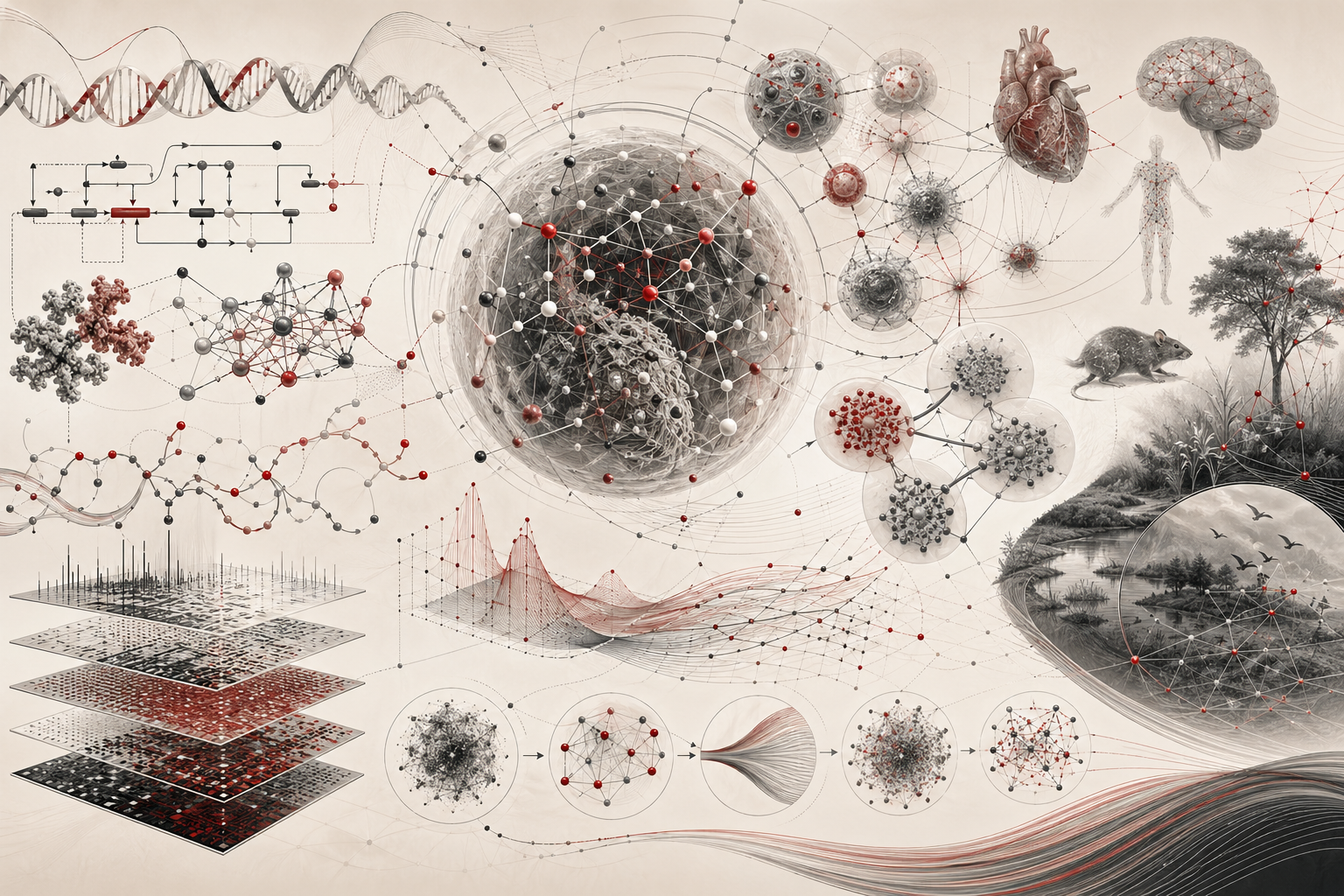
Systems biology and complexity in living networks provide a rigorous framework for understanding life as an organized, dynamic, multiscale system of interacting genes, proteins, metabolites, cells, tissues, organisms, environments, and regulatory processes. Living systems are not merely collections of parts. They are networks of relationships: feedback loops, signaling pathways, metabolic flows, gene-regulatory circuits, immune interactions, ecological dependencies, developmental programs, and physiological controls that produce behavior no single component can explain by itself.
This article introduces systems biology as a central method for studying biological complexity. It explains how living networks are represented, measured, modeled, simulated, visualized, validated, and interpreted. The focus is not only on network diagrams, but on the deeper logic of biological systems: interaction, regulation, modularity, robustness, emergence, adaptation, nonlinearity, constraint, and reproducibility.
Main Library
Publications
Article Map
Biology
Related Topic
Chemistry
Related Topic
Environmental Science
Related Topic
Earth Science
The article is written for biologists, systems biologists, molecular biologists, computational biologists, bioinformaticians, biomedical researchers, ecologists, network scientists, data engineers, biotechnology teams, scientific software developers, and engineers. It emphasizes biological mechanism, pathway structure, omics integration, dynamic modeling, uncertainty, metadata, model standards, network provenance, and responsible interpretation.
The article also extends the discussion into reproducible computational practice through Python and R examples, biological network summaries, signal-propagation scaffolds, feedback dynamics, pathway scoring, simple flux-balance logic, multi-omics integration, validation metrics, SQL-backed provenance, and a linked full-stack GitHub repository containing Python, R, Julia, Fortran, Rust, Go, C, C++, SQL, notebooks, data files, validation notes, and reproducibility documentation.
Why systems biology matters
Systems biology matters because living systems are organized through relationships. A gene does not act alone. A protein does not function outside cellular context. A metabolic reaction depends on substrates, enzymes, cofactors, compartments, energy state, regulation, and flux constraints. A cell responds to signals through pathways, thresholds, feedback, and history. An organism maintains physiology through interacting networks of control. An ecosystem persists through dependencies among populations, resources, disturbances, and environmental conditions.
Reductionist biology remains essential because biological mechanisms require detailed understanding of molecules, cells, structures, and processes. Systems biology does not reject reductionism. It asks what happens when the parts interact. It studies organization, regulation, dynamics, and emergent behavior.
This is especially important in modern life science because biological data are increasingly high-dimensional. Genomics, transcriptomics, proteomics, metabolomics, imaging, single-cell data, spatial biology, microbiome data, clinical measurements, and ecological observations all describe different layers of living systems. The challenge is not only to collect data, but to connect evidence across scales.
Systems biology gives researchers a way to ask how biological order emerges from interaction.
Living networks as biological organization
A biological network represents entities and relationships. Nodes may represent genes, proteins, metabolites, reactions, cells, species, tissues, pathways, phenotypes, or environmental variables. Edges may represent regulation, binding, catalysis, activation, inhibition, transport, transformation, signaling, predation, competition, cooperation, or information flow.
Networks are useful because they make interdependence visible. They reveal that biological function is not located only in isolated components, but in patterns of connection. A highly connected protein may influence many processes. A regulatory feedback loop may stabilize a system. A metabolic branch point may redirect flux. A signaling hub may integrate multiple signals. A weak interaction may become important under stress.
However, a network diagram is not automatically a model. A diagram may show possible interactions without specifying rates, strengths, conditions, compartments, time scales, or uncertainty. Systems biology therefore requires careful distinction among maps, models, measurements, simulations, and interpretations.
A network becomes scientifically powerful when its edges have evidence, its assumptions are documented, and its behavior can be analyzed.
Genes, proteins, metabolites, and pathways
Systems biology often begins with molecular networks. Gene-regulatory networks describe how transcription factors, enhancers, chromatin state, noncoding RNAs, and feedback circuits influence gene expression. Protein-interaction networks describe binding, complex formation, signaling, modification, and physical association. Metabolic networks describe biochemical transformations among metabolites. Pathway networks organize processes such as cell cycle control, apoptosis, immune signaling, DNA repair, energy metabolism, development, and stress response.
These layers are connected. Gene expression affects protein abundance. Protein activity affects metabolism and signaling. Metabolic state affects gene regulation. Signaling pathways affect transcription. Cellular state affects phenotype. Phenotype affects selection, disease progression, or ecological interaction.
A systems view asks how these layers coordinate. For example, a stress signal may activate a kinase cascade, alter transcription factor activity, change gene expression, redirect metabolism, change cell morphology, and influence survival. Studying only one layer may miss the system-level response.
Systems biology therefore treats biological knowledge as layered and conditional. It asks not only whether a component exists, but when it acts, where it acts, what it interacts with, and how its effect changes under different conditions.
Feedback, nonlinearity, and dynamic regulation
Living systems regulate themselves through feedback. Negative feedback can stabilize temperature, hormone levels, gene expression, signaling activity, metabolic state, and immune response. Positive feedback can amplify signals, create switches, drive differentiation, reinforce cell fate, or produce runaway dynamics. Coupled feedback can generate oscillations, pulses, adaptation, bistability, and complex temporal behavior.
Nonlinearity is central. A small signal may have little effect below a threshold but a large effect above it. A receptor may saturate. An enzyme may follow cooperative kinetics. A pathway may respond sharply when multiple conditions align. A regulatory loop may produce hysteresis, where system history affects current response.
These dynamics explain why biological systems cannot always be understood from static measurements. Two cells with similar gene expression at one time point may be on different trajectories. A transient signal may produce a lasting state. A pathway may adapt after repeated stimulation. A network may look stable until a threshold is crossed.
Systems biology therefore studies time, regulation, and state change. It asks how living networks behave, not only how they are connected.
Omics integration and multiscale evidence
Omics technologies measure biological systems at large scale. Genomics describes sequence and variation. Transcriptomics measures RNA expression. Proteomics measures proteins and modifications. Metabolomics measures small molecules and biochemical state. Epigenomics measures chromatin and regulatory marks. Single-cell omics resolves heterogeneity among cells. Spatial omics preserves location.
Each omics layer is partial. RNA abundance does not always predict protein abundance. Protein abundance does not always predict activity. Metabolite levels reflect both production and consumption. Single-cell data reveal heterogeneity but introduce sparsity and noise. Spatial data preserve context but may have lower molecular coverage.
Systems biology integrates these layers through networks, pathways, models, and statistical frameworks. A gene-expression signature may be mapped onto pathways. A metabolite shift may be interpreted through flux constraints. A protein-interaction network may help identify modules. A single-cell trajectory may be connected to signaling pathways. A disease phenotype may be linked to networks of molecular perturbation.
The aim is not to collapse all data into one score. The aim is to preserve relationships among evidence layers so that biological interpretation becomes more coherent.
Network topology, modules, and emergence
Network topology describes the structure of connections. Degree measures how many edges a node has. Centrality measures different forms of importance. Clustering describes local connectivity. Communities or modules describe groups of nodes that are more connected to one another than to the rest of the network. Paths describe routes through which influence, information, or material may flow.
Modules matter because biological systems often organize function in partially separable units. A signaling module may respond to stress. A metabolic module may process a class of substrates. A gene-regulatory module may control development. A protein complex may perform a cellular task. Modules can provide robustness because local changes do not always disrupt the entire system.
Emergence occurs when system behavior cannot be easily predicted from individual components alone. A feedback loop can produce oscillation. A network can buffer perturbation. A metabolic system can reroute flux. A multicellular tissue can produce pattern. A microbial community can exhibit properties absent from isolated species.
Systems biology studies emergence without mystifying it. Emergent behavior is not magic. It is the result of structured interaction.
Metabolic networks and flux constraints
Metabolic networks are among the most developed areas of systems biology because biochemical reactions can be represented as structured transformations. Metabolites enter and leave reactions. Enzymes catalyze conversions. Stoichiometry constrains what flows are possible. Energy, redox state, compartments, transport, enzyme capacity, and regulation shape what actually happens.
Constraint-based modeling examines possible flux distributions through a metabolic network. In flux balance analysis, a stoichiometric matrix represents reaction structure, and the model seeks a flux distribution that satisfies mass-balance constraints while optimizing or evaluating an objective. Such models can be used to study growth, metabolic engineering, gene knockouts, nutrient limitation, microbial communities, and disease metabolism.
These models are powerful because they connect network structure to feasible system behavior. But they require careful interpretation. A feasible flux is not necessarily the true flux. An objective function may not reflect actual biology. Missing reactions, wrong bounds, compartment errors, and incomplete annotations can distort results.
Metabolic systems biology demonstrates both the promise and discipline of computational modeling: formal structure creates insight, but only when assumptions are visible.
Signaling networks and cellular decision-making
Cells make decisions through signaling networks. They sense external and internal conditions, process information, integrate signals, and alter behavior. A cell may divide, differentiate, migrate, secrete, die, repair damage, activate immune function, or change metabolism. These decisions are rarely controlled by one molecule alone. They arise from pathways, feedback, thresholds, timing, localization, and cross-talk.
Signaling networks are complex because activity matters as much as abundance. A protein may be present but inactive. A kinase may act only when phosphorylated. A transcription factor may matter only when localized to the nucleus. A pathway may produce different outcomes depending on signal duration, amplitude, pulsatility, and cellular context.
Systems biology helps represent these processes through network diagrams, logical models, ordinary differential equations, stochastic simulations, Boolean networks, rule-based models, and data-driven pathway activity scores. Each representation has strengths and limits.
The goal is to understand how cells convert signals into outcomes.
Robustness, adaptation, and failure modes
Living systems are robust because they can maintain function despite perturbation. Cells buffer noise. Metabolic networks reroute flux. Immune systems adapt. Development produces reliable structures despite variation. Physiological systems maintain homeostasis. Ecosystems can absorb disturbance up to a point.
Robustness often depends on redundancy, feedback, modularity, degeneracy, repair mechanisms, and distributed control. But robustness has limits. When perturbations exceed system capacity, networks may shift state, collapse, oscillate pathologically, become inflamed, become cancerous, lose homeostasis, or reorganize in harmful ways.
Systems biology is especially useful for studying failure modes. Disease can be interpreted as network dysregulation: oncogenic signaling, metabolic reprogramming, immune imbalance, neurodegenerative cascades, endocrine disruption, inflammatory loops, pathogen-host interactions, or microbiome instability. Ecological collapse can also be framed through network breakdown: loss of keystone species, nutrient imbalance, disrupted mutualism, invasive spread, or weakened resilience.
Complexity is not only about richness. It is also about vulnerability.
Model standards, provenance, and reproducibility
Systems biology depends on reproducibility because models can be complex, multilayered, and difficult to reconstruct from prose alone. A pathway model, signaling model, metabolic model, or gene-regulatory model should preserve entities, reactions, compartments, parameters, units, assumptions, evidence, initial conditions, software versions, and output artifacts.
Model standards help. Machine-readable model formats allow researchers to exchange, simulate, inspect, and reuse biological models across tools. Model repositories help preserve published mathematical models. Pathway databases provide curated biological context. Network visualization platforms help integrate interactions with omics attributes. Simulation tools help analyze biochemical dynamics.
Provenance is equally important. A network result should record the source of edges, data preprocessing, filtering thresholds, model parameters, pathway identifiers, database versions, scripts, outputs, and validation checks. Without provenance, a systems-biology result may be impossible to reproduce.
Systems biology should therefore be treated as scientific infrastructure, not just analysis.
Mathematical lens: systems biology
Several mathematical ideas are central to systems biology and living networks. These expressions do not replace biological interpretation, but they help clarify how networks, dynamics, feedback, flux constraints, pathway activity, and perturbation response can be represented formally.
Graph representation
G=(V,E)
\]
Interpretation: A graph \(G\) contains a set of biological entities \(V\) and a set of interactions \(E\). Nodes may represent genes, proteins, metabolites, cells, species, pathways, or environmental variables.
Degree
k_i=\sum_j A_{ij}
\]
Interpretation: The degree \(k_i\) of node \(i\) is computed from the adjacency matrix \(A\). It summarizes how many connections a node has within the represented biological network.
Network density
D=\frac{2|E|}{|V|(|V|-1)}
\]
Interpretation: Network density compares observed edges with possible edges in an undirected network. Higher density indicates a more connected network, but biological interpretation depends on evidence quality and network construction.
Signal propagation
x_{t+1}=\alpha A x_t + u
\]
Interpretation: Node state at the next time step depends on the current state \(x_t\), normalized interaction matrix \(A\), propagation strength \(\alpha\), and external input \(u\). This can represent simplified flow of influence through a biological network.
Dynamic regulatory model
\frac{dx}{dt}=f(x,\theta,u)
\]
Interpretation: System state \(x\) changes over time according to a regulatory function \(f\), parameters \(\theta\), and inputs \(u\). This general form can represent gene regulation, signaling, physiology, or population dynamics.
Negative feedback
\frac{dx}{dt}=a\frac{1}{1+y^n}-bx
\]
Interpretation: Production of \(x\) is inhibited by \(y\), while \(x\) is degraded at rate \(b\). The exponent \(n\) controls regulatory sharpness. This form illustrates how feedback can stabilize or shape biological dynamics.
Stoichiometric constraint
S v = 0
\]
Interpretation: The stoichiometric matrix \(S\) and flux vector \(v\) represent mass-balance constraints in metabolic systems. This formalism underlies many metabolic-network and flux-balance models.
Pathway activity score
P_k=\frac{1}{|G_k|}\sum_{i\in G_k} z_i
\]
Interpretation: Pathway activity \(P_k\) averages standardized molecular measurements \(z_i\) across genes in pathway set \(G_k\). The score is useful for summarization but should not be mistaken for direct mechanism.
Perturbation response
\Delta x=x_{\text{perturbed}}-x_{\text{baseline}}
\]
Interpretation: Perturbation response summarizes how a system changes after intervention or disturbance. Interpretation depends on measurement scale, baseline definition, timing, and biological context.
Python and R workflows
The following examples are compact article-level workflows. The full GitHub repository expands them into richer full-stack implementations with SQL provenance, biological network summaries, feedback dynamics, signal propagation, pathway scoring, flux-balance scaffolds, omics integration, validation metrics, and reproducible documentation.
Python example: biological network summary
import pandas as pd

nodes = pd.DataFrame(
    {
        "node_id": ["GATA1", "SPI1", "MYC", "MAPK1", "AKT1", "TP53"],
        "node_type": ["gene", "gene", "gene", "protein", "protein", "protein"],
        "pathway": ["differentiation", "differentiation", "growth", "signaling", "signaling", "stress_response"],
    }
)

edges = pd.DataFrame(
    {
        "source": ["GATA1", "SPI1", "MYC", "MAPK1", "AKT1", "TP53", "TP53"],
        "target": ["SPI1", "GATA1", "AKT1", "MYC", "MAPK1", "MYC", "AKT1"],
        "interaction": ["inhibits", "inhibits", "activates", "activates", "activates", "inhibits", "inhibits"],
        "evidence_score": [0.82, 0.78, 0.74, 0.69, 0.66, 0.88, 0.72],
    }
)

degree = (
    pd.concat(
        [
            edges.rename(columns={"source": "node_id"})[["node_id"]],
            edges.rename(columns={"target": "node_id"})[["node_id"]],
        ],
        ignore_index=True,
    )
    .value_counts("node_id")
    .reset_index(name="degree")
)

summary = nodes.merge(degree, on="node_id", how="left").fillna({"degree": 0})
summary["degree"] = summary["degree"].astype(int)

print(summary.sort_values("degree", ascending=False).to_string(index=False))
Python example: signal propagation scaffold
import pandas as pd

edges = pd.DataFrame(
    {
        "source": ["receptor", "receptor", "kinase_A", "kinase_B", "transcription_factor"],
        "target": ["kinase_A", "kinase_B", "transcription_factor", "transcription_factor", "target_gene"],
        "weight": [0.8, 0.5, 0.7, 0.4, 0.9],
    }
)

nodes = sorted(set(edges["source"]).union(edges["target"]))
state = {node: 0.0 for node in nodes}
state["receptor"] = 1.0

alpha = 0.75
rows = []

for step in range(6):
    rows.append({"step": step, **state})

    next_state = {node: 0.0 for node in nodes}
    next_state["receptor"] = 1.0

    for _, edge in edges.iterrows():
        next_state[edge["target"]] += alpha * state[edge["source"]] * edge["weight"]

    state = {node: min(value, 1.0) for node, value in next_state.items()}

trajectory = pd.DataFrame(rows)

print(trajectory.round(4).to_string(index=False))
Python example: feedback dynamics
import pandas as pd

def simulate_negative_feedback(
    x0: float,
    y0: float,
    production_x: float,
    production_y: float,
    degradation_x: float,
    degradation_y: float,
    hill_n: float,
    dt: float,
    steps: int,
) -> pd.DataFrame:
    """Simulate a two-variable negative-feedback scaffold."""
    x = float(x0)
    y = float(y0)
    rows = []

    for step in range(steps + 1):
        rows.append({"step": step, "time": step * dt, "x": x, "y": y})

        dx = production_x / (1 + y ** hill_n) - degradation_x * x
        dy = production_y * x - degradation_y * y

        x = max(x + dt * dx, 0.0)
        y = max(y + dt * dy, 0.0)

    return pd.DataFrame(rows)

trajectory = simulate_negative_feedback(
    x0=0.2,
    y0=0.1,
    production_x=1.2,
    production_y=0.8,
    degradation_x=0.4,
    degradation_y=0.3,
    hill_n=2.0,
    dt=0.1,
    steps=80,
)

print(trajectory.tail().round(4).to_string(index=False))
Python example: pathway activity scoring
import pandas as pd

expression = pd.DataFrame(
    {
        "gene": ["GATA1", "SPI1", "MYC", "MAPK1", "AKT1", "TP53"],
        "z_score": [1.2, -0.8, 1.5, 0.9, 0.7, -1.1],
    }
)

gene_sets = pd.DataFrame(
    {
        "pathway": [
            "differentiation",
            "differentiation",
            "growth_signaling",
            "growth_signaling",
            "stress_response",
        ],
        "gene": ["GATA1", "SPI1", "MYC", "MAPK1", "TP53"],
    }
)

activity = (
    gene_sets.merge(expression, on="gene", how="left")
    .groupby("pathway")
    .agg(
        pathway_activity=("z_score", "mean"),
        n_genes=("gene", "count"),
    )
    .reset_index()
)

print(activity.round(4).to_string(index=False))
Python example: flux-balance scaffold
import pandas as pd

reactions = pd.DataFrame(
    {
        "reaction": ["glucose_import", "glycolysis", "biomass"],
        "lower_bound": [0.0, 0.0, 0.0],
        "upper_bound": [10.0, 10.0, 6.0],
        "chosen_flux": [8.0, 8.0, 4.0],
    }
)

stoichiometry = pd.DataFrame(
    {
        "metabolite": ["glucose", "pyruvate", "biomass_precursor"],
        "glucose_import": [1, 0, 0],
        "glycolysis": [-1, 2, 0],
        "biomass": [0, -2, 1],
    }
)

flux_lookup = dict(zip(reactions["reaction"], reactions["chosen_flux"]))

mass_balance = []

for _, row in stoichiometry.iterrows():
    balance = 0.0
    for reaction in reactions["reaction"]:
        balance += row[reaction] * flux_lookup[reaction]

    mass_balance.append(
        {
            "metabolite": row["metabolite"],
            "mass_balance_residual": balance,
        }
    )

balance_table = pd.DataFrame(mass_balance)

print(reactions.to_string(index=False))
print(balance_table.round(4).to_string(index=False))
R example: network degree cross-check
# Compact R network degree cross-check.

edges <- data.frame(
  source = c("GATA1", "SPI1", "MYC", "MAPK1", "AKT1", "TP53", "TP53"),
  target = c("SPI1", "GATA1", "AKT1", "MYC", "MAPK1", "MYC", "AKT1"),
  interaction = c("inhibits", "inhibits", "activates", "activates", "activates", "inhibits", "inhibits")
)

all_nodes <- c(edges$source, edges$target)
degree_table <- as.data.frame(table(all_nodes))
names(degree_table) <- c("node_id", "degree")

degree_table <- degree_table[order(-degree_table$degree), ]

print(degree_table)GitHub repository
The article body includes compact Python and R examples so the scientific argument remains readable. The full repository expands those examples into a rigorous workflow for systems biology and living-network complexity, including biological network summaries, graph topology, signal propagation, feedback dynamics, pathway activity scoring, flux-balance scaffolds, omics integration, validation metrics, provenance records, SQL audit structures, notebook documentation, cross-language validation helpers, and full-stack scientific-computing examples across Python, R, Julia, Fortran, Rust, Go, C, C++, SQL, and notebooks.
The full code distribution for this article, including selected article examples, expanded computational workflows, reproducible data structures, provenance documentation, validation notes, and full-stack scientific-computing scaffolding, is available on GitHub.
Limits, ethics, and responsible interpretation
Systems biology can make living networks more understandable, but it can also produce misleading abstraction. A network edge may represent physical binding, statistical association, curated knowledge, predicted interaction, regulatory influence, or experimental evidence. These are not equivalent. A pathway activity score may summarize data but hide cell-type heterogeneity. A dynamic model may be mathematically elegant but poorly calibrated. A flux model may identify feasible behavior without proving actual biological flux.
Ethics also matter. Systems-biology models can influence biomedical interpretation, drug discovery, precision medicine, environmental risk, biotechnology, and public-health reasoning. Misinterpreted models can overstate causality, understate uncertainty, or obscure bias in underlying data. Human omics and clinical systems biology require privacy, consent, governance, and responsible communication.
Responsible systems biology requires transparent assumptions, model validation, provenance, uncertainty communication, biological review, and humility. A systems model should support scientific reasoning, not replace it.
Why systems biology matters today
Systems biology matters today because biology is increasingly too interconnected to interpret one variable at a time. Disease mechanisms involve regulatory circuits, immune states, metabolism, tissue context, genetics, environment, and treatment response. Ecology involves species networks, climate drivers, nutrient flows, disturbance, and adaptation. Biotechnology involves engineered circuits, metabolic pathways, cell factories, and biosafety. Medicine increasingly depends on integrating molecular, imaging, clinical, and environmental data.
Systems biology provides a language for that integration. It helps scientists connect mechanism and data, model and measurement, local interaction and system behavior. It also creates a bridge between biological knowledge and computational infrastructure.
The deepest value of systems biology is not complexity for its own sake. It is disciplined understanding of how living networks produce organized behavior.
Conclusion
Systems biology and complexity in living networks provide a rigorous framework for understanding life as interaction, regulation, flow, feedback, adaptation, and emergence. They connect genes, proteins, metabolites, cells, pathways, tissues, organisms, and environments into structured models of biological organization.
The strongest systems-biology workflows are not the largest or most complicated. They are the clearest about network evidence, model assumptions, parameter choices, data provenance, validation, uncertainty, and biological interpretation. They preserve the difference between correlation, interaction, mechanism, and causality.
Used responsibly, systems biology does not reduce life to diagrams or equations. It helps reveal the organized complexity that makes living systems alive.
Related articles
- Biology
- Networks, Systems, and Biological Complexity
- Mathematical Biology and the Logic of Living Systems
- Nonlinearity, Feedback, and Biological Regulation
- Differential Equations in Population and Physiological Modeling
- Genomics, Sequence Analysis, and Biological Data
- Python for Biological Modeling and Automation
- Python for Simulation, Bioinformatics, and Scientific Workflows
- Data, Measurement, and Reproducibility in the Life Sciences
- Image Analysis, Microscopy, and Computational Biology
- Modeling Disease, Epidemiology, and Biological Spread
Further reading
- SBML.org (n.d.) What is SBML? Available at: https://sbml.org/documents/what-is-sbml/
- EMBL-EBI Training (n.d.) What is BioModels? Available at: https://www.ebi.ac.uk/training/online/courses/biomodels-quick-tour/what-is-biomodels/
- Reactome (n.d.) What is Reactome? Available at: https://reactome.org/what-is-reactome
- Cytoscape (n.d.) What is Cytoscape? Available at: https://cytoscape.org/what_is_cytoscape.html
- COPASI (n.d.) COPASI: Biochemical System Simulator. Available at: https://copasi.org/
- COPASI (n.d.) Support/Features. Available at: https://copasi.org/Support/Features/
- Hucka, M. et al. (2018) ‘The Systems Biology Markup Language’, Molecular Systems Biology. Available at: https://pmc.ncbi.nlm.nih.gov/articles/PMC6167032/
- Shannon, P. et al. (2003) ‘Cytoscape: A software environment for integrated models of biomolecular interaction networks’, Genome Research. Available at: https://pmc.ncbi.nlm.nih.gov/articles/PMC403769/
- Le Novère, N. et al. (2006) ‘BioModels Database: a free, centralized database of curated, published, quantitative kinetic models of biochemical and cellular systems’, Nucleic Acids Research. Available at: https://pmc.ncbi.nlm.nih.gov/articles/PMC1347454/
- Ebrahim, A. et al. (2013) ‘COBRApy: COnstraints-Based Reconstruction and Analysis for Python’, BMC Systems Biology. Available at: https://pmc.ncbi.nlm.nih.gov/articles/PMC3843582/
References
- COPASI (n.d.) COPASI: Biochemical System Simulator. Available at: https://copasi.org/
- COPASI (n.d.) Support/Features. Available at: https://copasi.org/Support/Features/
- Cytoscape (n.d.) What is Cytoscape? Available at: https://cytoscape.org/what_is_cytoscape.html
- Ebrahim, A. et al. (2013) ‘COBRApy: COnstraints-Based Reconstruction and Analysis for Python’, BMC Systems Biology. Available at: https://pmc.ncbi.nlm.nih.gov/articles/PMC3843582/
- EMBL-EBI Training (n.d.) What is BioModels? Available at: https://www.ebi.ac.uk/training/online/courses/biomodels-quick-tour/what-is-biomodels/
- Hucka, M. et al. (2018) ‘The Systems Biology Markup Language’, Molecular Systems Biology. Available at: https://pmc.ncbi.nlm.nih.gov/articles/PMC6167032/
- Le Novère, N. et al. (2006) ‘BioModels Database: a free, centralized database of curated, published, quantitative kinetic models of biochemical and cellular systems’, Nucleic Acids Research. Available at: https://pmc.ncbi.nlm.nih.gov/articles/PMC1347454/
- Reactome (n.d.) What is Reactome? Available at: https://reactome.org/what-is-reactome
- SBML.org (n.d.) What is SBML? Available at: https://sbml.org/documents/what-is-sbml/
- Shannon, P. et al. (2003) ‘Cytoscape: A software environment for integrated models of biomolecular interaction networks’, Genome Research. Available at: https://pmc.ncbi.nlm.nih.gov/articles/PMC403769/