
Last Updated May 28, 2026
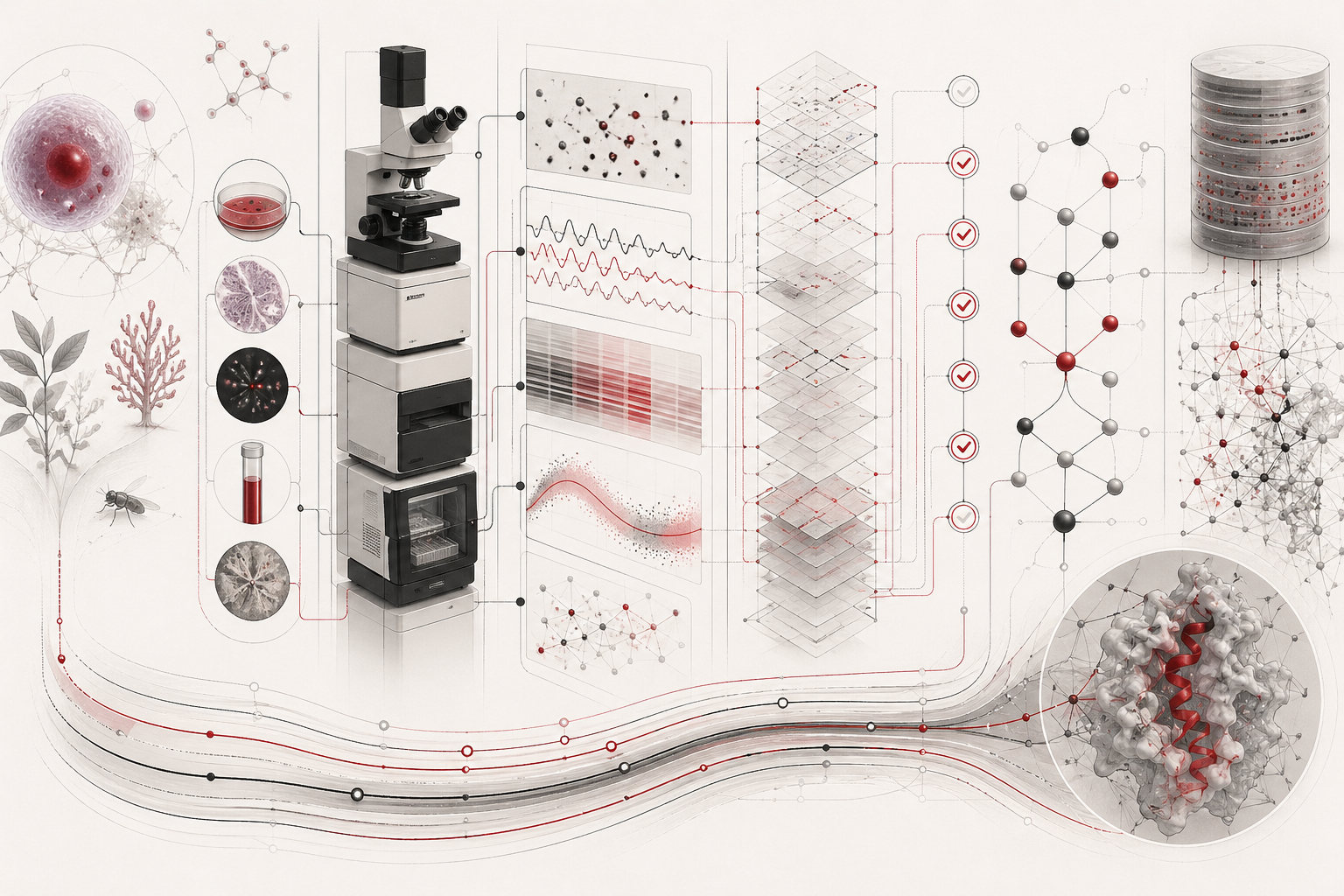
Data, measurement, and reproducibility in the life sciences define how biological observations become trustworthy evidence: through careful measurement design, calibrated instruments, transparent metadata, documented protocols, versioned code, uncertainty analysis, quality control, provenance, validation, and responsible sharing. Biology is now deeply data-intensive, but more data does not automatically mean better science. Sequencing reads, microscopy images, ecological surveys, clinical biomarkers, physiological traces, behavioral recordings, metabolomics profiles, microbiome samples, sensor streams, and computational simulations become meaningful only when their origins, assumptions, uncertainties, transformations, and limitations are made visible.
This article introduces data and reproducibility as foundational problems in modern biology. It explains why biological data must be understood as measured, processed, interpreted, and contextualized—not simply collected. It examines metadata, provenance, measurement uncertainty, calibration, assay validation, laboratory notebooks, workflow documentation, data dictionaries, version control, computational environments, FAIR principles, code availability, reproducible pipelines, quality-control thresholds, and responsible data sharing.
Main Library
Publications
Article Map
Biology
Related Topic
Mathematical Modeling
Related Topic
Environmental Science
Related Topic
Chemistry
The article is written for biologists, ecologists, marine biologists, biomedical researchers, laboratory scientists, field scientists, computational biologists, data scientists, statisticians, engineers, biotechnology teams, environmental scientists, and scientific readers who need a rigorous but usable framework for producing reproducible life-science evidence. It treats reproducibility not as a bureaucratic requirement, but as a scientific architecture for trust.
The article also extends the discussion into reproducible computational practice through metadata schemas, measurement logs, uncertainty budgets, quality-control flags, audit trails, data dictionaries, CSV validation, checksum records, workflow manifests, R workflows, Python workflows, SQL provenance structures, and a linked full-stack GitHub repository containing Python, R, Julia, Fortran, Rust, Go, C, C++, SQL, notebooks, data files, validation notes, and reproducibility documentation.
Why data quality matters in biology
Data quality matters in biology because biological evidence is often fragile, contextual, and deeply dependent on how observations were produced. A sequencing dataset is shaped by sample collection, extraction, library preparation, instrument chemistry, batch effects, read depth, alignment, filtering, annotation, and statistical modeling. A microscopy dataset is shaped by fixation, staining, imaging settings, segmentation choices, illumination, resolution, and thresholding. An ecological dataset is shaped by sampling design, site selection, observer effort, season, weather, detectability, spatial scale, and classification method.
Biological data are therefore never merely “raw.” Even so-called raw data are produced by instruments, protocols, sampling choices, and technical systems. A sensor transforms a biological signal into an electrical signal. A sequencing machine transforms molecular fragments into reads. A microscope transforms tissue, light, optics, and detectors into images. A field observer transforms ecological presence into recorded observation. Each transformation can introduce uncertainty, bias, loss, or interpretation.
The scientific value of a dataset depends on whether others can understand what was measured, how it was measured, why it was measured, where it came from, what transformations it underwent, what uncertainty it carries, and what claims it can support. Reproducibility begins with this basic premise: evidence should be traceable.
In the life sciences, traceability is not optional. It is essential for diagnosis, biomedical research, conservation, regulatory science, environmental monitoring, biotechnology, ecological restoration, public health, and computational biology.
Measurement before data
Measurement comes before data. Before a spreadsheet, database, image file, sequence archive, or model output exists, a biological system must be observed through a measurement process. That process defines what kind of evidence can be produced.
A measurement requires a measurand: the quantity or property intended to be measured. In biology, the measurand might be gene expression, organism abundance, cell size, fluorescence intensity, blood glucose, enzyme activity, microbial diversity, dissolved oxygen, leaf area, tumor volume, survival time, protein concentration, or behavioral frequency. The measurand must be defined clearly enough that the measurement can be interpreted.
Measurement also requires units, instruments, protocols, calibration, sampling frames, detection limits, quality-control thresholds, and documentation. Without these, numerical values may appear precise while remaining scientifically ambiguous. A concentration without units is incomplete. A count without sampling effort is incomplete. A sequencing read count without library size and normalization context is incomplete. A field observation without location, time, and method is incomplete.
Good data practice therefore begins before data collection. It asks what is being measured, why it is being measured, what biological question it serves, what uncertainty is expected, how quality will be checked, how metadata will be recorded, and how the resulting data will be reused.
Metadata, provenance, and context
Metadata are data about data. In biology, metadata may include sample identifiers, organism, tissue, cell type, population, location, collection date, instrument, protocol, operator, batch, reagent lot, environmental condition, sequencing platform, imaging settings, calibration information, file format, units, quality-control flags, and processing history.
Provenance describes the origin and transformation history of data. It answers questions such as: where did the sample come from, who collected it, which protocol was used, which instrument produced the measurement, which script transformed the file, which software version was used, which parameters were applied, and which output supports the claim?
Metadata and provenance are essential because biological data often travel far from their origin. A dataset collected in a field season may later support ecological modeling. A sequencing dataset may be reused for meta-analysis. A clinical dataset may inform biomarker discovery. A microscopy dataset may train a machine-learning model. Without metadata and provenance, reuse becomes risky or impossible.
A useful biological dataset should therefore include a data dictionary, variable definitions, units, allowable values, missing-data conventions, file descriptions, processing notes, quality-control criteria, license information, and contact or repository information. The goal is not paperwork for its own sake. The goal is to preserve meaning.
Reproducibility, replicability, and repeatability
Reproducibility, replicability, and repeatability are related but distinct. The terminology varies across fields, but the underlying concerns are consistent.
Repeatability often refers to whether the same team can obtain the same result using the same method, equipment, conditions, and materials. Replicability often refers to whether an independent team can obtain a consistent result using new data or repeated experiments. Reproducibility often refers to whether the same analysis can be rerun from the same data and code to obtain the same computational results. In practice, life-science research needs all three.
A biological result is stronger when the measurement can be repeated, the experiment can be replicated, and the computation can be reproduced. If only one of these holds, the evidence remains limited. A computational analysis may be perfectly reproducible but based on a weak experiment. A biological experiment may replicate but lack available code. A dataset may be well shared but poorly documented.
Reproducibility is therefore not a single checkbox. It is an evidence system that links experimental design, measurement quality, documentation, data stewardship, code transparency, statistical reasoning, and independent validation.
FAIR data and scientific stewardship
The FAIR principles—Findable, Accessible, Interoperable, and Reusable—provide one of the major frameworks for scientific data stewardship. In the life sciences, FAIR thinking matters because biological datasets are often expensive to generate, difficult to reproduce, and valuable beyond the original study.
Findable data have persistent identifiers, searchable metadata, clear titles, and repository records. Accessible data can be obtained through defined protocols, even when access is restricted for ethical or privacy reasons. Interoperable data use shared vocabularies, standard formats, controlled terminology, and machine-readable structures where possible. Reusable data include clear licenses, provenance, methods, metadata, quality information, and enough context to support future use.
FAIR does not mean all data must be openly downloadable without constraint. Human-subject data, endangered-species locations, Indigenous data, sensitive ecological data, pathogen data, and proprietary biotechnology data may require controlled access. FAIR means that data stewardship should be intentional, documented, and structured for appropriate reuse.
For life science, FAIR data practice strengthens cumulative knowledge. It allows datasets to support meta-analysis, model validation, education, regulatory review, environmental monitoring, clinical translation, and new questions that the original investigators may not have imagined.
Quality control and validation
Quality control is the process of checking whether data meet predefined standards for reliability, completeness, consistency, and usability. Validation asks whether the measurement or workflow actually supports the intended scientific use.
Quality control can include range checks, unit checks, missing-value checks, duplicate detection, instrument calibration checks, control samples, blank samples, spike-ins, replicate agreement, read-depth thresholds, image-quality metrics, contamination screens, batch diagnostics, field-audit checks, and outlier review. In computational workflows, quality control can include schema validation, checksum verification, dependency checks, automated tests, and reproducible environment capture.
Validation is broader. A biomarker assay must be validated for sensitivity, specificity, precision, accuracy, linearity, detection limit, and intended context. A species-detection method must be validated against field conditions and detection probability. A machine-learning model must be validated on data not used for training. A measurement pipeline must be validated against standards or known controls where possible.
Quality control and validation should be documented before analysis. Post hoc filtering can introduce bias if decisions are made after seeing results. Transparent criteria make data processing more defensible.
Uncertainty, bias, and measurement error
Measurement uncertainty is the quantified doubt associated with a measurement result. In biology, uncertainty may arise from sampling, instruments, observers, calibration, environmental variation, biological heterogeneity, technical noise, model assumptions, missing data, and processing choices.
Measurement error can be random or systematic. Random error increases variability. Systematic error introduces bias. A scale that fluctuates randomly produces imprecision. A scale that is consistently miscalibrated produces bias. A sequencing batch that systematically differs from another batch can distort biological inference. A field survey that misses cryptic species can bias abundance estimates. An imaging pipeline that segments large cells better than small cells can bias morphology results.
Uncertainty should not be hidden. It should be estimated, reported, propagated, and interpreted. A measurement without uncertainty can create false confidence. A model without uncertainty can appear more authoritative than it deserves.
Biological systems are variable even when measurements are perfect, and measurements are never perfect. Reproducible life science requires acknowledging both biological variation and measurement uncertainty.
Laboratory, field, and computational data
Life-science data arise in many settings. Laboratory data include assays, microscopy, cell culture, sequencing, mass spectrometry, electrophysiology, histology, animal studies, and biochemical measurements. Field data include ecological surveys, biodiversity records, marine sampling, environmental sensors, behavioral observations, remote sensing, and restoration monitoring. Computational data include simulations, model outputs, derived features, processed images, alignments, inferred networks, annotations, and machine-learning predictions.
Each setting has different reproducibility challenges. Laboratory data require protocol documentation, reagent tracking, instrument calibration, batch management, controls, and biological replication. Field data require location, time, weather, observer, effort, detection probability, sampling design, and environmental context. Computational data require code, dependencies, versions, parameters, random seeds, containers, workflow manifests, and output provenance.
The strongest life-science projects treat these as connected layers. A biological sample has a field or laboratory origin. It becomes a measurement. The measurement becomes a file. The file becomes processed data. Processed data become features, summaries, models, figures, and claims. Reproducibility requires the chain to remain traceable.
Code, workflows, and computational environments
Modern life science is computational. Even projects that begin in wet labs or field sites often end in code: scripts for cleaning data, notebooks for analysis, pipelines for sequencing, image-processing workflows, statistical models, simulations, database queries, and figure generation.
Code should be treated as part of the scientific method. It should be organized, versioned, documented, tested, and linked to data and outputs. A result produced by undocumented manual spreadsheet edits is difficult to audit. A result produced by a versioned script with defined inputs, outputs, and dependencies is much easier to reproduce.
Computational environments matter because code depends on software versions, packages, operating systems, compilers, random seeds, and hardware assumptions. A reproducible project should record dependencies through tools such as environment files, lockfiles, containers, session information, package manifests, or workflow managers.
Not every project needs industrial-scale infrastructure. But every computational life-science project benefits from a basic reproducibility structure: organized folders, readme files, data dictionaries, scripts with comments, version control, documented assumptions, and outputs that can be regenerated from defined inputs.
Data sharing, privacy, and ethical constraints
Data sharing can accelerate science, but life-science data can also carry ethical risks. Human-subject data may contain sensitive health information or re-identification risk. Genomic data can implicate relatives and communities. Indigenous data may require sovereignty, consent, and governance frameworks. Endangered-species locations may require protection. Pathogen data may carry biosecurity concerns. Environmental data may affect communities, land rights, or resource governance.
Responsible data sharing therefore requires judgment. Open access is valuable when appropriate, but controlled access, embargoes, de-identification, aggregation, restricted-use agreements, or metadata-only records may be necessary in some contexts. Data management plans should address these issues before data are collected.
Ethical reproducibility means balancing transparency with protection. The goal is not maximum exposure of all data. The goal is appropriate stewardship that supports verification, reuse, accountability, and respect for people, communities, species, and ecosystems.
Biological databases and interoperability
Biology depends on shared databases and repositories. Sequence archives, protein databases, gene-expression repositories, biodiversity platforms, clinical trial registries, ecological data repositories, imaging repositories, ontology systems, and institutional data archives all support cumulative science.
Interoperability is essential because life-science data often need to be combined. A genomics study may integrate sequences, annotations, phenotypes, pathways, and clinical variables. An ecological study may integrate species observations, climate data, remote sensing, soil data, and land-use records. A microbiome study may integrate sequencing, metabolomics, diet, host traits, and environmental conditions.
Interoperability requires identifiers, controlled vocabularies, ontologies, common file formats, units, schemas, and documentation. Without these, data integration becomes fragile. The same organism, tissue, disease, gene, site, or variable may appear under multiple names, making analysis difficult or misleading.
The future of life-science data depends not only on larger datasets but on better-connected datasets: findable, interpretable, computable, and responsibly reusable.
Reproducibility in high-throughput biology
High-throughput biology creates special reproducibility challenges. Sequencing, proteomics, metabolomics, CRISPR screens, spatial transcriptomics, high-content imaging, single-cell assays, biosensors, and automated platforms can generate enormous data volumes. But high volume can amplify error if design, metadata, and quality control are weak.
Batch effects are central. Samples processed together may resemble each other for technical reasons. Plate position, reagent lot, sequencing run, library preparation, operator, instrument, extraction method, storage time, and computational pipeline can all shape results. If these technical structures align with biological groups, confounding can occur.
High-throughput reproducibility therefore requires careful experimental design, randomized sample allocation, balanced batches, spike-ins or controls where appropriate, quality metrics, metadata capture, workflow versioning, and transparent filtering. Computational pipelines should be rerunnable, and intermediate outputs should be traceable.
The same principle applies across technologies: scale does not eliminate the need for rigor. It increases it.
Mathematical lens: measurement and reproducibility
Several mathematical ideas are foundational for data, measurement, and reproducibility in biology. These expressions do not replace protocol design, laboratory validation, field expertise, statistical review, or ethical governance. They help clarify how measurement, uncertainty, error, completeness, and file stability can be represented formally.
Measurement model
y_i = x_i + b + \epsilon_i
\]
Interpretation: Observed measurement \(y_i\) is represented as the target quantity \(x_i\), systematic bias \(b\), and random measurement error \(\epsilon_i\). This makes clear that measured values are not automatically identical to the biological quantity of interest.
Mean and standard deviation
\bar{y}=\frac{1}{n}\sum_{i=1}^{n}y_i
\]
Interpretation: The mean summarizes central tendency across repeated measurements or observations, but it should be interpreted alongside biological context, sampling design, and measurement uncertainty.
s=\sqrt{\frac{1}{n-1}\sum_{i=1}^{n}(y_i-\bar{y})^2}
\]
Interpretation: Standard deviation summarizes dispersion among observations. In biology, dispersion may reflect biological heterogeneity, measurement noise, batch effects, or sampling structure.
Standard error
SE=\frac{s}{\sqrt{n}}
\]
Interpretation: Standard error describes uncertainty in the estimated mean under model assumptions. It should not be confused with biological variability among individual observations.
Coefficient of variation
CV=\frac{s}{\bar{y}}
\]
Interpretation: Coefficient of variation is useful when comparing relative measurement variability across scales, instruments, assays, or biological contexts.
Root mean squared error
RMSE=\sqrt{\frac{1}{n}\sum_{i=1}^{n}(\hat{y}_i-y_i)^2}
\]
Interpretation: RMSE summarizes prediction or measurement error relative to observed values. It is sensitive to large errors and should be interpreted in the units and scale of the measurement.
Expanded uncertainty
U=k u_c
\]
Interpretation: Expanded uncertainty \(U\) combines standard uncertainty \(u_c\) with a coverage factor \(k\). It is useful when communicating measurement uncertainty in laboratory, calibration, or standards-oriented contexts.
Checksum logic
H(f_t)=H(f_{t+1})
\]
Interpretation: If file content is unchanged across time, its hash remains stable. A changed hash indicates that file contents differ, which supports reproducible file auditing.
Completeness rate
C=1-\frac{m}{N}
\]
Interpretation: Completeness rate compares missing values \(m\) with the total number of expected values \(N\). It helps summarize whether a dataset is sufficiently complete for analysis or reuse.
Quality-control pass rate
P=\frac{n_{\text{pass}}}{n_{\text{total}}}
\]
Interpretation: Quality-control pass rate gives the fraction of records, samples, or measurements passing predefined quality criteria. The criteria should be documented before analysis whenever possible.
R and Python workflows
The following examples are compact article-level workflows. The full GitHub repository expands them into richer multi-language implementations with SQL provenance, validation notes, simulations, and reproducible scaffolding.
R example: measurement quality summary
# Measurement quality summary.
#
# Example uses:
# assay measurements, field observations, sensor readings,
# biomarker data, microscopy features, or ecological counts.

measurements <- data.frame(
  sample_id = paste0("sample_", sprintf("%02d", 1:12)),
  value = c(10.2, 10.5, 10.1, 10.4, 10.8, 11.0, 10.7, 10.6, 10.3, NA, 10.9, 10.4),
  qc_flag = c("pass", "pass", "pass", "pass", "pass", "review", "pass", "pass", "pass", "fail", "pass", "pass")
)

valid_values <- measurements$value[measurements$qc_flag == "pass" & !is.na(measurements$value)]

summary_df <- data.frame(
  n_total = nrow(measurements),
  n_missing = sum(is.na(measurements$value)),
  n_pass = sum(measurements$qc_flag == "pass"),
  completeness_rate = 1 - sum(is.na(measurements$value)) / nrow(measurements),
  mean_value = mean(valid_values),
  sd_value = sd(valid_values),
  coefficient_of_variation = sd(valid_values) / mean(valid_values)
)

print(round(summary_df, 4))
R example: reproducibility manifest
# Minimal reproducibility manifest.
#
# A real project should also record package versions, operating system,
# data source, license, analysis date, and workflow identifiers.

manifest <- data.frame(
  artifact = c("raw_measurements.csv", "clean_measurements.csv", "analysis_script.R", "summary_table.csv"),
  role = c("input", "processed", "code", "output"),
  owner = c("lab_team", "analysis_team", "analysis_team", "analysis_team"),
  status = c("archived", "generated", "versioned", "generated"),
  notes = c(
    "Original synthetic measurement table",
    "Quality-controlled derived table",
    "Script used to generate summaries",
    "Output table regenerated from clean data"
  )
)

print(manifest)
Python example: data dictionary and schema validation
import pandas as pd

measurements = pd.DataFrame(
    {
        "sample_id": ["sample_01", "sample_02", "sample_03", "sample_04"],
        "organism": ["model_species", "model_species", "model_species", "model_species"],
        "measurement_value": [10.2, 10.5, 10.1, 10.4],
        "unit": ["mmol/L", "mmol/L", "mmol/L", "mmol/L"],
        "qc_flag": ["pass", "pass", "pass", "review"],
    }
)

data_dictionary = pd.DataFrame(
    {
        "column_name": ["sample_id", "organism", "measurement_value", "unit", "qc_flag"],
        "description": [
            "Unique sample identifier",
            "Organism or biological source",
            "Measured biological value",
            "Measurement unit",
            "Quality-control status",
        ],
        "required": [True, True, True, True, True],
    }
)

required_columns = set(data_dictionary.loc[data_dictionary["required"], "column_name"])
observed_columns = set(measurements.columns)

missing_columns = sorted(required_columns - observed_columns)

valid_qc_flags = {"pass", "review", "fail"}
invalid_qc_flags = sorted(set(measurements["qc_flag"]) - valid_qc_flags)

validation_summary = pd.DataFrame(
    {
        "check": ["missing_required_columns", "invalid_qc_flags", "n_records"],
        "result": [
            ", ".join(missing_columns) if missing_columns else "none",
            ", ".join(invalid_qc_flags) if invalid_qc_flags else "none",
            len(measurements),
        ],
    }
)

print(validation_summary.to_string(index=False))
Python example: measurement uncertainty budget
import math
import pandas as pd

uncertainty_components = pd.DataFrame(
    {
        "component": ["instrument_repeatability", "calibration", "sample_preparation", "operator_variation"],
        "standard_uncertainty": [0.08, 0.05, 0.11, 0.06],
    }
)

combined_standard_uncertainty = math.sqrt(
    (uncertainty_components["standard_uncertainty"] ** 2).sum()
)

coverage_factor = 2.0
expanded_uncertainty = coverage_factor * combined_standard_uncertainty

summary = pd.DataFrame(
    {
        "combined_standard_uncertainty": [combined_standard_uncertainty],
        "coverage_factor": [coverage_factor],
        "expanded_uncertainty": [expanded_uncertainty],
    }
)

print(uncertainty_components.to_string(index=False))
print(summary.round(4).to_string(index=False))
Python example: file provenance and checksums
import hashlib
import pandas as pd

def sha256_text(content: str) -> str:
    return hashlib.sha256(content.encode("utf-8")).hexdigest()

artifacts = pd.DataFrame(
    {
        "artifact_name": ["raw_measurements.csv", "clean_measurements.csv", "analysis.py"],
        "artifact_role": ["input", "processed", "code"],
        "content_preview": [
            "sample_id,value,unit",
            "sample_id,value,unit,qc_flag",
            "generate_summary_tables",
        ],
    }
)

artifacts["sha256"] = artifacts["content_preview"].apply(sha256_text)

provenance = pd.DataFrame(
    {
        "step": [1, 2, 3],
        "input_artifact": ["raw_measurements.csv", "clean_measurements.csv", "analysis.py"],
        "output_artifact": ["clean_measurements.csv", "summary_table.csv", "summary_table.csv"],
        "operation": ["quality_control", "statistical_summary", "workflow_execution"],
    }
)

print(artifacts[["artifact_name", "artifact_role", "sha256"]].to_string(index=False))
print(provenance.to_string(index=False))GitHub repository
The article body includes compact R and Python examples so the scientific argument remains readable. The full repository expands those examples into a rigorous data, measurement, and reproducibility workflow, including metadata schemas, data dictionaries, measurement logs, uncertainty budgets, quality-control checks, provenance tables, checksum manifests, reproducibility manifests, workflow documentation, SQL audit structures, validation notes, reproducible data files, and full-stack scientific-computing examples across Python, R, Julia, Fortran, Rust, Go, C, C++, SQL, and notebooks.
Limits, governance, and responsible reuse
Reproducibility has limits. Some biological systems cannot be fully recreated because environments change, organisms vary, field conditions differ, and historical contingencies matter. A restoration project cannot simply rerun the same ecosystem. A clinical cohort cannot be perfectly repeated. A rare-event observation may be scientifically valuable even if not easily replicated. A long-term ecological dataset may be unique.
These limits do not weaken reproducibility as a goal. They clarify what reproducibility should mean. In some contexts, reproducibility means rerunning code. In others, it means transparent documentation, independent confirmation, traceable provenance, or clear uncertainty. In still others, it means making enough information available for responsible reuse and critique.
Governance matters because data stewardship affects people, institutions, species, ecosystems, and future research communities. Good governance defines who can access data, under what conditions, with what consent, with what safeguards, and with what responsibilities. Reuse should respect the context in which data were collected.
Reproducibility should therefore be understood as a disciplined practice of accountability, not as a claim that all biological phenomena can be made perfectly repeatable.
Why reproducible life science matters
Reproducible life science matters because biological claims influence action. Clinical decisions, drug development, conservation policy, environmental regulation, biotechnology design, public health planning, ecological restoration, and basic scientific theory all depend on evidence that can be examined, trusted, challenged, and built upon.
It also matters because science is cumulative. A dataset that cannot be understood cannot be reused. A workflow that cannot be rerun cannot be audited. A measurement that lacks units cannot be interpreted. A protocol that lacks detail cannot be repeated. A model that lacks provenance cannot be validated. A result that lacks uncertainty can mislead decision-makers.
Finally, reproducibility matters because it is a form of scientific ethics. It respects the labor of researchers, the participation of human subjects, the use of animals, the value of field sites, the cost of instruments, the fragility of ecosystems, and the time of future scientists. It says that biological evidence should remain intelligible after the moment of publication.
Conclusion
Data, measurement, and reproducibility in the life sciences form the infrastructure of reliable biological knowledge. Biology is filled with variation, complexity, uncertainty, and context. Reproducibility does not remove these features. It makes them visible enough to evaluate.
Good biological data require clear measurement design, metadata, provenance, calibration, quality control, uncertainty analysis, validation, workflow documentation, and responsible sharing. Good computational biology requires versioned code, documented dependencies, reproducible environments, transparent transformations, and auditable outputs. Good scientific stewardship requires balancing openness with privacy, ethics, ecological sensitivity, and governance.
To make biology reproducible is not simply to make it tidier. It is to make biological evidence durable, inspectable, reusable, and worthy of trust.
Related articles
- Biology
- What Is Biology? Life, Evolution, and Living Systems
- Observation, Experiment, and the Methods of Biological Inquiry
- Statistics, Uncertainty, and Measurement in Biology
- Biostatistics and Experimental Design in Biology
- Probability, Variation, and Biological Inference
- Mathematical Biology and the Logic of Living Systems
- Networks, Systems, and Biological Complexity
- Genomics and the Expansion of Biological Knowledge
- Microbiology and the Hidden Majority of Life
- Ecology and the Interdependence of Life
Further reading
- National Institutes of Health (2025) Data Management & Sharing Policy Overview. Available at: https://grants.nih.gov/policy-and-compliance/policy-topics/sharing-policies/dms/policy-overview
- National Institutes of Health (2025) Data Management and Sharing Policy. Available at: https://grants.nih.gov/policy-and-compliance/policy-topics/sharing-policies/dms
- Wilkinson, M.D. et al. (2016) ‘The FAIR Guiding Principles for scientific data management and stewardship’, Scientific Data, 3, 160018. Available at: https://www.nature.com/articles/sdata201618
- NIST (2010) Measurement Uncertainty. Available at: https://www.nist.gov/itl/sed/topic-areas/measurement-uncertainty
- NIST (n.d.) Uncertainty of Measurement Results. Available at: https://physics.nist.gov/cuu/Uncertainty/
- Nature Portfolio (n.d.) Reporting Standards and Availability of Data, Materials, Code and Protocols. Available at: https://www.nature.com/nature-portfolio/editorial-policies/reporting-standards
- Springer Nature (n.d.) Data Availability Statements. Available at: https://www.springernature.com/gp/authors/research-data-policy/data-availability-statements
- Sharma, N.K. et al. (2024) ‘Analytical code sharing practices in biomedical research’. Available at: https://pmc.ncbi.nlm.nih.gov/articles/PMC11232620/
- Milinković, N. et al. (2018) ‘Uncertainty of Measurement in Laboratory Medicine’. Available at: https://pmc.ncbi.nlm.nih.gov/articles/PMC6298468/
- GO FAIR (n.d.) FAIR Principles. Available at: https://www.go-fair.org/fair-principles/
References
- GO FAIR (n.d.) FAIR Principles. Available at: https://www.go-fair.org/fair-principles/
- Milinković, N. et al. (2018) ‘Uncertainty of Measurement in Laboratory Medicine’. Available at: https://pmc.ncbi.nlm.nih.gov/articles/PMC6298468/
- National Institutes of Health (2025) Data Management & Sharing Policy Overview. Available at: https://grants.nih.gov/policy-and-compliance/policy-topics/sharing-policies/dms/policy-overview
- National Institutes of Health (2025) Data Management and Sharing Policy. Available at: https://grants.nih.gov/policy-and-compliance/policy-topics/sharing-policies/dms
- NIST (2010) Measurement Uncertainty. Available at: https://www.nist.gov/itl/sed/topic-areas/measurement-uncertainty
- NIST (n.d.) Uncertainty of Measurement Results. Available at: https://physics.nist.gov/cuu/Uncertainty/
- Nature Portfolio (n.d.) Reporting Standards and Availability of Data, Materials, Code and Protocols. Available at: https://www.nature.com/nature-portfolio/editorial-policies/reporting-standards
- Sharma, N.K. et al. (2024) ‘Analytical code sharing practices in biomedical research’. Available at: https://pmc.ncbi.nlm.nih.gov/articles/PMC11232620/
- Springer Nature (n.d.) Data Availability Statements. Available at: https://www.springernature.com/gp/authors/research-data-policy/data-availability-statements
- Wilkinson, M.D. et al. (2016) ‘The FAIR Guiding Principles for scientific data management and stewardship’, Scientific Data, 3, 160018. Available at: https://www.nature.com/articles/sdata201618