
Last Updated May 28, 2026
Machine learning in the life sciences is not merely a technical upgrade to biological data analysis; it is a transformation in how biological patterns, mechanisms, predictions, and uncertainties are represented across molecular, cellular, organismal, ecological, and clinical systems. Modern biology now produces data at scales that exceed ordinary human inspection: genomes, transcriptomes, proteomes, metabolomes, microscopy images, single-cell profiles, spatial tissue maps, remote-sensing observations, electronic health records, environmental sensor streams, and experimental perturbation data. Machine learning provides methods for discovering structure in these data, but its scientific value depends on disciplined study design, biological validation, transparent assumptions, reproducible workflows, and careful interpretation.
This article introduces machine learning as a methodological framework for the life sciences. It explains how models learn from biological data, how prediction differs from explanation, how model performance should be evaluated, how data leakage can distort results, and how machine learning connects to genomics, imaging, drug discovery, ecology, epidemiology, biomedical research, environmental health, and systems biology.
Main Library
Publications
Article Map
Biology
Related Topic
Environmental Science
Related Topic
Chemistry
Related Topic
Earth Science
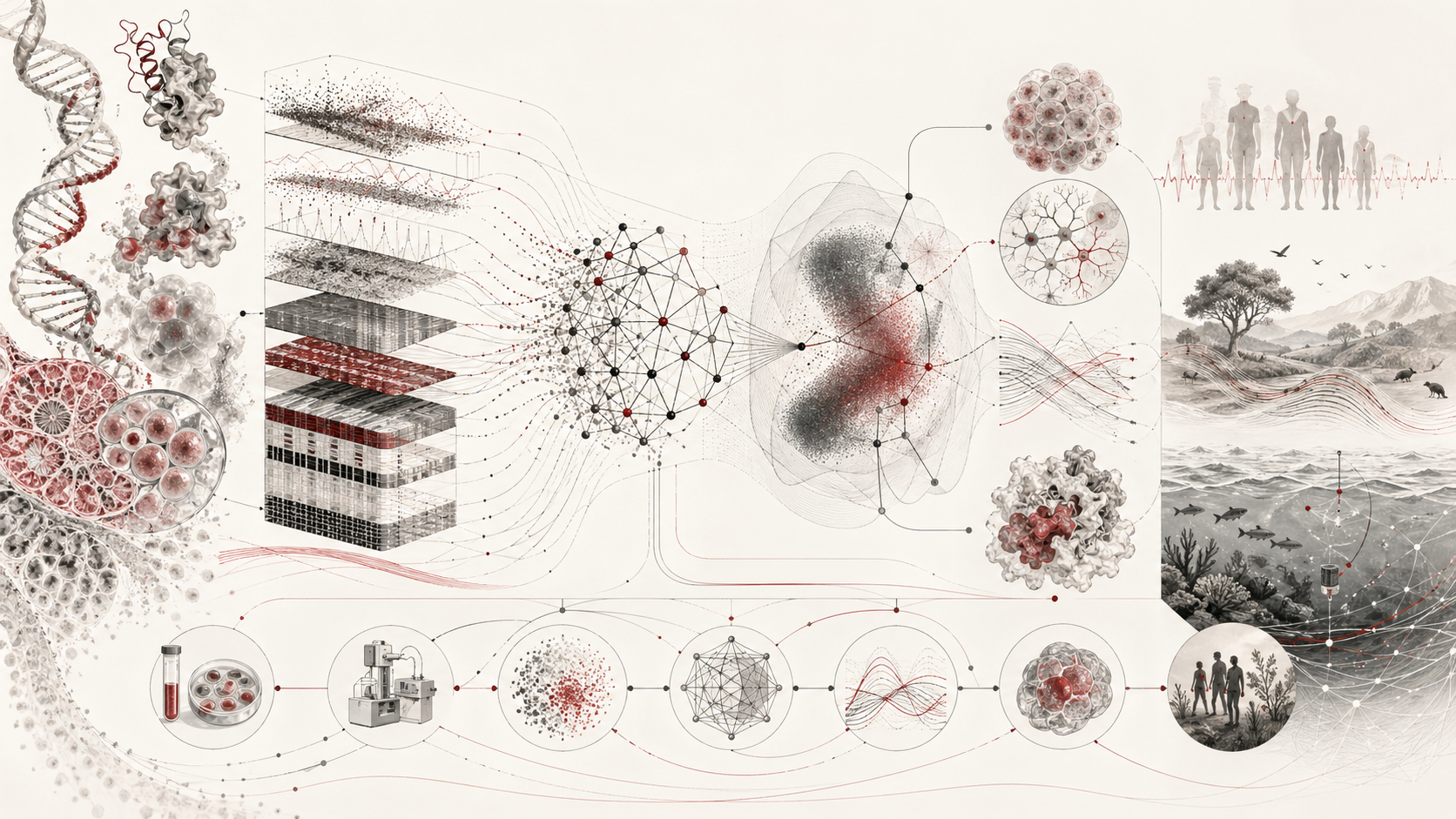
The central argument is that machine learning becomes scientifically useful in biology when it is treated as part of a larger evidence system. Models must be connected to sampling design, experimental context, metadata, biological mechanism, uncertainty, external validation, and responsible governance. A model that predicts well in one dataset may fail when biological populations, instruments, batches, species, clinical settings, or ecological conditions change.
This article is written for biologists, ecologists, marine biologists, computational biologists, bioinformaticians, medical and environmental-health readers, biodiversity scientists, biotechnology teams, data engineers, scientific software developers, and research groups building reproducible computational biology workflows.
Why machine learning matters in the life sciences
Machine learning matters in the life sciences because biological systems are high-dimensional, heterogeneous, nonlinear, context-dependent, and difficult to observe completely. A genome may contain millions of variants. A tissue section may contain millions of pixels and thousands of cells. A microbiome sample may contain many taxa with uneven abundance. A disease cohort may combine clinical history, imaging, laboratory measurements, molecular profiles, medications, environmental exposure, and social context. An ecosystem may combine species interactions, climate signals, land-use change, nutrient flows, disturbance regimes, and sampling uncertainty.
Traditional statistical and mechanistic models remain essential. They provide interpretability, causal discipline, and theoretical structure. Machine learning adds a complementary capacity: it can learn complex patterns from data, build predictive models, identify latent structure, integrate multiple data modalities, and support hypothesis generation where explicit equations are incomplete.
The risk is that prediction can be mistaken for biological understanding. A classifier that separates two groups may exploit batch effects, sampling artifacts, instrument differences, geographic confounding, or hidden metadata rather than biological mechanism. A neural network may produce accurate predictions while obscuring the features driving those predictions. A model trained in one organism, population, tissue type, laboratory, or environment may not generalize to another.
Machine learning in biology therefore requires more than model accuracy. It requires a scientific architecture: sampling logic, metadata, preprocessing, model selection, validation, interpretation, uncertainty analysis, and biological review.
Learning from biological data
A machine learning model learns a mapping from input data to output structure. In biology, the input might be a gene-expression matrix, a DNA sequence, a microscopy image, a protein sequence, a metabolite profile, a species-observation table, a sensor stream, or a clinical record. The output might be a disease label, phenotype, pathway state, species distribution, protein property, cell type, ecological risk, treatment response, or cluster assignment.
The scientific question determines the learning task. A model trained to classify tumor subtypes is different from a model trained to estimate gene expression from histology, detect plankton in marine images, predict protein structure, classify antimicrobial resistance, identify damaged coral reefs, forecast disease spread, or infer microbial community states.
Machine learning workflows usually involve several stages:
- Problem formulation: defining the biological question, outcome, unit of analysis, and decision context.
- Data assembly: collecting measurements, labels, metadata, and provenance.
- Preprocessing: cleaning, normalizing, filtering, transforming, and aligning data.
- Representation: turning biological observations into features, embeddings, graphs, tensors, images, sequences, or tables.
- Model training: fitting a model to data.
- Validation: testing performance on data not used during training.
- Interpretation: connecting model behavior to biological evidence.
- Deployment or reuse: documenting limitations, monitoring drift, and preserving reproducibility.
The most important decision is often not which algorithm to use, but how the biological problem is framed.
Prediction, explanation, and mechanism
Machine learning is powerful because it can predict. But biology often requires explanation. Prediction asks whether a model can estimate an outcome from observed inputs. Explanation asks why the pattern exists. Mechanism asks what biological process produces the pattern.
These are related but distinct. A model may predict disease status from gene expression without identifying the causal pathway. A model may classify cell types without explaining differentiation. A model may predict species presence without isolating the ecological mechanisms that control distribution. A model may identify protein structures without fully explaining folding dynamics.
This distinction matters because biological decisions often require intervention. If a model predicts that a pathway is associated with disease, researchers still need to know whether the pathway causes disease, responds to disease, reflects cell-type composition, or captures a technical artifact. If a model predicts ecological collapse, scientists still need to know which stressors are causal, reversible, or governable.
Interpretability methods can help identify influential features, but they do not automatically establish mechanism. Feature importance, saliency maps, SHAP values, attention weights, partial dependence plots, and embedding visualizations should be treated as interpretive tools, not proof of causation.
In rigorous life-science machine learning, prediction is a starting point. Biological validation is the test.
Biological data types and learning problems
Life-science machine learning spans many data structures. Each data type carries different assumptions, preprocessing needs, validation risks, and biological interpretation challenges.
Tabular biological data
Tabular data include species traits, clinical variables, laboratory measurements, phenotypes, environmental covariates, experimental treatments, and summarized omics features. These data are often modeled using logistic regression, random forests, gradient boosting, support vector machines, generalized additive models, Bayesian models, and interpretable machine learning methods.
Sequence data
DNA, RNA, and protein sequences can be modeled as symbolic strings, k-mer profiles, embeddings, alignments, or tokenized biological language. Machine learning can support variant effect prediction, regulatory sequence analysis, protein property prediction, antimicrobial resistance classification, phylogenetic feature extraction, and protein design.
Image data
Microscopy, histopathology, remote sensing, fluorescence imaging, live-cell imaging, medical imaging, and ecological imagery can be modeled using convolutional neural networks, vision transformers, segmentation models, object detection, self-supervised representation learning, and image-derived morphometrics.
Graph and network data
Biological systems are often relational. Protein interactions, gene-regulatory networks, metabolic reactions, ecological food webs, epidemiological contacts, and cell-cell communication can be represented as graphs. Machine learning on graphs can support node classification, link prediction, community detection, pathway inference, and network perturbation analysis.
Time-series data
Physiology, epidemiology, ecological monitoring, bioreactor measurements, experimental perturbations, cell imaging, and sensor networks produce time-dependent data. These can be modeled using recurrent neural networks, state-space models, Gaussian processes, temporal convolutional networks, mechanistic differential equations, and hybrid physics-informed or biology-informed models.
Multimodal data
Many life-science problems combine data modalities: sequence plus structure, image plus transcriptomics, clinical variables plus genomics, geospatial data plus biodiversity observations, or microbiome profiles plus environmental metadata. Multimodal learning can connect evidence layers, but it also increases the risk of leakage, confounding, and opaque model behavior.
Supervised, unsupervised, and self-supervised learning
Supervised learning uses labeled examples. In biology, labels might be disease status, species identity, cell type, phenotype, treatment response, ecological condition, or experimental class. The model learns to predict labels from measured features.
Unsupervised learning searches for structure without explicit labels. Clustering, dimensionality reduction, topic modeling, matrix factorization, and manifold learning can reveal latent cell states, ecological communities, sample groups, molecular signatures, or hidden technical structure.
Self-supervised learning trains models using tasks derived from the data itself. A sequence model may learn by predicting masked biological tokens. An image model may learn by reconstructing missing regions or aligning augmented views. A protein model may learn representations from large protein-sequence databases. Self-supervised learning is important because biological labels are expensive, incomplete, noisy, and context-dependent, while unlabeled biological data are increasingly abundant.
Reinforcement learning is less common in everyday biological data analysis but may be used in experimental design, molecular design, adaptive therapy research, closed-loop microscopy, robotics-assisted biology, and optimization problems where actions affect future states.
Each learning paradigm carries different assumptions. Supervised models depend heavily on label quality. Unsupervised models may reveal structure that is biological, technical, or both. Self-supervised models may learn useful representations while inheriting biases from training corpora. Reinforcement learning requires careful specification of objectives and constraints.
Features, representations, and embeddings
A feature is a measurable input used by a model. In a simple ecological model, features might include temperature, precipitation, land-cover class, nutrient concentration, and species abundance. In a genomics model, features might include variants, expression values, methylation levels, or k-mer counts. In microscopy, features may be extracted from images or learned directly by a neural network.
Representation learning allows models to learn features automatically. A deep learning model may convert an image into a latent vector, a protein sequence into an embedding, or a cell-expression profile into a lower-dimensional representation. These learned representations can be powerful because they capture patterns that are difficult to design manually.
But learned representations are not neutral. They reflect training data, preprocessing choices, architecture, objective functions, and sampling biases. A model trained on one population, species, tissue preparation, sequencing technology, or imaging protocol may encode assumptions that fail elsewhere.
Biological machine learning therefore requires representational humility. Good embeddings are useful only when their scope, provenance, uncertainty, and limits are understood.
Model evaluation, validation, and leakage
Model evaluation is one of the most important parts of machine learning in the life sciences. A model should be tested on data not used during training. This sounds simple, but biological data make it difficult.
Data leakage occurs when information from the test set enters the training process. Leakage can happen through repeated measurements from the same organism, shared patients, duplicated sequences, related species, batch effects, preprocessing before splitting, feature selection performed on the full dataset, image tiles from the same slide appearing in both train and test sets, or temporal data split incorrectly.
Good validation depends on the biological unit of independence. If the model is intended to generalize to new patients, split by patient. If it is intended to generalize to new field sites, split by site. If it is intended to generalize to future samples, use temporal validation. If it is intended to generalize to new laboratories, instruments, species, or populations, external validation is essential.
Common evaluation metrics include accuracy, sensitivity, specificity, precision, recall, F1 score, area under the receiver operating characteristic curve, area under the precision-recall curve, calibration error, mean absolute error, root mean squared error, concordance, and decision-curve measures. The correct metric depends on the scientific and decision context.
For high-stakes biomedical or environmental use, model performance should be reported with uncertainty intervals, calibration, subgroup analysis, external validation, and clear documentation of intended use.
Applications across the life sciences
Genomics and sequence analysis
Machine learning can classify variants, predict regulatory elements, identify sequence motifs, infer gene function, detect antimicrobial resistance, prioritize candidate genes, and model expression patterns. Sequence-based models are especially important as biological databases grow and as self-supervised learning creates reusable representations for DNA, RNA, and proteins.
Proteomics, protein structure, and molecular biology
Protein machine learning has become one of the most visible areas of biological AI. Structure prediction, protein design, interaction prediction, functional annotation, and molecular property estimation are reshaping biological research. These models can accelerate hypothesis generation, but predicted structures and interactions still require experimental validation, especially when used in drug discovery, mechanistic biology, or clinical translation.
Microscopy, imaging, and spatial biology
Image-based machine learning can segment cells, classify tissue patterns, quantify morphology, detect phenotypes, identify spatial organization, and support high-content screening. Spatial biology connects images with molecular measurements, making machine learning central to integrating tissue architecture with gene and protein expression.
Drug discovery and toxicology
Machine learning can support target prioritization, virtual screening, molecular property prediction, toxicity estimation, pharmacogenomics, drug repurposing, and trial enrichment. However, drug discovery models are vulnerable to dataset bias, assay artifacts, chemical-space limitations, and poor external validation.
Ecology, biodiversity, and conservation
Machine learning is increasingly used for species distribution modeling, acoustic biodiversity monitoring, camera-trap classification, habitat mapping, invasive species detection, ecological forecasting, and remote-sensing analysis. These applications connect biology directly to sustainability, conservation, land systems, marine ecosystems, freshwater systems, forestry, agroecology, and biodiversity risk.
Epidemiology and environmental health
Machine learning can help analyze disease spread, environmental exposure, syndromic surveillance, pathogen genomics, wastewater monitoring, climate-health relationships, and public-health risk. These models require special caution because predictions may influence resource allocation, policy, and public trust.
Systems biology and mechanistic integration
Machine learning can integrate omics data, network structure, pathway annotations, perturbation experiments, and dynamic models. The strongest systems-biology applications often combine machine learning with mechanistic knowledge rather than replacing mechanistic reasoning.
Foundation models and generative biology
Foundation models are large models trained on broad datasets that can be adapted to many downstream tasks. In biology, foundation models are emerging for protein sequences, DNA, RNA, molecules, cells, tissues, images, and multimodal biomedical data. Generative models can propose sequences, structures, molecules, images, or experimental designs.
This development is important because it shifts some biological modeling from task-specific feature engineering toward reusable learned representations. A protein-language model may encode structural and functional signals. A single-cell model may capture cell-state relationships. A multimodal biomedical model may connect text, images, clinical variables, and molecular features.
The opportunity is substantial, but so are the risks. Foundation models may inherit biases from public databases, underrepresent certain species or populations, obscure data provenance, produce confident but invalid outputs, and make it difficult to distinguish plausible hypotheses from validated findings. In biology, generative output is not biological truth. It is a candidate for testing.
The future of machine learning in the life sciences will likely depend on hybrid systems: data-driven models constrained by biological knowledge, uncertainty-aware validation, curated databases, reproducible software, and experimental feedback.
Reproducibility, provenance, and FAIR data
Machine learning workflows are difficult to reproduce unless data, code, parameters, software versions, metadata, random seeds, model artifacts, training splits, preprocessing steps, and evaluation decisions are preserved.
Reproducibility is not a cosmetic issue. In the life sciences, model results can change when a preprocessing step changes, a random split changes, a batch effect is removed, a feature is scaled differently, or a hidden duplicate is discovered. A model without provenance may be impossible to evaluate scientifically.
FAIR data principles — findable, accessible, interoperable, and reusable — are especially important for biological machine learning. A dataset should have clear identifiers, metadata, controlled vocabularies where appropriate, documented licenses, file formats, provenance, and reuse conditions. Model artifacts should also be documented: architecture, training data, intended use, limitations, evaluation metrics, and known failure modes.
For biomedical prediction models, reporting standards and governance frameworks are increasingly important. A life-science model should not only report performance. It should report who or what the model applies to, how it was trained, how validation was performed, where it may fail, and what evidence supports its interpretation.
Mathematical lens: machine learning in biology
Several mathematical ideas are central to machine learning in the life sciences. These expressions do not replace biological reasoning, but they help clarify how models learn from observations, optimize parameters, evaluate error, and report predictive performance.
Training data
D=\{(x_i,y_i)\}_{i=1}^{n}
\]
Interpretation: A supervised learning dataset contains biological observations \(x_i\) paired with labels, measurements, or outcomes \(y_i\). The scientific meaning of both depends on study design, sampling, metadata, and measurement quality.
Prediction function
\hat{y}=f_{\theta}(x)
\]
Interpretation: A model with learned parameters \(\theta\) maps an input observation \(x\) to a prediction \(\hat{y}\). The prediction may be a class, probability, risk score, continuous estimate, or learned representation.
Loss function
\theta^*=\arg\min_{\theta}\frac{1}{n}\sum_{i=1}^{n}L(f_{\theta}(x_i),y_i)
\]
Interpretation: Training searches for parameters that minimize average prediction error over the training data. The loss function \(L\) should match the scientific and decision context of the task.
Regularization
\theta^*=\arg\min_{\theta}\left[\frac{1}{n}\sum_{i=1}^{n}L(f_{\theta}(x_i),y_i)+\lambda R(\theta)\right]
\]
Interpretation: Regularization adds a complexity penalty \(R(\theta)\), controlled by \(\lambda\). It can reduce overfitting, especially when biological datasets are small, high-dimensional, noisy, or confounded.
Classification probability
P(y=1|x)=\sigma(w^Tx+b)
\]
Interpretation: A logistic model estimates the probability of a binary outcome using weighted input features. The probability should be calibrated and validated before being interpreted in clinical, ecological, or public-health settings.
Mean squared error
MSE=\frac{1}{n}\sum_{i=1}^{n}(y_i-\hat{y}_i)^2
\]
Interpretation: Mean squared error measures average squared prediction error for continuous outcomes. It is sensitive to large errors and should be interpreted alongside biological scale and units.
Cross-validation estimate
\hat{E}_{CV}=\frac{1}{K}\sum_{k=1}^{K}E_k
\]
Interpretation: Cross-validation averages validation error across \(K\) folds. In biology, folds must respect the biological unit of independence to avoid leakage from related samples, patients, slides, sites, organisms, or time periods.
Confusion matrix metrics
Accuracy=\frac{TP+TN}{TP+TN+FP+FN}
\]
Interpretation: Accuracy measures the fraction of correct classifications, but it can be misleading when classes are imbalanced or when false positives and false negatives have different consequences.
Sensitivity=\frac{TP}{TP+FN}
\]
Interpretation: Sensitivity measures the fraction of true positives correctly detected. It is especially important when missing a biological or clinical condition carries high risk.
Specificity=\frac{TN}{TN+FP}
\]
Interpretation: Specificity measures the fraction of true negatives correctly identified. It matters when false positives create unnecessary treatment, alarm, intervention, or ecological management action.
Calibration
E[y|P(\hat{y}=1|x)=p]\approx p
\]
Interpretation: A well-calibrated probabilistic model assigns probabilities that match observed outcome frequencies. Calibration is essential when predictions inform risk, triage, surveillance, or intervention decisions.
Python and R workflows
The following compact examples illustrate reproducible machine-learning practice for life-science data. The full GitHub repository expands these examples into a cross-language scientific-computing workflow with Python, R, Julia, Fortran, Rust, Go, C, C++, SQL, notebooks, synthetic data, provenance records, validation notes, and reproducibility documentation.
Python example: biomarker classification with leakage-aware splitting
"""
Compact life-science machine-learning example.

This example trains a small classifier on synthetic biomarker data.
The split is made by sample_id to emphasize the principle that biological
units of independence must be protected during validation.
"""

import pandas as pd
from sklearn.ensemble import RandomForestClassifier
from sklearn.metrics import classification_report, roc_auc_score
from sklearn.model_selection import train_test_split

data = pd.DataFrame(
    {
        "sample_id": [f"S{i:03d}" for i in range(1, 13)],
        "immune_score": [0.81, 0.77, 0.66, 0.59, 0.45, 0.41, 0.28, 0.25, 0.73, 0.69, 0.36, 0.31],
        "metabolic_score": [0.20, 0.25, 0.34, 0.39, 0.55, 0.61, 0.70, 0.73, 0.28, 0.32, 0.66, 0.69],
        "morphology_score": [0.78, 0.74, 0.62, 0.57, 0.49, 0.44, 0.31, 0.29, 0.71, 0.67, 0.37, 0.34],
        "condition": [1, 1, 1, 1, 0, 0, 0, 0, 1, 1, 0, 0],
    }
)

features = ["immune_score", "metabolic_score", "morphology_score"]
X = data[features]
y = data["condition"]

X_train, X_test, y_train, y_test = train_test_split(
    X,
    y,
    test_size=0.33,
    random_state=42,
    stratify=y,
)

model = RandomForestClassifier(
    n_estimators=200,
    random_state=42,
    max_depth=3,
)

model.fit(X_train, y_train)

predicted = model.predict(X_test)
probability = model.predict_proba(X_test)[:, 1]

print(classification_report(y_test, predicted, zero_division=0))
print("ROC AUC:", round(roc_auc_score(y_test, probability), 3))

importance = pd.DataFrame(
    {
        "feature": features,
        "importance": model.feature_importances_,
    }
).sort_values("importance", ascending=False)

print(importance.to_string(index=False))
Python example: simple external validation table
"""
External validation should be treated as a separate scientific test.
This example compares predicted probabilities with observed labels
in a small synthetic validation set.
"""

import pandas as pd
from sklearn.metrics import accuracy_score, brier_score_loss, roc_auc_score

validation = pd.DataFrame(
    {
        "sample_id": ["EXT001", "EXT002", "EXT003", "EXT004", "EXT005", "EXT006"],
        "observed_condition": [1, 1, 0, 0, 1, 0],
        "predicted_probability": [0.91, 0.74, 0.33, 0.22, 0.68, 0.41],
    }
)

validation["predicted_class"] = (validation["predicted_probability"] >= 0.50).astype(int)

metrics = {
    "accuracy": accuracy_score(validation["observed_condition"], validation["predicted_class"]),
    "roc_auc": roc_auc_score(validation["observed_condition"], validation["predicted_probability"]),
    "brier_score": brier_score_loss(validation["observed_condition"], validation["predicted_probability"]),
}

for metric, value in metrics.items():
    print(metric, round(value, 4))
R example: transparent logistic model for biological risk classification
# Compact R example for transparent biological classification.
# The dataset is synthetic and used only to demonstrate workflow structure.

data <- data.frame(
  sample_id = sprintf("S%03d", 1:12),
  immune_score = c(0.81, 0.77, 0.66, 0.59, 0.45, 0.41, 0.28, 0.25, 0.73, 0.69, 0.36, 0.31),
  metabolic_score = c(0.20, 0.25, 0.34, 0.39, 0.55, 0.61, 0.70, 0.73, 0.28, 0.32, 0.66, 0.69),
  morphology_score = c(0.78, 0.74, 0.62, 0.57, 0.49, 0.44, 0.31, 0.29, 0.71, 0.67, 0.37, 0.34),
  condition = c(1, 1, 1, 1, 0, 0, 0, 0, 1, 1, 0, 0)
)

model <- glm(
  condition ~ immune_score + metabolic_score + morphology_score,
  data = data,
  family = binomial()
)

data$predicted_probability <- predict(model, type = "response")
data$predicted_class <- ifelse(data$predicted_probability >= 0.5, 1, 0)

accuracy <- mean(data$predicted_class == data$condition)

print(summary(model))
print(data[, c("sample_id", "condition", "predicted_probability", "predicted_class")])
print(paste("Apparent accuracy:", round(accuracy, 3)))GitHub repository
The companion repository provides a reproducible technical scaffold for the article’s computational examples, including biomarker classification, leakage-aware validation, external validation summaries, transparent logistic modeling, provenance records, synthetic data, and reproducibility documentation.
The full code distribution for this article, including selected article examples, expanded computational workflows, reproducible data structures, provenance documentation, and full-stack scientific-computing scaffolding, is available on GitHub.
Limits, ethics, and responsible interpretation
Machine learning can amplify biological discovery, but it can also amplify error. Models may learn confounding, reproduce inequities, overfit small datasets, hide uncertainty, or produce misleading explanations. In clinical and public-health contexts, failures can affect patients and communities. In ecological and conservation contexts, failures can misdirect scarce resources or obscure vulnerable systems.
Several limits deserve special attention.
First, biological data are often biased. Public databases overrepresent certain organisms, populations, tissues, diseases, environments, and research priorities. Models trained on these data may perform poorly for underrepresented groups, rare species, neglected diseases, geographically diverse ecosystems, or low-resource settings.
Second, labels are often imperfect. Disease categories, cell-type annotations, ecological condition classes, and phenotype labels may be uncertain, contested, or dependent on expert interpretation. A model cannot overcome flawed labels simply by using a more sophisticated algorithm.
Third, biological systems change. A model trained on past disease variants, previous land-use patterns, older sequencing platforms, historic climate regimes, or one laboratory protocol may drift over time.
Fourth, interpretability is not causality. A feature that helps prediction is not necessarily a mechanism, target, or intervention point.
Responsible machine learning in the life sciences should therefore include external validation, uncertainty reporting, subgroup analysis, provenance, documentation, biological review, model monitoring, and a clear statement of intended use.
Why this matters now
Machine learning now sits at the center of many biological research frontiers. It helps researchers read genomes, interpret images, model proteins, predict molecular interactions, monitor ecosystems, analyze disease spread, integrate omics data, and generate hypotheses from complex datasets.
But the deeper significance is institutional. Life-science research is becoming computational, collaborative, and infrastructure-dependent. Data stewardship, code quality, model documentation, and reproducibility are no longer optional technical details. They are part of scientific credibility.
The best future for machine learning in biology is not a future where algorithms replace biological expertise. It is a future where machine learning strengthens biological reasoning: making patterns visible, prioritizing experiments, testing predictions, clarifying uncertainty, integrating scales, and expanding the reach of reproducible science.
Conclusion
Machine learning in the life sciences should be understood as a disciplined method for learning from biological complexity. Its value does not come from novelty alone. It comes from whether models improve scientific inference, support reproducible workflows, respect biological context, and remain transparent about uncertainty and limits.
The life sciences need models that can work across scales: molecules, cells, tissues, organisms, populations, ecosystems, and environments. They also need models that can be audited, challenged, validated, and connected to mechanism. A machine-learning result is strongest when it becomes part of a larger scientific chain: observation, model, interpretation, validation, experiment, revision, and reuse.
The future of biological machine learning will be shaped not only by larger models, but by better scientific practice.
Related articles
- Biology
- Systems Biology and Complexity in Living Networks
- Networks, Systems, and Biological Complexity
- Genomics, Sequence Analysis, and Biological Data
- Python for Biological Modeling and Automation
- Python for Simulation, Bioinformatics, and Scientific Workflows
- Data, Measurement, and Reproducibility in the Life Sciences
- Image Analysis, Microscopy, and Computational Biology
- Modeling Disease, Epidemiology, and Biological Spread
- Mathematical Biology and the Logic of Living Systems
Further reading
- Bishop, C.M. and Bishop, H. (2024) Deep Learning: Foundations and Concepts. Cham: Springer. Available at: https://link.springer.com/book/10.1007/978-3-031-45468-4
- Goodfellow, I., Bengio, Y. and Courville, A. (2016) Deep Learning. Cambridge, MA: MIT Press. Available at: https://www.deeplearningbook.org/
- Hastie, T., Tibshirani, R. and Friedman, J. (2009) The Elements of Statistical Learning. 2nd edn. New York: Springer. Available at: https://hastie.su.domains/ElemStatLearn/
- National Academies of Sciences, Engineering, and Medicine (2020) Life-Cycle Decisions for Biomedical Data: The Challenge of Forecasting Costs. Washington, DC: National Academies Press. Available at: https://nap.nationalacademies.org/catalog/25639/life-cycle-decisions-for-biomedical-data-the-challenge-of-forecasting-costs
- ELIXIR (n.d.) Research Data Management Kit: Machine Learning. Available at: https://rdmkit.elixir-europe.org/machine_learning
References
- Abramson, J., Adler, J., Dunger, J., Evans, R., Green, T., Pritzel, A., et al. (2024) ‘Accurate structure prediction of biomolecular interactions with AlphaFold 3’, Nature, 630, pp. 493–500. Available at: https://www.nature.com/articles/s41586-024-07487-w
- Collins, G.S., Moons, K.G.M., Dhiman, P., Riley, R.D., Beam, A.L., Van Calster, B., et al. (2024) ‘TRIPOD+AI statement: updated guidance for reporting clinical prediction models that use regression or machine learning methods’, BMJ, 385, e078378. Available at: https://www.bmj.com/content/385/bmj-2023-078378
- FDA (2025) Artificial Intelligence in Software as a Medical Device. U.S. Food and Drug Administration. Available at: https://www.fda.gov/medical-devices/software-medical-device-samd/artificial-intelligence-software-medical-device
- Jordan, M.I. and Mitchell, T.M. (2015) ‘Machine learning: Trends, perspectives, and prospects’, Science, 349(6245), pp. 255–260. Available at: https://www.science.org/doi/10.1126/science.aaa8415
- Jumper, J., Evans, R., Pritzel, A., Green, T., Figurnov, M., Ronneberger, O., et al. (2021) ‘Highly accurate protein structure prediction with AlphaFold’, Nature, 596, pp. 583–589. Available at: https://www.nature.com/articles/s41586-021-03819-2
- LeCun, Y., Bengio, Y. and Hinton, G. (2015) ‘Deep learning’, Nature, 521, pp. 436–444. Available at: https://www.nature.com/articles/nature14539
- NIST (2023) Artificial Intelligence Risk Management Framework (AI RMF 1.0). National Institute of Standards and Technology. Available at: https://www.nist.gov/publications/artificial-intelligence-risk-management-framework-ai-rmf-10
- Tarca, A.L., Carey, V.J., Chen, X., Romero, R. and Drăghici, S. (2007) ‘Machine learning and its applications to biology’, PLoS Computational Biology, 3(6), e116. Available at: https://pmc.ncbi.nlm.nih.gov/articles/PMC1904382/
- Wilkinson, M.D., Dumontier, M., Aalbersberg, I.J., Appleton, G., Axton, M., Baak, A., et al. (2016) ‘The FAIR Guiding Principles for scientific data management and stewardship’, Scientific Data, 3, 160018. Available at: https://www.nature.com/articles/sdata201618
- Yu, K.H., Beam, A.L. and Kohane, I.S. (2018) ‘Artificial intelligence in healthcare’, Nature Biomedical Engineering, 2, pp. 719–731. Available at: https://www.nature.com/articles/s41551-018-0305-z