
Last Updated May 28, 2026
Agriculture is one of humanity’s most consequential forms of biological management: the deliberate shaping of plants, animals, soils, microbes, water, landscapes, labor, infrastructure, markets, diets, and ecosystems to sustain human life. It is not merely food production. It is the organized management of living systems at planetary scale. Every field, orchard, pasture, fishery, greenhouse, seed bank, irrigation network, livestock system, soil community, supply chain, and food environment participates in a larger biological system through which societies transform sunlight, water, nutrients, genetic diversity, labor, and ecological relationships into nourishment.
This article examines agriculture and food systems as the management of life. It connects crop science, livestock systems, soil biology, agroecology, biodiversity, nutrition, climate risk, food security, public health, economics, governance, and ecological resilience. It argues that agriculture cannot be understood only as yield, output, efficiency, or commodity production. It must also be understood as biological stewardship: a system that depends on soil organisms, pollinators, crop diversity, water cycles, nutrient flows, genetic resources, animal health, microbial communities, ecological services, and human institutions.
Main Library
Publications
Article Map
Biology
Related Topic
Environmental Science
Related Topic
Earth Science
Related Topic
Chemistry
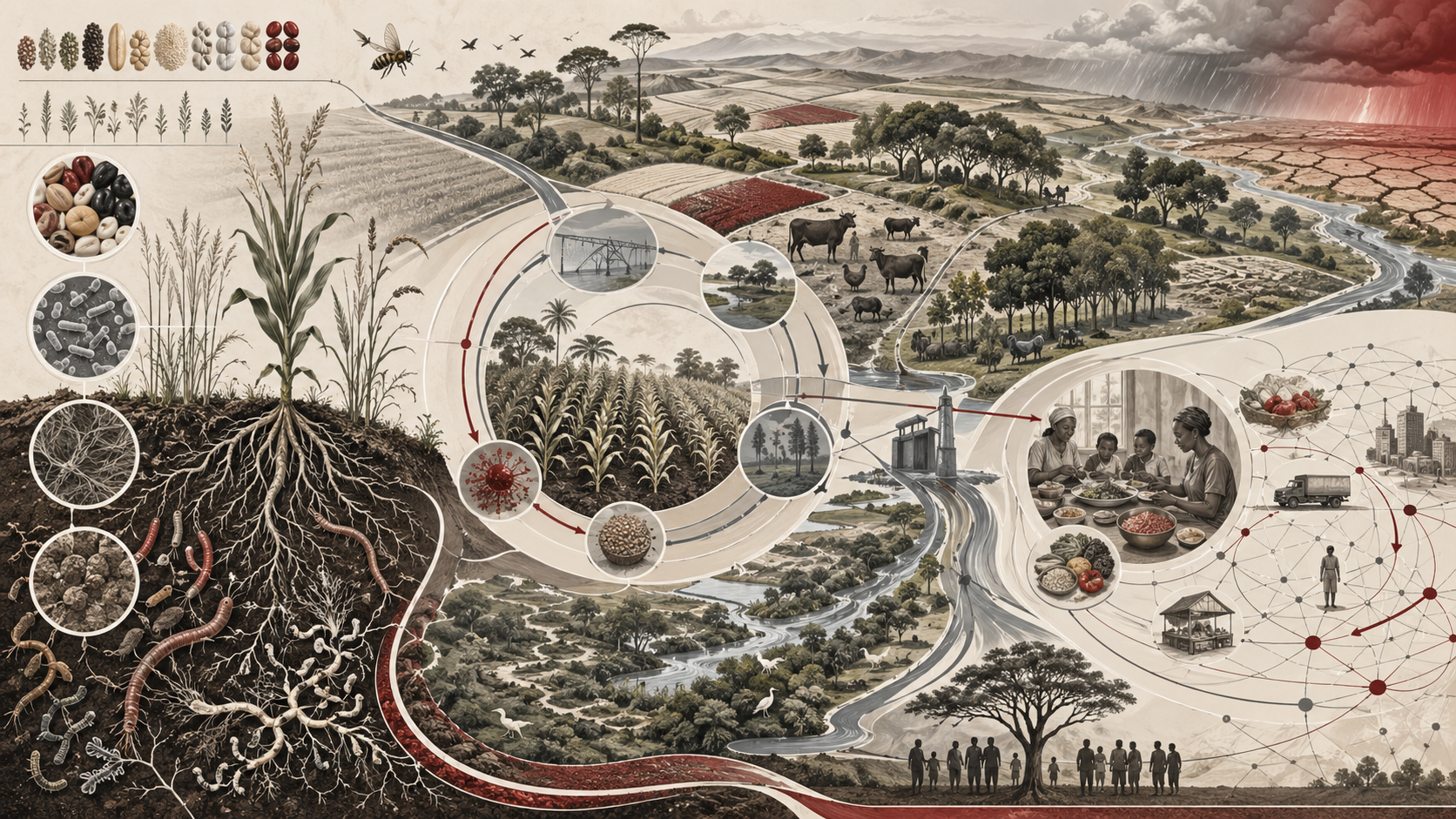
The central argument is that food systems succeed when they manage life without exhausting the conditions that make life productive. Agriculture must feed people, support livelihoods, protect biodiversity, maintain soil fertility, conserve water, reduce pollution, adapt to climate change, preserve genetic diversity, respect farm workers and communities, and produce diets that sustain human health.
This article is written for biologists, ecologists, agronomists, soil scientists, food-systems researchers, public-health readers, environmental-health professionals, computational biologists, sustainability scientists, biodiversity experts, policy readers, and scientific software developers interested in the biological and systemic foundations of agriculture.
Why agriculture is biological management
Agriculture manages life by selecting which organisms grow, where they grow, how they reproduce, what they consume, how they interact, and how their products move through society. A cultivated field is not simply land under production. It is an ecological simplification, a genetic system, a soil-biological community, a hydrological intervention, a nutrient transformation, a labor system, a market object, and a source of human nutrition.
A crop is a domesticated evolutionary lineage. A livestock breed is a biological population shaped by selection, husbandry, disease management, feed systems, and market demand. A soil is a living system composed of minerals, organic matter, roots, fungi, bacteria, archaea, invertebrates, water, gases, and chemical gradients. A farm is an ecosystem embedded in a landscape. A food system is a network connecting production, processing, transport, retail, culture, access, waste, health, and governance.
This biological management can be regenerative or extractive. It can maintain soil structure, support biodiversity, diversify diets, and strengthen rural livelihoods. It can also degrade soils, simplify landscapes, concentrate genetic risk, increase greenhouse-gas emissions, pollute waterways, undermine farm labor, intensify animal suffering, and produce cheap calories without adequate nourishment.
Agriculture is therefore not only a technical challenge. It is a biological, ecological, ethical, and institutional challenge.
Food systems beyond production
Food systems include all activities and relationships involved in feeding people: production, harvesting, storage, processing, transport, distribution, retail, preparation, consumption, waste, and governance. They also include the ecological foundations of food: soil fertility, water availability, climate stability, biodiversity, pollination, pest regulation, genetic resources, and microbial processes.
A production-only view asks: how much food is produced? A food-systems view asks broader questions. Is the food nutritious? Is it affordable? Is it culturally appropriate? Who produces it? Who owns the land? Who bears environmental costs? Who has access to healthy diets? What happens to waste? What happens to farm workers? What happens to soils, rivers, pollinators, livestock, forests, fisheries, and future generations?
This systems view matters because food problems are rarely isolated. Hunger can coexist with obesity. High yields can coexist with soil degradation. Export success can coexist with local food insecurity. Cheap food can hide environmental and health costs. Technological innovation can improve productivity while increasing dependence on concentrated input markets. Food abundance can still fail to produce dietary health if food environments are dominated by ultra-processed products, poverty, inequity, or weak public policy.
The management of life in agriculture must therefore be evaluated across production, nutrition, ecology, labor, resilience, and justice.
Crops, domestication, and genetic diversity
Crops are products of long biological and cultural histories. Domestication transformed wild plants through selection for traits useful to humans: larger seeds, reduced shattering, altered growth habit, synchronized maturation, reduced bitterness, improved storage, yield stability, fiber quality, oil content, sweetness, starch accumulation, and response to cultivation.
This history created extraordinary food possibilities, but it also narrowed genetic diversity in many systems. Modern agriculture often depends heavily on a small number of major crops and commercial varieties. Genetic uniformity can increase efficiency, standardization, and yield, but it can also increase vulnerability to pests, diseases, drought, heat, market disruption, and changing environments.
Crop wild relatives, landraces, traditional varieties, seed banks, farmer selection, indigenous knowledge, participatory breeding, and open genetic resources all matter for food-system resilience. Genetic diversity is not a museum artifact. It is adaptive capacity. It gives breeders and farmers options when climate, pests, diseases, soils, and market conditions change.
Agricultural biology therefore depends on conservation biology. The future of crops depends partly on preserving the evolutionary resources from which future crops can be adapted.
Soil life and biogeochemical cycles
Soil is one of the living foundations of agriculture. It stores carbon, holds water, supports roots, cycles nutrients, filters contaminants, hosts microbial communities, and provides habitat for organisms that shape plant growth. Soil fertility is not merely chemical fertility. It is also biological structure: aggregates, organic matter, fungal networks, microbial metabolism, root exudates, nematodes, arthropods, earthworms, and decomposer communities.
Agricultural practices can build or degrade soil life. Crop rotations, cover crops, compost, reduced disturbance, agroforestry, integrated livestock, perennial systems, and organic amendments can support soil structure and biological activity. Excessive tillage, erosion, compaction, salinization, nutrient imbalance, pesticide overuse, and loss of organic matter can weaken soil function.
Soil connects agriculture to biogeochemical cycles. Nitrogen, phosphorus, carbon, sulfur, potassium, calcium, and micronutrients move through soil organisms, plant uptake, fertilizers, manure, waterways, atmosphere, and food chains. Nutrient management is therefore both an agronomic and ecological problem. Too little nutrient availability limits crops and food security. Too much nutrient loss can pollute rivers, lakes, groundwater, and coastal ecosystems.
Managing soil is managing a living interface between geology, biology, water, atmosphere, and food.
Livestock, animal health, and ecological pressure
Livestock systems are central to many food systems, livelihoods, cultures, and landscapes. Animals provide meat, milk, eggs, fiber, traction, manure, savings, cultural value, and ecological functions in mixed farming systems. Pastoral and smallholder livestock systems can support livelihoods in environments where crop production is limited.
At the same time, livestock production can create major ecological and ethical pressures. Feed production, land use, methane emissions, manure management, water use, antimicrobial use, animal welfare, zoonotic risk, and habitat conversion all matter. Livestock systems vary widely: extensive pastoralism, mixed crop-livestock farming, integrated agroecological systems, industrial feedlots, backyard poultry, aquaculture, and dairy systems have different biological and social consequences.
Animal health is also human and environmental health. Diseases can move among animals, humans, and ecosystems. Antimicrobial use in animal agriculture can contribute to resistance selection when poorly governed. Manure can be a nutrient resource or a pollution source. Grazing can maintain some grassland ecosystems or degrade land depending on stocking density, mobility, rainfall, soil, vegetation, and governance.
Livestock should therefore be evaluated within specific ecological and social contexts rather than treated as a single category.
Agroecology and farming as ecosystem design
Agroecology applies ecological principles to agriculture. It treats farms as ecosystems and food systems as socio-ecological systems. Instead of relying only on external inputs, agroecology emphasizes diversity, recycling, biological interactions, soil health, ecological regulation, local knowledge, farmer agency, and social equity.
Agroecological practices may include crop rotations, intercropping, agroforestry, cover cropping, integrated pest management, biological control, mixed crop-livestock systems, polycultures, seed diversity, water harvesting, composting, landscape heterogeneity, and participatory knowledge systems. These practices do not reject science or technology. They ask technology to work with ecological processes rather than replace them.
Farming as ecosystem design means asking how organisms interact. Can crop diversity reduce pest pressure? Can flowering strips support pollinators and beneficial insects? Can cover crops reduce erosion and improve soil carbon? Can agroforestry buffer heat and wind? Can diversified systems reduce risk under climate variability? Can circular nutrient flows reduce dependence on synthetic inputs?
Agroecology is not a single recipe. It is a framework for redesigning food systems around ecological relationships, local contexts, and justice.
Biodiversity, pollination, and food-system resilience
Biodiversity supports agriculture at genetic, species, and ecosystem levels. Crop diversity, livestock breeds, soil organisms, pollinators, natural enemies of pests, decomposers, aquatic species, forests, wetlands, grasslands, and crop wild relatives all contribute to food systems.
Pollination is one visible example. Many crops depend partly or heavily on animal pollinators. Pollinator decline can threaten yield, quality, and nutritional diversity. But biodiversity’s role is broader than pollination. Soil microbes cycle nutrients. Predatory insects regulate pests. Wetlands filter water. Forests influence rainfall, microclimates, and erosion. Genetic diversity supports breeding and adaptation. Landscape diversity buffers shocks.
Food-system resilience depends on biological diversity because diversity provides redundancy, flexibility, and adaptive capacity. A simplified system may be efficient under stable conditions but fragile under disturbance. Climate shocks, pest outbreaks, supply-chain disruptions, disease emergence, and market volatility reveal the importance of diversity.
The management of life in agriculture must therefore include the protection of life beyond the crop or livestock species being sold.
Water, nutrients, and the cost of extraction
Agriculture is deeply dependent on water and nutrients. Irrigation supports high productivity in many regions, but excessive groundwater withdrawal, river depletion, salinization, and inefficient water use can undermine long-term resilience. Rainfed agriculture depends on rainfall patterns that are becoming less predictable in many places. Water scarcity connects agriculture to climate, energy, governance, and conflict.
Nutrient management creates similar tensions. Nitrogen and phosphorus fertilizers have transformed agricultural productivity, but nutrient losses contribute to eutrophication, nitrous oxide emissions, groundwater contamination, and dead zones. Manure and organic amendments can build fertility, but they can also pollute when poorly managed. Nutrient circularity is one of the central challenges of sustainable food systems.
The core problem is not simply input use. It is input dependence without ecological accounting. A food system can appear productive while transferring costs to rivers, aquifers, atmosphere, soils, workers, consumers, and future generations.
Agriculture must therefore be evaluated through material flows: water, nitrogen, phosphorus, carbon, energy, biomass, waste, and nutrients embodied in trade.
Climate change, risk, and adaptation
Climate change affects agriculture through heat stress, drought, flooding, altered rainfall, pest and disease shifts, wildfire, soil moisture change, salinity, extreme events, and changing growing seasons. It affects crops, livestock, fisheries, forests, farm workers, supply chains, food prices, and nutrition.
Agriculture also contributes to climate change through greenhouse-gas emissions from land-use change, methane, nitrous oxide, energy use, fertilizer production, livestock systems, rice cultivation, manure management, and supply chains. This creates a double responsibility: agriculture must adapt to climate change while reducing its own climate forcing where possible.
Adaptation strategies include crop diversification, drought-tolerant varieties, heat-tolerant livestock, agroforestry, improved soil water retention, early-warning systems, climate-informed planting calendars, water management, seed-system resilience, diversified livelihoods, insurance, local knowledge, and social protection. Mitigation strategies include reducing food loss and waste, improving nutrient efficiency, protecting carbon-rich ecosystems, changing some production practices, restoring degraded land, improving manure management, and supporting dietary shifts where appropriate.
Climate-resilient agriculture must avoid narrow technical fixes. Adaptation is not only a seed trait or irrigation technology. It is also land tenure, farmer knowledge, infrastructure, public investment, extension, biodiversity, risk governance, and justice.
Nutrition, public health, and food environments
Food systems shape health not only by producing calories, but by determining what foods are available, affordable, desirable, marketed, processed, culturally meaningful, and safe. A food system can produce enough calories while failing to provide healthy diets. It can produce abundance alongside hunger, micronutrient deficiency, obesity, diabetes, cardiovascular disease, and diet-related chronic illness.
Nutrition links agriculture to public health. Crop diversity affects dietary diversity. Food processing affects nutrient quality. Supply chains affect freshness. Poverty affects choice. Marketing affects consumption. School meals, public procurement, subsidies, food labeling, urban planning, trade policy, wages, and healthcare all influence food environments.
Food safety is another biological dimension. Pathogens, mycotoxins, chemical residues, heavy metals, water contamination, and supply-chain failures can turn food into a vehicle of harm. Food safety requires microbiology, veterinary health, environmental monitoring, regulation, worker training, and traceability.
A biologically serious food system must ask whether food production supports human flourishing, not merely whether it maximizes commodity output.
Governance, justice, and food sovereignty
Agriculture is organized through power. Land tenure, seed ownership, water rights, credit, subsidies, trade rules, patents, labor systems, procurement, infrastructure, extension services, research agendas, corporate concentration, and public policy shape what food systems become.
Justice questions are therefore central. Who owns land? Who controls seeds? Who works under hazardous conditions? Who is exposed to pesticide drift? Who lacks access to healthy food? Who profits from food value chains? Whose knowledge counts? Which communities lose biodiversity, water, or land to production systems that serve distant markets? Which farmers bear climate risk they did little to create?
Food sovereignty emphasizes the rights of peoples and communities to define their own food systems, protect culturally appropriate food, support local production, maintain seed diversity, and participate in decisions about land, agriculture, and nutrition. This framework does not eliminate the need for global trade or scientific innovation, but it challenges food systems that treat communities as passive consumers or labor inputs.
The management of life in agriculture is never only biological. It is also political.
Mathematical lens: agriculture and food systems
Several mathematical ideas help clarify agriculture and food systems. These expressions do not replace field knowledge, ecological interpretation, farmer experience, or public deliberation. They help make assumptions visible across production, nutrient flow, water use, biodiversity, loss, diet, and true-cost accounting.
Crop yield
Y=\frac{P}{A}
\]
Interpretation: Crop yield \(Y\) is harvested production \(P\) divided by cultivated area \(A\). Yield is useful, but it does not by itself measure soil health, biodiversity, labor conditions, nutrition, or resilience.
Nutrient use efficiency
NUE=\frac{N_{\text{harvested}}}{N_{\text{input}}}
\]
Interpretation: Nutrient use efficiency compares nutrients removed in harvested biomass with nutrients applied or available. It helps evaluate whether nutrient flows are supporting production or being lost to air, soil, and water systems.
Water productivity
WP=\frac{Y}{W}
\]
Interpretation: Water productivity compares yield \(Y\) with water used \(W\). It is especially important where irrigation, groundwater depletion, drought, salinity, or water competition affect food-system resilience.
Soil organic carbon change
\Delta SOC=SOC_{t+1}-SOC_t
\]
Interpretation: Soil organic carbon change compares soil carbon at two time points. Positive change can indicate improved soil function, though interpretation depends on measurement depth, baseline conditions, management history, and local soil ecology.
Food-system loss rate
L=\frac{F_{\text{lost}}}{F_{\text{produced}}}
\]
Interpretation: Food-system loss rate compares food lost before consumption with total food produced. Loss analysis helps connect production systems to storage, transport, processing, infrastructure, markets, and household access.
Diet diversity score
D=\sum_{i=1}^{k} I_i
\]
Interpretation: A simplified diet diversity score sums food-group indicators \(I_i\). It can help connect agricultural diversity and food access to nutritional outcomes, though it should not be treated as a complete measure of dietary quality.
Biodiversity-resilience index
R = \alpha C + \beta S + \gamma L
\]
Interpretation: A simplified resilience index can combine crop diversity \(C\), soil biological function \(S\), and landscape heterogeneity \(L\), with weights \(\alpha\), \(\beta\), and \(\gamma\). The weights should be transparent and context-specific.
True-cost balance
T = P_{\text{market}} + C_{\text{environment}} + C_{\text{health}} + C_{\text{social}}
\]
Interpretation: True-cost accounting expands price beyond market price by including environmental, health, and social costs. It helps reveal costs that may otherwise be displaced onto ecosystems, workers, communities, consumers, and future generations.
Python and R workflows
The following compact examples illustrate how agriculture and food-system concepts can be represented computationally. The full GitHub repository expands these examples into a broader reproducible workflow with Python, R, Julia, Fortran, Rust, Go, C, C++, SQL, notebooks, synthetic data, nutrient-flow analysis, water productivity, crop diversity, soil organic carbon, dietary diversity, food-loss accounting, provenance documentation, and reproducibility notes.
Python example: food-system indicator dashboard
"""
Compact agriculture and food-system indicator example.

This synthetic example calculates yield, water productivity,
nutrient use efficiency, and food-loss rate for several production systems.
It is educational and not a decision model.
"""

import pandas as pd

systems = pd.DataFrame(
    {
        "system": ["monocrop_grain", "diversified_crop", "agroforestry", "mixed_crop_livestock"],
        "production_tonnes": [850, 620, 480, 700],
        "area_hectares": [100, 80, 75, 95],
        "water_used_m3": [420000, 260000, 210000, 350000],
        "nutrient_input_kg": [12000, 7600, 5200, 9000],
        "nutrient_harvested_kg": [4800, 4100, 3600, 4700],
        "food_lost_tonnes": [90, 45, 30, 60],
    }
)

systems["yield_t_ha"] = systems["production_tonnes"] / systems["area_hectares"]
systems["water_productivity_t_per_m3"] = systems["production_tonnes"] / systems["water_used_m3"]
systems["nutrient_use_efficiency"] = systems["nutrient_harvested_kg"] / systems["nutrient_input_kg"]
systems["food_loss_rate"] = systems["food_lost_tonnes"] / systems["production_tonnes"]

print(systems.round(4).to_string(index=False))
Python example: biodiversity and resilience scoring
"""
Synthetic biodiversity-resilience scoring for food systems.

The values are conceptual and illustrate how crop diversity,
soil biological function, and landscape heterogeneity might be combined.
"""

import pandas as pd

farms = pd.DataFrame(
    {
        "farm_system": ["monocrop_grain", "diversified_crop", "agroforestry", "mixed_crop_livestock"],
        "crop_diversity": [0.20, 0.65, 0.80, 0.55],
        "soil_biological_function": [0.35, 0.70, 0.82, 0.62],
        "landscape_heterogeneity": [0.25, 0.60, 0.88, 0.58],
    }
)

farms["resilience_index"] = (
    0.35 * farms["crop_diversity"]
    + 0.35 * farms["soil_biological_function"]
    + 0.30 * farms["landscape_heterogeneity"]
)

print(farms.sort_values("resilience_index", ascending=False).round(3).to_string(index=False))
R example: soil organic carbon change
# Compact R example for soil organic carbon change.
# Synthetic values are used for demonstration only.

soil <- data.frame(
  system = c("monocrop_grain", "diversified_crop", "agroforestry", "mixed_crop_livestock"),
  soc_t0 = c(42.0, 45.0, 50.0, 46.0),
  soc_t1 = c(40.8, 47.3, 54.2, 48.1)
)

soil$delta_soc <- soil$soc_t1 - soil$soc_t0
soil$annualized_change <- soil$delta_soc / 5

print(round(soil, 3))
R example: diet diversity and food access
# Compact R example for simplified diet diversity.
# Synthetic values are used for demonstration only.

households <- data.frame(
  household_id = c("H001", "H002", "H003", "H004"),
  grains = c(1, 1, 1, 1),
  legumes = c(1, 0, 1, 0),
  fruits = c(1, 0, 1, 0),
  vegetables = c(1, 1, 1, 0),
  animal_source = c(0, 0, 1, 0),
  nuts_seeds = c(1, 0, 0, 0)
)

food_groups <- c("grains", "legumes", "fruits", "vegetables", "animal_source", "nuts_seeds")

households$diet_diversity_score <- rowSums(households[, food_groups])
households$low_diversity_flag <- households$diet_diversity_score < 4

print(households)GitHub repository
The companion repository provides a reproducible technical scaffold for the article’s computational examples, including synthetic food-system indicators, nutrient-flow analysis, water productivity, crop diversity, soil organic carbon change, diet diversity, food-loss accounting, provenance documentation, and responsible-use notes.
Limits, ethics, and responsible interpretation
Agriculture and food systems should not be reduced to a single metric. Yield matters, but yield alone does not measure nutrition, soil health, biodiversity, water security, labor justice, animal welfare, public health, cultural value, climate resilience, or ecological integrity. A system can be productive and still be fragile. It can be efficient and still be unjust. It can be profitable and still be biologically extractive.
Several cautions matter.
First, “sustainable agriculture” is context-specific. Practices that work in one ecological, cultural, or economic setting may not work in another.
Second, technology is not automatically transformative. Improved seeds, digital agriculture, precision inputs, biotechnology, irrigation, and mechanization can help, but their effects depend on access, governance, cost, knowledge, ecological context, and power.
Third, agroecology should not be romanticized. Diversified systems require knowledge, labor, markets, infrastructure, and supportive policy.
Fourth, food choices are not purely individual. Diets are shaped by poverty, marketing, work schedules, built environments, culture, policy, and unequal access.
Fifth, food-system transitions must include farmers, farm workers, indigenous peoples, small-scale producers, pastoralists, fishers, consumers, and communities already bearing ecological and economic risk.
Responsible interpretation requires biological detail and institutional humility.
Why this matters now
Agriculture is being asked to solve multiple crises at once: hunger, malnutrition, climate adaptation, biodiversity loss, rural livelihoods, water scarcity, soil degradation, public health, food affordability, and economic resilience. These demands are often in tension. Producing more food is necessary in some contexts, but production alone cannot solve food-system failure.
The future of agriculture will depend on whether societies can manage life without simplifying it beyond resilience. That means preserving genetic diversity, restoring soil function, protecting pollinators, reducing pollution, improving nutrition, supporting farmer autonomy, adapting to climate change, and building food systems that are biologically productive and socially just.
Agriculture is not only an economic sector. It is one of the central ways humanity participates in the biosphere.
Conclusion
Agriculture, food systems, and the management of life must be understood as a biological and institutional whole. Food is produced through living systems: crops, animals, soils, microbes, pollinators, forests, wetlands, rivers, genes, farmers, workers, and communities. To manage agriculture responsibly is to manage relationships among these systems.
The central challenge is not simply to produce more. It is to produce nourishment while sustaining the ecological and social conditions that make nourishment possible. This requires soil health, biodiversity, water stewardship, climate resilience, genetic diversity, nutrition, public health, fair labor, food access, and governance that recognizes the value of life beyond commodity output.
Agriculture is the management of life. The question is whether that management will be extractive, fragile, and unequal — or regenerative, resilient, and just.
Related articles
- Biology
- Restoration Ecology and the Repair of Living Systems
- Systems Biology and Complexity in Living Networks
- Evolutionary Medicine and the Biological Understanding of Disease
- Biotechnology, Intervention, and the Power to Alter Life
- Synthetic Biology and the Engineering of Biological Systems
- Data, Measurement, and Reproducibility in the Life Sciences
- Modeling Disease, Epidemiology, and Biological Spread
- Nonlinearity, Feedback, and Biological Regulation
Further reading
- FAO (2023) The State of Food and Agriculture 2023: Revealing the True Cost of Food to Transform Agrifood Systems. Rome: Food and Agriculture Organization of the United Nations. Available at: https://www.fao.org/3/cc7724en/online/state-of-food-and-agriculture-2023/
- FAO (2019) The State of the World’s Biodiversity for Food and Agriculture. Rome: Food and Agriculture Organization of the United Nations. Available at: https://www.fao.org/interactive/state-of-biodiversity-for-food-agriculture/en/
- HLPE (2019) Agroecological and Other Innovative Approaches for Sustainable Agriculture and Food Systems that Enhance Food Security and Nutrition. Rome: High Level Panel of Experts on Food Security and Nutrition. Available at: https://www.fao.org/family-farming/detail/en/c/1263887/
- IPCC (2022) Chapter 5: Food, Fibre and Other Ecosystem Products, in Climate Change 2022: Impacts, Adaptation and Vulnerability. Available at: https://www.ipcc.ch/report/ar6/wg2/chapter/chapter-5/
- IPBES (2019) Global Assessment Report on Biodiversity and Ecosystem Services. Bonn: Intergovernmental Science-Policy Platform on Biodiversity and Ecosystem Services. Available at: https://ipbes.net/global-assessment
References
- Altieri, M.A. (1995) Agroecology: The Science of Sustainable Agriculture. Boulder, CO: Westview Press. Available at: https://www.taylorfrancis.com/books/mono/10.1201/9780429495465/agroecology-miguel-altieri
- FAO (2017) The Future of Food and Agriculture: Trends and Challenges. Rome: Food and Agriculture Organization of the United Nations. Available at: https://www.fao.org/3/i6583e/i6583e.pdf
- FAO (2019) The State of the World’s Biodiversity for Food and Agriculture. Rome: Food and Agriculture Organization of the United Nations. Available at: https://www.fao.org/interactive/state-of-biodiversity-for-food-agriculture/en/
- FAO (2023) The State of Food and Agriculture 2023: Revealing the True Cost of Food to Transform Agrifood Systems. Rome: Food and Agriculture Organization of the United Nations. Available at: https://www.fao.org/3/cc7724en/online/state-of-food-and-agriculture-2023/
- FAO, IFAD, UNICEF, WFP and WHO (2024) The State of Food Security and Nutrition in the World 2024: Financing to End Hunger, Food Insecurity and Malnutrition in All Its Forms. Rome: FAO. Available at: https://openknowledge.fao.org/handle/20.500.14283/cd1254en
- Gliessman, S.R. (2015) Agroecology: The Ecology of Sustainable Food Systems. 3rd edn. Boca Raton, FL: CRC Press. Available at: https://www.routledge.com/Agroecology-The-Ecology-of-Sustainable-Food-Systems/Gliessman/p/book/9781439895610
- HLPE (2017) Nutrition and Food Systems. Rome: High Level Panel of Experts on Food Security and Nutrition. Available at: https://www.fao.org/3/i7846e/i7846e.pdf
- HLPE (2019) Agroecological and Other Innovative Approaches for Sustainable Agriculture and Food Systems that Enhance Food Security and Nutrition. Rome: High Level Panel of Experts on Food Security and Nutrition. Available at: https://www.fao.org/family-farming/detail/en/c/1263887/
- IPBES (2016) The Assessment Report on Pollinators, Pollination and Food Production. Bonn: Intergovernmental Science-Policy Platform on Biodiversity and Ecosystem Services. Available at: https://ipbes.net/assessment-reports/pollinators
- IPBES (2019) Global Assessment Report on Biodiversity and Ecosystem Services. Bonn: Intergovernmental Science-Policy Platform on Biodiversity and Ecosystem Services. Available at: https://ipbes.net/global-assessment
- IPCC (2022) Chapter 5: Food, Fibre and Other Ecosystem Products, in Climate Change 2022: Impacts, Adaptation and Vulnerability. Available at: https://www.ipcc.ch/report/ar6/wg2/chapter/chapter-5/
- Lal, R. (2020) ‘Soil organic matter and water retention’, Agronomy Journal, 112(5), pp. 3265–3277. Available at: https://acsess.onlinelibrary.wiley.com/doi/10.1002/agj2.20282
- Rockström, J., Edenhofer, O., Gaertner, J. and DeClerck, F. (2020) ‘Planet-proofing the global food system’, Nature Food, 1, pp. 3–5. Available at: https://www.nature.com/articles/s43016-019-0010-4
- Tilman, D., Balzer, C., Hill, J. and Befort, B.L. (2011) ‘Global food demand and the sustainable intensification of agriculture’, Proceedings of the National Academy of Sciences, 108(50), pp. 20260–20264. Available at: https://www.pnas.org/doi/10.1073/pnas.1116437108
- Willett, W., Rockström, J., Loken, B., Springmann, M., Lang, T., Vermeulen, S., Garnett, T., et al. (2019) ‘Food in the Anthropocene: the EAT–Lancet Commission on healthy diets from sustainable food systems’, The Lancet, 393(10170), pp. 447–492. Available at: https://www.thelancet.com/commissions/EAT