
Last Updated May 28, 2026
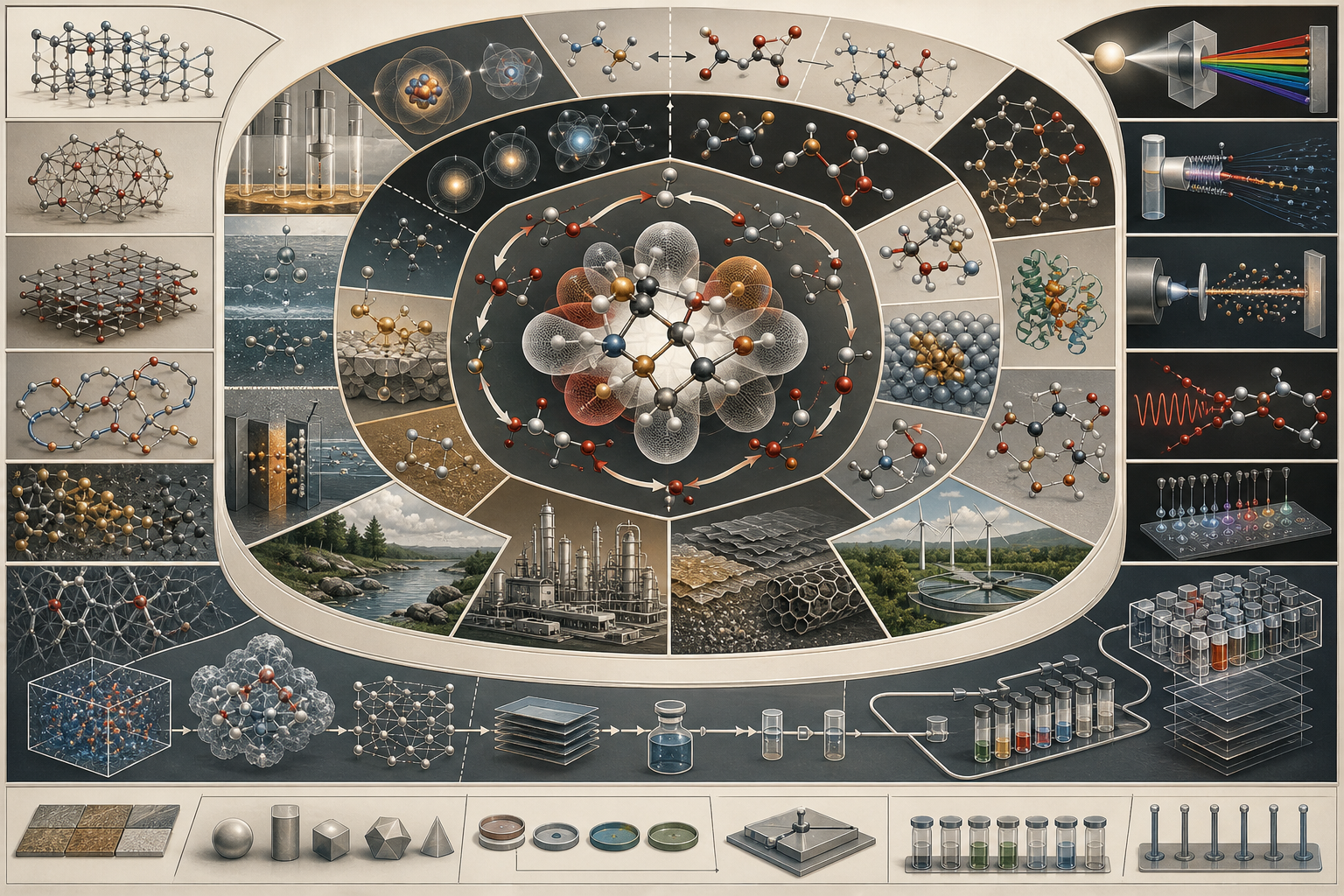
Chemistry examines the composition, structure, properties, measurement, interaction, and transformation of matter at atomic, molecular, material, biological, environmental, and industrial scales. It explains how substances are constituted, how atoms and molecules interact, how chemical systems store and exchange energy, how reactions proceed, how materials acquire function, and how matter becomes active, organized, measurable, and transformable. As a foundational natural science, chemistry provides one of the principal frameworks through which human beings understand material structure, molecular change, laboratory evidence, environmental conditions, biological function, technological possibility, and the designed transformation of the physical world.
This article map brings together the major domains through which chemistry interprets matter and transformation. It treats chemistry not as a catalog of substances, formulas, or reactions, but as a disciplined framework for understanding material organization across scales: from atoms, elements, bonds, molecules, reactions, thermodynamics, kinetics, equilibrium, acids, bases, and redox systems to organic chemistry, inorganic chemistry, physical chemistry, analytical chemistry, biochemistry, materials chemistry, environmental chemistry, computational chemistry, green chemistry, industrial chemistry, and chemical measurement. Across medicine, agriculture, energy systems, environmental monitoring, manufacturing, food science, toxicology, climate analysis, biotechnology, materials research, and public health, chemistry provides an indispensable language for explaining composition, interaction, reactivity, risk, function, and material possibility.
Main Library
Publications
Article Map
Chemistry
Related Topic
Earth Science
Related Topic
Biology
Related Topic
Physics
This series also approaches chemistry as a field that increasingly depends on formal reasoning, quantitative measurement, computational modeling, chemical data systems, reproducible laboratory workflows, and open scientific code. Many of the most important chemical questions now require not only laboratory experiment and theoretical explanation, but programmable environments capable of modeling molecular structure, reaction pathways, thermodynamic systems, kinetic behavior, spectra, chromatographic signals, mass-spectrometry data, materials properties, environmental fate, chemical risk, and complex reaction networks. For that reason, this pillar integrates chemistry with mathematics, Python, R, Julia, C++, Fortran, C, Rust, SQL, notebooks, chemical metadata, reproducible data practices, and open scientific code. Mathematics clarifies stoichiometry, equilibrium, thermodynamics, kinetics, quantum structure, probability, uncertainty, transport, and reaction networks. Python supports molecular modeling, cheminformatics, simulation, automation, visualization, laboratory data processing, and scientific machine learning workflows. R supports statistical analysis, experimental design, calibration, uncertainty, toxicology, environmental chemistry, and reproducible reporting. Julia supports high-performance numerical modeling, differential equations, scientific machine learning, and molecular simulation workflows. C++, Fortran, C, and Rust support performance-critical molecular simulation, numerical kernels, instrument-adjacent computation, safe scientific tooling, and research infrastructure. SQL supports chemical inventories, experiment logs, standards metadata, analytical results, provenance, and reproducible research infrastructure.
Chemistry therefore appears here not only as a laboratory and theoretical science, but also as a quantitative, computational, instrumental, environmental, industrial, biological, technological, and ethical one. The aim of the series is to preserve the conceptual richness of chemical thought while also showing how contemporary chemistry increasingly relies on measurement systems, molecular data, computational modeling, simulation, reference standards, reproducible workflows, and chemical informatics in order to understand matter under real conditions of uncertainty, complexity, toxicity, transformation, and scale. In that sense, this series treats chemistry not simply as the study of substances, but as one of the deepest and most consequential ways human beings have developed for thinking about matter, transformation, risk, design, and the material foundations of life and civilization.
GitHub Repository
The Chemistry knowledge series is supported by an open computational repository with article-level folders, reproducible examples, synthetic datasets, documentation, and full-stack scientific-computing scaffolding where appropriate.
Complete Code RepositoryThe repository supports the Chemistry article map with reproducible scientific-computing examples across Python, R, Julia, C++, Fortran, C, Rust, SQL, notebooks, metadata, synthetic datasets, and documentation.
Chemistry as a Foundational Science
Chemistry occupies a foundational position within the natural sciences because it explains how matter is organized and how it changes. Physics supplies many of the most general laws governing matter and energy, but chemistry shows how those laws are expressed in atoms, elements, molecules, compounds, phases, reactions, materials, and the patterned transformations that shape the material world. Biology depends on chemistry to explain metabolism, signaling, heredity, membranes, enzymes, protein folding, cellular energetics, and the molecular basis of life. Earth and environmental sciences depend on chemistry to understand atmospheric composition, mineral formation, water systems, biogeochemical cycles, pollution, climate processes, toxicity, and the chemical conditions that support or threaten habitability.
This foundational role does not reduce other sciences to chemistry. Rather, it highlights chemistry’s distinctive task: to explain how material structure and transformation occur at the scales where composition, bonding, energetics, reactivity, and measurement become decisive. Chemistry serves as one of the central bridges between physical law, living systems, environmental processes, technological design, and industrial production.
Chemistry also provides a powerful bridge between abstraction and practice. Its concepts are theoretical, but its claims remain answerable to measurement, synthesis, separation, purification, spectroscopy, chromatography, calibration, reference standards, uncertainty, and reproducibility. It is at once molecular, mathematical, experimental, instrumental, computational, environmental, and industrial. That combination gives chemistry a distinctive place in the architecture of scientific knowledge.
Chemistry as a Science of Structure, Interaction, and Transformation
Chemistry may be understood as one of the great sciences of structure, interaction, and transformation. It asks how matter is composed, how atoms combine, how electrons shape bonding, how molecules acquire geometry and function, how substances interact, how reactions proceed, and how materials can be designed or altered. It studies not only what substances are, but what they can become.
This makes chemistry different from a static classification of matter. Chemical systems are dynamic. Molecules collide, bind, rearrange, ionize, catalyze, dissolve, crystallize, polymerize, oxidize, reduce, fold, degrade, and assemble. Chemical systems can reach equilibrium, move away from equilibrium, store energy, dissipate energy, transport charge, absorb light, emit light, transfer protons, exchange electrons, and generate new structures from prior arrangements of matter.
Chemistry therefore sits at the center of many systems-level questions. How does molecular structure generate biological function? How does atmospheric chemistry shape climate and air quality? How do nutrients, toxins, and pollutants move through water, soil, and organisms? How do batteries store energy? How do catalysts make industrial systems possible? How do materials acquire electronic, optical, mechanical, or thermal properties? Chemistry provides the language through which these questions become measurable and tractable.
Chemistry as a Quantitative and Computational Science
Modern chemistry is deeply quantitative. Chemical systems are not only observed and described; they are measured, modeled, simulated, calibrated, inferred, and represented through formal methods. Stoichiometry turns reaction into quantitative relation. Thermodynamics connects energy, entropy, equilibrium, and spontaneity. Kinetics describes rate, mechanism, activation energy, and catalytic pathways. Quantum chemistry explains electronic structure, bonding, spectra, and molecular properties. Analytical chemistry depends on calibration curves, detection limits, uncertainty, signal processing, and data interpretation.
This does not mean chemistry ceases to be experimental or material. Rather, it means that modern chemical understanding often depends on moving across modes of inquiry. A chemist may synthesize a compound, purify it, characterize it using spectroscopy or chromatography, compare results against standards, analyze data in Python or R, simulate molecular behavior, store metadata in SQL, document the workflow in a computational notebook, and interpret the result through thermodynamics, kinetics, structure, or mechanism. Chemistry has become a science in which laboratory practice, theoretical reasoning, computation, instrumentation, and data governance must work together.
For that reason, this series treats mathematics, computation, chemical data systems, reproducible notebooks, and open code repositories as increasingly important parts of chemical literacy. Some articles remain primarily conceptual or historical. Others naturally require equations, molecular modeling, cheminformatics, reaction simulations, spectroscopy workflows, environmental fate modeling, or laboratory data-processing examples. The goal is not to force code into every article, but to build a Chemistry pillar that reflects how the chemical sciences are actually practiced.
What Chemistry Studies
Chemistry studies matter at the atomic, molecular, supramolecular, material, biological, environmental, and industrial levels. At the atomic level, it examines elements, isotopes, electrons, orbitals, periodicity, and the organization of matter through the periodic table. At the molecular level, it examines bonding, molecular geometry, functional groups, intermolecular forces, polarity, stereochemistry, reactivity, and structure-property relationships.
At the reaction level, chemistry studies stoichiometry, thermodynamics, kinetics, equilibrium, acid-base behavior, redox processes, catalysis, reaction mechanisms, and reaction networks. At the analytical level, it studies how substances are detected, separated, measured, quantified, identified, validated, and compared. At the biological level, chemistry studies proteins, nucleic acids, lipids, carbohydrates, enzymes, metabolism, signaling, molecular recognition, and the chemical logic of life.
At broader scales, chemistry studies materials, polymers, surfaces, interfaces, batteries, semiconductors, catalysts, nanomaterials, atmospheric systems, oceans, soils, pollutants, medicines, food systems, industrial processes, and sustainable chemical transformations. Chemistry is therefore not limited to laboratory glassware or isolated molecules. It studies matter wherever composition, structure, interaction, measurement, and transformation are decisive.
What This Article Map Covers
This article map brings together the major domains through which chemistry interprets the material world. It includes atomic structure, periodicity, bonding, molecular geometry, stoichiometry, thermodynamics, kinetics, equilibrium, acid-base chemistry, redox chemistry, catalysis, organic chemistry, inorganic chemistry, physical chemistry, analytical chemistry, biochemistry, materials chemistry, environmental chemistry, computational chemistry, cheminformatics, electrochemistry, spectroscopy, chromatography, mass spectrometry, toxicology, green chemistry, industrial chemistry, and the role of measurement, standards, and instrumentation in chemical inquiry.
These domains differ in scale, method, and emphasis, but together they form a coherent intellectual project: the attempt to understand matter through composition, structure, interaction, energy, measurement, and transformation. Chemistry is therefore not only a body of knowledge about substances. It is also a way of asking what matter is made of, how it changes, how it can be measured, how it can be designed, how it becomes useful, and how it can become harmful.
The series also treats chemistry as a field that links the molecular and the planetary. Chemical knowledge informs medicine, drug discovery, toxicology, energy storage, food science, agriculture, environmental monitoring, climate analysis, water quality, industrial production, materials design, waste reduction, and sustainability. For that reason, the article map is designed not only to introduce chemical concepts, but to clarify why chemical reasoning remains indispensable for understanding the contemporary world.
Mathematics, Computation, and Data in Chemistry
Mathematics provides part of the formal language through which chemistry understands material change. Stoichiometry depends on proportional reasoning and conservation. Thermodynamics depends on energy functions, entropy, equilibrium constants, and free energy. Kinetics depends on rates, differential equations, reaction order, activation barriers, and mechanisms. Quantum chemistry depends on linear algebra, operators, eigenvalues, wavefunctions, molecular orbitals, approximation, and probability. Analytical chemistry depends on statistics, uncertainty, calibration, signal-to-noise ratios, regression, detection limits, and validation. Environmental chemistry depends on transport, partitioning, mass balance, reaction networks, and fate modeling.
Computation is especially valuable where chemical systems become too complex for direct analytic treatment. Python supports cheminformatics, molecular parsing, laboratory-data pipelines, visualization, simulation orchestration, machine learning, spectroscopy processing, and automation. R supports statistics, experimental design, calibration, toxicology, environmental chemistry, uncertainty analysis, and reproducible reporting. Julia supports numerical modeling, differential equations, scientific machine learning, and molecular simulation workflows. C++, Fortran, C, and Rust support performance-critical simulation, numerical kernels, instrument-adjacent computation, safe scientific tooling, and research infrastructure. SQL supports chemical inventories, experiment logs, sample metadata, instrument outputs, calibration records, standards, provenance, and auditability.
Used together, mathematics, computation, chemical data systems, notebooks, SQL metadata, and open code repositories help make chemistry more explicit, testable, reproducible, and scalable. They allow chemical systems to be modeled as well as measured, uncertainty to be quantified rather than hidden, and molecular or material behavior to be explored under controlled assumptions. In this series, those tools are integrated where they deepen explanation rather than distract from chemical reasoning.
Major Domains of Chemistry
Chemistry includes a wide range of major domains, each of which illuminates a different dimension of matter and transformation. Organic chemistry studies carbon-based structures, functional groups, stereochemistry, synthesis, reaction mechanisms, and the molecular basis of many biological and industrial compounds. Inorganic chemistry studies metals, minerals, coordination compounds, solid-state systems, catalysts, organometallics, and the chemistry of elements beyond the carbon-centered framework. Physical chemistry uses thermodynamics, kinetics, quantum theory, spectroscopy, and statistical reasoning to explain chemical behavior at a deeper theoretical level.
Analytical chemistry studies the identification, separation, quantification, calibration, and validation of chemical substances. Biochemistry studies the molecular basis of living systems, including proteins, nucleic acids, enzymes, metabolism, membranes, and biochemical regulation. Materials chemistry studies polymers, ceramics, composites, nanomaterials, semiconductors, surfaces, interfaces, and the chemical design of function. Environmental chemistry studies pollutants, atmospheric reactions, water chemistry, soil chemistry, toxic substances, biogeochemical cycles, and chemical movement through natural systems.
Computational chemistry and cheminformatics study molecules, reactions, spectra, materials, and chemical datasets through algorithms, simulations, molecular representations, and data-driven methods. Electrochemistry studies redox systems, electrodes, batteries, fuel cells, corrosion, sensors, and charge transfer. Green chemistry and sustainable chemistry study how chemical practice can reduce harm, waste, toxicity, and energy intensity while supporting safer design and more responsible material systems.
Many of these domains are now inseparable from computational and data-driven methods. Quantum chemistry, molecular dynamics, high-throughput screening, spectroscopy pipelines, mass-spectrometry analysis, environmental fate modeling, chemical risk assessment, and materials discovery all rely on numerical modeling, reproducible workflows, and structured data. Chemistry therefore continues to broaden not only in subject matter, but also in formal and technical depth.
Why Chemistry Matters
Chemistry matters because it explains how the material world becomes active, organized, and transformable. It clarifies why substances have the properties they do, why some reactions proceed while others do not, how energy is stored and released, how materials acquire function, how medicines interact with biological targets, how nutrients and toxins move through bodies and ecosystems, and how molecular interactions make possible both ordinary life and advanced technology.
Chemistry also matters because it sits at the center of human attempts to understand and shape the world. It informs medicine, agriculture, manufacturing, climate science, toxicology, energy transitions, industrial production, environmental monitoring, water treatment, food safety, and the design of new materials. It is at once a theoretical science, an experimental science, a measurement science, a computational science, and a practical science of extraordinary civilizational consequence.
At the same time, chemistry matters because chemical power carries risk. The same capacity to synthesize, transform, scale, and distribute substances can produce medicine, fertilizer, batteries, clean water, and useful materials, but also pollution, toxicity, waste, environmental burden, and long-lived harms. A mature Chemistry pillar must therefore connect chemical knowledge to responsibility, standards, stewardship, sustainability, and governance.
Chemistry and Human Self-Understanding
Chemistry changes how human beings understand themselves because it reveals that ordinary experience is grounded in molecular and atomic structure. Taste, smell, medicine, metabolism, color, combustion, corrosion, nutrition, disease, pollution, energy storage, and material durability all depend on chemical interactions that are not directly visible to unaided perception. Chemistry makes matter intellectually legible.
Yet chemistry also complicates self-understanding. It shows that the boundary between natural and synthetic is often less simple than it appears. Human beings are biochemical organisms, but they are also chemical designers. They transform matter at industrial scale, alter atmospheric composition, synthesize pharmaceuticals, engineer materials, manufacture fertilizers, create persistent pollutants, and redesign molecular systems with consequences that extend across bodies, ecosystems, and generations.
For that reason, chemistry has philosophical and ethical significance as well as scientific significance. It raises enduring questions about substance, purity, transformation, risk, classification, artificiality, toxicity, responsibility, and the material conditions of life. As chemistry becomes increasingly computational, interventionist, and industrially powerful, those questions become more important rather than less.
Chemistry Article Map
The map below organizes the Chemistry knowledge series into conceptual domains, moving from foundations and first principles toward atomic and molecular structure, chemical change, measurement, computation, materials, environmental systems, technology, sustainability, and the wider human significance of chemical knowledge.
The Chemistry article map is organized to move from foundations and first principles into atomic and molecular structure, chemical change, core subfields, computational chemistry, measurement and instrumentation, materials and applied systems, Earth-system chemistry, and the wider human significance of chemical knowledge. Mathematics, Python, R, Julia, C++, Fortran, C, Rust, SQL, and computational notebooks are integrated within the series where they deepen chemical understanding, especially in areas such as thermodynamics, kinetics, analytical chemistry, molecular simulation, spectroscopy, environmental chemistry, reaction networks, toxicology, green chemistry, and reproducible laboratory workflows. The goal is a series architecture that remains clearly and fully chemical while also reflecting the quantitative and computational depth of contemporary chemistry.
Foundations of Chemistry
- What Is Chemistry? — An opening article defining chemistry as the study of matter, composition, structure, properties, measurement, interaction, and transformation. This piece clarifies the identity of the field, its scope within the natural sciences, and its role as a bridge between physics, biology, environmental science, medicine, materials, and industrial life.
- The Chemical Revolution and the Rise of Modern Chemistry — An account of how chemistry emerged from alchemy, natural philosophy, metallurgy, pharmacy, laboratory craft, measurement, and the study of combustion into a modern scientific discipline. This article explains why quantification, conservation, nomenclature, and experiment were decisive in the formation of chemistry.
- Measurement, Quantification, and the Experimental Basis of Chemistry — A foundational treatment of laboratory measurement, stoichiometric reasoning, mass balance, standardization, purity, reproducibility, and carefully controlled experiment. This piece shows how chemical knowledge becomes reliable through material practice as well as theory.
- Chemical Metrology, Standards, and Reference Materials — An article on calibration, reference materials, standards, traceability, uncertainty, interlaboratory comparison, and the infrastructure that makes chemical measurement trustworthy. This piece connects chemistry to quality assurance, regulation, public health, and scientific reproducibility.
- Mathematics for Chemistry and Molecular Systems — A bridge article covering the mathematical structures used across chemistry, including stoichiometry, thermodynamics, kinetics, probability, statistics, linear algebra, differential equations, reaction networks, and uncertainty. This piece strengthens the formal foundation beneath the entire Chemistry pillar.
Atomic and Molecular Structure
- Atoms, Elements, and the Periodic Organization of Matter — An article on atoms, elements, atomic number, isotopes, electron configuration, and the periodic table as a central organizing achievement of modern science. This piece explains how chemical identity emerges from atomic structure and periodic relationship.
- Electronic Structure and the Quantum Foundations of Chemistry — A treatment of electrons, orbitals, quantum states, energy levels, valence, molecular orbitals, and the quantum basis of chemical behavior. This article connects chemistry to quantum physics while keeping the focus on chemically meaningful structure and reactivity.
- Chemical Bonding and Molecular Structure — A study of ionic, covalent, metallic, coordinate, and intermolecular bonding, along with molecular geometry, polarity, valence, hybridization, resonance, and electronic structure. This article explains how atoms become molecules, networks, crystals, and functional materials.
- The Periodic Table and the Logic of Chemical Classification — A deeper article on periodic trends, valence, atomic radius, electronegativity, ionization energy, group behavior, nomenclature, and the interpretive power of chemical classification. This piece shows how the periodic table functions as both data structure and conceptual map.
- Molecular Geometry, Symmetry, and Structure — An article on molecular shape, symmetry, stereochemistry, structural representation, chirality, conformations, and the relationship between molecular form and function. This piece links geometry to reactivity, spectroscopy, materials, and biological recognition.
- Intermolecular Forces and the Chemistry of Condensed Matter — A treatment of hydrogen bonding, dispersion forces, dipoles, solvation, phase behavior, crystallization, liquids, solids, and molecular interaction in bulk matter. This article explains how molecules become materials, fluids, crystals, and biological environments.
Chemical Change and Reaction
- Stoichiometry and the Quantitative Language of Reactions — An article on mole relationships, balanced equations, conservation of mass, limiting reagents, yield, concentration, dilution, and the quantitative structure of chemical reaction. This piece establishes the numerical language through which chemical change becomes measurable.
- Chemical Thermodynamics and Energetics — A major article on enthalpy, entropy, Gibbs free energy, spontaneity, heat, work, equilibrium, chemical potential, and the energetic logic of transformation. This piece explains what chemical systems can do under given conditions, even when reaction speed is governed by kinetics.
- Chemical Kinetics and Reaction Mechanisms — An article on reaction rates, rate laws, activation energy, catalysis, transition states, intermediates, mechanisms, temperature dependence, and pathways of change. This piece explains why possible reactions do not all occur at the same speed or through the same route.
- Equilibrium and the Dynamics of Reversible Systems — A study of reversible reactions, equilibrium constants, reaction quotient, Le Châtelier’s principle, solubility equilibria, acid-base equilibria, and dynamic balance. This article clarifies how chemical systems can be stable and active at the same time.
- Acids, Bases, and Proton Transfer — An article on acid-base theories, pH, buffering, proton transfer, titration, equilibrium, acidity, alkalinity, and acid-base chemistry across chemical, biological, environmental, and industrial systems.
- Oxidation, Reduction, and Electron Transfer — A study of redox chemistry, oxidation states, electron transfer, electrochemical cells, corrosion, metabolism, batteries, environmental transformation, and the role of redox processes in energy systems.
- Catalysis and the Control of Chemical Pathways — An article on catalysts, enzymes, heterogeneous catalysis, homogeneous catalysis, activation barriers, selectivity, surface reactions, catalytic cycles, and the chemical control of industrial and biological transformation.
- Reaction Networks and Chemical Systems Modeling — A computationally oriented article on coupled reactions, nonlinear chemical systems, oscillation, autocatalysis, reaction-diffusion behavior, kinetic models, and programmable reaction-network modeling. This piece bridges chemistry, systems thinking, and scientific simulation.
Core Domains of Chemistry
- Organic Chemistry and Carbon-Based Structure — An article on hydrocarbons, functional groups, isomerism, stereochemistry, reaction mechanisms, synthesis, carbon frameworks, aromaticity, biomolecules, pharmaceuticals, and the distinctive richness of carbon-based chemistry.
- Inorganic Chemistry and the Diversity of Non-Carbon Systems — An article on metals, minerals, coordination compounds, solid-state systems, catalysts, organometallics, main-group chemistry, transition metals, and the chemical diversity beyond carbon-centered frameworks.
- Physical Chemistry and the Chemical Interpretation of Matter — A synthesis of thermodynamics, kinetics, quantum theory, spectroscopy, statistical mechanics, and molecular interpretation. This article provides the theoretical spine that links chemical measurement to physical explanation.
- Analytical Chemistry and the Identification of Matter — An article on detection, separation, quantification, spectroscopy, chromatography, calibration, uncertainty, validation, detection limits, and chemical confidence. This piece shows how chemistry turns matter into evidence.
- Biochemistry and the Molecular Basis of Life — An article on proteins, nucleic acids, lipids, carbohydrates, enzymes, metabolism, membranes, signaling, molecular recognition, and the chemical logic of living systems.
- Chemical Biology and Molecular Intervention in Living Systems — A bridge article on chemical probes, molecular recognition, drug-like molecules, pathway intervention, bioorthogonal chemistry, labeling, and the use of chemical tools to understand and alter biological processes.
Computational, Theoretical, and Data-Driven Chemistry
- Computational Chemistry and Molecular Modeling — A dedicated treatment of molecular modeling, numerical methods, simulation, molecular representation, energy landscapes, and the role of code in modern chemical inquiry. This article formalizes a methodological layer already present across contemporary chemistry.
- Quantum Chemistry and Electronic Structure — An article on wavefunctions, molecular orbitals, Hartree-Fock theory, density functional theory, basis sets, electron correlation, electronic structure, and the calculation of molecular properties.
- Molecular Dynamics and Chemical Simulation — A treatment of force fields, trajectories, thermodynamic ensembles, time steps, sampling, solvation, boundary conditions, molecular motion, and the simulation of chemical systems over time.
- Cheminformatics and Molecular Data Science — An article on molecular descriptors, fingerprints, SMILES, graph representations, structure databases, similarity search, QSAR, high-throughput screening, and chemical machine learning.
- Python for Chemistry, Simulation, and Laboratory Data — A practical article on Python workflows for chemical data, molecular representation, plotting, laboratory automation, spectroscopy processing, cheminformatics, simulation orchestration, and reproducible analysis.
- R for Chemistry, Statistics, and Experimental Analysis — A practical article on R for calibration, regression, experimental design, uncertainty analysis, toxicology, environmental chemistry, quality control, analytical validation, and reproducible chemical reporting.
- Computational Notebooks and Reproducible Chemical Research — A reproducibility article on notebooks, data provenance, code, laboratory metadata, chemical workflows, executable analysis, version control, transparent reporting, and the auditability of computational chemical research.
Measurement, Instrumentation, and Chemical Evidence
- Spectroscopy and the Measurement of Molecular Structure — An article on UV-visible, infrared, Raman, NMR, fluorescence, absorption, emission, molecular transitions, spectral interpretation, and the use of light to infer structure and composition.
- Chromatography, Separation Science, and Chemical Identification — A treatment of gas chromatography, liquid chromatography, retention, resolution, mobile phases, stationary phases, detectors, sample preparation, and analytical workflows for separating complex mixtures.
- Mass Spectrometry and Molecular Detection — An article on ionization, mass-to-charge ratios, fragmentation, molecular identification, isotope patterns, high-resolution detection, proteomics, metabolomics, and analytical confidence in molecular detection.
- Electroanalytical Chemistry and Chemical Sensors — A study of voltammetry, potentiometry, electrodes, electrochemical detection, biosensors, redox-active analytes, corrosion monitoring, and the chemistry of sensing at interfaces.
- Laboratory Automation, Chemical Data, and Instrument Workflows — An article on laboratory information systems, instrument data, automation, metadata, calibration records, reproducibility, quality control, sample tracking, and the digital infrastructure of modern chemical practice.
Matter, Materials, and Applied Chemical Systems
- Materials Chemistry and the Design of Function — An article on polymers, ceramics, composites, nanomaterials, semiconductors, surfaces, interfaces, and the chemical design of materials with targeted electronic, optical, mechanical, thermal, or catalytic properties.
- Polymer Chemistry and Macromolecular Materials — A treatment of polymerization, chain structure, molecular weight, branching, crosslinking, thermoplastics, elastomers, biopolymers, degradation, recycling, and macromolecular material behavior.
- Surface Chemistry, Interfaces, and Catalysis — An article on adsorption, surface reactions, interfaces, heterogeneous catalysis, thin films, colloids, corrosion, electrochemical surfaces, and surface-driven material behavior.
- Nanochemistry and Molecular-Scale Materials — A study of nanoparticles, quantum dots, nanoscale surfaces, self-assembly, nanostructured materials, confinement, surface-to-volume effects, and scale-dependent chemical properties.
- Colloids, Soft Matter, and Complex Fluids — An article on emulsions, gels, surfactants, colloidal stability, micelles, foams, soft materials, complex fluids, interfacial behavior, and chemically structured matter between molecular and macroscopic scales.
- Semiconductor, Electronic, and Photochemical Materials — A chemistry-centered article on electronic materials, photochemistry, photovoltaics, dopants, molecular electronics, light-driven function, charge separation, and the chemical basis of modern electronic and optical technologies.
- Electrochemistry, Batteries, and Energy Storage — An article on redox systems, electrodes, electrolytes, electrochemical cells, batteries, fuel cells, corrosion, ion transport, charge transfer, and the chemical foundations of stored energy.
- Industrial Chemistry and the Transformation of Scale — A treatment of process chemistry, catalysts, fertilizers, petrochemicals, feedstocks, reactors, separations, safety, scale-up, emissions, material flows, and the industrial transformation of chemical knowledge into production systems.
Chemistry and the Earth System
- Environmental Chemistry and the Chemical Conditions of Habitability — An article on pollutants, atmospheric chemistry, water chemistry, soil chemistry, toxic substances, biogeochemical cycles, chemical fate, exposure, degradation, and the movement of chemicals through natural and built environments.
- Atmospheric Chemistry and Climate Processes — A treatment of greenhouse gases, aerosols, ozone chemistry, radicals, reactive species, photochemistry, air-quality chemistry, atmospheric oxidation, and the chemical processes that shape climate and atmospheric composition.
- Water Chemistry and Environmental Monitoring — An article on pH, alkalinity, dissolved oxygen, nutrients, metals, contaminants, water treatment, monitoring, sampling, standards, and the chemical measurement of freshwater, groundwater, wastewater, and drinking water systems.
- Soil Chemistry, Nutrient Cycles, and Land Systems — A study of soil minerals, organic matter, nutrients, pH, sorption, fertilizers, contaminants, microbial mediation, carbon storage, and land-system chemistry.
- Geochemistry and the Chemical History of Earth — An article on minerals, isotope systems, elemental cycling, rocks, oceans, mantle processes, planetary formation, weathering, and the chemical record of Earth history.
- Ocean Chemistry and the Carbonate System — A treatment of seawater composition, carbonate chemistry, alkalinity, dissolved inorganic carbon, acidification, nutrients, trace metals, marine productivity, and ocean chemical systems.
- Astrochemistry and the Molecular Universe — An article on molecules in space, interstellar chemistry, molecular clouds, icy grains, planetary atmospheres, comets, meteorites, prebiotic chemistry, and the chemical conditions that precede and accompany planetary formation.
Chemistry in Human Knowledge and Practice
- Medicinal Chemistry and Drug Discovery — An article on molecular design, structure-activity relationships, pharmacophores, binding, optimization, metabolism, toxicity, selectivity, drug-like properties, and chemical approaches to medicine.
- Toxicology, Exposure, and Chemical Risk — A treatment of dose, exposure, hazard, risk, metabolism, persistence, bioaccumulation, endocrine disruption, mixtures, uncertainty, vulnerable populations, and chemical safety.
- Food Chemistry and the Molecular Basis of Nutrition — An article on carbohydrates, proteins, lipids, vitamins, flavor, aroma, preservation, fermentation, processing, cooking chemistry, contaminants, and the molecular basis of food systems.
- Green Chemistry, Responsibility, and Sustainable Transformation — An article on safer synthesis, waste minimization, energy efficiency, toxicity reduction, solvent choice, renewable feedstocks, atom economy, degradation, and responsible chemical design.
- Circular Chemistry, Waste, and Material Futures — A study of recycling, degradation, circular materials, persistent pollutants, plastic systems, waste streams, product life cycles, material redesign, and the chemical challenges of circular economies.
- Chemistry, Classification, and the Human Understanding of Matter — A capstone article on nomenclature, taxonomy, representation, standards, periodic order, molecular identity, laboratory categories, and the conceptual ordering of material reality.
- Chemistry, Ethics, and the Governance of Molecular Power — A capstone article on chemical responsibility, dual use, toxicity, environmental justice, sustainable design, regulation, industrial accountability, public health, and the governance of chemical transformation.
Measurement, Data, and Chemical Practice
One of chemistry’s enduring contributions is its insistence that material claims must be measurable, comparable, and reproducible. Chemical knowledge depends on concentrations, purity, mass balance, stoichiometry, reference materials, calibration, standard solutions, validated instruments, structured metadata, and trusted data systems. The authority of chemistry therefore rests not only on theory, but on laboratory practice, analytical rigor, data quality, and shared measurement frameworks.
This matters far beyond the laboratory. Chemical measurement supports pharmaceuticals, environmental regulation, food safety, forensics, manufacturing, toxicology, energy systems, public health, water quality, air-quality monitoring, and industrial compliance. Chemistry is thus inseparable not only from discovery, but from the practical architectures through which modern societies test, monitor, certify, and govern material reality.
Modern chemistry also makes clear that measurement is not a passive act. Instruments shape what can be detected. Standards determine whether results can be compared. Sample preparation determines what counts as the analyte. Calibration determines whether numbers can be trusted. Data processing shapes interpretation. In analytical chemistry, measurement is therefore both practical and epistemological: it is how matter becomes knowable under constraint.
Chemistry, Technology, and the Modern World
Modern civilization depends on chemistry in ways that are both obvious and hidden. Medicines, fertilizers, fuels, plastics, coatings, batteries, electronics, construction materials, catalysts, solvents, detergents, pigments, adhesives, food additives, semiconductors, and industrial feedstocks all depend on chemical understanding. Chemistry makes modern life more powerful, more efficient, and more materially complex.
The connection between chemistry and technology is especially visible in pharmaceuticals, materials, energy storage, catalysis, manufacturing, environmental monitoring, water treatment, polymers, and electronics. Drug discovery depends on molecular recognition and structure-activity relationships. Batteries depend on electrochemical redox systems and ion transport. Semiconductors depend on materials chemistry, doping, interfaces, and surface control. Industrial agriculture depends on fertilizers, soil chemistry, and nutrient cycling. Environmental protection depends on detection, monitoring, degradation chemistry, and chemical risk analysis.
At the same time, the technological fruitfulness of chemistry should not obscure its risks. Chemistry has produced enormous benefits, but also persistent pollutants, toxic exposures, waste streams, environmental burdens, and unequal distributions of harm. The future of chemistry will therefore depend not only on making new substances, but on designing safer, more circular, more accountable, and more sustainable material systems.
Chemistry, Computation, and Molecular Simulation
Chemistry is increasingly inseparable from computation. Molecular modeling, quantum chemistry, molecular dynamics, cheminformatics, reaction-network modeling, spectroscopy analysis, laboratory automation, and machine learning now shape how chemical systems are studied, designed, and interpreted. Many chemical systems are too complex to understand through isolated equations or single experiments. Proteins, polymers, catalysts, solvents, aerosols, porous materials, electrochemical interfaces, and environmental mixtures all require computational methods that approximate chemical behavior while controlling assumptions and uncertainty.
This computational turn does not replace laboratory chemistry. It extends it. A molecular simulation is not merely an illustration; it is a structured numerical argument about how a chemical model behaves under specified assumptions, force fields, basis sets, parameters, boundary conditions, and sampling rules. Its credibility depends on validation, convergence, comparison with experiment, uncertainty quantification, reproducibility, and clear reporting.
Cheminformatics and chemical machine learning add another layer. Molecular fingerprints, descriptors, graph representations, predictive models, high-throughput screening, and structure-property relationships can accelerate discovery, but they also raise problems of bias, interpretability, data quality, chemical-domain validity, and reproducibility. The central standard remains scientific: chemical computation must remain auditable, chemically meaningful, and answerable to evidence.
Chemistry in a Wider Intellectual Context
Chemistry belongs not only to science, but to the broader history of human thought. Its development has shaped ideas of element, substance, purity, transformation, affinity, classification, measurement, synthesis, and the relation between visible properties and invisible structure. It has linked laboratory practice to philosophy, medicine, industry, agriculture, environmental governance, and technological development. It has also shown that the world of ordinary experience is underwritten by molecular and atomic interactions that cannot be seen directly but can nonetheless be inferred, tested, modeled, and used.
Chemistry also changes the imagination of material reality. It forces thought to move between the visible and invisible, the natural and synthetic, the microscopic and industrial, the beneficial and hazardous, the measured and the transformed. It shows that matter is not inert substance alone. Matter can store energy, transfer electrons, absorb light, catalyze change, encode biological function, carry toxicity, form materials, and participate in planetary cycles.
For that reason, chemistry should be understood as both a scientific and civilizational achievement. It brings together observation, experiment, theory, computation, instrumentation, standards, and synthesis in a sustained effort to understand how matter is organized and how it changes. It remains indispensable not only for the natural sciences, but for any serious intellectual framework concerned with material systems, environmental conditions, technological development, sustainability, and the transformation of the world through knowledge.
Related articles
- Natural Science
- Physics
- Biology
- Earth System Science
- Environmental Science
- Sustainable Development
- Planetary Boundaries
- Systems Modeling
- Data Systems & Analytics
Further Reading
- American Chemical Society (n.d.) About ACS. Available at: https://www.acs.org/about.html
- American Chemical Society (n.d.) Green Chemistry & Sustainability. Available at: https://www.acs.org/greenchemistry.html
- Atkins, P., de Paula, J. and Keeler, J. (2018) Atkins’ Physical Chemistry. 11th edn. Oxford: Oxford University Press. Available at: https://global.oup.com/academic/product/atkins-physical-chemistry-9780198769866
- Brown, T.L., LeMay, H.E., Bursten, B.E., Murphy, C.J., Woodward, P.M. and Stoltzfus, M.W. (2018) Chemistry: The Central Science. 14th edn. Harlow: Pearson. Available at: https://www.pearson.com/en-us/subject-catalog/p/chemistry-the-central-science/P200000006848
- Cramer, C.J. (2013) Essentials of Computational Chemistry: Theories and Models. 2nd edn. Chichester: Wiley. Available at: https://www.wiley.com/en-us/Essentials+of+Computational+Chemistry%3A+Theories+and+Models%2C+2nd+Edition-p-9780470091821
- International Union of Pure and Applied Chemistry (n.d.) What We Do. Available at: https://iupac.org/what-we-do/
- Jensen, F. (2017) Introduction to Computational Chemistry. 3rd edn. Chichester: Wiley. Available at: https://www.wiley.com/en-us/Introduction+to+Computational+Chemistry%2C+3rd+Edition-p-9781118825990
- National Institute of Standards and Technology (n.d.) Chemistry Topics. Available at: https://www.nist.gov/chemistry
- National Institute of Standards and Technology (n.d.) NIST Chemistry WebBook. Available at: https://webbook.nist.gov/chemistry/
- National Institute of Standards and Technology (n.d.) Standard Reference Materials. Available at: https://www.nist.gov/srm
- National Library of Medicine (n.d.) PubChem. Available at: https://pubchem.ncbi.nlm.nih.gov/
- Royal Society of Chemistry (n.d.) About the Royal Society of Chemistry. Available at: https://www.rsc.org/about-us
- Royal Society of Chemistry (n.d.) Periodic Table. Available at: https://periodic-table.rsc.org/
- U.S. Environmental Protection Agency (n.d.) Green Chemistry. Available at: https://www.epa.gov/greenchemistry
References
- American Chemical Society (n.d.) About ACS. Available at: https://www.acs.org/about.html
- American Chemical Society (n.d.) Green Chemistry & Sustainability. Available at: https://www.acs.org/greenchemistry.html
- Anastas, P.T. and Warner, J.C. (1998) Green Chemistry: Theory and Practice. Oxford: Oxford University Press. Available at: https://global.oup.com/academic/product/green-chemistry-9780198506980
- Atkins, P., de Paula, J. and Keeler, J. (2018) Atkins’ Physical Chemistry. 11th edn. Oxford: Oxford University Press. Available at: https://global.oup.com/academic/product/atkins-physical-chemistry-9780198769866
- Brown, T.L., LeMay, H.E., Bursten, B.E., Murphy, C.J., Woodward, P.M. and Stoltzfus, M.W. (2018) Chemistry: The Central Science. 14th edn. Harlow: Pearson. Available at: https://www.pearson.com/en-us/subject-catalog/p/chemistry-the-central-science/P200000006848
- Chang, R. and Goldsby, K. (2016) Chemistry. 12th edn. New York: McGraw-Hill Education. Available at: https://www.mheducation.com/highered/product/chemistry-chang-goldsby/M9780078021510.html
- Cramer, C.J. (2013) Essentials of Computational Chemistry: Theories and Models. 2nd edn. Chichester: Wiley. Available at: https://www.wiley.com/en-us/Essentials+of+Computational+Chemistry%3A+Theories+and+Models%2C+2nd+Edition-p-9780470091821
- Housecroft, C.E. and Sharpe, A.G. (2018) Inorganic Chemistry. 5th edn. Harlow: Pearson. Available at: https://www.pearson.com/en-gb/subject-catalog/p/inorganic-chemistry/P200000003145
- International Union of Pure and Applied Chemistry (n.d.) What We Do. Available at: https://iupac.org/what-we-do/
- International Union of Pure and Applied Chemistry (n.d.) Brief Guides to Nomenclature. Available at: https://iupac.org/what-we-do/nomenclature/brief-guides/
- International Union of Pure and Applied Chemistry (2025) Guiding Principles of Responsible Chemistry. Available at: https://iupac.org/guiding-principles-of-responsible-chemistry/
- Jensen, F. (2017) Introduction to Computational Chemistry. 3rd edn. Chichester: Wiley. Available at: https://www.wiley.com/en-us/Introduction+to+Computational+Chemistry%2C+3rd+Edition-p-9781118825990
- National Institute of Standards and Technology (n.d.) Chemical Sciences Division. Available at: https://www.nist.gov/mml/csd
- National Institute of Standards and Technology (n.d.) Chemistry Topics. Available at: https://www.nist.gov/chemistry
- National Institute of Standards and Technology (n.d.) NIST Chemistry WebBook. Available at: https://webbook.nist.gov/chemistry/
- National Institute of Standards and Technology (n.d.) Standard Reference Materials. Available at: https://www.nist.gov/srm
- National Library of Medicine (n.d.) PubChem. Available at: https://pubchem.ncbi.nlm.nih.gov/
- Royal Society of Chemistry (n.d.) About the Royal Society of Chemistry. Available at: https://www.rsc.org/about-us
- Royal Society of Chemistry (n.d.) Periodic Table. Available at: https://periodic-table.rsc.org/
- Royal Society of Chemistry (n.d.) Journals. Available at: https://pubs.rsc.org/en/journals
- U.S. Environmental Protection Agency (n.d.) Green Chemistry. Available at: https://www.epa.gov/greenchemistry
- Zumdahl, S.S. and Zumdahl, S.A. (2014) Chemistry. 9th edn. Belmont, CA: Brooks/Cole.