
Last Updated May 28, 2026
Astrochemistry studies the molecules, ions, radicals, grains, ices, reactions, spectra, and chemical histories of astronomical environments. It asks how matter becomes molecular in space, how atoms and molecules survive under radiation and extreme temperatures, how interstellar clouds form chemical complexity, how star-forming regions inherit and transform molecular material, how protoplanetary disks distribute volatile and organic compounds, and how planets, comets, meteorites, and atmospheres preserve chemical evidence of cosmic history.
The central thesis of astrochemistry is that the universe is chemically structured. Space is not chemically empty. It contains molecular hydrogen, carbon monoxide, water, ammonia, methanol, formaldehyde, hydrogen cyanide, complex organic molecules, polycyclic aromatic hydrocarbons, silicates, carbon grains, nitriles, radicals, ions, sulfur-bearing molecules, metal-bearing species, icy mantles, refractory dust, and atmospheric molecules on planets beyond the Solar System. These species are not merely isolated detections. They form networks of evidence about temperature, density, radiation, shocks, ice chemistry, dust surfaces, stellar evolution, planet formation, and the chemical conditions from which habitable worlds may emerge.
Astrochemistry is therefore a bridge between chemistry and cosmic history. It connects quantum transitions to telescope spectra, laboratory ice experiments to molecular clouds, grain-surface reactions to planet-forming disks, cometary volatiles to early Solar System chemistry, and exoplanet spectra to atmospheric photochemistry. It shows that molecules are not passive debris in space. They are records of physical conditions, reaction pathways, inheritance, destruction, and transformation across cosmic time.
Main Library
Publications
Article Map
Chemistry
Related Topic
Physics
Related Topic
Astronomy
Related Topic
Environmental Science
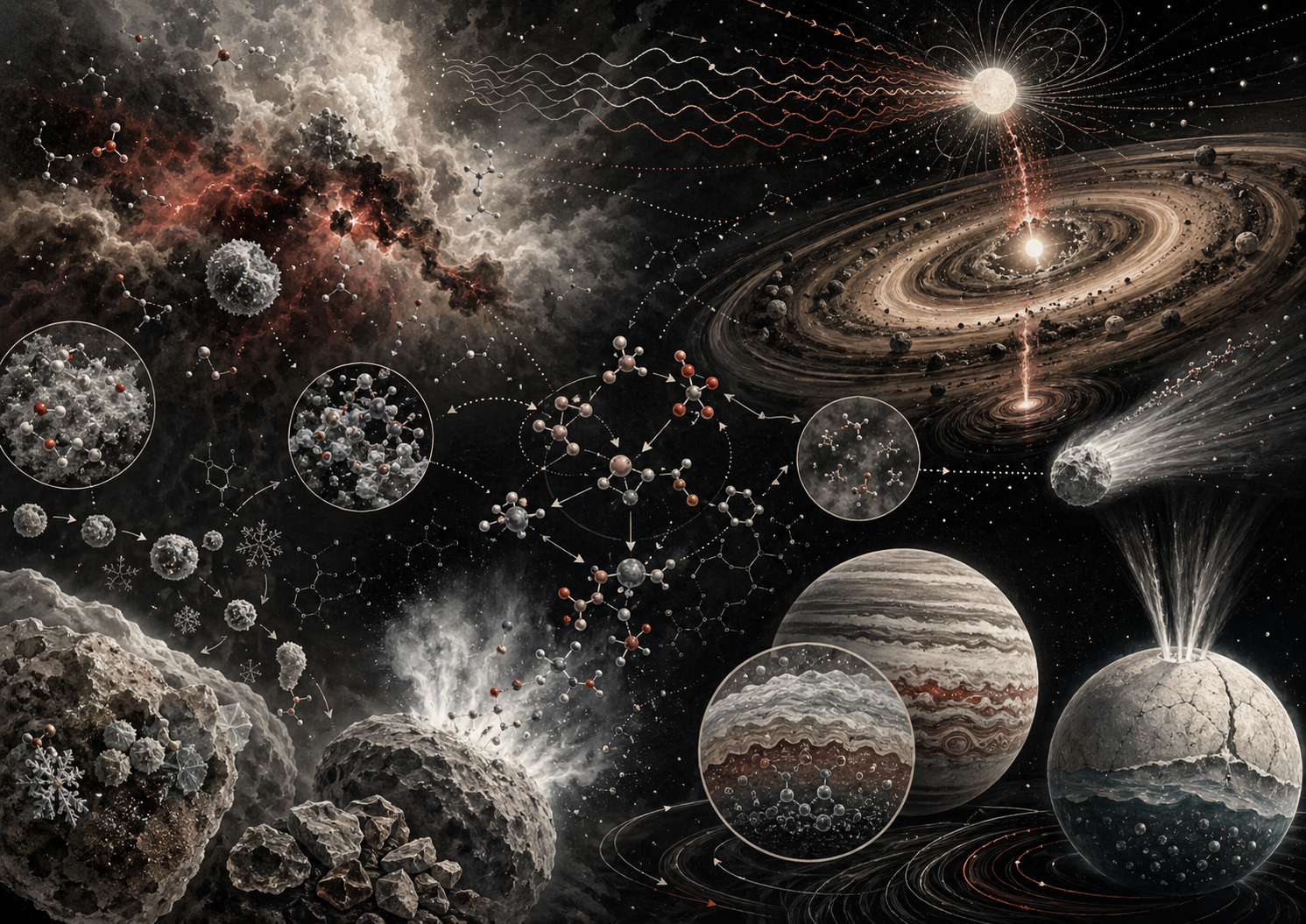
The Molecular Universe
Astrochemistry begins with a shift in imagination. The universe is not only a place of stars, galaxies, planets, radiation, gravity, and plasma. It is also a molecular environment. Atoms combine, ions react, radicals persist, dust grains acquire icy mantles, photons drive dissociation, cosmic rays ionize gas, shocks liberate molecules from grains, and cold clouds preserve compounds that later enter star-forming systems.
The molecular universe is chemically diverse because astronomical environments are physically diverse. Diffuse clouds are exposed to ultraviolet radiation. Dense molecular clouds are cold, shielded, and rich in molecular hydrogen. Hot cores and hot corinos are warmed by young stars, releasing molecules from icy grains. Protoplanetary disks contain gradients of temperature, density, radiation, ionization, and ice stability. Comets preserve volatile and organic material from early Solar System history. Planetary atmospheres contain photochemical reaction networks shaped by stellar radiation, pressure, temperature, composition, and circulation.
Astrochemistry therefore connects chemistry to cosmic evolution. It asks how simple molecules become complex molecules, how molecules survive or break apart, how chemical inventories are inherited or reset during star and planet formation, and how molecular evidence can reveal otherwise hidden physical conditions.
For researchers and scientists, the field is also a measurement problem. Astrochemical evidence usually arrives as light: spectral lines, absorption features, emission bands, isotopic shifts, solid-state features, or mission-instrument measurements. The chemical claim depends on laboratory spectroscopy, molecular databases, calibration, radiative-transfer assumptions, source geometry, and physical modeling. Astrochemistry is therefore observational, experimental, theoretical, and computational at once.
The Interstellar Medium as a Chemical Environment
The interstellar medium is the gas and dust between stars. It includes diffuse atomic gas, molecular clouds, ionized regions, dust grains, cosmic rays, magnetic fields, ultraviolet radiation, shock fronts, and turbulent structures. Its average density is extremely low compared with laboratory or planetary environments, yet its enormous volume and long time scales allow chemistry to occur in ways that are unfamiliar from everyday conditions.
The most abundant molecule in the interstellar medium is molecular hydrogen. It is difficult to observe directly in cold molecular clouds because its rotational transitions are not easily excited at low temperature. Carbon monoxide is often used as a tracer of molecular gas because it has accessible rotational transitions and is abundant relative to many other molecules. Other molecules serve as tracers of density, ionization, shocks, temperature, carbon chemistry, nitrogen chemistry, sulfur chemistry, deuterium fractionation, and star formation.
Interstellar chemistry depends on both gas-phase reactions and grain-surface chemistry. Gas-phase ion-molecule reactions can proceed efficiently at low temperature because electrostatic attraction helps overcome barriers. Neutral-neutral reactions may be slow unless barrierless or activated by shocks or heat. Dust grains provide surfaces on which atoms and molecules can meet, react, freeze out, hydrogenate, photolyze, or be released back into the gas.
The interstellar medium also makes chemistry spatial. A molecule detected in one region may be absent in another not because the underlying elements are missing, but because temperature, density, radiation, shielding, ionization, freeze-out, and time have shifted the chemical network. Astrochemical maps are therefore maps of physical history as much as molecular abundance.
Molecular Clouds and Star-Forming Chemistry
Molecular clouds are cold, dense regions where stars and planets form. They contain gas, dust, ice-coated grains, molecular hydrogen, carbon monoxide, and a wide variety of trace molecules. Their low temperatures favor freeze-out of volatile species onto dust grains. Their high column densities shield molecules from destructive ultraviolet radiation. Their embedded young stars later warm surrounding material, triggering evaporation, sublimation, and chemical restructuring.
Dense clouds can produce chemical differentiation. Some regions are rich in carbon-chain molecules. Others show strong nitrogen chemistry, deuterated species, sulfur-bearing species, or complex organics. These differences reflect density, temperature, age, ionization, elemental depletion, grain-surface chemistry, cosmic-ray exposure, and collapse history.
Star formation changes the chemistry. As protostars form, they heat surrounding gas and dust. Molecules frozen in icy mantles return to the gas phase. Hot cores around massive young stars and hot corinos around low-mass protostars can show rich spectra of complex organic molecules. Outflows and shocks can sputter grains, heat gas, and release refractory or ice-bound species. Molecular observations therefore reveal both chemistry and dynamics.
For researchers, molecular clouds are natural laboratories for low-temperature reaction networks. Their chemistry depends on rate coefficients, branching ratios, ionization rates, elemental depletion, grain size distributions, ice composition, gas-grain exchange, shielding, and collapse timescales. A molecular abundance is rarely explained by one reaction alone. It usually reflects a network history.
Dust Grains, Ices, and Surface Chemistry
Dust grains are central to astrochemistry. They absorb and scatter radiation, catalyze molecular hydrogen formation, provide surfaces for reactions, accumulate icy mantles, and carry refractory elements. A dust grain may contain silicate, carbonaceous material, metal oxides, organics, or layered mantles of water, carbon monoxide, carbon dioxide, methanol, methane, ammonia, and other species.
Ice chemistry is especially important in cold molecular clouds and protostellar environments. At low temperatures, atoms and molecules adhere to grain surfaces. Hydrogen atoms can migrate and react. Carbon monoxide can be hydrogenated toward formaldehyde and methanol. Ultraviolet photons and cosmic rays can process ices, generating radicals and more complex products. Heating during star formation can mobilize radicals and release volatile species into the gas.
This chemistry matters because icy grains may preserve and transform molecules before they are incorporated into comets, planetesimals, and planets. The chemical inventory of a planetary system does not begin at the planet. It begins in molecular clouds, interstellar grains, protostellar envelopes, and planet-forming disks.
Laboratory astrochemistry is essential here. Experiments with cryogenic ices, vacuum chambers, ultraviolet irradiation, ion bombardment, infrared spectroscopy, mass spectrometry, and simulated grain surfaces help researchers interpret what telescopes and missions observe. The physical properties of ices—binding energy, diffusion, porosity, phase, photolysis products, and desorption behavior—shape molecular inventories in space.
Spectroscopy and Molecular Identification
Astrochemistry depends on spectroscopy. Molecules are identified because they absorb, emit, or scatter radiation at characteristic wavelengths. Rotational transitions are especially important in radio, millimeter, and submillimeter astronomy. Vibrational transitions are important in infrared astronomy. Electronic transitions, photodissociation signatures, isotopic shifts, and solid-state features contribute additional evidence.
A molecular detection requires more than a visually plausible feature. Astronomers compare observed spectral lines with laboratory-measured or theoretically predicted transition frequencies. They evaluate line position, intensity, line width, excitation, source velocity, blending, isotopic variants, and whether multiple transitions of the same species appear consistently. Laboratory spectroscopy and molecular databases are therefore part of the astronomical instrument.
The same molecule can reveal physical conditions. A set of rotational transitions can constrain excitation temperature. Isotopologues can constrain optical depth or isotope ratios. Molecular line widths can reveal turbulence, thermal broadening, or outflows. Spatial maps of emission can show disks, shocks, chemical rings, snowlines, envelopes, or irradiated surfaces. In astrochemistry, a spectrum is both a chemical fingerprint and a physical diagnostic.
Spectral-line confusion is a serious challenge in molecule-rich sources. A dense forest of lines can create ambiguous assignments. A credible identification often requires multiple transitions with consistent velocities and intensities, reliable rest frequencies, plausible excitation, and careful rejection of alternatives. This is why laboratory spectral catalogs, quantum calculations, and professional line-survey methods are foundational to the field.
Complex Organic Molecules and Prebiotic Pathways
Astrochemistry often attracts attention because complex organic molecules have been detected in space. In astrochemical usage, “complex organic molecule” usually refers to a carbon-bearing molecule with several atoms, not necessarily to a molecule that is biologically produced. Methanol, methyl formate, dimethyl ether, formamide, acetonitrile, acetaldehyde, and many related species can appear in star-forming environments.
Organic molecules in space do not prove life. They show that abiotic chemistry can generate molecular complexity under astronomical conditions. This distinction is essential. Astrochemistry studies pathways that may contribute to prebiotic inventories, but it does not treat molecular detection as biological evidence unless additional context supports that interpretation.
Prebiotic relevance depends on pathways, delivery, preservation, concentration, and environment. A molecule of astrobiological interest in a cold cloud does not automatically become available on a habitable planet. It may be destroyed, transformed, diluted, trapped, or delivered by grains, comets, meteorites, or planetesimals. Astrochemistry therefore studies the continuity and discontinuity between interstellar chemistry, Solar System chemistry, planetary chemistry, and the origin of life.
For researchers, the central question is not whether organic molecules exist in space, but how they form, where they survive, how they are transported, and whether they enter environments where further chemistry can occur. Organic complexity is a chemical inventory. Habitability and life require additional planetary, energetic, geological, and evolutionary conditions.
Protoplanetary Disks and Planet-Building Chemistry
Protoplanetary disks are disks of gas and dust around young stars. They are the environments in which planets form. Their chemistry is spatially structured. Temperature declines with distance from the star. Density changes with height and radius. Radiation fields vary across disk surfaces and midplanes. Volatile molecules freeze out beyond snowlines, while warmer regions keep them in the gas phase. Dust grows, settles, migrates, and traps ices and organics.
Disk chemistry can influence planetary composition. A planet forming inside the water snowline may acquire different volatile inventory than one forming beyond it. Carbon, oxygen, nitrogen, and sulfur partition among gas, ice, dust, organics, and refractory material. Chemical gradients can affect atmospheric composition, core composition, ice content, and the delivery of water or organics.
Observations of molecules in disks therefore connect chemistry to planet formation. Carbon monoxide isotopologues trace gas mass and temperature. HCN and CN can trace ultraviolet-driven chemistry. Methanol can indicate ice chemistry and release. Sulfur-bearing molecules may trace shocks or unusual local processes. Molecular rings and gaps may reveal interactions among dust, gas, radiation, and emerging planets.
Disk chemistry is also a problem of inheritance. Some molecules may be inherited from molecular clouds and protostellar envelopes. Others may be destroyed and rebuilt in the disk. Still others may be locked into ice-coated grains, planetesimals, or comets. Understanding which chemical signatures are inherited and which are reset is central to connecting interstellar chemistry with planetary composition.
Comets, Meteorites, and Chemical Delivery
Comets, meteorites, asteroids, interplanetary dust particles, and micrometeorites preserve chemical records of early Solar System material. They contain minerals, organics, water-bearing phases, volatile compounds, isotopic anomalies, presolar grains, amino acids, nucleobase-related compounds, hydrocarbons, carboxylic acids, and complex macromolecular organic matter. Their chemistry links interstellar material, nebular processing, parent-body alteration, and planetary delivery.
Comets are especially important because they preserve volatile-rich material from cold regions of the early Solar System. Their ices and dust can contain water, carbon monoxide, carbon dioxide, methanol, methane, ammonia, hydrogen cyanide, formaldehyde, and many other species. Meteorites, especially carbonaceous chondrites, preserve organic and mineral evidence of aqueous alteration, thermal processing, and prebiotic chemistry.
Chemical delivery does not mean that life arrived fully formed. It means that planetary surfaces may receive ingredients, catalysts, redox couples, volatiles, organics, minerals, and reactive environments from extraterrestrial sources. Astrochemistry helps determine what materials were available before planetary geology and biology transformed them.
Sample-return missions and in situ spacecraft measurements are especially important because they provide direct chemical evidence rather than remote spectra alone. Mass spectrometry, isotope analysis, mineralogy, chromatography, and microscopy can reveal molecular and mineral histories that connect Solar System bodies to earlier astrophysical environments.
Exoplanet Atmospheres and Photochemistry
Astrochemistry has expanded beyond interstellar clouds and Solar System materials into exoplanet atmospheres. Transit spectroscopy, emission spectroscopy, phase curves, and direct imaging can reveal molecular absorption features in planetary atmospheres. Water vapor, carbon dioxide, carbon monoxide, methane, sulfur dioxide, alkali metals, clouds, hazes, and silicate particles may be inferred under favorable conditions.
Exoplanet atmospheric chemistry is strongly shaped by stellar radiation. Ultraviolet and X-ray photons can dissociate molecules, ionize species, and drive photochemical networks. Atmospheric temperature, pressure, metallicity, carbon-to-oxygen ratio, vertical mixing, clouds, hazes, escape, and circulation all affect observed spectra. A molecule observed in a hot giant planet may have a very different meaning from the same molecule in a temperate rocky atmosphere.
Photochemistry is particularly important because it can create species not expected from thermochemical equilibrium alone. Sulfur dioxide in a highly irradiated atmosphere, hydrocarbon hazes in methane-rich atmospheres, or oxygen-bearing species in unusual redox contexts may require photochemical interpretation. Exoplanet astrochemistry must therefore combine spectroscopy, atmospheric modeling, molecular data, stellar physics, and planetary context.
For researchers, the greatest interpretive challenge is degeneracy. Clouds, hazes, temperature profiles, atmospheric composition, stellar contamination, instrumental systematics, and retrieval assumptions can produce overlapping spectral signatures. A claimed molecule in an exoplanet atmosphere is strongest when supported by robust data, multiple spectral features, transparent retrieval assumptions, and physically plausible atmospheric models.
Astrochemistry and Habitability
Astrochemistry matters for habitability because habitable worlds inherit chemical histories. Water, carbon, nitrogen, sulfur, phosphorus, metals, silicates, organics, ices, and atmospheric gases are distributed through clouds, disks, planetesimals, comets, meteorites, and planets before biology begins. The availability of these materials shapes planetary atmospheres, oceans, crusts, prebiotic chemistry, and potential biospheres.
This does not mean astrochemistry alone explains life. Habitability requires planetary mass, orbit, atmosphere, geology, climate, water stability, energy gradients, chemical disequilibrium, and long-term environmental stability. Astrochemistry supplies one part of the story: the origin, transformation, and delivery of molecular ingredients.
The field also helps define what counts as evidence. A molecule may be a chemical ingredient, a tracer of physical conditions, a product of photochemistry, a sign of disequilibrium, or a possible biosignature only under strict contextual constraints. Astrochemistry therefore teaches caution. The same molecular species can arise from abiotic and biological pathways. Interpretation requires planetary context, environmental modeling, false-positive analysis, and independent evidence.
Astrochemistry is strongest when it resists sensational interpretation. Organic molecules are not life. Disequilibrium is not automatically biology. Water is not automatically habitability. A biosignature candidate is not a biosphere without contextual support. The discipline’s value lies in building the chemical evidence base needed for careful interpretation of worlds beyond Earth.
Measurement, Databases, and Astrochemical Evidence
Astrochemical evidence depends on a chain of measurement. Laboratory spectroscopy provides rest frequencies, intensities, energy levels, and molecular constants. Astronomical observatories provide spectra from distant environments. Molecular databases organize transition data. Chemical models test whether proposed formation and destruction pathways are plausible. Laboratory ice experiments test reactions under low-temperature, irradiated, or vacuum conditions. Mission instruments analyze comets, meteorites, planetary atmospheres, and returned samples.
The strongest astrochemical claims are multi-evidence claims. A molecule is more credible when multiple transitions are detected, when the lines match the same velocity, when intensities are physically consistent, when blending is evaluated, when laboratory data are reliable, when isotopologues or related molecules support the chemistry, and when alternative assignments are considered. Spectral confusion is a serious problem in molecule-rich sources.
Astrochemical databases and laboratory measurements are therefore not peripheral. They are essential infrastructure. A telescope can detect a line, but the identity of the molecule depends on the quality of laboratory spectroscopy, calibration, line catalogs, and interpretation.
For researchers, evidence provenance is critical. A line assignment should be traceable to rest frequency, uncertainty, catalog source, quantum numbers, source velocity, line width, instrument resolution, observing conditions, and competing assignments. A chemical model should be traceable to reaction network version, rate coefficients, physical conditions, initial abundances, dust parameters, and desorption assumptions.
Mathematical Lens: Spectral Lines, Abundance, and Reaction Rates
Astrochemistry turns faint light into chemical inference. A photon associated with a molecular transition has energy:
E = h\nu
\]
Interpretation: \(E\) is photon energy, \(h\) is Planck’s constant, and \(\nu\) is frequency. Molecular spectroscopy links quantum energy differences to observed radiation.
For a spectral line shifted by source motion, the nonrelativistic Doppler relation can be written as:
\frac{\Delta \nu}{\nu_0} \approx -\frac{v}{c}
\]
Interpretation: \(\nu_0\) is rest frequency, \(\Delta \nu\) is observed minus rest frequency, \(v\) is radial velocity, and \(c\) is the speed of light. Molecular line identification must account for source velocity.
Molecular abundance is often expressed relative to molecular hydrogen:
X_i = \frac{N_i}{N_{\mathrm{H_2}}}
\]
Interpretation: \(X_i\) is fractional abundance, \(N_i\) is column density of species \(i\), and \(N_{\mathrm{H_2}}\) is molecular hydrogen column density. Column density is a line-of-sight quantity, not a local volume density.
A simplified reaction-rate expression is:
\frac{dn_i}{dt} = \sum P_i – \sum L_i
\]
Interpretation: \(n_i\) is the number density of species \(i\), \(P_i\) represents production terms, and \(L_i\) represents loss terms. Astrochemical abundance evolves through competing formation and destruction pathways.
For a two-body gas-phase reaction:
r = k n_A n_B
\]
Interpretation: \(r\) is reaction rate, \(k\) is the rate coefficient, and \(n_A\) and \(n_B\) are number densities. Low-density astronomical environments require careful attention to reaction timescales.
Photodissociation can be represented in simplified form as:
\frac{dn}{dt} = -k_{\mathrm{ph}}n
\]
Interpretation: \(k_{\mathrm{ph}}\) is a photodissociation rate coefficient. Radiation fields can destroy molecules or create reactive fragments.
with solution:
n(t) = n_0 e^{-k_{\mathrm{ph}}t}
\]
Interpretation: \(n(t)\) declines exponentially under this simplified first-order photodestruction model. Real environments require shielding, geometry, and wavelength-dependent radiation fields.
Thermal desorption from a grain surface can be approximated by:
k_{\mathrm{des}} = \nu_0 e^{-E_b/T}
\]
Interpretation: \(k_{\mathrm{des}}\) is desorption rate, \(\nu_0\) is an attempt frequency, \(E_b\) is binding energy expressed in kelvin, and \(T\) is dust temperature. Small temperature changes can strongly affect whether molecules remain frozen on grains or enter the gas phase.
These equations are simplified, but they reveal the logic of astrochemical inference: spectra identify molecules, column densities estimate abundance, reaction networks model change, and temperature controls whether molecules reside in gas or ice.
Computational Workflows for Astrochemistry
Computational astrochemistry can make molecular evidence more transparent. A reproducible workflow can track observed frequency, rest frequency, source velocity, line intensity, molecular candidate, spectral catalog source, column density, abundance relative to molecular hydrogen, physical environment, dust temperature, radiation field, desorption regime, photochemical regime, and uncertainty flags.
Useful workflows include spectral-line matching, velocity correction, line-catalog cross-matching, abundance screening, environment classification, desorption-rate screening, photodissociation scenario modeling, molecule-class summaries, reaction-network simulation, protoplanetary disk chemistry mapping, cometary volatile comparison, exoplanet retrieval quality-control, and evidence provenance tracking.
For researchers, computational workflows should preserve uncertainty. A line match should not be treated as final identification without evaluating line blending, alternative assignments, catalog accuracy, multiple transitions, excitation conditions, velocity consistency, optical depth, and source structure. A chemical model should expose its reaction network, physical parameters, grain assumptions, initial abundance choices, and missing pathways.
The examples below use synthetic data. They are not professional line-identification tools, radiative-transfer models, exoplanet retrieval systems, or mission-data pipelines. Their purpose is to make astrochemical reasoning visible, reproducible, and auditable.
Python Example: Spectral-Line Matching and Molecular Abundance Screening
The following Python example uses synthetic astrochemical survey data to match observed lines to candidate molecular rest frequencies, correct for radial velocity, estimate a simple fractional abundance, and flag environments where ice desorption or photodissociation may be important. It is educational and not a substitute for radiative-transfer modeling, laboratory spectroscopy, or professional line-survey analysis.
from dataclasses import dataclass
from typing import Dict, List
import math


@dataclass
class AstrochemicalObservation:
    """Synthetic educational astrochemical observation.

    Frequencies are illustrative and are not authoritative line-catalog values.
    This example does not identify real molecules or replace professional
    line-survey analysis, laboratory spectroscopy, or radiative-transfer modeling.
    """

    source: str
    environment: str
    candidate_species: str
    rest_frequency_ghz: float
    observed_frequency_ghz: float
    integrated_intensity_k_km_s: float
    column_density_cm2: float
    h2_column_density_cm2: float
    dust_temperature_k: float
    uv_field_index: float


C_KM_S = 299792.458

BINDING_ENERGY_K: Dict[str, float] = {
    "CO": 855,
    "NH3": 3000,
    "CH3OH": 5500,
    "HCN": 4170,
    "H2O": 5700,
    "CO2": 2575,
}

ATTEMPT_FREQUENCY_S1 = 1.0e12


def radial_velocity_km_s(rest_frequency_ghz: float, observed_frequency_ghz: float) -> float:
    """Estimate radial velocity using the nonrelativistic Doppler relation."""
    if rest_frequency_ghz <= 0:
        return 0.0

    return -C_KM_S * (observed_frequency_ghz - rest_frequency_ghz) / rest_frequency_ghz


def fractional_abundance(column_density_cm2: float, h2_column_density_cm2: float) -> float:
    """Estimate abundance relative to molecular hydrogen column density."""
    if h2_column_density_cm2 <= 0:
        return 0.0

    return column_density_cm2 / h2_column_density_cm2


def desorption_rate_s1(species: str, temperature_k: float) -> float:
    """Simplified thermal desorption screen."""
    if temperature_k <= 0:
        return 0.0

    binding_energy = BINDING_ENERGY_K.get(species, 3000)
    return ATTEMPT_FREQUENCY_S1 * math.exp(-binding_energy / temperature_k)


def photochemical_flag(uv_field_index: float) -> str:
    """Classify simplified photochemical processing potential."""
    if uv_field_index > 10:
        return "high photochemical processing"
    return "lower photochemical processing"


def summarize_observation(obs: AstrochemicalObservation) -> Dict[str, object]:
    """Return a transparent synthetic astrochemical summary."""

    return {
        "source": obs.source,
        "environment": obs.environment,
        "candidate_species": obs.candidate_species,
        "radial_velocity_km_s": round(
            radial_velocity_km_s(obs.rest_frequency_ghz, obs.observed_frequency_ghz),
            3
        ),
        "fractional_abundance": "{:.3e}".format(
            fractional_abundance(obs.column_density_cm2, obs.h2_column_density_cm2)
        ),
        "desorption_rate_s1_simplified": "{:.3e}".format(
            desorption_rate_s1(obs.candidate_species, obs.dust_temperature_k)
        ),
        "photochemical_attention": photochemical_flag(obs.uv_field_index),
    }


observations: List[AstrochemicalObservation] = [
    AstrochemicalObservation(
        source="Cloud-A",
        environment="cold_cloud",
        candidate_species="CO",
        rest_frequency_ghz=115.271,
        observed_frequency_ghz=115.269,
        integrated_intensity_k_km_s=18.5,
        column_density_cm2=2.0e17,
        h2_column_density_cm2=2.0e22,
        dust_temperature_k=10,
        uv_field_index=0.2,
    ),
    AstrochemicalObservation(
        source="HotCore-B",
        environment="hot_core",
        candidate_species="CH3OH",
        rest_frequency_ghz=96.741,
        observed_frequency_ghz=96.738,
        integrated_intensity_k_km_s=42.0,
        column_density_cm2=8.0e16,
        h2_column_density_cm2=5.0e23,
        dust_temperature_k=120,
        uv_field_index=8.0,
    ),
    AstrochemicalObservation(
        source="Disk-C",
        environment="protoplanetary_disk",
        candidate_species="HCN",
        rest_frequency_ghz=88.632,
        observed_frequency_ghz=88.631,
        integrated_intensity_k_km_s=3.8,
        column_density_cm2=2.5e13,
        h2_column_density_cm2=1.0e22,
        dust_temperature_k=35,
        uv_field_index=4.0,
    ),
    AstrochemicalObservation(
        source="Exoplanet-E",
        environment="exoplanet_atmosphere",
        candidate_species="CO2",
        rest_frequency_ghz=667.380,
        observed_frequency_ghz=667.210,
        integrated_intensity_k_km_s=0.8,
        column_density_cm2=3.0e15,
        h2_column_density_cm2=1.0e22,
        dust_temperature_k=900,
        uv_field_index=150.0,
    ),
]

for observation in observations:
    print(summarize_observation(observation))
The workflow illustrates the structure of astrochemical reasoning. Molecular identification depends on rest frequency and source velocity. Chemical interpretation depends on abundance, environment, temperature, radiation, and plausible reaction pathways. A real workflow would include uncertainty, beam dilution, excitation, partition functions, optical depth, line blending, catalog cross-matching, isotopologues, radiative transfer, and physical source modeling.
R Example: Astrochemical Survey Summary
The following R example summarizes a synthetic astrochemical survey by environment and molecule class. It uses base R for portability and emphasizes transparent grouping rather than advanced modeling.
source <- c("Cloud-A", "Cloud-A", "HotCore-B", "Disk-C", "Comet-D", "Exoplanet-E")

environment <- c(
  "cold_cloud",
  "cold_cloud",
  "hot_core",
  "protoplanetary_disk",
  "comet",
  "exoplanet_atmosphere"
)

candidate_species <- c("CO", "NH3", "CH3OH", "HCN", "H2O", "CO2")

molecule_class <- c(
  "simple_molecule",
  "nitrogen_hydride",
  "complex_organic_proxy",
  "nitrile",
  "volatile_ice",
  "atmospheric_molecule"
)

column_density_cm2 <- c(2.0e17, 6.5e14, 8.0e16, 2.5e13, 1.0e17, 3.0e15)
h2_column_density_cm2 <- c(2.0e22, 2.0e22, 5.0e23, 1.0e22, 5.0e19, 1.0e22)
dust_temperature_k <- c(10, 10, 120, 35, 160, 900)
uv_field_index <- c(0.2, 0.2, 8.0, 4.0, 12.0, 150.0)

astro <- data.frame(
  source,
  environment,
  candidate_species,
  molecule_class,
  column_density_cm2,
  h2_column_density_cm2,
  dust_temperature_k,
  uv_field_index
)

astro$fractional_abundance <- astro$column_density_cm2 / astro$h2_column_density_cm2

astro$thermal_regime <- ifelse(
  astro$dust_temperature_k >= 100,
  "warm_or_hot",
  "cold_or_moderate"
)

astro$photochemical_regime <- ifelse(
  astro$uv_field_index > 10,
  "high_photochemical_processing",
  "lower_photochemical_processing"
)

environment_summary <- aggregate(
  cbind(fractional_abundance, dust_temperature_k, uv_field_index) ~ environment,
  data = astro,
  FUN = mean
)

class_counts <- as.data.frame(table(astro$molecule_class, astro$thermal_regime))
names(class_counts) <- c("molecule_class", "thermal_regime", "count")

print(astro)
print(environment_summary)
print(class_counts)
This summary shows how astrochemical evidence becomes interpretable when molecular detections are organized by environment. The same molecule may have different meaning in a cold cloud, a hot core, a disk, a comet, or an atmosphere. Context is not decorative; it is chemical evidence.
SQL Example: Astrochemical Evidence Register
Astrochemical claims are stronger when line identifications, source properties, catalog references, and uncertainty flags are traceable. A simple evidence register can preserve observed lines, candidate species, environmental context, and provenance.
CREATE TABLE astrochemical_observation (
    observation_id INTEGER PRIMARY KEY,
    source_name TEXT NOT NULL,
    environment TEXT,
    candidate_species TEXT NOT NULL,
    rest_frequency_ghz REAL CHECK (rest_frequency_ghz > 0),
    observed_frequency_ghz REAL CHECK (observed_frequency_ghz > 0),
    integrated_intensity_k_km_s REAL CHECK (integrated_intensity_k_km_s >= 0),
    column_density_cm2 REAL CHECK (column_density_cm2 >= 0),
    h2_column_density_cm2 REAL CHECK (h2_column_density_cm2 > 0),
    dust_temperature_k REAL CHECK (dust_temperature_k >= 0),
    uv_field_index REAL CHECK (uv_field_index >= 0),
    uncertainty_notes TEXT
);

CREATE TABLE spectral_evidence (
    evidence_id INTEGER PRIMARY KEY,
    observation_id INTEGER NOT NULL,
    catalog_name TEXT,
    transition_label TEXT,
    quantum_numbers TEXT,
    line_blending_flag TEXT,
    confidence_score REAL CHECK (confidence_score BETWEEN 0 AND 1),
    evidence_summary TEXT,
    FOREIGN KEY (observation_id) REFERENCES astrochemical_observation(observation_id)
);

SELECT
    source_name,
    environment,
    candidate_species,
    ROUND(
        -299792.458 * (observed_frequency_ghz - rest_frequency_ghz) / rest_frequency_ghz,
        3
    ) AS radial_velocity_km_s,
    printf('%.3e', column_density_cm2 / h2_column_density_cm2) AS fractional_abundance,
    CASE
        WHEN uv_field_index > 10 THEN 'high photochemical processing'
        ELSE 'lower photochemical processing'
    END AS photochemical_regime
FROM astrochemical_observation
ORDER BY environment, candidate_species;
The purpose of this register is to keep molecular claims attached to evidence. A detected line should be connected to a catalog, uncertainty, velocity, environment, possible blending, and source context. Without provenance, astrochemical interpretation can become visually persuasive but scientifically fragile.
GitHub Repository
The companion repository for this article can support reproducible workflows for spectral-line matching, Doppler velocity correction, abundance screening, desorption-rate scenarios, photochemical flags, molecule-class summaries, SQL provenance, and responsible astrochemical interpretation.
Complete Code Repository
The full code distribution for this article, including selected astrochemistry examples, expanded computational workflows, reproducible data structures, provenance documentation, spectral-line screening, abundance analysis, SQL evidence registers, and scientific-computing scaffolding, is available on GitHub.
Limits, Uncertainty, and Responsible Interpretation
Astrochemical interpretation is difficult because observations are indirect. Astronomers usually do not collect a cloud, disk, or exoplanet atmosphere in a bottle. They infer composition from photons. Those photons may come from unresolved regions, blended lines, non-local thermodynamic equilibrium conditions, optically thick transitions, dust extinction, instrumental noise, foreground absorption, and multiple physical components along the line of sight.
Spectral-line confusion is a major challenge in molecule-rich sources. A proposed detection may be weakened if only one transition is observed, if lines are blended, if laboratory data are uncertain, if source velocity is ambiguous, or if the intensity pattern is inconsistent. Conversely, nondetection does not prove absence. It may reflect excitation, sensitivity, beam dilution, optical depth, or observing wavelength.
Chemical models also contain uncertainty. Reaction networks may omit pathways. Rate constants may be poorly measured at low temperature. Grain-surface processes may depend on morphology, diffusion barriers, binding energies, and ice composition. Cosmic-ray ionization rates may vary. Disk models may depend on uncertain dust evolution, radiation fields, and mixing. Exoplanet atmospheric models may be degenerate because clouds, hazes, temperature profiles, and composition can produce similar spectra.
Good astrochemistry therefore combines laboratory data, observations, modeling, uncertainty analysis, and skepticism. It does not treat every spectral feature as a discovery or every organic molecule as a sign of life. It treats molecular evidence as powerful but context-dependent.
The computational examples associated with this article are synthetic and educational. They do not identify real astronomical molecules, validate spectral detections, interpret mission data, perform radiative-transfer modeling, retrieve exoplanet atmospheres, or determine habitability. They are designed to show how astrochemical evidence can be structured, audited, and interpreted responsibly.
Conclusion
Astrochemistry reveals a molecular universe. It shows that chemistry operates in cold clouds, irradiated ices, collapsing cores, stellar outflows, protoplanetary disks, comets, meteorites, planetary atmospheres, and exoplanet systems. It connects quantum transitions to telescope spectra, dust grains to molecular complexity, ice chemistry to volatile inheritance, and chemical networks to the formation of worlds.
The field’s importance lies in continuity. The molecules observed in interstellar clouds are not separate from planetary chemistry. They are part of a long chain of transformation: atoms become molecules, molecules freeze onto grains, grains enter clouds and disks, disks form planetesimals, planetesimals deliver material, planets differentiate, atmospheres evolve, and some worlds become chemically habitable.
Astrochemistry is therefore not a decorative extension of chemistry into space. It is chemistry at cosmic scale. It asks how the molecular universe is made, how it is observed, how it changes, and how its chemical history becomes the starting material for planets, oceans, atmospheres, and perhaps life.
Related articles
- Geochemistry and the Chemical History of Earth
- Ocean Chemistry and the Carbonate System
- Atmospheric Chemistry and Climate Processes
- Environmental Chemistry and the Chemical Conditions of Habitability
- Spectroscopy and the Measurement of Molecular Structure
- Mass Spectrometry and Molecular Detection
- Reaction Networks and Chemical Systems Modeling
- Quantum Chemistry and Electronic Structure
- Computational Chemistry and Molecular Modeling
- Green Chemistry, Responsibility, and Sustainable Transformation
Further reading
- Herbst, E. and van Dishoeck, E.F. (2009) ‘Complex organic interstellar molecules’, Annual Review of Astronomy and Astrophysics, 47, pp. 427–480. Available at: https://doi.org/10.1146/annurev-astro-082708-101654
- Tielens, A.G.G.M. (2005) The Physics and Chemistry of the Interstellar Medium. Cambridge: Cambridge University Press.
- van Dishoeck, E.F. (2014) ‘Astrochemistry of dust, ice and gas: introduction and overview’, Faraday Discussions, 168, pp. 9–47. Available at: https://doi.org/10.1039/C4FD00140K
- Lequeux, J. (2005) The Interstellar Medium. Berlin: Springer.
- Caselli, P. and Ceccarelli, C. (2012) ‘Our astrochemical heritage’, Astronomy & Astrophysics Review, 20, 56. Available at: https://doi.org/10.1007/s00159-012-0056-x
- Allamandola, L.J. (2014) Life and the Universe: From Astrochemistry to Astrobiology. NASA Technical Reports Server. Available at: https://ntrs.nasa.gov/citations/20140009127
References
- Atacama Large Millimeter/submillimeter Array (n.d.) Dust and Molecules in Space: Astrochemistry. Available at: https://www.almaobservatory.org/en/about-alma/how-alma-works/capabilities/dust-and-molecules-in-space-astrochemistry/
- Atacama Large Millimeter/submillimeter Array (n.d.) MAPS: Molecules with ALMA at Planet-Forming Scales. Available at: https://www.almaobservatory.org/en/events/maps-molecules-with-alma-at-planet-forming-scales/
- Atacama Large Millimeter/submillimeter Array (n.d.) ALMA Reveals Carbon-Rich, Organic Birth Environments of Planets. Available at: https://www.almaobservatory.org/en/press-releases/alma-reveals-carbon-rich-organic-birth-environments-of-planets/
- Cologne Database for Molecular Spectroscopy (n.d.) CDMS. Available at: https://cdms.astro.uni-koeln.de/
- International Union of Pure and Applied Chemistry (n.d.) Compendium of Chemical Terminology, the Gold Book. Available at: https://goldbook.iupac.org/
- NASA Ames Research Center (n.d.) The Astrophysics & Astrochemistry Laboratory. Available at: https://www.astrochem.org/
- NASA Goddard Space Flight Center (2026) The Cosmic Ice Laboratory. Available at: https://science.gsfc.nasa.gov/691/cosmicice/
- NASA Goddard Space Flight Center (2026) The Cosmic Ice Laboratory: Our Research. Available at: https://science.gsfc.nasa.gov/691/cosmicice/research.html
- NASA Science (n.d.) Webb’s Impact on Exoplanet Research. Available at: https://science.nasa.gov/mission/webb/science-overview/science-explainers/webbs-impact-on-exoplanet-research/
- National Institute of Standards and Technology (n.d.) Spectroscopic Identification of Interstellar Molecules. Available at: https://www.nist.gov/pml/sensor-science/optical-radiation/spectroscopic-identification-interstellar-molecules
- National Institute of Standards and Technology (n.d.) NIST Chemistry WebBook. Available at: https://webbook.nist.gov/chemistry/
- National Institute of Standards and Technology (n.d.) Observed Interstellar Molecular Microwave Transitions. Available at: https://physics.nist.gov/PhysRefData/Micro/Html/sec2.html
- Sandford, S.A. (2016) Ice Chemistry in Interstellar Dense Molecular Clouds, Protostellar Disks, and Comets. NASA Technical Reports Server. Available at: https://ntrs.nasa.gov/citations/20160001638
- Virtual Atomic and Molecular Data Centre (n.d.) Cologne Database for Molecular Spectroscopy. Available at: https://vamdc.org/type_database/cdms/