
Last Updated May 28, 2026
Medicinal chemistry is the discipline that turns biological hypotheses into chemically testable therapeutic possibilities. It connects molecular structure, target biology, potency, selectivity, physicochemical properties, pharmacokinetics, pharmacodynamics, toxicology, formulation, metabolism, exposure, safety margins, synthetic tractability, assay reliability, translational relevance, and clinical feasibility. The medicinal chemist does not simply make molecules more potent. The medicinal chemist works inside a multi-constraint decision system where potency must be balanced against solubility, permeability, metabolic stability, off-target activity, safety liabilities, manufacturability, formulation, intellectual property, assay quality, and patient-centered therapeutic need.
The central thesis of medicinal chemistry is that drug discovery is not the search for the strongest molecule. It is the search for a molecule whose total evidence profile can survive biology, chemistry, pharmacology, safety assessment, manufacturability, regulatory scrutiny, and clinical use. A molecule that looks extraordinary in one assay may fail because it is insoluble, unstable, nonselective, toxic, impossible to formulate, metabolized too rapidly, trapped in plasma protein binding, blocked by transporters, associated with cardiac ion-channel risk, or misleading because of assay interference. Medicinal chemistry is therefore a discipline of disciplined tradeoffs.
Medicinal chemistry is also an evidence discipline. Every analog, assay result, property measurement, selectivity panel, pharmacokinetic result, and safety signal changes the project’s understanding of what chemical matter can and cannot do. The field’s intellectual challenge is not simply to optimize a structure, but to decide what evidence matters, how much uncertainty remains, and whether the molecule is becoming more therapeutically credible or merely more impressive on a narrow metric.
Main Library
Publications
Article Map
Chemistry
Related Topic
Biology
Related Topic
Data Systems
Related Topic
Risk & Resilience
What Medicinal Chemistry Does
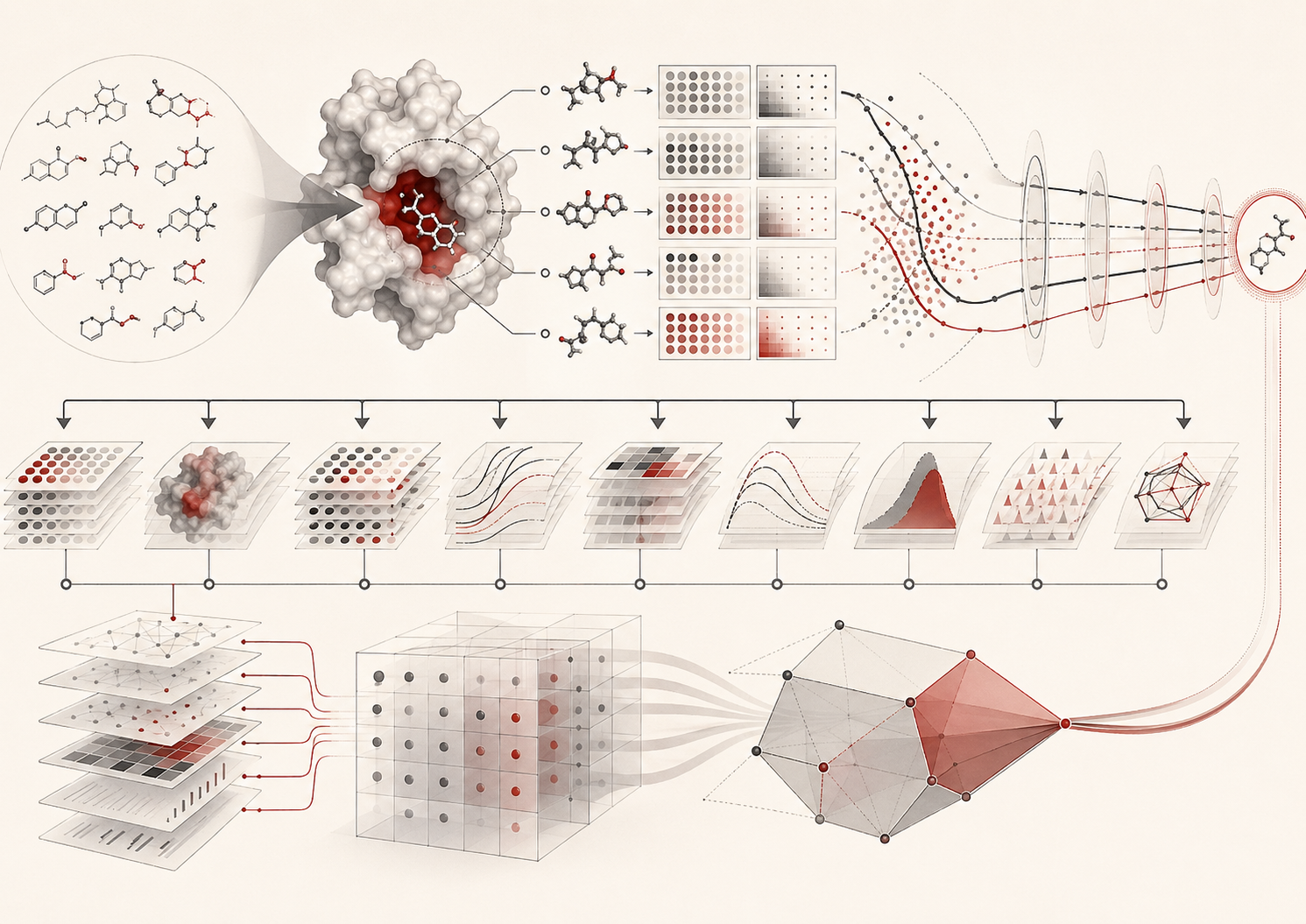
Medicinal chemistry sits at the intersection of chemistry, biology, pharmacology, toxicology, data science, and translational medicine. Its immediate object is often a molecule, but its real object is a decision: should this chemical series be advanced, optimized, redesigned, deprioritized, or used to test a biological hypothesis? The best medicinal chemistry programs do not treat molecules as isolated structures. They treat molecules as evidence-bearing systems.
A medicinal chemistry program begins with a therapeutic idea: a biological target, pathway, phenotype, or mechanism that may be modulated to produce a useful clinical effect. The chemistry effort then asks whether a molecule can engage that mechanism with sufficient potency, selectivity, exposure, safety margin, and developability. Every new analog is an experiment. It tests whether a structural change improves one property, worsens another, reveals a new liability, or clarifies the structure-activity relationship.
In practical discovery, medicinal chemistry is never only about potency. Potency without selectivity can create toxicity. Selectivity without exposure may not matter in vivo. Exposure without safety margin is dangerous. Solubility without permeability may fail. Permeability without metabolic stability may fail. Metabolic stability without clearance control may create accumulation. A favorable in vitro profile may still collapse when translated into cells, animals, or humans. Medicinal chemistry works because it integrates these competing dimensions early, repeatedly, and quantitatively.
For researchers and scientists, the key intellectual discipline is tradeoff visibility. A compound’s value depends on the pattern of evidence across biology, chemistry, pharmacology, safety, and development. A single best-in-class number can conceal a weak total profile. A less spectacular molecule can sometimes be more credible because its liabilities are understood, measurable, and addressable.
Drug Discovery as an Evidence System
Drug discovery can be understood as a sequence of evidence filters. Early discovery generates hypotheses and hits. Lead discovery tests whether chemical matter can be improved into a coherent series. Lead optimization refines potency, selectivity, pharmacokinetics, safety, and developability. Candidate selection asks whether one molecule has enough evidence to justify more expensive and stringent development work.
This evidence system is imperfect because the measurements are imperfect. Assays have artifacts. Biological systems vary. In vitro potency may not predict cellular activity. Cellular activity may not predict in vivo efficacy. Animal exposure may not translate cleanly to human exposure. Toxicology can reveal liabilities not visible in early assays. Medicinal chemistry therefore operates under uncertainty, and good discovery teams make that uncertainty explicit rather than hiding it behind simple rankings.
Professional discovery programs typically rely on multiple classes of evidence: biochemical potency, cellular potency, binding mode, selectivity panels, solubility, permeability, metabolic stability, plasma protein binding, CYP inhibition, transporter risk, cardiac ion-channel risk, cytotoxicity, microsomal stability, hepatocyte stability, formulation feasibility, pharmacokinetics, efficacy models, safety pharmacology, and toxicology. The details vary by modality, therapeutic area, and target class, but the decision problem remains the same: improve the molecule’s total probability of becoming a safe and effective medicine.
Discovery evidence should also be staged. A hit does not need the same data package as a development candidate, but it should have enough evidence to justify additional investment. A candidate does not need final clinical certainty, but it must have enough integrated evidence to justify moving into more consequential testing. Medicinal chemistry is the craft of knowing which evidence is needed at which decision point.
Targets, Mechanisms, and Therapeutic Hypotheses
A drug-discovery project is only as strong as its biological hypothesis. A target may be genetically validated, chemically validated, clinically validated, or only theoretically attractive. Genetic evidence may indicate that modulating a target could affect disease, but does not guarantee that a small molecule can safely achieve the right degree, timing, tissue distribution, and mechanism of modulation. Chemical validation may show that a tool compound produces a phenotype, but the tool compound may have off-target effects. Clinical validation may exist for one mechanism but not for a new population, combination, route, or safety margin.
Medicinal chemistry must therefore remain connected to mechanism. A molecule is not “good” simply because it binds a protein. It must bind in a way that is pharmacologically meaningful. An inhibitor, antagonist, agonist, partial agonist, degrader, stabilizer, covalent modifier, allosteric modulator, or molecular glue each carries different design problems. Target class matters: kinases, GPCRs, proteases, nuclear receptors, epigenetic proteins, transporters, ion channels, metabolic enzymes, and protein-protein interaction targets each impose different chemical and biological constraints.
Mechanistic clarity also affects safety. A target expressed broadly across tissues may require strong selectivity, a special therapeutic window, or localized exposure. A target with a narrow physiological role may tolerate stronger modulation. A pathway with compensatory biology may require combination therapy or different endpoint design. Medicinal chemistry therefore lives inside both molecular and systems-level biology.
For researchers, a therapeutic hypothesis should be tested with more than binding evidence. It should connect target engagement to pathway modulation, pathway modulation to disease-relevant biology, and disease-relevant biology to a plausible clinical benefit. Medicinal chemistry can strengthen this chain, but it cannot compensate for a weak biological premise.
Hits, Leads, and Candidate Quality
A hit is a starting point, not a medicine. Hits may arise from high-throughput screening, fragment screening, DNA-encoded libraries, virtual screening, phenotypic screening, natural products, repurposing, covalent screening, structure-based design, or literature mining. A hit becomes useful when it is reproducible, chemically tractable, mechanistically interpretable, and improvable.
Lead discovery asks whether a hit can become a lead series. A lead series is not just a potent molecule. It is a chemically coherent family with structure-activity relationships, tractable analog design, acceptable early property space, and a plausible route to solving liabilities. A series with one strong compound but no interpretable SAR may be risky. A less potent series with clear SAR, good ligand efficiency, clean selectivity, and attractive properties may be a better investment.
A development candidate represents a higher threshold. It must have a compelling integrated profile: potency at the target, activity in relevant biology, adequate selectivity, suitable pharmacokinetics, manageable safety risks, chemical stability, feasible synthesis, acceptable formulation, and enough evidence to justify preclinical development. Candidate nomination is not a prize for the most potent compound. It is a decision that a molecule’s total risk profile is now worth testing under more demanding conditions.
Researchers should therefore distinguish hit quality, lead quality, and candidate quality. The criteria become progressively more stringent. A weak hit can be valuable if it reveals a new binding mode or biological hypothesis. A lead must be optimizable. A candidate must be developable. Treating these stages as the same category creates poor decisions.
Potency, Selectivity, and Assay Translation
Potency measures how much compound is required to produce a defined effect under a defined assay condition. IC50, EC50, Ki, Kd, and other values are not interchangeable without context. Assay format, substrate concentration, protein construct, incubation time, detection method, cell type, serum level, transporter expression, and compound aggregation can all change apparent potency.
For decision-making, potency is often transformed into a logarithmic measure such as pIC50. This transformation makes potency differences easier to compare. A compound with an IC50 of 10 nM has a pIC50 of 8. A compound with an IC50 of 100 nM has a pIC50 of 7. A one-unit difference in pIC50 corresponds to a tenfold difference in potency.
Selectivity is equally important. A compound that inhibits its desired target at 10 nM but an important off-target at 20 nM may be less attractive than a 100 nM compound with a thousandfold selectivity window. Selectivity may be measured across target-family panels, safety pharmacology panels, kinome panels, receptor panels, enzyme panels, or cell-based counterscreens. The relevant selectivity window depends on exposure, tissue distribution, target biology, safety margin, and therapeutic area.
Assay translation is the difficult bridge from measured activity to biological meaning. A biochemical assay may demonstrate target engagement under controlled conditions, while a cell assay introduces permeability, efflux, metabolism, serum binding, pathway redundancy, and cellular context. An in vivo model adds exposure, tissue distribution, metabolism, immune context, disease biology, and species differences. Medicinal chemistry must connect these levels without pretending they are interchangeable.
Physicochemical Properties and Molecular Design Space
Physicochemical properties shape whether a molecule can become a medicine. Molecular weight, lipophilicity, polar surface area, hydrogen bond donors, hydrogen bond acceptors, rotatable bonds, aromatic ring count, ionization state, solubility, permeability, and three-dimensionality influence absorption, distribution, metabolism, excretion, toxicity, formulation, and target engagement.
Rules of thumb such as Lipinski-style and Veber-style filters are not laws. They are decision aids. Useful medicines exist outside simple rule boundaries, and some therapeutic areas require property spaces that look unusual. Nevertheless, property filters help discovery teams recognize when potency is being purchased with excessive molecular size, lipophilicity, polarity, flexibility, or structural complexity.
Lipophilicity deserves special attention. Increasing lipophilicity often improves apparent potency by strengthening nonspecific interactions, but it can also worsen solubility, metabolic liability, plasma protein binding, promiscuity, cardiac ion-channel risk, and toxicity. Lipophilic ligand efficiency is one way to ask whether potency is being achieved efficiently or merely by making the molecule more lipophilic.
Property optimization is not universal. A central-nervous-system program, an oral systemic therapy, an inhaled therapy, a topical therapy, a gut-restricted therapy, and a targeted degrader may require very different property spaces. Medicinal chemistry must therefore define design criteria according to modality, route, tissue, target, and therapeutic need.
ADMET and Developability
ADMET stands for absorption, distribution, metabolism, excretion, and toxicity. In discovery, ADMET is not a late-stage afterthought. It is a design constraint. A compound that cannot dissolve, cannot cross relevant membranes, is cleared too rapidly, strongly inhibits drug-metabolizing enzymes, or creates early safety liabilities may fail even if it has strong potency.
Solubility affects formulation and exposure. Permeability affects absorption and tissue access. Metabolic stability affects half-life and dosing feasibility. Clearance affects systemic exposure. Volume of distribution affects tissue partitioning. Plasma protein binding affects free concentration. CYP inhibition and transporter interactions affect drug-drug interaction risk. Cardiac ion-channel inhibition can signal cardiac safety concerns. Reactive or unstable chemical groups can create toxicology risk or assay artifacts.
Developability is the ability of a compound to progress as a practical therapeutic candidate. It includes chemistry, biology, pharmacology, safety, formulation, and manufacturing considerations. A compound with excellent potency but poor developability may be a poor lead. A compound with moderate potency but excellent developability and clear SAR may be a better optimization path.
Researchers should treat ADMET not as a set of pass-fail boxes, but as an integrated exposure and safety profile. A moderate liability may be acceptable if exposure is local and low. A modest potency advantage may not justify a severe metabolic or safety liability. A strong in vitro profile may be irrelevant if free exposure cannot reach the target safely.
Safety Liabilities and Off-Target Risk
Safety begins early. Discovery-stage safety does not prove clinical safety, but it can identify avoidable liabilities. Common early concerns include cardiac ion-channel inhibition, CYP inhibition, reactive structural alerts, cytotoxicity, mitochondrial toxicity, phospholipidosis risk, off-target receptor activity, poor selectivity, genotoxicity alerts, excessive lipophilicity, high aromaticity, and unstable functional groups.
Off-target risk depends on exposure. A weak off-target activity may matter if free systemic concentration is high. A stronger off-target may be irrelevant if exposure is low in the relevant tissue. The medicinal chemistry question is therefore not simply whether an off-target exists, but whether the exposure, potency, tissue distribution, and biological consequence create a plausible safety risk.
Good teams treat safety signals as design information. A cardiac ion-channel liability may push a series toward lower lipophilicity, different basicity, reduced aromaticity, or alternative scaffolds. CYP inhibition may prompt changes to lipophilicity, heteroatom arrangement, or steric shape. Cytotoxicity may reveal nonspecific reactivity or promiscuity. The exact chemical strategy depends on the project, but the principle is universal: liabilities should be measured early enough to redesign intelligently.
For researchers, safety interpretation should remain proportional. An early alert is not the same as clinical harm, but it is not noise either. It is a signal that should be contextualized by potency, exposure, mechanism, assay quality, chemical series, and therapeutic risk tolerance.
PK/PD Thinking and Exposure
Pharmacokinetics describes what the body does to the drug. Pharmacodynamics describes what the drug does to the body or target system. Medicinal chemistry must connect the two. A compound can only modulate a target if sufficient free concentration reaches the relevant site for a sufficient duration with an acceptable safety margin.
Important PK concepts include clearance, volume of distribution, half-life, bioavailability, plasma protein binding, tissue distribution, free fraction, maximum concentration, area under the curve, and time above a relevant threshold. Important PD concepts include target occupancy, pathway modulation, biomarker response, efficacy, tolerance, hysteresis, and exposure-response relationships.
At discovery stage, PK/PD models are usually provisional. They help teams ask better questions: is the compound cleared too rapidly? Is high plasma protein binding reducing free exposure? Is the target potency sufficient relative to expected free concentration? Does the efficacy model require sustained coverage or transient engagement? Is local tissue exposure more important than plasma exposure? A medicinal chemistry program matures when potency optimization becomes exposure-aware.
Exposure-aware design prevents false progress. A molecule may become more potent in vitro while losing the ability to reach the target in vivo. Another may be less potent but produce better free target coverage because it has superior solubility, permeability, stability, or tissue distribution. PK/PD thinking turns potency into a biological exposure question.
Assay Quality, Artifacts, and Reproducibility
Medicinal chemistry depends on assay evidence, but assays can mislead. Compound aggregation, fluorescence interference, redox cycling, reactive chemistry, impurities, metal chelation, detergent sensitivity, covalent nonspecific binding, poor solubility, colloid formation, and cytotoxicity can create false activity. A molecule can appear potent because it disrupts the assay rather than modulating the intended target.
Assay quality includes controls, replicates, concentration-response behavior, counter-screens, orthogonal assays, reference compounds, statistical quality measures, and reproducibility across formats. A single-point screen is useful for triage, but it is not strong evidence of mechanism. A concentration-response curve is stronger, but still requires interpretation. Orthogonal validation is essential when a hit class has known artifact risks.
Researchers should distinguish activity from validity. A strong number in a weak assay is not strong evidence. A modest number in a robust, translationally relevant assay may be more meaningful. Medicinal chemistry advances when assay results are treated as evidence claims with uncertainty, not as isolated facts.
Reproducibility also includes chemical identity. A compound record should preserve structure, stereochemistry, salt form, purity, batch, analytical data, storage conditions, and assay conditions. Biological irreproducibility sometimes begins with chemical ambiguity.
Chemical Tractability, Synthesis, and Scale-Aware Design
Medicinal chemistry must also consider chemical tractability. A series that is theoretically attractive but difficult to synthesize, purify, diversify, stabilize, or scale may slow discovery. Synthetic accessibility affects how quickly structure-activity relationships can be explored. Route robustness affects candidate supply, impurity control, formulation work, toxicology studies, and eventual manufacturing feasibility.
Scale-aware design does not mean that every early analog must be manufactured-ready. It means that chemistry teams should notice when potency depends on structures that are unstable, excessively complex, difficult to purify, reliant on hazardous reagents, difficult to control stereochemically, or prone to problematic impurities. These issues may be solvable, but they should not be invisible.
Impurities also matter. A biological signal may reflect the intended compound, an impurity, a degradation product, or a mixture. Analytical chemistry is therefore central to medicinal chemistry. LC-MS, NMR, chromatography, purity analysis, chiral analysis, stability studies, and batch tracking are not administrative details. They protect the interpretation of biological evidence.
For researchers, chemical tractability is part of scientific quality. A molecule that cannot be reliably made, characterized, stored, or reproduced cannot serve as a strong basis for biological inference. The chemistry must support the biology.
Translation, Patient Need, and Ethical Responsibility
Medicinal chemistry is ethically consequential because it sits upstream of patient-facing medicine. Discovery decisions influence which therapeutic hypotheses receive investment, which diseases are prioritized, which safety margins are accepted, which populations are studied, and which molecules enter expensive development pathways. A discovery program is not only a technical enterprise. It is a resource allocation system.
Patient need should shape medicinal chemistry strategy. A high-risk mechanism may be more acceptable in a severe disease with limited treatment options than in a mild condition with safer alternatives. A narrow therapeutic window may be unacceptable for chronic use in broad populations but potentially justified in carefully monitored oncology settings. Route, dosing frequency, formulation, tolerability, access, and adherence all affect whether a molecule can become a useful medicine.
Ethical medicinal chemistry also requires honesty about uncertainty. A compound is not a therapy because it is promising. A model is not proof because it is elegant. A biomarker is not a clinical outcome unless validated. Responsible discovery does not overpromise to patients, investors, institutions, or the public.
The goal is not to remove risk from innovation. That is impossible. The goal is to make risk scientifically visible, ethically justified, and progressively reduced as evidence accumulates.
Mathematical Lens: Potency, Efficiency, Exposure, and Decision Scores
Medicinal chemistry is deeply quantitative. Even simple metrics can prevent misleading progress when they are interpreted carefully and connected to assay context.
Potency can be represented as:
pIC_{50} = -\log_{10}(IC_{50})
\]
Interpretation: \(IC_{50}\) must be expressed in molar units. A one-unit increase in \(pIC_{50}\) corresponds to a tenfold improvement in apparent potency under the assay conditions.
Ligand efficiency can be approximated as:
LE \approx \frac{pIC_{50}}{N_{\mathrm{heavy}}}
\]
Interpretation: \(LE\) is a simplified ligand-efficiency proxy and \(N_{\mathrm{heavy}}\) is heavy-atom count. It asks whether potency is being achieved efficiently relative to molecular size.
Lipophilic ligand efficiency is:
LLE = pIC_{50} – cLogP
\]
Interpretation: \(LLE\) asks whether potency is being achieved without excessive lipophilicity. It is useful for detecting potency gains that may be driven by nonspecific hydrophobicity.
Selectivity can be represented as a window:
S = \frac{IC_{50,\ \mathrm{off-target}}}{IC_{50,\ \mathrm{target}}}
\]
Interpretation: \(S\) is a selectivity window. A larger value suggests wider separation between target and off-target activity, but interpretation depends on exposure, assay comparability, and biological consequence.
In early discovery, a simplified multiparameter optimization score can be written conceptually as:
MPO = w_1P + w_2S + w_3L + w_4A + w_5D + w_6Q
\]
Interpretation: \(P\) represents potency, \(S\) selectivity, \(L\) lipophilic efficiency, \(A\) ADMET fitness, \(D\) developability, \(Q\) assay quality, and \(w_i\) terms are weights. The purpose is not to reduce drug discovery to one number, but to make tradeoffs visible and auditable.
These metrics should not be interpreted mechanically. A compound can have good efficiency metrics and still fail for safety, exposure, formulation, mechanism, or translational reasons. Quantitative medicinal chemistry is valuable when it improves judgment, not when it replaces judgment.
Computational Workflows for Discovery Triage
Modern medicinal chemistry depends on computational workflows. These may include chemical registration, assay data curation, structure-activity relationship tables, property calculation, matched molecular pair analysis, docking, molecular dynamics, free-energy calculations, pharmacophore modeling, QSAR, ADMET prediction, PK modeling, knowledge graphs, and portfolio dashboards.
For a research-grade companion workflow, the goal should not be to pretend to replace specialized cheminformatics software. Instead, the workflow should demonstrate the logic of discovery triage in a reproducible way: how potency becomes pIC50, how selectivity windows are calculated, how ligand efficiency and LLE are evaluated, how ADMET liabilities are flagged, how multiparameter scores are calculated, how Pareto frontiers are identified, and how decision matrices connect assays to project strategy.
The goal is not to generate molecules or prescribe treatments. The goal is to show how medicinal chemistry reasoning can be made auditable: each decision should trace back to data, assumptions, thresholds, evidence quality, and uncertainty.
For researchers, computational discovery triage should preserve provenance. Compound structures, assay identifiers, units, batch information, curve quality, property-calculation method, prediction model, domain of applicability, and decision thresholds should be documented. A clean dashboard without data provenance can create false authority.
Python Example: Multiparameter Optimization Screening
The following simplified Python example shows the logic of potency, LLE, selectivity, and multiparameter scoring. It is a transparent educational workflow, not a drug-design system, clinical tool, or regulatory model.
from dataclasses import dataclass
import math
from typing import Dict


@dataclass
class DiscoveryCompound:
    """Synthetic educational compound record for discovery triage.

    This example does not recommend compounds for use, generate synthesis
    routes, assess real patient risk, or replace professional medicinal
    chemistry, toxicology, pharmacology, clinical, legal, or regulatory review.
    """

    compound_id: str
    target_ic50_nm: float
    off_target_ic50_nm: float
    clogp: float
    heavy_atom_count: int
    solubility_um: float
    permeability_score: float
    admet_fitness: float
    assay_quality: float
    safety_liability: float


def clamp(value: float, low: float = 0.0, high: float = 1.0) -> float:
    """Constrain a value to a defined interval."""
    return max(low, min(high, value))


def pic50_from_nm(ic50_nm: float) -> float:
    """Convert IC50 in nM to pIC50."""
    if ic50_nm <= 0:
        return 0.0
    return -math.log10(ic50_nm * 1e-9)


def lipophilic_ligand_efficiency(ic50_nm: float, clogp: float) -> float:
    """Calculate LLE = pIC50 - cLogP."""
    return pic50_from_nm(ic50_nm) - clogp


def ligand_efficiency_proxy(ic50_nm: float, heavy_atom_count: int) -> float:
    """Simplified educational ligand efficiency proxy."""
    if heavy_atom_count <= 0:
        return 0.0
    return pic50_from_nm(ic50_nm) / heavy_atom_count


def selectivity_window(off_target_ic50_nm: float, target_ic50_nm: float) -> float:
    """Calculate off-target / target selectivity window."""
    if target_ic50_nm <= 0:
        return float("inf")
    return off_target_ic50_nm / target_ic50_nm


def mpo_score(compound: DiscoveryCompound) -> Dict[str, float]:
    """Compute transparent multiparameter screening indicators."""

    pic50 = pic50_from_nm(compound.target_ic50_nm)
    lle = lipophilic_ligand_efficiency(compound.target_ic50_nm, compound.clogp)
    le = ligand_efficiency_proxy(compound.target_ic50_nm, compound.heavy_atom_count)
    selectivity = selectivity_window(
        compound.off_target_ic50_nm,
        compound.target_ic50_nm
    )

    potency_component = clamp((pic50 - 5.0) / 3.0)
    selectivity_component = clamp(math.log10(max(selectivity, 1.0)) / 3.0)
    lle_component = clamp((lle - 2.0) / 5.0)
    solubility_component = clamp(compound.solubility_um / 100.0)
    permeability_component = clamp(compound.permeability_score)
    admet_component = clamp(compound.admet_fitness)
    assay_component = clamp(compound.assay_quality)
    safety_component = 1.0 - clamp(compound.safety_liability)

    score = (
        0.20 * potency_component
        + 0.15 * selectivity_component
        + 0.15 * lle_component
        + 0.10 * solubility_component
        + 0.10 * permeability_component
        + 0.15 * admet_component
        + 0.10 * safety_component
        + 0.05 * assay_component
    )

    return {
        "pIC50": round(pic50, 2),
        "LLE": round(lle, 2),
        "LE_proxy": round(le, 3),
        "selectivity_window": round(selectivity, 1),
        "MPO_score": round(score, 3),
    }


compound = DiscoveryCompound(
    compound_id="MED-EDU-001",
    target_ic50_nm=18,
    off_target_ic50_nm=2100,
    clogp=3.2,
    heavy_atom_count=31,
    solubility_um=45,
    permeability_score=0.70,
    admet_fitness=0.68,
    assay_quality=0.82,
    safety_liability=0.22,
)

print(compound.compound_id)
print(mpo_score(compound))
The output is useful only as a transparent screening pattern. A high score does not mean a compound is safe, effective, developable, or clinically useful. It means the specified assumptions produced a stronger synthetic triage profile under the chosen weights.
R Example: Project-Level Lead Series Summary
The following R example shows how a discovery team might summarize synthetic compound profiles at the project level. This is not a validated model; it is a transparent reporting pattern for potency, selectivity, LLE, and project-level comparison.
compound_id <- c("MEDADV001", "MEDADV002", "MEDADV003", "MEDADV004")
project <- c("Kinase-A", "Kinase-A", "GPCR-B", "GPCR-B")
ic50_nM <- c(18, 42, 7, 28)
off_target_ic50_nM <- c(2100, 980, 320, 1400)
clogP <- c(3.2, 4.1, 2.8, 3.0)
heavy_atom_count <- c(31, 34, 29, 30)
assay_quality <- c(0.82, 0.74, 0.79, 0.86)

pic50 <- -log10(ic50_nM * 1e-9)
selectivity_window <- off_target_ic50_nM / ic50_nM
lle <- pic50 - clogP
le_proxy <- pic50 / heavy_atom_count

data <- data.frame(
  compound_id,
  project,
  ic50_nM,
  pic50,
  selectivity_window,
  clogP,
  lle,
  le_proxy,
  assay_quality
)

summary <- aggregate(
  cbind(pic50, selectivity_window, lle, le_proxy, assay_quality) ~ project,
  data = data,
  FUN = mean
)

summary <- summary[order(summary$pic50, decreasing = TRUE), ]

print(data)
print(summary)
Project-level summaries should be interpreted as decision support. They can show whether a series is improving, but they should be paired with SAR interpretation, assay quality, ADMET evidence, safety signals, synthetic tractability, and translational relevance.
SQL Example: Medicinal Chemistry Evidence Register
Medicinal chemistry decisions become more reliable when evidence is traceable. A simple evidence register can preserve compound identifiers, assay values, calculated metrics, ADMET flags, safety signals, and review notes.
CREATE TABLE medicinal_compound (
    compound_id TEXT PRIMARY KEY,
    project TEXT NOT NULL,
    target_name TEXT,
    target_ic50_nm REAL CHECK (target_ic50_nm > 0),
    off_target_ic50_nm REAL CHECK (off_target_ic50_nm > 0),
    clogp REAL,
    heavy_atom_count INTEGER CHECK (heavy_atom_count > 0),
    solubility_um REAL CHECK (solubility_um >= 0),
    permeability_score REAL CHECK (permeability_score BETWEEN 0 AND 1),
    admet_fitness REAL CHECK (admet_fitness BETWEEN 0 AND 1),
    assay_quality REAL CHECK (assay_quality BETWEEN 0 AND 1),
    safety_liability REAL CHECK (safety_liability BETWEEN 0 AND 1),
    uncertainty_notes TEXT
);

CREATE TABLE discovery_evidence (
    evidence_id INTEGER PRIMARY KEY,
    compound_id TEXT NOT NULL,
    evidence_type TEXT NOT NULL,
    assay_or_method TEXT,
    evidence_summary TEXT,
    confidence_score REAL CHECK (confidence_score BETWEEN 0 AND 1),
    source_reference TEXT,
    FOREIGN KEY (compound_id) REFERENCES medicinal_compound(compound_id)
);

SELECT
    compound_id,
    project,
    target_name,
    ROUND(-LOG10(target_ic50_nm * 1e-9), 3) AS pic50,
    ROUND((-LOG10(target_ic50_nm * 1e-9)) - clogp, 3) AS lle,
    ROUND(off_target_ic50_nm / target_ic50_nm, 2) AS selectivity_window,
    ROUND((-LOG10(target_ic50_nm * 1e-9)) / heavy_atom_count, 3) AS le_proxy,
    assay_quality,
    admet_fitness,
    safety_liability
FROM medicinal_compound
ORDER BY pic50 DESC;
The purpose of this register is not to automate drug discovery. It is to keep medicinal chemistry decisions attached to data, methods, assumptions, uncertainty, and review quality. A discovery decision should be auditable before it becomes expensive, consequential, or patient-facing.
GitHub Repository
The companion repository for this article can support reproducible workflows for medicinal chemistry decision analytics, potency and selectivity triage, ligand efficiency, ADMET screening, multiparameter optimization, Pareto frontier analysis, uncertainty scenarios, assay progression logic, SQL provenance, and responsible-use documentation.
Complete Code Repository
The full code distribution for this article, including medicinal chemistry decision analytics, potency and selectivity triage, ligand efficiency, ADMET screening, multiparameter optimization, Pareto frontier analysis, uncertainty scenarios, assay progression logic, SQL provenance, and professional responsible-use documentation, is available on GitHub.
Limits, Ethics, and Responsible Use
Medicinal chemistry is ethically consequential because it sits upstream of patient-facing medicine. A discovery decision can affect safety, clinical feasibility, cost, access, and public trust. Professional medicinal chemistry must therefore avoid overclaiming. A compound with a strong in vitro profile is not a medicine. A promising animal result is not proof of human efficacy. A computational score is not a toxicology assessment. An ADMET screen is not clinical safety. A model is only as trustworthy as its data, assumptions, validation, domain of applicability, and interpretation.
The computational examples associated with this article are synthetic and educational. They do not generate synthesis routes, recommend compounds for use, provide dosing guidance, assess real patient risk, identify safe or effective medicines, or replace professional medicinal chemistry, toxicology, pharmacology, clinical, legal, or regulatory review. They are designed to support transparent reasoning about discovery tradeoffs.
Responsible medicinal chemistry also requires attention to misuse. Chemical knowledge can be misapplied. A professional discovery workflow should focus on safety, transparency, legitimate therapeutic research, reproducibility, and responsible boundaries. The purpose of this article and its code is to explain discovery decision systems, not to enable unsafe chemical design or unverified biomedical claims.
Ethically serious medicinal chemistry must also remember the patient without pretending that early discovery has already reached the clinic. The patient-centered question is not whether a compound looks exciting in a table. It is whether the evidence path can eventually support a therapy that is safe, effective, accessible, and worth the risks of development.
Conclusion
Medicinal chemistry and drug discovery transform chemical structure into therapeutic possibility through disciplined evidence. The field is not defined by a single assay, a single molecule, or a single score. It is defined by integration: potency with selectivity, potency with properties, properties with exposure, exposure with safety, safety with mechanism, mechanism with disease biology, and all of these with practical developability.
The strongest medicinal chemistry programs are honest about tradeoffs. They know that potency can mislead, that lipophilicity can disguise poor design, that assay artifacts can create false progress, that safety liabilities can appear early, and that a compound’s value depends on its total profile. This is why computational decision systems matter. They make assumptions visible. They allow teams to compare molecules consistently. They help turn chemical data into auditable strategy.
Medicinal chemistry is therefore not simply the chemistry of drugs. It is the science of making molecular decisions under biological uncertainty, with the discipline to ask not only whether a compound works, but whether it can become a safe, effective, developable, and ethically justified medicine.
Related articles
- Organic Chemistry and Carbon-Based Matter
- Biochemistry and the Chemistry of Life
- Analytical Chemistry and the Identification of Matter
- Spectroscopy and the Measurement of Molecular Structure
- Mass Spectrometry and Molecular Detection
- Chemical Kinetics and Reaction Mechanisms
- Computational Chemistry and Molecular Modeling
- Cheminformatics and Chemical Data for Molecular Discovery
- Toxicology, Exposure, and Chemical Risk
- Green Chemistry, Responsibility, and Sustainable Transformation
Further reading
- Hopkins, A.L., Keserü, G.M., Leeson, P.D., Rees, D.C. and Reynolds, C.H. (2014) ‘The role of ligand efficiency metrics in drug discovery’, Nature Reviews Drug Discovery, 13, pp. 105–121. Available at: https://doi.org/10.1038/nrd4163
- Kerns, E.H. and Di, L. (2008) Drug-like Properties: Concepts, Structure Design and Methods. Burlington, MA: Academic Press.
- Lipinski, C.A., Lombardo, F., Dominy, B.W. and Feeney, P.J. (2001) ‘Experimental and computational approaches to estimate solubility and permeability in drug discovery and development settings’, Advanced Drug Delivery Reviews, 46(1–3), pp. 3–26. Available at: https://doi.org/10.1016/S0169-409X(00)00129-0
- Patrick, G.L. (2023) An Introduction to Medicinal Chemistry. 7th edn. Oxford: Oxford University Press.
- Waring, M.J. et al. (2015) ‘An analysis of the attrition of drug candidates from four major pharmaceutical companies’, Nature Reviews Drug Discovery, 14, pp. 475–486. Available at: https://doi.org/10.1038/nrd4609
- Wermuth, C.G., Aldous, D., Raboisson, P. and Rognan, D. (eds.) (2015) The Practice of Medicinal Chemistry. 4th edn. Amsterdam: Academic Press.
References
- European Bioinformatics Institute (n.d.) ChEMBL. Available at: https://www.ebi.ac.uk/chembl/
- European Bioinformatics Institute (n.d.) ChEMBL Documentation. Available at: https://chembl.gitbook.io/chembl-interface-documentation
- International Council for Harmonisation (n.d.) Safety Guidelines. Available at: https://www.ich.org/page/safety-guidelines
- International Council for Harmonisation (2024) ICH M12: Drug Interaction Studies. Available at: https://database.ich.org/sites/default/files/ICH_M12_Step4_Guideline_2024_0521_0.pdf
- International Union of Pure and Applied Chemistry (n.d.) Compendium of Chemical Terminology, the Gold Book. Available at: https://goldbook.iupac.org/
- National Center for Biotechnology Information (n.d.) PubChem. Available at: https://pubchem.ncbi.nlm.nih.gov/
- National Center for Biotechnology Information (n.d.) PubChem BioAssay. Available at: https://pubchem.ncbi.nlm.nih.gov/docs/bioassays
- National Institute of Standards and Technology (n.d.) NIST Chemistry WebBook. Available at: https://webbook.nist.gov/chemistry/
- U.S. Food and Drug Administration (n.d.) The Drug Development Process. Available at: https://www.fda.gov/patients/learn-about-drug-and-device-approvals/drug-development-process
- U.S. Food and Drug Administration (n.d.) Step 1: Discovery and Development. Available at: https://www.fda.gov/patients/drug-development-process/step-1-discovery-and-development
- U.S. Food and Drug Administration (n.d.) Step 2: Preclinical Research. Available at: https://www.fda.gov/patients/drug-development-process/step-2-preclinical-research
- U.S. Food and Drug Administration (2024) ICH M12 Drug-Drug Interaction Studies Final Guidance. Available at: https://www.fda.gov/drugs/news-events-human-drugs/ich-m12-drug-drug-interaction-studies-final-guidance-10092024