
Last Updated May 28, 2026
Chemistry depends on classification because matter becomes intelligible only when its patterns can be named, compared, grouped, measured, and explained. Before chemistry can predict how a substance reacts, how a material behaves, how a phase changes, how a molecule binds, or how an unknown sample should be interpreted, it must first ask what kind of matter is being examined. Is it an element, compound, mixture, mineral, polymer, alloy, salt, acid, base, gas, liquid, solid, solution, colloid, biomolecule, material, contaminant, catalyst, reagent, product, or transformed residue?
The central thesis of chemical classification is that categories are not merely labels. They are instruments of understanding. Classification links observation to theory, measurement to identity, and substance to system. It helps chemists identify unknowns, compare substances, organize complexity, predict reactivity, communicate evidence, build models, design materials, assess risk, and revise old frameworks when new evidence appears. Chemistry, in this sense, is not only the science of matter. It is also the disciplined practice of making matter understandable.
Classification is powerful because matter is not given to science as already organized knowledge. It arrives as samples, spectra, phases, structures, signals, properties, reactions, impurities, mixtures, residues, materials, and contexts. Chemical understanding emerges when these observations are placed into categories that can be tested, revised, and connected to explanation.
Main Library
Publications
Article Map
Chemistry
Related Topic
Earth Science
Related Topic
Physics
Related Topic
Biology
What Chemical Classification Studies
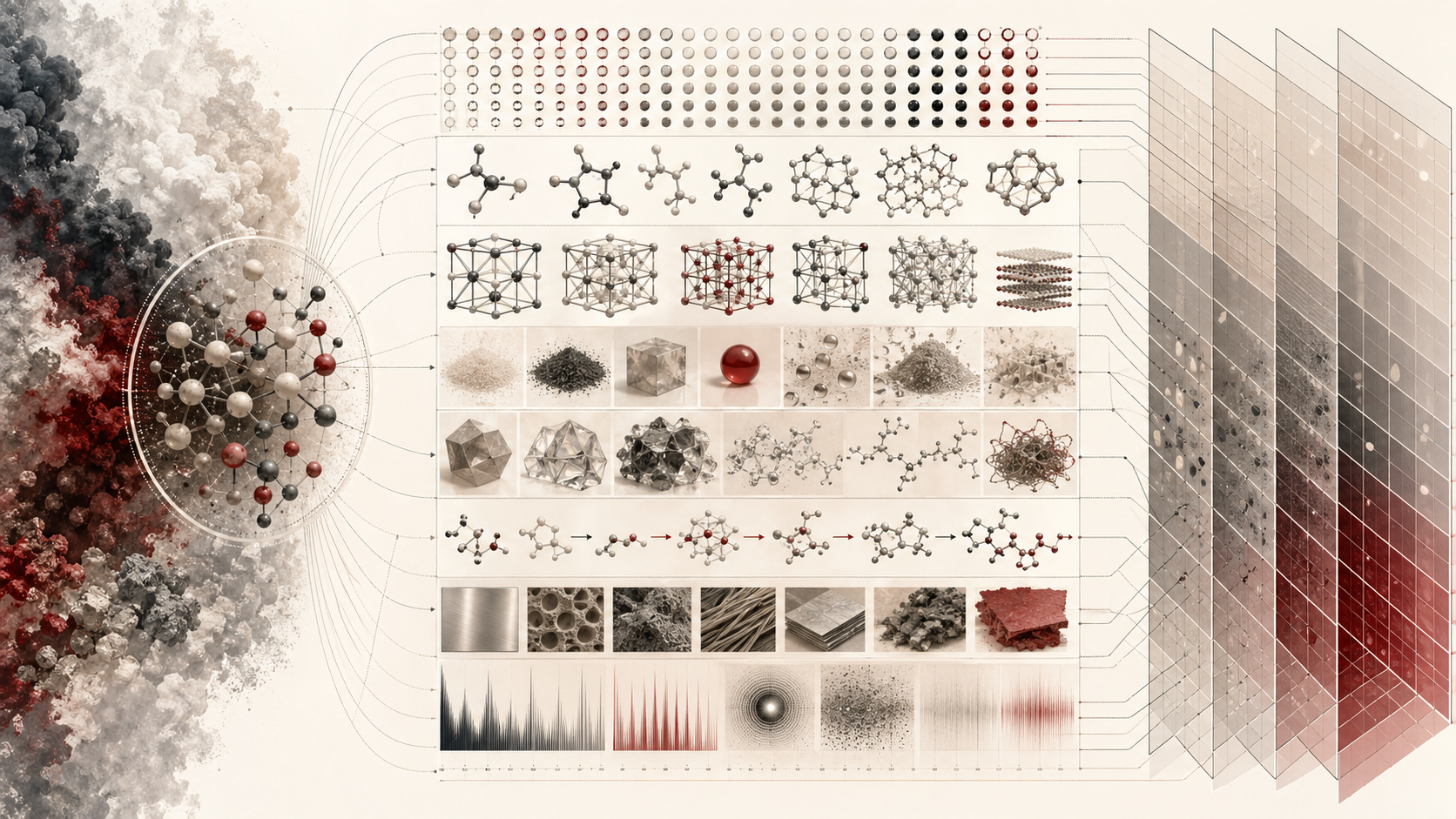
Chemical classification studies how matter is organized into meaningful categories. These categories include elements, compounds, mixtures, atoms, molecules, ions, formula units, phases, solutions, colloids, crystals, minerals, acids, bases, salts, oxides, metals, nonmetals, polymers, biomolecules, functional groups, reaction types, oxidation states, coordination environments, material classes, analytical signatures, environmental categories, and toxicological categories.
Classification is not a minor preliminary step. It shapes what questions can be asked. If a sample is classified as a pure substance, the chemist may ask about identity, structure, purity, phase, and properties. If it is a mixture, the chemist may ask about composition, separation, heterogeneity, matrix effects, and interactions. If it is a polymer, molecular-weight distribution and architecture matter. If it is a mineral, crystal structure and geological context matter. If it is an environmental sample, concentration, speciation, mobility, exposure, and transformation may matter more than purity alone.
Chemistry therefore operates through layered classification. A material can be a solid, a mixture, a composite, a polymer-containing product, a consumer good, a potential waste stream, and an environmental exposure source at the same time. A compound can be classified by formula, structure, functional group, hazard, use, regulatory status, environmental fate, and analytical signature. None of these categories cancels the others. Each serves a different scientific purpose.
Good classification is explicit about purpose. A teaching classification may simplify. A regulatory classification must be precise and accountable. An analytical classification must be evidence-based. A materials classification must include structure and performance. A toxicological classification must connect hazard to exposure, dose, route, vulnerability, and uncertainty.
Matter, Substance, and Sample
Matter is anything that has mass and occupies space, but chemistry rarely studies matter in such a general form. It studies samples, substances, materials, and systems. A sample is the portion of matter actually examined. A substance is matter with defined composition and characteristic properties. A material is matter used or studied for its structure, function, performance, or role in a system.
This distinction matters. A bottle labeled “ethanol” may contain ethanol as the main substance, but the sample may also include water, denaturants, stabilizers, impurities, or degradation products. A polymer product may contain polymer chains, residual monomers, additives, fillers, pigments, plasticizers, stabilizers, and contaminants. A soil sample may contain minerals, organic matter, water, air, ions, microbes, roots, pollutants, and particles across many sizes.
Chemistry must therefore distinguish between ideal identity and real sample complexity. Classification begins with the question: what exactly is being classified? A chemical name may refer to a pure substance, a commercial product, a laboratory reagent, a technical-grade mixture, a natural material, a waste stream, or a detected analyte within a complex matrix.
This distinction is especially important for researchers and scientists because many classification errors arise from confusing the label with the sample. A label can indicate intended identity. It cannot prove purity, phase, composition, degradation state, contamination status, or analytical validity. Classification should therefore be treated as an evidence claim, not merely a naming act.
Elements and the Periodic Organization of Matter
The chemical element is one of chemistry’s most powerful classifications. An element groups atoms by nuclear charge: atoms with the same number of protons belong to the same element. This classification links atomic structure to periodic behavior. Hydrogen, carbon, oxygen, sodium, iron, chlorine, and uranium are not arbitrary names. They are categories grounded in nuclear identity and expressed through recurring patterns of electron structure and chemical behavior.
The periodic table organizes elements by atomic number and recurring properties. It allows chemists to infer valence, bonding tendencies, atomic size, ionization energy, electronegativity, metallic behavior, oxidation states, redox behavior, acid-base character, and reactivity patterns. It is both a classification system and a predictive model.
Periodicity shows that classification can become theory. The periodic table does not merely sort known elements. It reveals relationships, predicts unknowns, and explains why chemical behavior repeats in structured ways. Its power lies in connecting microscopic atomic structure to macroscopic chemical behavior.
Elements also reveal that classification can operate at different conceptual levels. Carbon as an element is defined by atomic number, but carbon-containing matter can appear as diamond, graphite, graphene, carbonate minerals, carbon dioxide, methane, proteins, polymers, soot, coal, dissolved organic matter, or biological tissue. Elemental identity is foundational, but it is only one layer in the classification of matter.
Compounds, Mixtures, and Chemical Identity
A compound contains chemical entities in a defined composition. Water, sodium chloride, carbon dioxide, glucose, and ammonia are familiar examples. A mixture contains more than one substance physically combined without being a single chemically defined substance. Air, seawater, soil, milk, gasoline, concrete, blood, and many consumer products are mixtures.
The distinction between compound and mixture is foundational, but real cases can be complicated. A salt crystal may be a pure compound. A natural mineral may contain substitutions and defects. A polymer may contain a distribution of chain lengths. A biological sample may contain thousands of molecules. A petroleum fraction may contain many hydrocarbons. A material may be chemically heterogeneous by design.
Chemical identity depends on composition, structure, bonding, stereochemistry, isotopic composition, phase, purity, and context. Classification must therefore be precise enough for the problem. For some purposes, “salt” is adequate. For others, the exact hydrate, polymorph, impurity profile, particle size, and crystal structure are essential.
The compound-mixture distinction also affects regulation, safety, and reproducibility. A pure compound can often be represented by a molecular formula or structural formula. A mixture may require component ranges, batch records, manufacturing route, impurities, matrix composition, and analytical method. Scientific reproducibility depends on knowing whether two researchers are actually studying the same chemical entity or merely using similar names.
Atoms, Molecules, Ions, and Formula Units
Chemistry classifies matter by the entities that compose it. Atoms are the basic units of elements. Molecules are discrete groups of atoms connected by chemical bonds. Ions carry net charge. Formula units describe the simplest ratio of ions or atoms in extended ionic or network structures.
This distinction affects how chemists think. Molecular substances may have discrete structures, conformations, functional groups, and intermolecular forces. Ionic compounds are often better described through lattices, charges, coordination, and formula units. Metals are described through metallic bonding and electron delocalization. Covalent networks are described through extended bonding patterns rather than isolated molecules.
Classification at this level connects microscopic structure to macroscopic properties. Melting point, solubility, conductivity, hardness, volatility, viscosity, optical behavior, magnetic behavior, and reactivity all depend on what kind of chemical entities make up the material and how those entities interact.
For researchers, this classification layer also affects modeling strategy. Molecular substances may be represented with molecular graphs, conformer ensembles, quantum-chemical calculations, or molecular dynamics. Ionic and extended solids often require unit cells, lattice parameters, defects, surfaces, and periodic boundary conditions. A good classification points the scientist toward the right explanatory and computational framework.
Phases, States, and Material Form
Chemistry classifies matter by phase: solid, liquid, gas, plasma, supercritical fluid, solution, colloid, gel, glass, liquid crystal, crystalline solid, amorphous solid, and multiphase material. Phase classification matters because the same chemical substance can behave differently depending on physical state. Water as ice, liquid water, vapor, supercritical fluid, or aqueous solvent is chemically continuous but physically distinct.
Phase also affects reaction. Gas-phase reactions depend on collisions, pressure, temperature, and transport. Solution reactions depend on solvation, ionic strength, diffusion, pH, and solvent effects. Solid-state reactions depend on defects, interfaces, diffusion, crystal structure, and particle size. Surface reactions depend on adsorption, active sites, morphology, and catalytic context.
Material form matters as much as composition. Carbon can appear as graphite, diamond, graphene, soot, carbon nanotubes, activated carbon, or amorphous carbon. These are not interchangeable simply because they contain the same element. Chemical classification must include structure and form.
Phase classification is also central to safety and environmental behavior. A substance in vapor form may create inhalation risk. A fine powder may create dust-explosion or respiratory hazards. A nanoparticle may behave differently from a bulk material. A dissolved ion may be more mobile than a precipitated solid. A supercritical fluid may have solvent properties unlike ordinary gases or liquids.
Bonding, Structure, and Chemical Families
Bonding provides another major basis for classification. Matter can be classified according to covalent, ionic, metallic, coordinate, hydrogen-bonding, van der Waals, network, and supramolecular interactions. These categories help explain properties such as volatility, conductivity, solubility, hardness, reactivity, thermal stability, and mechanical behavior.
Structure also defines chemical families. Aromatic compounds, alkanes, alcohols, carboxylic acids, amines, silicates, oxides, sulfides, halides, carbonates, phosphates, coordination complexes, organometallics, polymers, ceramics, alloys, and biomolecules are classified by structural patterns. These patterns are not merely descriptive. They imply likely reactions, analytical signatures, hazards, environmental fate, and applications.
Classification by bonding and structure is especially important for prediction. If a chemist recognizes a carbonyl group, a coordination center, a silicate tetrahedron, a conjugated system, or an ionic lattice, that classification immediately suggests possible behavior. Structure turns chemical naming into inference.
At the same time, bonding categories are models. They simplify electron distribution and structure so chemists can reason effectively. Real bonding may involve mixed character, resonance, delocalization, polarization, defects, disorder, or nonclassical interactions. A responsible classification uses bonding categories as explanatory tools while remaining attentive to evidence.
Functional Groups and Organic Classification
Organic chemistry relies heavily on functional-group classification. Alcohols, ethers, aldehydes, ketones, carboxylic acids, esters, amides, amines, nitriles, alkenes, alkynes, arenes, thiols, sulfides, phosphates, and halides all represent recurring structural motifs. Functional groups help chemists predict reactivity, acidity, polarity, hydrogen bonding, spectroscopy, metabolism, toxicity, and synthetic strategy.
Functional-group classification is powerful because it compresses complexity. A molecule may have many atoms, but a few functional groups can explain much of its chemical behavior. A carboxylic acid suggests acidity and salt formation. An amine suggests basicity and protonation. An ester suggests hydrolysis. An aromatic ring suggests resonance, substitution patterns, and characteristic spectra.
However, functional groups do not act in isolation. Neighboring groups, stereochemistry, conformation, electronic effects, solvent, pH, sterics, and molecular environment all modify behavior. Classification is a guide, not a substitute for evidence.
For researchers, functional-group classification is especially useful when paired with mechanistic reasoning. It can support retrosynthetic analysis, reaction prediction, metabolite identification, medicinal chemistry optimization, environmental transformation assessment, and structure-activity reasoning. But functional groups must be interpreted in molecular context, not treated as independent switches.
Inorganic Classes, Minerals, Salts, Oxides, and Coordination Compounds
Inorganic chemistry uses its own classification systems. Salts, oxides, sulfides, halides, carbonates, nitrates, phosphates, silicates, borates, metal complexes, organometallic compounds, intermetallics, ceramics, minerals, and extended solids each require different descriptive frameworks. Oxidation state, coordination number, ligand field, crystal structure, lattice energy, ionic radius, acid-base behavior, and redox activity may be central.
Mineral classification, for example, often depends on anionic group and crystal structure. Silicates are classified by tetrahedral connectivity. Oxides are classified by metal-oxygen frameworks. Coordination compounds are classified by central metal, ligands, geometry, charge, and electronic structure. These categories help connect atomic-scale structure to geological, environmental, catalytic, and material behavior.
Inorganic classification reminds us that chemistry is not only molecular. Much of matter is extended, crystalline, ionic, metallic, mineralogical, or networked. A molecular drawing may be inadequate for substances whose identity depends on lattice structure, defects, hydration state, solid solution, surface chemistry, or coordination environment.
Inorganic classification is also central to environmental and industrial chemistry. The speciation of a metal can determine mobility, bioavailability, toxicity, catalytic behavior, and remediation strategy. Chromium metal, chromium(III), and chromium(VI) compounds are not ethically, chemically, or toxicologically interchangeable. Classification can therefore have direct consequences for risk, regulation, and public health.
Reaction Types and Mechanistic Classification
Chemists classify reactions to understand transformation. Common reaction classes include synthesis, decomposition, substitution, addition, elimination, oxidation-reduction, acid-base, precipitation, complexation, hydrolysis, condensation, polymerization, rearrangement, photochemical, electrochemical, catalytic, radical, pericyclic, and biochemical reactions.
Reaction classification helps chemists predict products, conditions, rates, mechanisms, and hazards. A redox reaction implies electron transfer and oxidation-state changes. An acid-base reaction implies proton or electron-pair transfer depending on the model. A precipitation reaction depends on solubility and ion activity. A polymerization depends on initiation, propagation, termination, molecular-weight distribution, and architecture.
Mechanistic classification is deeper than surface description. Two reactions that look similar in stoichiometry may proceed by different mechanisms. Conversely, reactions across different substrates may share a mechanistic pattern. Classification helps connect observed transformation to explanatory pathway.
This matters in research because mechanism guides intervention. If a reaction is radical-mediated, oxygen, inhibitors, light, and initiators may matter. If it is acid-catalyzed, pH and solvent can dominate. If it is diffusion-limited, mixing and surface area may matter more than intrinsic rate constants. If it is catalyzed on a surface, active-site structure, poisoning, and mass transport may be decisive.
Analytical Signatures and Evidence-Based Classification
Modern chemical classification depends on analytical evidence. Spectroscopy, chromatography, mass spectrometry, elemental analysis, titration, thermal analysis, microscopy, diffraction, electrochemistry, nuclear magnetic resonance, infrared spectroscopy, Raman spectroscopy, ultraviolet-visible spectroscopy, X-ray methods, and sensor systems all produce signatures that help classify matter.
An unknown compound may be classified by molecular mass, fragmentation pattern, retention time, functional-group vibrations, NMR shifts, elemental composition, isotope pattern, crystal structure, or thermal transitions. A material may be classified by morphology, phase composition, glass-transition temperature, crystallinity, porosity, surface area, particle size, and mechanical properties.
Classification becomes strongest when multiple lines of evidence converge. A name alone is weak. A spectrum alone can be ambiguous. A robust classification connects analytical signatures, reference standards, metadata, uncertainty, and chemical reasoning.
Researchers should distinguish identification, classification, and interpretation. Identification asks what the substance is. Classification asks what category it belongs to. Interpretation asks what that classification means for mechanism, function, risk, or use. These are related but not identical. A laboratory result should make clear which claim is being made and how strongly the evidence supports it.
Materials, Polymers, Alloys, Ceramics, and Composites
Materials chemistry classifies matter by structure, processing, properties, and function. Polymers are classified by monomer, architecture, molecular weight, tacticity, crystallinity, thermal behavior, and degradation. Alloys are classified by composition, phase, microstructure, and treatment. Ceramics are classified by bonding, crystal structure, porosity, grain size, and thermal behavior. Composites are classified by matrix, reinforcement, interface, orientation, and failure mode.
Material classification often requires multiple scales. A polymer bottle is not only a chemical substance. It is a material with chain distribution, additives, crystallinity, thermal history, shape, mechanical properties, and recycling context. A battery cathode is not only a compound. It is a structured material with phase behavior, particle morphology, electronic conductivity, ion transport, and degradation pathways.
Materials show that chemical understanding must move from composition to architecture. Matter is not only what it contains, but how it is arranged. This is why materials classification often combines chemistry, physics, microscopy, mechanical testing, thermodynamics, and engineering performance.
For researchers, material classification should include provenance and processing history. Two materials with the same nominal composition may behave differently because of synthesis route, annealing, particle size, porosity, additives, crystallinity, grain boundaries, surface treatment, moisture content, aging, or mechanical history. Classification must therefore connect identity to process.
Classification, Risk, Hazard, and Responsibility
Chemical classification has consequences. A substance classified as flammable, corrosive, toxic, persistent, bioaccumulative, carcinogenic, explosive, reactive, endocrine-active, sensitizing, or environmentally hazardous is treated differently from a substance without those classifications. Waste classification affects handling, transport, storage, disposal, worker protection, and community exposure.
Risk classification must be evidence-based and ethically responsible. Underclassification can expose workers and communities to harm. Overclassification can create confusion or unnecessary burden. Misclassification can undermine trust. Classification systems therefore need transparency, uncertainty, revision, and accountability.
This is especially important for communities that have historically carried disproportionate chemical burdens. Classification is not merely administrative. It influences whose exposure is recognized, whose harm is measured, and whose environment is protected.
Classification also affects substitution. If a hazardous substance is replaced with another poorly characterized substance, classification can create the appearance of progress while moving risk elsewhere. Responsible classification therefore requires attention to alternatives, data gaps, cumulative exposure, and life-cycle consequences.
Historical and Philosophical Dimensions
Chemistry has always depended on changing classifications. Ancient categories of elements, alchemical principles, phlogiston theory, affinity tables, atomic theory, periodic classification, structural formulas, thermodynamics, quantum chemistry, spectroscopy, and modern informatics all reshaped how matter was understood. Chemical categories evolve when evidence changes.
The history of chemistry shows that classification is neither arbitrary nor final. Categories are tools built to explain patterns. Some survive because they remain useful. Others are replaced when they fail. The periodic table endured because it organized deep regularities. Phlogiston disappeared because it failed against better evidence. Structural formulas became indispensable because they explained isomerism and reactivity.
The philosophy of chemistry asks what chemical kinds are, how substances retain identity across change, how models represent unseen structure, and why classification systems work. These questions are not abstract luxuries. They shape how chemistry teaches, regulates, discovers, and designs.
Scientific classification is therefore historically situated and evidence-constrained. It is not a static dictionary. It is a living infrastructure of inquiry. Researchers inherit categories from earlier science, but they also revise them when new instruments, theories, materials, and environmental concerns expose old limits.
Chemical Informatics, Ontologies, and Machine-Readable Classification
Modern chemistry increasingly depends on machine-readable classification. Databases, registries, ontologies, identifiers, molecular fingerprints, structure files, spectral libraries, reaction databases, regulatory inventories, and materials repositories all require structured ways of representing chemical identity. Classification is no longer only a conceptual practice. It is also a data infrastructure.
Chemical informatics systems may classify substances by molecular formula, structure, stereochemistry, charge, isotope composition, functional group, ring system, scaffold, biological activity, hazard category, patent record, assay result, or literature evidence. Materials databases may classify by composition, crystal structure, phase, synthesis method, thermal behavior, mechanical properties, or application.
Ontologies make classification explicit by defining relationships among entities. A compound may be a member of a chemical class, contain a functional group, participate in a reaction, appear in a pathway, have an assay result, carry a hazard label, or correspond to multiple database identifiers. These structured relationships allow search, integration, modeling, and automated reasoning.
But machine-readable classification can also reproduce errors. Inconsistent identifiers, ambiguous mixtures, missing stereochemistry, incomplete metadata, unvalidated predictions, proprietary data gaps, and overconfident labels can create false precision. Responsible cheminformatics requires provenance, uncertainty, version control, and human review.
Mathematical Lens: Similarity, Feature Spaces, and Classification Scores
Chemical classification can be represented through feature vectors. A substance, sample, or material can be described by a set of measured, computed, or curated properties:
\mathbf{x} = (x_1, x_2, x_3, \ldots, x_n)
\]
Interpretation: \(\mathbf{x}\) is a feature vector describing a chemical record. Features might include molecular weight, polarity, charge, boiling point, density, pH, oxidation state, spectral peaks, elemental composition, phase, or hazard indicators.
A simple weighted classification score can be written as:
S_c = \sum_{i=1}^{n} w_i f_i
\]
Interpretation: \(S_c\) is the score for class \(c\), \(w_i\) are feature weights, and \(f_i\) are normalized feature values. The highest score may suggest a class, but only when evidence strength and uncertainty are acceptable.
Similarity between two chemical records can be represented conceptually as:
D(\mathbf{x}, \mathbf{y}) = \sqrt{\sum_{i=1}^{n}(x_i – y_i)^2}
\]
Interpretation: \(D(\mathbf{x}, \mathbf{y})\) is the Euclidean distance between two records in a selected feature space. A smaller distance suggests greater similarity with respect to the chosen features.
In cheminformatics, more specialized molecular fingerprints, graph representations, kernel methods, and similarity metrics are often used. The important point is that classification depends on chosen features. Different features produce different classifications. A molecular fingerprint may emphasize connectivity. A spectral vector may emphasize measured instrument response. A hazard model may emphasize toxicological endpoints. A materials model may emphasize structure-property relationships.
For this reason, mathematical classification should always disclose feature selection, scaling, missing-data treatment, confidence thresholds, and validation method. A classifier without documentation is not scientific infrastructure. It is an opaque sorting device.
Computational Workflows for Chemical Classification
Computational chemistry and cheminformatics extend classification into searchable, reproducible systems. A workflow can classify records by elemental composition, molecular formula, charge, functional groups, phase, molecular weight, polarity, boiling point, density, spectral signature, material type, hazard indicators, reaction role, and analytical confidence. It can also track uncertainty, provenance, and evidence.
Useful workflows include sample classification, compound-versus-mixture screening, functional-group inference, phase classification, material-class scoring, analytical-signature matching, hazard-category triage, chemical database normalization, and similarity analysis. More advanced workflows can use molecular fingerprints, graph neural networks, ontology mapping, spectral libraries, and probabilistic classification.
For researchers, computational classification should be auditable. Each classification should record input features, data sources, transformation steps, decision rules, confidence scores, and uncertainty notes. This is especially important when classification affects safety, regulation, environmental monitoring, clinical research, or product stewardship.
The code examples below provide synthetic demonstrations of classification logic. They are not substitutes for expert chemical identification, regulatory classification, laboratory quality assurance, safety-data review, or analytical validation. Their purpose is to make chemical classification logic visible, auditable, and reusable.
Python Example: Classifying Synthetic Chemical Records
This Python example shows a transparent rule-based classifier for synthetic chemical records. In real chemical informatics, classification rules would need to be validated against curated datasets, linked to evidence sources, and reviewed by domain experts.
from dataclasses import dataclass
from typing import Dict, Tuple


@dataclass
class ChemicalRecord:
    """Synthetic educational record for chemical classification.

    This model demonstrates transparent decision logic. It does not identify
    real unknowns, validate analytical results, assign regulatory categories,
    or replace expert chemical review.
    """

    chemical_id: str
    components: int
    is_polymer: bool
    charge: int
    contains_metal: bool
    coordination_number: int
    functional_group: str
    phase: str
    network_structure: bool
    analytical_confidence: float


def classify_record(record: ChemicalRecord) -> Tuple[str, Dict[str, str]]:
    """Classify a synthetic record and return an audit trail."""

    evidence = {}

    if record.components > 1:
        evidence["reason"] = "More than one component was reported."
        return "mixture", evidence

    if record.is_polymer:
        evidence["reason"] = "The record is marked as polymeric."
        return "polymer", evidence

    if record.charge != 0:
        evidence["reason"] = "The record has nonzero net charge."
        return "ion_or_salt", evidence

    if record.contains_metal and record.coordination_number >= 4:
        evidence["reason"] = "A metal center with coordination number four or greater was reported."
        return "coordination_or_inorganic_complex", evidence

    if record.functional_group in {"alcohol", "amine", "carboxylic_acid", "ester", "amide"}:
        evidence["reason"] = f"The functional group '{record.functional_group}' was detected."
        return "organic_compound", evidence

    if record.phase in {"crystalline_solid", "amorphous_solid"} and record.network_structure:
        evidence["reason"] = "The record is a solid with an extended network structure."
        return "extended_solid_or_material", evidence

    evidence["reason"] = "No higher-priority class rule was triggered."
    return "molecular_substance", evidence


sample = ChemicalRecord(
    chemical_id="SYN-001",
    components=1,
    is_polymer=False,
    charge=0,
    contains_metal=False,
    coordination_number=0,
    functional_group="ester",
    phase="liquid",
    network_structure=False,
    analytical_confidence=0.86,
)

assigned_class, audit = classify_record(sample)

print({
    "chemical_id": sample.chemical_id,
    "assigned_class": assigned_class,
    "analytical_confidence": sample.analytical_confidence,
    "audit": audit,
})
The value of this example is not chemical sophistication. It shows the logic that every classifier should preserve: classification inputs, decision rules, confidence, and explanation. Even complex machine-learning models should be evaluated against this standard of interpretability when decisions affect safety, research reproducibility, or public trust.
R Example: Chemical Class Summary
This R example summarizes synthetic classification records by assigned class. It demonstrates how a research workflow might monitor classification confidence, missing molecular-weight values, and class distribution across a small dataset.
chemical_id <- c("C001", "C002", "C003", "C004", "C005", "C006")
assigned_class <- c(
  "organic_compound",
  "mixture",
  "polymer",
  "ion_or_salt",
  "extended_solid",
  "coordination_complex"
)

molecular_weight <- c(88.1, NA, 50000, 58.4, NA, 312.7)
components <- c(1, 5, 1, 2, 1, 1)
classification_confidence <- c(0.86, 0.72, 0.81, 0.90, 0.76, 0.79)
has_reference_standard <- c(TRUE, FALSE, FALSE, TRUE, FALSE, TRUE)

data <- data.frame(
  chemical_id,
  assigned_class,
  molecular_weight,
  components,
  classification_confidence,
  has_reference_standard
)

summary <- aggregate(
  classification_confidence ~ assigned_class,
  data = data,
  FUN = mean
)

summary$record_count <- as.numeric(table(data$assigned_class)[summary$assigned_class])

summary <- summary[order(summary$classification_confidence, decreasing = TRUE), ]

print(summary)

low_confidence <- subset(data, classification_confidence < 0.80)

print(low_confidence)
For actual research use, class summaries should be connected to quality-control flags. Low confidence, missing reference standards, incomplete metadata, uncertain stereochemistry, unknown impurities, or inconsistent spectra should trigger review rather than automatic acceptance.
SQL Example: Classification Evidence Register
A classification system becomes more scientific when evidence is traceable. A simple evidence register can preserve the analytical basis for classification decisions, including method, source, confidence, uncertainty, and review status.
CREATE TABLE chemical_record (
    chemical_id TEXT PRIMARY KEY,
    preferred_name TEXT NOT NULL,
    assigned_class TEXT NOT NULL,
    components INTEGER,
    molecular_formula TEXT,
    molecular_weight REAL,
    phase TEXT,
    classification_confidence REAL CHECK (
        classification_confidence BETWEEN 0 AND 1
    ),
    uncertainty_notes TEXT
);

CREATE TABLE classification_evidence (
    evidence_id INTEGER PRIMARY KEY,
    chemical_id TEXT NOT NULL,
    evidence_type TEXT NOT NULL,
    method TEXT,
    evidence_summary TEXT NOT NULL,
    source_reference TEXT,
    confidence_score REAL CHECK (confidence_score BETWEEN 0 AND 1),
    review_status TEXT,
    FOREIGN KEY (chemical_id) REFERENCES chemical_record(chemical_id)
);

INSERT INTO chemical_record (
    chemical_id,
    preferred_name,
    assigned_class,
    components,
    molecular_formula,
    molecular_weight,
    phase,
    classification_confidence,
    uncertainty_notes
) VALUES (
    'SYN-001',
    'synthetic ester example',
    'organic_compound',
    1,
    'C4H8O2',
    88.1,
    'liquid',
    0.86,
    'Educational synthetic record; not a real identification.'
);

SELECT
    chemical_id,
    preferred_name,
    assigned_class,
    classification_confidence,
    CASE
        WHEN classification_confidence >= 0.85 THEN 'high_review_priority_confirmed'
        WHEN classification_confidence >= 0.70 THEN 'moderate_confidence_review_needed'
        ELSE 'low_confidence_do_not_use_without_review'
    END AS classification_status
FROM chemical_record
ORDER BY classification_confidence DESC;
This type of register helps prevent classification from becoming detached from evidence. A class label should be connected to data, method, uncertainty, and review. Without that connection, chemical classification can become administratively convenient but scientifically fragile.
GitHub Repository
The companion repository for this article can support reproducible workflows for sample classification, compound-versus-mixture screening, functional-group inference, phase classification, material-class scoring, analytical-signature matching, SQL provenance, and full-stack computational examples.
Complete Code Repository
The full code distribution for this article, including sample classification, compound-versus-mixture screening, functional-group inference, phase classification, material-class scoring, analytical-signature matching, SQL provenance, and full-stack computational examples, is available on GitHub.
Limits, Ethics, and Responsible Use
Chemical classification can mislead when it is treated as more certain than the evidence allows. A sample may be mislabeled, contaminated, degraded, transformed, impure, or heterogeneous. A database record may normalize a structure in a way that differs from a submitted sample. A material may have the same nominal composition but different structure, phase, morphology, or performance. A hazard classification may depend on exposure route, dose, particle size, bioavailability, degradation products, or mixture effects.
The computational examples associated with this article are synthetic and educational. They do not identify real unknowns, validate laboratory results, determine regulatory classification, replace analytical chemistry, assign legally binding hazard categories, produce safety data sheets, certify purity, or substitute for expert review. They demonstrate classification logic, not authoritative chemical judgment.
Responsible classification requires transparency about evidence, uncertainty, and purpose. The same sample may need different classifications for teaching, synthesis, toxicology, environmental monitoring, materials design, waste handling, or regulation. Good chemistry knows not only how to classify, but why a classification is being made.
Classification also has ethical stakes. Misclassification can affect worker safety, environmental protection, waste handling, exposure assessment, research reproducibility, and public trust. A responsible classification system should be revisable, evidence-linked, uncertainty-aware, and accountable to the people and systems affected by chemical decisions.
Conclusion
Chemistry makes matter understandable by classifying it. Elements, compounds, mixtures, phases, functional groups, materials, reactions, structures, and analytical signatures are not isolated vocabulary terms. They are the conceptual architecture that allows chemists to move from observation to explanation.
Classification is powerful because it reveals pattern. It is limited because matter is complex. The best chemical classifications are therefore both disciplined and revisable. They organize evidence without pretending that categories are final. They help chemists predict behavior while remaining open to anomaly, uncertainty, and new forms of matter.
To study chemistry is to learn how matter becomes knowable. Classification is where that knowledge begins, but it is also where scientific humility begins. Every classification is an invitation to ask what evidence supports the category, what purpose the category serves, what it reveals, and what it may hide.
Related articles
- Analytical Chemistry and the Identification of Matter
- Chemical Bonding and Molecular Structure
- The Periodic Table, Elements, and Chemical Periodicity
- Materials Chemistry: Structure, Function, and Design
- Polymer Chemistry, Macromolecules, and Materials
- Environmental Chemistry and the Chemical Conditions of Habitability
- Green Chemistry, Responsibility, and Sustainable Transformation
Further reading
- Atkins, P. and Jones, L. (2016) Chemical Principles: The Quest for Insight. 7th edn. New York: W.H. Freeman.
- Bensaude-Vincent, B. and Simon, J. (2008) Chemistry: The Impure Science. London: Imperial College Press.
- Goodwin, W. (2011) Philosophy of Chemistry. In: Zalta, E.N. (ed.) The Stanford Encyclopedia of Philosophy. Available at: https://plato.stanford.edu/entries/chemistry/
- Hendry, R.F. (2012) Elements, Compounds, and Other Chemical Kinds. Philosophy of Science, 79(5), pp. 864–875.
- Needham, P. (2011) Substance and Chemistry. Dordrecht: Springer.
- Scerri, E.R. (2019) The Periodic Table: Its Story and Its Significance. 2nd edn. Oxford: Oxford University Press.
References
- International Union of Pure and Applied Chemistry (n.d.) Compendium of Chemical Terminology: The Gold Book. Available at: https://goldbook.iupac.org/
- International Union of Pure and Applied Chemistry (n.d.) Chemical Element. Available at: https://goldbook.iupac.org/terms/view/C01022
- International Union of Pure and Applied Chemistry (n.d.) Chemical Substance. Available at: https://goldbook.iupac.org/terms/view/C01039
- International Union of Pure and Applied Chemistry (n.d.) Periodic Table of the Elements. Available at: https://iupac.org/what-we-do/periodic-table-of-elements/
- International Union of Pure and Applied Chemistry (n.d.) Nomenclature. Available at: https://iupac.org/what-we-do/nomenclature/
- National Center for Biotechnology Information (n.d.) PubChem. Available at: https://pubchem.ncbi.nlm.nih.gov/
- National Center for Biotechnology Information (n.d.) PubChem Compound vs Substance. Available at: https://pubchem.ncbi.nlm.nih.gov/docs/compound-vs-substance
- National Center for Biotechnology Information (n.d.) PubChem Classification Browser. Available at: https://pubchem.ncbi.nlm.nih.gov/classification/
- National Institute of Standards and Technology (n.d.) NIST Chemistry WebBook. Available at: https://webbook.nist.gov/chemistry/
- National Institute of Standards and Technology (n.d.) A Guide to the NIST Chemistry WebBook. Available at: https://webbook.nist.gov/chemistry/guide/
- Linstrom, P.J. and Mallard, W.G. (eds.) (n.d.) NIST Chemistry WebBook, NIST Standard Reference Database Number 69. National Institute of Standards and Technology. Available at: https://webbook.nist.gov/chemistry/
- Royal Society of Chemistry (n.d.) ChemSpider. Available at: https://www.chemspider.com/