
Last Updated May 5, 2026
The Yellow Emperor, Huangdi, occupies a singular position in Chinese mythology because he stands at the intersection of myth, rulership, ancestry, territorial order, warfare, ritual authority, and the political imagination of origins. If Pangu represents cosmological separation, Nüwa cosmic repair, Fuxi symbolic and social ordering, and Shennong the securing of subsistence, Huangdi belongs to another decisive register altogether: the mythic consolidation of political civilization. Under his name, early China remembers not merely a primordial being or civilizational inventor, but a ruler whose authority is tied to warfare, territorial integration, ritual order, administrative organization, and the transformation of scattered power into a recognizable center.
Huangdi is therefore not just a legendary emperor in the loose sense of an ancient ruler surrounded by myth. He is one of the great figures through whom Chinese tradition imagines the beginning of legitimate political order. His story brings together combat and civilization, ancestry and governance, geography and ritual, culture heroism and historiography. His mythic authority is not only personal. It is structural. Through Huangdi, the tradition asks how power becomes central, how territory becomes ordered, how rival forces are subordinated, how ritual links rulership to the cosmos, and how political antiquity becomes a usable memory.
Series context: This article is part of the Chinese Myth, Folklore & Legend knowledge series. It should be read alongside Pangu and the Separation of Heaven and Earth, Nüwa: Creation, Repair, and the Human World, Fuxi and the Myth of Cultural Order, and Shennong and the Invention of Agriculture, Medicine, and Rule. Within that sequence, Huangdi marks the point at which myth turns decisively toward sovereignty, legitimacy, military consolidation, ritual centrality, and the imagined political beginnings of China.
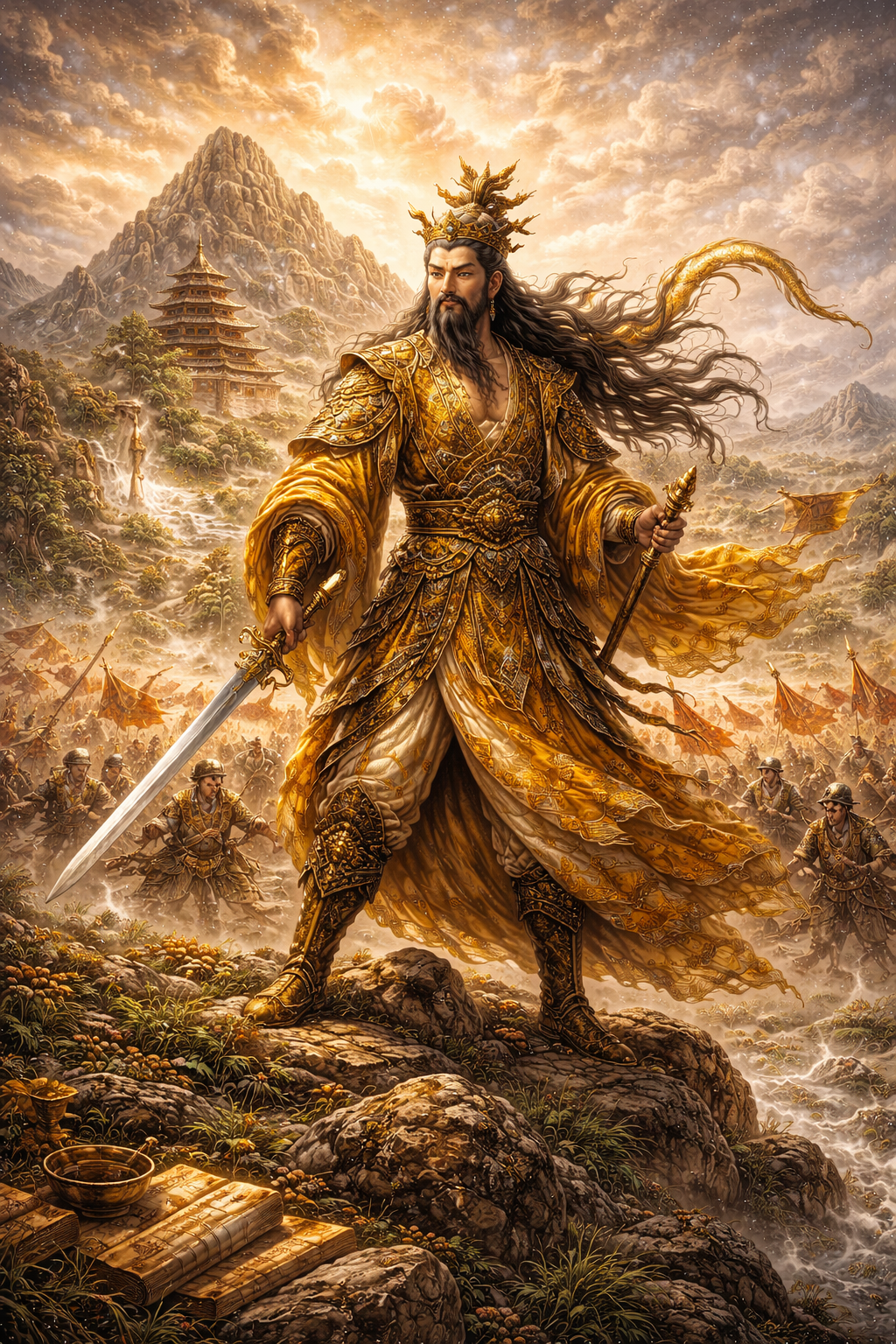
The classical record gives Huangdi unusual weight. The Shiji does not present him merely as a fabulous culture hero among others. In the “Annals of the Five Emperors,” Sima Qian places him at the head of the account, names him as the son of Shaodian, surnamed Gongsun and named Xuanyuan, and portrays him as a figure of exceptional intelligence, military capacity, and rulership. The text associates him with pacification, movement across the four directions, the ordering of offices, oversight of the myriad states, sacrifice to spirits, mountains, and rivers, and the diffusion of grains, plants, animals, and practical knowledge. In the transmitted historiographical tradition, Huangdi is therefore not simply remembered. He is politically installed.
That installation matters. Huangdi is where myth and historiography become deeply entangled. His figure is not reducible to recoverable biography, nor should he be dismissed as empty legend. He is a political ancestor constructed through texts, rituals, genealogies, territorial memories, and later intellectual traditions. To study Huangdi is to study how a civilization imagines the beginning of sovereignty.
Who Is Huangdi?
Huangdi, the Yellow Emperor, is one of the most consequential figures in the Chinese mythic and historiographical imagination. The Shiji identifies him as the son of Shaodian, surnamed Gongsun and named Xuanyuan, and depicts him as precociously gifted from birth. These details matter not because they provide recoverable biography in a modern sense, but because they establish him as an origin figure already marked by distinction, aptitude, and eventual sovereignty. He is introduced not merely as one ruler among others, but as the exemplary beginning of a line of political order.
Primary Source
黃帝者,少典之子,姓公孫,名曰軒轅。Huangdi was the son of Shaodian; his surname was Gongsun, and his name was Xuanyuan.Shiji, “Annals of the Five Emperors” 五帝本紀.
The opening identification places Huangdi at the head of a historiographical sequence. The passage gives him name, lineage, and political recognizability before the narrative turns to conflict and rule.
Supplementary reference traditions strengthen this picture. Later accounts present Huangdi not only as an ancient mythological emperor, but as a culture hero, ancestor, and figure of Daoist and political memory. Used carefully, such summaries help confirm how large Huangdi’s later symbolic life became, but the essential point remains visible already in the transmitted primary archive: Huangdi is the ruler under whose name early Chinese tradition imagines the concentration of political beginnings.
His identity is therefore layered. He is a mythic emperor, a culture hero, an ancestral sovereign, a military victor, a ritual actor, a territorial organizer, and a later figure of philosophical and religious reflection. These layers should not be collapsed into one simple biography. Huangdi’s importance lies precisely in the way so many forms of authority gather around his name.
Huangdi and the Mythic Politics of Origin
Huangdi’s importance lies in the fact that he turns myth toward politics without emptying it of symbolic depth. Earlier figures in the Chinese mythic archive explain how the cosmos became differentiated, repaired, provisioned, and socially patterned. Huangdi explains how power becomes centered, defended, and legitimated. Under his name, origin is no longer only a matter of the world’s structure or the people’s subsistence. It becomes a matter of who rules, by what right, across what territory, and under what cosmological sanction.
This makes Huangdi a foundational figure in the mythic politics of Chinese origins. He is not simply a conqueror. He is the prototype of unifying rule. The tradition does not remember him only because he fought; it remembers him because warfare becomes, under his name, the precondition of order. Violence is not celebrated for its own sake. It is narrated as the means by which scattered, disorderly, or rival powers are subordinated to a larger and more durable political form.
That political form is more than military success. Huangdi is associated with territory, administration, ritual, offices, and cosmic alignment. His story therefore presents legitimate rule as a composite achievement. A ruler must defeat disorder, gather allegiance, traverse and organize space, honor spirits and mountains, supervise communities, and align human governance with a larger order.
In this sense, Huangdi’s myth is not only about the beginning of rule. It is about the conditions under which rule becomes meaningful. Power must be justified by order. Centering must be accompanied by ritual. Victory must be converted into governance. This is the deeper political logic of Huangdi’s mythic authority.
The Shiji and the Construction of Ancestral Rule
The “Annals of the Five Emperors” in the Shiji is the single most important transmitted source for Huangdi’s political stature. There Sima Qian does more than preserve tradition; he arranges it. Huangdi is given precedence, linked genealogically to later rulers, and presented as the first great point of integration in the annalistic narrative. He moves, campaigns, appoints, supervises, sacrifices, and governs. The annal is therefore not neutral preservation. It is a historiographical act of political founding.
That historiographical construction is decisive for interpretation. Huangdi is mythic, but he is mythic within a narrative form designed to explain the beginnings of orderly rule. He becomes an ancestral sovereign through whom later political civilization can imagine its own pedigree. The question is not whether every detail is historically verifiable. The question is what kind of political memory the text creates. Its answer is clear: legitimate order begins under Huangdi.
This makes the Shiji both source and shaper. It transmits older traditions, but it also organizes them into a sequence that gives antiquity a political architecture. Huangdi appears at the start of that architecture because he is made to bear the burden of origin. He is not simply earlier than later rulers; he authorizes the idea that later rule has deep ancestral roots.
For this reason, Huangdi should be read as a historiographical construction without being dismissed as artificial. All political antiquity is mediated. The power of Huangdi lies in how successfully the tradition uses him to link memory, rule, ritual, and civilization into a single founding figure.
From Shennong to Huangdi
One of the most important features of the Shiji account is its placement of Huangdi after the decline of Shennong’s line. In the narrative, the age of Shennong weakens, rival powers attack one another, the people suffer, and Shennong’s authority can no longer restrain disorder. Huangdi’s rise therefore occurs in a moment of political crisis. This is essential. He does not emerge in an already stable world. He emerges when older forms of order can no longer hold.
This transition gives Huangdi’s mythic role its urgency. Shennong represents agriculture, food, goods, and material sustenance. Huangdi represents military and political consolidation after that agrarian order has become insufficient to restrain conflict. The sequence does not negate Shennong’s importance; it shows that subsistence alone cannot guarantee political order. A fed society still needs legitimate authority, territorial integration, and capacity to respond to violence.
Primary Source
軒轅之時,神農氏世衰。諸侯相侵伐,暴虐百姓,而神農氏弗能征。In the time of Xuanyuan, the line of Shennong had declined. The lords attacked one another and oppressed the people, and the house of Shennong could not punish them.Shiji, “Annals of the Five Emperors” 五帝本紀.
The passage frames Huangdi’s rise as a response to political breakdown. He appears not as a ruler in a vacuum, but as the figure who answers a crisis of failed authority.
This transition from Shennong to Huangdi also helps explain the larger architecture of the Chinese mythic sequence. Civilization unfolds through stages: world-formation, repair, social ordering, subsistence, political consolidation. Huangdi becomes necessary when the question shifts from how people survive to how political order is established and defended.
In that sense, Huangdi’s story is not simply heroic. It is institutional. The problem he solves is not one monster, one battle, or one rival, but the problem of dispersed violence and weakened authority. His mythic victory is the re-centering of the human world.
Warfare, Chiyou, and the Legitimation of Power
No aspect of Huangdi’s mythic-political identity is more important than the war with Chiyou. In the Shiji, Chiyou appears as the most violent and difficult adversary, one whom others cannot subdue. Huangdi gathers forces, fights at Zhuolu, captures and kills Chiyou, and is then honored by the lords as Son of Heaven in place of Shennong. The political logic is explicit: victory over the impossible enemy authorizes succession to central rule.
This is not merely a battle story. It is a narrative about legitimacy. Huangdi’s authority is proven in crisis. The old order has weakened; rival powers have caused violence; the people suffer; Chiyou embodies unassimilated force. Huangdi’s victory turns military capacity into political recognition. The lords honor him because he has demonstrated the ability to restore order where others could not.
Primary Source
蚩尤作亂,不用帝命。於是黃帝乃徵師諸侯,與蚩尤戰於涿鹿之野,遂禽殺蚩尤。Chiyou made disorder and did not obey the emperor’s command. Huangdi then levied troops from the lords, fought Chiyou on the plain of Zhuolu, and finally captured and killed him.Shiji, “Annals of the Five Emperors” 五帝本紀.
The Zhuolu battle turns warfare into political legitimation. Huangdi’s authority is established through the defeat of a figure who represents disobedient and violent disorder.
Yet this martial legitimation should be read carefully. The tradition does not present violence as self-justifying. Huangdi’s warfare becomes legitimate because it is directed toward pacification. He defeats adversaries in order to create a stable center. The moral question is therefore not simply who is strongest, but whether strength can be converted into order.
This is why Chiyou remains important as more than an enemy. He is the foil through whom Huangdi’s legitimacy becomes visible. The figure of Chiyou concentrates the problem of rival force, martial danger, and political disorder. Huangdi becomes Huangdi by defeating what the older order could not contain.
Yinglong, Nüba, and Cosmic War
The Shanhaijing preserves another major version of the Huangdi-Chiyou conflict, and it is especially valuable because it stages the war cosmologically. The battle is not simply between two military leaders. It involves Yinglong, the Rain Master, the Wind Earl, storm, water, drought, and the heavenly daughter Ba or Nüba. The conflict unfolds through weather and divine agency. Political struggle is imagined as cosmic struggle.
This matters because Huangdi’s victory becomes more than a human military triumph. His side is able to mobilize forces that restore order against destabilizing wind and rain. Chiyou summons storm; Huangdi sends down Ba; the rain ceases; Chiyou is killed. The story embeds political legitimacy in a weather-drama of excess and restraint.
Primary Source
蚩尤作兵伐黃帝,黃帝乃令應龍攻之冀州之野。Chiyou raised weapons to attack Huangdi, and Huangdi ordered Yinglong to attack him on the plain of Jizhou.Shanhaijing, “Northern Classic of the Great Wilderness” 大荒北經.
The Shanhaijing version turns the conflict into a mythic war involving dragon power, weather, and divine intervention.
The figure of Nüba is especially important. She stops the rain, but her presence also creates drought, and she cannot return fully to heaven. This gives the story a complex ecological afterlife. Victory has consequences. The divine force that ends one crisis may create another kind of imbalance if not properly placed. The myth therefore does not simply celebrate supernatural power. It shows the difficulty of managing forces that exceed ordinary human control.
This Shanhaijing layer deepens Huangdi’s political myth. Rule is not merely the command of armies. It is the capacity to engage cosmic agencies, weather, water, drought, and the boundaries between heaven and earth. Huangdi’s political centrality is imagined through his relation to forces larger than the political field itself.
At the same time, this mythic war should be read source-critically. It is not the same kind of source as the Shiji. The Shiji arranges Huangdi within political historiography; the Shanhaijing preserves a more mythic, cosmographic, and divine-war register. The two should be read together, not flattened into a single prose biography.
Territory, Movement, and the Ordering of Space
The Shiji repeatedly emphasizes Huangdi’s movement across space. He goes east to the sea and Mount Dai, west to Kongtong and Jitou, south to the Yangzi region, and north in pursuit of hostile forces, finally settling at Zhuolu. These motions are not incidental travel notes. They are political geography. Under Huangdi’s name, the world of early rule is imagined as traversable, claimable, and subject to integration. Space becomes political through movement.
This geographic breadth is central to Huangdi’s symbolic function. Earlier Chinese myth often stores power in mountains, seas, borderlands, and sacred places. Huangdi’s story takes that charged geography and folds it into rulership. The ruler does not merely live within sacred space; he orders it, traverses it, and sacralizes it through ritual and supervision. Territory becomes one of the media through which political legitimacy is imagined.
Primary Source
東至于海,登丸山,及岱宗。西至于空桐,登雞頭。南至于江,登熊、湘。Eastward he reached the sea, ascended Wanshan, and came to Daizong. Westward he reached Kongtong and ascended Jitou. Southward he reached the river and ascended Xiong and Xiang.Shiji, “Annals of the Five Emperors” 五帝本紀.
The passage presents Huangdi through directional movement. The ruler’s body and army traverse the symbolic geography of rule.
Movement across the four directions is one way the tradition imagines centrality. Huangdi is central not because he remains fixed in one place, but because he can move outward, incorporate, supervise, and return. Political order is created by the ability to make space coherent.
This also links Huangdi to the mythic geography explored elsewhere in this series. In the Shanhaijing, mountains and seas preserve sacred and strange knowledge. In the Shiji, Huangdi’s movement across mountains, rivers, seas, and regions turns geography into a political field. The same landscape that holds mythic power becomes the stage of sovereign integration.
Ritual, Cosmos, and Political Centrality
Huangdi’s political role cannot be separated from ritual. The Shiji explicitly connects his reign with numerous sacrifices to spirits, mountains, and rivers, and it also associates him with calendrical and cosmological attentiveness. This is crucial because it places rulership inside a ritualized cosmos. Political centrality is not only military or administrative. It is sacrificial and cosmological. A ruler worthy of the center must stand in proper relation to the visible and invisible orders of the world.
That relation between rule and cosmos helps explain why Huangdi became such an enduring figure. He is not merely the one who defeats enemies; he is the one whose rule aligns with heaven, earth, mountains, rivers, spirits, calendars, and the ordering of life. In this sense, the mythic politics of origin is never secular in the modern meaning of the term. The political order is authorized by its place within a larger cosmic grammar.
Ritual also transforms conquest. Without ritual, victory might remain force. With ritual, victory becomes order, memory, obligation, and sanctioned rule. Huangdi’s sacrifices to spirits, mountains, and rivers integrate the political center with sacred geography. The ruler acknowledges powers beyond himself and positions his authority within them.
This is one of the reasons Huangdi belongs in a mythology series rather than only a political-history discussion. His authority is mythic because it is cosmological. The ruler’s legitimacy depends not only on human allegiance but on ritual relation to the ordered and unseen world.
Administration, Offices, and the Cloud Order
Huangdi’s mythic authority is also administrative. The Shiji notes that he established supervisors over the myriad states and that the names of offices were connected with clouds. This detail is easy to overlook, but it matters deeply. It suggests that Huangdi’s world is not only a battlefield and ritual landscape, but also an administrative order. Political centrality requires offices, oversight, naming, and delegation.
The cloud terminology is especially revealing. It gives administration a cosmic metaphor. Offices are not merely bureaucratic conveniences; they belong to a symbolic order linking governance with heavenly or atmospheric patterns. This is characteristic of early political imagination: statecraft is encoded through cosmological language.
Huangdi’s administrative role therefore deepens the meaning of his victory. He does not simply defeat Chiyou and remain a warrior. He becomes the organizer of a political world. The transition from battle to office is one of the most important signs of legitimate rule. Violence may create the opening, but administration sustains the order.
This also places Huangdi in a broader civilizational sequence. Fuxi gives symbols and relations; Shennong gives agriculture and exchange; Huangdi gives central authority, offices, and territorial supervision. His contribution is the architecture of rule itself.
In this respect, Huangdi is not only a heroic ancestor. He is the mythic founder of governance as structured oversight. His world becomes governable because power is named, delegated, supervised, and ritually embedded.
Huangdi as Culture Hero and Political Ancestor
Later tradition also remembers Huangdi as a culture hero. His legendary reign is associated with inventions and institutions such as houses, vehicles, boats, weapons, writing, governmental institutions, and forms of civilized life. These motifs should be treated carefully as later synthetic tradition, but they remain significant because they show how thoroughly Huangdi’s image expanded beyond kingship in the narrow sense. He becomes the name under which political, technical, and cultural origins are gathered together.
That expansion does not erase his political meaning. It intensifies it. The ideal founding ruler is remembered not merely for coercive success, but for setting civilization into motion. Under Huangdi’s name, polity and culture become inseparable. The origin of rule is also the origin of ordered life on a broader scale.
This is one of the major differences between Huangdi and a purely military founder. Huangdi’s memory does not stop at conquest. He becomes ancestor, organizer, inventor, ritual actor, and civilizational reference point. His figure gathers the whole apparatus of early order: territory, war, office, ritual, culture, and lineage.
In this sense, Huangdi participates in the same culture-hero logic as Fuxi and Shennong, but at a different level. Fuxi makes the world symbolically intelligible; Shennong makes it materially sustainable; Huangdi makes it politically consolidated. Together, these figures show how Chinese myth imagines civilization as cumulative and multi-dimensional.
Huangdi in Daoist and Huang-Lao Memory
Huangdi’s afterlife in Daoist and later intellectual traditions is particularly revealing. In Huang-Lao thought and related traditions, Huangdi is not only a founding sovereign but also a seeker of knowledge, a ruler associated with wisdom, cosmic order, and disciplined governance. This is a crucial later development. Huangdi becomes not only the first ruler, but a figure through whom political wisdom, cosmic inquiry, and learning are joined.
That later memory matters because it shows the flexibility of Huangdi’s symbolic role. He can be warrior, ruler, ancestor, ritual centralizer, and seeker of knowledge without contradiction. Each role develops from the same underlying premise: Huangdi is the name under which political origin is made intellectually and cosmologically meaningful. He is not frozen in one archaic story. He becomes a continuing resource for thinking power and order.
Huang-Lao memory also softens and complicates the martial Huangdi. The same figure who defeats Chiyou can later become a model of rulership informed by cosmological alignment, noncoercive order, and knowledge-seeking. This does not erase the warrior. It transforms him into a ruler whose legitimacy depends on wisdom as much as victory.
This afterlife is one of the reasons Huangdi remains such a powerful figure in Chinese intellectual history. He can carry political authority into philosophical reflection. He can be imagined as a ruler who learns, asks, observes, and seeks harmony with the deeper patterns of the world. His mythic authority becomes a vessel for thinking about how power should be disciplined by knowledge.
Ancestry, Identity, and Interpretive Caution
Huangdi’s status as an ancestral figure has made him especially powerful in later cultural memory. He is often remembered as a progenitor, a civilizational ancestor, and a symbolic source of Chinese identity. This aspect of his afterlife is important, but it requires care. Ancestral myths can unify, but they can also simplify complex histories of migration, regional difference, ethnic plurality, and cultural exchange.
A scholarly reading should therefore avoid turning Huangdi into a crude nationalist emblem. His mythic importance lies in how tradition imagined political origin, not in providing a simple biological genealogy for all later people. Huangdi belongs to the symbolic and historiographical construction of antiquity. He is an ancestor in the realm of cultural memory, political imagination, and civilizational narrative.
This distinction is important because Chinese civilization was never made by one figure, one lineage, one ethnic community, or one center alone. It emerged through many regions, peoples, languages, rituals, conflicts, exchanges, and remembered traditions. Huangdi’s myth condenses the desire for a centered origin, but it should not erase the plurality that made Chinese civilization historically real.
Read well, Huangdi becomes not a weapon of exclusion, but a case study in how civilizations construct ancestral centers. His story shows how myth can make political belonging imaginable, while also reminding readers that such belonging is always mediated through texts, rituals, memory, and later interpretation.
Source History and Historiographical Shaping
A properly scholarly reading of Huangdi must distinguish between transmitted primary sources and later secondary syntheses. The Shiji is the principal historiographical source for his role as ancestral ruler. The Shanhaijing preserves major mythic material connected to the war with Chiyou, Yinglong, Wind Earl, Rain Master, and the heavenly daughter Ba. Other classical and received texts preserve parallel notices, genealogical echoes, medical associations, Daoist reinterpretations, and later intellectual uses. None of this should be flattened into a single timeless biography. Huangdi’s identity emerges through textual shaping, selection, and retrospective political ordering.
This is not a weakness in the archive. It is precisely what makes Huangdi so important. He is the figure through whom mythology and historiography become entangled. The source tradition does not simply preserve him; it constructs him as a beginning. To study Huangdi is therefore to study not only myth, but the making of political antiquity itself.
The difference between the Shiji and the Shanhaijing is especially instructive. The Shiji offers political sequence, genealogy, conflict, office, ritual, and territory. The Shanhaijing offers mythic war, weather, dragon force, divine drought, and strange sacred geography. Both matter. One gives Huangdi historiographical centrality; the other gives his conflict cosmic texture.
Later sources then extend Huangdi further. He becomes a culture hero, ancestor, patron of knowledge, figure of Daoist memory, and symbolic ruler associated with medicine, governance, and civilizational origins. The result is not one Huangdi, but a layered Huangdi: political, mythic, ritual, intellectual, ancestral, and cultural.
This layeredness should be preserved. Huangdi’s greatness as a mythic figure lies not in being simple, but in being able to hold together so many different forms of origin.
Why Huangdi Still Matters
Huangdi still matters because he embodies a foundational proposition in the Chinese mythic imagination: political order must be won, centralized, ritualized, administered, and remembered. He is not merely the ruler at the start of a sequence. He is the figure through whom the very idea of a unified and legitimate beginning becomes thinkable.
He also matters because his myth binds together domains modern discourse often separates. War, territory, ritual, administration, ancestry, culture, and knowledge all converge in his figure. Under Huangdi’s name, origin is not a simple moment of first appearance. It is the founding of political intelligibility.
Huangdi also matters because he clarifies the difference between force and legitimacy. The tradition remembers his battles, but it does not stop there. Victory must be converted into order. Rule must be embedded in ritual. Space must be organized. Offices must be established. The people must be supervised and sustained. The founding ruler is not only the one who wins, but the one who makes victory durable.
Finally, Huangdi matters because he shows how myth and historiography collaborate to create civilizational memory. He is not merely a character in ancient story. He is a construction of political antiquity, a symbolic ancestor, a ritual center, a culture hero, and a continuing resource for thinking about power. That is why he remains one of the most consequential figures in Chinese myth.
Related Reading
- Chinese Myth, Folklore & Legend
- What Is Chinese Myth, Folklore & Legend?
- The Problem of Sources in Chinese Mythology
- Reading the Shanhaijing: Mythic Geography, Strange Beings, and Sacred Space
- Chaos, Cosmos, and the Origins of the World in Chinese Myth
- Pangu and the Separation of Heaven and Earth
- Nüwa: Creation, Repair, and the Human World
- Fuxi and the Myth of Cultural Order
- Shennong and the Invention of Agriculture, Medicine, and Rule
- Chinese Thought
Primary Sources
- Chinese Text Project (n.d.) Shiji: Wudi benji 史記:五帝本紀 / Annals of the Five Emperors. Available at: https://ctext.org/shiji/wu-di-ben-ji/ens
- Chinese Text Project (n.d.) Shiji: Wudi benji 史記:五帝本紀, Chinese text. Available at: https://ctext.org/shiji/wu-di-ben-ji/zh
- Chinese Text Project (n.d.) Shanhaijing: Da Huang Bei Jing 山海經:大荒北經 / Northern Classic of the Great Wilderness. Available at: https://ctext.org/shan-hai-jing/da-huang-bei-jing
- Chinese Text Project (n.d.) Shanhaijing: Da Huang Bei Jing 山海經:大荒北經, Chinese text. Available at: https://ctext.org/shan-hai-jing/da-huang-bei-jing/zh
- Chinese Text Project (n.d.) dictionary entry for Huangdi 黃帝. Available at: https://ctext.org/dictionary.pl?did=739&if=en
- Chinese Text Project (n.d.) Huangdi Neijing 黃帝內經 / Yellow Emperor’s Inner Canon. Available at: https://ctext.org/huangdi-neijing
Further Reading
- Birrell, A. (1993) Chinese Mythology: An Introduction. Baltimore: Johns Hopkins University Press. Available at: https://archive.org/details/chinesemythology0000birr
- Yang, L. and An, D. (2005) Handbook of Chinese Mythology. Santa Barbara: ABC-CLIO. Available at: https://archive.org/details/handbookofchines0000yang
- Chinese Text Project (n.d.) Shiji: Wudi benji. Available at: https://ctext.org/shiji/wu-di-ben-ji/ens
- Chinese Text Project (n.d.) Shanhaijing: Da Huang Bei Jing. Available at: https://ctext.org/shan-hai-jing/da-huang-bei-jing
- Chinese Text Project (n.d.) dictionary entry for Huangdi. Available at: https://ctext.org/dictionary.pl?did=739&if=en
- Encyclopaedia Britannica (n.d.) “Huangdi.” Available at: https://www.britannica.com/topic/Huangdi
- Encyclopaedia Britannica (n.d.) “Chiyou.” Available at: https://www.britannica.com/topic/Chiyou
- Encyclopaedia Britannica (n.d.) “Taoism: History.” Available at: https://www.britannica.com/topic/Taoism/History
- Major, J.S., Queen, S.A., Meyer, A.S. and Roth, H.D. (2010) The Huainanzi: A Guide to the Theory and Practice of Government in Early Han China. New York: Columbia University Press. Available at: https://cup.columbia.edu/book/the-huainanzi/9780231142045
- Puett, M. (2002) To Become a God: Cosmology, Sacrifice, and Self-Divinization in Early China. Cambridge, MA: Harvard University Asia Center.
References
- Birrell, A. (1993) Chinese Mythology: An Introduction. Baltimore: Johns Hopkins University Press. Available at: https://archive.org/details/chinesemythology0000birr
- Chinese Text Project (n.d.) dictionary entry for Huangdi. Available at: https://ctext.org/dictionary.pl?did=739&if=en
- Chinese Text Project (n.d.) Huangdi Neijing. Available at: https://ctext.org/huangdi-neijing
- Chinese Text Project (n.d.) Shanhaijing: Da Huang Bei Jing. Available at: https://ctext.org/shan-hai-jing/da-huang-bei-jing
- Chinese Text Project (n.d.) Shanhaijing: Da Huang Bei Jing, Chinese text. Available at: https://ctext.org/shan-hai-jing/da-huang-bei-jing/zh
- Chinese Text Project (n.d.) Shiji: Wudi benji. Available at: https://ctext.org/shiji/wu-di-ben-ji/ens
- Chinese Text Project (n.d.) Shiji: Wudi benji, Chinese text. Available at: https://ctext.org/shiji/wu-di-ben-ji/zh
- Encyclopaedia Britannica (n.d.) “Chiyou.” Available at: https://www.britannica.com/topic/Chiyou
- Encyclopaedia Britannica (n.d.) “Huangdi.” Available at: https://www.britannica.com/topic/Huangdi
- Encyclopaedia Britannica (n.d.) “Taoism: History.” Available at: https://www.britannica.com/topic/Taoism/History
- Major, J.S., Queen, S.A., Meyer, A.S. and Roth, H.D. (2010) The Huainanzi: A Guide to the Theory and Practice of Government in Early Han China. New York: Columbia University Press. Available at: https://cup.columbia.edu/book/the-huainanzi/9780231142045
- Puett, M. (2002) To Become a God: Cosmology, Sacrifice, and Self-Divinization in Early China. Cambridge, MA: Harvard University Asia Center.
- Yang, L. and An, D. (2005) Handbook of Chinese Mythology. Santa Barbara: ABC-CLIO. Available at: https://archive.org/details/handbookofchines0000yang