
Last Updated May 5, 2026
Pangu stands among the most widely recognized figures in Chinese creation myth, yet his importance is best understood within the larger plurality of Chinese cosmogony rather than as the sole or original source of all world-beginning traditions. Chinese myth does not preserve one universally authoritative creation epic. Instead, it preserves layered accounts of undifferentiated beginning, cosmic separation, world-repair, flood, heavenly rupture, and the emergence of habitable order. Within that broader archive, Pangu becomes one of the most powerful symbolic figures for the moment when heaven and earth, once compressed within primordial chaos, are forced into distinction.
Pangu is not merely a mythic strongman of beginnings. He is a figure through whom Chinese tradition imagines differentiation, vertical structure, bodily transformation, and the conversion of chaos into cosmos. In the most familiar later versions, he emerges from a primal enclosed state, separates heaven and earth, holds them apart through immense duration, and finally becomes the world through the transformation of his body. Breath, voice, eyes, blood, limbs, hair, bones, and bodily force become wind, thunder, sun, moon, rivers, mountains, vegetation, minerals, and cosmic structure. Creation is therefore not only an act. It is labor, endurance, sacrifice, and transformation.
Series context: This article is part of the Chinese Myth, Folklore & Legend knowledge series. It builds on the article on Chaos, Cosmos, and the Origins of the World in Chinese Myth by focusing on Pangu as a later but powerful image of cosmic separation, embodied world-formation, and the transformation of primordial life into ordered reality.
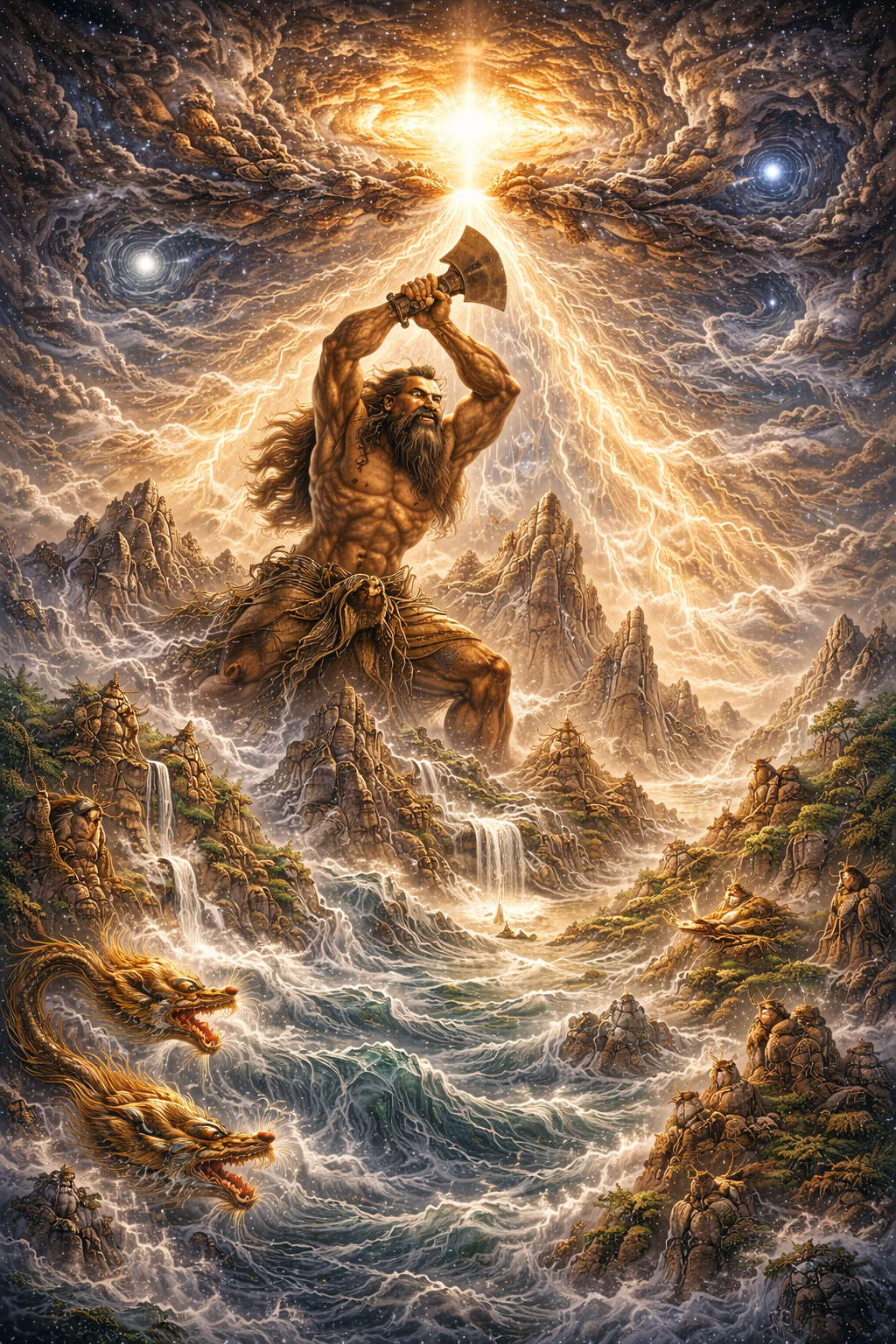
Pangu’s source history is important. He is famous today, but the myth’s textual preservation is layered, and early medieval transmission plays a major role in the form in which later readers encounter him. Xu Zheng, an Eastern Wu figure associated with early accounts of Pangu, is especially significant for the tradition. This does not make Pangu insignificant; it makes him methodologically revealing. He shows how Chinese myth can become culturally central not because it appears as the oldest single creation account, but because later textual, religious, visual, and folkloric transmission made one image of cosmic beginning especially memorable.
Read within the wider Chinese cosmogonic archive, Pangu gives vivid form to a recurring problem: how can an undifferentiated condition become a structured world? Chinese origin thought often asks how above and below become distinct, how heaven and earth are stabilized, how cosmic supports are maintained, and how a world fit for life emerges from enclosure, instability, or rupture. Pangu answers these questions through the image of a primordial body that separates, holds, grows, dies, and becomes the world.
Who Is Pangu?
Pangu is one of the great world-forming figures of Chinese myth. In the most widely circulated versions of the story, he emerges from a condition of primordial enclosure or undifferentiated chaos and brings about the separation of heaven and earth. This action is foundational because it transforms an unformed or compressed totality into an ordered world of above and below, height and depth, light and heaviness, structure and habitation.
What makes Pangu especially compelling is that he is not simply a creator in the sense of issuing commands from outside the world. He is internal to the process of world-formation. His labor, growth, and transformation are part of the making of reality itself. The cosmos is not spoken into being from a distant transcendence. It is opened, held apart, and materially constituted through embodied effort.
This gives the myth an unusually physical force. Pangu’s story imagines creation as exertion. Heaven and earth do not gently unfold by themselves; they must be separated, held, and kept from collapsing back into primal compression. The world is born through pressure, endurance, and strain. The vertical cosmos is a work of cosmic labor.
Pangu is therefore best understood as a cosmogonic figure of differentiation. He does not merely create objects within the world. He makes the very structure of a world possible. His action establishes the first great relation: heaven above, earth below, and space between them. Without that separation, there can be no weather, no terrain, no movement, no human habitation, and no intelligible order.
Pangu Within the Plurality of Chinese Cosmogony
Pangu should not be treated as the single key to all Chinese creation thought. Chinese cosmogony is plural. Some traditions emphasize primal chaos or undifferentiated unity. Others emphasize cosmic repair, as in the Nüwa sky-repair story. Others move more quickly toward flood control, culture heroes, ritual order, agriculture, marriage, or the conditions of human rule. Pangu is one major strand within this larger field.
This point matters methodologically. Modern readers often want a single founding myth that explains everything. Chinese tradition does not work that way. Pangu belongs to an important but historically layered body of creation lore. His prominence reflects the later consolidation and diffusion of a particularly vivid image of cosmogenesis: a primordial being whose act of differentiation makes the world inhabitable.
That does not make the Pangu myth secondary in meaning. It means that its significance lies in how powerfully it gathers several older and broader themes: chaos, separation, verticality, cosmic duration, bodily transformation, and the material continuity between life and landscape. Pangu gives narrative body to questions that Chinese cosmogony asks in many forms.
This also prevents a common simplification. It is misleading to say simply that “the Chinese creation myth” is Pangu. It is more accurate to say that Pangu is one of the most influential later images through which Chinese tradition imagined creation as separation and world-formation. He belongs beside, not above, other cosmogonic motifs such as hundun, Nüwa’s repair, the emergence of qi, yin-yang differentiation, and flood-control traditions.
Chaos, the Cosmic Egg, and Primal Confinement
One of the most striking elements of the Pangu tradition is the image of primal enclosure, often described through the motif of chaos or a cosmic egg. In this symbolic configuration, the world is not initially arranged into distinct domains. Heaven and earth remain compressed together, undifferentiated, awaiting separation. The image is powerful because it makes origin a matter of release, distinction, and opening rather than creation from absolute nothingness.
This motif places the Pangu story in conversation with wider Chinese reflections on hundun, or primal undifferentiation. The world begins not as a finished system but as a condition in which structure has not yet emerged. Pangu’s importance lies in making that emergence possible. He is the force through which distinction enters being.
Primary Source
天地渾沌如雞子,盤古生其中。萬八千歲,天地開闢,陽清為天,陰濁為地。Heaven and earth were chaotic like a hen’s egg, and Pangu was born within it. After eighteen thousand years, heaven and earth opened apart: the clear yang became heaven, and the turbid yin became earth.Fragment traditionally attributed to Xu Zheng, Sanwu Liji 三五歷紀.
This received fragment gives the Pangu myth its classic cosmogonic structure: primal enclosure, long duration, separation, and the differentiation of clear and turbid forces into heaven and earth.
The egg image is not only a convenient visual metaphor. It gives the myth a theory of potential. Everything exists, but not yet in ordered form. The cosmos is present as a compressed totality, but not yet articulated into relation. Pangu’s emergence breaks the closed condition and makes space possible.
The motif also helps explain why Pangu’s creation is not an absolute beginning from nothing. It is a beginning through differentiation. The world is born when what was fused becomes distinct. This is one of the deepest themes in Chinese cosmogony: order is not simply added to emptiness; it emerges from the transformation of a prior, undifferentiated condition.
The Separation of Heaven and Earth
The central act of the Pangu myth is the separation of heaven and earth. This is more than a dramatic image. It is a cosmogonic principle. A world fit for life requires differentiated levels, stable relations, and enduring vertical order. Above and below must hold. The heavy must sink and the light must rise. Structure must replace compression.
In symbolic terms, this act makes intelligibility possible. Once heaven and earth stand apart, the world can be organized spatially, temporally, and morally. The distinction between realms becomes the first great condition of cosmos. Pangu’s labor therefore represents not simply brute strength but the founding of ordered relation.
The separation of heaven and earth also makes mediation possible. Once there is above and below, there can be movement between them: winds, clouds, rain, mountains, ritual ascent, celestial observation, seasonal rhythm, and the moral imagination of heaven’s relation to human affairs. Separation is not isolation. It is the beginning of meaningful relation.
This point is important because Chinese cosmology often emphasizes relational order. Heaven and earth must be distinct, but they must also correspond. Pangu’s act does not sever the cosmos into unrelated parts. It creates the spacing that allows pattern to arise. Difference becomes the condition for harmony.
Growth, Labor, and the Vertical World
In many accounts, Pangu does not separate heaven and earth in a single instantaneous gesture and then disappear. Instead, he continues to grow as heaven rises and earth thickens, maintaining the distinction between them over immense stretches of time. This detail is cosmologically significant. Order is not achieved all at once. It must be sustained.
This gives the myth a distinctive texture of labor and duration. Pangu is not merely the inaugurator of differentiation; he is its custodian. The world’s structure is held open through endurance. In this respect, the myth suggests that creation is inseparable from maintenance. Cosmos is not only made; it is upheld.
That theme resonates strongly with the broader Chinese mythic archive, where repair, harmonization, stabilization, and alignment repeatedly matter. The making of a habitable world is a prolonged accomplishment, not just a single act of origin. Nüwa must repair the sky; Yu must control the flood; sage-kings must order human life. Pangu’s labor belongs to this wider pattern of world-making as sustained work.
The vertical world also carries moral and ritual implications. Heaven above and earth below become the framework within which human beings learn orientation. Ritual, agriculture, seasonal observance, political order, and moral imagination all depend on a stable cosmos. Pangu’s labor therefore gives later human order its first spatial condition.
The Body of Pangu and the Material Cosmos
One of the most important dimensions of the Pangu myth is the idea that the cosmos is materially related to the body of the primordial being. In later accounts, mountains, winds, waters, celestial bodies, and other features of the world are formed from Pangu’s transformed body. This makes the myth anthropocosmic: the world is not merely shaped by Pangu but becomes continuous with him.
The symbolic implications are profound. Matter itself is mythically alive. The world is not an external artifact constructed by a distant maker. It is the dispersed embodiment of primordial life. Landscape becomes body; breath becomes wind; voice becomes thunder; eyes become celestial lights; blood becomes rivers; flesh becomes earth; hair becomes vegetation. In this configuration, the cosmos is not only ordered but animated by sacrificial transformation.
Primary Source
首生盤古,垂死化身。氣成風雲,聲為雷霆,左眼為日,右眼為月,四肢五體為四極五嶽,血液為江河,筋脈為地理,肌肉為田土。First was born Pangu; as he approached death, his body transformed. His breath became wind and clouds, his voice thunder, his left eye the sun, his right eye the moon. His limbs and body became the four limits and five sacred mountains; his blood became rivers; his sinews and veins became the patterns of the earth; his flesh became fields and soil.Fragment traditionally attributed to Xu Zheng, Wuyun Linian Ji 五運歷年紀.
This received body-transformation motif gives Pangu’s myth its anthropocosmic force. The world is not merely arranged by a primordial being; it is made from his transformed body.
This also helps explain the myth’s enduring imaginative power. Pangu’s world is intimate and immense at once. The humanly legible body becomes the model through which the vastness of the cosmos is made thinkable. The myth turns landscape into anatomy and anatomy into cosmology.
The body-transformation motif also gives creation a sacrificial quality. Pangu’s death is not simple disappearance. It is conversion into world. The cosmos is the afterlife of primordial labor. Mountains, rivers, winds, and lights become traces of a body that has become too vast to remain a body.
Pangu and the Anthropocosmic Imagination
Pangu’s body-world transformation belongs to a larger pattern in mythic imagination: the human or humanoid body becomes a way to understand cosmic scale. This does not mean the cosmos is reduced to the human. It means the body provides a symbolic bridge between the intimate and the immeasurable. Breath, blood, bones, eyes, hair, voice, and limbs are familiar, but in the Pangu myth they become planetary, atmospheric, and celestial.
This anthropocosmic imagination is powerful because it makes the world relational. Human beings do not stand outside a dead environment. They inhabit a world imagined as continuous with primordial life. The terrain beneath them, the rivers around them, the winds above them, and the lights in the sky are all integrated into a living symbolic order.
The Pangu myth therefore resists a sharp separation between nature and body. It also resists a purely mechanical view of creation. The world is structured through embodiment. It is not a machine assembled from parts; it is a transformed organism whose parts continue to carry meaning.
This does not mean the myth should be read as literal natural history. Its importance lies in symbolic structure. It teaches that the cosmos is not empty space, but a meaningful order whose features can be imagined through the transformation of life into landscape. For Chinese mythic thought, this makes Pangu one of the most vivid figures of material continuity between origin and inhabited world.
Pangu and the Problem of Sources
Pangu is a crucial case for the problem of sources in Chinese mythology. He is famous, but his fame can obscure the layered nature of his transmission. The Pangu myth is not simply present in the earliest classical archive in the same way as some other mythic motifs. The tradition is closely associated with later textual preservation, especially the early medieval materials attributed to Xu Zheng. This makes Pangu an excellent example of why later sources matter in Chinese myth studies.
This does not weaken the myth’s significance. It clarifies it. Pangu is a reminder that later sources are often indispensable, not because they transparently preserve untouched antiquity, but because they record how mythic imagination developed, crystallized, and entered durable cultural memory. The source problem is thus part of the myth’s history.
It is also important to distinguish between historical priority and symbolic power. A myth need not be the oldest attested cosmogonic account in order to become culturally central. Pangu’s story became powerful because it offered a clear, memorable, and narratively satisfying image of cosmic differentiation. It converted abstract questions about heaven, earth, yin, yang, and emergence into the figure of a primordial being whose body and labor made the world.
For this reason, Pangu should be read source-critically but not dismissively. The question is not whether Pangu is the oldest Chinese creation figure. The question is what the Pangu myth does within the larger archive: how it imagines beginning, how it organizes relation, how it transforms body into cosmos, and how later tradition used it to narrate the making of a world.
Pangu, Nüwa, and Two Models of Origin
Pangu and Nüwa represent two different but complementary models of Chinese cosmogonic imagination. Pangu is associated with separation, vertical structure, and the body’s transformation into the material cosmos. Nüwa is associated with repair, stabilization, and the restoration of a broken world. Pangu opens the world; Nüwa mends it. Pangu establishes the conditions of cosmic structure; Nüwa restores those conditions when they collapse.
This comparison is important because it shows why Chinese origin myth cannot be reduced to one story. Creation can mean separation from primordial unity. It can also mean repair after catastrophe. It can mean the transformation of a body into mountains and rivers. It can also mean the reestablishment of the four limits and the stopping of floods. Origin is not a single event but a recurring set of symbolic problems.
Pangu’s myth gives the world body and structure. Nüwa’s myth gives the world rescue and restoration. Together, they suggest that a habitable cosmos must be both formed and maintained. It must be opened from chaos, but also repaired when supports fail. It must become differentiated, but also remain whole enough to sustain life.
This pairing also places masculine and feminine mythic agency in productive relation. Pangu is often imagined as the primordial divider and embodied world-source. Nüwa is the divine repairer whose action saves human life from cosmic collapse. Both are indispensable to a full account of Chinese origin thought. One gives form; the other restores livability.
Pangu, Daoist Legends, and Later Mythic Life
Pangu is often situated within Chinese Daoist or Daoist-associated legends of creation, and that association is important. It shows that Pangu did not survive only as a distant antiquarian figure. He entered religiously inflected cosmological discourse and later mythic life. Once embedded in wider Daoist or Daoist-associated traditions, the story could participate in broader reflections on primal unity, differentiation, immortality, cosmic transformation, and the relation between visible form and invisible origin.
This later life is one reason Pangu became so culturally legible. He was not confined to a narrow textual layer. He became part of the expanding mythological imagination through which Chinese communities continued to think about origin, order, and the living structure of reality. Pangu could be read as a cosmological figure, a primordial ancestor, a giant, a culture-memory figure, a temple presence, or a visual emblem of creation.
The Pangu tradition also demonstrates how mythic figures move across media. A textual fragment can become a religious image. A cosmogonic account can become a temple story. A mythic body can become an illustration. A story of separation can become a modern cultural symbol of world-making. This mobility is one of the defining features of Chinese mythic survival.
In later visual culture, Pangu is often depicted with an axe, sometimes in a wild or primitive form, standing between heaven and earth or opening the cosmos through force. These images may simplify the older textual tradition, but they also make its symbolic structure immediately visible: the world begins when closed chaos is split and vertical order appears.
Modern Afterlives of Pangu
Pangu remains visible today in children’s books, popular mythology collections, animation, fantasy art, educational materials, museum interpretation, online encyclopedias, and comparative mythology. His myth is especially adaptable because it has a clear visual grammar: chaos, awakening, separation, vertical expansion, world-body transformation. These images translate easily into modern illustration and narrative retelling.
Modern retellings often simplify the story into a universal “Chinese creation myth,” and while that can make Pangu accessible, it can also distort the broader archive. Pangu should be introduced as a major Chinese creation figure, not as the single origin of all Chinese cosmological imagination. His importance increases, rather than decreases, when he is placed beside other origin traditions.
The modern appeal of Pangu also reflects a global fascination with body-of-the-world myths. Many cultures preserve stories in which the cosmos is formed from a primordial body. Pangu belongs in that comparative field, but he should not be flattened into a generic type. His Chinese significance lies in his relation to hundun, yin-yang differentiation, heaven-earth separation, vertical order, and the later textual history that made his myth durable.
Pangu’s afterlife is therefore double. He remains a compelling mythic figure for broad audiences, but he also remains a serious source problem for scholars and careful readers. The task is to preserve both: the imaginative power of the story and the historical care needed to understand its transmission.
Why Pangu Still Matters
Pangu still matters because he condenses several of the deepest themes in Chinese cosmogony: chaos and differentiation, embodied world-formation, laborious maintenance of order, and the transformation of primal life into a habitable cosmos. He is a figure of beginning, but also of structure. He explains not only that the world exists, but why it is vertically ordered, materially continuous, and cosmically alive.
He also matters because he reveals something broader about Chinese mythology. Origin in this tradition is rarely just a question of first creation. It is a question of how relations are established, how supports are maintained, how a world fit for human life emerges from instability or enclosure, and how later traditions remember the labor of making order. Pangu embodies that transition with unusual vividness.
The myth’s body-world transformation remains especially powerful. It imagines the environment not as dead matter but as the transformed remains of primordial life. Mountains, rivers, winds, thunder, sun, moon, fields, and minerals become part of one continuous act of cosmic conversion. The world is not only made; it is inherited from a body that has become too large to remain personal.
Finally, Pangu matters because he teaches readers how to approach Chinese mythology with both imagination and caution. His myth is visually unforgettable, but historically layered. It belongs to the plural archive of Chinese cosmogony, not above it. Read well, Pangu becomes not a simplification of Chinese creation myth, but one of its most vivid expressions: chaos opened, heaven and earth separated, order sustained, and body transformed into world.
Related Reading
- Chinese Myth, Folklore & Legend
- What Is Chinese Myth, Folklore & Legend?
- The Problem of Sources in Chinese Mythology
- Chaos, Cosmos, and the Origins of the World in Chinese Myth
- The Huainanzi and the Philosophical Ordering of Myth
- Reading the Shanhaijing: Mythic Geography, Strange Beings, and Sacred Space
- Mythic Allusion and Cosmology in the Chu Ci
- From Classical Text to Folkloric Archive: How Chinese Myth Survived
- Chinese Thought
Primary Sources
- Chinese Text Project (n.d.) “Xu Zheng” 徐整. Available at: https://ctext.org/datawiki.pl?if=en&remap=gb&res=360192
- Chinese Text Project (n.d.) Taiping guangji 太平廣記. Available at: https://ctext.org/taiping-guangji
- Chinese Text Project (n.d.) Taiping guangji, “Temple of Pangu” 盤古祠. Available at: https://ctext.org/taiping-guangji/313/panguci/ens
- Chinese Text Project (n.d.) Zhuangzi: Yingdiwang 莊子:應帝王. Available at: https://ctext.org/zhuangzi/normal-course-for-rulers-and-kings
- Chinese Text Project (n.d.) Huainanzi: Chu Zhen Xun 淮南子:俶真訓. Available at: https://ctext.org/huainanzi/chu-zhen-xun/zhs
- Chinese Text Project (n.d.) Huainanzi: Lanming xun 淮南子:覽冥訓. Available at: https://ctext.org/huainanzi/lan-ming-xun/zh
Further Reading
- Birrell, A. (1993) Chinese Mythology: An Introduction. Baltimore: Johns Hopkins University Press. Available at: https://archive.org/details/chinesemythology0000birr
- Yang, L. and An, D. (2005) Handbook of Chinese Mythology. Santa Barbara: ABC-CLIO. Available at: https://archive.org/details/handbookofchines0000yang
- Chinese Text Project (n.d.) “Xu Zheng.” Available at: https://ctext.org/datawiki.pl?if=en&remap=gb&res=360192
- Chinese Text Project (n.d.) Taiping guangji, “Temple of Pangu.” Available at: https://ctext.org/taiping-guangji/313/panguci/ens
- Encyclopaedia Britannica (n.d.) “Pan Gu.” Available at: https://www.britannica.com/topic/Pan-Gu
- Encyclopaedia Britannica (n.d.) “Chinese mythology.” Available at: https://www.britannica.com/topic/Chinese-mythology
- Major, J.S., Queen, S.A., Meyer, A.S. and Roth, H.D. (2010) The Huainanzi: A Guide to the Theory and Practice of Government in Early Han China. New York: Columbia University Press. Available at: https://cup.columbia.edu/book/the-huainanzi/9780231142045
References
- Birrell, A. (1993) Chinese Mythology: An Introduction. Baltimore: Johns Hopkins University Press. Available at: https://archive.org/details/chinesemythology0000birr
- Chinese Text Project (n.d.) “Xu Zheng.” Available at: https://ctext.org/datawiki.pl?if=en&remap=gb&res=360192
- Chinese Text Project (n.d.) Taiping guangji. Available at: https://ctext.org/taiping-guangji
- Chinese Text Project (n.d.) Taiping guangji, “Temple of Pangu.” Available at: https://ctext.org/taiping-guangji/313/panguci/ens
- Chinese Text Project (n.d.) Zhuangzi: Yingdiwang. Available at: https://ctext.org/zhuangzi/normal-course-for-rulers-and-kings
- Chinese Text Project (n.d.) Huainanzi: Chu Zhen Xun. Available at: https://ctext.org/huainanzi/chu-zhen-xun/zhs
- Chinese Text Project (n.d.) Huainanzi: Lanming xun. Available at: https://ctext.org/huainanzi/lan-ming-xun/zh
- Encyclopaedia Britannica (n.d.) “Chinese mythology.” Available at: https://www.britannica.com/topic/Chinese-mythology
- Encyclopaedia Britannica (n.d.) “Pan Gu.” Available at: https://www.britannica.com/topic/Pan-Gu
- Major, J.S., Queen, S.A., Meyer, A.S. and Roth, H.D. (2010) The Huainanzi: A Guide to the Theory and Practice of Government in Early Han China. New York: Columbia University Press. Available at: https://cup.columbia.edu/book/the-huainanzi/9780231142045
- Yang, L. and An, D. (2005) Handbook of Chinese Mythology. Santa Barbara: ABC-CLIO. Available at: https://archive.org/details/handbookofchines0000yang