
Last Updated May 5, 2026
Chinese myth survived not because it was preserved intact in a single canonical epic, but because it was repeatedly transmitted, reworked, localized, ritualized, performed, visualized, and reimagined across many different cultural forms. This is one of the most important facts in the study of Chinese mythology. Early mythic materials survive in fragmentary and distributed form in classical texts, but they do not remain confined to those texts. They continue into religious traditions, local cults, temple practices, miracle tales, theatrical performance, visual culture, vernacular fiction, calendrical observance, and living forms of intangible heritage. Chinese myth therefore endured less as a closed literary canon than as a long civilizational archive.
The question, then, is not simply where Chinese myth originated, but how it lasted. The answer lies in transmission. Mythic materials moved from early textual witnesses into ritual and religion, from sacred landscapes into temple culture, from legendary antiquity into moral and political imagination, from anomaly literature into folklore, and from oral and performative traditions into socially embodied forms of remembrance. The survival of Chinese myth is therefore not a story of static preservation. It is a story of mobility, adaptation, and cultural memory.
Article Map
Chinese Myth, Folklore & Legend
Related Topic
Chinese Literature
Series context: This article is part of the Chinese Myth, Folklore & Legend knowledge series. It follows earlier articles on source problems, the Shanhaijing, the Chu ci, and the Huainanzi by asking how Chinese myth moved from classical textual fragments into religion, ritual, folklore, performance, and living cultural memory.
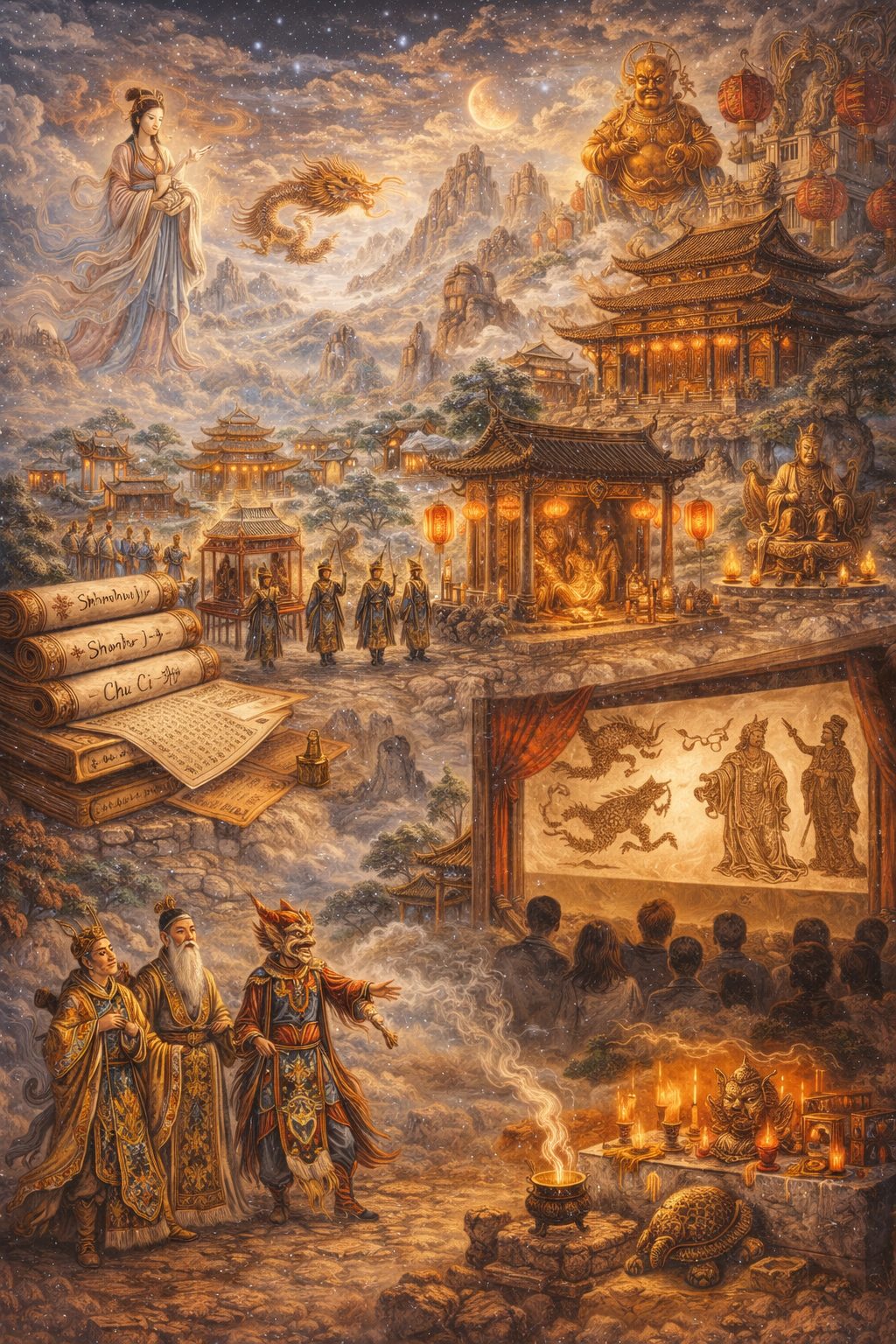
Chinese myth survived because it became more than text. It became landscape, rite, image, seasonal practice, temple devotion, dramatic performance, moral teaching, household story, and local identity. Early sources such as the Shanhaijing, Chu ci, and Huainanzi preserved mythic fragments with extraordinary force, but those fragments remained powerful because later communities continued to activate them. A mythic image could become a festival. A deity could become a temple presence. A strange being could become a tale. A sacred mountain could become a pilgrimage world. A cosmological question could become a poetic inheritance.
Why Survival Is the Central Question
The study of Chinese mythology is shaped by an unusual archival condition. Many mythic traditions around the world are approached through recognizable epic or scriptural containers. Chinese myth is different. Early mythic materials are dispersed across poetry, geography, philosophy, historical compilation, ritual memory, and religious writing, while later materials survive through performance, festival practice, vernacular storytelling, temple culture, and local tradition. For this reason, the central scholarly question is not simply “What are the myths?” but “How did they survive?”
This point changes the structure of interpretation. Chinese myth cannot be studied only by isolating early stories and treating them as fossils. It must also be studied through the mechanisms that carried symbolic materials forward: commentary, ritual, sacred art, local devotion, dramatic adaptation, festival repetition, oral transmission, and visual culture. Survival is therefore not secondary to meaning. It is part of meaning. The form in which myth survives helps determine what myth becomes.
Primary Source
遂古之初,誰傳道之?上下未形,何由考之?At the beginning of ancient time, who handed down the way? Before above and below had taken form, how could it be examined?Chu ci, “Tianwen” 天問.
The opening questions of “Tianwen” show that Chinese mythic survival often begins not with a closed doctrine of origins, but with inquiry, fragment, memory, and the difficulty of knowing the ancient beginning.
Because the archive is fragmentary, survival itself becomes evidence. The repeated appearance of certain motifs across texts, rites, festivals, and later media tells us that mythic materials were not simply forgotten remnants. They were resources repeatedly made useful for new communities, new institutions, and new historical circumstances.
From Fragmented Texts to Long Memory
Chinese mythic tradition endured through what may be called long cultural memory. The earliest sources preserve fragments, motifs, places, and figures rather than a single continuous mythology. Yet those fragments proved remarkably durable because they were adaptable. A divine figure could become a liturgical presence. A sacred mountain could become a pilgrimage site. A legendary ruler could become a moral-political exemplar. A supernatural being could move from anomaly literature into theater, decorative art, popular fiction, or regional storytelling.
Survival, in this sense, depended on flexibility. The archive remained alive because it could move. Mythic material did not need to remain identical in every setting in order to remain recognizable. It could be reframed through Daoist cosmology, Buddhist underworld narrative, local cult practice, imperial political symbolism, opera, shadow puppetry, or modern visual media. Chinese myth often endured by becoming newly legible within changing social worlds.
This helps explain why Chinese myth often appears more as a distributed symbolic ecology than as a closed body of stories. Myths survived by attaching themselves to institutions and practices: religion, lineage memory, local cults, temple economies, visual motifs, dramatic repertoires, pilgrimage landscapes, and calendrical customs. They were not preserved in spite of change. They were preserved through change.
Classical Texts as Early Containers
Classical texts were among the earliest and most important containers of Chinese mythic materials, but they were never the whole archive. The Shanhaijing preserved sacred geography, strange beings, extraordinary places, directional catalogues, divine traces, and borderland imagination. The Chu ci preserved mythic consciousness in poetic, visionary, and interrogative form. The Huainanzi philosophically ordered inherited cosmological and symbolic materials. Their very differences show that mythology in China was distributed across genres from the outset.
These texts did not fix myth once and for all. They provided durable points of reference from which later traditions could draw. Mythic survival therefore depended partly on textual memory, but those texts functioned more as seedbeds than as total archives. They preserved motifs that later religion, folklore, literature, art, and performance would continue to elaborate.
Primary Source
海內崑崙之墟,在西北,帝之下都。Within the realm, the ruins of Kunlun lie in the northwest: the lower capital of the Thearch.Shanhaijing, “Hainei xi jing” 海內西經.
Kunlun illustrates how myth survived spatially. Sacred geography became a container of memory, allowing divine presence, cosmological scale, and mythic imagination to remain attached to place.
The survival of Chinese myth through classical texts is therefore not simply a matter of written preservation. It is a matter of textual openness. Early sources preserved images, names, places, questions, and symbolic structures that later traditions could reactivate. A mountain, a goddess, a dragon, a flood, a celestial journey, or an underworld court could migrate from one medium into another because the early archive was already suggestive rather than closed.
Religion, Ritual, and the Preservation of Myth
Chinese myth survived to a large extent through religion and ritual. Daoist traditions, Buddhist adaptations, local deity cults, temple networks, underworld beliefs, spirit-medium practices, protective rites, and ritual calendars all provided settings in which mythic figures and symbolic structures remained socially active. These religious settings helped preserve myth not as detached narrative, but as enacted cosmology.
This is one reason Chinese myth cannot be separated from Chinese popular religion. Many mythic beings and legendary figures remained alive because they were worshiped, petitioned, painted, carried in procession, invoked in ritual, incorporated into moral teaching, or placed within temple communities. A mythic archive embedded in religion is harder to isolate neatly, but it is also more durable. It is sustained by use rather than by literary remembrance alone.
Daoist traditions reworked older motifs through immortals, sacred mountains, divine bureaucracies, talismans, celestial registers, paradisal geographies, and ritual technologies. Buddhist traditions reshaped underworld imagery, karmic judgment, miracle tales, and hagiographic narrative. Popular religion localized both, making divine and supernatural figures available within specific communities. Myth survived because it became part of how people asked for protection, healing, rain, fertility, justice, safe passage, and moral order.
Primary Source
往古之時,四極廢,九州裂,天不兼覆,地不周載……於是女媧煉五色石以補蒼天,斷鼇足以立四極。In ancient times, the four limits collapsed and the nine provinces split; heaven could not fully cover and earth could not fully bear. Then Nüwa smelted five-colored stones to repair the blue heaven and cut the turtle’s legs to set up the four limits.Huainanzi, “Lanming xun” 覽冥訓.
The Nüwa repair myth shows how a mythic narrative could survive as cosmology, moral order, and a model of restoring a broken world. Later traditions could remember the story not only as narrative but as symbolic repair.
Local Cults, Temples, and Sacred Geography
Local cults and temples were among the most important mediators between classical mythic materials and lived tradition. Sacred geography in China did not remain abstract. Mountains, rivers, grottoes, temples, shrines, pilgrimage sites, and coastal sanctuaries gave symbolic worlds durable local form. Sacred places became repositories of legend, divine presence, miracle memory, communal identity, and ritual obligation.
This localization made survival resilient. Even when a myth was not preserved as a canonical narrative, its figures and meanings could persist in a place-name, a shrine tradition, a temple fair, a local miracle account, a regional deity cult, or a procession. Myth survived not only in texts but in maps of devotion. A local community could preserve a figure through offerings, stories, images, and annual rites even when elite literature gave that figure little attention.
The sea-goddess Mazu offers a powerful example of how local devotion can become transregional sacred memory. Her cult is rooted in maritime danger, coastal life, protection, pilgrimage, and communal transmission. Through temple networks and ritual practice, a local holy figure could become part of a much larger mythic and religious world. This is one of the great survival pathways of Chinese myth: a story becomes a cult, a cult becomes a network, and a network becomes durable cultural memory.
Sacred geography also allowed plural traditions to coexist. Daoist mountains, Buddhist pilgrimage sites, popular temples, ancestral shrines, and local deity cults often overlapped. Mythic survival did not require one centralized institution. It depended on many communities sustaining different fragments of the symbolic world.
Folklore, Anomaly Tales, and Vernacular Transmission
Chinese myth also survived by moving into folklore, anomaly literature, and vernacular narrative. Once mythic materials entered tale traditions, they could circulate beyond elite textual settings and become part of broader social storytelling. Supernatural collections, ghost stories, transformation tales, fox-spirit narratives, local legends, miracle accounts, and strange encounters preserved symbolic structures in more flexible and accessible forms. Such materials often blurred the boundaries between myth, legend, and folklore, but that very ambiguity helped them travel.
This transition from classical text to folkloric archive is one of the most important survival mechanisms in Chinese mythology. A tradition no longer depends on being remembered as “high myth” once it becomes woven into ordinary narrative culture. When strange beings, immortals, dragons, moon figures, underworld judges, serpent women, miraculous monks, protective deities, and uncanny women enter popular stories, they become available for continual retelling, reshaping, and moral reinterpretation. The archive expands socially as it becomes less formally bounded.
Anomaly literature such as the Soushen ji is especially important because it preserves the uncanny at the level of anecdote. These stories may not look like cosmogony or high mythology, but they keep alive some of the deepest structures of mythic thought: transformation, divine intervention, revenge, haunting, karmic consequence, ritual danger, and the unstable boundary between visible and invisible worlds.
Folklore also allowed marginal and local voices to persist. Ghost women, fox spirits, wronged dead, village deities, local heroes, and regional protectors often preserve social tensions that official texts may mute. Through vernacular transmission, mythic memory could carry anxieties about gender, class, death, injustice, desire, household order, and the vulnerability of ordinary people.
Performance, Visual Culture, and Embodied Memory
Performance and visual culture were equally important to survival. Shadow puppetry, opera, storytelling, ritual drama, temple theater, balladry, popular prints, murals, sculpture, and festival display preserved myth not only as plot but as gesture, voice, costume, rhythm, color, music, and communal expectation. Performance does more than transmit a story. It teaches a community how to feel the story, when to repeat it, where to gather around it, and how to recognize its figures.
Visual culture extends the same logic. Sacred beings, paradisal landscapes, immortality motifs, dragons, phoenixes, underworld judges, celestial maidens, protective gods, and cosmological symbols became embedded in painting, temple decoration, prints, sculpture, household objects, and ritual implements. Once myth enters image, it gains another durable medium of repetition. Visual memory allows mythic forms to survive even when narrative detail shifts.
Embodied transmission matters because it resists the idea that myth is only a text to be read. A myth performed in shadow puppetry, opera, or ritual drama is not merely a representation of an older story. It is a social event. It creates memory by gathering bodies in time and space. The survival of Chinese myth is therefore inseparable from performance communities, family lineages of practice, regional repertoires, and the material arts that keep stories visible.
Modern media continue this process. Film, television, animation, comics, games, and digital fandom now carry figures such as Nezha, Sun Wukong, Chang’e, Hou Yi, White Snake, Mazu, Zhong Kui, dragons, fox spirits, and underworld judges into new imaginative worlds. These adaptations may simplify, distort, deepen, or renew inherited symbols, but they continue the older pattern: myth survives by moving into the media people actually use.
Festival Calendars and Seasonal Recurrence
Seasonal recurrence is another major mechanism of survival. Calendrical systems, festival observances, temple fairs, ghost festivals, lantern festivals, dragon-boat traditions, lunar rituals, harvest customs, New Year practices, and solar-term knowledge stabilize memory by linking narrative and symbol to repeated action. A myth tied to a date, procession, weather pattern, ritual practice, or annual celebration is much harder to lose than one preserved only in a rarely read text.
This is especially important for folklore. Festivals do not preserve myth in purely literary form. They preserve it through anticipation, repetition, embodiment, and communal participation. In such settings, myth becomes part of the social calendar. It survives because people continue to live inside its rhythms.
The Twenty-Four Solar Terms are not mythology in the narrow sense, but they illuminate the broader cultural logic through which cosmic pattern, seasonal observation, agricultural life, ritual timing, and communal practice become durable memory. Chinese mythic and folkloric traditions often survive in precisely this kind of patterned recurrence. Time itself becomes an archive.
Festival survival is also plural. A single national or widely recognized festival may contain many regional variants. Local communities may emphasize different deities, origin stories, foods, songs, processions, or ritual details. This plurality does not weaken the tradition. It is one of the ways the tradition remains alive.
Gender, Spirits, and Local Memory
Many of the most durable Chinese mythic and folkloric figures are gendered, liminal, or socially marginal. Nüwa repairs the broken cosmos. Chang’e becomes associated with the moon, loss, beauty, exile, and longing. The Weaver Girl gives celestial romance a calendrical life. Mazu becomes a maritime protector whose memory is sustained through temple networks, pilgrimage, and coastal devotion. Fox spirits and ghost women move through anomaly tales, vernacular fiction, theater, and popular imagination as figures of desire, danger, intelligence, revenge, and unresolved injustice.
These figures show that myth survives not only through state ritual, classical texts, or elite philosophy. It also survives through the emotional and social pressures that communities continue to feel. Stories of women, spirits, ghosts, and local protectors often preserve tensions around kinship, marriage, widowhood, death, social vulnerability, migration, sexuality, injustice, and the limits of patriarchal order. Mythic survival is therefore also a survival of voices and anxieties that formal histories may not center.
Local memory gives such figures a place to endure. A woman remembered as a protector, a wronged ghost attached to a site, a sea goddess honored by sailors, a fox spirit associated with literary danger, or a local deity invoked for protection can persist across generations because the community continues to need the story. Myth survives where it remains socially meaningful.
Why Chinese Myth Did Not Need a Single Canon
Modern readers often assume that survival requires canonical closure: one text, one pantheon, one authoritative structure. Chinese myth suggests otherwise. The absence of a single epic canon did not prevent survival; it encouraged diffusion. Because mythic materials were not confined to one container, they could circulate through many. They entered philosophy, poetry, shrine cults, painting, festival cycles, regional legends, dramatic traditions, religious practice, and modern media. This made the archive harder to systematize, but easier to sustain historically.
In that sense, Chinese myth survived not by resisting pluralization but by embracing it. Its archive became layered, local, overlapping, and internally diverse. What may look like fragmentation from one perspective appears, from another, as civilizational resilience. A closed canon preserves by fixing. A distributed archive preserves by moving.
This distinction matters. Chinese myth survived because it could be many things at once: literary allusion, sacred geography, temple memory, political symbolism, moral tale, family performance, festival practice, regional identity, theatrical repertoire, artistic motif, and modern cultural resource. Its durability comes from the fact that no single institution owned the whole.
Implications for Reading Chinese Mythology
The survival of Chinese myth across classical, religious, folkloric, and performative media has important interpretive consequences. First, no single source should be treated as exhaustive. Second, later sources are not merely corruptions of earlier truth; they are often the means by which older materials remained visible. Third, living and local traditions matter because they preserve symbolic functions that texts alone cannot fully explain. A myth that survives in ritual, image, or performance may tell us as much about cultural memory as a myth preserved in writing.
This is why the Chinese Myth, Folklore & Legend knowledge series must keep moving across media. To understand how Chinese myth survived, one must read the classics, but also temples, landscapes, rituals, festivals, performances, local traditions, visual culture, and modern reinventions. Chinese mythology is not only a body of old stories. It is a history of transmission.
The methodological lesson is simple but demanding: do not ask Chinese myth to behave like a single book. Read it as an archive of movement. Its stories endure because they pass through forms, places, communities, and centuries. Its survival is not accidental. It is the result of repeated cultural labor: remembering, adapting, performing, worshiping, painting, teaching, dramatizing, and retelling.
Related Reading
- Chinese Myth, Folklore & Legend
- What Is Chinese Myth, Folklore & Legend?
- The Problem of Sources in Chinese Mythology
- Reading the Shanhaijing: Mythic Geography, Strange Beings, and Sacred Space
- Mythic Allusion and Cosmology in the Chu Ci
- The Huainanzi and the Philosophical Ordering of Myth
Primary Sources
- Chinese Text Project (n.d.) Shanhaijing 山海經 / Classic of Mountains and Seas. Available at: https://ctext.org/shan-hai-jing
- Chinese Text Project (n.d.) Shanhaijing: Hainei xi jing 山海經:海內西經. Available at: https://ctext.org/shan-hai-jing/hai-nei-xi-jing/zh
- Chinese Text Project (n.d.) Chu ci 楚辭 / Songs of Chu. Available at: https://ctext.org/chu-ci
- Chinese Text Project (n.d.) Chu ci: Tianwen 楚辭:天問. Available at: https://ctext.org/chu-ci/tian-wen/zh
- Chinese Text Project (n.d.) Huainanzi 淮南子. Available at: https://ctext.org/huainanzi
- Wikisource (n.d.) Huainanzi: Lanming xun 淮南子:覽冥訓. Available at: https://zh.wikisource.org/wiki/%E6%B7%AE%E5%8D%97%E5%AD%90/%E8%A6%BD%E5%86%A5%E8%A8%93
- Chinese Text Project (n.d.) Soushen Ji 搜神記 / In Search of the Supernatural. Available at: https://ctext.org/wiki.pl?if=en&res=839038
- Chinese Text Project (n.d.) Shijing 詩經 / Book of Odes. Available at: https://ctext.org/book-of-poetry
Further Reading
- Birrell, A. (1993) Chinese Mythology: An Introduction. Baltimore: Johns Hopkins University Press. Available at: https://archive.org/details/chinesemythology0000birr
- Strassberg, R.E. (2002) A Chinese Bestiary: Strange Creatures from the Guideways Through Mountains and Seas. Berkeley: University of California Press. Available at: https://www.ucpress.edu/book/9780520298514/a-chinese-bestiary
- Yang, L. and An, D. (2005) Handbook of Chinese Mythology. Santa Barbara: ABC-CLIO. Available at: https://archive.org/details/handbookofchines0000yang
- Encyclopaedia Britannica (n.d.) “Chinese literature: Literary use of myths.” Available at: https://www.britannica.com/art/Chinese-literature/Literary-use-of-myths
- Encyclopaedia Britannica (n.d.) “Chinese mythology.” Available at: https://www.britannica.com/topic/Chinese-mythology
- The Metropolitan Museum of Art (2004) “Nature in Chinese Culture.” Available at: https://www.metmuseum.org/essays/nature-in-chinese-culture
- The Metropolitan Museum of Art (2010) “Longevity in Chinese Art.” Available at: https://www.metmuseum.org/essays/longevity-in-chinese-art
- The Metropolitan Museum of Art (2011) “Daoism and Daoist Art.” Available at: https://www.metmuseum.org/essays/daoism-and-daoist-art
- UNESCO Intangible Cultural Heritage (n.d.) “China.” Available at: https://ich.unesco.org/en/state/china-CN?info=elements-on-the-lists
- UNESCO Intangible Cultural Heritage (2011) “Chinese shadow puppetry.” Available at: https://ich.unesco.org/en/RL/chinese-shadow-puppetry-00421
- UNESCO Intangible Cultural Heritage (2016) “The Twenty-Four Solar Terms, knowledge in China of time and practices developed through observation of the sun’s annual motion.” Available at: https://ich.unesco.org/en/RL/the-twenty-four-solar-terms-knowledge-in-china-of-time-and-practices-developed-through-observation-of-the-sun-s-annual-motion-00647
References
- Chinese Text Project (n.d.) Shanhaijing. Available at: https://ctext.org/shan-hai-jing
- Chinese Text Project (n.d.) Shanhaijing: Hainei xi jing. Available at: https://ctext.org/shan-hai-jing/hai-nei-xi-jing/zh
- Chinese Text Project (n.d.) Chu ci. Available at: https://ctext.org/chu-ci
- Chinese Text Project (n.d.) Chu ci: Tianwen. Available at: https://ctext.org/chu-ci/tian-wen/zh
- Chinese Text Project (n.d.) Huainanzi. Available at: https://ctext.org/huainanzi
- Wikisource (n.d.) Huainanzi: Lanming xun. Available at: https://zh.wikisource.org/wiki/%E6%B7%AE%E5%8D%97%E5%AD%90/%E8%A6%BD%E5%86%A5%E8%A8%93
- Chinese Text Project (n.d.) Soushen Ji. Available at: https://ctext.org/wiki.pl?if=en&res=839038
- Chinese Text Project (n.d.) Shijing. Available at: https://ctext.org/book-of-poetry
- Birrell, A. (1993) Chinese Mythology: An Introduction. Baltimore: Johns Hopkins University Press. Available at: https://archive.org/details/chinesemythology0000birr
- Strassberg, R.E. (2002) A Chinese Bestiary: Strange Creatures from the Guideways Through Mountains and Seas. Berkeley: University of California Press. Available at: https://www.ucpress.edu/book/9780520298514/a-chinese-bestiary
- Yang, L. and An, D. (2005) Handbook of Chinese Mythology. Santa Barbara: ABC-CLIO. Available at: https://archive.org/details/handbookofchines0000yang
- Encyclopaedia Britannica (n.d.) “Chinese literature: Literary use of myths.” Available at: https://www.britannica.com/art/Chinese-literature/Literary-use-of-myths
- Encyclopaedia Britannica (n.d.) “Chinese mythology.” Available at: https://www.britannica.com/topic/Chinese-mythology
- The Metropolitan Museum of Art (2004) “Nature in Chinese Culture.” Available at: https://www.metmuseum.org/essays/nature-in-chinese-culture
- The Metropolitan Museum of Art (2010) “Longevity in Chinese Art.” Available at: https://www.metmuseum.org/essays/longevity-in-chinese-art
- The Metropolitan Museum of Art (2011) “Daoism and Daoist Art.” Available at: https://www.metmuseum.org/essays/daoism-and-daoist-art
- UNESCO Intangible Cultural Heritage (n.d.) “China.” Available at: https://ich.unesco.org/en/state/china-CN?info=elements-on-the-lists
- UNESCO Intangible Cultural Heritage (2011) “Chinese shadow puppetry.” Available at: https://ich.unesco.org/en/RL/chinese-shadow-puppetry-00421
- UNESCO Intangible Cultural Heritage (2016) “The Twenty-Four Solar Terms, knowledge in China of time and practices developed through observation of the sun’s annual motion.” Available at: https://ich.unesco.org/en/RL/the-twenty-four-solar-terms-knowledge-in-china-of-time-and-practices-developed-through-observation-of-the-sun-s-annual-motion-00647