
Last Updated May 11, 2026
Sustainable development is the long-run project of improving human wellbeing, reducing deprivation, expanding collective capability, and building durable institutions within the ecological limits of a finite Earth system. It asks how societies can pursue prosperity, public health, education, infrastructure, justice, resilience, and institutional legitimacy while confronting material constraints, ecological degradation, unequal vulnerability, delayed feedbacks, and the systemic risks of overshoot.
Sustainable development is not simply an environmental slogan, a policy checklist, or an SDG dashboard. It is a disciplined framework for understanding the co-evolution of human wellbeing, institutions, infrastructure, economic systems, ecological limits, public capacity, technological change, and long-run transformation. It joins questions that are too often separated: poverty and climate risk, growth and ecological constraint, public finance and social capability, infrastructure and justice, technology and governance, resilience and intergenerational responsibility.
This article map brings together the major domains through which sustainable development interprets human progress under constraint. Across poverty reduction, human capability, climate risk, biodiversity, public health, finance, governance, food systems, cities, energy systems, water systems, industrial policy, technology, measurement, scenario modeling, and resilience, sustainable development provides an indispensable language for asking whether human flourishing can be made more just, durable, adaptive, and ecologically viable.
Main Library
Publications
Article Map
Sustainable Development
Related Topic
Planetary Boundaries
Related Topic
Risk & Resilience
Related Topic
Economic Systems
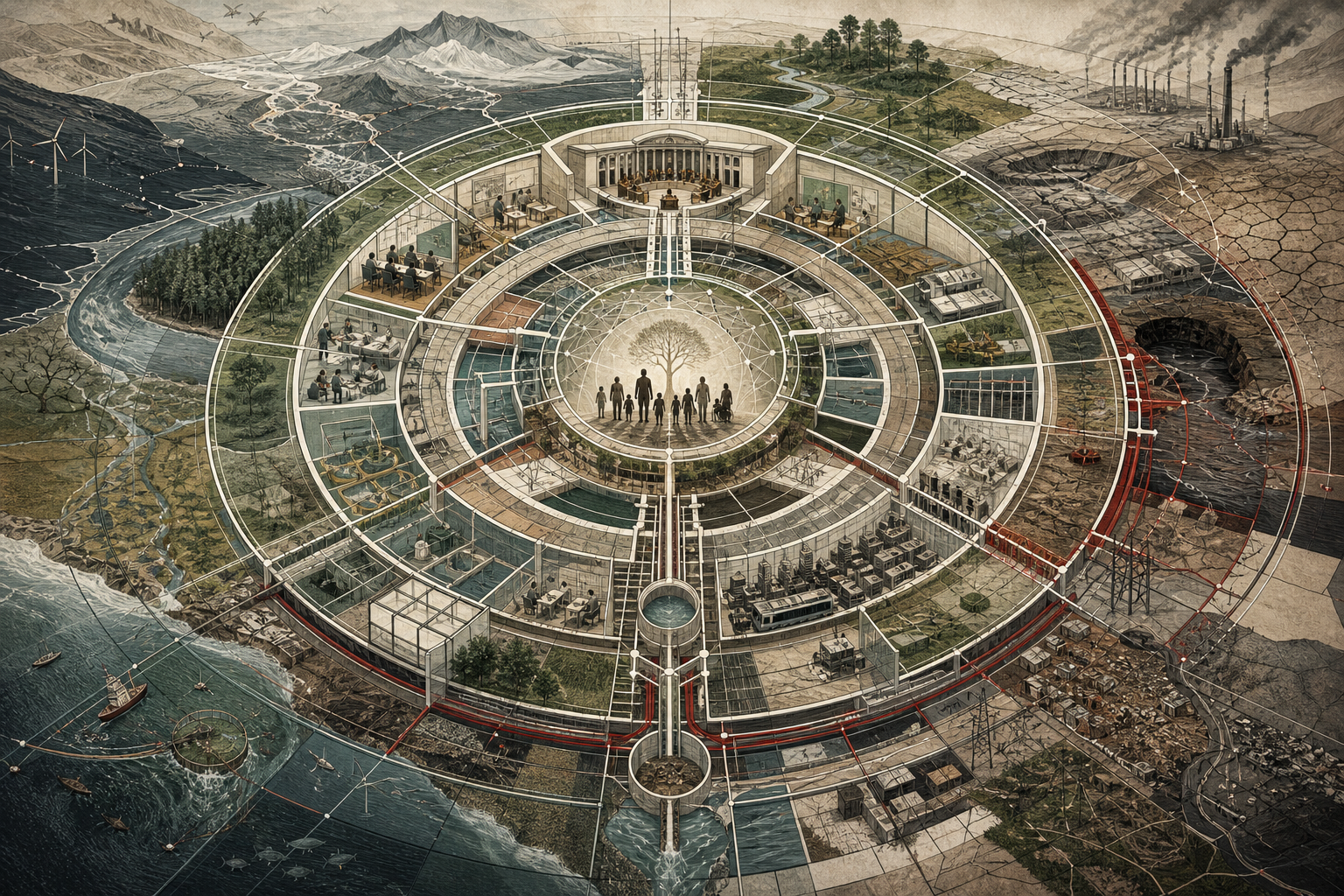
This series approaches sustainable development as a field that increasingly depends on systems modeling, quantitative indicators, computational analysis, scenario planning, resilience assessment, geospatial evidence, reproducible workflows, and open analytical code. Many of the most important sustainable development questions now require not only ethical reasoning and policy analysis, but programmable environments capable of modeling population change, poverty dynamics, infrastructure gaps, climate risk, water stress, biodiversity pressure, urban systems, finance constraints, technological transition, and deep uncertainty.
For that reason, this article map integrates sustainable development with mathematics, statistics, R, Python, Julia, C++, Fortran, C, Rust, SQL, Go, notebooks, reproducible data practices, and open scientific code. Mathematics clarifies growth, constraint, trade-offs, feedback, nonlinearity, risk, resilience, threshold behavior, and indicator construction. R supports statistics, indicators, visualization, public-data analysis, survey interpretation, development metrics, and reproducible reporting. Python supports simulation, geospatial analysis, scenario modeling, automation, data pipelines, machine learning, and decision-support workflows. Julia supports high-performance numerical modeling, differential equations, optimization, and systems simulation. C++, Fortran, C, Rust, and Go support performance-critical modeling, embedded infrastructure analytics, safe command-line tooling, numerical kernels, and reproducible computational services. SQL supports indicator databases, development metadata, policy data, infrastructure inventories, public records, scenario tables, and auditable evidence systems.
Sustainable development therefore appears here not only as a policy framework, but also as a systems, quantitative, institutional, ecological, technological, ethical, and civilizational one. The aim of the series is to preserve the moral and political seriousness of sustainable development while also showing how contemporary sustainability practice increasingly relies on measurement systems, data infrastructures, scenario analysis, computational modeling, institutional diagnostics, public finance analysis, and reproducible workflows. In that sense, sustainable development is not simply a set of goals. It is one of the deepest and most demanding ways human beings have developed for thinking about wellbeing, justice, resilience, ecological limits, and the long-run viability of civilization.
Sustainable Development Code Repository
The Sustainable Development knowledge series is supported by an open computational repository with article-level folders, reproducible examples, synthetic datasets, documentation, indicator workflows, scenario models, and full-stack analytical scaffolding across Python, R, Julia, C++, Fortran, C, Rust, SQL, Go, and notebooks where appropriate.
Sustainable Development as a Foundational Framework
Sustainable development occupies a distinctive place within contemporary social, ecological, and institutional thought because it joins questions that are too often treated separately. It asks how societies can reduce deprivation, expand human capability, build infrastructure, strengthen institutions, and improve material wellbeing while also respecting the ecological limits and Earth-system conditions that make long-run development possible. It is therefore not only an environmental framework. It is also a development framework, a justice framework, a governance framework, a resilience framework, and a systems framework.
This foundational role does not mean that sustainable development replaces economics, ecology, political science, public health, engineering, environmental science, or law. Rather, it provides an integrating architecture through which those fields can be brought into relation. Economic growth must be interpreted alongside inequality, institutional capacity, public goods, ecological stress, and intergenerational responsibility. Environmental protection must be understood alongside poverty reduction, energy access, health systems, sanitation, food security, housing, and development justice. Sustainable development gains its seriousness from refusing to isolate human flourishing from the conditions that support it.
Sustainable development also provides a bridge between diagnosis and design. It is concerned with how systems fail, but also with how they can be redesigned. It examines overshoot, pollution, fragility, poverty, exclusion, and governance failure, but it also investigates capability expansion, public investment, policy coordination, institutional legitimacy, resilient infrastructure, sustainable finance, and just transformation. It therefore occupies a powerful middle ground: analytical, ethical, institutional, ecological, technological, and practical at once.
Sustainable Development as a Science of Wellbeing, Limits, and Institutions
Sustainable development may be understood as one of the great modern frameworks for thinking about wellbeing, limits, and institutions together. It asks what development is for, what ecological conditions make development possible, and what institutional capacities are required to maintain progress over time. It recognizes that human wellbeing depends on material systems, but also that those systems depend on biophysical foundations that can be degraded, destabilized, or exceeded.
The field is shaped by two major intellectual traditions. The first is the systems tradition associated with The Limits to Growth, which highlights overshoot, delayed response, feedback loops, exponential material expansion, and the risks of ecological destabilization in finite systems. The second is the development tradition associated with human development theory and The Age of Sustainable Development, which emphasizes poverty reduction, health, education, infrastructure, institutional capacity, public goods, and global coordination. Taken together, these traditions suggest that the central challenge of sustainable development is not whether to choose growth or limits, but how to redesign development so that wellbeing, equity, and institutional legitimacy can be pursued within ecological constraint.
This makes sustainable development especially important within any wider intellectual project concerned with systems, infrastructure, ethics, technology, and long-horizon responsibility. Development is not simply an increase in output, and sustainability is not simply the reduction of environmental harm. The field asks how societies can construct durable prosperity under conditions of ecological interdependence, political conflict, uneven vulnerability, technological change, and systemic uncertainty. To study sustainable development seriously is therefore to study the conditions under which human progress can endure.
Sustainable Development as a Quantitative and Computational Field
Modern sustainable development is increasingly quantitative. Development systems are not only described through moral language or policy priorities; they are measured, modeled, compared, monitored, visualized, simulated, and evaluated using formal methods. Poverty can be measured multidimensionally. Inequality can be analyzed statistically. Climate risk can be modeled spatially. Infrastructure gaps can be mapped. Public finance constraints can be quantified. Ecological pressures can be tracked through indicators. Scenario planning can compare possible futures under different assumptions. Sustainable development therefore increasingly emerges through the combination of ethical reasoning, institutional analysis, data systems, and computational modeling.
This does not mean that sustainable development becomes a purely technocratic field. Rather, it means that serious development reasoning must move across modes of inquiry. A researcher or practitioner may interpret household surveys, model water stress, analyze urban service gaps, map climate vulnerability, evaluate SDG indicators, simulate energy transition pathways, compare fiscal constraints, document assumptions in notebooks, store metadata in SQL, and interpret the results through political economy, public administration, ecology, and justice. Sustainable development has become one of the clearest examples of a field in which values, evidence, institutions, and computation must work together.
For that reason, this series treats mathematics, statistics, computation, systems modeling, public data, geospatial analysis, scenario simulation, SQL metadata, and reproducible notebooks as increasingly important parts of sustainable development literacy. Some articles remain primarily conceptual, historical, ethical, or institutional. Others naturally require indicators, models, data workflows, simulations, uncertainty analysis, dashboards, maps, or reproducible code. The aim is not to reduce development to metrics, but to build a Sustainable Development article map that reflects how the field is actually practiced when it is taken seriously.
What Sustainable Development Studies
Sustainable development studies the conditions under which societies can improve human wellbeing over time without undermining the ecological and institutional foundations of that improvement. At the human level, it examines poverty, health, education, nutrition, gender, livelihoods, inclusion, housing, urban services, public goods, and human capability. At the institutional level, it examines governance, public administration, law, accountability, participation, state capacity, policy coordination, international organizations, and the delivery systems through which development becomes real.
At the material and infrastructural level, sustainable development studies energy, water, sanitation, transport, housing, digital infrastructure, food systems, industry, finance, technology transfer, and structural transformation. At the ecological and Earth-system level, it studies climate change, biosphere integrity, freshwater systems, land-system change, nutrient cycles, pollution, atmospheric aerosols, ocean systems, ecological thresholds, and the planetary conditions that constrain development pathways.
Sustainable development further studies time. It asks how short-term gains can generate long-term risks; how delayed feedbacks become crises; how institutions remain legitimate under stress; how development can persist across generations; and how societies can make decisions when future conditions are uncertain. It is therefore not only concerned with progress now, but with the durability, justice, and ecological viability of progress over time.
What This Pillar Covers
This article map brings together the major domains through which sustainable development interprets human flourishing under ecological and institutional constraint. It includes foundational definitions, the Brundtland legacy, the 2030 Agenda, human development theory, systems thinking, business-as-usual pathways, planetary boundaries, growth, overshoot, trade-offs, intergenerational justice, poverty, inequality, health, education, food security, urbanization, work, infrastructure, governance, law, finance, resilience, uncertainty, and future development pathways.
The map also integrates Earth-system conditions into development thought. Climate change, biosphere integrity, freshwater change, land-system transformation, nutrient cycles, pollution, ocean systems, air quality, and ecological thresholds are treated not as external environmental issues, but as boundary conditions that shape the possibility of development itself. Likewise, institutions, finance, public administration, infrastructure, and technological systems are treated not as secondary topics, but as the practical machinery through which development succeeds, fails, or becomes fragile.
The series also treats sustainable development as a field that links the conceptual and the applied. It informs public policy, international governance, sustainable finance, climate adaptation, infrastructure planning, ecological restoration, public health, urban systems, digital development, energy transitions, food systems, and long-run resilience. For that reason, the map is designed not only to introduce sustainable development concepts, but to clarify why sustainable development reasoning is indispensable for understanding the contemporary world.
Mathematics, Computation, and Systems Modeling in Sustainable Development
Mathematics provides part of the formal language through which sustainable development understands growth, constraint, risk, trade-off, and transformation. Rates of population change, poverty reduction, emissions growth, resource use, infrastructure expansion, and ecological pressure can all be clarified through quantitative reasoning. Systems modeling helps identify feedback loops, delays, thresholds, nonlinear change, overshoot, resilience, and policy resistance. Statistics supports indicator construction, uncertainty analysis, survey interpretation, causal inference, and evaluation. Optimization, decision analysis, scenario modeling, and simulation help clarify difficult trade-offs under constraint.
Computation is especially valuable where sustainable development systems become too complex for direct intuition alone. R supports development indicators, statistical modeling, public data analysis, visualization, survey analysis, and reproducible reporting. Python supports simulation, geospatial analysis, data pipelines, machine learning, scenario modeling, automation, and interactive analytical workflows. Julia supports high-performance systems modeling, optimization, differential equations, and large-scale simulation. SQL supports structured development data, indicator databases, metadata, scenario assumptions, infrastructure inventories, governance records, and reproducible provenance. C++, Fortran, C, Rust, and Go support performance-critical simulation, embedded monitoring, resilient tooling, command-line workflows, numerical kernels, and public-interest data infrastructure.
Used together, mathematics, computation, indicators, notebooks, SQL metadata, and open code repositories help make sustainable development more explicit, testable, reproducible, and accountable. They allow trade-offs to be examined rather than hidden, uncertainty to be represented rather than ignored, and complex development pathways to be explored under transparent assumptions. In this series, those tools are integrated where they deepen explanation rather than distract from institutional, ethical, and ecological reasoning.
Major Domains of Sustainable Development
Sustainable development includes a wide range of major domains, each of which illuminates a different dimension of long-run human flourishing. Human development studies poverty, health, education, nutrition, inclusion, livelihoods, dignity, and the expansion of substantive capabilities. Ecological sustainability studies climate stability, biodiversity, water systems, land use, pollution, nutrient flows, ecosystem function, and the Earth-system conditions that make human systems viable. Governance studies institutions, public administration, law, participation, accountability, coordination, and the capacity to deliver public goods.
Infrastructure and structural transformation study the material systems through which societies organize energy, water, sanitation, transport, housing, digital connectivity, industry, food systems, and public services. Sustainable finance studies investment, fiscal space, debt, risk, capital allocation, climate finance, development banking, and the financing of long-term transformation. Resilience and uncertainty studies shocks, fragility, scenario planning, adaptive governance, disaster risk, climate vulnerability, and the ability of systems to absorb disturbance without collapse.
Many of these domains are now inseparable from quantitative and computational methods. Development indicators depend on statistical systems. Climate adaptation depends on models, maps, and risk assessment. Infrastructure planning depends on spatial data and scenario analysis. Sustainable finance depends on metrics, disclosures, risk models, and investment pathways. Governance increasingly depends on administrative data, monitoring systems, and digital infrastructure. Sustainable development therefore continues to broaden not only in moral and political scope, but also in formal and technical depth.
Why Sustainable Development Matters
Sustainable development matters because the central problems of the contemporary world are no longer separable. Poverty reduction cannot be isolated from climate risk. Food security cannot be isolated from water systems, land use, biodiversity, and nutrient cycles. Infrastructure cannot be isolated from public finance, institutions, emissions, and social inclusion. Economic growth cannot be isolated from ecological limits, inequality, public legitimacy, and long-run resilience. Sustainable development matters because it offers a framework for thinking across these interdependencies rather than pretending they can be solved one at a time.
Sustainable development also matters because human societies have gained the power to alter planetary systems while still failing to secure basic welfare for billions of people. This creates a double imperative: to reduce deprivation and expand capability, while also transforming the material, institutional, and ecological systems that shape future possibility. A field that ignores poverty is morally inadequate. A field that ignores limits is materially unrealistic. Sustainable development matters because it refuses both forms of failure.
Finally, sustainable development matters because it disciplines hope. It does not assume that good intentions automatically produce good outcomes. It asks how institutions function, how systems respond, how trade-offs are managed, how vulnerable communities are protected, how futures are measured, and how societies can build prosperity that remains viable under stress. It is therefore one of the most important frameworks for thinking about responsible growth, public purpose, and long-run civilizational survival.
Sustainable Development and Human Self-Understanding
Sustainable development changes how human beings understand themselves because it places human progress within a larger web of ecological dependence, institutional fragility, and intergenerational responsibility. It challenges the idea that development is simply a linear movement toward greater output, consumption, or technological sophistication. It asks whether progress remains progress if it destroys the foundations of future wellbeing or leaves large populations excluded from its benefits.
Yet sustainable development also complicates simple narratives of restraint. It recognizes that billions of people still need better housing, sanitation, energy access, healthcare, education, infrastructure, nutrition, safety, and economic opportunity. The problem is not development itself, but development pathways that generate exclusion, ecological degradation, and systemic fragility. Sustainable development therefore asks human beings to understand themselves as builders of institutions, users of energy, members of ecosystems, inheritors of unequal histories, and trustees of futures they will not personally inhabit.
For that reason, sustainable development has philosophical as well as practical significance. It raises enduring questions about justice, stewardship, growth, freedom, responsibility, progress, risk, and the meaning of prosperity. It asks what societies owe to the poor, to future generations, to nonhuman life, and to the stability of the Earth systems that make civilization possible. A serious Sustainable Development article map should therefore not end with policy instruments alone. It should also clarify the wider implications of development for ethics, governance, and human self-understanding.
Sustainable Development Pillar Map
The map below organizes the Sustainable Development knowledge series into conceptual domains, moving from foundations and first principles toward human capability, ecological limits, governance, infrastructure, finance, resilience, uncertainty, measurement, and long-run transformation.
The Sustainable Development article map is organized to move from foundations and definitions into human wellbeing, ecological limits, institutions, infrastructure, finance, measurement, resilience, uncertainty, and future pathways. Mathematics, R, Python, Julia, C++, Fortran, C, Rust, SQL, Go, and computational notebooks are integrated within the series where they deepen understanding, especially in areas such as development indicators, poverty measurement, planetary boundaries, climate risk, infrastructure planning, resilience analysis, scenario modeling, public finance, geospatial development data, and reproducible governance workflows. The goal is a map that remains clearly and fully grounded in sustainable development while also reflecting the quantitative, computational, institutional, and systems depth of contemporary practice.
Foundations of Sustainable Development
- What Is Sustainable Development? Meaning, Systems, and Long-Run Viability — An opening article defining sustainable development as the effort to improve human wellbeing, reduce deprivation, expand capability, and build durable institutions within ecological limits. This piece clarifies the identity of the field and explains why development can no longer be evaluated by output growth alone.
- The Four Dimensions of Sustainable Development — A framework article on the economic, social, environmental, and institutional dimensions of sustainable development. This piece shows why durable development requires coordination across multiple forms of value, capacity, and constraint.
- The Brundtland Definition and Its Legacy — A focused article on the Brundtland formulation of sustainable development and its enduring influence. This piece examines needs, future generations, ecological limits, institutional responsibility, and the strengths and ambiguities of one of the field’s defining concepts.
- From Economic Growth to Human Development — An article on the shift from GDP-centered development to human development, capability expansion, health, education, dignity, and substantive freedom. This piece connects economic progress to the wider question of what development is actually for.
- The 2030 Agenda and the Logic of the SDGs — A study of the Sustainable Development Goals as a global framework for coordinating development priorities. This article examines the SDGs’ strengths, tensions, measurement challenges, political uses, and role in connecting social, economic, and ecological objectives.
- Sustainable Development as a Systems Problem — A major article on interdependence, feedback loops, delays, trade-offs, synergies, path dependence, and policy resistance. This piece explains why sustainable development requires systems thinking rather than isolated intervention.
- Business as Usual vs Sustainable Development — An article comparing conventional development pathways with transformative approaches. It examines why short-term growth, material throughput, institutional inertia, and ecological pressure can generate long-run fragility if development systems are not redesigned.
- Anthropocene and Planetary Boundaries — A bridge article connecting sustainable development to the Anthropocene, Earth-system change, planetary boundaries, and the realization that human activity has become a geological and ecological force.
- Beyond GDP Development: Measuring Prosperity as a Systems Outcome — An article on the limits of GDP as a measure of progress and the need for richer indicators of wellbeing, distribution, resilience, ecological pressure, public goods, and social capability.
- Growth, Limits, and the Problem of Overshoot — A systems article on exponential growth, resource use, delayed feedbacks, ecological thresholds, and the risk that development systems can exceed the conditions that support them.
- Trade-Offs, Synergies, and Policy Coherence — An article on how sustainable development goals interact, conflict, reinforce, or undermine one another. This piece examines why serious sustainability work requires coordination, sequencing, prioritization, and institutional learning.
- Intergenerational Justice and Long-Term Stewardship — A philosophical and policy article on what present societies owe to future generations. It examines stewardship, ecological inheritance, fiscal responsibility, infrastructure, climate risk, and the ethics of long-run development.
- Safe Operating Space and the Conditions of Long-Run Development — An article on the ecological and institutional conditions within which development can remain viable. This piece connects planetary boundaries, resilience, human development, and systems transformation.
- Strong Sustainability, Weak Sustainability, and Substitution (Planned) — A conceptual article on whether natural capital can be substituted by human-made capital, and why this debate matters for ecological limits, development strategy, intergenerational justice, and long-run human wellbeing.
- Ecological Economics and Sustainable Development (Planned) — A bridge article connecting sustainable development to ecological economics, biophysical limits, material throughput, steady-state thinking, natural capital, and the critique of growth-centered economic systems.
- Doughnut Economics and the Social Foundation (Planned) — A focused article on the doughnut framework, connecting planetary boundaries, social minimums, distributive justice, ecological ceilings, and development pathways that remain within a safe and just operating space.
- Colonialism, Extraction, and Unequal Development (Planned) — A historically grounded article on colonial extraction, dependency, unequal exchange, resource frontiers, debt, trade, racial capitalism, and the uneven global geography of development opportunity.
- Sustainable Consumption, Sufficiency, and Demand Reduction (Planned) — An article on consumption systems, sufficiency, demand-side mitigation, lifestyle politics, advertising, social norms, material footprints, and the limits of sustainability strategies focused only on production efficiency.
- Culture, Religion, Values, and Sustainable Development (Planned) — A humanities-and-social-systems article on how moral traditions, cultural narratives, religious ethics, civic values, and collective meaning shape sustainability transitions, ecological responsibility, and public legitimacy.
Human Wellbeing, Capability, and Inclusion
- Poverty, Deprivation, and Multidimensional Development — An article on poverty as more than income deprivation, including health, education, housing, sanitation, nutrition, safety, empowerment, and access to public goods. This piece explains why sustainable development must be grounded in lived human conditions.
- Geography of Global Poverty — A spatial article on where poverty is concentrated, how geography shapes development opportunity, and why climate, infrastructure, conflict, institutions, and historical inequality affect development pathways.
- Population Growth and the Global Economy — An article on demographic change, fertility, age structure, labor markets, urbanization, dependency ratios, resource demand, and the relationship between population dynamics and development systems.
- Health, Education, and Human Capability Expansion — A human development article on how health and education expand life chances, productivity, civic participation, resilience, and substantive freedom. This piece connects public goods to long-run development capacity.
- Education Systems, Skills, and Sustainable Development (Planned) — A dedicated article on schooling, literacy, technical education, universities, vocational systems, civic capability, digital skills, lifelong learning, and the role of education in expanding agency under changing social and ecological conditions.
- Universities, Research Capacity, and Development Transformation (Planned) — An article on higher education, scientific capacity, public-interest research, local knowledge production, technical training, policy institutes, and the institutional ecosystems that support long-run development capability.
- Public Health Systems, Disease Risk, and Development Resilience (Planned) — A dedicated article on public health systems, pandemics, vaccination, disease ecology, health surveillance, sanitation, climate-health risks, and the institutional capacities required to protect development gains.
- Heat, Labor, Health, and Urban Resilience (Planned) — An article on extreme heat, occupational exposure, public health, cooling access, housing quality, energy poverty, urban form, labor productivity, and the unequal burden of climate stress.
- Economic Growth & Human Progress — An article on the relationship between productivity, income, employment, poverty reduction, public investment, and human welfare. It examines both the developmental importance and the limits of growth-centered frameworks.
- Inequality and Inclusive Development — A treatment of income, wealth, spatial, gender, racial, and institutional inequality as development constraints. This article shows why aggregate progress can conceal exclusion, fragility, and unequal exposure to risk.
- Gender, Exclusion, and Development Justice — An article on gender inequality, social exclusion, care work, rights, representation, education, health, labor markets, safety, and the institutional barriers that prevent development gains from being equitably shared.
- Care Work, Time Poverty, and the Reproductive Economy (Planned) — A gender and political-economy article on unpaid care, social reproduction, childcare, elder care, time use, labor markets, public services, and why development depends on often-invisible care systems.
- Food Security, Nutrition, and Human Development — An article on hunger, nutrition, agriculture, supply chains, affordability, climate stress, food systems, health, and the role of secure nourishment in human development.
- Urbanization, Housing, and Basic Services — A study of cities, housing, sanitation, transport, informal settlements, public services, density, spatial inequality, and the urban foundations of sustainable development.
- Work, Livelihoods, and Decent Employment — An article on labor markets, informal work, wages, livelihoods, social protection, industrial transformation, dignity, and the role of decent employment in development pathways.
- Social Protection, Welfare Systems, and Development Resilience (Planned) — A major article on cash transfers, unemployment protection, pensions, food assistance, health coverage, shock-responsive welfare, and the role of social protection in preventing development reversal.
- Migration, Displacement, and Sustainable Development (Planned) — An article on climate displacement, labor migration, refugees, urban absorption, remittances, borders, rights, and the development consequences of forced and voluntary mobility.
- Disability, Accessibility, and Inclusive Development (Planned) — A justice-centered article on disability inclusion, accessible infrastructure, public services, education, labor markets, data gaps, and the limits of aggregate development measures.
- Indigenous Peoples, Land, and Ecological Knowledge (Planned) — An article on indigenous rights, land defense, ecological stewardship, biodiversity protection, extractive pressure, and the importance of traditional ecological knowledge in sustainability governance.
- Race, Caste, Ethnicity, and Unequal Development Pathways (Planned) — An article on historically produced inequality, racialized and caste-based exclusion, land and labor regimes, institutional discrimination, spatial segregation, and the ways unequal power structures shape development opportunity.
- Behavioral Change, Social Norms, and Sustainability Transitions (Planned) — An article on household behavior, collective norms, social learning, institutional incentives, consumption shifts, public communication, and why individual change must be understood within structural conditions.
- Human Development Indicators and Their Limits — A methodological article on the Human Development Index, multidimensional indicators, inequality adjustment, measurement gaps, dashboard logic, and the limits of quantifying human progress.
Earth-System Conditions, Ecological Limits, and Boundary Pressures
- Planetary Boundaries and Sustainable Development — A major article connecting development to climate, biosphere integrity, freshwater, land systems, nutrient cycles, pollution, and the safe operating space for humanity.
- Climate Change as a Development Constraint — An article on climate change as a direct constraint on health, infrastructure, agriculture, water, cities, finance, migration, public administration, and long-run development viability.
- Biosphere Integrity and Human Development — A treatment of biodiversity, ecosystem function, extinction risk, ecological resilience, livelihoods, agriculture, public health, and why human development depends on living systems.
- Freshwater Change and Development Risk — An article on water scarcity, groundwater depletion, river systems, sanitation, agriculture, ecosystems, urban resilience, and the development risks created by freshwater stress.
- Land-System Change and Development Pathways — A study of deforestation, agriculture, urban expansion, habitat conversion, land tenure, food systems, carbon storage, and the development consequences of land transformation.
- Nutrient Cycles, Agriculture, and Ecological Stress — An article on nitrogen, phosphorus, fertilizer use, eutrophication, soil fertility, agricultural productivity, water pollution, and the ecological costs of food-system intensification.
- Pollution, Novel Entities, and Long-Run Development — A treatment of chemical pollution, plastics, toxic substances, persistent compounds, industrial waste, public health, regulation, and the long-run development risks of novel entities.
- Ocean Systems, Acidification, and Coastal Development — An article on marine systems, ocean acidification, fisheries, coastal economies, sea-level rise, coral reefs, blue economies, and the dependence of human development on ocean health.
- Atmospheric Aerosols, Air Quality, and Public Health — A study of particulate pollution, aerosols, health risk, urban air quality, climate forcing, environmental justice, monitoring, and the development burden of polluted air.
- Ecological Thresholds, Nonlinearity, and Systemic Risk — A systems article on tipping points, regime shifts, nonlinear ecological change, delayed feedback, resilience loss, and why sustainability requires attention to threshold behavior.
- Circular Economy, Material Flows, and Sustainable Production (Planned) — A major article on material throughput, recycling, repair, industrial ecology, waste systems, product lifecycles, resource efficiency, and the limits of linear production models.
- Waste Systems, Sanitation, and Pollution Governance (Planned) — A practical article on solid waste, hazardous waste, informal waste work, landfill systems, recycling, wastewater, public health, municipal capacity, and environmental regulation.
- Ecological Restoration and Regenerative Development (Planned) — An article on restoration ecology, reforestation, wetlands, soil recovery, watershed restoration, biodiversity repair, and the limits of mitigation without ecosystem regeneration.
- Environmental Justice and Unequal Exposure in Sustainable Development (Planned) — An article on pollution burdens, climate exposure, environmental racism, sacrifice zones, procedural justice, community monitoring, and the unequal geography of environmental harm.
- Climate Adaptation, Maladaptation, and Resilient Development (Planned) — An article on adaptation planning, maladaptation risk, infrastructure lock-in, local vulnerability, ecosystem-based adaptation, climate services, and the challenge of building resilience without reproducing inequality.
- Disaster Risk Reduction and Sustainable Development (Planned) — An article on hazards, vulnerability, exposure, preparedness, emergency management, resilient infrastructure, recovery systems, and the connection between development quality and disaster risk.
Institutions, Governance, and Public Capacity
- Why Institutions Matter for Sustainable Development — An article on the central role of institutions in shaping public goods, trust, policy implementation, accountability, resilience, investment, and long-run development outcomes.
- State Capacity, Public Administration, and Delivery Systems — A treatment of public administration, bureaucratic capability, service delivery, taxation, regulation, coordination, and the state capacity required to turn development goals into lived reality.
- Local Governance, Cities, and Territorial Development — An article on municipal capacity, territorial inequality, cities, regions, local planning, public services, and the governance systems that shape development close to everyday life.
- International Organizations and Global Development Governance — A study of the UN system, development banks, global coordination, multilateral institutions, policy frameworks, financing mechanisms, and the politics of international development governance.
- Law, Rights, and Sustainable Development — An article on legal systems, rights, environmental law, land tenure, social protection, accountability, procedural justice, and the role of law in making sustainable development enforceable and legitimate.
- Corruption, Accountability, and Institutional Trust — A treatment of corruption, transparency, procurement, public finance, institutional trust, governance failure, and the ways accountability affects development outcomes.
- Participation, Voice, and Community-Led Development — An article on democratic participation, community knowledge, local agency, consultation, co-production, social movements, and the importance of voice in development legitimacy.
- Policy Coordination Across Complex Systems — A systems-governance article on coordination failure, siloed ministries, cross-sector planning, trade-offs, policy coherence, adaptive governance, and institutional learning.
- Taxation, Domestic Resource Mobilization, and Development Capacity (Planned) — A major governance-finance article on taxation, revenue systems, fiscal legitimacy, illicit financial flows, public goods, state capacity, and the domestic resource base of development.
- Regulation, Standards, and Public Interest Governance (Planned) — An article on regulatory capacity, safety standards, environmental enforcement, labor protections, procurement standards, public utilities, and the state’s role in shaping markets for public purpose.
- Democracy, Legitimacy, and the Social Contract in Sustainable Development (Planned) — A governance article on trust, representation, civic legitimacy, social contracts, public consent, democratic accountability, institutional legitimacy, and why development cannot be sustained through capacity alone.
- Conflict, Peacebuilding, and Sustainable Development (Planned) — A dedicated article on violence, conflict prevention, peacebuilding, SDG 16, institutional repair, displacement, trauma, reconstruction, and development in fragile contexts.
- Corporate Accountability, ESG, and the Limits of Voluntary Sustainability (Planned) — An article on corporate sustainability claims, ESG disclosure, supply-chain accountability, greenwashing, regulation, fiduciary duty, public-interest standards, and the limits of voluntary governance.
- Data Justice, Statistical Capacity, and Development Visibility (Planned) — An article on who is counted, who remains invisible, how statistical systems shape policy, and why development measurement requires public capacity, rights protections, and accountable data governance.
- Open Data, Public Evidence, and Development Accountability (Planned) — An article on open government data, public dashboards, reproducible evidence, administrative transparency, civic monitoring, and the institutional conditions that make development claims reviewable.
Infrastructure, Finance, and Structural Transformation
- Infrastructure as the Material Basis of Development — A major article on infrastructure as the physical foundation of development, including energy, water, sanitation, transport, housing, communications, public services, resilience, and spatial inclusion.
- Energy Systems, Energy Access, and Sustainable Development (Planned) — A core article on energy access, electricity systems, clean cooking, renewables, fossil dependence, grid reliability, affordability, energy poverty, and the role of energy in development capability.
- Energy Transition, Decarbonization, and Development Justice (Planned) — A companion article focused on transition pathways, just transition, workers, regions, public finance, fossil fuel phaseout, electrification, affordability, and unequal burdens of decarbonization.
- Transport, Mobility, and Spatial Inclusion — An article on transport systems, mobility, access, emissions, urban form, rural connectivity, logistics, public transit, and the role of movement in economic and social inclusion.
- Water, Sanitation, and Public Infrastructure Systems — A study of drinking water, sanitation, wastewater, public health, infrastructure maintenance, governance, service delivery, and the foundational role of water systems in development.
- Food Systems and Agricultural Transformation (Planned) — An article on agriculture, supply chains, agroecology, smallholders, input systems, climate risk, food prices, soil, biodiversity, rural livelihoods, nutrition, and the political economy of food-system change.
- Rural Development, Smallholders, and Territorial Inequality (Planned) — An article on rural livelihoods, smallholder agriculture, infrastructure gaps, rural finance, migration, land rights, territorial inequality, and the uneven geography of development opportunity.
- Land Tenure, Agrarian Reform, and Development Justice (Planned) — An article on land ownership, customary rights, agrarian reform, land concentration, displacement, rural livelihoods, conservation conflict, and the institutional foundations of just development.
- Housing, Buildings, and the Built Environment (Planned) — A built-environment article on building codes, embodied carbon, heat resilience, housing quality, retrofits, informal settlements, construction materials, and spatially just urban development.
- Digital Infrastructure and Development Capacity — An article on broadband, data systems, digital public infrastructure, platforms, identity systems, service delivery, inclusion, and the governance challenges of digital development.
- Energy-Efficient Embedded Systems for Sustainable Digital Infrastructure — An engineering-oriented article on embedded systems, energy efficiency, edge computing, monitoring, digital infrastructure, and the technical foundations of sustainable computing systems.
- FPGA Environmental Monitoring: Reconfigurable Edge Hardware for Smart Agriculture — A technical article on FPGA-based environmental monitoring, agricultural sensing, edge analytics, reconfigurable hardware, data acquisition, and infrastructure for climate-smart agriculture.
- Industrial Policy and Sustainable Structural Transformation — An article on industrial upgrading, production systems, green manufacturing, technology capability, public investment, trade, jobs, and the political economy of structural transformation.
- Trade, Global Value Chains, and Sustainable Development (Planned) — An article on trade regimes, supply chains, labor standards, carbon leakage, industrial upgrading, market access, dependency, logistics, and the sustainability consequences of global production networks.
- Critical Minerals, Supply Chains, and the Green Transition (Planned) — An article on lithium, cobalt, copper, rare earths, mining, labor, land rights, geopolitical dependency, industrial strategy, and the material basis of energy transition.
- Sustainable Finance and Development Investment — A treatment of climate finance, development finance, green bonds, blended finance, public investment, private capital, risk, and the financing of sustainable transformation.
- Adaptation Finance, Loss and Damage, and Climate Justice (Planned) — A finance-and-justice article on adaptation gaps, loss and damage, climate reparations, vulnerable states, insurance limits, debt, and the politics of who pays for climate impacts.
- Debt, Fiscal Space, and Development Constraints — An article on sovereign debt, fiscal limits, public investment, austerity, development finance, debt distress, and the constraints that shape what states can realistically deliver.
- Innovation, Technology Transfer, and Leapfrogging — A study of innovation systems, technological diffusion, knowledge transfer, industrial capability, leapfrogging, intellectual property, and the role of technology in development pathways.
Measurement, Resilience, and Future Pathways
- How Sustainable Development Is Measured — A methodological article on indicators, dashboards, composite indexes, data systems, targets, baselines, uncertainty, and the difficulty of measuring progress across social, economic, institutional, and ecological domains.
- SDG Indicators: Strengths, Gaps, and Political Uses — A focused article on the SDG indicator framework, its strengths, limitations, data gaps, political uses, comparability problems, and role in global development governance.
- Geospatial Data, Remote Sensing, and Development Intelligence (Planned) — A methodological article on satellites, GIS, land monitoring, urban mapping, climate exposure, poverty mapping, environmental monitoring, and the politics of spatial development data.
- Monitoring, Evaluation, Learning, and Adaptive Development Practice (Planned) — A practical article on MEL systems, feedback loops, implementation learning, adaptive management, theory of change, program revision, and why development practice needs learning mechanisms.
- Impact Evaluation, Causal Inference, and Development Evidence (Planned) — An article on randomized trials, quasi-experimental methods, observational data, causal claims, evidence hierarchies, implementation context, and the limits of technocratic evaluation.
- Boundary Transgression and Development Fragility — An article on how crossing ecological thresholds can destabilize development systems, increase vulnerability, undermine public goods, and intensify institutional fragility.
- Resilience Thinking and Sustainable Development — A systems article on resilience, adaptive capacity, disturbance, transformation, robustness, vulnerability, social-ecological systems, and the capacity of development systems to absorb shocks.
- Risk, Shock, and Fragility in Development Systems — A treatment of disasters, conflict, disease outbreaks, financial shocks, climate stress, supply disruptions, institutional fragility, and the compounding risks that can reverse development gains.
- Early Warning Systems and Anticipatory Governance (Planned) — A bridge article between risk, resilience, climate adaptation, data systems, public preparedness, early warning, anticipatory action, and institutional capacity before crisis.
- Scenario Planning for Sustainable Futures — An article on scenario analysis, foresight, uncertainty, pathways, assumptions, stress testing, and the use of structured imagination to guide development planning.
- Development Under Deep Uncertainty — A methodological article on decision-making when probabilities, models, futures, and institutional conditions are uncertain. This piece examines robust decision-making, adaptive pathways, resilience, and governance under ambiguity.
- Geopolitics, Resource Security, and Sustainable Development (Planned) — An article on resource competition, energy security, food security, minerals, industrial strategy, sanctions, supply-chain vulnerability, geopolitical inequality, and the sustainability consequences of strategic rivalry.
- Water Conflict, Hydro-politics, and Regional Development Risk (Planned) — An article on shared rivers, groundwater stress, dams, irrigation, treaty regimes, regional power, climate variability, and the governance of water systems across borders.
- AI, Data Systems, and the Future of Development Governance — An article on artificial intelligence, administrative data, digital public infrastructure, predictive analytics, surveillance risk, accountability, bias, and the role of data systems in future governance.
- Future Directions in Sustainable Development Thought — A capstone-style article on where the field is moving, including planetary boundaries, resilience, deep uncertainty, institutional legitimacy, digital governance, ecological economics, and long-run civilizational transformation.
Measurement, Indicators, and Development Practice
One of sustainable development’s enduring contributions is its insistence that progress must be measured more carefully than conventional growth metrics allow. Development knowledge depends on indicators, surveys, administrative records, environmental monitoring, geospatial data, fiscal records, health statistics, education data, infrastructure inventories, poverty measures, inequality metrics, and ecological indicators. The authority of sustainable development therefore rests not only on moral aspiration, but on the practical ability to observe, compare, evaluate, and revise development pathways.
This matters far beyond reporting. Measurement systems shape what governments prioritize, what funders support, what institutions monitor, and what societies recognize as progress or failure. If progress is measured only through GDP, then ecological degradation, unpaid care work, inequality, institutional fragility, and long-run risk may remain hidden. If sustainability is measured only through environmental indicators, then poverty, exclusion, health, education, and social capability may be obscured. Sustainable development measurement must therefore be multidimensional, institutionally honest, and attentive to trade-offs.
Modern development practice also makes clear that measurement is never neutral. Indicators define categories. Data systems include some people and exclude others. Targets can motivate action, but they can also distort incentives. Dashboards can clarify complexity, but they can also oversimplify it. A rigorous sustainable development practice therefore treats indicators as tools for inquiry and accountability, not as substitutes for judgment.
Sustainable Development, Technology, and the Modern World
Sustainable development is inseparable from technology because modern wellbeing depends on infrastructures, tools, systems, and networks that organize daily life. Energy grids, water systems, sanitation networks, roads, ports, railways, hospitals, schools, digital platforms, sensors, satellites, agricultural technologies, financial systems, and public data infrastructures all shape the possibility of development. Technology is not external to sustainable development. It is one of the ways development becomes material.
The connection between sustainable development and technology is especially visible in energy transitions, digital public infrastructure, climate adaptation, environmental monitoring, precision agriculture, public health surveillance, remote sensing, data systems, and resilient infrastructure. Digital tools can improve service delivery, transparency, coordination, and evidence-based planning. Sensor systems can monitor water quality, air pollution, soil conditions, energy use, and infrastructure performance. Machine learning and geospatial analytics can help identify vulnerability, but they can also reproduce bias, deepen surveillance, or create dependence on opaque systems.
For that reason, sustainable development requires a careful account of technological power. The question is not whether technology matters, but which technologies are deployed, under whose governance, with what distribution of benefits and risks, and within what ecological constraints. A mature sustainable development framework must therefore link innovation to public purpose, institutional capacity, equity, ecological responsibility, and accountable governance.
Sustainable Development, Computation, and Scenario Simulation
Computation has become central to sustainable development because the field deals with complex, interconnected, high-stakes systems. Poverty, climate risk, migration, infrastructure, water stress, public finance, agriculture, energy transitions, and ecological degradation all involve interactions across scale, time, geography, and institutions. These systems cannot be understood through single indicators or linear forecasts alone. They require models, scenarios, simulations, maps, uncertainty analysis, and reproducible workflows.
Scenario simulation is especially important because sustainable development is future-oriented. Development pathways unfold under uncertainty. A policy may look effective under one climate scenario and inadequate under another. An infrastructure plan may reduce vulnerability in one region while increasing exposure elsewhere. An energy transition may reduce emissions while generating new mineral, land, or labor pressures. Computational modeling makes these tensions more explicit, not by predicting the future perfectly, but by clarifying assumptions, trade-offs, sensitivities, and plausible pathways.
For that reason, this map treats computation as a supporting discipline of sustainable development, not as a replacement for political judgment. Models must be transparent, interpretable, reproducible, and accountable to communities affected by their use. Data systems must be governed ethically. AI systems must be evaluated for bias, legitimacy, and public purpose. The strongest form of computational sustainable development is therefore not technocratic automation, but auditable reasoning in service of human wellbeing, institutional learning, and ecological viability.
Sustainable Development in a Wider Intellectual Context
Sustainable development belongs not only to policy, but to the broader history of human thought about progress, justice, nature, technology, and civilization. It challenges older assumptions that development can be understood primarily as industrial growth, national income, technological modernization, or market expansion. It also challenges purely preservationist frameworks that fail to reckon with deprivation, infrastructure deficits, public health needs, and the moral urgency of poverty reduction.
The field changes the imagination of progress. It forces thought to move between the local and planetary, the present and future, the measurable and moral, the technical and political, the economic and ecological. It shows that prosperity is not simply produced; it is maintained through institutions, infrastructures, ecosystems, public goods, trust, and collective decisions across time. It also reveals that failures of development and failures of sustainability are often interconnected: poverty can intensify ecological vulnerability, and ecological degradation can deepen poverty.
For that reason, sustainable development should be understood as both a practical agenda and an intellectual achievement. It brings together ethics, economics, ecology, governance, systems thinking, engineering, public health, law, finance, and computational analysis in a sustained effort to ask how human societies can flourish without undermining their own foundations. It remains indispensable for any serious framework concerned with responsible growth, planetary stability, institutional legitimacy, and the future of civilization.
Related Reading
- Sustainable Development
- Planetary Boundaries
- Systems Thinking
- Systems Modeling
- Environmental Science
- Earth System Science
- Biology
- Chemistry
- Data Systems & Analytics
Further Reading
- Brundtland, G.H. (ed.) (1987) Our Common Future. Oxford: Oxford University Press. Available at: https://www.un-documents.net/wced-ocf.htm
- Meadows, D.H., Meadows, D.L., Randers, J. and Behrens, W.W. (1972) The Limits to Growth. New York: Universe Books. Available at: https://www.clubofrome.org/publication/the-limits-to-growth/
- Meadows, D.H., Randers, J. and Meadows, D.L. (2004) Limits to Growth: The 30-Year Update. White River Junction, VT: Chelsea Green. Available at: https://chelseagreen.co.uk/book/limits-to-growth/
- Sachs, J.D. (2015) The Age of Sustainable Development. New York: Columbia University Press. Available at: https://cup.columbia.edu/book/the-age-of-sustainable-development/9780231173155/
- Sen, A. (1999) Development as Freedom. Oxford: Oxford University Press. Available at: https://global.oup.com/academic/product/development-as-freedom-9780192893307
- Haq, M. ul (1995) Reflections on Human Development. Oxford: Oxford University Press. Available at: https://global.oup.com/academic/product/reflections-on-human-development-9780195101935
- Raworth, K. (2017) Doughnut Economics: Seven Ways to Think Like a 21st-Century Economist. London: Random House Business. Available at: https://www.penguin.co.uk/books/436418/doughnut-economics-by-raworth-kate/9781847941398
- Ostrom, E. (1990) Governing the Commons. Cambridge: Cambridge University Press. Available at: https://doi.org/10.1017/CBO9780511807763
- Steffen, W. et al. (2015) ‘Planetary Boundaries: Guiding Human Development on a Changing Planet’, Science, 347(6223). Available at: https://www.science.org/doi/10.1126/science.1259855
- Richardson, K. et al. (2023) ‘Earth Beyond Six of Nine Planetary Boundaries’, Science Advances, 9(37), eadh2458. Available at: https://www.science.org/doi/10.1126/sciadv.adh2458
References
- Brundtland, G.H. (ed.) (1987) Our Common Future. Oxford: Oxford University Press. Available at: https://www.un-documents.net/wced-ocf.htm
- Meadows, D.H., Meadows, D.L., Randers, J. and Behrens, W.W. (1972) The Limits to Growth. New York: Universe Books. Available at: https://www.clubofrome.org/publication/the-limits-to-growth/
- Meadows, D.H., Randers, J. and Meadows, D.L. (2004) Limits to Growth: The 30-Year Update. White River Junction, VT: Chelsea Green. Available at: https://chelseagreen.co.uk/book/limits-to-growth/
- Sachs, J.D. (2015) The Age of Sustainable Development. New York: Columbia University Press. Available at: https://cup.columbia.edu/book/the-age-of-sustainable-development/9780231173155/
- Sen, A. (1999) Development as Freedom. Oxford: Oxford University Press. Available at: https://global.oup.com/academic/product/development-as-freedom-9780192893307
- Haq, M. ul (1995) Reflections on Human Development. Oxford: Oxford University Press. Available at: https://global.oup.com/academic/product/reflections-on-human-development-9780195101935
- United Nations (2015) Transforming Our World: The 2030 Agenda for Sustainable Development. Available at: https://sdgs.un.org/2030agenda
- United Nations (n.d.) The 17 Goals. Available at: https://sdgs.un.org/goals
- United Nations Statistics Division (n.d.) SDG Indicators. Available at: https://unstats.un.org/sdgs
- United Nations Statistics Division (2025) The Sustainable Development Goals Report 2025. Available at: https://unstats.un.org/sdgs/report/2025/
- United Nations Development Programme (2025) Human Development Report 2025: A Matter of Choice: People and Possibilities in the Age of AI. New York: UNDP. Available at: https://hdr.undp.org/content/human-development-report-2025
- United Nations Development Programme (n.d.) Human Development Data Center. Available at: https://hdr.undp.org/data-center/country-insights
- Stockholm Resilience Centre (n.d.) Planetary Boundaries. Available at: https://www.stockholmresilience.org/research/planetary-boundaries.html
- Steffen, W., Richardson, K., Rockström, J., Cornell, S.E., Fetzer, I., Bennett, E.M., Biggs, R., Carpenter, S.R., de Vries, W., de Wit, C.A., Folke, C., Gerten, D., Heinke, J., Mace, G.M., Persson, L.M., Ramanathan, V., Reyers, B. and Sörlin, S. (2015) ‘Planetary Boundaries: Guiding Human Development on a Changing Planet’, Science, 347(6223). Available at: https://www.science.org/doi/10.1126/science.1259855
- Richardson, K., Steffen, W., Lucht, W., Bendtsen, J., Cornell, S.E., Donges, J.F., Drüke, M., Fetzer, I., Bala, G., von Bloh, W., Feulner, G., Fiedler, S., Gerten, D., Gleeson, T., Hofmann, M., Huiskamp, W., Kummu, M., Mohan, C., Nogués-Bravo, D., Petri, S., Porkka, M., Rahmstorf, S., Schaphoff, S., Thonicke, K., Tobian, A., Virkki, V., Wang-Erlandsson, L., Weber, L. and Rockström, J. (2023) ‘Earth Beyond Six of Nine Planetary Boundaries’, Science Advances, 9(37), eadh2458. Available at: https://www.science.org/doi/10.1126/sciadv.adh2458
- Raworth, K. (2017) Doughnut Economics: Seven Ways to Think Like a 21st-Century Economist. London: Random House Business. Available at: https://www.penguin.co.uk/books/436418/doughnut-economics-by-raworth-kate/9781847941398
- Ostrom, E. (1990) Governing the Commons. Cambridge: Cambridge University Press. Available at: https://doi.org/10.1017/CBO9780511807763