
Last Updated May 7, 2026
Transport and mobility matter for sustainable development because movement is never only movement. Transport systems determine who can reach work, education, healthcare, public services, markets, care networks, and social life within reasonable cost, time, safety, and effort. Spatial inclusion depends not only on where opportunities exist, but on whether people can actually get to them.
A city, region, or nation may contain jobs, schools, clinics, institutions, and public spaces in abundance, yet remain developmentally exclusionary if mobility systems distribute access unevenly. Sustainable development therefore depends not only on building infrastructure, but on organizing transport in ways that widen access, reduce exclusion, lower burden, and connect people to the spaces of opportunity that shape their lives.
Main Library
Publications
Article Map
Sustainable Development
Related Topic
Infrastructure Systems
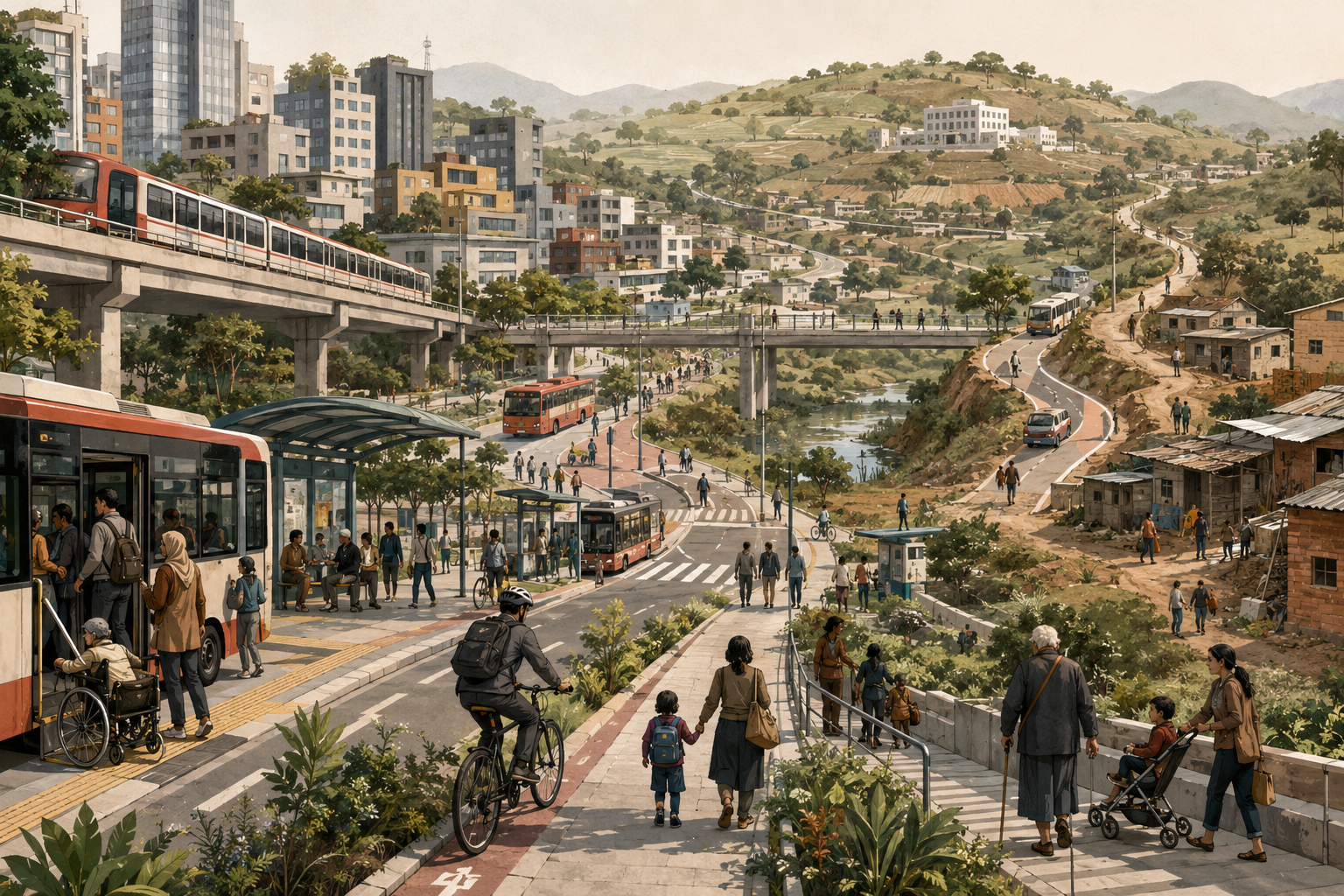
The deeper reason transport matters is that development is spatially organized. Jobs cluster in some places, services in others, housing in others still. Transport is the system that mediates these distances. Reliable, accessible, safe, and affordable mobility allows people to convert the formal presence of opportunity into usable access. Without that connection, development can exist nearby but remain practically unreachable.
This means mobility should not be understood only in terms of speed, traffic volume, vehicle flow, or road capacity. The more developmentally important question is accessibility: whether people can reach valued destinations reliably, safely, affordably, and without disproportionate burden. A transport system can move vehicles efficiently while still excluding people who cannot afford fares, cannot drive, face unsafe travel conditions, live too far from reliable service, or need accessible routes that the system does not provide.
Transport is also a justice issue because mobility burdens are distributed unevenly. Women, low-income households, disabled people, older adults, children, rural residents, informal-settlement residents, and people in peripheral neighborhoods often face longer travel times, higher insecurity, weaker service, higher relative cost, and reduced access to opportunity. A transport system may appear technically functional in aggregate while remaining exclusionary in lived experience.
What Transport and Mobility Mean in Development
Transport, in development terms, is more than the movement of vehicles across infrastructure. It includes the systems, services, networks, technologies, rules, institutions, and spatial arrangements that allow people and goods to move through space. Mobility refers to the capacity to travel, but developmentally the more meaningful concept is often accessibility: the ability to reach jobs, education, healthcare, public services, markets, social networks, and civic life.
This distinction matters because the central developmental question is not how much movement occurs, but whether movement allows people to reach what they need in order to live well. A society can increase mobility in a narrow sense while worsening development in a broader one. Faster roads may move traffic more efficiently while deepening dependence on private cars and excluding people without them. Expanded highway capacity may improve vehicle speed while making walking, cycling, and transit less safe or less viable.
Transport also includes the quality of travel. A route that exists but is unsafe, unreliable, unaffordable, inaccessible, or too slow does not provide the same developmental value as one that people can actually use. Mobility must therefore be evaluated through time, cost, safety, dignity, reliability, universal access, and destination reach. Transport is not only a network question. It is a lived access question.
To ask what transport means in development is therefore to ask how societies organize access through space. Mobility is not only an engineering question. It is part of how opportunity, service access, social membership, and public participation are materially distributed.
Why Transport Matters for Sustainable Development
Transport matters because development is spatially mediated. Workplaces, clinics, schools, markets, care networks, public offices, cultural institutions, and social infrastructure are unevenly distributed across territory. Access depends on the mobility systems that connect people to those places. Safe, affordable, accessible, and sustainable transport systems are therefore central to sustainable development because access to opportunity is inseparable from access to transport.
This matters because transport failure can convert formal opportunity into practical exclusion. Jobs may exist but remain unreachable within reasonable time or cost. Health facilities may exist but be inaccessible to those without safe and affordable travel. Education may be available but too distant, too expensive, or too dangerous to reach consistently. Public institutions may exist but remain functionally remote for people in peripheral settlements or rural areas.
Transport also shapes household economies. High transport costs reduce disposable income. Long commutes reduce time for care, rest, education, and community life. Unsafe mobility restricts movement and participation. Unreliable service makes work, school, and medical care harder to sustain. These burdens do not fall evenly. They often fall most heavily on people already facing economic, territorial, gendered, racial, disability-related, or age-based exclusion.
Transport therefore matters not simply because it supports economic growth, but because it shapes the lived accessibility of social life. Sustainable development becomes more real when mobility systems widen practical reach rather than merely expanding physical movement.
From Mobility to Accessibility
One of the most important shifts in transport thinking is the movement from mobility to accessibility. Mobility asks how much movement occurs and how quickly. Accessibility asks whether people can reach valued destinations and opportunities. This changes the evaluative standard of transport policy from throughput toward social reach.
This matters because mobility can increase while inclusion does not. A city may expand vehicle lanes and road capacity yet leave peripheral neighborhoods poorly connected to jobs and care. Travel speeds for some groups may improve while travel burdens for others remain severe. A transport corridor may generate economic value while bypassing communities that need service most. Accessibility reveals these differences more clearly because it asks whether movement produces meaningful access rather than merely greater circulation.
Accessibility also requires looking at land use. A transport system cannot be evaluated apart from where housing, jobs, schools, clinics, services, and public institutions are located. A well-designed route may still fail if destinations are spatially segregated, housing is unaffordable near opportunity, or essential services are concentrated far from underserved communities. Mobility systems and land systems produce access together.
Accessibility also changes how transport investments should be judged. A project that saves a few minutes for already mobile commuters may be less developmentally significant than one that gives low-income households reliable access to jobs, schools, clinics, and care networks. The question becomes not only how many vehicles move, but whose lives become more reachable.
Sustainable development therefore depends on transport systems designed around access to opportunity, not just movement volume. Public transport, walking, cycling, universal access, safety, affordability, service frequency, and integration with land use matter because they determine whether mobility becomes practical inclusion. This section also aligns naturally with Infrastructure as the Material Basis of Development.
Transport and Human Capability
Transport matters because it widens or narrows what people are practically able to do. Mobility systems shape whether people can reach jobs, schools, clinics, administrative offices, childcare, markets, religious spaces, cultural life, family networks, and public participation. Formal rights and services become weaker when people cannot reach the places where those rights and services are exercised.
This matters because poor transport imposes cumulative burdens on time, safety, income, and wellbeing. Long commutes reduce discretionary time and strain households. Unsafe routes deter participation, especially for women, older adults, children, and disabled people. High transport costs can turn low-wage work or public services into inaccessible options. Unreliable service can make employment precarious, appointments difficult, and daily life uncertain.
Transport also shapes educational and health capability. Students need safe and reliable access to schools. Patients need mobility to clinics, hospitals, pharmacies, and preventive care. Workers need access to employment centers. Caregivers need mobility across multiple destinations. A transport system that fails these ordinary needs weakens human development even if schools, clinics, and jobs formally exist.
Mobility is also a dignity issue. People forced into unsafe, exhausting, expensive, or humiliating travel conditions experience development differently than people with convenient, protected access. Transport burden can become a daily reminder of social exclusion. Conversely, accessible and reliable transport can expand the sense that public systems recognize people as full participants in social life.
To treat transport seriously in development theory is therefore to recognize mobility as part of the conditions of substantive freedom. A society that contains opportunities but does not connect people to them remains developmentally thinner than its aggregate assets suggest. This section also complements From Economic Growth to Human Development.
Spatial Inclusion and the Geography of Opportunity
Transport and spatial inclusion belong together because opportunity is geographically uneven. Employment centers, higher-quality schools, hospitals, administrative offices, parks, libraries, transit hubs, cultural institutions, and public services often cluster in particular zones. Transport determines whether these clusters function as shared opportunities or as enclaves for those already well located.
This matters because spatial exclusion is not only about where people live. It is about whether transport systems bridge the distance between residence and opportunity. Peripheral settlements, informal neighborhoods, underconnected rural areas, segregated districts, and low-income suburbs may remain structurally disadvantaged because transport systems impose higher time costs, fewer route options, lower safety, greater unreliability, or greater relative cost.
Mobility inequality is therefore a geography-of-opportunity problem. A household’s access to opportunity depends not only on income or skill, but on whether the surrounding transport system connects it to jobs, services, and public life. People may be excluded not because opportunity does not exist in the wider territory, but because the mobility system makes that opportunity too expensive, too slow, too unsafe, or too uncertain to use.
Spatial inclusion also depends on service frequency and temporal access. A route that operates rarely, stops early, or does not serve shift workers, caregivers, students, or people with irregular schedules may not provide meaningful access. Developmental mobility must account for time-of-day patterns, trip chaining, care work, informal work, emergency access, and the realities of daily movement.
Sustainable development requires transport systems that reduce the mismatch between people and opportunity. Spatial inclusion depends on whether mobility systems connect lives to places of value without demanding disproportionate cost, risk, or effort. This section also aligns with Local Governance, Cities, and Territorial Development.
Public Transport, Affordability, and Everyday Access
Public transport matters because safe, affordable, and accessible collective mobility is one of the most direct ways to widen access across urban and regional space. Buses, rail, metro, paratransit, shared mobility, ferries, feeder routes, and integrated walking and cycling access can reduce dependence on private vehicles and connect more people to opportunity. But public transport works developmentally only when it is usable in everyday life.
This matters because affordability and proximity together shape whether daily mobility is feasible for lower-income households and those without private vehicles. Even where routes exist, fares, transfers, waiting times, unreliability, unsafe stops, inaccessible vehicles, and poor service frequency can make participation too costly. Public transport is therefore not only a technical network issue. It is a distributive issue that affects who can sustain employment, access care, maintain social ties, and participate in public life without incurring excessive burden.
Affordability must be understood broadly. A fare may appear low in absolute terms while still consuming a high share of income for poor households. Travel may require multiple transfers, informal feeder payments, or additional walking time. A household may have to choose between transport, food, school expenses, medicine, or rent. Developmental transport policy must ask whether mobility costs are manageable relative to household resources.
Public transport also supports climate-compatible development when it reduces car dependence, emissions, congestion, and land consumption. But climate value and social value must be aligned. A low-emission transport system that remains unaffordable, unsafe, or inaccessible is not fully sustainable. A socially inclusive transport system that remains fossil-dependent may still require transition. Sustainable mobility requires both inclusion and ecological direction.
Sustainable development is stronger when public transport reduces the friction of daily life rather than intensifying it. Reliable and affordable access transforms transport from a survival burden into a platform of inclusion.
Gender, Safety, and Unequal Mobility Burdens
Mobility burdens are unequally distributed, and gender is one of the clearest axes along which this inequality appears. Safety, harassment, route design, lighting, station design, walking conditions, trip chaining, caregiving responsibilities, and service frequency all shape how transport is experienced. A transport system can appear functional in aggregate while remaining exclusionary or threatening in lived experience.
This matters because women and girls may face unsafe walking conditions, insecure stations, harassment on vehicles, poorly lit routes, or route structures poorly aligned with care work. Travel needs may involve multiple short trips rather than simple home-to-work commuting. Transport planning that assumes a single commuter traveling from home to a central workplace can undercount the mobility patterns created by care, informal work, school drop-offs, healthcare visits, and household provisioning.
Safety is not only a personal concern. It is a development condition. If fear limits travel, then access to education, work, public services, political participation, and social life is constrained. Unsafe mobility can narrow life choices even where formal rights exist. Transport inclusion therefore requires attention to security, lighting, staffing, complaint mechanisms, vehicle design, station placement, and public accountability.
Gendered transport burdens also intersect with income, age, disability, race, caste, ethnicity, religion, migration status, and territory. A low-income woman traveling at night through poorly served districts may face layered mobility constraints. A disabled caregiver may face both accessibility barriers and trip-complexity burdens. Sustainable transport analysis must therefore examine how multiple forms of vulnerability combine inside mobility systems.
Transport justice requires more than network coverage. It requires safety, usability, affordability, dignity, and design attentive to unequal travel conditions. Sustainable development depends on mobility systems that do not silently exclude through fear, inaccessibility, or disproportionate burden.
Disability, Age, and Universal Access
Transport systems must also be evaluated through disability, age, and universal access. A system that is technically available but physically inaccessible is not genuinely inclusive. Stairs without alternatives, vehicles without level boarding, inaccessible stations, missing curb cuts, unsafe crossings, unclear information, poor seating, inaccessible digital systems, and unreliable assistance can convert public transport into a formal service that many people cannot use.
This matters because disabled people, older adults, children, caregivers, people carrying goods, and people with temporary injuries all experience mobility systems differently from the imagined able-bodied commuter. Universal access is not a niche concern. It is a core feature of developmentally serious transport policy because mobility systems are public systems, and public systems must be designed around human variation.
Age also matters. Older adults may need shorter walking distances, safer crossings, seating, reliable service, accessible vehicles, and protection from unsafe traffic conditions. Children need safe routes to school, traffic calming, sidewalks, crossings, and transport systems that do not make education dependent on dangerous travel. Transport planning that ignores age creates exclusion through design.
Universal access also strengthens broader system quality. Streets designed for wheelchair users are often safer for parents with strollers, older people, delivery workers, and pedestrians generally. Clear signage helps many users, including migrants and visitors. Reliable service helps people with medical appointments, shift work, and caregiving responsibilities. Accessibility improves the public character of the system.
Sustainable development requires mobility systems that treat accessibility as a baseline rather than an accommodation after the fact. Transport becomes inclusive when people with different bodies, ages, abilities, schedules, and responsibilities can move with dignity and practical independence.
Transport, Climate, and Urban Systems
Transport is central to sustainable development not only because it connects people to opportunity, but because it is deeply embedded in climate and urban systems. Transport is shaped by urban form, infrastructure, land use, vehicle technologies, fuels, public investment, service design, and enabling conditions. Mobility choices are inseparable from settlement patterns and long-term emissions trajectories.
This matters because transport systems can either support low-carbon, inclusive urban development or lock societies into high-emission, car-dependent, spatially unequal patterns. Urban infrastructure, settlements, land markets, and climate risks are tightly coupled. Transport policy is therefore never only about travel. It also shapes air quality, land consumption, public health, congestion, hazard exposure, energy demand, and the ecological form of cities.
A climate-compatible transport system cannot be reduced to electrifying private vehicles. Electrification can reduce tailpipe emissions, but it does not automatically solve congestion, road danger, land consumption, car dependence, inequality, or spatial exclusion. Sustainable mobility requires public transport, active mobility, land-use coordination, freight efficiency, compact development, accessibility planning, and policies that reduce unnecessary travel burdens while improving access.
Transport also interacts with climate adaptation. Flooded roads, overheated transit systems, damaged rail lines, disrupted ports, and storm-exposed bridges can interrupt work, care, school, emergency response, and supply chains. Mobility resilience is therefore part of development resilience. A transport system that fails under climate stress can convert environmental shocks into social and economic disruption.
Sustainable development requires transport systems that reduce exclusion while supporting climate-compatible urban futures. Mobility inclusion and environmental sustainability are not separate goals; they are increasingly joined at the level of system design. This section also connects clearly to Climate Change as a Development Constraint.
Territory, Peripherality, and Rural Connection
Transport inequality is also territorial. Rural areas, peripheral regions, small towns, informal settlements, and underconnected districts often face reduced service frequency, weaker infrastructure quality, higher travel costs, lower route redundancy, and longer distances to services. Developmentally, access depends on how systems connect people to opportunity across space, not only on how well central corridors function.
This matters because peripherality can become self-reinforcing. Weak transport discourages investment, limits service access, narrows labor-market reach, increases time poverty, and weakens the practical presence of public institutions. Territories then remain developmentally secondary not because opportunities are absent everywhere, but because connection to them is poor. Transport helps organize the hierarchy of places inside development.
Rural mobility is especially important because services may be farther away and travel options thinner. Access to hospitals, secondary schools, administrative offices, markets, banking, extension services, and employment may depend on roads, buses, informal transport, seasonal passability, fuel costs, and digital substitutes. A road that is impassable during rains or a bus that runs too rarely can reproduce territorial exclusion even where infrastructure formally exists.
Peripheral urban areas can face similar dynamics. Residents may live within a metropolitan region yet remain distant from employment centers, formal transit, safe sidewalks, schools, clinics, and public space. Urban peripherality is therefore not simply distance from the center. It is a condition of weak connectivity, high burden, and limited access to the networks that organize opportunity.
Sustainable development requires mobility systems that reduce territorial abandonment. Spatial inclusion means not only improving central mobility, but ensuring that peripheral, rural, and underconnected lives are not structurally disconnected from social and economic participation.
Governance, Coordination, and Mobility Systems
Transport is never only an engineering problem. It is also a governance and coordination problem. Urban and regional mobility depends on the alignment of land use, infrastructure investment, operations, pricing, safety regulation, accessibility standards, environmental policy, public finance, and local institutional capacity. When these systems are not coordinated, mobility becomes fragmented even where infrastructure exists.
This matters because transport failure often reflects governance failure as much as technical deficiency. Routes may exist but be badly coordinated. Fares may be unaffordable. Stations may be unsafe. Land use may generate travel demand that transit systems were never designed to serve. Roads may be expanded while public transport remains underfunded. Different agencies may manage pieces of the same mobility system without sufficient alignment.
Mobility governance must also coordinate across jurisdictions. Metropolitan travel rarely respects municipal boundaries. Commuting regions, bus routes, rail systems, freight corridors, roads, parking policy, emissions regulation, land use, and housing markets often require regional coordination. Without it, each jurisdiction may act rationally in isolation while producing system-wide congestion, exclusion, emissions, or service gaps.
Transport governance also requires participation. People who depend most on public transport, walking, cycling, informal transport, paratransit, or accessible services are often underrepresented in planning. Community knowledge can reveal unsafe routes, service gaps, informal travel patterns, hidden costs, and accessibility failures that technical models miss. Mobility systems become more inclusive when users are treated as sources of knowledge rather than only demand forecasts.
Sustainable development therefore depends on mobility governance capable of integrating infrastructure, service design, safety, affordability, accessibility, climate alignment, and land-use logic rather than treating them as separate policy files. This section also aligns naturally with Policy Coordination Across Complex Systems.
Path Dependence, Car Dependence, and Spatial Lock-In
Transport systems create path dependence. Once cities and regions are organized around highways, dispersed land use, private-vehicle assumptions, parking requirements, low-density development, and road-centered investment, future choices narrow. Travel behavior, settlement form, infrastructure finance, emissions pathways, and public expectations adjust to that system.
This matters because car dependence can become a form of spatial lock-in. Those without cars face exclusion; those with cars may still bear high costs in congestion, fuel, insurance, parking, emissions, danger, and infrastructure burden. Public transport becomes harder to operate efficiently when land use is dispersed. Walking and cycling become harder when streets are designed around vehicles rather than people. Retrofitting such systems toward public transport, active mobility, and accessibility can become politically and materially difficult once the spatial order is entrenched.
Car dependence also creates fiscal lock-in. Roads, bridges, parking, traffic management, and dispersed infrastructure require ongoing maintenance. Public budgets may become committed to preserving a mobility system that remains costly, exclusionary, and emission-intensive. Transport choices therefore shape future public finance as well as present travel patterns.
Spatial lock-in also affects housing and land markets. When affordable housing is pushed far from opportunity and transport is weak, low-income households absorb time and cost burdens. When transport investments raise land values without protections, improved access can produce displacement. Sustainable mobility must therefore coordinate with housing, land governance, and anti-displacement policy.
Sustainable development requires transport foresight. The issue is not only whether a transport investment solves today’s movement problem, but what kind of settlement pattern, mobility culture, access regime, and emissions pathway it makes more likely for decades to come.
Why Building Roads Is Not Enough
It is not enough simply to build roads or increase traffic capacity. Developmentally, the central question is whether transport systems widen affordable, safe, accessible, reliable, and sustainable access to opportunity. A network can expand in physical terms while remaining socially exclusionary, environmentally damaging, and poorly matched to lived mobility needs.
This matters because road-centered approaches can underdeliver on inclusion if they neglect public transport, active mobility, safety, affordability, universal accessibility, land-use coordination, and climate effects. More road capacity may generate more travel demand, more sprawl, more emissions, more danger, and more car dependence if it is not embedded in a broader accessibility strategy.
Building roads may be necessary in some contexts, especially where basic connectivity is absent, rural access is weak, or emergency routes are inadequate. But roads alone do not guarantee spatial inclusion. A road that primarily serves freight or private vehicles may not help people without cars reach schools, clinics, jobs, or services. A road that divides neighborhoods or makes walking dangerous can reduce accessibility even while increasing vehicle movement.
The deeper goal is therefore not transport expansion alone, but mobility systems that are inclusive, safe, affordable, low-emission, universally accessible, and oriented toward opportunity reach. Sustainable development depends on transport systems judged by whom they connect, under what conditions, at what cost, and with what long-term consequences.
Why This Matters for Sustainable Development
Transport, mobility, and spatial inclusion belong together because development depends not only on the existence of opportunity, but on whether people can reach it. Jobs, education, healthcare, public services, care networks, and civic life are spatially distributed, and transport systems mediate the distance between people and those goods. A serious development framework must therefore ask not only what is available, but who can get there safely, affordably, reliably, and with dignity.
This is why transport matters so much for sustainable development. It reveals a central truth that vehicle-centered or infrastructure-centered thinking can miss: movement is developmental when it becomes access, and access is developmental when it reduces exclusion rather than reproducing it. Public transport, accessibility, safety, territorial connection, universal design, and climate-aware system planning are all part of how mobility becomes socially meaningful.
The issue is also one of justice. Transport determines whose commute is bearable, whose school is reachable, whose clinic is accessible, whose neighborhood is connected, whose disability is accommodated, whose safety is protected, and whose opportunities remain practically out of reach. Sustainable development cannot be credible if transport investments improve aggregate movement while leaving marginalized people with unsafe, unaffordable, inaccessible, or exhausting mobility burdens.
To take transport seriously is therefore to take spatial inclusion seriously. Long-run development depends not only on what societies build, but on whether their mobility systems allow people to inhabit opportunity without disproportionate burden, risk, exclusion, or dependence on private means they may not possess.
Development becomes credible when transport systems connect people to opportunity with safety, affordability, reliability, universal access, climate responsibility, and enough public purpose to make movement a pathway into shared life rather than a daily test of exclusion.
Mathematical Lens
Transport inclusion can be clarified by thinking in terms of accessibility rather than throughput. Let \(I_s\) represent practical spatial inclusion, \(A\) accessibility, \(F\) fare affordability, \(S\) safety, \(T\) travel-time burden, and \(C\) car-dependence risk:
I_s = \alpha A + \beta F + \gamma S – \delta T – \epsilon C
\]
Interpretation: Practical spatial inclusion rises when accessibility, affordability, and safety improve, and falls when travel-time burden and car-dependence risk increase.
This captures a central point in the article: transport becomes developmentally valuable not when movement rises in the abstract, but when people can reach opportunity with lower burden and greater dignity.
We can also represent accessibility as a weighted opportunity-reach function:
A_m = w_1 J + w_2 E + w_3 H + w_4 P
\]
Interpretation: Mobility accessibility rises when people can reach jobs, education, healthcare, and public transport coverage more reliably.
Here, \(J\) is access to jobs, \(E\) is access to education, \(H\) is access to healthcare, and \(P\) is public transport coverage. Higher \(A_m\) means a transport system is connecting people to spaces of value rather than simply enabling circulation.
Finally, territorial exclusion can be expressed as a function of peripherality, weak service usability, and high trip burden:
X_t = \lambda R + \mu (1 – U) + \nu B
\]
Interpretation: Territorial exclusion rises when peripherality, weak service usability, and trip burden reinforce one another.
Here, \(R\) is peripherality, \(U\) is service usability or reliability, and \(B\) is trip burden. This helps show why transport inequality is also a geography-of-opportunity problem.
| Term | Meaning | Interpretive role |
|---|---|---|
| \(I_s\) | Practical spatial inclusion | Represents the degree to which transport systems allow people to reach opportunity with manageable burden. |
| \(A\) | Accessibility | Represents whether people can reach valued destinations such as work, school, healthcare, and public services. |
| \(F\) | Fare affordability | Represents whether transport costs are manageable relative to household resources. |
| \(S\) | Safety | Represents protection from traffic danger, harassment, violence, and unsafe travel conditions. |
| \(T\) | Travel-time burden | Represents the time cost imposed by distance, delay, weak service frequency, and unreliable travel. |
| \(C\) | Car-dependence risk | Represents the degree to which access depends on private vehicle ownership. |
| \(X_t\) | Territorial exclusion | Represents exclusion created by peripherality, weak service usability, and high trip burden. |
The equations are conceptual rather than predictive. Their value is to make visible the structure of the problem: transport contributes to sustainable development only when accessibility, affordability, safety, usability, land-use coordination, universal access, and climate alignment work together.
Advanced Python Workflow: Accessibility and Opportunity-Reach Scoring
This Python workflow translates the article’s core argument into a structured accessibility model. Rather than treating transport performance as simple movement, it scores places across public transport coverage, jobs access, education access, healthcare access, fare affordability, travel burden, safety, walkability, universal access, multimodal integration, car-dependence risk, climate alignment, and service reliability. That makes it possible to compare not only how much movement a system enables, but whether it is actually broadening practical access to opportunity.
from __future__ import annotations

import pandas as pd
import numpy as np

INPUT_FILE = "mobility_accessibility_panel.csv"
OUTPUT_FILE = "accessibility_and_opportunity_reach_scores.csv"


def load_data(path: str) -> pd.DataFrame:
    """
    Load accessibility and mobility data.

    All *_index columns should be normalized to [0, 1].
    Higher values should mean more of the named property.

    Examples:
      - jobs_access_index: higher = stronger access to jobs
      - fare_affordability_index: higher = more affordable transport
      - travel_time_burden_index: higher = greater travel-time burden
      - car_dependence_risk_index: higher = greater dependence on private cars
    """
    df = pd.read_csv(path)

    required_columns = [
        "city_region",
        "country_or_region",
        "territory_type",
        "public_transport_coverage_index",
        "jobs_access_index",
        "education_access_index",
        "healthcare_access_index",
        "fare_affordability_index",
        "travel_time_burden_index",
        "safety_index",
        "walkability_index",
        "universal_access_index",
        "multimodal_integration_index",
        "service_reliability_index",
        "car_dependence_risk_index",
        "climate_alignment_index",
    ]

    missing = [col for col in required_columns if col not in df.columns]

    if missing:
        raise ValueError(f"Missing required columns: {missing}")

    return df


def validate_indices(df: pd.DataFrame) -> pd.DataFrame:
    """Validate that all *_index fields are complete and normalized to [0, 1]."""
    index_columns = [col for col in df.columns if col.endswith("_index")]

    for col in index_columns:
        if df[col].isna().any():
            raise ValueError(f"Column '{col}' contains missing values.")

        if ((df[col] < 0) | (df[col] > 1)).any():
            raise ValueError(f"Column '{col}' contains values outside [0, 1].")

    return df


def compute_scores(df: pd.DataFrame) -> pd.DataFrame:
    """
    Compute accessibility, everyday mobility inclusion,
    sustainable mobility alignment, burden exposure,
    and constrained spatial inclusion.

    Accessibility rises with jobs, education, healthcare,
    public transport coverage, walkability, multimodal integration,
    and service reliability.

    Everyday mobility inclusion rises with affordability, lower travel burden,
    safety, universal access, coverage, and reliability.

    Sustainable mobility alignment rises with climate alignment,
    walkability, multimodal integration, lower car dependence,
    and public transport coverage.
    """
    df = df.copy()

    df["accessibility_score"] = (
        0.18 * df["jobs_access_index"] +
        0.17 * df["education_access_index"] +
        0.17 * df["healthcare_access_index"] +
        0.14 * df["public_transport_coverage_index"] +
        0.11 * df["walkability_index"] +
        0.12 * df["multimodal_integration_index"] +
        0.11 * df["service_reliability_index"]
    ).clip(lower=0, upper=1)

    df["everyday_mobility_inclusion_score"] = (
        0.19 * df["fare_affordability_index"] +
        0.18 * (1 - df["travel_time_burden_index"]) +
        0.18 * df["safety_index"] +
        0.18 * df["universal_access_index"] +
        0.14 * df["public_transport_coverage_index"] +
        0.13 * df["service_reliability_index"]
    ).clip(lower=0, upper=1)

    df["sustainable_mobility_alignment_score"] = (
        0.28 * df["climate_alignment_index"] +
        0.22 * df["walkability_index"] +
        0.20 * df["multimodal_integration_index"] +
        0.18 * (1 - df["car_dependence_risk_index"]) +
        0.12 * df["public_transport_coverage_index"]
    ).clip(lower=0, upper=1)

    df["mobility_burden_exposure_score"] = (
        0.34 * df["travel_time_burden_index"] +
        0.24 * (1 - df["fare_affordability_index"]) +
        0.18 * (1 - df["safety_index"]) +
        0.14 * (1 - df["universal_access_index"]) +
        0.10 * df["car_dependence_risk_index"]
    ).clip(lower=0, upper=1)

    df["constrained_spatial_inclusion_score"] = (
        0.34 * df["accessibility_score"] +
        0.28 * df["everyday_mobility_inclusion_score"] +
        0.18 * df["sustainable_mobility_alignment_score"] +
        0.12 * (1 - df["mobility_burden_exposure_score"]) +
        0.08 * (1 - df["car_dependence_risk_index"])
    ).clip(lower=0, upper=1)

    df["access_burden_gap"] = (
        df["accessibility_score"] -
        df["mobility_burden_exposure_score"]
    )

    df["inclusion_band"] = np.select(
        [
            df["constrained_spatial_inclusion_score"] >= 0.80,
            df["constrained_spatial_inclusion_score"] >= 0.60,
            df["constrained_spatial_inclusion_score"] >= 0.40,
        ],
        [
            "High spatial inclusion",
            "Strong spatial inclusion",
            "Moderate spatial inclusion",
        ],
        default="Constrained spatial inclusion",
    )

    df["mobility_warning"] = np.select(
        [
            df["mobility_burden_exposure_score"] >= 0.75,
            df["car_dependence_risk_index"] >= 0.70,
            df["universal_access_index"] <= 0.30,
            df["safety_index"] <= 0.30,
        ],
        [
            "Severe mobility burden exposure",
            "High car-dependence risk",
            "Low universal access",
            "Low transport safety",
        ],
        default="Lower mobility exclusion warning",
    )

    return df


def build_summary(df: pd.DataFrame) -> pd.DataFrame:
    """Return a ranked summary table for review or reporting."""
    columns = [
        "city_region",
        "country_or_region",
        "territory_type",
        "accessibility_score",
        "everyday_mobility_inclusion_score",
        "sustainable_mobility_alignment_score",
        "mobility_burden_exposure_score",
        "constrained_spatial_inclusion_score",
        "inclusion_band",
        "mobility_warning",
    ]

    summary = df[columns].copy()

    summary = summary.sort_values(
        by=[
            "constrained_spatial_inclusion_score",
            "accessibility_score",
            "everyday_mobility_inclusion_score",
            "mobility_burden_exposure_score",
        ],
        ascending=[False, False, False, True],
    ).reset_index(drop=True)

    return summary


def main() -> None:
    df = load_data(INPUT_FILE)
    df = validate_indices(df)
    scored = compute_scores(df)
    summary = build_summary(scored)

    summary.to_csv(OUTPUT_FILE, index=False)

    print("Accessibility and opportunity-reach scoring complete.")
    print(summary.to_string(index=False))


if __name__ == "__main__":
    main()
This workflow is intentionally transparent. It does not claim that mobility justice can be reduced to one objective score. Instead, it makes assumptions visible: public transport coverage, opportunity reach, affordability, travel-time burden, safety, walkability, universal access, multimodal integration, reliability, car dependence, and climate alignment are treated as distinct components. The value of the model is diagnostic. It helps identify where spatial inclusion is strongest, where travel burdens remain exclusionary, and where policy should shift from throughput toward access.
Advanced R Workflow: Mobility Burden and Spatial Exclusion Analysis
This R workflow is designed for the part of the article that emphasizes uneven burdens across countries, regions, territory types, and groups. It compares places across public transport coverage, jobs access, education access, healthcare access, affordability, safety, universal access, service reliability, travel-time burden, car dependence, and climate alignment. It then builds grouped summaries that help reveal where opportunity remains spatially out of reach.
library(readr)
library(dplyr)

input_file <- "transport_access_country_panel.csv"
country_output_file <- "cross_country_transport_access_summary.csv"
region_output_file <- "regional_transport_access_summary.csv"
territory_output_file <- "territory_type_transport_access_summary.csv"

transport_df <- read_csv(input_file, show_col_types = FALSE)

required_cols <- c(
  "country_or_region",
  "region",
  "territory_type",
  "year",
  "public_transport_coverage_index",
  "jobs_access_index",
  "education_access_index",
  "healthcare_access_index",
  "fare_affordability_index",
  "travel_time_burden_index",
  "safety_index",
  "universal_access_index",
  "service_reliability_index",
  "car_dependence_risk_index",
  "climate_alignment_index"
)

missing_cols <- setdiff(required_cols, names(transport_df))

if (length(missing_cols) > 0) {
  stop(paste("Missing required columns:", paste(missing_cols, collapse = ", ")))
}

index_cols <- names(transport_df)[grepl("_index$", names(transport_df))]

invalid_index_cols <- index_cols[
  vapply(
    transport_df[index_cols],
    function(x) any(is.na(x) | x < 0 | x > 1),
    logical(1)
  )
]

if (length(invalid_index_cols) > 0) {
  stop(
    paste(
      "Index columns must be complete and normalized to [0, 1]:",
      paste(invalid_index_cols, collapse = ", ")
    )
  )
}

transport_df <- transport_df %>%
  mutate(
    accessibility_proxy = (
      public_transport_coverage_index +
      jobs_access_index +
      education_access_index +
      healthcare_access_index +
      fare_affordability_index +
      safety_index +
      service_reliability_index
    ) / 7,
    mobility_burden_proxy = (
      travel_time_burden_index +
      (1 - fare_affordability_index) +
      (1 - safety_index) +
      (1 - universal_access_index) +
      car_dependence_risk_index
    ) / 5,
    sustainable_access_proxy = (
      climate_alignment_index +
      public_transport_coverage_index +
      universal_access_index +
      service_reliability_index +
      (1 - car_dependence_risk_index)
    ) / 5,
    constrained_mobility_proxy = (
      accessibility_proxy +
      (1 - mobility_burden_proxy) +
      sustainable_access_proxy +
      universal_access_index +
      service_reliability_index
    ) / 5,
    access_band = case_when(
      constrained_mobility_proxy >= 0.75 ~ "High access inclusion",
      constrained_mobility_proxy >= 0.55 ~ "Strong access inclusion",
      constrained_mobility_proxy >= 0.35 ~ "Moderate access inclusion",
      TRUE ~ "Constrained access inclusion"
    )
  )

country_summary <- transport_df %>%
  group_by(country_or_region) %>%
  summarise(
    avg_accessibility_proxy = mean(accessibility_proxy, na.rm = TRUE),
    avg_mobility_burden = mean(mobility_burden_proxy, na.rm = TRUE),
    avg_sustainable_access = mean(sustainable_access_proxy, na.rm = TRUE),
    avg_constrained_mobility = mean(constrained_mobility_proxy, na.rm = TRUE),
    avg_public_transport_coverage = mean(public_transport_coverage_index, na.rm = TRUE),
    avg_jobs_access = mean(jobs_access_index, na.rm = TRUE),
    avg_education_access = mean(education_access_index, na.rm = TRUE),
    avg_healthcare_access = mean(healthcare_access_index, na.rm = TRUE),
    avg_fare_affordability = mean(fare_affordability_index, na.rm = TRUE),
    avg_travel_time_burden = mean(travel_time_burden_index, na.rm = TRUE),
    avg_safety = mean(safety_index, na.rm = TRUE),
    avg_universal_access = mean(universal_access_index, na.rm = TRUE),
    avg_service_reliability = mean(service_reliability_index, na.rm = TRUE),
    avg_car_dependence = mean(car_dependence_risk_index, na.rm = TRUE),
    avg_climate_alignment = mean(climate_alignment_index, na.rm = TRUE),
    observations = n(),
    .groups = "drop"
  ) %>%
  mutate(
    access_band = case_when(
      avg_constrained_mobility >= 0.75 ~ "High access inclusion",
      avg_constrained_mobility >= 0.55 ~ "Strong access inclusion",
      avg_constrained_mobility >= 0.35 ~ "Moderate access inclusion",
      TRUE ~ "Constrained access inclusion"
    )
  ) %>%
  arrange(desc(avg_constrained_mobility))

region_summary <- transport_df %>%
  group_by(region) %>%
  summarise(
    avg_accessibility_proxy = mean(accessibility_proxy, na.rm = TRUE),
    avg_mobility_burden = mean(mobility_burden_proxy, na.rm = TRUE),
    avg_sustainable_access = mean(sustainable_access_proxy, na.rm = TRUE),
    avg_constrained_mobility = mean(constrained_mobility_proxy, na.rm = TRUE),
    avg_public_transport_coverage = mean(public_transport_coverage_index, na.rm = TRUE),
    avg_service_reliability = mean(service_reliability_index, na.rm = TRUE),
    avg_car_dependence = mean(car_dependence_risk_index, na.rm = TRUE),
    observations = n(),
    .groups = "drop"
  ) %>%
  arrange(desc(avg_constrained_mobility))

territory_summary <- transport_df %>%
  group_by(territory_type) %>%
  summarise(
    avg_accessibility_proxy = mean(accessibility_proxy, na.rm = TRUE),
    avg_mobility_burden = mean(mobility_burden_proxy, na.rm = TRUE),
    avg_sustainable_access = mean(sustainable_access_proxy, na.rm = TRUE),
    avg_constrained_mobility = mean(constrained_mobility_proxy, na.rm = TRUE),
    avg_jobs_access = mean(jobs_access_index, na.rm = TRUE),
    avg_healthcare_access = mean(healthcare_access_index, na.rm = TRUE),
    avg_fare_affordability = mean(fare_affordability_index, na.rm = TRUE),
    avg_universal_access = mean(universal_access_index, na.rm = TRUE),
    observations = n(),
    .groups = "drop"
  ) %>%
  arrange(desc(avg_constrained_mobility))

write_csv(country_summary, country_output_file)
write_csv(region_summary, region_output_file)
write_csv(territory_summary, territory_output_file)

cat("Cross-country transport access summary exported to:", country_output_file, "\n")
print(country_summary)

cat("\nRegional transport access summary exported to:", region_output_file, "\n")
print(region_summary)

cat("\nTerritory-type transport access summary exported to:", territory_output_file, "\n")
print(territory_summary)
This workflow helps distinguish formal transport presence from developmentally consequential spatial inclusion. A city, region, or country may have extensive roads or transit infrastructure but weak affordability, unsafe travel, low universal access, poor reliability, high car dependence, or limited opportunity reach. Another may have fewer assets but stronger service integration, lower travel burden, better safety, and more equitable access. The workflow therefore treats transport as a development condition, not as a simple measure of movement.
GitHub Repository
Complete Code Repository
The full code distribution for this article, including accessibility scoring workflows, safety and affordability diagnostics, SQL materials, optional transport-monitoring support tooling, supporting documentation, and repository structure, is available on GitHub.
Related Articles
- Infrastructure as the Material Basis of Development
- Urbanization, Housing, and Basic Services
- Local Governance, Cities, and Territorial Development
- Climate Change as a Development Constraint
- Policy Coordination Across Complex Systems
- Inequality and Inclusive Development
- Gender, Exclusion, and Development Justice
- Development Under Deep Uncertainty
- Risk, Shock, and Fragility in Development Systems
- Digital Infrastructure and Development Capacity
Further Reading
- United Nations Department of Economic and Social Affairs (n.d.) Goal 11: Make cities and human settlements inclusive, safe, resilient and sustainable. New York: United Nations. Available at: https://sdgs.un.org/goals/goal11
- United Nations Department of Economic and Social Affairs (n.d.) Sustainable transport. New York: United Nations. Available at: https://sdgs.un.org/topics/sustainable-transport
- International Transport Forum / OECD (2024) Sustainable Accessibility for All. Paris: OECD Publishing. Available at: https://www.oecd.org/en/publications/sustainable-accessibility-for-all_5c91857c-en.html
- World Bank Group (n.d.) Transport. Washington, DC: World Bank Group. Available at: https://www.worldbank.org/ext/en/topic/transport
- World Bank Group (n.d.) Gender & Transport. Washington, DC: World Bank Group. Available at: https://www.worldbank.org/ext/en/topic/transport/gender-transport
- Intergovernmental Panel on Climate Change (2022) Chapter 10: Transport. In: Climate Change 2022: Mitigation of Climate Change. Geneva: IPCC. Available at: https://www.ipcc.ch/report/ar6/wg3/chapter/chapter-10/
- Intergovernmental Panel on Climate Change (2022) Chapter 6: Cities, Settlements and Key Infrastructure. In: Climate Change 2022: Impacts, Adaptation and Vulnerability. Geneva: IPCC. Available at: https://www.ipcc.ch/report/ar6/wg2/chapter/chapter-6/
References
- United Nations Department of Economic and Social Affairs (n.d.) Goal 11: Make cities and human settlements inclusive, safe, resilient and sustainable. New York: United Nations. Available at: https://sdgs.un.org/goals/goal11
- United Nations Department of Economic and Social Affairs (n.d.) Sustainable transport. New York: United Nations. Available at: https://sdgs.un.org/topics/sustainable-transport
- International Transport Forum / OECD (2024) Sustainable Accessibility for All. Paris: OECD Publishing. Available at: https://www.oecd.org/en/publications/sustainable-accessibility-for-all_5c91857c-en.html
- World Bank Group (n.d.) Transport. Washington, DC: World Bank Group. Available at: https://www.worldbank.org/ext/en/topic/transport
- World Bank Group (2026) Moving People, Creating Jobs: How Better Transport Drives Opportunity. Washington, DC: World Bank Group. Available at: https://www.worldbank.org/en/results/2026/04/01/how-better-transport-drives-opportunity
- World Bank Group (n.d.) Gender & Transport. Washington, DC: World Bank Group. Available at: https://www.worldbank.org/ext/en/topic/transport/gender-transport
- Intergovernmental Panel on Climate Change (2022) Chapter 10: Transport. In: Climate Change 2022: Mitigation of Climate Change. Geneva: IPCC. Available at: https://www.ipcc.ch/report/ar6/wg3/chapter/chapter-10/
- Intergovernmental Panel on Climate Change (2022) Chapter 6: Cities, Settlements and Key Infrastructure. In: Climate Change 2022: Impacts, Adaptation and Vulnerability. Geneva: IPCC. Available at: https://www.ipcc.ch/report/ar6/wg2/chapter/chapter-6/