
Last Updated May 7, 2026
Innovation, technology transfer, and leapfrogging matter for sustainable development because development is not only about accumulating more capital or adopting more equipment. It is also about how societies learn, absorb, adapt, govern, and redirect knowledge into new productive, social, and ecological capabilities. Technological change affects what economies can produce, how services are delivered, how energy systems transition, how firms compete, how states build capacity, and how communities respond to constraint.
Sustainable development therefore depends not only on invention at the frontier, but on whether countries and communities can access, govern, adapt, and diffuse technologies in ways that expand capability, inclusion, and resilience. Innovation is developmental when it becomes a system of learning rather than a spectacle of novelty. Technology transfer is developmental when it builds local agency rather than permanent dependence. Leapfrogging is developmental when it allows societies to bypass harmful or inefficient pathways without bypassing the deeper work of institution-building.
Main Library
Publications
Article Map
Sustainable Development
Related Article
Industrial Policy
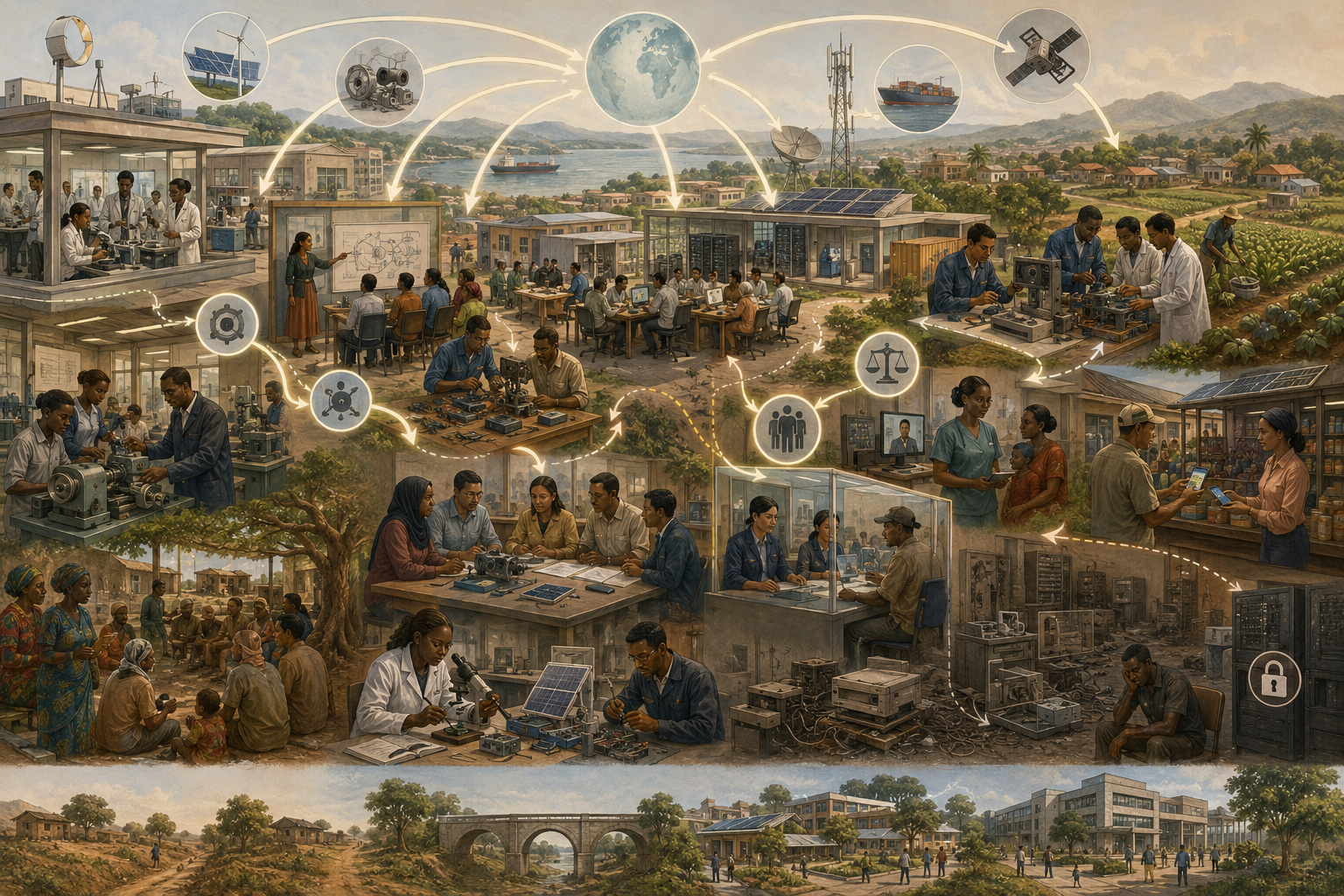
The deeper reason innovation matters is that development is always partly a process of learning under constraint. Countries do not develop simply by importing machinery or waiting for frontier technologies to diffuse automatically. They develop by building the capabilities to use, adapt, improve, maintain, regulate, and eventually generate technologies under local conditions. Innovation is therefore not just novelty. It is the institutionalization of learning and the widening of technological agency.
Technology transfer should not be understood narrowly as the one-way movement of machines, patents, or software from advanced economies to developing ones. In development terms, transfer is meaningful only when it supports absorption, adaptation, upgrading, maintenance, and local capability-building. Technology transfer matters not when technology merely arrives, but when it becomes usable, improvable, governable, and embedded in local systems of production and problem-solving.
What Innovation and Technology Transfer Mean in Development
Innovation, in development terms, is broader than scientific breakthrough, frontier invention, or high-technology entrepreneurship. It includes the introduction, adaptation, combination, and diffusion of new products, processes, organizational forms, and technologies that improve productive capability, public service delivery, resilience, ecological stewardship, or social wellbeing. Innovation may occur in laboratories and firms, but it also occurs in public agencies, farms, clinics, workshops, schools, utilities, cooperatives, local governments, and community institutions.
Technology transfer similarly extends beyond the sale of equipment or licensing of patents. It includes the movement of know-how, standards, technical routines, operating practices, maintenance procedures, design capabilities, quality systems, organizational methods, and institutional arrangements that allow technologies to become usable and developmental in new settings. A machine can be imported quickly; the capability to maintain, modify, improve, regulate, and reproduce its value takes much longer to build.
This matters because sustainable development cannot be achieved simply by buying technology from elsewhere. Imported systems may remain shallow if local institutions cannot adapt, maintain, regulate, finance, or improve them. A solar system that cannot be maintained locally, a digital platform that cannot be audited, a medical device that cannot be repaired, or an industrial technology that creates no supplier learning may appear modern while leaving deeper capability thin.
Innovation therefore becomes developmental when knowledge moves into practical systems of use. It must be translated into production, infrastructure, public service, environmental management, and institutional learning. Technology transfer becomes developmental when it strengthens local problem-solving rather than simply expanding dependence on external vendors, consultants, standards, or proprietary systems.
To ask what innovation and technology transfer mean is therefore to ask how knowledge becomes capability under local conditions. Sustainable development depends not only on who invents, but on who can use, adapt, govern, and redirect technological change toward public purposes.
Why Innovation Matters for Sustainable Development
Innovation matters because development increasingly depends on the ability to solve complex problems under conditions of ecological constraint, technological concentration, institutional weakness, and uneven global capability. Productivity, industrial upgrading, climate transition, health delivery, agriculture, logistics, energy access, public administration, environmental monitoring, and digital infrastructure all rely on innovation in some form. Innovation matters developmentally because it changes what societies can do with their resources, institutions, and infrastructures.
This matters because development cannot rely indefinitely on static comparative advantage or on older technological pathways that may be environmentally damaging, low-learning, extractive, or externally dependent. Innovation is developmental when it allows societies to solve local problems more effectively, upgrade value creation, reduce ecological pressure, and widen institutional reach. It is less developmental when it produces novelty without diffusion, productivity without inclusion, or technical sophistication without governance.
Innovation also matters because sustainable development requires adaptation to changing conditions. Climate stress, biodiversity loss, water scarcity, supply-chain volatility, demographic change, and public-health risk all demand practical learning. Technologies that worked in one context or historical period may not remain adequate. Innovation capacity allows societies to adjust systems before crisis forces harsher adjustment later.
Innovation is also a public-capacity issue. A government that cannot learn from data, improve procurement, adapt service delivery, maintain infrastructure, regulate new technologies, or coordinate knowledge across agencies remains developmentally constrained even if advanced technologies are available in the market. Public-sector innovation can therefore be as important as private-sector innovation, especially where services, infrastructure, and resilience depend on state capability.
Sustainable development therefore depends not only on adopting more technology, but on cultivating systems of innovation that support inclusive problem-solving and long-run capability growth across sectors. This section also aligns naturally with Industrial Policy and Sustainable Structural Transformation.
From Technology Imports to Capability-Building
One of the most important distinctions in development analysis is the difference between importing technology and building capability. Technology imports may expand output, service provision, or visible modernization quickly, but they do not necessarily generate local learning, supplier development, engineering competence, technical standards, repair ecosystems, or institutional adaptability. Capability-building involves developing the skills, organizations, standards, financial systems, public institutions, and supporting ecosystems needed to use and improve technologies over time.
This matters because development can remain technologically dependent even when it appears modernized. Countries may use advanced tools while remaining dependent on external vendors, imported expertise, proprietary standards, black-box platforms, and weak domestic research or engineering capacity. A public agency may digitize services while depending entirely on external contractors. A factory may use advanced machinery without developing local maintenance or process-improvement capacity. A health system may acquire equipment that becomes idle when parts, training, or servicing are unavailable.
Capability-building changes the meaning of adoption. It asks whether workers are trained, whether local suppliers learn, whether standards bodies can certify quality, whether universities and firms interact, whether public agencies can regulate, whether maintenance systems exist, and whether technologies can be adapted to local environmental and social conditions. Without these conditions, technology adoption may remain shallow.
Imported technology can still be valuable. No country builds everything from scratch. Development often requires importing tools, equipment, software, and expertise. The question is whether importation becomes a bridge to learning or a channel of permanent dependency. The strongest development strategies use imports, partnerships, licensing, procurement, foreign direct investment, and research collaboration to deepen local capability over time.
Sustainable development therefore depends on whether technology adoption is linked to capability-building. Without that link, diffusion may increase access temporarily while leaving deeper dependency intact.
Technology Transfer and Local Absorption
Technology transfer matters when recipient systems can absorb and adapt what arrives. Absorption includes technical training, institutional support, maintenance capacity, local supplier integration, regulatory clarity, finance, standards, field testing, user adaptation, and the ability to modify technologies for specific economic, social, and environmental conditions. Technology transfer is therefore not a discrete transaction. It is an extended process of embedding knowledge in local systems.
This matters because technologies often fail developmentally not because they are ineffective in principle, but because they are introduced into environments without enough absorptive capacity. Equipment may be underused, maintenance may lag, standards may be missing, spare parts may be unavailable, and local users may remain dependent on foreign technical support. Transfer without absorption can produce fragile modernization rather than durable capability.
Absorption also depends on local problem definition. A technology designed for one geography, infrastructure base, regulatory system, language environment, labor market, or income level may not transfer smoothly into another. Adaptation is not a minor afterthought. It is often where development value is created. Technologies must fit local climates, public institutions, cultural practices, grid conditions, repair systems, budgets, and user capabilities.
Local absorption is also social. Workers need training. Managers need routines. Public agencies need procurement and regulatory competence. Communities need trust and usable access. Universities and technical institutions need ways to connect research to implementation. Finance systems need to understand the technology well enough to fund it. Technology transfer becomes developmental only when these surrounding systems are strengthened.
Sustainable development therefore requires attention to the full pathway by which technology moves from external origin to local functionality. The real question is not simply whether technologies travel, but whether knowledge settles, circulates, and becomes locally improvable.
Innovation Systems, Learning, and Institutional Capacity
Innovation does not occur in isolation. It depends on systems of universities, firms, public agencies, standards bodies, research centers, technical colleges, financing channels, infrastructure providers, procurement systems, and policy institutions that together support learning and diffusion. Innovation capacity is institutional and networked rather than merely individual or firm-level.
This matters because sustainable development often requires repeated problem-solving rather than one-off adoption. Agricultural systems need adaptation to local climates and soils. Public administration needs technologies that fit institutional realities. Industrial sectors need ecosystems for learning and upgrading. Health systems need procurement, training, maintenance, and data governance. Energy systems need grids, regulation, finance, and skilled labor. Innovation systems matter because they allow countries to do more than receive solutions; they help countries generate, refine, and diffuse them.
Learning is cumulative. A firm that learns to meet quality standards may later move into higher-value markets. A public agency that learns to manage digital records may later improve targeting, monitoring, and accountability. A university-industry collaboration may create new technical capacity. A local supplier network may expand from basic assembly to design, maintenance, and process improvement. These forms of learning build on one another.
Institutional capacity matters because innovation systems need coordination. Without coordination, research may remain disconnected from production, firms may not trust public programs, finance may avoid unfamiliar sectors, standards may lag, and public procurement may reward lowest cost rather than capability-building. Innovation policy therefore needs institutions that can connect knowledge to use.
Sustainable development is stronger when innovation is treated as a system-level capacity rather than a frontier spectacle. Long-run development depends on institutions that can learn, connect knowledge to implementation, and reproduce capability beyond isolated projects.
Leapfrogging: Promise, Limits, and Developmental Conditions
Leapfrogging refers to the possibility that countries or sectors can bypass older technological stages and move more directly into newer systems. This idea remains attractive because it suggests that developing economies may avoid some costs of path-dependent industrialization or infrastructure buildout. In practice, leapfrogging is most plausible where technologies are modular, distributed, scalable, more affordable than older systems, or less dependent on legacy infrastructure.
This matters because leapfrogging is often misunderstood as a shortcut that removes the need for institutional development. In reality, leapfrogging still requires standards, skills, finance, maintenance systems, governance, infrastructure, and absorption capacity. Newer technologies may lower entry barriers in some sectors, but they do not eliminate the need for regulation, interoperability, public trust, workforce development, or institutional accountability. Leapfrogging without institutional depth can simply replace one form of dependency with another.
Mobile payments, distributed renewable energy, digital public services, telemedicine, satellite monitoring, and some forms of agricultural technology illustrate where leapfrogging may be possible. But even these domains require enabling conditions. Mobile payments require identity, regulation, consumer protection, network coverage, trust, and liquidity. Distributed energy requires maintenance, grid integration, finance, standards, and governance. Digital services require data protection, accessibility, interoperability, and public capacity.
Leapfrogging can also create hidden dependencies. A society may skip older infrastructure only to become dependent on proprietary platforms, foreign cloud services, imported devices, external standards, or vendor-controlled ecosystems. That may improve access in the short run while limiting technological agency in the long run.
Sustainable development should therefore treat leapfrogging as a strategic possibility rather than a guarantee. It works best where new technologies are embedded in broader ecosystems of capability, infrastructure, governance, and local learning.
Digital Leapfrogging and New Infrastructure Pathways
Digital systems are among the clearest domains in which leapfrogging can occur. Mobile connectivity, digital payments, distributed digital services, satellite connectivity, cloud-based tools, and platform-enabled coordination can sometimes extend access more quickly than older infrastructure-heavy pathways. Digital leapfrogging can reduce some legacy constraints, especially where fixed-line systems, banking infrastructure, or traditional administrative capacity were weak or absent.
This matters because digital leapfrogging can widen inclusion while also creating new forms of stratification. Societies may adopt advanced digital services without building domestic compute capacity, data governance, cybersecurity, local innovation ecosystems, accessibility standards, or secure public digital infrastructure. The result can be rapid uptake alongside external dependency, weak oversight, and uneven public benefit.
Digital leapfrogging is strongest when it strengthens public capacity. Digital identity, payment rails, interoperable registries, mobile service delivery, and data systems can improve social protection, health access, emergency response, licensing, taxation, education, and local administration. But these systems require careful governance. If identity systems exclude people, if payment systems are insecure, if data exchange is unregulated, or if platforms concentrate power, digital leapfrogging can produce new developmental risks.
The digital divide also complicates leapfrogging. Connectivity, device access, affordability, literacy, language, disability access, gender, geography, electricity, and trust all shape who benefits. A digital system may leap ahead for the connected while creating new barriers for those who remain offline or underconnected.
Sustainable development depends on whether digital pathways expand public capability, not only private connectivity. Leapfrogging is strongest where digital systems become part of durable institutional architecture rather than isolated technical upgrades. This section also aligns naturally with Digital Infrastructure and Development Capacity.
Green Technology Transfer and Climate Transition
Technology transfer is central to climate-compatible development. Renewable energy systems, grid technologies, storage systems, heat pumps, public transport technologies, industrial decarbonization processes, green materials, clean hydrogen where appropriate, precision agriculture, climate-resilient infrastructure, water technologies, and environmental monitoring systems all require transfer, adaptation, and capability-building if they are to diffuse widely beyond early adopters.
This matters because climate transition is not only a matter of setting targets. It is also a matter of whether lower-income and industrially weaker economies can access and use the technologies required to decarbonize without sacrificing development opportunity. Green technology transfer therefore sits at the intersection of climate justice, industrial strategy, public finance, and development capability.
Green technologies also require local adaptation. A renewable-energy system must fit grid conditions, maintenance capacity, financing arrangements, land-use constraints, weather patterns, and community needs. A water technology must fit local hydrology, governance, and affordability. A climate-resilient agricultural technology must fit soil, crop, labor, and ecological conditions. Transfer without adaptation can lead to poor performance, wasted investment, or dependence on external support.
Climate-compatible leapfrogging is possible when countries bypass high-carbon infrastructure and move toward cleaner systems earlier. But this requires finance, standards, skills, supply chains, public procurement, and institutions capable of governing transition. It also requires fairer access to technologies and less unequal control over intellectual property, manufacturing capacity, and global supply chains.
Sustainable development depends on whether clean technologies become globally usable and locally adaptable rather than remaining concentrated in a few technological and financial centers. This section also complements Climate Change as a Development Constraint.
Intellectual Property, Standards, and the Politics of Access
Innovation and technology transfer are shaped not only by technical feasibility but by rules governing access. Standards, intellectual property, licensing terms, platform control, proprietary ecosystems, trade rules, procurement requirements, and participation in standard-setting processes all influence which countries can adopt, adapt, and shape new technologies.
This matters because access to technology is never only a market transaction. It is structured by legal, institutional, and geopolitical arrangements that influence who can participate as users, producers, adapters, regulators, or authors of technological systems. Countries that remain excluded from standard-setting or dependent on closed proprietary systems may adopt technologies without gaining real strategic influence over them.
Intellectual property can support innovation by protecting inventors and encouraging investment. But it can also restrict access, raise costs, slow diffusion, and limit local adaptation when applied in ways that do not account for development needs. The developmental issue is not whether intellectual property exists, but how innovation incentives are balanced against access, public purpose, climate urgency, health needs, and technology diffusion.
Standards are equally important. Standards determine interoperability, safety, quality, certification, market access, and compatibility with global systems. Countries that cannot participate in standards development may find themselves adopting rules designed elsewhere. That can limit local technological agency and value capture. Standards capacity is therefore part of development capacity.
Sustainable development requires attention not only to technology diffusion, but to the governance regimes that shape technological access and developmental autonomy. The politics of standards is part of the politics of capability.
Innovation Inequality and the Risk of Technological Dependence
Innovation is highly unequal globally. Frontier capabilities are concentrated in a small number of countries, firms, research institutions, financial centers, and platform ecosystems. This matters because technological concentration can turn innovation into a new axis of dependency rather than a shared engine of development.
Countries that remain primarily consumers of advanced technologies may face weak bargaining power, limited local value capture, thin innovation ecosystems, and difficulty translating adoption into durable productivity growth. Technological dependence can also weaken sovereignty in digital, industrial, and infrastructural domains if critical systems remain externally owned, governed, or updated on terms set elsewhere.
Technological dependence does not always look like underdevelopment. It can coexist with sophisticated consumer adoption, advanced public interfaces, modern logistics, and high levels of digital use. The deeper issue is whether local actors can understand, repair, modify, audit, regulate, and improve the systems on which they depend. A society may be technologically advanced in use but weak in agency.
Innovation inequality also appears within countries. Well-connected firms, elite universities, major cities, and high-income users may gain access to new technologies while smaller firms, rural regions, public agencies, informal workers, and marginalized communities remain excluded. Innovation can widen inequality when diffusion follows existing power and capacity rather than public-purpose design.
Sustainable development therefore requires reducing innovation inequality not only by expanding access, but by widening participation in knowledge creation, technological adaptation, repair, governance, and institutional learning. Without this, technology transfer may reproduce hierarchical dependence rather than developmental convergence.
State Capacity, Industrial Policy, and Strategic Direction
Innovation and technology transfer do not organize themselves automatically in developmentally beneficial ways. States and public institutions matter because they help coordinate priorities, shape incentives, build infrastructure, connect research to industry, support capability development, regulate risks, and align technological change with public purpose over time.
This matters because sustainable leapfrogging and innovation require strategic direction as well as market openness. Without public coordination, countries may adopt fragmented technologies, miss complementarities, underinvest in capabilities, or remain locked into external dependency. Industrial policy, science-and-technology policy, public procurement, education systems, standards institutions, and innovation governance matter because they can align technology transfer with broader goals of structural transformation and resilience.
Public procurement is especially important. Governments can use purchasing power to create demand for local capability, require standards compliance, support green technologies, and build supplier ecosystems. Procurement can also fail if it rewards the cheapest imported solution without considering long-term maintenance, interoperability, local learning, or public value. The way states buy technology shapes whether transfer builds capability or dependence.
State capacity also matters for regulation. New technologies can produce risks involving privacy, safety, labor displacement, environmental harm, market concentration, misinformation, cybersecurity, and exclusion. Developmental states must be able to encourage innovation while protecting public interests. Weak regulation can allow harmful adoption; overrigid regulation can block useful diffusion. The challenge is to build adaptive governance.
Sustainable development depends not only on technological dynamism, but on whether public institutions can steer that dynamism toward capability-building, inclusion, resilience, and long-run strategic autonomy. This section also aligns naturally with Why Institutions Matter for Sustainable Development.
Path Dependence, Platform Power, and Technological Lock-In
Technological systems create path dependence. Once countries, firms, and public institutions adopt particular platforms, proprietary ecosystems, standards, vendor relationships, data architectures, cloud infrastructures, or payment rails, future options narrow. Early adoption choices can shape later bargaining power, interoperability, maintenance cost, data control, and strategic flexibility.
This matters because poor technological choices can lock societies into expensive dependence, weak local control, or limited capacity to adapt systems over time. Lock-in can arise not only from outdated technologies, but from advanced technologies introduced without open standards, local capability-building, or institutional oversight. Platform dependence may appear efficient in the short term while weakening autonomy in the long term.
Digital platforms are especially important because they can become infrastructural. A payment platform, cloud provider, identity system, operating environment, agricultural platform, education platform, or health-data system may begin as a tool but later become a dependency. Once users, public agencies, firms, and data flows are organized around it, switching becomes costly. Platform power can therefore shape development pathways.
Lock-in is not always avoidable. Complex systems require standards and durable infrastructure. The question is whether lock-in preserves public agency or undermines it. Open standards, interoperability, local technical capacity, transparent procurement, data portability, audit rights, and exit options can reduce dependency risk. Closed systems, opaque contracts, weak domestic skills, and proprietary control can deepen it.
Sustainable development requires technological foresight. The question is not only whether a technology solves a present problem, but what kind of dependency structure, capability trajectory, and institutional future it makes more likely.
Local Knowledge, Repair, and Maintenance
Innovation is often described through invention, diffusion, and scaling, but repair and maintenance are equally important for sustainable development. Technologies become durable only when people can keep them working. A technology that cannot be repaired locally, maintained affordably, updated safely, or adapted to changing conditions may produce short-term modernization and long-term fragility.
This matters because many development failures occur after the launch moment. Equipment arrives, platforms are deployed, pilot projects begin, and infrastructure is installed. Then maintenance budgets shrink, spare parts become unavailable, skills remain thin, vendor support ends, software becomes obsolete, or local institutions cannot adapt the system. The result is not only waste. It is a loss of trust in development itself.
Repair capacity is also a form of technological agency. Communities, technicians, public agencies, and firms that can diagnose and repair systems are less dependent on external actors. They can extend asset life, reduce waste, lower costs, improve resilience, and learn from use. Maintenance is therefore not a secondary operational detail. It is one of the ways knowledge becomes embedded.
Local knowledge also matters because users understand constraints that external designers may miss. Farmers, nurses, teachers, mechanics, municipal workers, technicians, and community organizations often know where technologies fail in practice. Their knowledge should inform adaptation and design. Technology transfer that ignores local knowledge can produce systems that are technically impressive but socially misaligned.
Sustainable innovation should therefore include the right to maintain, the capacity to repair, and the institutional willingness to learn from use. Developmental technology is not only technology that arrives. It is technology that remains useful, maintainable, and improvable.
Why Technology Alone Is Not Enough
It is not enough simply to move more technology across borders. Technologies can remain underused, exclusionary, poorly governed, environmentally misaligned, or strategically dependent if underlying institutions, skills, finance, standards, and maintenance systems are weak. Innovation can also remain narrowly concentrated if local ecosystems are too thin to absorb or improve what arrives. Technology transfer without capability-building can create dependency rather than transformation.
This matters because development is not secured by technological availability alone. It depends on whether societies can convert technologies into durable systems of production, service delivery, resilience, and public capability. Leapfrogging without ecosystem-building is fragile. Innovation without inclusion can widen inequality. Technology transfer without governance can intensify dependence. Digital adoption without data rights and cybersecurity can create new vulnerabilities.
Technology alone is also insufficient because technological systems are embedded in power relations. Who owns the platform? Who sets the standard? Who controls the data? Who captures value? Who repairs the system? Who bears environmental cost? Who is excluded by design? These questions determine whether innovation widens capability or concentrates advantage.
Sustainable development also requires ecological judgment. New technologies can reduce emissions, improve resource efficiency, and support resilience. They can also increase extraction, energy demand, e-waste, surveillance, land conflict, and dependency. A technology is not sustainable simply because it is new. It must be evaluated through its full social, ecological, institutional, and lifecycle effects.
The deeper goal is therefore not technology adoption as visible modernization alone, but innovation systems that are inclusive, adaptive, locally embedded, repairable, accountable, and strategically governed. Sustainable development depends on that broader standard.
Why This Matters for Sustainable Development
Innovation, technology transfer, and leapfrogging belong together because sustainable development depends not only on technological possibility, but on whether societies can convert knowledge into capability under real institutional, financial, ecological, and political constraints. Technology changes what is potentially possible, but development depends on whether that possibility becomes locally usable, improvable, maintainable, and governable.
This is why these themes matter so much for sustainable development. They reveal a central truth that simple modernization narratives often miss: technological progress is developmental when it supports learning, inclusion, public capability, productive upgrading, repair capacity, and climate-compatible transformation. It becomes developmentally thin when it produces dependency, exclusion, ungoverned adoption, or symbolic modernization without institutional depth.
The issue is also one of justice. Innovation systems determine who learns, who produces, who repairs, who governs, who captures value, whose knowledge counts, and whose communities receive technologies that actually fit their needs. Sustainable development cannot be credible if technological transition deepens dependence, leaves poorer regions as consumers rather than co-creators, or transfers environmental and social burdens onto those with the least power.
To take innovation and technology transfer seriously is therefore to take capability-building seriously. Long-run progress depends not only on access to technology, but on whether institutions and communities can absorb, adapt, govern, repair, and strategically direct technological change toward more resilient, equitable, and sustainable futures.
Development becomes credible when technology transfer builds local agency, when leapfrogging strengthens institutions rather than bypassing them, when innovation systems include marginalized communities and practical knowledge, and when technological change expands public capability rather than merely accelerating dependency.
Mathematical Lens
Innovation and transfer can be clarified by thinking in terms of capability rather than simple access. Let \(T\) represent technology availability and \(A\) represent absorptive capacity:
D = T \cdot A
\]
Interpretation: Developmental technological effect depends on both access to technology and the capacity to absorb, use, adapt, and govern it.
This simple relationship captures a major argument in the article: technology does not become developmentally powerful on its own. Its effect depends on the institutional, technical, financial, and organizational capacity available to absorb it.
Leapfrogging readiness can be represented as a function of access, systems capacity, and dependence risk:
L = \alpha T + \beta A – \gamma R
\]
Interpretation: Leapfrogging readiness rises when technology access and absorptive capacity are strong, and falls when dependence risk is high.
Here, \(L\) is leapfrogging readiness, \(T\) is technology access, \(A\) is absorptive and institutional capacity, and \(R\) is dependence risk. This helps clarify why leapfrogging is not a shortcut. Readiness rises not only when technologies are available, but when supporting institutions and skills are present and dependency risks are kept lower.
Technological dependence can be represented as a structural exposure problem:
R = \frac{P + S + V}{3}
\]
Interpretation: Dependence risk rises when platform concentration, standards dependency, and vendor dependency are high.
Here, \(P\) measures platform concentration, \(S\) standards dependency, and \(V\) vendor dependency. Adoption may increase capability in the short run while also increasing strategic vulnerability in the long run if technological systems remain externally governed.
A capability-diffusion score can also be represented as:
C_d = w_1 U + w_2 M + w_3 H + w_4 G
\]
Interpretation: Capability diffusion improves when technology use, maintenance capacity, human skills, and governance capacity reinforce one another.
| Term | Meaning | Interpretive role |
|---|---|---|
| \(D\) | Developmental technological effect | Represents the real development value created when technology availability is matched by absorptive capacity. |
| \(T\) | Technology availability or access | Represents whether relevant technologies can be obtained, licensed, purchased, shared, or accessed. |
| \(A\) | Absorptive capacity | Represents skills, institutions, infrastructure, finance, standards, and organizational learning. |
| \(L\) | Leapfrogging readiness | Represents whether a country or sector can move into newer systems without creating fragile dependency. |
| \(R\) | Dependence risk | Represents exposure to platform concentration, standards dependency, vendor dependency, or external control. |
| \(C_d\) | Capability diffusion | Represents the spread of usable, maintainable, governable technological capability across society or sectors. |
The equations are conceptual rather than predictive. Their value is to make visible the structure of the problem: innovation contributes to sustainable development only when access, absorption, diffusion, governance, maintenance, and dependence risk are evaluated together.
Advanced Python Workflow: Absorptive Capacity, Leapfrogging Readiness, and Dependence Risk
This Python workflow translates the article’s core argument into a structured analytical model. Rather than treating technology transfer as a binary event, it scores whether countries or sectors have the underlying conditions needed to turn access into durable capability. It combines infrastructure readiness, skills, institutional capacity, supplier depth, finance, standards, technology access, local adaptation, maintenance capacity, and dependence risk into a readiness framework that makes the difference between simple adoption and developmental transformation more visible.
from __future__ import annotations

import pandas as pd
import numpy as np

INPUT_FILE = "technology_transfer_capability_data.csv"
OUTPUT_FILE = "leapfrogging_readiness_scores.csv"


def load_data(path: str) -> pd.DataFrame:
    """Load technology transfer and capability data from CSV."""
    df = pd.read_csv(path)

    required_columns = [
        "country",
        "sector",
        "infrastructure_readiness_index",
        "skills_capacity_index",
        "institutional_capacity_index",
        "supplier_depth_index",
        "finance_access_index",
        "standards_capacity_index",
        "technology_access_index",
        "local_adaptation_index",
        "maintenance_capacity_index",
        "dependency_risk_index",
    ]

    missing = [col for col in required_columns if col not in df.columns]

    if missing:
        raise ValueError(f"Missing required columns: {missing}")

    return df


def validate_indices(df: pd.DataFrame) -> pd.DataFrame:
    """Ensure all index fields are complete and in the [0, 1] range."""
    index_columns = [col for col in df.columns if col.endswith("_index")]

    for col in index_columns:
        if df[col].isna().any():
            raise ValueError(f"Column '{col}' contains missing values.")

        if ((df[col] < 0) | (df[col] > 1)).any():
            raise ValueError(f"Column '{col}' contains values outside [0, 1].")

    return df


def compute_absorptive_capacity(df: pd.DataFrame) -> pd.DataFrame:
    """Compute absorptive capacity as a weighted systems score."""
    df = df.copy()

    df["absorptive_capacity_score"] = (
        0.18 * df["skills_capacity_index"] +
        0.17 * df["institutional_capacity_index"] +
        0.14 * df["supplier_depth_index"] +
        0.13 * df["standards_capacity_index"] +
        0.13 * df["infrastructure_readiness_index"] +
        0.13 * df["finance_access_index"] +
        0.12 * df["maintenance_capacity_index"]
    ).clip(lower=0, upper=1)

    return df


def compute_capability_diffusion(df: pd.DataFrame) -> pd.DataFrame:
    """Estimate whether access is becoming usable local capability."""
    df = df.copy()

    df["capability_diffusion_score"] = (
        0.25 * df["technology_access_index"] +
        0.25 * df["local_adaptation_index"] +
        0.20 * df["skills_capacity_index"] +
        0.15 * df["maintenance_capacity_index"] +
        0.15 * df["institutional_capacity_index"]
    ).clip(lower=0, upper=1)

    return df


def compute_leapfrogging_readiness(df: pd.DataFrame) -> pd.DataFrame:
    """Estimate leapfrogging readiness from access, systems capacity, and dependence risk."""
    df = df.copy()

    df["leapfrogging_readiness_score"] = (
        0.30 * df["technology_access_index"] +
        0.35 * df["absorptive_capacity_score"] +
        0.20 * df["capability_diffusion_score"] -
        0.15 * df["dependency_risk_index"]
    ).clip(lower=0, upper=1)

    df["readiness_band"] = np.select(
        [
            df["leapfrogging_readiness_score"] >= 0.75,
            df["leapfrogging_readiness_score"] >= 0.55,
            df["leapfrogging_readiness_score"] >= 0.35,
        ],
        [
            "High readiness",
            "Moderate readiness",
            "Constrained readiness",
        ],
        default="Low readiness",
    )

    return df


def compute_dependency_exposure(df: pd.DataFrame) -> pd.DataFrame:
    """Compute technology-dependence exposure."""
    df = df.copy()

    df["technology_dependency_exposure"] = (
        0.45 * df["dependency_risk_index"] +
        0.20 * (1 - df["supplier_depth_index"]) +
        0.20 * (1 - df["standards_capacity_index"]) +
        0.15 * (1 - df["maintenance_capacity_index"])
    ).clip(lower=0, upper=1)

    df["dependency_warning"] = np.select(
        [
            df["technology_dependency_exposure"] >= 0.75,
            df["dependency_risk_index"] >= 0.75,
            df["standards_capacity_index"] <= 0.30,
            df["maintenance_capacity_index"] <= 0.30,
        ],
        [
            "Severe technology-dependence exposure",
            "High platform or vendor dependence",
            "Weak standards capacity",
            "Weak maintenance capacity",
        ],
        default="Lower dependence warning",
    )

    return df


def build_summary(df: pd.DataFrame) -> pd.DataFrame:
    """Build a summary table sorted by readiness and dependence exposure."""
    summary_columns = [
        "country",
        "sector",
        "absorptive_capacity_score",
        "capability_diffusion_score",
        "leapfrogging_readiness_score",
        "technology_dependency_exposure",
        "readiness_band",
        "dependency_warning",
    ]

    summary = df[summary_columns].copy()

    summary = summary.sort_values(
        by=[
            "leapfrogging_readiness_score",
            "capability_diffusion_score",
            "technology_dependency_exposure",
        ],
        ascending=[False, False, True],
    ).reset_index(drop=True)

    return summary


def main() -> None:
    df = load_data(INPUT_FILE)
    df = validate_indices(df)
    df = compute_absorptive_capacity(df)
    df = compute_capability_diffusion(df)
    df = compute_leapfrogging_readiness(df)
    df = compute_dependency_exposure(df)

    summary = build_summary(df)
    summary.to_csv(OUTPUT_FILE, index=False)

    print("Leapfrogging readiness scoring complete.")
    print(summary.to_string(index=False))


if __name__ == "__main__":
    main()
This workflow is intentionally transparent. It does not reduce innovation systems to one final number. Instead, it makes capability-building analytically legible. In practice, a tool like this can help compare sectors or countries, identify where technology transfer is likely to remain shallow, and estimate where leapfrogging is supported by real absorptive capacity rather than symbolic modernization alone.
Advanced R Workflow: Innovation Inequality and Diffusion Analysis
This R workflow is designed for the part of the article that emphasizes uneven innovation capability and the risk of technological dependence. It compares countries and sectors across technology access, local adaptation, skills, public support, maintenance capacity, and dependence risk, then builds a diffusion-oriented summary that highlights whether adoption is translating into local capability or remaining externally dependent.
library(readr)
library(dplyr)

input_file <- "innovation_diffusion_panel.csv"
country_output_file <- "innovation_diffusion_country_summary.csv"
sector_output_file <- "innovation_diffusion_sector_summary.csv"

innovation_df <- read_csv(input_file, show_col_types = FALSE)

required_cols <- c(
  "country",
  "sector",
  "year",
  "technology_access_index",
  "local_adaptation_index",
  "skills_capacity_index",
  "public_support_index",
  "maintenance_capacity_index",
  "dependency_risk_index"
)

missing_cols <- setdiff(required_cols, names(innovation_df))

if (length(missing_cols) > 0) {
  stop(paste("Missing required columns:", paste(missing_cols, collapse = ", ")))
}

index_cols <- names(innovation_df)[grepl("_index$", names(innovation_df))]

invalid_index_cols <- index_cols[
  vapply(
    innovation_df[index_cols],
    function(x) any(is.na(x) | x < 0 | x > 1),
    logical(1)
  )
]

if (length(invalid_index_cols) > 0) {
  stop(
    paste(
      "Index columns must be complete and normalized to [0, 1]:",
      paste(invalid_index_cols, collapse = ", ")
    )
  )
}

innovation_df <- innovation_df %>%
  mutate(
    capability_diffusion_proxy = (
      technology_access_index +
      local_adaptation_index +
      skills_capacity_index +
      public_support_index +
      maintenance_capacity_index
    ) / 5,
    innovation_dependency_gap = capability_diffusion_proxy - dependency_risk_index,
    diffusion_band = case_when(
      capability_diffusion_proxy >= 0.75 ~ "High diffusion capability",
      capability_diffusion_proxy >= 0.55 ~ "Moderate diffusion capability",
      capability_diffusion_proxy >= 0.35 ~ "Constrained diffusion capability",
      TRUE ~ "Low diffusion capability"
    )
  )

country_summary <- innovation_df %>%
  group_by(country) %>%
  summarise(
    avg_capability_diffusion = mean(capability_diffusion_proxy, na.rm = TRUE),
    min_capability_diffusion = min(capability_diffusion_proxy, na.rm = TRUE),
    max_capability_diffusion = max(capability_diffusion_proxy, na.rm = TRUE),
    avg_dependency_gap = mean(innovation_dependency_gap, na.rm = TRUE),
    avg_dependency_risk = mean(dependency_risk_index, na.rm = TRUE),
    avg_maintenance_capacity = mean(maintenance_capacity_index, na.rm = TRUE),
    observations = n(),
    .groups = "drop"
  ) %>%
  mutate(
    diffusion_band = case_when(
      avg_capability_diffusion >= 0.75 ~ "High diffusion capability",
      avg_capability_diffusion >= 0.55 ~ "Moderate diffusion capability",
      avg_capability_diffusion >= 0.35 ~ "Constrained diffusion capability",
      TRUE ~ "Low diffusion capability"
    )
  ) %>%
  arrange(desc(avg_capability_diffusion))

sector_summary <- innovation_df %>%
  group_by(country, sector) %>%
  summarise(
    avg_access = mean(technology_access_index, na.rm = TRUE),
    avg_local_adaptation = mean(local_adaptation_index, na.rm = TRUE),
    avg_maintenance_capacity = mean(maintenance_capacity_index, na.rm = TRUE),
    avg_dependency_risk = mean(dependency_risk_index, na.rm = TRUE),
    avg_dependency_gap = mean(innovation_dependency_gap, na.rm = TRUE),
    observations = n(),
    .groups = "drop"
  ) %>%
  arrange(country, desc(avg_local_adaptation), desc(avg_dependency_gap))

write_csv(country_summary, country_output_file)
write_csv(sector_summary, sector_output_file)

cat("Innovation diffusion country summary exported to:", country_output_file, "\n")
print(country_summary)

cat("\nInnovation diffusion sector summary exported to:", sector_output_file, "\n")
print(sector_summary)
R is useful here because innovation and transfer are rarely uniform across sectors or places. A country may show strong uptake in one domain while remaining weak elsewhere. The workflow helps make those patterns more visible and is especially useful when the analytical goal is to compare innovation inequality, local adaptation, maintenance capacity, and capability diffusion across time or across sectors.
Advanced Go Workflow: Lightweight Readiness Scoring Service
This Go workflow is useful when the article’s ideas need to be operationalized into a lightweight service layer. While Python and R are good for analysis, Go is a strong fit for a lean scoring utility that can ingest records and return readiness estimates quickly. In practical terms, this kind of service could sit behind a dashboard or policy tool that evaluates sectors or countries for innovation readiness and technology-transfer depth.
package main

import (
	"encoding/csv"
	"fmt"
	"os"
	"strconv"
)

type TransferRecord struct {
	Country                 string
	Sector                  string
	InfrastructureReadiness float64
	SkillsCapacity          float64
	InstitutionalCapacity   float64
	SupplierDepth           float64
	FinanceAccess           float64
	StandardsCapacity       float64
	TechnologyAccess        float64
	LocalAdaptation         float64
	MaintenanceCapacity     float64
	DependencyRisk          float64
}

func parseIndex(value string) (float64, error) {
	parsed, err := strconv.ParseFloat(value, 64)
	if err != nil {
		return 0, err
	}

	if parsed < 0 || parsed > 1 {
		return 0, fmt.Errorf("index value outside [0, 1]: %f", parsed)
	}

	return parsed, nil
}

func parseRecord(row []string) (TransferRecord, error) {
	if len(row) != 12 {
		return TransferRecord{}, fmt.Errorf("invalid record length: expected 12 columns")
	}

	values := make([]float64, 10)

	for i, col := range row[2:] {
		value, err := parseIndex(col)
		if err != nil {
			return TransferRecord{}, err
		}

		values[i] = value
	}

	return TransferRecord{
		Country:                 row[0],
		Sector:                  row[1],
		InfrastructureReadiness: values[0],
		SkillsCapacity:          values[1],
		InstitutionalCapacity:   values[2],
		SupplierDepth:           values[3],
		FinanceAccess:           values[4],
		StandardsCapacity:       values[5],
		TechnologyAccess:        values[6],
		LocalAdaptation:         values[7],
		MaintenanceCapacity:     values[8],
		DependencyRisk:          values[9],
	}, nil
}

func clamp01(x float64) float64 {
	if x < 0 {
		return 0
	}

	if x > 1 {
		return 1
	}

	return x
}

func absorptiveCapacity(record TransferRecord) float64 {
	return 0.18*record.SkillsCapacity +
		0.17*record.InstitutionalCapacity +
		0.14*record.SupplierDepth +
		0.13*record.StandardsCapacity +
		0.13*record.InfrastructureReadiness +
		0.13*record.FinanceAccess +
		0.12*record.MaintenanceCapacity
}

func capabilityDiffusion(record TransferRecord) float64 {
	return 0.25*record.TechnologyAccess +
		0.25*record.LocalAdaptation +
		0.20*record.SkillsCapacity +
		0.15*record.MaintenanceCapacity +
		0.15*record.InstitutionalCapacity
}

func readinessScore(record TransferRecord) float64 {
	absorptive := absorptiveCapacity(record)
	diffusion := capabilityDiffusion(record)

	score := 0.30*record.TechnologyAccess +
		0.35*absorptive +
		0.20*diffusion -
		0.15*record.DependencyRisk

	return clamp01(score)
}

func readinessBand(score float64) string {
	switch {
	case score >= 0.75:
		return "High readiness"
	case score >= 0.55:
		return "Moderate readiness"
	case score >= 0.35:
		return "Constrained readiness"
	default:
		return "Low readiness"
	}
}

func main() {
	file, err := os.Open("technology_transfer_capability_data.csv")
	if err != nil {
		fmt.Println("Error opening CSV:", err)
		return
	}
	defer file.Close()

	reader := csv.NewReader(file)

	rows, err := reader.ReadAll()
	if err != nil {
		fmt.Println("Error reading CSV:", err)
		return
	}

	for i, row := range rows {
		if i == 0 {
			continue
		}

		record, err := parseRecord(row)
		if err != nil {
			fmt.Println("Parse error:", err)
			continue
		}

		score := readinessScore(record)

		fmt.Printf(
			"country=%s sector=%s readiness_score=%.3f band=%s\n",
			record.Country,
			record.Sector,
			score,
			readinessBand(score),
		)
	}
}
The point is not to build a full platform inside the article. The point is to show how the logic of absorptive capacity, capability diffusion, and leapfrogging readiness can move from analysis into an applied service. That makes Go a useful complement because the article is not only about theory; it is also about governable systems and operational decision-making.
GitHub Repository
Complete Code Repository
The full code distribution for this article, including capability scoring workflows, technology-diffusion analysis, leapfrogging-readiness diagnostics, dependence-risk scoring, optional readiness-service tooling, supporting documentation, and repository structure, is available on GitHub.
Related Articles
- Industrial Policy and Sustainable Structural Transformation
- Digital Infrastructure and Development Capacity
- Energy-Efficient Embedded Systems for Sustainable Digital Infrastructure
- FPGA Environmental Monitoring: Reconfigurable Edge Hardware for Smart Agriculture
- Sustainable Finance and Development Investment
- Infrastructure as the Material Basis of Development
- Climate Change as a Development Constraint
- Policy Coordination Across Complex Systems
- Why Institutions Matter for Sustainable Development
- Economic Systems
Further Reading
- United Nations Department of Economic and Social Affairs (n.d.) Goal 9: Build resilient infrastructure, promote inclusive and sustainable industrialization and foster innovation. Available at: https://sdgs.un.org/goals/goal9
- United Nations Department of Economic and Social Affairs (n.d.) Technology Facilitation Mechanism. Available at: https://sdgs.un.org/tfm
- UNCTAD (2025) Technology and Innovation Report 2025: Inclusive Artificial Intelligence for Development. Available at: https://unctad.org/publication/technology-and-innovation-report-2025
- UNCTAD (2025) Technology and Innovation Report 2025: Overview. Available at: https://unctad.org/system/files/official-document/tir2025overview_en.pdf
- World Bank (2018) Technology Transfer from Public Research Organizations: A Framework for Analysis. Available at: https://documents1.worldbank.org/curated/en/384851539285043693/pdf/Technology-Transfer-from-Public-Research-Organizations-A-Framework-for-Analysis.pdf
- World Bank (2024) The Impact and Effectiveness of Innovation Policy. Available at: https://thedocs.worldbank.org/en/doc/d3d62fd8bf435a032da07aca3f3aab67-0050022024/original/Impact-and-Effectiveness-of-Innovation-Policy-Pluvia-Zuniga.pdf
- UNCTAD (2025) Strengthening science, technology and innovation parks in national innovation systems of developing countries. Available at: https://unctad.org/system/files/official-document/tcsdtlinf2025d3_en.pdf
References
- United Nations (2015) Transforming our world: the 2030 Agenda for Sustainable Development. Available at: https://sdgs.un.org/2030agenda
- United Nations Department of Economic and Social Affairs (n.d.) Goal 9: Build resilient infrastructure, promote inclusive and sustainable industrialization and foster innovation. Available at: https://sdgs.un.org/goals/goal9
- United Nations Department of Economic and Social Affairs (n.d.) Technology Facilitation Mechanism. Available at: https://sdgs.un.org/tfm
- United Nations Department of Economic and Social Affairs (n.d.) Technology Facilitation Mechanism Online Platform. Available at: https://sdgs.un.org/tfm/online-platform2
- UNCTAD (2025) Technology and Innovation Report 2025: Inclusive Artificial Intelligence for Development. Available at: https://unctad.org/publication/technology-and-innovation-report-2025
- UNCTAD (2025) Technology and Innovation Report 2025: Overview. Available at: https://unctad.org/system/files/official-document/tir2025overview_en.pdf
- UNCTAD (2025) Launch of the Technology and Innovation Report 2025. Available at: https://unctad.org/meeting/launch-technology-and-innovation-report-2025
- World Bank (2018) Technology Transfer from Public Research Organizations: A Framework for Analysis. Available at: https://documents1.worldbank.org/curated/en/384851539285043693/pdf/Technology-Transfer-from-Public-Research-Organizations-A-Framework-for-Analysis.pdf
- World Bank (2023) Creating an Environment for Technology Transfer and Greater R&D Collaboration Between Research and Industry. Available at: https://thedocs.worldbank.org/en/doc/92fbf226a9a172809e59b59cd57022a8-0080012026/original/12-SK-CuRI3-Innovation-KSK-EN-2023.pdf
- World Bank (2024) The Impact and Effectiveness of Innovation Policy. Available at: https://thedocs.worldbank.org/en/doc/d3d62fd8bf435a032da07aca3f3aab67-0050022024/original/Impact-and-Effectiveness-of-Innovation-Policy-Pluvia-Zuniga.pdf
- UNCTAD (2025) Strengthening science, technology and innovation parks in national innovation systems of developing countries. Available at: https://unctad.org/system/files/official-document/tcsdtlinf2025d3_en.pdf