
Last Updated May 7, 2026
Industrial policy matters for sustainable development because development is not only about increasing output. It is also about changing what an economy can do, how it produces, where value is created, which capabilities are built, and whether structural change supports inclusion, resilience, and ecological viability. Sustainable structural transformation requires more than growth in the abstract. It requires shifts in productive structure, technological capability, infrastructure, skills, and institutional coordination that move economies toward higher-value, more resilient, and more sustainable forms of production.
Industrial policy is one of the principal ways states attempt to shape that transformation deliberately rather than waiting for it to emerge spontaneously. It is not merely a subsidy tool, a protectionist reflex, or a nostalgic return to older developmental models. At its best, industrial policy is a strategic effort to build productive capability, coordinate investment, deepen learning, strengthen domestic and regional ecosystems, and guide structural change toward public purposes.
Main Library
Publications
Article Map
Sustainable Development
Related Topic
Economic Systems
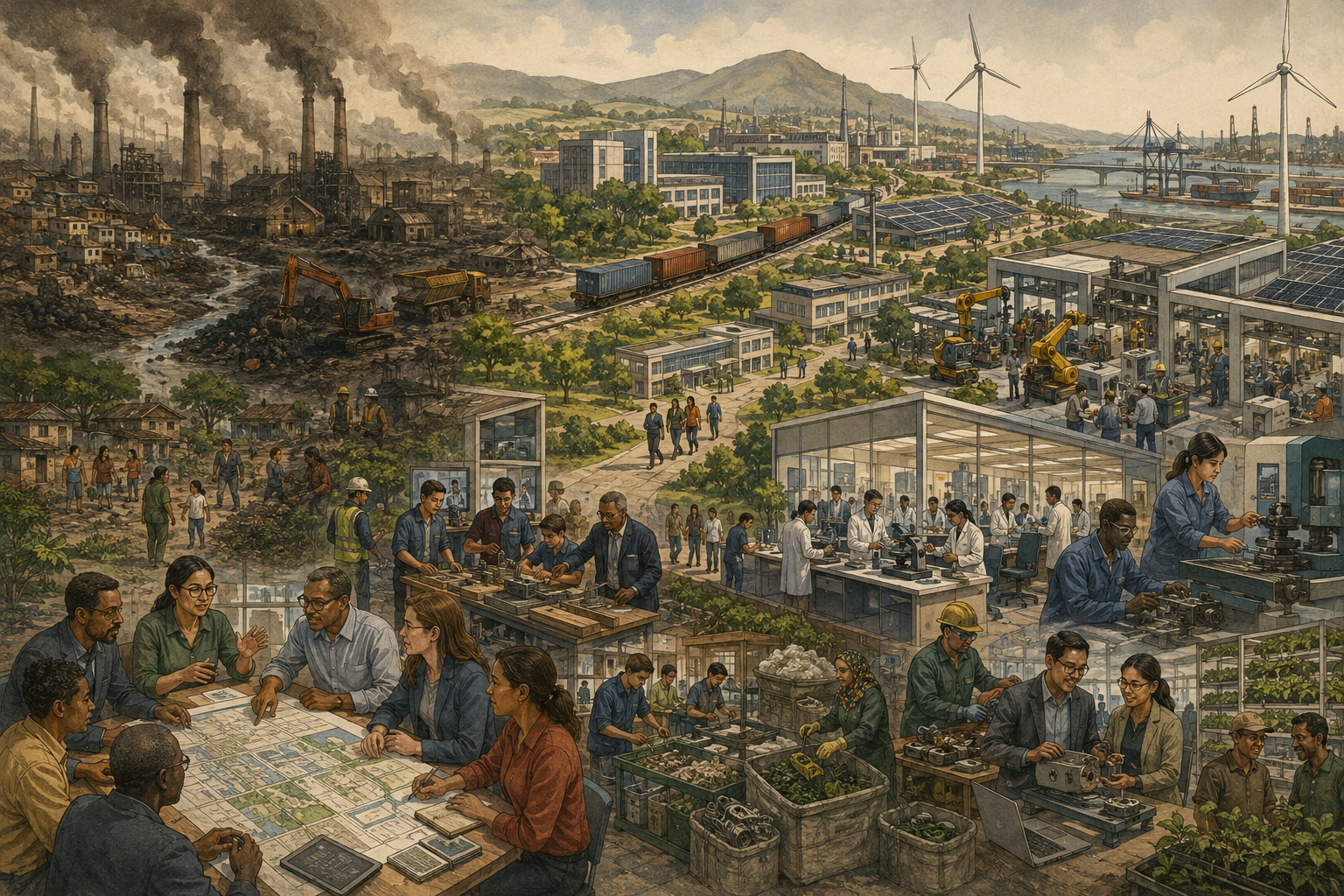
The deeper reason industrial policy matters is that structural transformation rarely occurs through markets alone in a smooth, self-correcting way. Productive upgrading depends on infrastructure, standards, skills, finance, technological learning, trade positioning, coordination across sectors, and institutions capable of sustaining long-horizon investment. Industrial development is therefore not simply the expansion of factories or sectors. It is the organized reshaping of productive possibility.
At the same time, industrial policy is never neutral. It allocates support, shapes winners and losers, redistributes risk, and can entrench concentration or exclusion if designed poorly. Structural transformation can widen employment, capability, and resilience, but it can also deepen regional inequality, ecological burden, or elite capture if policy is disconnected from social inclusion, institutional discipline, and environmental limits. Sustainable structural transformation therefore requires industrial policy that is not merely growth-seeking, but capability-building, socially grounded, and ecologically credible.
What Industrial Policy Means in Development
Industrial policy, in development terms, is broader than subsidies to favored firms or sectors. It refers to deliberate public efforts to shape productive structure, technological capability, investment patterns, and the conditions under which industries emerge, upgrade, diversify, or decline. This matters because industrial policy is not just about supporting “industry” narrowly construed. It is about governing productive transformation across connected systems of production, skills, trade, innovation, infrastructure, finance, standards, and territorial development.
Industrial policy can include public investment, research and development support, credit institutions, procurement rules, export promotion, skills programs, standards infrastructure, energy strategy, cluster development, technology transfer, local-content requirements, industrial parks, green transition incentives, and coordination among firms, universities, workers, regions, and public agencies. Its instruments vary across contexts, but its central purpose is to influence what kinds of productive capabilities an economy builds over time.
This matters because economies do not diversify, upgrade, or decarbonize automatically. Productive systems depend on complementary investments, institutions, standards, logistics, energy systems, skills, and long-horizon expectations. Without policy, these complementarities may remain too risky, too fragmented, or too slow to emerge. Industrial policy is therefore best understood as a response to coordination failures, learning failures, financing constraints, and strategic development bottlenecks rather than as an arbitrary departure from market order.
Industrial policy also differs from simple business support. A tax break that preserves an existing firm without improving productivity, learning, employment quality, ecological performance, or wider ecosystem capability is not necessarily developmental. A more serious industrial policy asks whether public support helps build capabilities that persist beyond the individual intervention: skilled workers, supplier networks, standards compliance, research capacity, export learning, cleaner production systems, and resilient regional economies.
To ask what industrial policy means is therefore to ask how states attempt to shape what an economy becomes capable of producing and sustaining. Sustainable development depends not only on growth rates, but on whether productive structures evolve toward greater resilience, inclusion, learning, and ecological compatibility.
Why Industrial Policy Matters for Structural Transformation
Industrial policy matters because structural transformation rarely occurs through passive specialization alone. Development historically has involved shifts from lower-productivity activities toward higher-productivity, higher-capability, and more technologically dynamic forms of production. A country can grow without building deep productive capability, diversified exports, technological learning, or resilient employment structures. Structural transformation asks a harder question than whether income rises. It asks whether the internal composition of the economy is changing in ways that expand long-run developmental possibility.
This matters because an economy can grow without transforming. Commodity booms, remittances, financial inflows, real-estate expansion, or narrow services growth may lift aggregate output without building the productive architecture needed for durable resilience, broad employment, or adaptive capacity. Industrial policy therefore matters not because every country can or should replicate older industrialization models, but because durable development still depends on shaping productive structure rather than merely accepting inherited comparative advantage.
Structural transformation also matters because productive systems shape the kinds of work available to people. Economies organized around low-wage, low-learning, precarious, or extractive activities do not create the same developmental possibilities as economies that build engineering capability, supplier networks, technical standards, research capacity, and more complex forms of production. Employment quantity matters, but employment quality and learning depth matter as well.
Industrial policy also helps address the fact that private investment alone may underprovide learning. Firms may hesitate to enter new sectors because early costs are high and benefits may spill over to competitors. Workers may not train for industries that do not yet exist. Banks may not finance unfamiliar productive activities. Infrastructure may not be built until demand is proven, while demand may not appear until infrastructure exists. Industrial policy matters when it helps break these circular constraints.
Without some strategy for structural change, economies can remain trapped in lower-value, lower-learning, or more externally vulnerable positions within the global economy. Sustainable transformation requires institutions capable of identifying bottlenecks, coordinating complementary investments, and steering productive change toward social and ecological goals rather than leaving transformation entirely to inherited market structure.
From Growth to Structural Change
One of the most important distinctions in development analysis is the difference between growth and structural change. Growth measures expansion in output. Structural change concerns shifts in sectors, technologies, employment composition, value-added patterns, productivity dynamics, and the capability base of the economy. These can move together, but they do not always do so. A country may experience growth without diversification, productivity deepening, technological upgrading, or social resilience.
This matters because sustainable development depends on the quality of growth as much as its quantity. Growth concentrated in narrow enclaves, extractive sectors, speculative finance, or low-learning activities may fail to generate durable resilience, broad employment, or adaptive capacity. Structural transformation matters because it changes the developmental foundations beneath growth: what kinds of firms emerge, what forms of work expand, what technologies become embedded, what knowledge circulates, and what kinds of shocks the economy can absorb.
Industrial policy enters here as an attempt to influence the composition and trajectory of growth rather than treating output expansion as sufficient by itself. It asks whether growth builds capability, whether new activities create linkages, whether technology diffuses, whether regions gain new productive roles, and whether public investment strengthens the economy’s future options.
This distinction is especially important under ecological constraint. Growth that expands carbon-intensive, resource-extractive, or pollution-heavy systems may create short-term output while worsening long-term development conditions. Sustainable structural transformation asks whether growth is shifting the economy toward lower-carbon production, circular material use, cleaner energy systems, resilience-building infrastructure, and industries that can remain viable under climate and resource constraints.
Industrial policy therefore should not be judged only by whether it increases near-term output. It should be judged by whether it helps change the structure of production in ways that widen long-run capability, reduce vulnerability, expand inclusion, and make economic development more compatible with planetary limits.
Productive Capabilities, Learning, and Upgrading
Industrial policy matters because development depends on productive capabilities, not just capital accumulation. Capabilities include technical know-how, organizational routines, supplier networks, engineering skill, standards compliance, innovation systems, logistics competence, management capacity, and the ability of firms and workers to learn and upgrade. These do not emerge costlessly. They are built through repeated interaction among firms, workers, institutions, infrastructure, and policy supports.
This matters because capability development is cumulative and path dependent. Once firms and institutions gain competence in more complex production, they are often better positioned to move further upward. Where capability remains shallow, economies may find themselves stuck in activities with weak learning spillovers or limited productivity growth. Industrial policy can matter by reducing early risks, supporting technological adaptation, facilitating diffusion, and aligning complementary investments that markets alone may underprovide.
Learning is also collective. A single firm may learn, but productive capability deepens more durably when workers, suppliers, universities, vocational institutions, standards bodies, logistics providers, financial institutions, and public agencies learn together. This is why industrial ecosystems matter. Productive upgrading is not simply the purchase of machinery. It is the accumulation of know-how across networks.
Technology transfer also requires absorptive capacity. Imported equipment, foreign direct investment, or licensing arrangements do not automatically produce domestic capability. Firms and workers must be able to adapt, maintain, modify, and improve technologies. Public policy can help by supporting training, engineering education, research institutions, testing facilities, standards compliance, and supplier-development programs.
Sustainable structural transformation therefore depends on learning-oriented development, not merely on attracting isolated investment. Productive upgrading is developmental because it widens what an economy can reliably make, maintain, improve, and eventually reinvent. Industrial policy is strongest when it supports that widening of capability rather than simply protecting existing firms from competition indefinitely.
Industrial Policy and the Coordination Problem
Industrial policy is fundamentally about coordination. Productive transformation usually requires multiple conditions to be present at once: infrastructure, skilled labor, finance, standards, technology access, logistics, trade support, demand certainty, and institutional credibility. Any one of these may be insufficient if the others are missing.
This matters because many potentially valuable activities fail to emerge not because they lack theoretical competitiveness, but because they lack supporting ecosystems. Firms may not invest because logistics are poor; logistics may not improve because firms have not yet invested. Training may lag because industry demand is weak; industry demand may remain weak because skills are missing. Finance may be unavailable because sectors are unfamiliar; sectors may remain unfamiliar because finance never supports early entrants. Industrial policy matters when it helps solve these mutual dependence problems.
Coordination also matters across time. Productive transformation may require present investments whose benefits appear only later. Private actors may avoid long-horizon investment when returns are uncertain, especially in economies facing political instability, weak infrastructure, volatile exchange rates, or limited domestic markets. Industrial policy can help create credible expectations that complementary investments will arrive.
Coordination matters across sectors as well. Green hydrogen, battery manufacturing, grid equipment, agricultural processing, medical devices, semiconductors, public transport manufacturing, and renewable-energy supply chains all depend on interlinked systems. A single plant or firm is not enough. Energy, logistics, standards, workforce development, research capacity, permitting, procurement, and export strategy must be aligned.
Sustainable development therefore requires more than incentives to individual firms. It often requires ecosystem-building: aligning institutions, infrastructures, standards, skills, and finance so that new productive possibilities become viable and persistent. This section also aligns naturally with Policy Coordination Across Complex Systems.
Industrialization, Services, and the Changing Structure of Development
Industrial policy today must confront a changing global development structure in which services play a growing role. That does not eliminate the importance of productive capability. The key issue is whether services deepen learning, raise productivity, strengthen linkages, and support diversification, or whether they remain low-productivity, informal, and weakly transformative.
This matters because sustainable structural transformation can no longer be equated automatically with a classic manufacturing-first trajectory in every context. Manufacturing remains important because it often supports productivity growth, exports, technological learning, supplier networks, and engineering capability. But contemporary production systems increasingly combine manufacturing, logistics, software, design, data services, maintenance, finance, after-sales support, research, and platform coordination. Industrial policy must understand those linkages rather than treating sectors as isolated categories.
Services can be developmentally transformative when they are tradable, knowledge-intensive, productivity-enhancing, or deeply connected to productive ecosystems. Engineering services, software, logistics, testing, certification, repair, design, research, digital infrastructure, health technology, educational technology, and professional services can all contribute to structural transformation. But services can also expand in low-productivity, precarious, or informal forms that do little to deepen capability.
The question is therefore not whether manufacturing or services matter more in the abstract. The question is what kinds of activities generate learning, productivity, resilience, and broadly shared opportunity. Industrial policy in the current era increasingly concerns productive ecosystems that include manufacturing, tradable services, logistics, digital systems, and knowledge-intensive sectors together.
Sustainable development depends on whether these sectors reinforce one another rather than substitute for transformation altogether. The issue is less whether an economy becomes “industrial” in a narrow historical sense and more whether it acquires more complex, higher-learning, cleaner, and more resilient productive structures.
Green Industrial Policy and Climate-Economic Resilience
Industrial policy has become increasingly bound up with the green transition. Climate mitigation and adaptation are not external constraints sitting outside productive policy. They increasingly shape which industries will expand, which technologies will matter, which infrastructures are viable, and which trade and investment patterns can remain sustainable. Industrial strategy is therefore becoming climate strategy, and climate strategy is becoming industrial strategy.
This matters because the developmental question is no longer only how to industrialize, but how to industrialize, diversify, and upgrade in ways that remain climate-compatible and materially resilient. Green industrial policy matters because the transition is not just environmental. It is also industrial, technological, infrastructural, financial, and geopolitical. Renewable-energy equipment, grid systems, batteries, public transport, building retrofits, green materials, circular manufacturing, climate-resilient agriculture, and adaptation infrastructure all require productive capability.
Green industrial policy also raises distributional questions. Decarbonization can create new industries and jobs, but it can also disrupt fossil-dependent regions, carbon-intensive manufacturing, and workers whose skills are tied to legacy sectors. A sustainable industrial transition must therefore include labor-market strategy, regional development, retraining, social protection, and public investment in places at risk of decline.
Climate-economic resilience also requires reducing exposure to volatile fossil-fuel markets, fragile supply chains, climate shocks, and stranded assets. Industrial policy can help build domestic or regional capabilities in strategic areas, but it can also become protectionist, inefficient, or geopolitically exclusionary if not disciplined by public purpose and international responsibility.
Sustainable structural transformation therefore requires industrial policy that does not treat sustainability as an afterthought. It must align productive upgrading with emissions reduction, resource efficiency, climate adaptation, regional fairness, and long-run resilience. This section also complements Climate Change as a Development Constraint.
Territory, Regions, and Uneven Industrial Transition
Industrial transformation is always territorial. Sectors cluster unevenly, infrastructure is spatially distributed, labor markets differ by region, and transitions create place-specific winners and losers. A national industrial strategy may look coherent at the aggregate level while leaving entire regions exposed to decline, weak connectivity, skill mismatch, environmental burden, or lack of new investment.
This matters because industrial policy can intensify regional divergence if support, infrastructure, and capability-building concentrate only in already-advantaged places. Conversely, well-designed policy can support place-sensitive transition by matching industrial strategy to regional strengths, vulnerabilities, and adaptive needs. Structural transformation that appears successful nationally can remain spatially exclusionary if entire regions are left with declining sectors, weak alternatives, and shrinking institutional capacity.
Territorial transition requires more than moving firms into favored clusters. It requires understanding the assets and constraints of places: energy access, transport links, land availability, workforce skills, educational institutions, supplier networks, environmental conditions, housing, public services, and local governance capacity. An industrial strategy that ignores these conditions may produce announcements without durable transformation.
Regional industrial policy also matters for legitimacy. Communities asked to bear the costs of transition need credible pathways into the future. Workers in legacy sectors need more than abstract promises of innovation. They need training, investment, mobility support, social protection, and regional institutions capable of organizing change. Industrial policy that ignores territorial justice risks producing backlash and mistrust.
Sustainable development therefore requires industrial policy attentive to place. Productive change is not only about national competitiveness; it is also about whether places can transition without being abandoned economically or institutionally. This section also aligns with Local Governance, Cities, and Territorial Development.
Standards, Infrastructure, and Industrial Ecosystems
Industrial policy depends on more than direct subsidies or trade instruments. It also depends on standards, infrastructure, logistics, energy systems, technical institutions, certification bodies, research organizations, public procurement, and supplier ecosystems. Firms do not operate in isolation. They rely on the wider environment that determines whether quality, scale, reliability, and learning can be sustained.
This matters because industrial upgrading often fails when firms receive support but the surrounding ecosystem remains weak. A manufacturer may need reliable electricity, testing facilities, quality certification, skilled technicians, supplier inputs, logistics routes, digital systems, and predictable regulation. If those systems are missing, firm-level assistance may not produce durable competitiveness.
Standards are especially important. They determine whether firms can participate in higher-value markets, meet environmental rules, comply with safety requirements, and integrate into sophisticated supply chains. Standards infrastructure includes laboratories, metrology, certification, inspection, accreditation, and technical assistance. Without these institutions, firms may remain trapped in lower-value production even when they have basic manufacturing capability.
Infrastructure is equally important. Transport, ports, rail, energy, water, digital networks, industrial land, waste systems, and logistics platforms all shape industrial viability. Green industrial policy also requires new forms of infrastructure: renewable electricity, grid flexibility, hydrogen systems where appropriate, recycling networks, battery supply chains, and low-carbon industrial zones.
Sustainable structural transformation therefore depends on building ecosystems, not just sectors. Productive upgrading is stronger when infrastructure, standards, logistics, skills, finance, and institutional supports evolve together. This section also connects to Infrastructure as the Material Basis of Development.
State Capacity, Governance, and Policy Discipline
Industrial policy is only as effective as the institutions that design, coordinate, monitor, and revise it. This requires state capacity, but not merely in the sense of administrative size. It requires diagnostic capability, cross-sector coordination, policy discipline, credible feedback mechanisms, and the ability to adjust support when outcomes disappoint or conditions change.
This matters because industrial policy can fail through capture, fragmentation, poor targeting, permanent subsidy dependence, weak evaluation, or political favoritism. Policy that cannot learn becomes rigid. Policy that cannot discipline support becomes vulnerable to rent-seeking. Policy that cannot coordinate across agencies becomes incoherent. Sustainable structural transformation therefore depends on institutions that can be strategic without becoming arbitrary and supportive without becoming captive.
Governance discipline requires clear criteria. Public support should be tied to performance, learning, investment, employment quality, export capability, emissions reduction, technology diffusion, regional development, or other public objectives. Support should not become a permanent entitlement. Firms and sectors receiving assistance should face expectations, monitoring, and revision. Industrial policy without discipline risks becoming a channel for private gain without public transformation.
Industrial policy also requires embeddedness and autonomy. Institutions need enough connection to firms, workers, regions, and technical experts to understand real constraints. But they also need enough autonomy to avoid capture by the very interests they support. This balance is difficult, but it is central. A state that is too distant may design irrelevant policy; a state that is too captured may subsidize stagnation.
Industrial policy is thus not only about the ambition to transform. It is also about the governance quality required to steer transformation without collapsing into clientelism, inefficiency, or symbolic intervention. This section also aligns naturally with Why Institutions Matter for Sustainable Development.
Path Dependence, Lock-In, and Strategic Choice
Industrial structures are path dependent. Existing sectors, infrastructures, skill profiles, energy systems, financial institutions, trade relationships, land-use patterns, and institutional routines shape what later transformation is able to do. This is why industrial policy is always constrained by inherited structure even as it attempts to reshape it.
This matters because poor strategic choices can lock economies into narrow, low-learning, externally vulnerable, or ecologically costly paths for long periods. Resource dependence, low-value assembly, weak domestic linkages, externally controlled standards regimes, carbon-intensive infrastructure, or fragile supply-chain positions may all limit later developmental space. Industrial policy matters partly because it is one of the few tools through which states try to alter those inherited trajectories deliberately.
Lock-in can also be institutional. Agencies may continue supporting sectors because they are familiar, politically powerful, or administratively easy to defend. Banks may continue lending to legacy industries because they understand them better than new sectors. Training systems may reproduce old skill patterns. Regions may remain dependent on declining activities because no credible alternative investment has appeared. Strategic transformation requires confronting these inherited patterns.
At the same time, path dependence is not only a constraint. It can also be an asset. Existing capabilities can be recombined. A region with metalworking capability may move into renewable-energy components. A textile ecosystem may upgrade into technical fabrics. An electronics cluster may support medical devices or agricultural sensors. Industrial policy should therefore identify adjacent possibilities, not only abstract future sectors.
Sustainable development requires strategic choice under conditions of lock-in. The question is not only how to expand what already exists, but which structures should be deepened, which dependencies reduced, which capabilities recombined, and which futures made easier to build.
Global Value Chains, Trade, and Strategic Dependence
Industrial policy today operates inside global value chains rather than purely national production systems. Components, technologies, standards, finance, logistics, intellectual property, and markets are distributed across borders. This creates opportunities for learning and market access, but it also creates dependence. Economies may enter global production networks without gaining significant domestic capability, value capture, or strategic autonomy.
This matters because participation in global value chains is not automatically transformative. A country may specialize in low-value assembly, resource extraction, or labor-intensive tasks while higher-value design, branding, research, finance, and standards control remain elsewhere. Industrial policy must therefore ask where learning occurs, where profits are retained, which domestic suppliers develop, and whether firms can move into more complex roles over time.
Trade rules, procurement systems, investment agreements, intellectual-property regimes, and geopolitical pressure all shape industrial policy space. Some countries have more room to subsidize, protect, coordinate, or direct investment than others. Unequal global power affects which forms of industrial policy are tolerated, which are challenged, and which development pathways remain available. Sustainable structural transformation therefore cannot be understood apart from global economic order.
Strategic dependence has become more visible in sectors such as semiconductors, batteries, pharmaceuticals, food systems, energy equipment, critical minerals, digital infrastructure, and climate technologies. States now worry not only about efficiency, but about resilience, security, technological sovereignty, and supply-chain vulnerability. Industrial policy has returned partly because global interdependence has become more politically and materially fragile.
The challenge is to avoid false choices. Complete self-sufficiency is neither possible nor desirable for most economies. But passive dependence can also be dangerous. Sustainable industrial strategy requires selective capability-building, regional cooperation, fairer value-chain participation, and trade relationships that support resilience rather than locking countries into permanent low-value roles.
Labor, Skills, and the Social Foundations of Transformation
Industrial policy cannot be separated from labor and skills. Productive transformation changes what workers do, what knowledge is valued, which regions gain employment, and which groups face displacement. A development strategy that builds new industries without building human capability remains fragile. Skills, education, technical training, labor institutions, worker voice, and social protection are not external to industrial policy. They are part of its foundation.
This matters because productive upgrading depends on people. Machines, infrastructure, and firms do not transform economies by themselves. Workers operate, repair, adapt, improve, and transmit knowledge across workplaces. Engineers, technicians, managers, craft workers, logistics workers, care workers, educators, and public officials all contribute to the capability base of an economy. Industrial policy that treats labor only as cost misses the social basis of productivity.
Skills policy must also be anticipatory. Training systems often lag behind industrial strategy. If new sectors expand before workers are prepared, firms may face shortages and communities may be excluded. If workers are trained for sectors that never materialize, public trust weakens. Industrial policy therefore requires coordination between education systems, vocational institutions, firms, unions, regions, and public agencies.
Labor institutions also matter for legitimacy. Structural transformation can produce dislocation. Workers in declining sectors need credible transition pathways, not only abstract promises of future growth. Green industrial policy especially requires just-transition planning: retraining, income support, regional investment, worker participation, and new employment pathways. Without these, industrial transition can appear as abandonment rather than development.
Sustainable structural transformation is strongest when productive upgrading and human development reinforce one another. An economy becomes more capable when workers gain skills, firms learn, institutions coordinate, and regions are not left behind. Industrial policy should therefore be judged not only by output and exports, but by whether it builds the human and social foundations of durable productive change.
Why Industrial Policy Alone Is Not Enough
It is not enough simply to revive industrial policy rhetorically. Industrial policy can become narrow, protectionist, capture-prone, territorially unequal, or environmentally contradictory if it is disconnected from education, infrastructure, labor institutions, competition policy, regional development, ecological governance, public finance, and democratic accountability.
This matters because structural transformation depends on wider social and institutional conditions. Productive upgrading without skill formation is fragile. Export strategy without logistics is thin. Green technology promotion without energy-system reform is partial. Subsidies without discipline can become rent extraction. Industrial strategy without environmental limits can reproduce unsustainable growth. Industrial policy can guide transformation, but it cannot substitute for broader development capacity.
Industrial policy also cannot repair unequal development by itself if the wider economy remains organized around exclusion. If land, finance, education, technology, and political influence are concentrated, public support may flow toward already powerful actors. If regional institutions are weak, new investment may bypass vulnerable places. If labor rights are weak, productivity gains may not translate into decent work. If environmental governance is weak, industrial upgrading may shift pollution rather than reduce it.
Nor is industrial policy a guarantee against global inequality. Lower-income countries may face constrained policy space, debt burdens, technology barriers, climate vulnerability, and unequal trade relationships. Industrial strategy must therefore be linked to international cooperation, technology access, fairer finance, and more legitimate global economic rules.
The deeper goal is therefore not industrial policy as a slogan of intervention, but industrial policy as part of a coherent developmental strategy that links productive change to inclusion, resilience, public accountability, and ecological sustainability. Sustainable structural transformation depends on that broader standard.
Why This Matters for Sustainable Development
Industrial policy and sustainable structural transformation belong together because development depends not only on growth, but on whether economies build more complex, higher-capability, more resilient, and more sustainable productive structures. Productive change does not happen automatically. It depends on coordination, learning, infrastructure, standards, strategic choice, and institutions capable of shaping long-horizon transformation under conditions of uncertainty and competition.
This is why industrial policy matters so much for sustainable development. It reveals a central truth that abstract market-led narratives often understate: long-run development depends on what an economy learns to make, how it organizes production, where value is retained, and whether structural change supports social inclusion and ecological viability rather than undermining them.
The issue is also one of justice. Industrial transformation determines which workers gain stable futures, which regions receive investment, which communities bear pollution, which firms capture value, which countries remain stuck in low-value roles, and which societies build the capabilities needed to adapt under climate and technological change. Sustainable development cannot be credible if structural transformation enriches narrow sectors while leaving workers, regions, ecosystems, or future generations exposed.
To take industrial policy seriously is therefore to take sustainable structural transformation seriously. It is to recognize that development requires not only more output, but deliberate efforts to shape productive systems toward resilience, capability, inclusion, and a more just and climate-compatible future.
Development becomes credible when productive transformation builds capability rather than dependency, strengthens regions rather than abandoning them, supports workers rather than treating them as adjustment costs, and aligns industrial upgrading with ecological limits rather than postponing sustainability to some later stage of growth.
Mathematical Lens
Industrial transformation can be clarified by thinking in terms of productive capability and structural change rather than simple output expansion. Let \(P\) represent productive capability, \(T\) technological upgrading, \(I\) infrastructure and ecosystem support, and \(C\) coordination quality:
S = \alpha P + \beta T + \gamma I + \delta C
\]
Interpretation: Structural transformation capacity rises when productive capability, technological upgrading, ecosystem support, and coordination quality develop together.
This captures a central point in the article: sectors do not move upward simply because demand exists. They move when capability, coordination, and supporting systems develop together.
Transition constraint can be represented as a function of lock-in risk and weak ecosystem conditions:
L = \theta R + \lambda (1 – E)
\]
Interpretation: Transition constraint rises when lock-in risk is high and ecosystem strength is weak.
Here, \(R\) is lock-in risk and \(E\) is ecosystem strength. Higher \(L\) means the productive system is more likely to remain stuck in inherited structures even if growth continues.
Regional transition can also be expressed as a balance between readiness and exposure:
Q = U – V
\]
Interpretation: Territorial transition balance improves when new-sector readiness exceeds legacy-sector exposure.
Here, \(Q\) is territorial transition balance, \(U\) is new-sector readiness, and \(V\) is legacy-sector exposure. Sustainable industrial transition depends not only on where new opportunity exists, but on whether regions can move into it before inherited structures collapse into exclusion.
Finally, a green industrial alignment score can be represented as:
G_i = w_1 D + w_2 K + w_3 Z + w_4 J
\]
Interpretation: Green industrial alignment improves when decarbonization potential, technological capability, infrastructure readiness, and just-transition capacity reinforce one another.
| Term | Meaning | Interpretive role |
|---|---|---|
| \(S\) | Structural transformation capacity | Represents the economy’s ability to shift toward higher-capability, more resilient, and more sustainable productive structures. |
| \(P\) | Productive capability | Represents skills, know-how, organizational routines, supplier networks, and production competence. |
| \(T\) | Technological upgrading | Represents movement into more advanced, knowledge-intensive, or cleaner technologies. |
| \(I\) | Infrastructure and ecosystem support | Represents logistics, energy, standards, finance, research, and supplier-system conditions. |
| \(C\) | Coordination quality | Represents the ability of institutions to align public and private investment across sectors and time. |
| \(L\) | Transition constraint | Represents the degree to which lock-in and weak ecosystems prevent structural change. |
| \(Q\) | Territorial transition balance | Represents the difference between regional readiness for new sectors and exposure to legacy-sector decline. |
| \(G_i\) | Green industrial alignment | Represents how well industrial transformation aligns with decarbonization, capability, infrastructure readiness, and just transition. |
The equations are conceptual rather than predictive. Their value is to make visible the structure of the problem: industrial policy contributes to sustainable development only when productive capability, technological learning, ecological alignment, regional inclusion, governance discipline, and transition readiness are evaluated together.
Advanced Python Workflow: Structural Transformation and Sector Upgrading
This Python workflow translates the article’s core argument into a structured industrial-policy model. Rather than treating industrial transformation as a vague aspiration, it scores countries and sectors across productive capability, structural upgrading, green industrial alignment, regional inclusion, institutional coordination, and lock-in risk. That makes it possible to compare not only which sectors are growing, but which sectors are actually building the deeper capabilities required for resilient and sustainable transformation.
from __future__ import annotations

import pandas as pd
import numpy as np

INPUT_FILE = "industrial_transformation_panel.csv"
OUTPUT_FILE = "structural_transformation_scores.csv"


def load_data(path: str) -> pd.DataFrame:
    """Load country-sector industrial transformation data."""
    df = pd.read_csv(path)

    required_columns = [
        "country",
        "region",
        "sector",
        "manufacturing_value_added_index",
        "services_productivity_index",
        "export_complexity_index",
        "technology_upgrading_index",
        "skills_depth_index",
        "infrastructure_quality_index",
        "supplier_ecosystem_index",
        "green_transition_readiness_index",
        "regional_inclusion_index",
        "institutional_coordination_index",
        "lock_in_risk_index",
    ]

    missing = [col for col in required_columns if col not in df.columns]

    if missing:
        raise ValueError(f"Missing required columns: {missing}")

    return df


def validate_indices(df: pd.DataFrame) -> pd.DataFrame:
    """Ensure all *_index columns are complete and bounded in [0, 1]."""
    index_columns = [col for col in df.columns if col.endswith("_index")]

    for col in index_columns:
        if df[col].isna().any():
            raise ValueError(f"Column '{col}' contains missing values.")

        if ((df[col] < 0) | (df[col] > 1)).any():
            raise ValueError(f"Column '{col}' contains values outside [0, 1].")

    return df


def compute_scores(df: pd.DataFrame) -> pd.DataFrame:
    """Compute productive capability and constrained transition scores."""
    df = df.copy()

    df["productive_capability_score"] = (
        0.20 * df["technology_upgrading_index"] +
        0.18 * df["skills_depth_index"] +
        0.17 * df["supplier_ecosystem_index"] +
        0.15 * df["infrastructure_quality_index"] +
        0.15 * df["institutional_coordination_index"] +
        0.15 * df["export_complexity_index"]
    ).clip(lower=0, upper=1)

    df["structural_transformation_score"] = (
        0.22 * df["manufacturing_value_added_index"] +
        0.15 * df["services_productivity_index"] +
        0.18 * df["productive_capability_score"] +
        0.15 * df["regional_inclusion_index"] +
        0.15 * df["supplier_ecosystem_index"] +
        0.15 * df["technology_upgrading_index"]
    ).clip(lower=0, upper=1)

    df["green_industrial_alignment_score"] = (
        0.35 * df["green_transition_readiness_index"] +
        0.25 * df["technology_upgrading_index"] +
        0.20 * df["infrastructure_quality_index"] +
        0.20 * df["institutional_coordination_index"]
    ).clip(lower=0, upper=1)

    df["constrained_transition_score"] = (
        0.45 * df["structural_transformation_score"] +
        0.25 * df["productive_capability_score"] +
        0.20 * df["green_industrial_alignment_score"] +
        0.10 * (1 - df["lock_in_risk_index"])
    ).clip(lower=0, upper=1)

    df["transition_warning"] = np.select(
        [
            df["lock_in_risk_index"] >= 0.75,
            df["supplier_ecosystem_index"] <= 0.30,
            df["infrastructure_quality_index"] <= 0.30,
            df["green_transition_readiness_index"] <= 0.30,
        ],
        [
            "High lock-in risk",
            "Weak supplier ecosystem",
            "Weak infrastructure foundation",
            "Low green-transition readiness",
        ],
        default="Lower transition fragility warning",
    )

    df["transition_band"] = np.select(
        [
            df["constrained_transition_score"] >= 0.80,
            df["constrained_transition_score"] >= 0.60,
            df["constrained_transition_score"] >= 0.40,
        ],
        [
            "High transition capacity",
            "Strong transition capacity",
            "Moderate transition capacity",
        ],
        default="Constrained transition capacity",
    )

    return df


def build_summary(df: pd.DataFrame) -> pd.DataFrame:
    """Return a ranked country-sector transition summary."""
    columns = [
        "country",
        "region",
        "sector",
        "productive_capability_score",
        "structural_transformation_score",
        "green_industrial_alignment_score",
        "constrained_transition_score",
        "transition_band",
        "transition_warning",
    ]

    summary = df[columns].copy()

    summary = summary.sort_values(
        by=[
            "constrained_transition_score",
            "structural_transformation_score",
            "productive_capability_score",
            "green_industrial_alignment_score",
        ],
        ascending=[False, False, False, False],
    ).reset_index(drop=True)

    return summary


def main() -> None:
    df = load_data(INPUT_FILE)
    df = validate_indices(df)
    scored = compute_scores(df)
    summary = build_summary(scored)

    summary.to_csv(OUTPUT_FILE, index=False)

    print("Structural transformation scoring complete.")
    print(summary.to_string(index=False))


if __name__ == "__main__":
    main()
This workflow is intentionally transparent. It does not reduce industrial strategy to one definitive number. Instead, it makes assumptions visible: value added, services productivity, export complexity, technological upgrading, skills, infrastructure, supplier ecosystems, green readiness, regional inclusion, institutional coordination, and lock-in risk are treated as distinct components. The value is diagnostic. It helps distinguish apparent expansion from genuine upgrading under sustainable-development conditions.
Advanced R Workflow: Regional Transition and Territorial Inequality Analysis
This R workflow is designed for the part of the article that emphasizes territorial unevenness and the geography of industrial transition. It compares countries and regions across manufacturing presence, services productivity, technological upgrading, ecosystem strength, green-transition readiness, regional inclusion, and lock-in risk. The goal is to make visible where industrial transition is broad-based and where it is spatially fragile.
library(readr)
library(dplyr)

input_file <- "industrial_transition_country_panel.csv"
country_output_file <- "cross_country_industrial_transition_summary.csv"
region_output_file <- "regional_industrial_transition_summary.csv"

transition_df <- read_csv(input_file, show_col_types = FALSE)

required_cols <- c(
  "country",
  "region",
  "year",
  "manufacturing_share_index",
  "services_productivity_index",
  "technology_upgrading_index",
  "supplier_ecosystem_index",
  "green_transition_readiness_index",
  "regional_inclusion_index",
  "lock_in_risk_index"
)

missing_cols <- setdiff(required_cols, names(transition_df))

if (length(missing_cols) > 0) {
  stop(paste("Missing required columns:", paste(missing_cols, collapse = ", ")))
}

index_cols <- names(transition_df)[grepl("_index$", names(transition_df))]

invalid_index_cols <- index_cols[
  vapply(
    transition_df[index_cols],
    function(x) any(is.na(x) | x < 0 | x > 1),
    logical(1)
  )
]

if (length(invalid_index_cols) > 0) {
  stop(
    paste(
      "Index columns must be complete and normalized to [0, 1]:",
      paste(invalid_index_cols, collapse = ", ")
    )
  )
}

transition_df <- transition_df %>%
  mutate(
    capability_proxy = (
      technology_upgrading_index +
      supplier_ecosystem_index +
      green_transition_readiness_index +
      regional_inclusion_index
    ) / 4,
    constrained_transition_proxy = (
      manufacturing_share_index +
      services_productivity_index +
      capability_proxy +
      (1 - lock_in_risk_index)
    ) / 4,
    territorial_fragility_proxy = (
      lock_in_risk_index +
      (1 - regional_inclusion_index) +
      (1 - green_transition_readiness_index) +
      (1 - supplier_ecosystem_index)
    ) / 4
  )

country_summary <- transition_df %>%
  group_by(country) %>%
  summarise(
    avg_capability_proxy = mean(capability_proxy, na.rm = TRUE),
    avg_transition_proxy = mean(constrained_transition_proxy, na.rm = TRUE),
    avg_territorial_fragility = mean(territorial_fragility_proxy, na.rm = TRUE),
    avg_lock_in_risk = mean(lock_in_risk_index, na.rm = TRUE),
    avg_green_readiness = mean(green_transition_readiness_index, na.rm = TRUE),
    observations = n(),
    .groups = "drop"
  ) %>%
  mutate(
    transition_band = case_when(
      avg_transition_proxy >= 0.75 ~ "High transition capacity",
      avg_transition_proxy >= 0.55 ~ "Strong transition capacity",
      avg_transition_proxy >= 0.35 ~ "Emerging transition capacity",
      TRUE ~ "Constrained transition capacity"
    )
  ) %>%
  arrange(desc(avg_transition_proxy))

region_summary <- transition_df %>%
  group_by(region) %>%
  summarise(
    avg_capability_proxy = mean(capability_proxy, na.rm = TRUE),
    avg_transition_proxy = mean(constrained_transition_proxy, na.rm = TRUE),
    avg_territorial_fragility = mean(territorial_fragility_proxy, na.rm = TRUE),
    avg_lock_in_risk = mean(lock_in_risk_index, na.rm = TRUE),
    avg_regional_inclusion = mean(regional_inclusion_index, na.rm = TRUE),
    observations = n(),
    .groups = "drop"
  ) %>%
  arrange(desc(avg_transition_proxy))

write_csv(country_summary, country_output_file)
write_csv(region_summary, region_output_file)

cat("Cross-country industrial transition summary exported to:", country_output_file, "\n")
print(country_summary)

cat("\nRegional industrial transition summary exported to:", region_output_file, "\n")
print(region_summary)
R is useful here because industrial policy is not only about national strategy. It is also about patterned regional difference. Some territories enter transition with strong infrastructure and supplier ecosystems; others face legacy-sector dependence and weak alternatives. The grouped summaries help reveal whether transformation is broad-based or concentrated in already-advantaged places.
Advanced Go Workflow: Lightweight Sector Readiness Scoring Service
This Go workflow is useful when the article’s industrial-policy logic needs to move from analysis into a lightweight operational service. Python and R are strong for diagnostics and comparative summaries, but Go is a good fit for a lean scoring utility that can ingest sector records and return a constrained transition score quickly. In practical terms, this kind of service could sit behind a dashboard, a ministry tool, or an industrial-ecosystem assessment workflow.
package main

import (
	"encoding/csv"
	"fmt"
	"os"
	"strconv"
)

type SectorRecord struct {
	Country                      string
	Region                       string
	Sector                       string
	ManufacturingValueAddedIndex float64
	ServicesProductivityIndex    float64
	ExportComplexityIndex        float64
	TechnologyUpgradingIndex     float64
	SkillsDepthIndex             float64
	InfrastructureQualityIndex   float64
	SupplierEcosystemIndex       float64
	GreenTransitionReadiness     float64
	RegionalInclusionIndex       float64
	InstitutionalCoordination    float64
	LockInRiskIndex              float64
}

func parseFloat(value string) (float64, error) {
	parsed, err := strconv.ParseFloat(value, 64)
	if err != nil {
		return 0, err
	}

	if parsed < 0 || parsed > 1 {
		return 0, fmt.Errorf("index value outside [0, 1]: %f", parsed)
	}

	return parsed, nil
}

func parseRecord(row []string) (SectorRecord, error) {
	if len(row) != 14 {
		return SectorRecord{}, fmt.Errorf("invalid record length: expected 14 columns")
	}

	values := make([]float64, 11)

	for i, col := range row[3:] {
		value, err := parseFloat(col)
		if err != nil {
			return SectorRecord{}, err
		}
		values[i] = value
	}

	return SectorRecord{
		Country:                      row[0],
		Region:                       row[1],
		Sector:                       row[2],
		ManufacturingValueAddedIndex: values[0],
		ServicesProductivityIndex:    values[1],
		ExportComplexityIndex:        values[2],
		TechnologyUpgradingIndex:     values[3],
		SkillsDepthIndex:             values[4],
		InfrastructureQualityIndex:   values[5],
		SupplierEcosystemIndex:       values[6],
		GreenTransitionReadiness:     values[7],
		RegionalInclusionIndex:       values[8],
		InstitutionalCoordination:    values[9],
		LockInRiskIndex:              values[10],
	}, nil
}

func clamp01(x float64) float64 {
	if x < 0 {
		return 0
	}

	if x > 1 {
		return 1
	}

	return x
}

func constrainedTransition(record SectorRecord) float64 {
	productiveCapability := 0.20*record.TechnologyUpgradingIndex +
		0.18*record.SkillsDepthIndex +
		0.17*record.SupplierEcosystemIndex +
		0.15*record.InfrastructureQualityIndex +
		0.15*record.InstitutionalCoordination +
		0.15*record.ExportComplexityIndex

	structuralTransformation := 0.22*record.ManufacturingValueAddedIndex +
		0.15*record.ServicesProductivityIndex +
		0.18*productiveCapability +
		0.15*record.RegionalInclusionIndex +
		0.15*record.SupplierEcosystemIndex +
		0.15*record.TechnologyUpgradingIndex

	greenAlignment := 0.35*record.GreenTransitionReadiness +
		0.25*record.TechnologyUpgradingIndex +
		0.20*record.InfrastructureQualityIndex +
		0.20*record.InstitutionalCoordination

	score := 0.45*structuralTransformation +
		0.25*productiveCapability +
		0.20*greenAlignment +
		0.10*(1-record.LockInRiskIndex)

	return clamp01(score)
}

func band(score float64) string {
	switch {
	case score >= 0.80:
		return "High transition capacity"
	case score >= 0.60:
		return "Strong transition capacity"
	case score >= 0.40:
		return "Moderate transition capacity"
	default:
		return "Constrained transition capacity"
	}
}

func main() {
	file, err := os.Open("industrial_transformation_panel.csv")
	if err != nil {
		fmt.Println("Error opening CSV:", err)
		return
	}
	defer file.Close()

	reader := csv.NewReader(file)

	rows, err := reader.ReadAll()
	if err != nil {
		fmt.Println("Error reading CSV:", err)
		return
	}

	for i, row := range rows {
		if i == 0 {
			continue
		}

		record, err := parseRecord(row)
		if err != nil {
			fmt.Println("Parse error:", err)
			continue
		}

		score := constrainedTransition(record)

		fmt.Printf(
			"country=%s region=%s sector=%s constrained_transition_score=%.3f band=%s\n",
			record.Country,
			record.Region,
			record.Sector,
			score,
			band(score),
		)
	}
}
The point is not to build a full industrial-policy platform inside the article. The point is to show how structural-transformation logic can be operationalized cleanly: define sector indicators, validate the data, compute constrained transition capacity, and return a readable score and band. This gives analytical policy work a path toward dashboards, lightweight services, and reproducible decision support.
GitHub Repository
Complete Code Repository
The full code distribution for this article, including structural-transformation scoring workflows, green-transition diagnostics, regional inequality analysis, optional sector-readiness service tooling, supporting documentation, and repository structure, is available on GitHub.
Related Articles
- Economic Systems
- Innovation, Technology Transfer, and Leapfrogging
- Business as Usual vs Sustainable Development
- Climate Change as a Development Constraint
- Infrastructure as the Material Basis of Development
- Policy Coordination Across Complex Systems
- State Capacity, Public Administration, and Delivery Systems
- Local Governance, Cities, and Territorial Development
- Inequality and Inclusive Development
- Why Institutions Matter for Sustainable Development
Further Reading
- United Nations Department of Economic and Social Affairs (n.d.) Goal 9: Build resilient infrastructure, promote inclusive and sustainable industrialization and foster innovation. Available at: https://sdgs.un.org/goals/goal9
- UNIDO (n.d.) Industrial Policy Advice and Capacity Development. Available at: https://www.unido.org/industrial-policy-advice-and-capacity-development
- UNIDO (2025) SDG 9 Progress Report 2025. Available at: https://stat.unido.org/portal/storage/file/publications/sdg/2025/sdg9-report-2025.pdf
- OECD (2025) Industrial Policy for the Future. Available at: https://www.oecd.org/en/publications/industrial-policy-for-the-future_273954e9-en.html
- OECD (n.d.) Green industrial policies. Available at: https://www.oecd.org/en/topics/green-industrial-policies.html
- OECD (n.d.) Regional development policy for industrial transition. Available at: https://www.oecd.org/en/about/projects/regional-development-policy-for-industrial-transition.html
- OECD (2025) An ecosystems approach to industrial policy, in OECD Science, Technology and Innovation Outlook 2025. Available at: https://www.oecd.org/en/publications/oecd-science-technology-and-innovation-outlook-2025_5fe57b90-en/full-report/an-ecosystems-approach-to-industrial-policy_a9c00ad7.html
References
- United Nations Department of Economic and Social Affairs (n.d.) Goal 9: Build resilient infrastructure, promote inclusive and sustainable industrialization and foster innovation. Available at: https://sdgs.un.org/goals/goal9
- UNIDO (n.d.) Industrial Policy Advice and Capacity Development. Available at: https://www.unido.org/industrial-policy-advice-and-capacity-development
- UNIDO (2025) Statistical Indicators of Inclusive and Sustainable Industrialization: SDG 9 Progress Report 2025. Available at: https://stat.unido.org/portal/storage/file/publications/sdg/2025/sdg9-report-2025.pdf
- OECD (2025) Industrial Policy for the Future. Available at: https://www.oecd.org/en/publications/industrial-policy-for-the-future_273954e9-en.html
- OECD (n.d.) Industrial policy. Available at: https://www.oecd.org/en/topics/industrial-policy.html
- OECD (n.d.) Green industrial policies. Available at: https://www.oecd.org/en/topics/green-industrial-policies.html
- OECD (2025) An ecosystems approach to industrial policy, in OECD Science, Technology and Innovation Outlook 2025. Available at: https://www.oecd.org/en/publications/oecd-science-technology-and-innovation-outlook-2025_5fe57b90-en/full-report/an-ecosystems-approach-to-industrial-policy_a9c00ad7.html
- OECD (n.d.) Regional development policy for industrial transition. Available at: https://www.oecd.org/en/about/projects/regional-development-policy-for-industrial-transition.html