
Last Updated May 6, 2026
Sustainable development is the long-run project of improving human wellbeing, reducing deprivation, expanding human capability, and building durable social, economic, ecological, and political institutions without undermining the systems on which future prosperity depends. It asks how societies can expand health, education, infrastructure, security, opportunity, and public dignity while remaining attentive to environmental limits, systemic interdependence, unequal vulnerability, delayed feedbacks, and the long time horizons through which benefits and harms accumulate.
Sustainable development is often invoked as a broad aspiration, but it is better understood as a serious intellectual, political, ethical, and practical problem. Modern development has delivered extraordinary gains in life expectancy, productive capacity, communication, mobility, and material welfare. Yet those gains have also been accompanied by climate instability, biodiversity loss, pollution, extractive land use, resource pressure, widening inequalities, and forms of institutional fragility that expose the limits of development measured by output alone.
By integrating development economics, human development theory, governance, systems thinking, ecology, infrastructure, public finance, political economy, and Earth-system science, sustainable development provides a framework for understanding how human flourishing can be pursued under conditions of planetary constraint. It is not a niche environmental concern. It is one of the central questions of long-run social order: how human societies can become more prosperous, just, capable, and resilient without exhausting the ecological and institutional foundations that make prosperity possible.
Main Library
Publications
Article Map
Sustainable Development
Related Topic
Planetary Boundaries
Related Topic
Risk & Resilience
Related Topic
Economic Systems
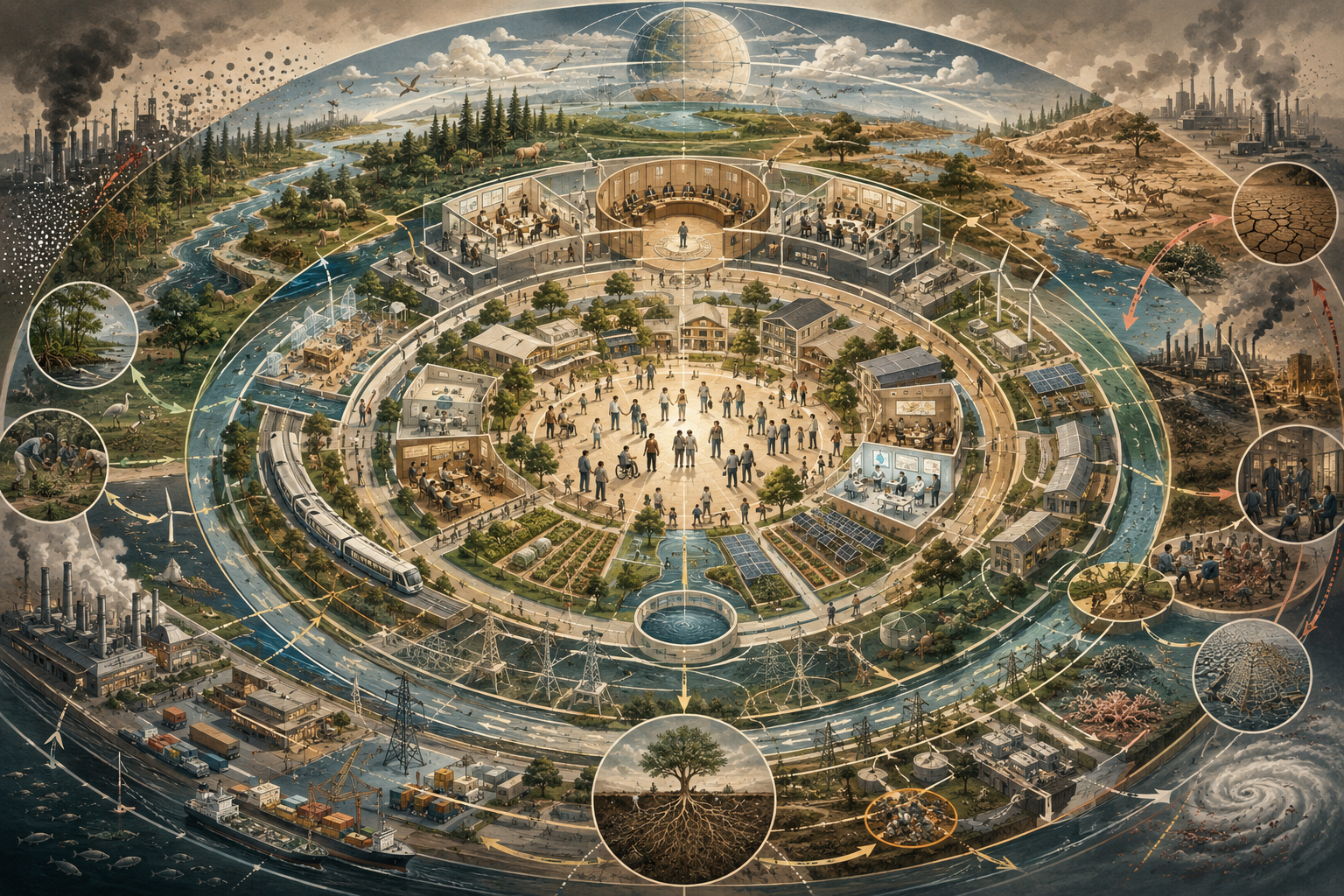
The concept gained its canonical formulation in the 1987 Brundtland Report, which defined sustainable development as development that meets the needs of the present without compromising the ability of future generations to meet their own needs. That definition remains influential because it links present welfare to long-run responsibility, and because it frames development not as an enemy of sustainability but as a project that must be reoriented by justice, interdependence, and temporal discipline.
Today, sustainable development is shaped by a wider architecture that includes the 2030 Agenda, the 17 Sustainable Development Goals, the Human Development Reports, multidimensional poverty analysis, ecological economics, resilience theory, climate-risk analysis, and Earth-system research on planetary boundaries. These frameworks differ in emphasis, but they converge on a common insight: societies cannot treat prosperity, social inclusion, institutional capacity, and ecological stability as separate domains. They are interwoven parts of a larger system.
That larger system is uneven. The burdens of unsustainable development do not fall equally. Poor communities, colonized and formerly colonized societies, Indigenous peoples, racialized populations, low-lying coastal communities, informal workers, women performing unpaid care labor, and future generations often bear risks generated by decisions from which they received little benefit. Sustainable development therefore cannot be reduced to technical optimization. It is also a question of justice, historical responsibility, public legitimacy, and the distribution of risk across people, places, and time.
The Core Definition
The most widely cited definition of sustainable development comes from Our Common Future, the report of the World Commission on Environment and Development. It defines sustainable development as development that meets the needs of the present without compromising the ability of future generations to meet their own needs. The endurance of this definition lies in the fact that it combines moral urgency with structural realism. It recognizes that development remains necessary because people require food, shelter, health, education, infrastructure, energy, security, and meaningful opportunity. At the same time, it rejects the idea that present prosperity can be pursued by eroding the conditions of future wellbeing.
That formulation contains two especially important ideas. The first is the priority of needs, particularly the essential needs of poorer populations for whom development remains an urgent material and moral requirement. The second is the idea of limitation: not an abstract rejection of development, but an acknowledgment that ecosystems, institutions, technology, and material resources shape what can be sustained over time. Sustainable development therefore concerns both distributive justice in the present and responsibility across generations.
Used rigorously, the concept does not imply simple harmony. Sustainable development does not assume that economic growth, social equity, environmental integrity, and political legitimacy align automatically. Rather, it asks what kind of development can remain viable when those domains are treated as interdependent and when the consequences of present decisions are allowed to extend across decades rather than electoral cycles. That is what makes it a demanding analytical framework rather than a soft moral slogan.
A more precise way to put the point is this: sustainable development is not merely about reducing damage. It is about constructing forms of prosperity, capability, coordination, and public legitimacy that can endure under conditions of ecological interdependence, material finitude, institutional complexity, and unequal power. It asks not only how societies grow, but how they remain governable, resilient, inclusive, and just while they do so.
Intellectual History and Conceptual Evolution
The deeper intellectual history of sustainable development lies at the intersection of several traditions. Postwar development theory often treated industrialization, modernization, and rising national output as the principal markers of progress. Later critiques complicated that view by showing that growth could coexist with exclusion, dependency, ecological degradation, authoritarian governance, and institutional weakness. By the late twentieth century, environmental politics and systems thinking had made it harder to ignore the fact that economic development was embedded in finite ecological systems. The Brundtland formulation emerged from precisely this historical tension: development remained necessary, but its prevailing form had become increasingly unstable.
In the decades that followed, the concept evolved in at least three important ways. First, it became more explicitly linked to human development, especially through the capability-oriented work institutionalized in the UNDP Human Development Reports, which define development in terms of people’s freedoms and opportunities rather than output alone. Second, it became more operational through the 2030 Agenda and the Sustainable Development Goals, which translated broad principles into a universal but highly ambitious policy architecture. Third, it became more tightly linked to Earth-system science through research on planetary boundaries, which reframed sustainability as a question of whether human activity remains inside a safe operating space for humanity.
This evolution matters because it shows that sustainable development is not one idea but a layered field. It includes moral claims about justice, economic claims about welfare and production, political claims about institutions and governance, and scientific claims about ecological thresholds and long-run stability. A serious account of sustainable development must therefore hold all of these together rather than reducing the field to any single tradition.
The field’s conceptual evolution also explains why sustainable development resists narrow ideological capture. It is not reducible to environmentalism, though environmental integrity is central to it. It is not reducible to growth economics, though material welfare and infrastructure remain indispensable. It is not reducible to governance reform, though institutional capacity is decisive. Its intellectual seriousness lies in forcing these domains into sustained conversation.
It also forces development history to confront power. Colonial extraction, racial capitalism, unequal land relations, forced labor, resource dependency, debt, unequal terms of trade, and geopolitical hierarchy shaped many of the development pathways that now appear as “underdevelopment” or “fragility.” Sustainable development is strongest when it does not erase those histories. The field must ask not only how development can be made sustainable in the future, but how past patterns of extraction and exclusion continue to structure vulnerability in the present.
Why Growth Alone Is Not Enough
Economic growth matters because it can expand state capacity, increase incomes, support infrastructure, finance public goods, and improve access to goods and services. Historically, it has been indispensable to many forms of poverty reduction and material improvement. But growth alone is an inadequate measure of development because it tells us too little about distribution, capability, resilience, ecological cost, public legitimacy, or long-run institutional durability. A society may become richer in aggregate while remaining unequal, institutionally brittle, environmentally degraded, or politically exclusionary. In that sense, growth is a means whose developmental value depends on how it is generated, distributed, governed, and sustained.
A narrow growth metric also fails to capture slow-moving forms of fragility. Growth may be driven by resource depletion, land degradation, fossil-energy lock-in, speculative finance, extractive labor arrangements, or underinvestment in public goods. It may conceal deteriorating health outcomes, infrastructure deficits, fiscal vulnerability, ecological overshoot, or rising exposure to climate and water stress. These pressures do not always register immediately in headline economic statistics, but they can shape long-run viability in decisive ways.
Sustainable development expands the evaluative lens by asking not only whether output is rising, but whether societies are becoming more capable, more resilient, less exclusionary, and less likely to compromise their future conditions of stability. It asks whether development produces durable public goods or merely private accumulation; whether infrastructure expands real capability or locks societies into fragile pathways; whether productivity gains are shared or captured; and whether ecological costs are accounted for or displaced onto poorer communities and future generations.
This does not make sustainable development anti-growth. It makes it anti-reductionist. It resists the idea that economic expansion can stand in for the full substance of development, and it insists that prosperity without social inclusion, institutional credibility, or ecological discipline is unstable by definition.
That is why this series links From Economic Growth to Human Development, Growth, Limits, and the Problem of Overshoot, Inequality and Inclusive Development, and How Sustainable Development Is Measured. Growth remains historically important, but it cannot be the sole criterion by which development is judged.
What Sustainable Development Is Not
Sustainable development is sometimes weakened by overuse. Because the phrase can be attached to almost any policy, project, product, investment, or institutional statement, it risks becoming decorative unless it is tied to clear standards of analysis. A rigorous definition helps prevent the term from becoming an empty signal of virtue.
Sustainable development is not the same as corporate sustainability branding. A company may reduce emissions, issue disclosures, publish environmental commitments, or finance green projects, but those activities do not automatically constitute sustainable development unless they improve real social and ecological outcomes, respect affected communities, and avoid shifting harm elsewhere. Nor is sustainable development the same as environmental protection alone. A strategy that protects ecosystems while ignoring poverty, hunger, housing, public health, sanitation, or energy access cannot answer the developmental question.
Sustainable development is also not identical to technological optimism. Innovation matters, but technology cannot substitute for institutions, law, public accountability, social trust, and fair distribution. Clean-energy technologies, digital public infrastructure, remote sensing, AI systems, and precision agriculture can support sustainable development, but they can also deepen extraction, surveillance, dependency, displacement, and unequal access if deployed without democratic safeguards and public purpose.
Finally, sustainable development is not a promise that all goals can be reconciled easily. It does not eliminate conflict between land use and biodiversity, energy access and emissions, infrastructure expansion and ecological integrity, or short-term welfare and long-term resilience. Instead, it provides a disciplined framework for identifying those tensions, making trade-offs visible, protecting vulnerable communities, and designing institutions capable of learning over time.
Sustainable Development and Adjacent Frameworks
Sustainable development is often confused with a number of adjacent frameworks, and clarifying those distinctions helps sharpen the concept. It is not identical to conventional development, because conventional development can privilege output growth while leaving ecological and distributive questions secondary. It is not identical to environmental protection, because sustainability without livelihoods, public health, education, and infrastructure is not a viable developmental project. Nor is it identical to resilience alone, because resilience can describe the persistence of undesirable systems as well as desirable ones.
It also differs from ecological modernization and green-growth optimism when those frameworks assume that technological efficiency alone can resolve structural contradictions. Technology matters enormously, but sustainable development cannot be reduced to cleaner production or better innovation. Institutions, law, finance, political legitimacy, and social distribution remain central. At the same time, sustainable development is not automatically equivalent to degrowth or post-growth critique. Those perspectives raise important questions about throughput, consumption, and scale, but sustainable development retains a stronger commitment to expanding material sufficiency and capability where deprivation persists. Its central concern is not less activity as such, but development that is socially just and ecologically viable over time.
These distinctions matter because they show that sustainable development is a synthetic framework. It sits between narrow economism and narrow environmentalism. It is concerned with human flourishing, but it refuses to imagine flourishing outside biophysical conditions. It is concerned with limits, but it refuses to treat limits as a reason to abandon the developmental claims of the poor. In that sense, sustainable development is best understood as a framework for redesigning development rather than rejecting it.
This series explores those distinctions further through articles on The Brundtland Definition and Its Legacy, Trade-Offs, Synergies, and Policy Coherence, Intergenerational Justice and Long-Term Stewardship, and Future Directions in Sustainable Development Thought.
Human Development, Capability, and Welfare
Human development theory deepens sustainable development by shifting the focal point from production to capability. Instead of asking only how much an economy produces, it asks what people are actually able to be and do: whether they can live long and healthy lives, gain education, exercise agency, participate meaningfully in society, enjoy security, and pursue lives they have reason to value. The UNDP’s human development tradition is especially important here because it defines development in terms of expanding choices and freedoms rather than merely increasing income.
Once development is understood in human terms, sustainability becomes sharper rather than vaguer. A development pathway that raises output while degrading ecosystems, deepening inequality, or weakening public institutions may improve short-term indicators while eroding long-run capability. Human development and sustainable development therefore belong together. The former clarifies what development is for; the latter clarifies the conditions under which development can endure. This is one reason multidimensional poverty analysis has become so important: it reveals deprivation that aggregate income metrics often conceal and shows how vulnerability can overlap with climate and environmental exposure.
Human capability also changes how infrastructure is evaluated. Roads, schools, clinics, broadband systems, water networks, sanitation systems, housing, and electricity grids are not merely capital assets. They are capability systems. They determine whether people can learn, work, move, communicate, remain healthy, withstand shocks, and participate in public life. Sustainable development therefore asks whether infrastructure expands substantive freedom while remaining resilient, affordable, inclusive, and ecologically responsible.
Sustainable development, then, is not merely about preserving resources. It is about building the social and material bases of human flourishing in ways that do not cannibalize the future. Capability, dignity, and inclusion remain central, but they must be secured through pathways that are institutionally and ecologically durable.
For that reason, this knowledge series connects sustainable development directly to Poverty, Deprivation, and Multidimensional Development, Health, Education, and Human Capability Expansion, Gender, Exclusion, and Development Justice, and Human Development Indicators and Their Limits.
Ecological Limits and Earth-System Conditions
Sustainable development requires a serious account of ecological constraint because human societies do not develop outside nature. They develop within biophysical systems that provide climate regulation, freshwater, fertile soils, ecosystem services, energy resources, and material inputs. Economic activity depends on these systems even when policy and markets fail to represent them adequately. This means ecological stability is not an optional environmental concern added onto development after the fact. It is part of the background structure that makes development possible in the first place.
Contemporary Earth-system science sharpens this argument by identifying large-scale processes whose destabilization raises systemic risk. The planetary-boundaries framework links sustainability to the maintenance of Earth-system stability rather than to vague environmental preference. The framework identifies nine global processes through which human activity affects Earth-system functioning, and recent summaries from the Stockholm Resilience Centre state that seven of nine boundaries have now been transgressed.
This has major implications for development thought. Climate disruption affects infrastructure, food systems, health, migration, insurance, public finance, and economic security. Freshwater change affects cities, agriculture, sanitation, hydropower, industry, and ecosystems. Biosphere degradation, land-system change, nutrient loading, ocean acidification, novel entities, and pollution alter the conditions under which human systems operate. Sustainable development must therefore ask not only how societies improve welfare, but under what ecological conditions those improvements remain durable.
Any account of development that ignores threshold effects, cumulative pressures, ecological debt, and boundary transgression is likely to mistake short-run gain for long-run viability. The question is not whether development should stop, but whether development pathways can be redesigned so that human capability expands while Earth-system pressures decline toward safer operating conditions.
This is why the series gives a central place to Planetary Boundaries and Sustainable Development, Climate Change as a Development Constraint, Freshwater Change and Development Risk, Boundary Transgression and Development Fragility, and Ecological Thresholds, Nonlinearity, and Systemic Risk.
Unequal Vulnerability and Historical Responsibility
Sustainable development becomes morally serious when it recognizes that vulnerability is not randomly distributed. Many communities most exposed to climate disruption, pollution, land degradation, water stress, food insecurity, and infrastructure failure contributed least to the systems that generated those risks. This is visible across global North–South inequalities, colonial histories of extraction, racialized environmental burdens, Indigenous land dispossession, informal settlements, sacrifice zones, and the unequal capacity of states to finance adaptation and public goods.
Historical responsibility does not mean reducing sustainable development to blame. It means refusing to treat present vulnerability as if it were detached from history. Colonial land systems, plantation economies, extractive mining, debt dependency, imposed borders, unequal trade, fossil-fuel industrialization, and financial hierarchy have shaped who accumulated wealth, who absorbed ecological damage, and who now has fiscal space to respond. A sustainable-development framework that ignores these structures risks treating symptoms as isolated technical problems.
This matters especially for climate and biodiversity policy. A purely aggregate model might say that emissions must fall, forests must be protected, or resource use must decline. Those claims may be scientifically necessary, but they are politically incomplete unless they ask who bears the costs of transition, who has already benefited from high-carbon development, who controls land and capital, and who receives finance, technology, and institutional support. Without that distributional analysis, sustainability can become another language through which powerful actors discipline poorer communities while preserving their own privileges.
A just account of sustainable development therefore requires differentiated responsibility, public participation, community knowledge, procedural rights, and attention to the voices of people most affected by environmental and development decisions. It must protect future generations, but it must also protect present communities whose futures are already being narrowed by poverty, extraction, displacement, ecological harm, and institutional neglect.
Institutions, Governance, and State Capacity
Sustainable development is not achieved by values alone. It depends on institutions: states, cities, legal systems, public administrations, regulatory bodies, international organizations, development banks, courts, civic structures, and monitoring systems capable of coordinating action across time and across sectors. Institutions determine whether resources are mobilized, whether public goods are delivered, whether rights are enforced, whether risks are monitored, and whether collective goals become credible policy rather than declarative aspiration.
This institutional dimension is often underappreciated. Development strategies can fail not because their goals are incoherent, but because the institutional capacity required to implement them is fragmented, underfinanced, corrupt, captured, or politically contested. The same is true for sustainability goals. Climate adaptation, water governance, industrial transition, social protection, and infrastructure planning all require organizations capable of long-term coordination. Without such institutions, the language of sustainability can become ceremonial while underlying systems remain unchanged.
Sustainable development therefore includes governance as a core analytic category. It asks whether societies possess the administrative competence, legitimacy, financing mechanisms, legal frameworks, public accountability, and political coalitions needed to align short-run welfare needs with long-run ecological and social stability. This is one reason the field cannot be reduced to technocratic design. It is as much about power, coordination, and public capacity as it is about targets or optimization.
State capacity matters, but so does democratic legitimacy. Institutions that can deliver infrastructure but silence affected communities may produce development without justice. Institutions that invite participation but cannot deliver services may produce legitimacy without capacity. Sustainable development requires both: capable institutions and accountable institutions. It requires public systems that can act, learn, correct, and remain answerable to the people whose lives are shaped by development decisions.
This series develops that dimension through articles on Why Institutions Matter for Sustainable Development, State Capacity, Public Administration, and Delivery Systems, Law, Rights, and Sustainable Development, Corruption, Accountability, and Institutional Trust, and Policy Coordination Across Complex Systems.
Systems Thinking, Trade-Offs, and Long-Run Viability
One reason sustainable development is intellectually demanding is that it rarely involves simple win-win logic. Some policies do generate reinforcing gains: clean energy can reduce emissions while improving air quality and long-term energy security; education can improve health, productivity, and social mobility; sanitation can reduce disease burden while strengthening economic participation. But development also produces difficult trade-offs. Industrialization may raise incomes while increasing material throughput and emissions. Urban growth may widen opportunity while intensifying housing strain and land conversion. Agricultural expansion may improve food supply while destabilizing water systems, nutrient cycles, or biodiversity.
Systems thinking is valuable here because it moves beyond static comparison and asks how interventions behave over time. It draws attention to delayed effects, cumulative pressures, path dependence, technological and infrastructural lock-in, cross-sector spillovers, and policy resistance. A strategy may appear beneficial in the short run while generating fragility that becomes visible only later. Conversely, investments that look costly in the present may improve resilience and welfare across longer horizons. Sustainable development therefore requires temporal intelligence as well as moral ambition.
The field is also concerned with scale. Local gains do not always aggregate globally, and global solutions do not always fit local institutional realities. Development pathways are mediated by geography, capacity, inequality, and political context. This means sustainable development cannot be managed as a uniform formula. It must be understood as a problem of coordination across levels, sectors, and time horizons. The relevant question is not whether all goals can be perfectly reconciled, but how societies can govern irreducible tensions without sacrificing either human dignity or ecological viability.
Systems thinking also helps explain why sustainable development cannot rely only on end-state targets. Goals matter, but the path matters too. A system can appear to move toward a target while increasing hidden fragility. Another system may move slowly but build durable capacity. The difference lies in feedback, institutional learning, resilience, and adaptive governance. Sustainable development therefore requires attention not only to what is measured, but to how systems respond when policies enter the real world.
That is why the later parts of this series move toward Resilience Thinking and Sustainable Development, Risk, Shock, and Fragility in Development Systems, Scenario Planning for Sustainable Futures, and Development Under Deep Uncertainty. Sustainable development increasingly requires thinking in systems, not slogans.
Measurement, Indicators, and Public Accountability
Sustainable development depends on measurement, but it cannot be reduced to measurement. Indicators help societies observe poverty, health, education, infrastructure access, emissions, land use, water stress, fiscal capacity, institutional performance, gender inequality, and ecological pressure. Without measurement, public accountability weakens. Claims about progress become difficult to verify, compare, or contest. The SDG indicator architecture, human-development indices, multidimensional poverty measures, environmental monitoring systems, and national statistical systems therefore play an important role in making development visible.
Yet measurement is never neutral. Indicators define what counts, who is counted, and what remains invisible. A dashboard may clarify broad patterns while concealing local experience. A composite index may support comparison while masking internal inequality. Administrative data may help deliver services while excluding people without documentation or digital access. Environmental indicators may reveal aggregate stress while failing to identify who bears the harm. Sustainable development therefore requires not only better data, but better public reasoning about data.
The strongest measurement systems are transparent, disaggregated, auditable, and open to revision. They allow uncertainty to be communicated rather than hidden. They show trade-offs rather than flattening them. They support participation rather than replacing it. They help institutions learn from failure. In this sense, sustainable-development indicators are not merely technical instruments. They are part of the public infrastructure of accountability.
This is why measurement connects directly to governance. What a society measures often shapes what it funds, regulates, rewards, and remembers. If progress is measured only through output, then deprivation, ecological degradation, care work, public health, and future risk may remain peripheral. If sustainability is measured only through carbon, then biodiversity, water, labor, land, and justice may be neglected. A rigorous sustainable-development framework must therefore combine quantitative evidence with institutional judgment and democratic contestability.
Technology, Infrastructure, and Development Pathways
Technology is central to sustainable development because modern wellbeing depends on infrastructures, tools, platforms, energy systems, communication networks, and scientific capabilities. Electricity, water systems, sanitation networks, roads, ports, railways, hospitals, schools, broadband, sensors, satellites, agricultural technologies, financial systems, and public data infrastructures all shape the possibility of development. Technology is not external to sustainable development. It is one of the ways development becomes material.
But technology is not automatically sustainable or just. The same digital systems that improve service delivery can deepen surveillance. The same energy-transition technologies that reduce emissions can generate new mineral pressures, land conflicts, labor abuses, or geopolitical dependencies. The same AI systems that support planning can reproduce bias, obscure accountability, or replace public judgment with opaque scoring. The same infrastructure that expands mobility can fragment ecosystems or displace communities. Sustainable development must therefore ask not only what technology can do, but who governs it, who benefits from it, who is harmed by it, and whether it reduces or merely relocates risk.
Infrastructure is especially important because it locks societies into pathways. A power grid, highway system, housing pattern, irrigation network, port, data center, or industrial cluster can shape development possibilities for decades. Poorly designed infrastructure can intensify emissions, inequality, debt, and vulnerability. Well-designed infrastructure can expand capability, reduce exposure, support adaptation, and enable low-carbon development. Sustainable development therefore requires infrastructure planning that is long-term, inclusive, climate-aware, fiscally responsible, and ecologically informed.
This is why sustainable development increasingly intersects with engineering, computation, public data, geospatial analysis, embedded monitoring, scenario modeling, and digital public infrastructure. Technical systems matter, but their developmental value depends on the social and institutional systems in which they are embedded.
Why Sustainable Development Matters
Sustainable development matters because it names one of the central political and civilizational problems of modernity: how to improve human life without exhausting the foundations on which improvement depends. This problem now shapes nearly every major domain of public life, including climate policy, energy systems, food systems, public health, infrastructure, industrial strategy, urbanization, migration, housing, water security, development finance, and global inequality.
The concept remains indispensable because it resists both complacency and fatalism. It rejects the complacent assumption that development will automatically solve its own ecological contradictions through growth alone. It also rejects the fatalistic assumption that ecological limits require abandoning the developmental claims of poorer societies. Instead, it asks how development can be redesigned so that prosperity, inclusion, and ecological discipline become mutually intelligible rather than mutually exclusive. That is not a solved problem. It is an ongoing field of inquiry, policy, struggle, and institutional experimentation.
In this sense, sustainable development is more than a policy vocabulary. It is a framework for judging whether societies are building forms of order that can endure the pressures they generate. It asks whether present gains are purchased at the expense of future instability, whether institutions are capable of managing long-run risks, whether development remains accountable to both human need and planetary reality, and whether the benefits and burdens of transformation are distributed justly.
It matters, too, because the field is widening. Sustainable development now intersects more visibly with measurement, SDG indicators, AI and development governance, and future directions in development thought. It is increasingly less a specialized subfield and more a general framework for thinking about long-run societal viability.
Mathematical Lens
Sustainable development can be expressed as a problem of improving present wellbeing while preserving future viable conditions under ecological and institutional constraint. Let \(S\) denote sustainable-development quality, \(W_p\) present wellbeing, \(W_f\) preserved future wellbeing capacity, \(E\) ecological integrity, \(G\) governance capacity, and \(R\) systemic resilience. A simple conceptual form is:
\[
S = \alpha W_p + \beta W_f + \gamma E + \delta G + \epsilon R
\]
where the core point is that development cannot be evaluated by present output alone if future viability, ecological conditions, and institutional durability are also constitutive of its legitimacy.
We can also express long-run sustainability risk as:
\[
R_s = \lambda D + \mu B + \nu F
\]
where \(D\) is present deprivation, \(B\) is boundary or ecological stress, and \(F\) is future-burden transfer. Higher \(R_s\) means a society is simultaneously failing present justice, long-run resilience, or both.
Finally, viable-development capacity can be represented as:
\[
V = \theta C + \kappa I + \rho T
\]
where \(C\) is capability expansion, \(I\) is institutional coordination, and \(T\) is temporal policy discipline. This helps clarify why sustainable development is best understood as both a moral and systems problem.
| Variable | Meaning | Interpretive role |
|---|---|---|
| \(W_p\) | Present wellbeing | Captures current health, education, income, security, and material conditions. |
| \(W_f\) | Future wellbeing capacity | Represents whether future generations inherit viable conditions for flourishing. |
| \(E\) | Ecological integrity | Represents climate, biodiversity, water, land, pollution, and Earth-system stability. |
| \(G\) | Governance capacity | Captures institutional ability to coordinate, finance, regulate, and deliver public goods. |
| \(R\) | Systemic resilience | Represents capacity to absorb shocks, adapt, and avoid cascading failure. |
| \(D\) | Present deprivation | Captures poverty, exclusion, unmet basic needs, and constrained capability. |
| \(B\) | Boundary stress | Represents ecological pressure relative to safe operating conditions. |
| \(F\) | Future-burden transfer | Captures the shifting of environmental, fiscal, infrastructural, or social costs into the future. |
The equations are not meant to imply that sustainable development can be reduced to a single score. They provide a conceptual structure for making the trade-offs explicit. The purpose of formal notation is to clarify what is otherwise easy to obscure: present welfare, future viability, ecological conditions, institutional capacity, and resilience must all be part of the evaluative frame.
Advanced Python Workflow: Sustainable Development Viability Risk Scoring
This Python workflow translates the article’s core argument into a structured sustainable-development model. Rather than treating sustainability as a broad label, it scores territories across present deprivation, ecological stress, institutional durability, human-development support, long-run viability, and intergenerational burden transfer. That makes it possible to compare not only where need is high, but where development pathways are most likely to remain socially and ecologically unstable over time.
from __future__ import annotations

import pandas as pd
import numpy as np

INPUT_FILE = "what_is_sustainable_development_panel.csv"
OUTPUT_FILE = "what_is_sustainable_development_scores.csv"


def load_data(path: str) -> pd.DataFrame:
    """
    Load a territory-level sustainable development dataset.

    Expected index values are normalized to the range [0, 1].
    Higher values should mean more of the named property.
    For example:
      - present_deprivation_index: higher = more deprivation
      - ecological_stress_index: higher = more stress
      - institutional_durability_index: higher = stronger institutions
    """
    df = pd.read_csv(path)

    required_columns = [
        "territory_name",
        "country_or_region",
        "territory_type",
        "present_deprivation_index",
        "human_wellbeing_support_index",
        "ecological_stress_index",
        "future_burden_transfer_index",
        "institutional_durability_index",
        "systems_interdependence_risk_index",
        "long_run_viability_index",
        "governance_capacity_index",
        "planetary_constraint_exposure_index",
        "development_alignment_index",
    ]

    missing = [col for col in required_columns if col not in df.columns]
    if missing:
        raise ValueError(f"Missing required columns: {missing}")

    return df


def validate_indices(df: pd.DataFrame) -> pd.DataFrame:
    """Validate that all *_index fields are normalized to [0, 1]."""
    index_columns = [col for col in df.columns if col.endswith("_index")]

    for col in index_columns:
        if df[col].isna().any():
            raise ValueError(f"Column '{col}' contains missing values.")

        if ((df[col] < 0) | (df[col] > 1)).any():
            raise ValueError(f"Column '{col}' contains values outside [0, 1].")

    return df


def compute_scores(df: pd.DataFrame) -> pd.DataFrame:
    """
    Compute pressure, capacity, and risk scores.

    Pressure score rises with deprivation, ecological stress,
    future-burden transfer, interdependence risk, and exposure.

    Capacity score rises with human-development support,
    institutional durability, long-run viability, governance capacity,
    lower exposure, and development alignment.

    Risk score combines high pressure, low capacity, and burden transfer.
    """
    df = df.copy()

    df["sustainable_development_pressure_score"] = (
        0.16 * df["present_deprivation_index"] +
        0.14 * (1 - df["human_wellbeing_support_index"]) +
        0.14 * df["ecological_stress_index"] +
        0.12 * df["future_burden_transfer_index"] +
        0.10 * (1 - df["institutional_durability_index"]) +
        0.10 * df["systems_interdependence_risk_index"] +
        0.12 * (1 - df["long_run_viability_index"]) +
        0.12 * df["planetary_constraint_exposure_index"]
    ).clip(lower=0, upper=1)

    df["sustainable_development_capacity_score"] = (
        0.22 * df["human_wellbeing_support_index"] +
        0.20 * df["institutional_durability_index"] +
        0.18 * df["long_run_viability_index"] +
        0.18 * df["governance_capacity_index"] +
        0.12 * (1 - df["planetary_constraint_exposure_index"]) +
        0.10 * df["development_alignment_index"]
    ).clip(lower=0, upper=1)

    df["sustainable_development_risk_score"] = (
        0.50 * df["sustainable_development_pressure_score"] +
        0.30 * (1 - df["sustainable_development_capacity_score"]) +
        0.20 * df["future_burden_transfer_index"]
    ).clip(lower=0, upper=1)

    df["risk_band"] = np.select(
        [
            df["sustainable_development_risk_score"] >= 0.80,
            df["sustainable_development_risk_score"] >= 0.60,
            df["sustainable_development_risk_score"] >= 0.40,
        ],
        [
            "Extreme sustainable development risk",
            "High sustainable development risk",
            "Moderate sustainable development risk",
        ],
        default="Lower sustainable development risk",
    )

    return df


def build_summary(df: pd.DataFrame) -> pd.DataFrame:
    """Return a clean ranked output table for review or reporting."""
    cols = [
        "territory_name",
        "country_or_region",
        "territory_type",
        "sustainable_development_pressure_score",
        "sustainable_development_capacity_score",
        "sustainable_development_risk_score",
        "risk_band",
    ]

    summary = df[cols].copy()
    summary = summary.sort_values(
        by=[
            "sustainable_development_risk_score",
            "sustainable_development_pressure_score",
            "sustainable_development_capacity_score",
        ],
        ascending=[False, False, True],
    )

    return summary


def main() -> None:
    df = load_data(INPUT_FILE)
    df = validate_indices(df)
    scored = compute_scores(df)
    summary = build_summary(scored)

    summary.to_csv(OUTPUT_FILE, index=False)

    print("What is sustainable development scoring complete.")
    print(summary.to_string(index=False))


if __name__ == "__main__":
    main()
This workflow is deliberately transparent. It uses explicit weights, named indices, and interpretable score components rather than an opaque model. In real use, the weights should be documented, sensitivity-tested, and revised through expert review and affected-community input. The point is not to claim that sustainable development can be objectively reduced to one number. The point is to create a reproducible structure for asking where pressure, capacity, and future-burden transfer are most dangerously misaligned.
Advanced R Workflow: Long-Run Viability, Ecological Constraint, and Governance Risk
This R workflow is designed for the part of the article that emphasizes long-run viability under social and ecological constraint. It compares settings across present deprivation, ecological stress, institutional durability, governance capacity, and future-burden transfer, then builds grouped summaries that help show where development is most likely to remain viable versus where it is most likely to become self-undermining.
library(readr)
library(dplyr)

input_file <- "what_is_sustainable_development_country_panel.csv"
region_output_file <- "cross_region_sustainable_development_summary.csv"
territory_output_file <- "cross_territory_sustainable_development_summary.csv"

sd_df <- read_csv(input_file, show_col_types = FALSE)

required_cols <- c(
  "territory_name",
  "country_or_region",
  "territory_type",
  "present_deprivation_index",
  "human_wellbeing_support_index",
  "ecological_stress_index",
  "future_burden_transfer_index",
  "institutional_durability_index",
  "systems_interdependence_risk_index",
  "long_run_viability_index",
  "governance_capacity_index",
  "planetary_constraint_exposure_index",
  "development_alignment_index"
)

missing_cols <- setdiff(required_cols, names(sd_df))

if (length(missing_cols) > 0) {
  stop(paste("Missing required columns:", paste(missing_cols, collapse = ", ")))
}

index_cols <- names(sd_df)[grepl("_index$", names(sd_df))]

invalid_index_cols <- index_cols[
  vapply(
    sd_df[index_cols],
    function(x) any(is.na(x) | x < 0 | x > 1),
    logical(1)
  )
]

if (length(invalid_index_cols) > 0) {
  stop(
    paste(
      "Index columns must be complete and normalized to [0, 1]:",
      paste(invalid_index_cols, collapse = ", ")
    )
  )
}

sd_df <- sd_df %>%
  mutate(
    sustainable_development_proxy = (
      present_deprivation_index +
      (1 - human_wellbeing_support_index) +
      ecological_stress_index +
      future_burden_transfer_index +
      (1 - institutional_durability_index) +
      systems_interdependence_risk_index +
      (1 - long_run_viability_index) +
      (1 - governance_capacity_index) +
      planetary_constraint_exposure_index +
      (1 - development_alignment_index)
    ) / 10,
    viability_capacity = (
      institutional_durability_index +
      long_run_viability_index +
      governance_capacity_index
    ) / 3,
    risk_band = case_when(
      sustainable_development_proxy >= 0.75 ~ "Extreme sustainable development risk",
      sustainable_development_proxy >= 0.55 ~ "High sustainable development risk",
      sustainable_development_proxy >= 0.35 ~ "Moderate sustainable development risk",
      TRUE ~ "Lower sustainable development risk"
    )
  )

region_summary <- sd_df %>%
  group_by(country_or_region) %>%
  summarise(
    avg_sustainable_development_proxy = mean(sustainable_development_proxy, na.rm = TRUE),
    avg_viability_capacity = mean(viability_capacity, na.rm = TRUE),
    avg_present_deprivation = mean(present_deprivation_index, na.rm = TRUE),
    avg_ecological_stress = mean(ecological_stress_index, na.rm = TRUE),
    avg_future_burden_transfer = mean(future_burden_transfer_index, na.rm = TRUE),
    observations = n(),
    .groups = "drop"
  ) %>%
  mutate(
    regional_risk_band = case_when(
      avg_sustainable_development_proxy >= 0.75 ~ "Extreme sustainable development risk",
      avg_sustainable_development_proxy >= 0.55 ~ "High sustainable development risk",
      avg_sustainable_development_proxy >= 0.35 ~ "Moderate sustainable development risk",
      TRUE ~ "Lower sustainable development risk"
    )
  ) %>%
  arrange(desc(avg_sustainable_development_proxy))

territory_summary <- sd_df %>%
  group_by(territory_type) %>%
  summarise(
    avg_sustainable_development_proxy = mean(sustainable_development_proxy, na.rm = TRUE),
    avg_viability_capacity = mean(viability_capacity, na.rm = TRUE),
    avg_present_deprivation = mean(present_deprivation_index, na.rm = TRUE),
    avg_ecological_stress = mean(ecological_stress_index, na.rm = TRUE),
    avg_future_burden_transfer = mean(future_burden_transfer_index, na.rm = TRUE),
    observations = n(),
    .groups = "drop"
  ) %>%
  arrange(desc(avg_sustainable_development_proxy))

write_csv(region_summary, region_output_file)
write_csv(territory_summary, territory_output_file)

cat("Cross-region sustainable development summary exported to:", region_output_file, "\n")
print(region_summary)

cat("\nCross-territory sustainable development summary exported to:", territory_output_file, "\n")
print(territory_summary)
This R workflow adds validation because sustainability indicators are only as useful as the assumptions behind them. Incomplete or non-normalized indices can produce misleading outputs. The workflow also separates pressure from viability capacity, which helps avoid a common analytical mistake: treating poor outcomes as evidence of poor governance alone when many places face inherited exposure, climate vulnerability, debt constraints, or historical underinvestment that must be interpreted structurally.
Complete Code Repository
The full code distribution for this article, including sustainable-development scoring workflows, long-run-viability diagnostics, SQL materials, optional monitoring support tooling, supporting documentation, and repository structure, is available on GitHub.
Related Articles
- The Brundtland Definition and Its Legacy
- From Economic Growth to Human Development
- Trade-Offs, Synergies, and Policy Coherence
- Intergenerational Justice and Long-Term Stewardship
- Planetary Boundaries and Sustainable Development
- Climate Change as a Development Constraint
- Policy Coordination Across Complex Systems
- Future Directions in Sustainable Development Thought
Further Reading
- World Commission on Environment and Development (1987) Our Common Future. Oxford: Oxford University Press. Available at: https://www.un-documents.net/our-common-future.pdf.
- United Nations (2015) Transforming our world: the 2030 Agenda for Sustainable Development. New York: United Nations. Available at: https://sdgs.un.org/2030agenda.
- United Nations Statistics Division (2025) The Sustainable Development Goals Report 2025. New York: United Nations. Available at: https://unstats.un.org/sdgs/report/2025/.
- United Nations Development Programme (2025) Human Development Report 2025: A Matter of Choice: People and Possibilities in the Age of AI. New York: UNDP. Available at: https://hdr.undp.org/content/human-development-report-2025.
- Sen, A. (1999) Development as Freedom. Oxford: Oxford University Press. Available at: https://global.oup.com/academic/product/development-as-freedom-9780192893307.
- Haq, M. ul (1995) Reflections on Human Development. Oxford: Oxford University Press. Available at: https://global.oup.com/academic/product/reflections-on-human-development-9780198292197.
- Raworth, K. (2017) Doughnut Economics: Seven Ways to Think Like a 21st-Century Economist. London: Random House Business. Available at: https://www.penguin.co.uk/books/436418/doughnut-economics-by-raworth-kate/9781847941398.
- Ostrom, E. (1990) Governing the Commons. Cambridge: Cambridge University Press. Available at: https://doi.org/10.1017/CBO9780511807763.
- Steffen, W. et al. (2015) ‘Planetary Boundaries: Guiding Human Development on a Changing Planet’, Science, 347(6223). Available at: https://www.science.org/doi/10.1126/science.1259855.
- Richardson, K. et al. (2023) ‘Earth beyond six of nine planetary boundaries’, Science Advances, 9(37), eadh2458. Available at: https://www.science.org/doi/10.1126/sciadv.adh2458.
- Stockholm Resilience Centre (n.d.) Planetary boundaries. Stockholm: Stockholm University. Available at: https://www.stockholmresilience.org/research/planetary-boundaries.html.
References
- World Commission on Environment and Development (1987) Our Common Future. Oxford: Oxford University Press. Available at: https://www.un-documents.net/our-common-future.pdf
- United Nations (2015) Transforming our world: the 2030 Agenda for Sustainable Development. New York: United Nations. Available at: https://sdgs.un.org/2030agenda
- United Nations (n.d.) The 17 Goals. New York: United Nations. Available at: https://sdgs.un.org/goals
- United Nations Statistics Division (n.d.) Global indicator framework for the Sustainable Development Goals and targets of the 2030 Agenda for Sustainable Development. New York: United Nations. Available at: https://unstats.un.org/sdgs/indicators/indicators-list/
- United Nations Statistics Division (2025) The Sustainable Development Goals Report 2025. New York: United Nations. Available at: https://unstats.un.org/sdgs/report/2025/
- United Nations Development Programme (2025) Human Development Report 2025: A Matter of Choice: People and Possibilities in the Age of AI. New York: UNDP. Available at: https://hdr.undp.org/content/human-development-report-2025
- United Nations Development Programme (n.d.) Human Development Data Center. New York: UNDP. Available at: https://hdr.undp.org/data-center/country-insights
- Stockholm Resilience Centre (n.d.) Planetary boundaries. Stockholm: Stockholm University. Available at: https://www.stockholmresilience.org/research/planetary-boundaries.html
- Stockholm Resilience Centre (2025) Seven of nine planetary boundaries now breached. Stockholm: Stockholm University. Available at: https://www.stockholmresilience.org/news–events/general-news/2025-09-24-seven-of-nine-planetary-boundaries-now-breached.html
- Steffen, W. et al. (2015) ‘Planetary Boundaries: Guiding Human Development on a Changing Planet’, Science, 347(6223). Available at: https://www.science.org/doi/10.1126/science.1259855
- Richardson, K. et al. (2023) ‘Earth beyond six of nine planetary boundaries’, Science Advances, 9(37), eadh2458. Available at: https://www.science.org/doi/10.1126/sciadv.adh2458
- Sen, A. (1999) Development as Freedom. Oxford: Oxford University Press. Available at: https://global.oup.com/academic/product/development-as-freedom-9780192893307
- Haq, M. ul (1995) Reflections on Human Development. Oxford: Oxford University Press. Available at: https://global.oup.com/academic/product/reflections-on-human-development-9780198292197
- Raworth, K. (2017) Doughnut Economics: Seven Ways to Think Like a 21st-Century Economist. London: Random House Business. Available at: https://www.penguin.co.uk/books/436418/doughnut-economics-by-raworth-kate/9781847941398
- Ostrom, E. (1990) Governing the Commons. Cambridge: Cambridge University Press. Available at: https://doi.org/10.1017/CBO9780511807763