
Last Updated June 1, 2026
Systems thinking examines how recurring patterns arise from relationships, feedback loops, delays, accumulations, incentives, goals, constraints, and structures of interdependence. It is not simply a way of describing complexity in the abstract. It is a disciplined way of seeing why systems behave as they do, why familiar problems return, why well-intentioned interventions often fail, and how structural change becomes possible.
This content pillar brings together the major domains through which systems thinking interprets complex behavior over time. It treats systems not as collections of isolated parts, but as dynamic structures in which relationships, feedback, stocks, flows, delays, mental models, rules, goals, information pathways, and paradigms generate recurring patterns. Across organizations, ecology, sustainability, governance, infrastructure, public health, technology, economics, education, institutional reform, and strategic decision-making, systems thinking provides an indispensable language for understanding why events recur, why interventions produce unintended consequences, and why durable change requires work at the level of structure.
Systems thinking also belongs to the contemporary sciences of modeling, simulation, network analysis, system dynamics, scenario design, resilience analysis, computational social science, sustainability modeling, organizational learning, and reproducible analytical workflows. Many systems-thinking questions now require not only diagrams and conceptual explanation, but programmable environments capable of modeling feedback loops, stock-and-flow structures, causal networks, delays, thresholds, scenario behavior, leverage points, resilience, policy resistance, cascading failure, and adaptive recovery. The field therefore stands at the intersection of systems theory, system dynamics, cybernetics, ecology, organizational learning, decision science, sustainability, governance, data systems, and computational modeling.
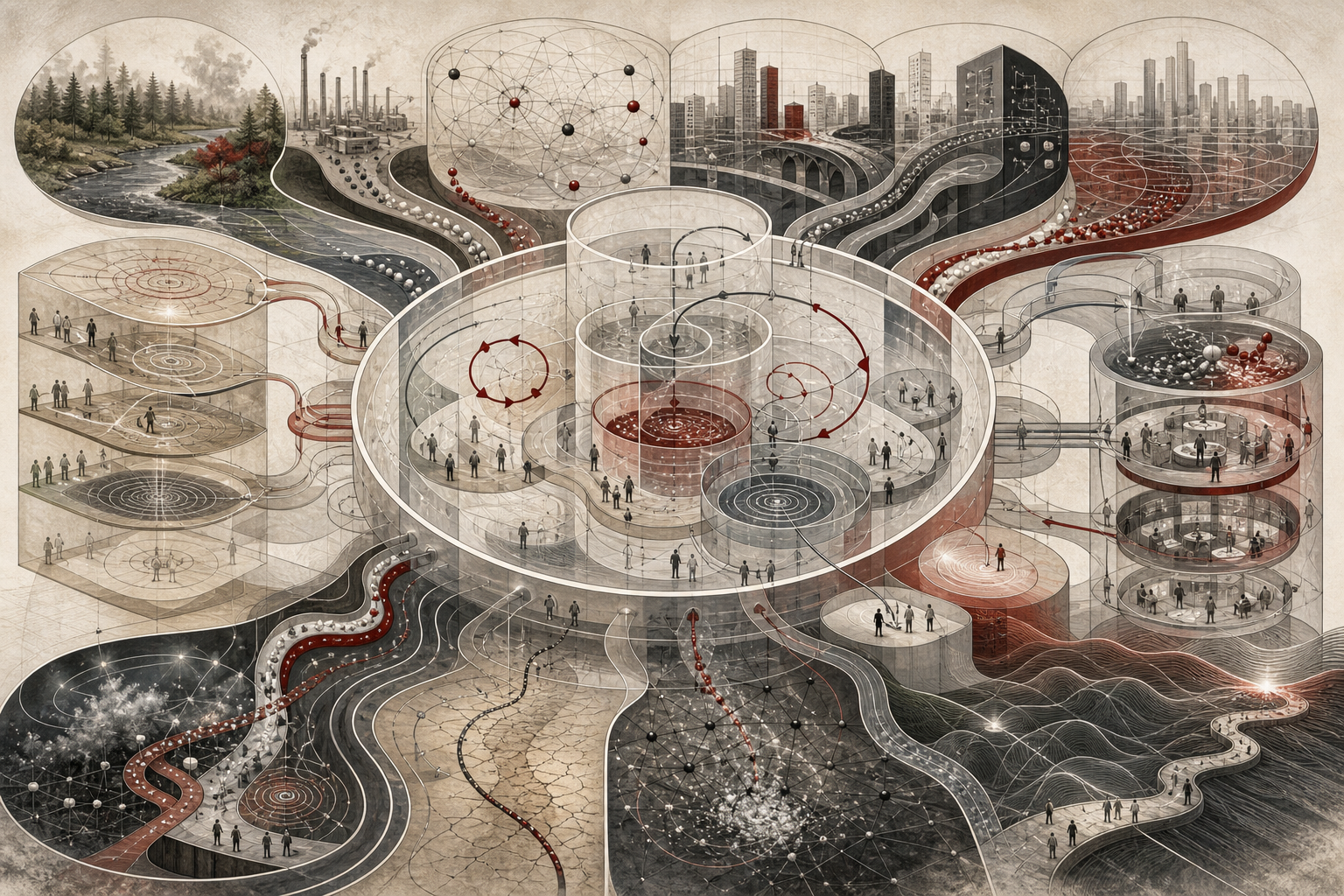
Systems thinking appears here not merely as a vocabulary for complexity, but as a practical architecture of structural reasoning. It explains how repeated events become patterns, how patterns arise from relationships, how relationships are shaped by feedback, how feedback is distorted by delay, and how systems reproduce themselves through rules, goals, information flows, incentives, constraints, and mental models. In that sense, systems thinking is not a decorative framework. It is a disciplined way of reading behavior over time.
The field matters because many of the defining problems of modern life are systemic rather than episodic. Ecological overshoot, economic instability, organizational burnout, policy resistance, congestion, shortage, institutional distrust, public-health failure, algorithmic harm, infrastructure fragility, educational inequity, and sustainability transition all involve patterns produced by interacting structures. Systems thinking helps explain why treating symptoms as isolated events often makes the underlying system harder to change.
GitHub Repository
This Systems Thinking article map is supported by a companion research and modeling repository with article-level folders, reproducible examples, synthetic datasets, causal-loop models, stock-and-flow simulations, feedback-loop workflows, system-archetype templates, scenario models, resilience analysis, network diagnostics, SQL schemas, documentation, and scientific-computing examples.
Complete Research & Modeling Repository
This knowledge series is supported by a computational companion repository with article-level folders, reproducible examples, synthetic datasets, causal-loop models, stock-and-flow simulations, feedback-loop workflows, system-archetype templates, scenario models, resilience analysis, network diagnostics, SQL schemas, documentation, and scientific-computing examples across Python, R, Julia, C++, Fortran, C, Rust, SQL, Go, and notebooks where appropriate.
Systems Thinking as a Foundational Discipline
Systems thinking occupies a foundational place within contemporary thought because it explains why behavior often emerges from relationships rather than isolated causes. A system is not merely a set of parts. It is an organized pattern of interaction in which components influence one another through feedback, delay, accumulation, constraint, and adaptation. To think systemically is to ask how the structure of relationships produces the behavior that appears at the surface.
This foundational role does not mean that systems thinking replaces disciplinary knowledge. Ecology, economics, engineering, public health, organizational psychology, political science, infrastructure studies, artificial intelligence, governance, and sustainability all retain their own concepts and methods. Systems thinking provides a bridge among them. It asks how variables interact, how causes return as consequences, how time lags distort perception, how local decisions generate collective outcomes, and how interventions alter the systems they enter.
The field matters because modern problems frequently cross boundaries. A housing shortage may involve land use, finance, infrastructure, labor markets, political incentives, household behavior, environmental regulation, public trust, and institutional capacity. A public-health crisis may involve biology, logistics, communication, social behavior, misinformation, governance, and inequality. A sustainability transition may involve technology, consumption, finance, policy, culture, infrastructure, and ecological thresholds. Systems thinking gives these problems a language of relation, feedback, and structure.
Systems Thinking as Structural Reasoning
Systems thinking may be understood as structural reasoning. It does not ask only what happened. It asks what keeps happening. It does not ask only who made a mistake. It asks what incentives, rules, norms, constraints, delays, and mental models make the pattern likely to recur. It does not ask only how to fix the visible symptom. It asks how the system is organized so that the symptom keeps returning.
This makes systems thinking different from ordinary complexity talk. Complexity can become a vague acknowledgment that “everything is connected.” Systems thinking asks how things are connected, which connections matter, which feedback loops dominate, which delays distort learning, which stocks are accumulating, which flows are too weak or too strong, which goals are guiding behavior, and which leverage points could alter the system’s trajectory.
Structural reasoning also changes the meaning of intervention. A shallow intervention may improve a visible metric while leaving the system’s deeper behavior unchanged. A deeper intervention may change information flows, rules, incentives, goals, or paradigms. Systems thinking therefore distinguishes activity from transformation. It asks not whether something has been done, but whether the structure that produces the pattern has changed.
Systems Thinking as a Quantitative and Computational Practice
Systems thinking is often introduced through causal-loop diagrams, behavior-over-time graphs, stock-and-flow diagrams, system archetypes, and leverage-point frameworks. These remain central. Yet serious systems thinking increasingly benefits from quantitative and computational practice. Dynamic systems can be modeled, simulated, visualized, stress-tested, compared across scenarios, and documented through reproducible workflows.
This does not mean that systems thinking becomes a purely technical field. A model is only as useful as its assumptions, boundaries, variables, and interpretation. A causal-loop diagram can clarify relationships, but it can also hide power, context, uncertainty, and lived experience. A simulation can reveal unexpected behavior, but it cannot decide what goals a system should pursue. Computational systems thinking is strongest when it supports structural judgment rather than replacing it.
For that reason, this series treats mathematics, system dynamics, network analysis, R, Python, Julia, SQL metadata, reproducible notebooks, and open code repositories as useful parts of systems-thinking literacy. Some articles remain primarily conceptual, historical, organizational, ethical, or interpretive. Others naturally require causal-network analysis, stock-and-flow modeling, delay simulation, scenario comparison, resilience indicators, threshold analysis, or reproducible code. The aim is not to reduce systems to equations, but to make structural assumptions explicit, inspectable, and revisable.
What Systems Thinking Studies
Systems thinking studies how behavior emerges from structure. At the pattern level, it examines recurring events, behavior over time, cycles, trends, oscillations, growth, collapse, drift, escalation, stagnation, lock-in, and recovery. At the relational level, it studies interdependence, influence, causality, dependency, constraint, network structure, boundary conditions, and cross-scale interaction.
At the feedback level, systems thinking studies reinforcing loops, balancing loops, delayed responses, nonlinear effects, self-reinforcement, stabilization, overshoot, correction, and unintended consequences. At the stock-and-flow level, it studies accumulation, depletion, inflow, outflow, capacity, reserves, delays, buffers, and thresholds. At the intervention level, it studies leverage points, rules, goals, information flows, mental models, paradigms, and system purpose.
Systems thinking further studies the gap between intention and outcome. A policy may intend relief but generate dependence. A performance metric may intend accountability but create gaming. A growth strategy may intend expansion but produce overload. A technology may intend efficiency but create fragility. A reform may intend fairness but increase administrative burden. Systems thinking is strongest when it explains these gaps without reducing them to incompetence alone.
What This Pillar Covers
This pillar brings together the major domains through which systems thinking interprets complex behavior. It includes patterns, events, structural explanation, wholes and parts, interdependence, feedback loops, reinforcing dynamics, balancing dynamics, delays, behavior over time, dynamic complexity, policy resistance, causal-loop diagrams, stocks and flows, system dynamics, simulation modeling, leverage points, paradigms, goals, system archetypes, mental models, organizational learning, sustainability, public policy, governance, resilience, thresholds, emergence, adaptation, networks, technology, artificial intelligence, infrastructure, ethics, and the future of systems thinking in an age of complexity.
These domains differ in method and scale, but together they form a coherent intellectual project: the attempt to understand why systems behave as they do and how structural change becomes possible. Systems thinking is therefore not only a method for analysis. It is a way of asking how reality is organized through relationships and how action changes when those relationships are understood.
The series also treats systems thinking as a bridge between interpretation and modeling. Interpretation gives systems meaning. Modeling gives systems structure. Simulation gives systems behavior over time. Ethics gives systems purpose and constraint. Without interpretation, modeling becomes technical abstraction. Without modeling, systems language can become metaphor. Without ethics, intervention can become control. A mature systems-thinking pillar must hold all three together.
Mathematics, Computation, and Modeling in Systems Thinking
Mathematics provides part of the formal language through which systems thinking clarifies feedback, accumulation, delay, resilience, threshold behavior, and intervention. A simple system state can be represented as:
S_{t+1} = S_t + I_t – O_t
\]
Interpretation: A stock changes over time through inflows and outflows. This simple structure underlies capacity, depletion, accumulation, reserves, trust, pollution, debt, knowledge, and many other system variables.
where \(S_t\) is the system stock at time \(t\), \(I_t\) is inflow, and \(O_t\) is outflow.
A reinforcing feedback loop can be represented as:
X_{t+1} = X_t + rX_t
\]
Interpretation: Reinforcing feedback amplifies change. Growth feeds more growth, decline feeds more decline, and small differences can compound over time.
where \(X_t\) is the system variable and \(r\) is the reinforcing rate.
A balancing loop can be represented as movement toward a target:
X_{t+1} = X_t + k(T – X_t)
\]
Interpretation: Balancing feedback reduces the gap between the current state and a desired target, producing correction, stabilization, or adjustment.
where \(T\) is the target and \(k\) is the correction strength.
A delayed response can be represented as:
X_{t+1} = X_t + k(T – X_{t-\tau})
\]
Interpretation: Delay causes intervention to respond to an earlier system state, increasing the risk of overcorrection, oscillation, and policy misperception.
where \(\tau\) is the delay.
A causal network can be represented as a directed graph:
G = (V,E)
\]
Interpretation: A system can be represented as nodes and directed relationships, making dependencies, feedback loops, bridge variables, and bottlenecks more visible.
A simple resilience model can describe recovery after disruption:
R_{t+1} = R_t + \alpha A_t + \beta L_t – \gamma P_t
\]
Interpretation: Resilience improves through adaptive capacity and learning, and declines under persistent pressure, depletion, or stress.
where \(R_t\) is resilience, \(A_t\) adaptive capacity, \(L_t\) learning, and \(P_t\) pressure.
A broader semi-formal model of systems-thinking quality can be represented as:
ST = f(PA, ID, FB, DL, AC, LV, RM, GV)
\]
Interpretation: Systems-thinking quality depends on pattern awareness, interdependence detection, feedback reasoning, delay recognition, accumulation logic, leverage analysis, reflective mental models, and governance awareness.
These formulations do not reduce systems thinking to equations. They clarify a central insight: systems behave through time. Patterns emerge from feedback, stocks, flows, delay, adaptation, and structure. Computation helps make those relationships more visible, but interpretation remains essential.
Computation is especially valuable when systems become large, nonlinear, delayed, or networked. R supports scenario comparison, indicator analysis, causal-network summaries, resilience metrics, visualization, and reproducible reporting. Python supports simulation, stock-and-flow modeling, graph analysis, Monte Carlo scenario analysis, and decision-support tools. Julia supports high-performance dynamic systems and nonlinear simulation. SQL supports structured system variables, causal relationships, model runs, scenario assumptions, indicators, and provenance. C++, Fortran, C, Rust, and Go support performance-sensitive simulation, command-line utilities, and reusable analytical infrastructure.
Major Domains of Systems Thinking
Systems thinking includes a wide range of major domains, each of which illuminates a different layer of structural reasoning. Pattern analysis studies recurring behavior over time. Interdependence studies how parts influence one another within wholes. Feedback analysis studies reinforcing and balancing loops. Delay analysis studies time lags between action and consequence. Stock-and-flow modeling studies accumulation, depletion, capacity, and flow.
Dynamic complexity studies systems whose behavior changes in response to intervention. Policy resistance studies why apparently sensible interventions fail or are absorbed by existing structures. System dynamics formalizes feedback, stocks, flows, and simulation. Causal-loop diagrams make relational structure visible. Leverage-point analysis studies where interventions can shift systems most deeply. System archetypes identify recurring patterns such as fixes that fail, shifting the burden, limits to growth, escalation, tragedy of the commons, and success to the successful.
Organizational systems thinking studies learning, mental models, routines, incentives, culture, and institutional adaptation. Sustainability systems thinking studies ecological limits, resource flows, overshoot, resilience, and long-horizon transitions. Governance systems thinking studies policy design, administrative capacity, accountability, legitimacy, coordination, and unintended consequences. Technology systems thinking studies digital platforms, AI systems, infrastructure, automation, cyber-physical systems, and system fragility. Together, these domains show why systems thinking is not merely a concept, but a general discipline of structural inquiry.
Why Systems Thinking Matters
Systems thinking matters because many failures in judgment begin by misreading patterns. People encounter recurring outcomes—crisis, congestion, shortage, turnover, burnout, escalation, institutional failure, ecological degradation—and treat them as isolated incidents rather than symptoms of deeper structure. When attention remains fixed on visible events, intervention tends to remain shallow. The result is familiar: repeated crisis management, unintended consequences, short-term relief, and long-term deterioration.
What systems thinking changes first is perception. Instead of asking only what happened, it asks what keeps happening. Instead of asking only who caused the problem, it asks what relationships, incentives, assumptions, delays, rules, and feedback processes are producing it. Patterns become intelligible when they are read as expressions of interdependence rather than disconnected accidents.
This is especially important because complexity is often dynamic rather than merely complicated. A system may contain many parts, but what makes it difficult is not only the number of components. It is the way actions feed back on one another, often with delays, so that consequences appear far from their origins. Systems thinking places attention on those hidden relations. It trains people to see why the behavior of a whole cannot always be understood by isolating one part at a time.
For that reason, systems thinking is not only a method for analysis. It is a discipline of interpretation. It teaches people to see wholes, to notice patterns that persist across time, and to understand that meaningful change usually requires structural change rather than episodic correction.
Systems Thinking and Human Self-Understanding
Systems thinking changes how human beings understand responsibility because it challenges purely individual explanations. It does not deny agency, but it asks how agency is shaped by structure. People make choices inside incentives, constraints, norms, routines, technologies, rules, and mental models. A system can reward behavior that individuals privately recognize as harmful. It can punish behavior that would improve the whole. It can produce outcomes no single actor intended.
This does not mean that systems thinking removes responsibility. It relocates responsibility. Instead of asking only who is at fault, it asks who has the power to change structure, who benefits from the current pattern, who bears the cost, whose knowledge is ignored, and which intervention level is being chosen. Systems thinking therefore expands responsibility from blame toward design, governance, maintenance, and reform.
For that reason, systems thinking has philosophical as well as practical significance. It raises enduring questions about agency, structure, causality, power, learning, adaptation, unintended consequence, and collective responsibility. A serious Systems Thinking pillar should therefore not end with diagrams alone. It should clarify the wider implications of systems reasoning for institutions, sustainability, technology, governance, ethics, and human action under complexity.
Systems Thinking Pillar Map
The map below organizes the Systems Thinking knowledge series into conceptual domains, moving from foundational pattern recognition toward feedback, stocks and flows, system dynamics, leverage points, archetypes, organizations, sustainability, governance, resilience, technology, ethics, and future systems practice. Expansion articles are placed inside the sections where they belong once the pillar is complete.
The Systems Thinking pillar is organized to move from foundational definitions and pattern recognition into interdependence, feedback loops, delays, behavior over time, dynamic complexity, causal-loop diagrams, stocks and flows, system dynamics, leverage points, system archetypes, mental models, organizational learning, sustainability, governance, resilience, networks, technology, ethics, and structural intervention. Mathematics, R, Python, Julia, C++, Fortran, C, Rust, SQL, Go, and computational notebooks are integrated where they deepen understanding, especially in areas such as causal-network modeling, feedback simulation, stock-and-flow modeling, delay analysis, scenario comparison, resilience indicators, leverage-point analysis, and reproducible systems workflows.
Foundations, Patterns, Boundaries, and Interdependence
- What Is Systems Thinking? — An opening article defining systems thinking as a discipline for understanding relationships, feedback, structure, and behavior over time.
- Patterns, Events, and Structural Explanation — An article on moving from isolated events toward recurring patterns and the deeper structures that generate them.
- Wholes, Parts, and Interdependence — A treatment of how system behavior emerges from relationships among parts rather than from isolated components alone.
- System Boundaries and Problem Framing — An article on how defining system boundaries changes what causes, stakeholders, time horizons, and responsibilities become visible.
- Causality in Systems Thinking — A study of circular causality, distributed causation, nonlinear causality, and the limits of single-cause explanations.
- Systems Thinking and Levels of Analysis — An article on individual, organizational, institutional, ecological, technological, and global scales of systemic explanation.
Feedback, Delay, and Behavior Over Time
- Feedback Loops and System Behavior — A foundational article on how reinforcing and balancing feedback generate growth, decline, stabilization, oscillation, and resistance.
- Reinforcing and Balancing Dynamics — A focused treatment of amplifying loops, corrective loops, compounding effects, and stabilization processes.
- Delays, Oscillation, and Misperception — An article on how time lags obscure cause and effect, encourage overreaction, and produce oscillation.
- Behavior Over Time and Structural Explanation — A methodological article on using time patterns to infer underlying system structure.
- Feedback Loop Polarity and Causal Signs — An article on positive and negative causal relationships, loop polarity, and the interpretation of causal-loop diagrams.
- Delayed Feedback and Policy Timing — A study of why interventions often fail when decision-makers misread how long systems take to respond.
- Overshoot, Collapse, and Correction — An article on systems that exceed limits because feedback arrives too late or corrective capacity is too weak.
Dynamic Complexity, Causal Mapping, Stocks, Flows, and Simulation
- Dynamic Complexity and Policy Resistance — An article on why systems resist interventions, absorb reforms, and produce unintended consequences.
- Causal Loop Diagrams and the Logic of Interaction — A methodological article on mapping variables, causal relationships, feedback loops, and structural hypotheses.
- Stocks, Flows, and the Architecture of Change — A major article on accumulation, depletion, capacity, inflows, outflows, and the material basis of dynamic behavior.
- System Dynamics and Simulation Modeling — A treatment of system dynamics as a formal method for modeling feedback, accumulation, delay, and behavior over time.
- Stock-Flow Thinking in Social Systems — An article on trust, legitimacy, knowledge, burnout, capacity, debt, social capital, and other social stocks.
- Scenario Modeling in Systems Thinking — A study of baseline, intervention, delay, resilience, collapse-risk, and adaptive-recovery scenarios.
- Sensitivity Analysis for System Interventions — An article on testing which assumptions, parameters, delays, and feedback strengths most shape outcomes.
Leverage Points, System Archetypes, and Structural Intervention
- Leverage Points and Places to Intervene in a System — A core article on where intervention can shift system behavior, from parameters and buffers to rules, goals, and paradigms.
- Paradigms, Goals, and Deep System Change — A study of the deepest layers of system transformation, including goals, mindsets, and system purpose.
- System Archetypes and Recurring Patterns — An article introducing recurring structures such as fixes that fail, shifting the burden, limits to growth, escalation, and tragedy of the commons.
- Limits to Growth — A focused article on reinforcing growth constrained by balancing limits, capacity, depletion, or resistance.
- Fixes That Fail — An article on short-term solutions that worsen long-term system behavior.
- Shifting the Burden — A study of symptomatic fixes that weaken deeper capacity for structural solution.
- Tragedy of the Commons and Shared Resource Systems — An article on shared resources, individual incentives, collective depletion, governance, and cooperation.
- Success to the Successful and Systemic Advantage — A treatment of reinforcing advantage, unequal access, cumulative opportunity, and structural inequality.
- Policy Resistance and Structural Redesign — An article on why systems push back against interventions and how redesign differs from pressure.
Organizations, Learning, Mental Models, and Institutions
- Systems Thinking in Organizations and Learning — An article on organizational learning, routines, feedback, incentives, mental models, and structural causes of repeated failure.
- Mental Models and the Limits of Linear Reasoning — A treatment of how assumptions, frames, and linear cause-effect habits constrain systemic understanding.
- Learning Organizations and Feedback Awareness — An article on how organizations learn when they can interpret feedback without blame, denial, or defensive routines.
- Organizational Burnout as a System Pattern — A systems article on workload, capacity, delay, turnover, recovery, incentives, and institutional exhaustion.
- Institutional Memory and System Learning — A study of documentation, turnover, learning decay, feedback preservation, and repeated institutional mistakes.
- Systems Thinking in Governance and Public Institutions — An article on administrative systems, public trust, policy design, coordination, accountability, and institutional resilience.
Sustainability, Resilience, Ecology, and Public Systems
- Systems Thinking and Sustainability — A major article on ecological limits, resource flows, feedback, overshoot, resilience, and long-horizon change.
- Systems Thinking in Public Policy — A treatment of policy design, administrative burden, feedback, unintended consequences, public value, and institutional coordination.
- Resilience, Thresholds, and Regime Shifts — An article on adaptive capacity, tipping points, loss of resilience, recovery, and transformation.
- Climate Systems and Feedback Dynamics — A systems article on climate feedbacks, inertia, delay, cumulative emissions, and policy timing.
- Food-Water-Energy Systems Thinking — A treatment of interdependent resource systems, trade-offs, shocks, infrastructure, and sustainability transitions.
- Public Health as a System — An article on disease, behavior, infrastructure, trust, communication, care capacity, and population-level feedback.
- Urban Systems: Congestion, Housing, and Infrastructure — A study of cities as interacting systems of land, transport, housing, economics, policy, and public services.
Networks, Technology, AI, Infrastructure, and Complex Adaptive Systems
- Emergence, Adaptation, and Complexity — A foundational article on system behavior that arises from interaction, adaptation, and nonlinear dynamics.
- Networks, Dependencies, and Cascade Risk — An article on network structure, fragility, bottlenecks, bridge nodes, redundancy, and cascading failure.
- Systems Thinking in AI and Technology — A systems article on AI as sociotechnical infrastructure shaped by feedback, incentives, data, governance, and unintended consequences.
- Platforms, Feedback Loops, and Digital Systems — A treatment of recommender systems, attention loops, network effects, platform incentives, and algorithmic amplification.
- Intelligent Infrastructure as a System — An article on cyber-physical systems, sensors, infrastructure monitoring, resilience, and governance of adaptive infrastructure.
- Complex Adaptive Systems and Social Change — A study of adaptation, emergence, agent interaction, learning, path dependence, and transformation.
History, Ethics, and the Future of Systems Thinking
- Jay Forrester and the Origins of System Dynamics — A historical article on Forrester, MIT, feedback-control ideas, industrial dynamics, urban dynamics, and the rise of formal system simulation.
- Donella Meadows and the Practice of Structural Insight — An article on Meadows, leverage points, sustainability, systems literacy, and the ethical intelligence of structural intervention.
- Peter Senge and the Learning Organization — A study of systems thinking as organizational discipline, including mental models, shared vision, team learning, and institutional awareness.
- Cybernetics, General Systems Theory, and Systems Thinking— A historical article on feedback, control, communication, general systems theory, and their influence on contemporary systems practice.
- The Ethics of Systems Thinking — An article on power, participation, boundaries, model authority, unintended harm, and responsible systems intervention.
- Systems Thinking in an Age of Complexity — A capstone-style article on systems thinking across sustainability, governance, AI, infrastructure, organizations, and long-term public problem solving.
This structure keeps the pillar grounded in systems thinking while making room for full expansion across feedback, stocks and flows, system archetypes, resilience, governance, technology, ethics, and computational systems modeling.
Methods, Measurement, and Systems Practice
One of systems thinking’s central challenges is that structure is often invisible until it produces repeated failure. People see congestion, crisis, collapse, escalation, burnout, shortage, drift, or resistance. They do not always see the feedback loops, delays, accumulations, goals, and mental models that generate those outcomes.
This is why systems thinking uses multiple methods. Behavior-over-time graphs help reveal recurring patterns. Causal-loop diagrams show hypothesized relationships and feedback structures. Stock-and-flow diagrams distinguish accumulations from rates of change. Scenario models test how behavior changes under different assumptions. Network analysis reveals dependencies, bridge nodes, bottlenecks, and cascade risks. System archetypes help identify recurring structural patterns. Leverage-point analysis asks where intervention can shift the system most deeply.
Modern systems practice benefits from both qualitative and quantitative evaluation. Qualitative systems mapping can include lived experience, institutional knowledge, stakeholder interpretation, local context, and historical memory. Quantitative modeling can simulate delay, accumulation, feedback strength, threshold behavior, and scenario sensitivity. A serious systems-thinking practice should treat both as essential. Without qualitative interpretation, models become detached from reality. Without quantitative structure, systems language can become vague.
Systems Thinking, Technology, and the Modern World
Systems thinking has become increasingly important because modern technologies are themselves systemic. AI systems, digital platforms, infrastructure networks, financial technologies, supply chains, public-service systems, health technologies, energy grids, and automated decision systems all create feedback loops. They change behavior, alter incentives, shift power, generate data, reinforce patterns, and produce unintended consequences.
Technology can strengthen systems thinking when it helps people model feedback, trace dependencies, visualize networks, monitor indicators, compare scenarios, and coordinate action. It can weaken systems thinking when it hides assumptions, accelerates feedback without accountability, optimizes narrow metrics, increases fragility, or disguises systemic harm behind technical complexity.
A mature systems-thinking approach to technology must therefore ask not only whether a technology works, but what system it enters, what behaviors it reinforces, what incentives it creates, what dependencies it deepens, what risks it amplifies, and who has the ability to contest or redesign it. The future of systems thinking will increasingly depend on understanding sociotechnical systems: systems in which technology, institutions, behavior, infrastructure, and governance are inseparable.
Systems Thinking, Computation, and Structural Simulation
Computation has become valuable for systems thinking because many systems cannot be understood through static description alone. A feedback loop may behave differently under delay. A stock may accumulate silently until a threshold is crossed. A network may appear stable until a bridge node fails. A policy may appear successful in the short term while weakening long-term capacity. A sustainability intervention may perform well under baseline assumptions and fail under stress.
Structural simulation allows researchers, analysts, educators, and decision-makers to formalize assumptions about system behavior. A model can test how intervention timing changes outcomes, how capacity depletion affects resilience, how trust accumulates or erodes, how policy resistance emerges, how reinforcing loops drive inequality, or how balancing loops stabilize a system after disruption. These models do not replace judgment. They make judgment more visible.
For that reason, this pillar treats computation as a supporting discipline of systems thinking, not as a substitute for interpretation. Models must remain transparent, contestable, documented, and ethically bounded. The strongest form of computational systems thinking is not technocratic control, but auditable structural reasoning: clear assumptions, explicit relationships, reproducible workflows, and careful interpretation.
R Section: Modeling Feedback, Delay, and Scenario Behavior
The R workflow below simulates simple reinforcing and balancing feedback with delay. It is educational only, but it illustrates how systems behavior emerges over time and why delay can produce oscillation or misperception.
# Systems Thinking: Feedback, Delay, and Scenario Behavior in R
# Educational example only.

# install.packages(c("tidyverse"))
library(tidyverse)

# -------------------------------------------------------------------
# Simulation settings.
# -------------------------------------------------------------------

time_steps <- 80

simulate_balancing_delay <- function(target = 100, initial = 25, correction = 0.18, delay = 1) {
  values <- numeric(time_steps)
  values[1] <- initial

  for (t in 2:time_steps) {
    delayed_index <- max(1, t - delay)
    perceived_gap <- target - values[delayed_index]
    values[t] <- values[t - 1] + correction * perceived_gap
  }

  tibble(
    time = 1:time_steps,
    value = values,
    delay = delay
  )
}

# Compare different delay structures.
scenario_data <- bind_rows(
  simulate_balancing_delay(delay = 1),
  simulate_balancing_delay(delay = 4),
  simulate_balancing_delay(delay = 8),
  simulate_balancing_delay(delay = 12)
)

print(head(scenario_data))

# -------------------------------------------------------------------
# Plot behavior over time.
# -------------------------------------------------------------------

ggplot(scenario_data, aes(x = time, y = value, group = delay)) +
  geom_line(aes(linetype = factor(delay))) +
  geom_hline(yintercept = 100) +
  labs(
    title = "Balancing Feedback with Different Delays",
    x = "Time",
    y = "System state",
    linetype = "Delay"
  ) +
  theme_minimal()

# -------------------------------------------------------------------
# Summarize overshoot.
# -------------------------------------------------------------------

overshoot_summary <- scenario_data |>
  group_by(delay) |>
  summarise(
    max_value = max(value),
    min_value = min(value),
    final_value = last(value),
    max_overshoot = max(value) - 100,
    .groups = "drop"
  )

print(overshoot_summary)

# -------------------------------------------------------------------
# Export outputs.
# -------------------------------------------------------------------

dir.create("outputs", showWarnings = FALSE, recursive = TRUE)

write_csv(scenario_data, "outputs/balancing_delay_scenarios.csv")
write_csv(overshoot_summary, "outputs/balancing_delay_overshoot_summary.csv")
This workflow models a core systems-thinking idea: the same corrective intention can produce very different behavior depending on delay. When actors respond to an outdated system state, they may overcorrect, oscillate, or misinterpret the effects of their own intervention.
Python Section: Simulating Stocks, Flows, Networks, and Resilience
The Python workflow below creates a simple stock-and-flow model, compares resilience under disruption, and builds a causal network. It demonstrates how systems thinking can move from conceptual structure to reproducible simulation.
# Systems Thinking: Stocks, Flows, Networks, and Resilience in Python
# Educational example only.

from __future__ import annotations

import numpy as np
import pandas as pd
import networkx as nx
import matplotlib.pyplot as plt


def simulate_capacity_system(
    time_steps: int = 80,
    initial_capacity: float = 60.0,
    baseline_inflow: float = 4.0,
    baseline_outflow: float = 3.2,
    disruption_start: int = 25,
    disruption_end: int = 42,
    disruption_pressure: float = 3.0,
    learning_rate: float = 0.05
) -> pd.DataFrame:
    """
    Simulate a simple stock-and-flow system.

    Capacity increases through inflow and learning, and declines through
    outflow and disruption pressure.
    """
    capacity = np.zeros(time_steps)
    resilience = np.zeros(time_steps)

    capacity[0] = initial_capacity
    resilience[0] = 0.55

    for t in range(1, time_steps):
        disruption = disruption_pressure if disruption_start <= t <= disruption_end else 0.0

        adaptive_learning = learning_rate * resilience[t - 1] * capacity[t - 1]

        inflow = baseline_inflow + adaptive_learning
        outflow = baseline_outflow + disruption

        capacity[t] = max(0.0, capacity[t - 1] + inflow - outflow)

        resilience[t] = min(
            1.0,
            max(
                0.0,
                resilience[t - 1]
                + 0.01 * (capacity[t] / 100.0)
                - 0.015 * (disruption > 0)
            )
        )

    return pd.DataFrame({
        "time": np.arange(time_steps),
        "capacity": capacity,
        "resilience": resilience
    })


def build_causal_network() -> nx.DiGraph:
    """
    Build a simple causal network for systems-thinking illustration.
    Edge signs represent positive or negative causal influence.
    """
    edges = [
        ("Learning", "Adaptive Capacity", "+"),
        ("Adaptive Capacity", "Resilience", "+"),
        ("Resilience", "Recovery Speed", "+"),
        ("Disruption Pressure", "Capacity", "-"),
        ("Capacity", "Service Quality", "+"),
        ("Service Quality", "Public Trust", "+"),
        ("Public Trust", "Cooperation", "+"),
        ("Cooperation", "Adaptive Capacity", "+"),
        ("Administrative Burden", "Public Trust", "-"),
        ("Resource Depletion", "Capacity", "-")
    ]

    graph = nx.DiGraph()

    for source, target, sign in edges:
        graph.add_edge(source, target, sign=sign)

    return graph


system_results = simulate_capacity_system()
print(system_results.head())
print(system_results.tail())

plt.figure(figsize=(10, 6))
plt.plot(system_results["time"], system_results["capacity"], label="Capacity")
plt.plot(system_results["time"], system_results["resilience"] * 100, label="Resilience x 100")
plt.xlabel("Time")
plt.ylabel("System value")
plt.title("Synthetic Capacity and Resilience System")
plt.legend()
plt.tight_layout()
plt.show()

causal_graph = build_causal_network()

metrics = pd.DataFrame({
    "node": list(causal_graph.nodes()),
    "in_degree": [causal_graph.in_degree(node) for node in causal_graph.nodes()],
    "out_degree": [causal_graph.out_degree(node) for node in causal_graph.nodes()],
    "degree_centrality": [
        nx.degree_centrality(causal_graph)[node] for node in causal_graph.nodes()
    ]
}).sort_values("degree_centrality", ascending=False)

print(metrics)

plt.figure(figsize=(12, 8))
positions = nx.spring_layout(causal_graph, seed=42)

nx.draw_networkx_nodes(causal_graph, positions, node_size=1400)
nx.draw_networkx_edges(causal_graph, positions, arrows=True, arrowstyle="->", arrowsize=18)
nx.draw_networkx_labels(causal_graph, positions, font_size=8)

plt.title("Synthetic Causal Network for Systems Thinking")
plt.axis("off")
plt.tight_layout()
plt.show()

system_results.to_csv("systems_thinking_capacity_resilience.csv", index=False)
metrics.to_csv("systems_thinking_causal_network_metrics.csv", index=False)
This workflow reinforces a central systems-thinking distinction. A system’s visible performance may depend on hidden stocks such as capacity, resilience, trust, institutional memory, ecological stability, or social cooperation. When those stocks are depleted, surface-level fixes become less effective. Structural intervention therefore requires attention to what is accumulating, what is eroding, and what feedback loops govern recovery.
Interpretive Limits and Systems Cautions
Systems thinking is powerful, but it can also overreach. Not every problem is best explained at the system level. Some harms have identifiable actors, decisions, histories, and power relations that should not be blurred into vague “system behavior.” Systems language can become evasive when it dissolves responsibility, ignores injustice, or treats all actors as equally positioned within a structure.
Analysts and practitioners should therefore avoid confusing complexity with neutrality. Systems have power. Boundaries are choices. Models include some variables and exclude others. Feedback loops may clarify structure, but they do not determine what is just. Leverage-point analysis may identify intervention levels, but it does not decide whose goals the system should serve. A systems map can reveal relationships, but it can also hide lived experience if built without participation.
The field is strongest when it combines structural rigor with ethical humility. It should help people see recurring patterns without flattening conflict, power, or responsibility. It should support deeper action without pretending that all consequences can be predicted. Systems thinking should make intervention more intelligent, more accountable, and more capable of learning from the systems it seeks to change.
Systems Thinking in a Wider Intellectual Context
Systems thinking belongs not only to management, sustainability, or system dynamics, but to the broader history of human thought about causality, order, interdependence, change, and responsibility. Philosophers, scientists, ecologists, engineers, planners, economists, sociologists, public administrators, and organizational theorists have long asked why wholes behave differently from their parts and why intervention so often produces unintended consequence.
The field changes the imagination of problem solving. It shows that many problems are not isolated defects waiting for direct repair. They are recurring patterns generated by living structures of relationship. This does not make action impossible. It makes action more demanding. Systems thinking asks people to move from reaction to pattern recognition, from blame to structure, from symptom relief to leverage, from linear causality to feedback, and from certainty to learning.
For that reason, systems thinking should be understood as both a practical and intellectual achievement. It brings together structural insight, modeling discipline, historical awareness, organizational learning, sustainability, public responsibility, and ethical intervention. It remains indispensable for any serious framework concerned with complexity, governance, technology, ecological transition, organizational change, and long-term public problem solving.
Related Reading
- Systems Modeling
- Mathematical Thinking
- Mathematical Modeling
- Knowledge Architecture
- Decision Science
- Futures Thinking
- Resilience Thinking
- Sustainable Development
- Institutions & Governance
- Data Systems & Analytics
Further Reading
- Donella Meadows Project (n.d.) Dana’s Writing. Available at: https://donellameadows.org/donella-meadows-legacy/danas-writing/ (Accessed: 4 May 2026).
- Forrester, J.W. (1961) Industrial Dynamics. Cambridge, MA: MIT Press.
- Forrester, J.W. (1969) Urban Dynamics. Cambridge, MA: MIT Press.
- Meadows, D.H. (1999) Leverage Points: Places to Intervene in a System. Hartland, VT: The Sustainability Institute. Available at: https://donellameadows.org/wp-content/userfiles/Leverage_Points.pdf (Accessed: 4 May 2026).
- Meadows, D.H. (2008) Thinking in Systems: A Primer. White River Junction, VT: Chelsea Green Publishing. Available at: https://www.chelseagreen.com/product/thinking-in-systems/ (Accessed: 4 May 2026).
- Senge, P.M. (1990) The Fifth Discipline: The Art and Practice of the Learning Organization. New York: Doubleday.
- Senge, P.M. (1990) ‘Systems thinking and organizational learning’, System Dynamics Society Proceedings. Available at: https://www.systemdynamics.org/wp-content/uploads/assets/proceedings/1990/senge1007.pdf (Accessed: 4 May 2026).
- System Dynamics Society (n.d.) What Is System Dynamics? Available at: https://systemdynamics.org/what-is-system-dynamics/ (Accessed: 4 May 2026).
- System Dynamics Society (n.d.) Origin of System Dynamics. Available at: https://systemdynamics.org/origin-of-system-dynamics/ (Accessed: 4 May 2026).
References
- Donella Meadows Project (n.d.) Dana’s Writing. Available at: https://donellameadows.org/donella-meadows-legacy/danas-writing/ (Accessed: 4 May 2026).
- Forrester, J.W. (1961) Industrial Dynamics. Cambridge, MA: MIT Press.
- Forrester, J.W. (1969) Urban Dynamics. Cambridge, MA: MIT Press.
- Meadows, D.H. (1999) Leverage Points: Places to Intervene in a System. Hartland, VT: The Sustainability Institute. Available at: https://donellameadows.org/wp-content/userfiles/Leverage_Points.pdf (Accessed: 4 May 2026).
- Meadows, D.H. (2008) Thinking in Systems: A Primer. White River Junction, VT: Chelsea Green Publishing. Available at: https://www.chelseagreen.com/product/thinking-in-systems/ (Accessed: 4 May 2026).
- MIT Sloan (n.d.) Peter M. Senge. Available at: https://mitsloan.mit.edu/faculty/directory/peter-m-senge (Accessed: 4 May 2026).
- Senge, P.M. (1990) ‘Systems thinking and organizational learning’, System Dynamics Society Proceedings. Available at: https://www.systemdynamics.org/wp-content/uploads/assets/proceedings/1990/senge1007.pdf (Accessed: 4 May 2026).
- System Dynamics Society (n.d.) About. Available at: https://systemdynamics.org/about/ (Accessed: 4 May 2026).
- System Dynamics Society (n.d.) Origin of System Dynamics. Available at: https://systemdynamics.org/origin-of-system-dynamics/ (Accessed: 4 May 2026).
- System Dynamics Society (n.d.) What Is System Dynamics? Available at: https://systemdynamics.org/what-is-system-dynamics/ (Accessed: 4 May 2026).