
Last Updated May 31, 2026
Systems thinking requires more than seeing connections. It requires knowing which level of the system is being examined, which levels are being left out, and how relationships move across scale. A problem can look very different depending on whether it is studied at the level of the individual, team, organization, institution, network, region, ecosystem, economy, or planet. Each level reveals part of the system. Each level also hides something.
Levels of analysis help systems thinkers avoid two common errors. The first is reduction: explaining system behavior only through the smallest visible unit, such as an individual person, component, event, or decision. The second is abstraction: explaining everything through “the system” without identifying concrete actors, mechanisms, structures, constraints, and relationships. A disciplined systems analysis moves between levels. It asks how lower-level interactions generate higher-level patterns, how higher-level structures constrain lower-level behavior, and how change at one level can produce consequences at another.
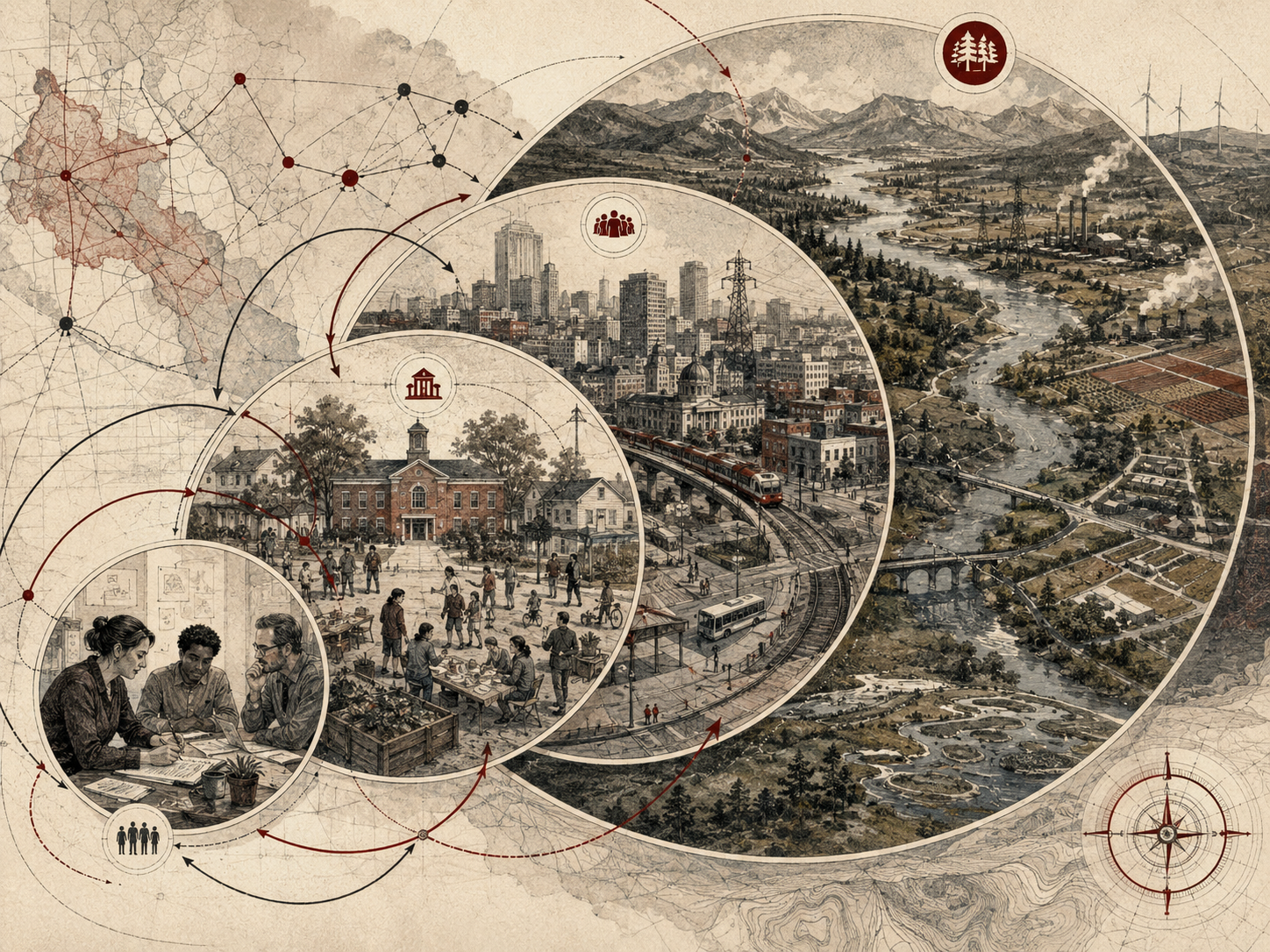
This article explains why levels of analysis are essential to systems thinking. It examines micro, meso, macro, and cross-scale explanation; shows how problems change when viewed at different levels; and explains why many interventions fail because they act at one level while the problem is generated at another. It also explores aggregation, emergence, nested systems, cross-scale feedback, institutional structure, ecological scale, and the ethical risks of blaming local actors for system-level outcomes.
Why Levels of Analysis Matter
A level of analysis is the scale or layer at which a system is being examined. A systems problem can be studied at the level of a person, team, organization, institution, network, community, region, economy, ecosystem, or planet. Each level has its own variables, relationships, evidence, and explanatory limits.
Levels matter because systems are organized across scale. Local actions produce collective patterns. Collective patterns reshape local action. Institutions create rules that affect individuals. Individuals and groups reproduce or resist institutions. Ecological processes shape economies. Economic systems reshape ecological processes. Technologies are designed by organizations, used by people, governed by institutions, and embedded in material infrastructures.
Without level awareness, analysis can become distorted. A public-health problem may be reduced to individual behavior when it is shaped by housing, work, food access, environmental exposure, medical access, and institutional trust. A workplace problem may be reduced to personality when it is shaped by workload, incentives, staffing, leadership, process design, and culture. An infrastructure failure may be reduced to a broken component when it reflects maintenance funding, governance, climate stress, procurement, and public investment.
Systems thinking asks which level is doing the explanatory work. Is the problem produced by individual choices, local interactions, organizational routines, institutional rules, network dependencies, historical structures, ecological constraints, or cross-scale feedback? A strong analysis does not assume one level in advance. It tests how levels interact.
| Level | Typical focus | Example question |
|---|---|---|
| Individual | Behavior, perception, choice, capacity, experience. | What constraints, incentives, knowledge, or burdens shape individual action? |
| Interactional | Relationships, communication, coordination, trust, conflict. | How do people, teams, or actors influence one another? |
| Organizational | Roles, processes, incentives, culture, resources, leadership. | How does organizational design generate recurring behavior? |
| Institutional | Rules, norms, legitimacy, governance, authority, enforcement. | How do formal and informal institutions structure action? |
| Network | Dependencies, flows, pathways, bottlenecks, cascades. | How does risk, information, material, or influence travel across connected systems? |
| Socio-ecological | Human-environment interdependence, limits, regeneration, resilience. | How do social systems and ecological systems co-produce outcomes? |
The goal is not to choose one level and ignore the rest. The goal is to understand which level explains which part of the problem, how levels interact, and which level of intervention is most likely to change the pattern responsibly.
Micro, Meso, Macro, and Cross-Scale Thinking
Systems analysis often uses the terms micro, meso, and macro to distinguish levels. These terms are not rigid categories. They are practical tools for organizing inquiry.
The micro level focuses on individuals, households, local decisions, experiences, perceptions, and immediate actions. It asks what people do, what they know, what they need, what they experience, and what constraints they face. Micro-level analysis is essential because systems are lived locally. People experience institutions through forms, delays, denials, classrooms, hospital visits, commutes, utility bills, workloads, interfaces, and interactions.
The meso level focuses on organizations, communities, networks, teams, local institutions, and intermediate structures. It asks how coordination, culture, process, resource allocation, authority, and communication shape behavior. Many systems failures occur at the meso level because organizations mediate between broad policy and local experience.
The macro level focuses on large-scale structures such as political economy, law, national policy, climate systems, public finance, markets, historical inequality, demographic change, technological regimes, and ecological limits. Macro-level analysis asks how broad structures create the conditions under which local actors operate.
Cross-scale thinking examines how these levels interact. A household decision may be shaped by macroeconomic conditions. A national policy may be implemented through meso-level organizations. A local practice may scale into institutional norms. A technological standard may reshape global supply chains. Ecological degradation may alter regional economies, household health, and public budgets.
| Level | Analytical focus | Risk if isolated |
|---|---|---|
| Micro | Individual behavior, lived experience, local decision-making. | Can blame individuals for structural conditions. |
| Meso | Organizations, communities, teams, networks, institutions-in-practice. | Can ignore broader political, economic, ecological, or historical forces. |
| Macro | Large-scale structures, policy regimes, markets, history, ecology. | Can become abstract and detached from concrete mechanisms or lived experience. |
| Cross-scale | Relationships among levels. | Can become too broad unless variables, boundaries, and mechanisms are specified. |
For example, educational inequality can be examined at the micro level through student experience, learning conditions, stress, health, and family obligations. At the meso level, it can be examined through school funding, teacher turnover, curriculum, discipline, transportation, counseling, and school climate. At the macro level, it can be examined through housing segregation, tax policy, labor markets, racialized wealth inequality, public investment, and national education policy. A systems explanation requires movement across levels because no single level contains the whole causal structure.
Level thinking protects against misplaced solutions. A micro-level intervention may help individuals cope, but it cannot by itself solve a meso- or macro-level problem. A macro-level reform may set policy, but it may fail if meso-level organizations lack capacity or if micro-level experience is ignored. Systems thinking asks where the problem is generated, where it is experienced, and where intervention can change the system.
Nested Systems and Hierarchical Complexity
Systems are often nested. A part at one level can be a whole at another level. A person is part of a household, a household is part of a neighborhood, a neighborhood is part of a city, a city is part of a region, and a region is part of broader ecological, economic, and political systems. A team is part of an organization, but the team is also a system of people, tasks, roles, tools, norms, and relationships. A cell is part of an organ, but the cell is also a complex system.
Nested systems matter because behavior at one level can only be understood in relation to surrounding levels. A team’s performance may depend on team skill, but also on organizational incentives, leadership priorities, data systems, resource allocation, and external demand. A neighborhood’s health may depend on local social networks, but also on housing policy, environmental exposure, transportation, employment geography, public investment, and historical exclusion.
Hierarchical complexity does not mean rigid top-down control. In systems thinking, hierarchy often means nested levels of organization. Lower levels combine to produce higher-level structures. Higher levels create constraints and opportunities for lower levels. The relationship is dynamic, not one-directional.
S = \{S_1, S_2, S_3, \ldots, S_n\}
\]
Interpretation: A larger system \(S\) can be represented as a set of nested subsystems \(S_i\). Each subsystem may itself contain further parts, relationships, and feedback loops.
Nested systems create several analytical challenges:
- A problem may originate at one level but appear at another.
- A solution at one level may create harm at another.
- A system may be resilient at one level and fragile at another.
- Data aggregated at a higher level may hide unequal experience at lower levels.
- Authority may exist at one level while knowledge exists at another.
- Change may require coordination across multiple levels at once.
Nested analysis is especially important in governance, ecology, infrastructure, public health, education, and technology. These domains are not flat. They involve multiple layers of authority, dependency, implementation, experience, and consequence. A systems thinker must therefore ask not only what level is visible, but what levels are nested inside and around it.
Upward and Downward Causation
Systems thinking studies causality across levels. Upward causation occurs when lower-level interactions generate higher-level patterns. Downward causation occurs when higher-level structures shape lower-level behavior. Most complex systems involve both.
Traffic congestion is produced upward through many local driving decisions, vehicle interactions, road conditions, lane changes, bottlenecks, signals, and travel demand. But driving behavior is shaped downward by urban design, housing patterns, transit availability, work schedules, road pricing, fuel costs, and public policy. The congestion pattern is not reducible to either individual drivers or regional structure alone. It is produced across levels.
Organizational culture offers another example. Culture emerges upward from repeated interactions, leadership behavior, informal norms, shared stories, incentives, hiring patterns, and responses to conflict. Once established, culture shapes downward what individuals feel safe saying, what risks they take, what errors they report, how they interpret priorities, and what behaviors they view as normal.
\text{Micro interactions} \rightarrow \text{Macro pattern} \rightarrow \text{Micro constraints}
\]
Interpretation: Lower-level interactions can generate higher-level patterns, and those higher-level patterns can return to shape lower-level behavior.
This recursive movement is central to systems thinking. Individuals create institutions, but institutions shape individuals. Local practices create norms, but norms shape local practice. Infrastructure is built through decisions, but once built it shapes future decisions. Technology is designed by people, but technological systems reorganize behavior, opportunity, and power.
Upward and downward causation also complicate responsibility. If a harmful pattern emerges from many local actions, responsibility may be distributed. If a higher-level structure repeatedly produces harmful local action, responsibility may lie with design, governance, rules, incentives, and resource allocation. Systems thinking asks how causal responsibility moves across levels rather than stopping at the most visible actor.
This matters for intervention. If the problem is generated by upward dynamics, intervention may require changing local interactions, feedback, information, or coordination. If the problem is generated by downward constraints, intervention may require changing policy, incentives, infrastructure, authority, standards, or institutional design. If both are operating, a single-level intervention is likely to disappoint.
Emergence Across Levels
Emergence occurs when interactions at one level produce patterns or properties at another level that cannot be fully understood by examining the parts separately. Emergence does not mean mystery. It means that relationships matter. The higher-level pattern arises from the organization of lower-level interactions.
A market price emerges from many buying, selling, production, expectation, supply, demand, policy, and institutional interactions. A public mood emerges from events, media, experience, social networks, economic conditions, political narratives, and institutional trust. A neighborhood identity emerges from history, place, architecture, memory, institutions, relationships, conflict, and care. An ecosystem function emerges from species interactions, nutrient cycles, water flows, soils, climate, disturbance, and regeneration.
Emergence creates analytical difficulty because higher-level patterns can appear to have their own reality. A culture, market, institution, or ecosystem is not simply a fiction. Once emergent patterns stabilize, they affect behavior. They become part of the causal environment. A culture shapes choices. A market shapes prices. A public narrative shapes politics. An ecosystem state shapes future ecological possibilities.
M = g(x_1, x_2, x_3, \ldots, x_n, R)
\]
Interpretation: A macro-level pattern \(M\) can emerge from lower-level elements \(x_i\) and their relationships \(R\). The relationships are essential to the emergent outcome.
Emergence helps explain why system behavior can surprise decision-makers. A set of local actions that appear harmless individually may generate harmful collective outcomes. Many commuters choosing the fastest route can produce congestion. Many firms minimizing inventory can produce supply-chain fragility. Many institutions optimizing narrow metrics can produce public distrust. Many households responding rationally to housing costs can produce regional displacement patterns.
Emergence also explains why whole-system change can be difficult. Higher-level patterns may persist even when individual actors change. A new manager enters the same incentive system. A new policy enters the same institutional culture. A new technology enters the same market pressures. A new reform enters the same political economy. The parts change, but the emergent pattern returns because the relationship structure remains.
Systems thinking therefore asks what lower-level interactions generate the higher-level pattern and what higher-level pattern then constrains the lower-level actors.
Aggregation, Averages, and Hidden Variation
Levels of analysis are closely tied to aggregation. Aggregation combines lower-level data into higher-level summaries: averages, totals, rates, indexes, scores, rankings, and indicators. Aggregation is useful because complex systems need summaries. But aggregation can hide variation, inequality, distribution, outliers, and subgroup experience.
A citywide average commute time may hide severe mobility burdens in particular neighborhoods. A school district average may hide large differences among schools. A hospital performance score may hide unequal outcomes by language, disability, income, race, age, or geography. A national economic indicator may improve while many households experience insecurity. A platform engagement metric may rise while trust, wellbeing, or democratic health declines.
This is why systems thinkers ask what level the data represents. A high-level metric may be accurate at its own level but misleading if used to explain lower-level experience. Conversely, a local story may be true but not representative of the system-wide pattern. Both aggregated data and local evidence require interpretation.
\bar{x} = \frac{1}{n}\sum_{i=1}^{n}x_i
\]
Interpretation: An average summarizes many observations, but it can hide distribution, inequality, clustering, extremes, and subgroup variation.
Aggregation can create several errors:
- Ecological fallacy: assuming group-level patterns apply to individuals.
- Atomistic fallacy: assuming individual-level patterns explain group-level outcomes.
- Average blindness: treating the average as representative when variation is large.
- Scale mismatch: using data from one level to justify claims at another level.
- Distribution erasure: hiding unequal burden behind system-wide improvement.
Systems thinking uses aggregation carefully. It asks: What is being averaged? What is being hidden? Who is doing better? Who is doing worse? Are improvements distributed fairly? Does the system-level metric conceal local harm? Does local harm reveal a system-level pattern?
Level-aware analysis does not reject metrics. It uses metrics with boundary awareness, distributional awareness, and ethical caution.
Matching Interventions to the Right Level
Many interventions fail because they act at the wrong level. A micro-level intervention may be useful for individual support but powerless against structural conditions. A macro-level policy may be ambitious but fail if meso-level institutions lack implementation capacity. A technical fix may repair a component while leaving governance unchanged. A training program may improve awareness while incentives continue to reward the old behavior.
Matching intervention level to causal level is one of the central tasks of systems thinking. If a problem is generated by individual knowledge gaps, education may help. If it is generated by workflow design, process redesign may help. If it is generated by incentives, measurement, staffing, or authority, organizational change may be needed. If it is generated by policy, markets, law, or historical inequality, broader institutional reform may be required.
| Causal level | Weak mismatch | Better intervention logic |
|---|---|---|
| Individual knowledge gap | Large policy overhaul without attention to practice. | Training, decision support, coaching, accessible information. |
| Team coordination failure | Blaming individual motivation. | Role clarity, handoff design, communication routines, shared tools. |
| Organizational incentive problem | Awareness campaign alone. | Metric redesign, workload governance, resource allocation, leadership accountability. |
| Institutional rule problem | Local workaround. | Policy reform, accountability, funding change, enforcement redesign. |
| Network dependency problem | Repairing one isolated node. | Redundancy, modularity, coordination, dependency mapping, cascade planning. |
| Socio-ecological problem | Short-term technical optimization. | Regeneration, resilience planning, long-term governance, adaptive monitoring. |
Interventions can also work across levels. A climate adaptation strategy may combine household preparedness, neighborhood cooling centers, municipal land-use reform, regional watershed planning, state infrastructure funding, national emissions policy, and ecological restoration. A public-health strategy may combine patient support, clinic coordination, hospital capacity, housing policy, environmental regulation, and public trust.
Level matching does not mean each problem has only one proper level. It means the intervention should correspond to the causal architecture of the problem. When causes are cross-scale, interventions must be cross-scale too.
A systems intervention is weak when it asks one level to solve a problem produced by another level.
Cross-Scale Feedback and System Behavior
Feedback loops often cross levels. A local action can change a broader pattern, and the broader pattern can return to shape local action. This is cross-scale feedback.
Consider public trust. Individual experiences with agencies accumulate into community narratives. Community narratives influence political pressure. Political pressure affects institutional reform or defensiveness. Institutional behavior then shapes future individual experiences. Trust is not located at one level. It circulates across micro experience, meso institutions, macro politics, and historical memory.
Consider infrastructure maintenance. Local asset failures increase public complaints. Public complaints create political pressure. Political pressure may shift budgets toward visible repair. If budgets favor emergency repair over preventive maintenance, hidden backlog grows. Backlog increases future local failures. The feedback loop moves from component failure to public experience, political decision-making, budget structure, maintenance capacity, and future component failure.
Cross-scale feedback can produce:
- reinforcing loops that amplify advantage, decline, trust, distrust, capacity, or fragility;
- balancing loops that stabilize systems or resist change;
- policy resistance when interventions at one level are offset by adaptation at another;
- cascading failure when stress moves through connected levels;
- learning loops when information from one level improves decisions at another;
- misalignment when feedback from affected levels never reaches decision-making levels.
x^{(l)}_{t+1} = f\left(x^{(l)}_t, x^{(l-1)}_t, x^{(l+1)}_t\right)
\]
Interpretation: The future state of a system at level \(l\) may depend on its current state, lower-level dynamics, and higher-level conditions. This is a simplified way to represent cross-scale influence.
Cross-scale feedback is a major reason systems resist simple control. A national policy can be altered by local implementation. A local innovation can be blocked by institutional rules. A technical fix can be undermined by market incentives. A community adaptation can be overwhelmed by ecological change. A new metric can be gamed by organizations responding to the measurement system.
Systems thinking therefore asks whether feedback is flowing across levels accurately, quickly, democratically, and meaningfully. A system that cannot hear from the level where harm is experienced will often continue producing that harm.
Power, Blame, and Responsibility Across Levels
Levels of analysis are not morally neutral. The level chosen for explanation often determines who is blamed and who is protected. If a problem is framed at the individual level, individuals may be blamed. If it is framed at the organizational level, management and process design become visible. If it is framed at the institutional level, rules, incentives, policy, and authority become visible. If it is framed historically, inherited injustice and accumulated advantage become visible.
Power often shapes which level is considered legitimate. Institutions may prefer micro-level explanations because they focus responsibility on individuals. Employers may frame burnout as resilience failure rather than workload design. Schools may frame absenteeism as family failure rather than housing, health, transportation, and school-climate conditions. Platforms may frame harm as user behavior rather than design incentives and governance. Public agencies may frame access problems as applicant confusion rather than administrative burden.
Systems thinking does not deny individual agency. It refuses to confuse constrained action with unconstrained choice. People act inside conditions created by higher-level systems. They also participate in reproducing or changing those systems. Responsibility is therefore layered.
A level-aware ethics asks:
- At what level is harm experienced?
- At what level is the cause generated?
- At what level does authority exist?
- At what level is data collected?
- At what level are resources controlled?
- At what level can repair occur?
- Who benefits when the explanation stays at a lower level?
- Who benefits when the explanation remains abstract at a higher level?
Responsibility can be misplaced in both directions. Blaming individuals for structural outcomes is unjust. But invoking “the system” without identifying actors, rules, decisions, and institutions can also evade responsibility. A serious systems analysis connects levels so that responsibility becomes clearer, not more obscure.
The ethical challenge is to explain without oversimplifying and to contextualize without excusing.
Examples Across Systems
Levels of analysis appear across every major systems domain. The same visible problem changes depending on the level at which it is examined.
Public health
A patient readmission can be examined at the individual level through diagnosis, medication, discharge understanding, and follow-up behavior. At the household level, it may involve caregiving, transportation, food, income, and housing stability. At the organizational level, it may involve discharge planning, staffing, care coordination, and electronic health records. At the institutional level, it may involve insurance, reimbursement, primary care access, and public-health infrastructure. At the environmental level, it may involve pollution, heat, neighborhood conditions, and chronic stress.
Education
A student’s academic performance can be studied through cognition, effort, sleep, health, motivation, and classroom experience. At the school level, it may involve teacher support, curriculum, class size, discipline, counseling, leadership, and school climate. At the district or state level, it may involve funding formulas, testing regimes, transportation, disability support, and policy. At the macro level, it may involve housing segregation, income inequality, labor markets, and historical exclusion.
Infrastructure
A road failure can be studied at the component level through materials, load, design, and weather. At the network level, it may involve traffic routing, redundancy, maintenance schedules, and dependency. At the institutional level, it may involve budgeting, procurement, inspection, political incentives, and public finance. At the ecological level, it may involve flooding, heat, land use, and climate stress.
Organizations
A missed deadline can be studied at the individual level through performance and task completion. At the team level, it may involve handoffs, communication, coordination, and trust. At the organizational level, it may involve staffing, incentives, leadership, tools, documentation, and decision rights. At the market level, it may involve customer pressure, competition, contracting, and resource constraints.
Artificial intelligence systems
An AI system can be studied at the model level through architecture, training data, parameters, evaluation, and performance. At the application level, it may involve user interface, workflow, oversight, and error handling. At the organizational level, it may involve incentives, deployment decisions, procurement, monitoring, and accountability. At the institutional level, it may involve law, regulation, standards, labor markets, public trust, and power. At the ecological level, it may involve energy use, hardware supply chains, and material extraction.
Climate and ecological systems
A flood can be studied as a weather event, watershed condition, land-use pattern, infrastructure failure, housing exposure, insurance problem, emergency-management issue, climate-change effect, or environmental-justice problem. Each level reveals different causes and interventions. None alone is complete.
Across these examples, the system cannot be understood from a single level. The visible event is usually local. The causal structure is often cross-scale.
Mathematics, Computation, and Modeling
Levels of analysis can be represented through qualitative maps, nested diagrams, multilevel models, network analysis, stock-flow models, agent-based simulations, scenario comparisons, and cross-scale indicators. Modeling does not replace judgment, but it can make level assumptions explicit.
A simple nested system can be represented as:
S^{(0)} \subset S^{(1)} \subset S^{(2)} \subset \cdots \subset S^{(n)}
\]
Interpretation: A lower-level system \(S^{(0)}\) may be nested inside progressively larger systems. Each level can shape and be shaped by adjacent levels.
A multilevel outcome can be represented conceptually as:
Y_{ijk} = \beta_0 + \beta_1 X_i + \beta_2 Z_j + \beta_3 W_k + \epsilon_{ijk}
\]
Interpretation: An outcome \(Y\) may depend on individual-level variables \(X_i\), organizational or community-level variables \(Z_j\), and broader institutional or regional variables \(W_k\). The equation is illustrative rather than exhaustive.
A cross-scale network can be represented as:
G = (V_L, E_{within}, E_{across})
\]
Interpretation: A cross-scale network includes nodes at different levels \(V_L\), relationships within levels \(E_{within}\), and relationships across levels \(E_{across}\).
Level-aware modeling can support several tasks:
| Modeling task | Level question | Example use |
|---|---|---|
| Multilevel modeling | How do individual and group-level factors jointly shape outcomes? | Studying students within schools, patients within hospitals, workers within organizations. |
| Nested systems mapping | Which systems contain which subsystems? | Mapping households, neighborhoods, cities, regions, and ecosystems. |
| Cross-scale network analysis | How do relationships connect levels? | Tracing dependencies among assets, organizations, regulators, users, and ecosystems. |
| Agent-based modeling | How do local interactions generate system-level patterns? | Studying traffic, markets, contagion, social norms, or institutional compliance. |
| Stock-flow modeling | What accumulates at each level? | Tracking trust, backlog, capacity, emissions, debt, fatigue, or knowledge. |
| Scenario comparison | How do interventions at different levels compare? | Testing individual support, organizational redesign, policy reform, and ecological restoration. |
Models must be interpreted carefully. A multilevel model may show that organizational context matters, but it may not capture history, power, dignity, or lived experience. A network map may show cross-level dependencies, but not whether those dependencies are fair or legitimate. An agent-based model may show emergent behavior, but its assumptions may oversimplify human meaning. Level-aware modeling is strongest when combined with qualitative evidence, institutional knowledge, stakeholder input, and ethical interpretation.
GitHub Repository
The companion repository for this article should help readers represent systems across levels of analysis, including nested systems, micro-meso-macro variables, cross-scale relationships, aggregation effects, intervention-level comparisons, and resilience diagnostics. It should support both conceptual explanation and reproducible computational examples.
Companion repository for the article, including micro-meso-macro examples, nested-system maps, cross-scale network analysis, aggregation-fallacy demonstrations, intervention-level scenarios, resilience diagnostics, synthetic datasets, documentation notes, and multi-language scaffolds for systems analysis.
articles/systems-thinking-and-levels-of-analysis/
├── python/
│   ├── micro_meso_macro_model.py
│   ├── nested_systems_network.py
│   ├── cross_scale_dependency_analysis.py
│   ├── aggregation_fallacy_examples.py
│   ├── intervention_level_comparison.py
│   └── resilience_by_level_diagnostics.py
├── r/
│   ├── multilevel_summary_tables.R
│   ├── aggregation_and_distribution_plots.R
│   ├── cross_scale_indicator_visualization.R
│   ├── intervention_level_comparison.R
│   └── nested_systems_summary.R
├── julia/
│   ├── dynamic_cross_scale_examples.jl
│   └── nonlinear_level_feedback.jl
├── sql/
│   ├── schema_system_levels.sql
│   ├── schema_system_entities.sql
│   ├── schema_cross_scale_relationships.sql
│   ├── schema_scenarios.sql
│   ├── schema_indicators.sql
│   └── schema_model_runs.sql
├── rust/
│   └── levels_diagnostics_cli.rs
├── go/
│   └── cross_scale_pathway_utility.go
├── cpp/
│   ├── efficient_nested_network.cpp
│   └── cross_scale_feedback_example.cpp
├── fortran/
│   └── recurrence_level_dynamics.f90
├── c/
│   └── low_level_cross_scale_simulation.c
├── docs/
│   ├── modeling_principles.md
│   ├── article_notes.md
│   ├── assumptions_and_limitations.md
│   └── responsible_use.md
├── data/
│   ├── synthetic_system_levels.csv
│   ├── synthetic_system_entities.csv
│   ├── synthetic_cross_scale_edges.csv
│   ├── synthetic_scenarios.csv
│   └── synthetic_indicators.csv
├── outputs/
│   ├── README.md
│   └── generated_outputs_placeholder.txt
└── notebooks/
    ├── python_levels_of_analysis_walkthrough.ipynb
    └── r_multilevel_visualization_placeholder.ipynb
This repository structure supports the article’s central argument: system behavior must often be studied across levels. The data/ folder separates levels, entities, cross-scale edges, scenarios, and indicators. The python/ and r/ folders support nested-system modeling, aggregation analysis, cross-scale dependency mapping, intervention comparison, and resilience diagnostics. The julia/ folder supports dynamic and nonlinear level-feedback examples. The sql/ folder defines schemas for levels, entities, relationships, scenarios, indicators, and model runs. The lower-level language folders provide scaffolds for efficient diagnostics, pathway tracing, recurrence, and simulation.
A Practical Method for Level-of-Analysis Work
Level-of-analysis work can become practical through a disciplined sequence of inquiry. The goal is not to make every analysis infinitely complex. The goal is to identify which levels matter for the problem and how they interact.
1. Name the focal outcome
Begin with the behavior or outcome that needs explanation. Is the concern burnout, flooding, absenteeism, failure rate, public distrust, ecological decline, congestion, cost growth, system fragility, algorithmic harm, or institutional breakdown?
2. Identify where the outcome is experienced
Ask at what level the harm or behavior is visible. A problem may be experienced by individuals, households, teams, neighborhoods, ecosystems, organizations, or regions even if its causes are generated elsewhere.
3. Identify possible causal levels
List the levels that may contribute to the outcome: individual, interactional, organizational, institutional, network, historical, economic, ecological, technological, or political.
4. Distinguish proximate and structural levels
Separate the immediate trigger from the deeper structure. A local event may be produced by higher-level policy, funding, infrastructure, or ecological conditions.
5. Map upward causation
Ask how local actions, interactions, or component behavior generate higher-level patterns. Look for aggregation, emergence, social norms, network effects, and collective outcomes.
6. Map downward causation
Ask how higher-level structures constrain local behavior. Examine rules, incentives, resources, policies, markets, histories, infrastructures, norms, and ecological limits.
7. Check aggregation and distribution
Ask whether high-level averages hide lower-level variation. Examine distributions, subgroups, geography, outliers, and unequal burden.
8. Compare intervention levels
Ask what would happen if intervention occurred at different levels. Would individual support, team redesign, organizational reform, policy change, network coordination, or ecological restoration change the pattern?
9. Look for cross-scale feedback
Identify whether feedback moves between levels. Does local experience reach decision-makers? Do institutional rules change local behavior? Do ecological signals influence governance? Does public trust alter compliance and performance?
10. Document the level choice
State why the analysis focuses on particular levels and what it excludes. Level choice is a boundary decision. It should be explicit enough to critique.
This method helps prevent misplaced explanations. It also helps identify whether action should support individuals, redesign organizations, reform institutions, restructure networks, or address broader ecological and political-economic conditions.
Common Mistakes
Levels of analysis are useful only when handled carefully. Several mistakes are common.
Reducing system behavior to individual behavior
This mistake treats system outcomes as the result of personal choices alone. It often leads to blame, training, persuasion, or punishment while leaving structural conditions unchanged.
Explaining everything through the highest level
The opposite mistake invokes capitalism, bureaucracy, culture, technology, or “the system” without identifying concrete mechanisms, institutions, rules, actors, and feedback loops.
Using the wrong data level
High-level data may not explain local experience. Local observations may not represent the whole. Analysts must match evidence to the claim being made.
Confusing aggregation with explanation
An average, rate, or index may summarize behavior, but it does not explain the structure that produced it.
Ignoring meso-level institutions
Many policies fail not because their goals are wrong, but because implementation depends on organizations, local institutions, professional norms, staffing, trust, and administrative capacity.
Assuming higher-level change automatically reaches lower levels
A law, strategy, or policy may not change lived experience if implementation systems are weak, underfunded, mistrusted, or misaligned.
Assuming local innovation automatically scales
A successful local practice may depend on relationships, resources, leadership, culture, or context that cannot simply be copied elsewhere.
Ignoring power across levels
Authority, knowledge, burden, and risk may sit at different levels. Affected people may know the problem but lack power to change it. Decision-makers may have power but lack local knowledge.
The test of level-aware systems thinking is whether it clarifies where a problem is generated, where it is experienced, where it is measured, and where change is possible.
Why Level Thinking Matters
Systems thinking depends on levels of analysis because complex problems are rarely generated at only one scale. Local events often reflect organizational structures. Organizational behavior often reflects institutional rules. Institutional systems often reflect history, political economy, technology, ecology, and public culture. Ecological processes shape human systems, and human systems reshape ecological processes.
Level thinking helps analysts avoid shallow blame and vague abstraction. It shows why individual action matters but is not enough, why policy matters but must be implemented through institutions, why organizations matter but are shaped by broader conditions, and why ecological limits cannot be treated as external context. It also shows why systems interventions must be placed at the level where they can actually change the pattern.
In public health, education, infrastructure, climate adaptation, organizational design, artificial intelligence, governance, and sustainability, level mistakes can produce harmful solutions. A system may ask individuals to adapt to conditions that should be changed structurally. It may pass policies without building implementation capacity. It may optimize high-level metrics while hiding local harm. It may declare success at one level while the system deteriorates at another.
To think systemically is to ask: at what level is the problem visible, at what level is it produced, at what level is authority located, and how do those levels interact over time?
Related Articles
- What Is Systems Thinking?
- Patterns, Events, and Structural Explanation
- Wholes, Parts, and Interdependence
- System Boundaries and Problem Framing
- Causality in Systems Thinking
- Feedback Loops and System Behavior (planned)
Further Reading
- Bertalanffy, Ludwig von. General System Theory: Foundations, Development, Applications. George Braziller.
- Bronfenbrenner, Urie. The Ecology of Human Development. Harvard University Press.
- Checkland, Peter. Systems Thinking, Systems Practice. John Wiley & Sons.
- Holland, John H. Hidden Order: How Adaptation Builds Complexity. Addison-Wesley.
- Meadows, Donella H. Thinking in Systems: A Primer. Chelsea Green Publishing.
- Ostrom, Elinor. Understanding Institutional Diversity. Princeton University Press.
- Simon, Herbert A. “The Architecture of Complexity.” Proceedings of the American Philosophical Society.
- Sterman, John D. Business Dynamics: Systems Thinking and Modeling for a Complex World. Irwin/McGraw-Hill.
References
- Bertalanffy, L. von (1968) General System Theory: Foundations, Development, Applications. New York: George Braziller.
- Bronfenbrenner, U. (1979) The Ecology of Human Development: Experiments by Nature and Design. Cambridge, MA: Harvard University Press.
- Checkland, P. (1981) Systems Thinking, Systems Practice. Chichester: John Wiley & Sons.
- Holland, J.H. (1995) Hidden Order: How Adaptation Builds Complexity. Reading, MA: Addison-Wesley.
- Meadows, D.H. (2008) Thinking in Systems: A Primer. White River Junction, VT: Chelsea Green Publishing. Available at: https://www.chelseagreen.com/product/thinking-in-systems/
- Ostrom, E. (2005) Understanding Institutional Diversity. Princeton, NJ: Princeton University Press.
- Simon, H.A. (1962) “The Architecture of Complexity.” Proceedings of the American Philosophical Society, 106(6), pp. 467–482.
- Sterman, J.D. (2000) Business Dynamics: Systems Thinking and Modeling for a Complex World. Boston: Irwin/McGraw-Hill.