
Last Updated June 1, 2026
Institutional memory is the capacity of an organization, agency, community, profession, or public system to remember what it has learned. It includes decisions, failures, assumptions, relationships, context, methods, data, practices, warnings, workarounds, stories, records, and the lived knowledge of people who have carried the system over time. Without institutional memory, systems repeat mistakes, reopen settled questions, lose hard-won judgment, and force each new generation of workers, leaders, citizens, and communities to rediscover what the institution should already know.
System learning depends on memory. Feedback does not become learning simply because it was observed once. A postmortem, report, dashboard, meeting, complaint, or lesson learned document does not change the system unless the knowledge is retained, made usable, connected to authority, and embedded into future routines. Institutions fail to learn when memory is trapped in individuals, buried in archives, lost through turnover, fragmented across departments, filtered by hierarchy, erased by politics, or disconnected from redesign.
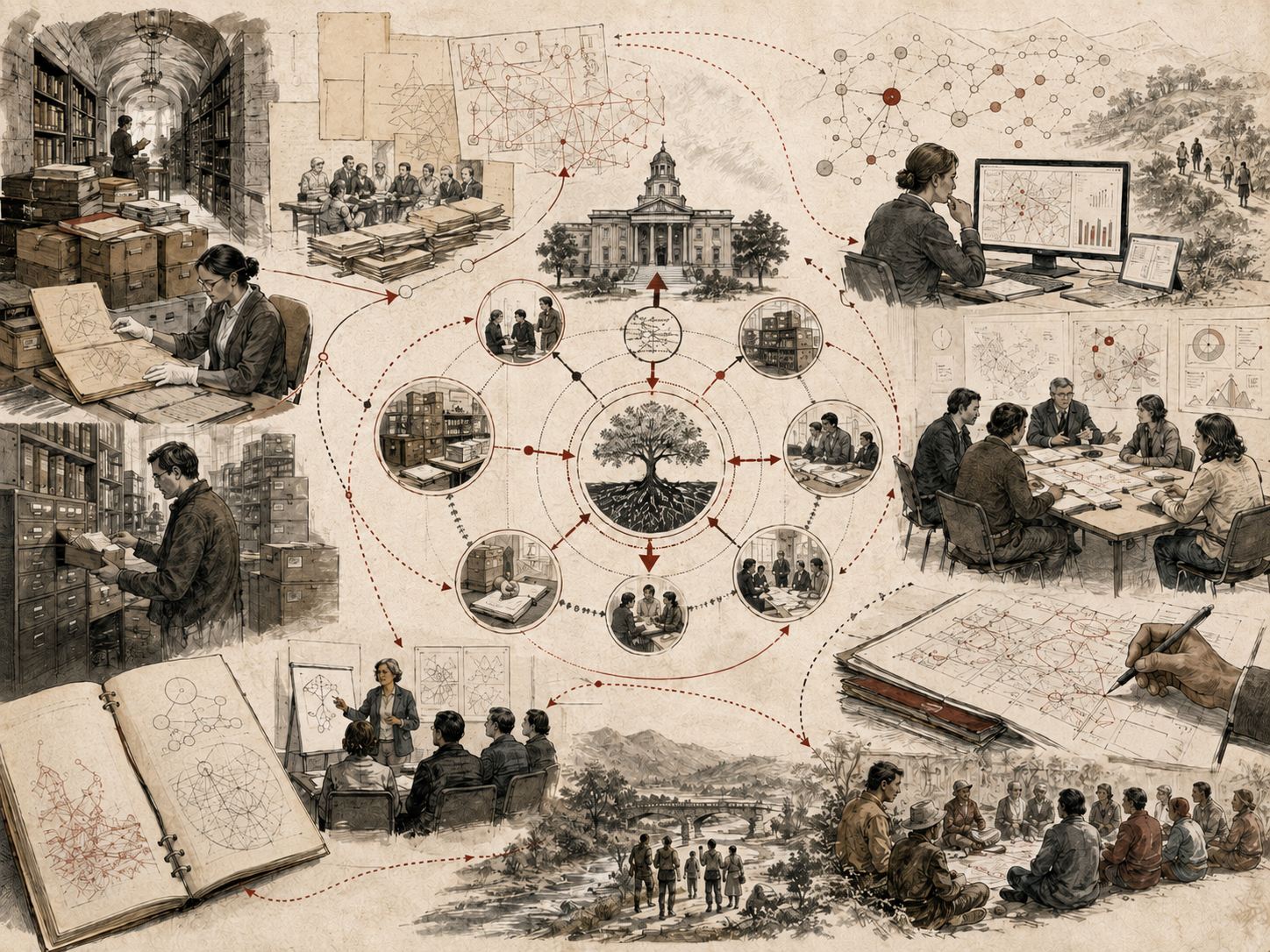
This article examines institutional memory as a systems capacity. It explains why organizations and public institutions forget, how turnover and documentation failure produce repeated mistakes, why memory must be connected to authority and redesign, and how knowledge architecture can support system learning. It also examines the ethics of institutional memory: whose knowledge is preserved, whose warnings are ignored, who is forced to repeatedly teach the institution, and how forgetting can become a way of avoiding responsibility for harm.
Why Institutional Memory Matters
Institutional memory matters because complex systems cannot learn if they cannot remember. A school district may repeat the same reform cycle every few years because prior implementation lessons were lost. A public agency may rediscover the same administrative burden after each leadership transition. A hospital may repeat safety problems because near-miss learning is not embedded into workflow. A technology organization may rebuild systems without understanding why earlier design choices were made. A nonprofit may lose community trust when staff turnover erases relational history. A government may respond to crisis without remembering prior warnings, ignored maintenance, or failed coordination.
Institutions often confuse activity with learning. They hold meetings, produce reports, run pilots, conduct evaluations, and collect feedback. But if those lessons do not alter future decisions, routines, incentives, documentation, onboarding, governance, or authority, the institution has experienced information without learning. Memory is what allows feedback to become cumulative.
Institutional memory also protects against the false freshness of recurring problems. Without memory, old failures appear new. New leaders repeat old interventions. New staff ask old questions. Communities are asked to restate harms they already reported. Frontline workers repeatedly explain the same constraints. The institution treats repetition as discovery rather than as evidence that it failed to retain knowledge.
| Institutional problem | Memory failure | System-learning question |
|---|---|---|
| Repeated failed reforms | Prior lessons were not preserved or used. | What did the institution already learn, and where did that knowledge go? |
| Turnover disrupts operations | Knowledge lives in people rather than shared systems. | What knowledge must survive role changes? |
| Communities repeat the same feedback | External knowledge is collected but not retained with authority. | Why must affected people keep teaching the institution the same lesson? |
| Postmortems do not prevent recurrence | Lessons are documented but not embedded into structure. | What process, rule, tool, or incentive changed after the lesson? |
| New teams repeat old mistakes | Decision rationale and design history are missing. | What context should have been available before action began? |
| Warnings are ignored until crisis | Weak signals are not preserved, escalated, or connected. | How does the system remember early warnings before they become failure? |
Institutional memory is not nostalgia. It is not resistance to change. It is the capacity to carry forward what experience has revealed so that change can be wiser. An institution with memory can adapt without erasing its own learning. An institution without memory may remain busy, innovative, and reform-oriented while repeating the same failures in new language.
What Institutional Memory Is
Institutional memory is the retained knowledge that allows a system to act with continuity, judgment, and learning over time. It includes explicit knowledge, such as policies, archives, datasets, reports, manuals, decision records, project documentation, code repositories, evaluations, and governance records. It also includes tacit knowledge: relationships, judgment, context, informal routines, historical awareness, trust, professional craft, community knowledge, and the practical understanding people develop by working inside a system.
Memory is not the same as storage. A file cabinet, shared drive, archive, wiki, or database may contain information, but institutional memory exists only when knowledge can be found, understood, trusted, applied, and updated. A document nobody uses is not memory in any practical sense. A report that does not influence future decisions is not learning. A dashboard that hides context may preserve numbers while losing meaning.
Institutional memory has several forms:
- Decision memory: why choices were made, what alternatives were considered, and what assumptions guided action.
- Operational memory: how work actually gets done, including routines, handoffs, bottlenecks, and workarounds.
- Relational memory: knowledge of trust, history, commitments, stakeholders, and communities.
- Failure memory: what went wrong, why it happened, and what was changed afterward.
- Context memory: historical, political, technical, cultural, and ecological conditions shaping the system.
- Design memory: why systems, tools, policies, or processes were built the way they were.
- Ethical memory: who was harmed, what repair was promised, and what responsibilities remain.
\text{Institutional Memory} = \text{Knowledge Retained} + \text{Context Preserved} + \text{Use in Future Decisions}
\]
Interpretation: Institutional memory requires more than stored information. It requires retained knowledge, preserved context, and active use in future action.
Memory also exists at different levels. Individuals remember. Teams remember. Communities remember. Organizations remember. Professions remember. Public institutions remember. A resilient system does not depend on one level alone. If memory lives only in individuals, it is vulnerable to turnover. If memory lives only in documents, it may lose tacit judgment. If memory lives only in leadership, it may ignore frontline and community knowledge. Strong institutional memory links individual, collective, documentary, and structural memory.
Institutional memory is therefore a living system. It must be maintained, interpreted, updated, protected, and connected to practice.
Memory as a System Stock
In systems thinking, memory can be understood as a stock. A stock is something that accumulates or depletes over time. Institutional memory grows when experience is captured, interpreted, organized, shared, embedded, and used. It declines when people leave, documents become obsolete, feedback is ignored, archives become unusable, political incentives suppress learning, or knowledge is not connected to future decisions.
This stock-flow view helps explain why institutions can lose capacity even while remaining active. An agency may continue processing cases while losing the knowledge of why certain rules create burden. A company may continue shipping products while losing the design rationale behind key systems. A school may continue teaching while losing community relationships and curricular memory. A hospital may continue treating patients while losing near-miss lessons through staff turnover.
M_{t+1} = M_t + L_t + D_t + S_t – T_t – F_t – O_t
\]
Interpretation: Institutional memory \(M\) grows through learning \(L_t\), documentation \(D_t\), and sharing \(S_t\), but declines through turnover \(T_t\), forgetting \(F_t\), and obsolescence \(O_t\).
Memory also has quality. More memory is not always better if knowledge is outdated, inaccessible, inaccurate, redundant, or poorly organized. A system can drown in records while losing the ability to learn. Memory must be curated, not merely accumulated. It must preserve what is useful, retire what is obsolete, and distinguish settled knowledge from open questions.
The stock of memory is affected by several flows:
| Memory flow | Increases or decreases memory? | Example |
|---|---|---|
| Learning capture | Increases | After-action reviews that record causes, assumptions, and redesign decisions. |
| Documentation | Increases if usable | Decision records, process maps, playbooks, and technical notes. |
| Mentoring | Increases shared tacit knowledge | Experienced staff transferring judgment to newer staff. |
| Turnover | Decreases if knowledge is not transferred | Key staff leave with historical context and informal relationships. |
| Obsolescence | Decreases usable memory | Old documentation persists after systems, laws, or tools change. |
| Political erasure | Decreases or distorts memory | Uncomfortable findings are buried, reframed, or omitted. |
Viewing memory as a stock also clarifies why short-term efficiency can damage long-term learning. Documentation, mentoring, reflection, archival care, and knowledge transfer require time. If an institution eliminates slack, it may increase short-term output while reducing the flows that replenish memory. The institution becomes faster and more forgetful at the same time.
System learning requires protecting the flows that build memory and reducing the flows that drain it.
How Institutions Forget
Institutions forget in many ways. They forget when people leave. They forget when documents are created but never maintained. They forget when leaders change and prior context is treated as irrelevant. They forget when metrics replace stories, when archives are inaccessible, when uncomfortable feedback is suppressed, when knowledge is fragmented across silos, and when political incentives encourage selective memory.
Forgetting is not always accidental. Sometimes institutions forget because remembering would create responsibility. Remembering a warning may reveal negligence. Remembering community feedback may require repair. Remembering prior failed reforms may challenge current leadership narratives. Remembering historical harm may demand accountability. Forgetting can therefore become a form of institutional self-protection.
Forgetting can also be built into structure. High turnover makes memory fragile. Short-term contracts weaken continuity. Outsourcing can remove knowledge from the institution. Project-based work can dissolve teams before lessons are embedded. Rapid reorganization can break knowledge networks. Poor search systems can make documentation functionally invisible. Overloaded staff may not have time to document what they know.
| Forgetting mechanism | How it works | System consequence |
|---|---|---|
| Turnover | People leave with tacit knowledge and relationships. | New staff repeat old mistakes and rediscover known constraints. |
| Siloed documentation | Knowledge remains trapped in departments or tools. | Whole-system learning is blocked across boundaries. |
| Obsolete archives | Records exist but are outdated or unmaintained. | People either distrust documentation or act on bad information. |
| Leadership churn | New leaders reset priorities without learning from history. | Reform cycles repeat with new language. |
| Blame culture | People hide problems instead of documenting them. | Failure memory becomes incomplete or distorted. |
| Political suppression | Uncomfortable findings are softened or buried. | Learning is subordinated to reputation management. |
Institutional forgetting has a pattern: experience happens, feedback appears, some people learn, but the knowledge does not become durable structure. It remains personal, informal, hidden, inaccessible, or politically inconvenient. The system then moves on. Later, the same conditions produce the same problem.
Forgetting should be treated as a systems failure, not merely an administrative inconvenience. When institutions forget, they waste public trust, human labor, time, resources, and moral credibility. They also transfer the burden of memory to the people least able to enforce it: frontline workers, affected communities, new staff, and people harmed by repeated institutional mistakes.
Turnover and Knowledge Loss
Turnover is one of the most important flows draining institutional memory. When people leave, the institution loses more than labor hours. It may lose judgment, historical context, informal networks, user knowledge, technical understanding, political awareness, relational trust, and memory of prior mistakes. If knowledge transfer is weak, each departure creates learning decay.
Turnover becomes especially damaging when the institution depends on tacit knowledge. Tacit knowledge is knowledge that is difficult to write down fully: how to interpret a situation, who to call, which warning signs matter, what a community has already said, what a legacy system really does, which workaround is safe, or why a past decision was made. Institutions often undervalue tacit knowledge because it is hard to measure, yet it is essential for competent action.
Turnover can also create a reinforcing loop. Workload rises. Burnout rises. People leave. Remaining staff absorb more work and lose knowledge support. Workload and uncertainty increase. More people leave. The institution loses capacity and memory simultaneously.
\text{Turnover} \uparrow \Rightarrow \text{Memory Loss} \uparrow \Rightarrow \text{Errors and Rework} \uparrow \Rightarrow \text{Workload} \uparrow \Rightarrow \text{Turnover} \uparrow
\]
Interpretation: Turnover can reinforce itself by reducing institutional memory, increasing rework, raising workload, and making additional turnover more likely.
Knowledge loss through turnover appears in several ways:
- new employees lack context for decisions they inherit;
- relationships with communities, partners, or clients weaken;
- technical systems become harder to maintain because design rationale is missing;
- prior failed experiments are repeated;
- informal quality checks disappear;
- onboarding becomes longer and more stressful;
- remaining staff become bottlenecks because too much memory depends on them;
- leadership underestimates how much knowledge has left the system.
Reducing memory loss requires more than exit interviews. Institutions need ongoing knowledge transfer before people leave. They need decision records, mentoring, role overlap, documentation standards, community relationship continuity, technical handoff practices, and repositories organized around future use. They also need to reduce the burnout and instability that make turnover likely in the first place.
A system that depends on people remembering everything personally has not built institutional memory. It has built institutional fragility.
Documentation and Usable Knowledge
Documentation is one of the most visible forms of institutional memory, but documentation alone does not guarantee learning. Many institutions produce documents that are too long, too scattered, too outdated, too technical, too vague, or too disconnected from actual work. Documentation becomes useful only when it helps people make better decisions, avoid repeated mistakes, understand context, and transfer knowledge across time.
Usable documentation answers the questions future users will actually have. Why did we choose this approach? What alternatives did we reject? What assumptions did we make? What failed before? What risks remain? What should not be repeated? What depends on whom? What changed after feedback? What historical commitments must be honored? What is still uncertain?
Documentation should preserve both information and rationale. A policy manual may explain what the rule is, but not why the rule exists, what harm it was meant to prevent, what trade-offs were considered, or how it affects people in practice. A technical document may explain how a system works, but not why it was designed that way or what constraints shaped it. A strategic plan may state goals, but not what assumptions would require revision.
| Weak documentation | Usable institutional memory |
|---|---|
| Records what happened. | Explains why it happened and what was learned. |
| Stores final decisions. | Preserves alternatives, assumptions, risks, and trade-offs. |
| Lives in scattered folders. | Is organized around workflows, decisions, and future use. |
| Created once and forgotten. | Maintained as a living knowledge asset. |
| Written for compliance. | Written for learning, continuity, and better judgment. |
| Contains information without ownership. | Has clear stewards responsible for accuracy and updates. |
Documentation must also avoid becoming a burden that crowds out work. If documentation demands are excessive, people may produce low-quality records or avoid documenting altogether. The system needs lightweight, meaningful routines. Decision records, after-action summaries, living playbooks, structured project notes, annotated datasets, and searchable knowledge bases can preserve memory without requiring bureaucratic overload.
Usable documentation depends on knowledge architecture. People must know where knowledge lives, how it is organized, who maintains it, what is current, and how to connect it to decisions. A memory system is not just a storage system. It is a structure for future learning.
Feedback Preservation and Learning Loops
Feedback preservation is the process of retaining signals from experience so the system can learn from them over time. Feedback may come from workers, users, residents, patients, students, customers, audits, incidents, complaints, evaluations, performance data, community meetings, technical logs, and weak signals from everyday practice. If feedback is not preserved, the system may receive the same signal repeatedly without learning from it.
Preserving feedback requires more than collecting it. The system must keep context. Who gave the feedback? Under what conditions? What pattern did it reveal? What action was taken? Was the action sufficient? Did the problem recur? Was the feedback from people with direct experience of harm or burden? Was it contradicted or confirmed by other evidence? Was it connected to decision-making authority?
Feedback becomes learning only when the loop closes. A person reports a problem. The organization interprets it. A decision is made. A change is implemented. The result is monitored. The lesson is stored. The person or group who gave feedback sees whether it mattered. Without loop closure, feedback collection can reduce trust.
\text{Feedback} \rightarrow \text{Interpretation} \rightarrow \text{Decision} \rightarrow \text{Action} \rightarrow \text{Memory} \rightarrow \text{Future Behavior}
\]
Interpretation: Feedback becomes system learning only when it is interpreted, acted upon, remembered, and used to shape future behavior.
Feedback preservation is especially important when the feedback is uncomfortable. Institutions often preserve positive evidence more carefully than negative evidence. Success stories are archived; warnings are diluted. Public praise is quoted; community criticism is summarized vaguely. Project wins are documented; failures are anonymized or buried. This creates biased memory. The institution remembers what protects its self-image and forgets what would require redesign.
A learning system should preserve:
- early warnings and weak signals;
- near misses and prevented failures;
- complaints and burden reports;
- community concerns and institutional responses;
- implementation problems and workarounds;
- postmortem findings and redesign actions;
- assumptions that proved wrong;
- lessons that changed future routines;
- unresolved issues requiring future accountability.
Feedback preservation prevents organizational amnesia. It helps a system remember not only what it wanted to hear, but what it needed to learn.
Repeated Mistakes and Learning Decay
Repeated mistakes are evidence of learning decay. A mistake may happen once because the system encountered uncertainty, novelty, or human error. When the same mistake recurs across time, teams, leaders, or programs, the deeper issue is often institutional memory failure. The system did not preserve, transmit, or embed what experience already revealed.
Learning decay occurs when knowledge weakens between the moment of experience and the moment it is needed again. The organization may learn during crisis, but the lesson fades when pressure declines. A team may document a lesson, but the next team does not see it. A community may warn an agency, but the warning does not enter policy memory. A technical team may know why a system is fragile, but the knowledge leaves when senior staff depart.
L_{\text{usable},t} = L_{\text{captured},t} \times A_t \times R_t \times E_t
\]
Interpretation: Usable learning depends on captured learning, accessibility \(A_t\), relevance \(R_t\), and embedding \(E_t\) into future routines.
Repeated mistakes can appear as:
- the same project risks appearing in every launch;
- the same community feedback repeated at every consultation;
- the same policy producing the same administrative burden;
- the same safety incident recurring after each staffing change;
- the same technology problems rebuilt into new platforms;
- the same reform cycle returning under a new name;
- the same crisis response repeated without prevention;
- the same leadership lesson relearned after every transition.
Repeated mistakes are costly because they erode trust. People may tolerate a genuine first mistake, especially if the institution learns and repairs. Repetition communicates something different. It suggests that feedback was ignored, memory was weak, or the institution valued convenience over learning. Communities, workers, and users begin to see the institution as incapable of remembering harm.
Learning decay should be diagnosed structurally. Did the lesson fail to get documented? Was documentation unusable? Did authority ignore the lesson? Did turnover remove the people who knew it? Did incentives reward repetition? Did leadership prefer a new initiative over an old lesson? Did the institution preserve the fact but lose the context?
A system has learned when the same conditions no longer produce the same preventable mistake.
Knowledge Architecture for System Learning
Knowledge architecture is the structure through which institutional knowledge is organized, connected, accessed, updated, and used. It includes taxonomies, repositories, decision records, metadata, search systems, documentation standards, ownership rules, archival practices, onboarding pathways, and the relationships among people, documents, data, and decisions. Good knowledge architecture turns memory into usable infrastructure.
Without knowledge architecture, institutions accumulate fragments. Reports live in one folder. Data lives in another. Decision rationale is in email. Lessons are in meeting notes. Community feedback is in consultation summaries. Technical knowledge is in individual memory. Policy history is in archived documents. New staff cannot find what matters. Leaders cannot connect patterns. The institution has information but lacks memory.
Knowledge architecture should be designed around use. Different users need different memory: frontline workers need practical guidance; analysts need data lineage; leaders need decision history; communities need accountability records; technical teams need design rationale; new staff need onboarding context; governance bodies need evidence of prior commitments and unresolved risks.
| Knowledge asset | System-learning purpose | Design requirement |
|---|---|---|
| Decision records | Preserve why choices were made. | Include alternatives, assumptions, trade-offs, and review triggers. |
| After-action reviews | Convert experience into future prevention. | Identify structural causes and required redesign. |
| Community feedback records | Prevent repeated consultation without memory. | Track commitments, responses, and unresolved concerns. |
| Technical documentation | Preserve system design and maintenance knowledge. | Include rationale, dependencies, constraints, and known risks. |
| Onboarding pathways | Transfer institutional context to new people. | Connect role guidance to history, relationships, and decision logic. |
| Learning repositories | Make lessons searchable and reusable. | Use clear taxonomy, metadata, ownership, and update cycles. |
Knowledge architecture must also include stewardship. Someone must maintain the memory system. Without ownership, repositories decay. Without standards, documentation fragments. Without review cycles, old knowledge becomes misleading. Without integration into workflow, knowledge remains outside practice.
Good knowledge architecture should answer three practical questions: What do we know? How do we know it? How will that knowledge change what we do next?
Memory, Authority, and Redesign
Institutional memory matters only if it can influence authority. A system may remember a problem in documents, conversations, reports, and frontline knowledge, yet continue unchanged because the memory does not reach decision-making power. This is common in large organizations and public institutions. People closest to the problem remember. People with authority do not hear, do not believe, or do not act.
Memory must therefore be connected to redesign. A lesson learned should trigger changes in rules, routines, metrics, budgets, authority, tools, staffing, training, or governance. If nothing changes, the memory remains informational rather than structural. The institution knows, but does not learn.
Authority also determines which memories count. Leadership memory may be treated as strategic. Frontline memory may be treated as anecdotal. Community memory may be treated as complaint. Technical memory may be ignored until failure. Historical memory may be excluded when it complicates current plans. A learning system must create channels through which different forms of memory can affect decisions.
\text{System Learning} = \text{Memory} \times \text{Authority to Redesign}
\]
Interpretation: Memory produces system learning only when it is connected to authority capable of changing structure.
Several questions help test whether memory reaches authority:
- Do decision-makers review prior lessons before approving similar work?
- Are past failures required context for new initiatives?
- Can frontline staff escalate recurring structural problems?
- Do community feedback records affect policy design?
- Are unresolved commitments tracked across leadership transitions?
- Do budgets fund the fixes that memory reveals are necessary?
- Are repeated mistakes treated as governance failures, not only operational failures?
- Does the institution change incentives after learning?
Memory without authority can become frustrating. People remember what went wrong, but cannot change it. They may become cynical because the institution repeatedly asks for lessons while refusing redesign. Over time, memory itself can become a burden. People carry knowledge of preventable failure while watching the system repeat it.
A learning institution does not merely archive lessons. It gives memory a route to power.
Ethics: Whose Knowledge Is Remembered?
Institutional memory has ethical stakes because institutions do not remember everyone equally. Some knowledge is preserved, cited, archived, and treated as authoritative. Other knowledge is dismissed, informalized, erased, or repeatedly requested without being acted upon. Whose memory counts often reflects power.
Communities may warn institutions for years about harms that later become officially recognized. Frontline workers may know that a process is failing long before leadership admits it. Marginalized employees may name exclusion long before it appears in formal metrics. Patients, students, residents, applicants, and caregivers may carry memory of institutional harm that the institution itself does not preserve. When institutions forget this knowledge, they often ask people to relive and restate harm repeatedly.
Ethical memory asks not only whether an institution remembers, but what it chooses to remember. Does it preserve praise more carefully than criticism? Does it archive successes but bury failures? Does it remember leadership decisions but not community warnings? Does it record compliance but not burden? Does it preserve technical facts but not lived experience? Does it treat historical harm as background rather than as active context?
Ethical institutional memory asks:
- Whose knowledge is preserved?
- Whose knowledge is dismissed as anecdotal or emotional?
- Who must repeatedly explain the same harm?
- What warnings were ignored before failure?
- What commitments were made and not honored?
- What histories are excluded from official records?
- Who benefits when the institution forgets?
- Who carries the cost of institutional amnesia?
- How is memory connected to repair?
- Who has authority to correct the record?
Institutional forgetting can become a form of harm. It can erase accountability, weaken trust, repeat injury, and force affected people to bear the labor of memory. Ethical memory requires preservation, acknowledgment, and repair. It also requires humility: institutions must recognize that their official records may not contain the whole truth.
A just institution remembers not only what it has achieved, but what it has been told, what it has ignored, what it has harmed, and what it still owes.
Examples Across Institutional Systems
Institutional memory and system learning matter across public agencies, healthcare systems, schools, nonprofits, technology organizations, research institutions, corporations, and civic institutions. The examples below show how memory changes diagnosis and redesign.
Public agencies
A public agency may repeatedly launch service reforms that promise easier access, yet applicants continue to face confusing rules, documentation burden, digital barriers, and delayed appeals. Institutional memory would preserve prior applicant feedback, frontline workarounds, implementation failures, and unresolved commitments. System learning would require those records to shape future rules, staffing, digital design, and accountability.
Healthcare organizations
Hospitals and clinics depend on memory for patient safety, handoffs, incident learning, and care continuity. Near misses, adverse events, staffing pressures, documentation problems, and workflow failures must be retained and translated into safer practice. If safety knowledge remains in incident reports but does not change staffing, tools, protocols, or training, the institution has documented risk without learning from it.
Schools and universities
Educational institutions often repeat reforms because prior lessons are lost through leadership transitions, staff turnover, policy shifts, and fragmented documentation. A school system may rediscover the same barriers to student support every few years. Institutional memory would preserve curriculum history, student feedback, teacher experience, community relationships, and the reasons past reforms succeeded or failed.
Nonprofits and community organizations
Nonprofits often rely on relational memory: trust with communities, knowledge of funder history, awareness of local needs, and understanding of past promises. When staff leave, relationships and context can disappear. Strong institutional memory requires relationship records, ethical handoffs, community accountability, and funding structures that support continuity rather than constant reinvention.
Technology organizations
Technology organizations need design memory. Why was a system built this way? What constraints shaped it? What known risks remain? What technical debt was accepted? What user feedback was ignored? Without design rationale, future teams may break hidden dependencies, repeat usability mistakes, or rebuild old failures into new platforms. Code is not enough; technical memory requires context.
Research institutions
Research systems depend on data provenance, methodological memory, replication records, lab notebooks, code documentation, mentoring, and institutional support for knowledge transfer. When projects end or researchers leave, data and methods may become unusable. System learning requires preserving not only results, but how results were produced, what assumptions were made, and what limitations were known.
Corporations
Companies often lose memory through restructuring, mergers, leadership changes, product pivots, and tool migration. Lessons from customer failures, quality issues, brand trust, supplier relationships, and internal culture may be lost when teams are reorganized. Institutional memory helps prevent the organization from treating old problems as new opportunities for avoidable mistakes.
Civic and governance institutions
Public trust depends on memory. Civic institutions must remember commitments, harms, consultations, promises, policy impacts, and community relationships across administrations. When institutions forget, residents may experience each engagement as another request to repeat what has already been said. System learning requires continuity, accountability records, and visible action on prior feedback.
Across these examples, institutional memory is not passive archive. It is the capacity to carry experience into future action.
Mathematics, Computation, and Modeling
Institutional memory can be modeled through stock-flow dynamics, knowledge-retention curves, turnover models, documentation quality measures, feedback-loop closure, network analysis, and learning-decay simulations. The purpose of modeling is not to reduce memory to a number. It is to reveal how learning accumulates, decays, fragments, and affects future system behavior.
A basic institutional memory stock can be represented as:
M_{t+1} = M_t + L_t + D_t + S_t – T_t – F_t – O_t
\]
Interpretation: Memory \(M\) increases through learning \(L_t\), documentation \(D_t\), and sharing \(S_t\), but declines through turnover \(T_t\), forgetting \(F_t\), and obsolescence \(O_t\).
Learning retention can be modeled as:
R_t = \frac{K_{\text{usable},t}}{K_{\text{captured},t}}
\]
Interpretation: Retention \(R_t\) compares usable knowledge with captured knowledge. A low ratio indicates that information exists but is not accessible or actionable.
Turnover-related memory loss can be represented as:
ML_t = \theta T_t (1 – H_t)
\]
Interpretation: Memory loss \(ML_t\) rises with turnover \(T_t\), moderated by handoff effectiveness \(H_t\). Better handoffs reduce memory loss.
Feedback loop closure can be represented as:
C_t = \frac{F_{\text{acted upon},t}}{F_{\text{received},t}}
\]
Interpretation: Closure \(C_t\) measures the share of received feedback that leads to documented action, decision change, or structural response.
Repeated mistake risk can be represented conceptually as:
P(\text{repeat error}) = f(1 – M_t, 1 – C_t, T_t, W_t)
\]
Interpretation: Repeat-error risk increases when memory is weak, feedback loops do not close, turnover is high, and workload pressure \(W_t\) limits learning time.
A memory-authority relationship can be represented as:
SL_t = M_t \times A_t \times E_t
\]
Interpretation: System learning \(SL_t\) depends on memory \(M_t\), authority connection \(A_t\), and embedding \(E_t\) into routines, rules, tools, or governance.
| Modeling task | Institutional-memory question | Example output |
|---|---|---|
| Memory stock-flow modeling | Is knowledge accumulating or decaying? | Institutional memory trajectory over time. |
| Turnover simulation | How does staff exit affect knowledge and performance? | Memory loss and onboarding burden under turnover scenarios. |
| Documentation quality analysis | Is captured knowledge usable? | Completeness, freshness, ownership, and searchability measures. |
| Feedback-loop closure | Does feedback lead to action and memory? | Received, interpreted, acted-upon, and embedded feedback rates. |
| Network analysis | Where does tacit knowledge concentrate? | Knowledge bottlenecks, bridge roles, and single points of failure. |
| Repeated-error modeling | What conditions predict repeated mistakes? | Error recurrence risk under weak-memory conditions. |
| Scenario comparison | Which memory interventions improve system learning? | Documentation, handoff, mentoring, repository, and redesign scenarios. |
Models of institutional memory should include both explicit and tacit knowledge. A system may have many documents but weak memory if knowledge is inaccessible, obsolete, or disconnected from authority. Conversely, a system may have strong tacit memory but high fragility if knowledge lives only in a few people. Good modeling helps reveal where memory is concentrated, where it is decaying, and where learning fails to become redesign.
Python Workflow: Institutional Memory, Learning Retention, Turnover Loss, and Feedback-Closure Diagnostics
The Python workflow below turns institutional memory analysis into a small reproducible systems model. It compares four scenarios: fragmented archive and turnover, documentation without authority, knowledge architecture and feedback closure, and embedded institutional learning. It also includes one-at-a-time sensitivity analysis for the embedded learning scenario. The script uses only the Python standard library, writes CSV outputs relative to the article folder, and is designed as a clear starting point for companion repository work.
# institutional_memory_system_learning_workflow.py
# Dependency-light workflow for institutional-memory diagnostics:
# memory stock-flow dynamics, learning retention, turnover-related knowledge loss,
# documentation quality, feedback-loop closure, repeated-error risk, and redesign scenarios.
# Writes outputs relative to the article root.

from __future__ import annotations

from dataclasses import dataclass, replace
from pathlib import Path
import csv
from statistics import mean

ARTICLE_ROOT = Path(__file__).resolve().parents[1]
TABLES = ARTICLE_ROOT / "outputs" / "tables"


@dataclass
class MemoryScenario:
    name: str
    learning_capture_rate: float
    documentation_quality: float
    sharing_rate: float
    turnover_rate: float
    forgetting_rate: float
    obsolescence_rate: float
    handoff_effectiveness: float
    feedback_closure_rate: float
    authority_connection: float
    embedding_strength: float
    knowledge_architecture_quality: float
    frontline_community_memory_weight: float
    political_erasure_risk: float


def clamp(value: float, low: float = 0.0, high: float = 140.0) -> float:
    return max(low, min(high, value))


def run_scenario(scenario: MemoryScenario, periods: int = 64) -> list[dict[str, object]]:
    memory_stock = 42.0 + scenario.documentation_quality * 16.0
    usable_knowledge = 36.0 + scenario.knowledge_architecture_quality * 18.0
    tacit_memory = 44.0 + scenario.handoff_effectiveness * 12.0
    feedback_memory = 34.0 + scenario.feedback_closure_rate * 16.0
    authority_link = 34.0 + scenario.authority_connection * 18.0
    embedded_learning = 30.0 + scenario.embedding_strength * 18.0
    community_trust_memory = 32.0 + scenario.frontline_community_memory_weight * 18.0
    repeated_error_stock = 44.0 + scenario.forgetting_rate * 14.0
    rows: list[dict[str, object]] = []

    for period in range(periods + 1):
        learning_inflow = clamp(
            scenario.learning_capture_rate * 14.0
            + scenario.feedback_closure_rate * 7.0
            + scenario.frontline_community_memory_weight * 6.0
            + max(0.0, repeated_error_stock - 45.0) * 0.06,
            0.0,
            100.0,
        )

        documentation_inflow = clamp(
            scenario.documentation_quality * 14.0
            + scenario.knowledge_architecture_quality * 6.0
            + scenario.learning_capture_rate * 5.0
            - scenario.obsolescence_rate * 4.0,
            0.0,
            100.0,
        )

        sharing_inflow = clamp(
            scenario.sharing_rate * 14.0
            + scenario.handoff_effectiveness * 7.0
            + scenario.knowledge_architecture_quality * 6.0
            + scenario.frontline_community_memory_weight * 5.0,
            0.0,
            100.0,
        )

        turnover_loss = clamp(
            scenario.turnover_rate * 14.0
            + tacit_memory * 0.06
            + max(0.0, 55.0 - handoff_score(scenario)) * 0.10
            - scenario.handoff_effectiveness * 6.0
            - scenario.knowledge_architecture_quality * 4.0,
            0.0,
            100.0,
        )

        forgetting_loss = clamp(
            scenario.forgetting_rate * 12.0
            + max(0.0, 55.0 - usable_knowledge) * 0.08
            + max(0.0, 55.0 - embedded_learning) * 0.06
            - scenario.embedding_strength * 5.0,
            0.0,
            100.0,
        )

        obsolescence_loss = clamp(
            scenario.obsolescence_rate * 12.0
            + max(0.0, memory_stock - usable_knowledge) * 0.05
            - scenario.knowledge_architecture_quality * 5.0
            - scenario.documentation_quality * 2.0,
            0.0,
            100.0,
        )

        erasure_loss = clamp(
            scenario.political_erasure_risk * 14.0
            + max(0.0, 55.0 - community_trust_memory) * 0.07
            - scenario.frontline_community_memory_weight * 5.0
            - scenario.feedback_closure_rate * 4.0
            - scenario.authority_connection * 3.0,
            0.0,
            100.0,
        )

        closure_flow = clamp(
            scenario.feedback_closure_rate * 16.0
            + scenario.authority_connection * 9.0
            + scenario.embedding_strength * 7.0
            + scenario.frontline_community_memory_weight * 6.0
            - scenario.political_erasure_risk * 5.0,
            0.0,
            100.0,
        )

        embedding_flow = clamp(
            scenario.embedding_strength * 16.0
            + authority_link * 0.07
            + usable_knowledge * 0.06
            + scenario.knowledge_architecture_quality * 8.0
            - scenario.obsolescence_rate * 4.0
            - scenario.political_erasure_risk * 4.0,
            0.0,
            100.0,
        )

        redesign_flow = clamp(
            embedded_learning * 0.08
            + closure_flow * 0.08
            + scenario.authority_connection * 12.0
            + scenario.frontline_community_memory_weight * 7.0
            + scenario.knowledge_architecture_quality * 6.0
            - scenario.political_erasure_risk * 6.0,
            0.0,
            100.0,
        )

        memory_stock = clamp(
            memory_stock
            + learning_inflow * 0.10
            + documentation_inflow * 0.10
            + sharing_inflow * 0.06
            - turnover_loss * 0.08
            - forgetting_loss * 0.08
            - obsolescence_loss * 0.07
            - erasure_loss * 0.06,
            0.0,
            120.0,
        )

        usable_knowledge = clamp(
            usable_knowledge
            + documentation_inflow * 0.07
            + sharing_inflow * 0.08
            + scenario.knowledge_architecture_quality * 1.2
            + embedding_flow * 0.05
            - obsolescence_loss * 0.08
            - forgetting_loss * 0.04,
            0.0,
            120.0,
        )

        tacit_memory = clamp(
            tacit_memory
            + sharing_inflow * 0.07
            + scenario.handoff_effectiveness * 1.1
            - turnover_loss * 0.10
            - scenario.turnover_rate * 0.7,
            0.0,
            120.0,
        )

        feedback_memory = clamp(
            feedback_memory
            + closure_flow * 0.10
            + scenario.frontline_community_memory_weight * 1.0
            - erasure_loss * 0.07
            - forgetting_loss * 0.04,
            0.0,
            120.0,
        )

        authority_link = clamp(
            authority_link
            + scenario.authority_connection * 1.2
            + closure_flow * 0.04
            + scenario.frontline_community_memory_weight * 0.6
            - scenario.political_erasure_risk * 0.8,
            0.0,
            100.0,
        )

        embedded_learning = clamp(
            embedded_learning
            + embedding_flow * 0.10
            + redesign_flow * 0.05
            - obsolescence_loss * 0.04
            - forgetting_loss * 0.04,
            0.0,
            120.0,
        )

        community_trust_memory = clamp(
            community_trust_memory
            + scenario.frontline_community_memory_weight * 1.3
            + closure_flow * 0.04
            + redesign_flow * 0.03
            - erasure_loss * 0.08
            - repeated_error_stock * 0.025,
            0.0,
            100.0,
        )

        retention_ratio = clamp(
            usable_knowledge / max(1.0, memory_stock) * 100.0,
            0.0,
            120.0,
        )

        repeat_error_risk = clamp(
            max(0.0, 65.0 - memory_stock) * 0.18
            + max(0.0, 65.0 - usable_knowledge) * 0.16
            + max(0.0, 65.0 - closure_flow) * 0.12
            + turnover_loss * 0.14
            + forgetting_loss * 0.12
            + erasure_loss * 0.16
            - embedded_learning * 0.08
            - authority_link * 0.06,
            0.0,
            100.0,
        )

        repeated_error_stock = clamp(
            repeated_error_stock
            + repeat_error_risk * 0.08
            + forgetting_loss * 0.05
            + obsolescence_loss * 0.04
            - redesign_flow * 0.10
            - embedded_learning * 0.04,
            0.0,
            120.0,
        )

        system_learning_score = clamp(
            memory_stock * 0.16
            + usable_knowledge * 0.16
            + feedback_memory * 0.14
            + authority_link * 0.14
            + embedded_learning * 0.18
            + community_trust_memory * 0.10
            + scenario.knowledge_architecture_quality * 8.0
            - repeat_error_risk * 0.18
            - repeated_error_stock * 0.12
            - erasure_loss * 0.12,
            0.0,
            100.0,
        )

        rows.append({
            "period": period,
            "scenario": scenario.name,
            "memory_stock": round(memory_stock, 3),
            "usable_knowledge": round(usable_knowledge, 3),
            "tacit_memory": round(tacit_memory, 3),
            "feedback_memory": round(feedback_memory, 3),
            "authority_link": round(authority_link, 3),
            "embedded_learning": round(embedded_learning, 3),
            "community_trust_memory": round(community_trust_memory, 3),
            "repeated_error_stock": round(repeated_error_stock, 3),
            "turnover_loss": round(turnover_loss, 3),
            "forgetting_loss": round(forgetting_loss, 3),
            "obsolescence_loss": round(obsolescence_loss, 3),
            "erasure_loss": round(erasure_loss, 3),
            "closure_flow": round(closure_flow, 3),
            "embedding_flow": round(embedding_flow, 3),
            "retention_ratio": round(retention_ratio, 3),
            "repeat_error_risk": round(repeat_error_risk, 3),
            "system_learning_score": round(system_learning_score, 3),
        })

    return rows


def handoff_score(scenario: MemoryScenario) -> float:
    return clamp(
        scenario.handoff_effectiveness * 55.0
        + scenario.documentation_quality * 25.0
        + scenario.knowledge_architecture_quality * 20.0,
        0.0,
        100.0,
    )


def summarize(rows: list[dict[str, object]]) -> list[dict[str, object]]:
    output: list[dict[str, object]] = []
    for scenario_name in sorted({row["scenario"] for row in rows}):
        subset = [row for row in rows if row["scenario"] == scenario_name]
        final = subset[-1]
        avg_learning = mean(float(row["system_learning_score"]) for row in subset)
        avg_repeat_risk = mean(float(row["repeat_error_risk"]) for row in subset)
        avg_memory = mean(float(row["memory_stock"]) for row in subset)
        avg_retention = mean(float(row["retention_ratio"]) for row in subset)
        avg_erasure = mean(float(row["erasure_loss"]) for row in subset)

        if float(final["system_learning_score"]) >= 65 and float(final["repeat_error_risk"]) <= 35:
            diagnostic = "memory is usable, embedded, and connected to system learning"
        elif avg_repeat_risk >= 55:
            diagnostic = "weak memory is creating repeated-error risk"
        elif avg_retention < 55:
            diagnostic = "knowledge exists but is not sufficiently usable"
        elif avg_erasure >= 45:
            diagnostic = "political or hierarchical erasure is distorting memory"
        elif avg_memory < 45:
            diagnostic = "institutional memory stock is too weak for continuity"
        elif avg_learning >= 55:
            diagnostic = "partial memory repair with remaining learning-decay risk"
        else:
            diagnostic = "weak evidence of durable system learning"

        output.append({
            "scenario": scenario_name,
            "final_system_learning_score": final["system_learning_score"],
            "final_repeat_error_risk": final["repeat_error_risk"],
            "final_memory_stock": final["memory_stock"],
            "final_usable_knowledge": final["usable_knowledge"],
            "final_retention_ratio": final["retention_ratio"],
            "final_authority_link": final["authority_link"],
            "final_embedded_learning": final["embedded_learning"],
            "average_system_learning_score": round(avg_learning, 3),
            "average_repeat_error_risk": round(avg_repeat_risk, 3),
            "average_memory_stock": round(avg_memory, 3),
            "average_retention_ratio": round(avg_retention, 3),
            "average_erasure_loss": round(avg_erasure, 3),
            "diagnostic": diagnostic,
        })

    return output


def one_at_a_time(base: MemoryScenario, delta: float = 0.10) -> list[dict[str, object]]:
    base_score = float(run_scenario(base)[-1]["system_learning_score"])
    parameters = [
        "learning_capture_rate",
        "documentation_quality",
        "sharing_rate",
        "turnover_rate",
        "forgetting_rate",
        "obsolescence_rate",
        "handoff_effectiveness",
        "feedback_closure_rate",
        "authority_connection",
        "embedding_strength",
        "knowledge_architecture_quality",
        "frontline_community_memory_weight",
        "political_erasure_risk",
    ]

    rows: list[dict[str, object]] = []
    for parameter in parameters:
        for direction in (-1, 1):
            current = getattr(base, parameter)
            revised_value = max(0.0, min(1.0, current + direction * delta))
            revised = replace(base, name=f"{base.name} {parameter} {direction * delta:+.2f}", **{parameter: revised_value})
            revised_score = float(run_scenario(revised)[-1]["system_learning_score"])
            rows.append({
                "parameter": parameter,
                "delta": direction * delta,
                "base_value": current,
                "revised_value": revised_value,
                "base_final_system_learning_score": round(base_score, 3),
                "revised_final_system_learning_score": round(revised_score, 3),
                "score_change": round(revised_score - base_score, 3),
                "absolute_score_change": round(abs(revised_score - base_score), 3),
            })

    return sorted(rows, key=lambda row: float(row["absolute_score_change"]), reverse=True)


def write_csv(path: Path, rows: list[dict[str, object]]) -> None:
    path.parent.mkdir(parents=True, exist_ok=True)
    if not rows:
        raise ValueError(f"No rows to write: {path}")
    with path.open("w", newline="", encoding="utf-8") as handle:
        writer = csv.DictWriter(handle, fieldnames=list(rows[0].keys()))
        writer.writeheader()
        writer.writerows(rows)


def main() -> None:
    scenarios = [
        MemoryScenario("Fragmented archive and turnover", 0.34, 0.32, 0.28, 0.76, 0.70, 0.64, 0.24, 0.22, 0.20, 0.22, 0.24, 0.20, 0.62),
        MemoryScenario("Documentation without authority", 0.54, 0.70, 0.48, 0.58, 0.54, 0.48, 0.42, 0.38, 0.24, 0.30, 0.50, 0.36, 0.46),
        MemoryScenario("Knowledge architecture and feedback closure", 0.70, 0.72, 0.68, 0.38, 0.34, 0.34, 0.68, 0.70, 0.66, 0.64, 0.72, 0.68, 0.28),
        MemoryScenario("Embedded institutional learning", 0.84, 0.84, 0.82, 0.24, 0.22, 0.24, 0.84, 0.84, 0.86, 0.86, 0.86, 0.86, 0.18),
    ]

    rows: list[dict[str, object]] = []
    for scenario in scenarios:
        rows.extend(run_scenario(scenario))

    write_csv(TABLES / "institutional_memory_timeseries.csv", rows)
    write_csv(TABLES / "institutional_memory_summary.csv", summarize(rows))
    write_csv(TABLES / "institutional_memory_sensitivity_analysis.csv", one_at_a_time(scenarios[-1]))

    print("Institutional memory workflow complete.")
    print(TABLES / "institutional_memory_timeseries.csv")


if __name__ == "__main__":
    main()
The workflow is intentionally simple enough to inspect. It shows how learning capture, documentation quality, sharing, turnover, forgetting, obsolescence, handoffs, feedback closure, authority connection, embedding, knowledge architecture, community memory, and political erasure risk interact over time. It also shows why memory is not simply storage: the system learns only when knowledge becomes usable, embedded, and connected to authority. The model is synthetic and illustrative; it supports disciplined inquiry rather than replacing domain expertise, stakeholder evidence, or ethical judgment.
R Workflow: Memory-System Summary and Learning-Scenario Visualization
The R workflow reads the Python-generated time-series and sensitivity outputs, creates institutional-memory summaries, and exports base R plots for memory stock, usable knowledge, retention ratio, repeat-error risk, embedded learning, and system learning. It uses only base R so it remains portable across simple local environments.
# institutional_memory_system_learning_diagnostics.R
# Base R workflow for memory-system summary and learning-scenario visualization.

args <- commandArgs(trailingOnly = FALSE)
file_arg <- grep("^--file=", args, value = TRUE)

if (length(file_arg) > 0) {
  script_path <- normalizePath(sub("^--file=", "", file_arg[1]), mustWork = TRUE)
  article_root <- normalizePath(file.path(dirname(script_path), ".."), mustWork = TRUE)
} else {
  article_root <- getwd()
}

setwd(article_root)

tables_dir <- file.path(article_root, "outputs", "tables")
figures_dir <- file.path(article_root, "outputs", "figures")

if (!dir.exists(tables_dir)) {
  dir.create(tables_dir, recursive = TRUE)
}

if (!dir.exists(figures_dir)) {
  dir.create(figures_dir, recursive = TRUE)
}

timeseries_path <- file.path(tables_dir, "institutional_memory_timeseries.csv")
sensitivity_path <- file.path(tables_dir, "institutional_memory_sensitivity_analysis.csv")

if (!file.exists(timeseries_path)) {
  stop(paste("Missing", timeseries_path, "Run the Python workflow first."))
}

data <- read.csv(timeseries_path, stringsAsFactors = FALSE)

last_by_scenario <- do.call(
  rbind,
  lapply(split(data, data$scenario), function(df) df[nrow(df), ])
)

avg_learning <- aggregate(system_learning_score ~ scenario, data = data, FUN = mean)
avg_repeat_risk <- aggregate(repeat_error_risk ~ scenario, data = data, FUN = mean)
avg_memory <- aggregate(memory_stock ~ scenario, data = data, FUN = mean)
avg_retention <- aggregate(retention_ratio ~ scenario, data = data, FUN = mean)
avg_erasure <- aggregate(erasure_loss ~ scenario, data = data, FUN = mean)

names(avg_learning)[2] <- "average_system_learning_score"
names(avg_repeat_risk)[2] <- "average_repeat_error_risk"
names(avg_memory)[2] <- "average_memory_stock"
names(avg_retention)[2] <- "average_retention_ratio"
names(avg_erasure)[2] <- "average_erasure_loss"

final_fields <- last_by_scenario[, c(
  "scenario",
  "system_learning_score",
  "repeat_error_risk",
  "memory_stock",
  "usable_knowledge",
  "retention_ratio",
  "authority_link",
  "embedded_learning"
)]

names(final_fields) <- c(
  "scenario",
  "final_system_learning_score",
  "final_repeat_error_risk",
  "final_memory_stock",
  "final_usable_knowledge",
  "final_retention_ratio",
  "final_authority_link",
  "final_embedded_learning"
)

summary_table <- Reduce(
  function(x, y) merge(x, y, by = "scenario"),
  list(avg_learning, avg_repeat_risk, avg_memory, avg_retention, avg_erasure, final_fields)
)

summary_table$diagnostic <- ifelse(
  summary_table$final_system_learning_score >= 65 &
    summary_table$final_repeat_error_risk <= 35,
  "memory is usable, embedded, and connected to system learning",
  ifelse(
    summary_table$average_repeat_error_risk >= 55,
    "weak memory is creating repeated-error risk",
    ifelse(
      summary_table$average_retention_ratio < 55,
      "knowledge exists but is not sufficiently usable",
      ifelse(
        summary_table$average_erasure_loss >= 45,
        "political or hierarchical erasure is distorting memory",
        ifelse(
          summary_table$average_memory_stock < 45,
          "institutional memory stock is too weak for continuity",
          ifelse(
            summary_table$average_system_learning_score >= 55,
            "partial memory repair with remaining learning-decay risk",
            "weak evidence of durable system learning"
          )
        )
      )
    )
  )
)

summary_table <- summary_table[order(summary_table$final_system_learning_score, decreasing = TRUE), ]

write.csv(
  summary_table,
  file.path(tables_dir, "institutional_memory_r_summary.csv"),
  row.names = FALSE
)

if (file.exists(sensitivity_path)) {
  sensitivity <- read.csv(sensitivity_path, stringsAsFactors = FALSE)
  sensitivity_ranked <- sensitivity[order(sensitivity$absolute_score_change, decreasing = TRUE), ]
  write.csv(
    sensitivity_ranked,
    file.path(tables_dir, "institutional_memory_sensitivity_ranked_r.csv"),
    row.names = FALSE
  )
}

plot_metric <- function(metric, label, file_name) {
  png(file.path(figures_dir, file_name), width = 1200, height = 700)
  scenarios <- unique(data$scenario)
  plot(
    NA,
    xlim = range(data$period),
    ylim = range(data[[metric]], na.rm = TRUE),
    xlab = "Period",
    ylab = label,
    main = paste(label, "by Institutional-Memory Scenario")
  )
  for (scenario_name in scenarios) {
    subset_data <- data[data$scenario == scenario_name, ]
    lines(subset_data$period, subset_data[[metric]], lwd = 2)
  }
  legend("topleft", legend = scenarios, lwd = 2, cex = 0.8, bty = "n")
  grid()
  dev.off()
}

plot_metric("memory_stock", "Memory stock", "memory_stock_trajectories.png")
plot_metric("usable_knowledge", "Usable knowledge", "usable_knowledge_trajectories.png")
plot_metric("retention_ratio", "Retention ratio", "retention_ratio_trajectories.png")
plot_metric("repeat_error_risk", "Repeat-error risk", "repeat_error_risk_trajectories.png")
plot_metric("embedded_learning", "Embedded learning", "embedded_learning_trajectories.png")
plot_metric("system_learning_score", "System learning score", "system_learning_score_trajectories.png")

png(file.path(figures_dir, "final_system_learning_scores.png"), width = 1200, height = 700)
barplot(
  summary_table$final_system_learning_score,
  names.arg = summary_table$scenario,
  las = 2,
  ylab = "Final system learning score",
  main = "Final System Learning Score by Scenario"
)
grid()
dev.off()

print(summary_table)
This workflow supports the article’s central methodological claim: institutional memory becomes system learning only when knowledge is preserved, findable, usable, authoritative, and embedded into future routines. The R outputs help readers compare storage-oriented memory with authority-connected learning systems.
GitHub Repository
The companion repository for this article should help readers model institutional memory, learning retention, turnover-related knowledge loss, documentation quality, feedback-loop closure, repeated-error risk, knowledge networks, and memory-based redesign scenarios using synthetic datasets and reproducible workflows.
Complete Code Repository
Companion repository for the article, including institutional-memory simulations, learning-retention models, turnover and knowledge-loss analysis, documentation-quality scoring, feedback-loop closure diagnostics, repeated-mistake modeling, knowledge-network analysis, synthetic datasets, documentation assets, and multi-language scaffolds for systems analysis.
articles/institutional-memory-and-system-learning/
├── python/
│   ├── institutional_memory_system_learning_workflow.py
│   ├── institutional_memory_baseline.py
│   ├── memory_stock_flow_model.py
│   ├── turnover_knowledge_loss.py
│   ├── documentation_quality_score.py
│   ├── feedback_loop_closure.py
│   ├── repeated_mistake_risk.py
│   ├── knowledge_network_analysis.py
│   ├── memory_redesign_scenarios.py
│   ├── validation_checks.py
│   └── run_all_memory_workflows.py
├── r/
│   ├── institutional_memory_system_learning_diagnostics.R
│   ├── memory_retention_plots.R
│   ├── turnover_memory_visualization.R
│   ├── documentation_quality_tables.R
│   ├── feedback_closure_summary.R
│   ├── repeated_error_analysis.R
│   ├── memory_redesign_outputs.R
│   └── run_all_memory_workflows.R
├── julia/
│   ├── nonlinear_memory_decay.jl
│   ├── learning_retention_dynamics.jl
│   └── memory_authority_feedback.jl
├── sql/
│   ├── schema_memory_assets.sql
│   ├── schema_decision_records.sql
│   ├── schema_feedback_signals.sql
│   ├── schema_learning_events.sql
│   ├── schema_turnover_events.sql
│   ├── schema_documentation_quality.sql
│   ├── schema_repeated_errors.sql
│   ├── schema_redesign_actions.sql
│   ├── schema_model_runs.sql
│   └── schema_outputs.sql
├── rust/
│   └── institutional_memory_diagnostics_cli.rs
├── go/
│   └── memory_scenario_runner.go
├── cpp/
│   ├── efficient_memory_decay_scan.cpp
│   └── feedback_closure_solver.cpp
├── fortran/
│   └── recurrence_memory_learning_model.f90
├── c/
│   └── low_level_memory_feedback_engine.c
├── docs/
│   ├── modeling_principles.md
│   ├── article_notes.md
│   ├── institutional_memory_framework.md
│   ├── feedback_preservation_framework.md
│   ├── documentation_quality_guide.md
│   ├── diagnostic_questions.md
│   ├── ethics_and_memory_notes.md
│   ├── assumptions_and_limitations.md
│   └── responsible_use.md
├── data/
│   ├── synthetic_memory_assets.csv
│   ├── synthetic_decision_records.csv
│   ├── synthetic_feedback_signals.csv
│   ├── synthetic_learning_events.csv
│   ├── synthetic_turnover_events.csv
│   ├── synthetic_documentation_quality.csv
│   ├── synthetic_repeated_errors.csv
│   ├── synthetic_redesign_actions.csv
│   ├── synthetic_model_runs.csv
│   └── synthetic_outputs.csv
├── outputs/
│   ├── README.md
│   ├── figures/
│   └── tables/
└── notebooks/
    ├── python_institutional_memory_walkthrough.ipynb
    └── r_memory_learning_visualization_placeholder.ipynb
This repository structure supports the article’s central argument: system learning depends on memory that is preserved, usable, connected to authority, and embedded into future action. The data/ folder separates memory assets, decision records, feedback signals, learning events, turnover events, documentation quality, repeated errors, redesign actions, model runs, and outputs. The python/ and r/ folders support memory stock-flow modeling, turnover-related knowledge loss, documentation quality scoring, feedback-loop closure, repeated-mistake risk, knowledge-network analysis, and redesign scenario comparison. The julia folder supports nonlinear memory decay and memory-authority feedback. The sql folder defines schemas for institutional memory data. The lower-level language folders provide scaffolds for diagnostics, memory-decay scanning, feedback-closure solving, recurrence modeling, and low-level memory simulation.
A Practical Method for Building Institutional Memory
Building institutional memory requires designing systems that preserve learning and connect it to future action. The goal is not to document everything. The goal is to preserve what future people will need in order to avoid repeated mistakes, understand context, honor commitments, and redesign the system intelligently.
1. Identify repeated mistakes and recurring questions
Start where memory failure is most visible. What issues keep returning? What questions are repeatedly reopened? What mistakes recur after turnover, leadership change, or project restart?
2. Map existing memory assets
Identify current repositories, archives, reports, decision records, datasets, process maps, onboarding materials, community feedback records, technical documentation, and informal knowledge holders.
3. Identify knowledge at risk
Ask what knowledge would disappear if key people left. Include tacit judgment, relationships, design rationale, workarounds, historical commitments, and lessons from failure.
4. Preserve decision rationale
Record not only what was decided, but why. Include assumptions, alternatives, trade-offs, dissent, evidence, constraints, and conditions that would require revision.
5. Capture feedback with context
Preserve feedback from workers, users, communities, and partners along with the conditions under which it was given and the response it received.
6. Build usable knowledge architecture
Organize knowledge around future use: workflows, decisions, programs, risks, communities, systems, and recurring problems. Make it searchable and maintained.
7. Connect memory to onboarding
Ensure new people learn not only tasks, but history, relationships, past failures, assumptions, and unresolved commitments.
8. Connect memory to authority
Require decision-makers to consult relevant memory before launching new initiatives, changing policy, repeating pilots, or redesigning systems.
9. Close feedback loops
Track whether feedback led to action, whether action worked, and whether the lesson was embedded into future practice.
10. Maintain memory as a living system
Assign stewardship, update cycles, retirement rules, metadata standards, and accountability for knowledge quality.
This method helps institutions move from documentation to memory, and from memory to system learning.
Common Pitfalls
Institutional memory work can fail when it becomes bureaucratic, symbolic, or disconnected from use. Several pitfalls are common.
- Confusing storage with memory: A file exists somewhere, but nobody can find it, understand it, trust it, or apply it. Storage is not memory unless it supports future action.
- Documenting facts without rationale: Future teams need to know why decisions were made, not only what decisions were made.
- Preserving successes while burying failures: A biased memory system protects reputation but weakens learning. Institutions need failure memory as well as success memory.
- Letting memory live only in people: Tacit knowledge matters, but if memory depends entirely on individuals, turnover becomes institutional amnesia.
- Creating documentation burden without reducing future burden: Documentation should make future work easier. If it only adds forms and reports, people will avoid or degrade it.
- Ignoring community and frontline memory: Official records may omit the knowledge of those closest to harm, implementation, or burden.
- Failing to connect memory to authority: Knowledge that cannot influence decisions does not become system learning.
- Letting memory become obsolete: Outdated documentation can be worse than no documentation if it creates false confidence.
The central pitfall is treating institutional memory as an archive rather than as a living system for preventing repeated failure and supporting wiser action.
Why Institutional Memory Is a Systems Capacity
Institutional memory is a systems capacity because learning must travel across time. A system cannot become wiser if every team, leader, project, or generation starts over. Feedback must be preserved. Decisions must retain context. Mistakes must leave usable traces. Community warnings must be remembered. Technical rationale must survive turnover. Lessons must change routines, tools, rules, incentives, and governance.
Institutions often fail not because they never learned, but because they did not retain learning long enough for it to matter. They learned in one meeting, one report, one crisis, one team, one administration, or one person’s experience. Then the learning decayed. The system repeated itself.
Systems thinking changes how memory is understood. Memory is not passive storage. It is a stock that grows and declines. It is shaped by flows of learning, documentation, sharing, turnover, forgetting, obsolescence, and power. It can be strengthened through knowledge architecture, feedback preservation, decision records, mentoring, onboarding, and authority pathways. It can be weakened by overload, silos, blame, political erasure, poor documentation, and unstable staffing.
An institution with memory can learn from its own history without being trapped by it. It can adapt while honoring what experience has revealed. It can stop asking people to repeat lessons the system has already been taught. It can turn feedback into repair and experience into judgment.
Institutional memory is not a luxury. It is the infrastructure of system learning.
Related Articles
- Organizational Burnout as a System Pattern
- Learning Organizations and Feedback Awareness
- Systems Thinking in Organizations and Learning
- Mental Models and the Limits of Linear Reasoning
- Systems Thinking in Governance and Public Institutions
- Policy Resistance and Structural Redesign
- Knowledge Architecture
- Feedback Loops and System Behavior
Further Reading
- Walsh, James P. and Ungson, Gerardo Rivera. “Organizational Memory.” Academy of Management Review.
- Argyris, Chris and Schön, Donald A. Organizational Learning: A Theory of Action Perspective. Addison-Wesley.
- Senge, Peter M. The Fifth Discipline: The Art and Practice of the Learning Organization. Doubleday/Currency.
- Nonaka, Ikujiro and Takeuchi, Hirotaka. The Knowledge-Creating Company. Oxford University Press.
- March, James G. “Exploration and Exploitation in Organizational Learning.” Organization Science.
- Edmondson, Amy C. The Fearless Organization: Creating Psychological Safety in the Workplace for Learning, Innovation, and Growth. Wiley.
- Weick, Karl E. and Sutcliffe, Kathleen M. Managing the Unexpected: Sustained Performance in a Complex World. Wiley.
- Sterman, John D. Business Dynamics: Systems Thinking and Modeling for a Complex World. Irwin/McGraw-Hill.
- Meadows, Donella H. Thinking in Systems: A Primer. Chelsea Green Publishing.
- Herd, Pamela and Moynihan, Donald P. Administrative Burden: Policymaking by Other Means. Russell Sage Foundation.
References
- Argyris, C. and Schön, D.A. (1978) Organizational Learning: A Theory of Action Perspective. Reading, MA: Addison-Wesley.
- Edmondson, A.C. (1999) “Psychological Safety and Learning Behavior in Work Teams.” Administrative Science Quarterly, 44(2), pp. 350–383. Available at: https://doi.org/10.2307/2666999
- Edmondson, A.C. (2018) The Fearless Organization: Creating Psychological Safety in the Workplace for Learning, Innovation, and Growth. Hoboken, NJ: Wiley.
- Herd, P. and Moynihan, D.P. (2018) Administrative Burden: Policymaking by Other Means. New York: Russell Sage Foundation.
- March, J.G. (1991) “Exploration and Exploitation in Organizational Learning.” Organization Science, 2(1), pp. 71–87. Available at: https://doi.org/10.1287/orsc.2.1.71
- Meadows, D.H. (2008) Thinking in Systems: A Primer. White River Junction, VT: Chelsea Green Publishing. Available at: https://www.chelseagreen.com/product/thinking-in-systems/
- Nonaka, I. and Takeuchi, H. (1995) The Knowledge-Creating Company: How Japanese Companies Create the Dynamics of Innovation. New York: Oxford University Press.
- Senge, P.M. (1990) The Fifth Discipline: The Art and Practice of the Learning Organization. New York: Doubleday/Currency.
- Sterman, J.D. (2000) Business Dynamics: Systems Thinking and Modeling for a Complex World. Boston: Irwin/McGraw-Hill.
- Walsh, J.P. and Ungson, G.R. (1991) “Organizational Memory.” Academy of Management Review, 16(1), pp. 57–91.
- Weick, K.E. and Sutcliffe, K.M. (2007) Managing the Unexpected: Resilient Performance in an Age of Uncertainty. 2nd edn. San Francisco: Jossey-Bass.