
Last Updated August 4, 2026
Organizational burnout is not only an individual experience of exhaustion. It is often a system pattern: a recurring structure in which workload, urgency, emotional labor, decision delay, rework, understaffing, unclear priorities, and weak recovery cycles combine to deplete human capacity faster than the organization restores it. The organization may continue to function for a time because people compensate through overtime, hidden labor, personal sacrifice, professional commitment, and informal workarounds. But the system is drawing down a stock it does not properly measure.
Burnout becomes organizational when exhaustion is produced by structure rather than isolated personal weakness. A team may be praised for resilience while being given impossible demand. A manager may rely on the most reliable people until their reliability becomes overload. A public agency may compensate for policy complexity by asking frontline workers and applicants to absorb the burden. A nonprofit may ask mission-driven staff to fill the gap between need and funding. A technology organization may treat speed as success while accumulating technical debt, support debt, and human debt. In each case, burnout is feedback from the system.
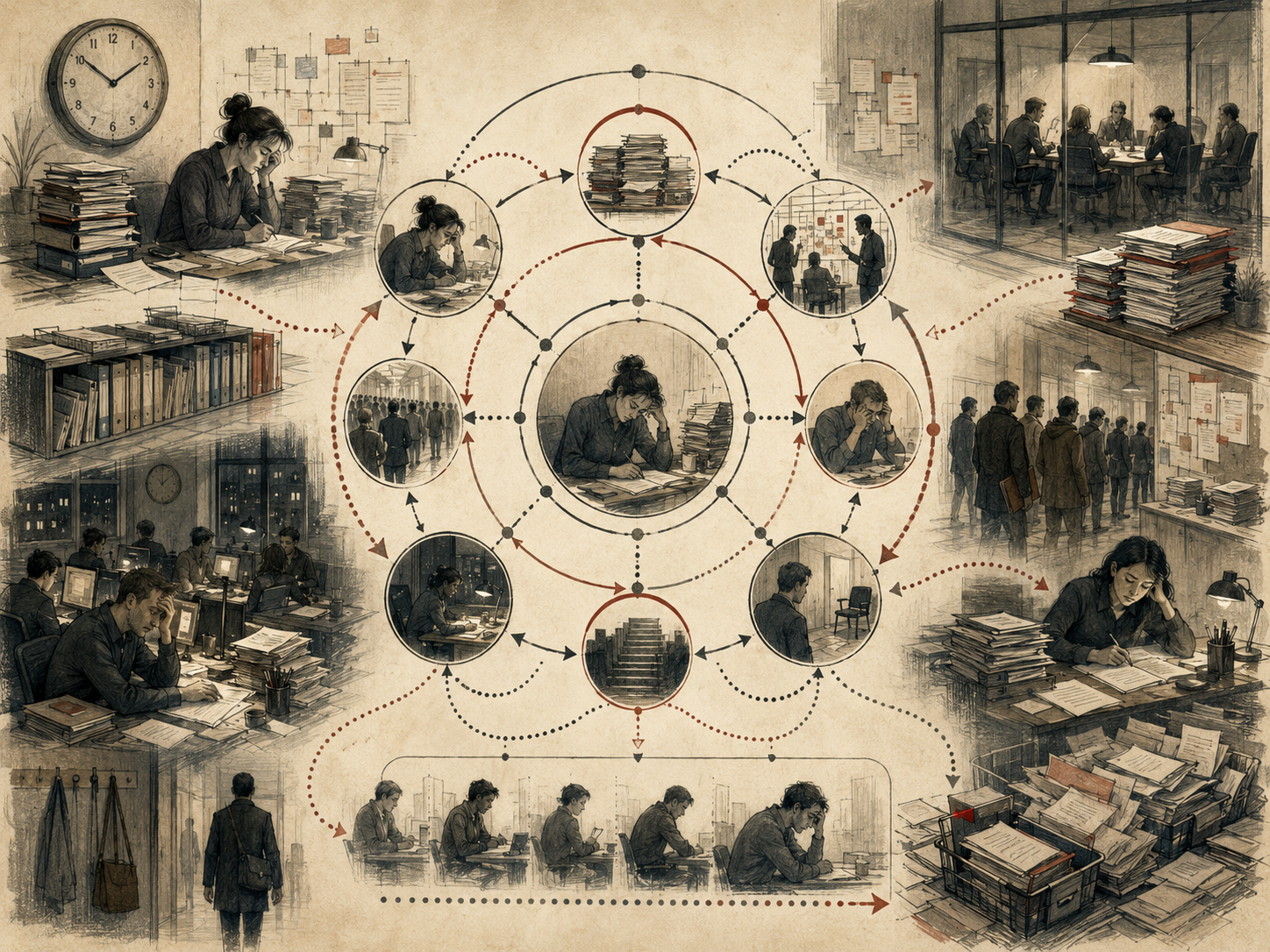
This article examines organizational burnout as a systems problem. It explains how workload, capacity, delay, rework, incentives, emotional labor, turnover, and institutional memory interact over time. It distinguishes individual stress from system-level depletion and shows why wellness programs, resilience messaging, or motivational language cannot repair burnout when the structure continues to produce overload. It also examines the ethical stakes of burnout: who absorbs hidden work, whose care and commitment are exploited, who benefits from under-measured labor, and what redesign is required to make organizations sustainable for the people who keep them alive.
Why Organizational Burnout Matters
Organizational burnout matters because it reveals a failure of system design. When exhaustion becomes normal, the organization is not merely experiencing a morale problem. It is operating beyond sustainable human capacity. The system may still produce output, meet deadlines, serve clients, satisfy funders, release products, process cases, or respond to crises, but the visible output is being supported by invisible depletion.
Burnout is often misunderstood because organizations see the final symptoms before they see the structure. They see disengagement, absenteeism, turnover, conflict, cynicism, lowered quality, missed deadlines, or emotional exhaustion. They may respond with wellness programs, recognition campaigns, resilience training, or time-management advice. These responses may help at the margins, but they do not address the system if workload, staffing, recovery, priorities, incentives, and authority remain unchanged.
A systems view asks what the organization is drawing from and whether that stock is being replenished. Human capacity includes energy, attention, skill, trust, memory, care, patience, coordination, emotional availability, cognitive bandwidth, and willingness to keep helping the system function. These are not infinite. When the organization treats them as endlessly renewable, burnout becomes predictable.
| Visible burnout symptom | Possible system structure | Systems-thinking question |
|---|---|---|
| Chronic fatigue | Demand exceeds capacity and recovery is insufficient. | Is the organization replenishing the human stock it consumes? |
| Rising errors | Urgency reduces attention, quality, and learning time. | Is speed creating rework and future workload? |
| Turnover | People exit when depletion exceeds meaning, support, and agency. | What conditions make staying costly? |
| Cynicism | Repeated promises of change fail to alter structure. | Has feedback been collected without consequence? |
| Conflict | Scarce time, unclear priorities, and overload create competition. | Are people fighting each other because the system has overloaded them? |
| Low innovation | No slack remains for reflection, experimentation, or learning. | Has the organization optimized away its learning capacity? |
Burnout matters because it damages people, but it also damages the organization’s ability to learn. Exhausted systems become reactive. They lose memory. They suppress feedback. They narrow attention. They punish mistakes. They defer prevention. They become more dependent on heroic effort. Over time, the system becomes less capable of the redesign required to escape burnout.
Organizational burnout is therefore not only a human-resources concern. It is a systems concern, a governance concern, and an ethical concern.
Burnout as a System Pattern
Burnout becomes a system pattern when the organization repeatedly produces conditions that deplete people faster than it restores them. The pattern may appear in one team, spread across departments, or become part of the institution’s culture. People adapt by working longer hours, skipping breaks, absorbing emotional strain, creating workarounds, lowering standards, delaying maintenance, or quietly disengaging. These adaptations allow the system to continue temporarily, but they also hide the severity of the problem.
A system pattern differs from an isolated case. One person may experience burnout because of personal circumstances, role mismatch, conflict, or temporary overload. A system pattern appears when burnout repeats across people, roles, teams, departments, or cycles. The organization replaces exhausted individuals, but the next people experience the same structure. The pattern survives personnel changes.
Systems thinking asks what makes burnout likely. The answer often includes demand growth, inadequate staffing, unclear priorities, frequent interruptions, rework loops, emotional labor, lack of authority, low recovery, high responsibility without control, poor tools, conflicting goals, and a culture that rewards sacrifice. These variables interact. Burnout is not caused by one factor alone; it emerges from the structure of work.
\text{Burnout Risk} = f(\text{Demand}, \text{Capacity}, \text{Recovery}, \text{Control}, \text{Meaning}, \text{Support}, \text{Fairness})
\]
Interpretation: Burnout risk depends on the relationship among workload demand, available capacity, recovery, autonomy, meaning, support, and perceived fairness.
Burnout as a system pattern often includes several recurring dynamics:
- the system depends on people working beyond sustainable limits;
- high performers receive more work because they are trusted;
- turnover transfers work to remaining staff;
- rework grows because urgency reduces quality;
- managers normalize crisis because crisis response has become routine;
- employees stop reporting problems because feedback has not changed structure;
- wellness language appears while workload remains unchanged;
- institutional memory declines as experienced people leave.
A burnout system is often self-concealing. People who care most may compensate the longest. Their effort delays visible collapse. The organization sees output and assumes the system is functioning. In reality, it is converting commitment into depletion.
Burnout becomes visible only after the hidden stock has been drawn down. By then, repair is harder. This is why systems thinking treats burnout as early warning, not as a personal failure.
Workload, Capacity, and Recovery
The core structure of organizational burnout is the relationship between workload, capacity, and recovery. Workload is the demand placed on people. Capacity is the human and organizational ability to respond. Recovery is the replenishment that allows people to remain capable over time. Burnout emerges when workload repeatedly exceeds capacity and recovery is insufficient to restore the system.
Organizations often measure workload poorly. They count projects, tickets, cases, meetings, deadlines, or hours, but miss cognitive switching, emotional labor, decision fatigue, hidden coordination, interruptions, documentation burden, ambiguity, and rework. A role may look manageable on paper while being unsustainable in practice because the official workload excludes the labor required to make the work possible.
Capacity is also often misunderstood. It is not just headcount. It includes skill, experience, trust, tools, clear priorities, decision authority, institutional memory, coordination quality, psychological safety, and time for learning. A team can have enough people and still lack capacity if work is poorly structured, decisions are delayed, tools are broken, or knowledge is fragmented.
P_t = \frac{W_t}{C_t}
\]
Interpretation: Work pressure \(P_t\) rises when workload \(W_t\) grows faster than capacity \(C_t\). Sustained high pressure increases burnout risk.
Recovery is not a perk. It is a system requirement. People need rest, reflection, uninterrupted work time, learning time, emotional decompression, meaningful support, and periods when demand does not exceed capacity. Organizations that remove all slack may appear efficient in the short term, but they lose resilience, creativity, quality, and adaptability. Slack is not always waste. Sometimes it is the capacity that prevents collapse.
| Capacity element | How burnout depletes it | How redesign can restore it |
|---|---|---|
| Attention | Interruptions, urgency, and switching fragment cognitive focus. | Limit work-in-progress, protect focus time, reduce unnecessary meetings. |
| Trust | Repeated unmet promises make people cynical. | Close feedback loops and make visible structural changes. |
| Skill | No time remains for learning or mentoring. | Protect training, peer learning, and onboarding time. |
| Institutional memory | Turnover removes knowledge and history. | Build documentation, decision records, and knowledge-sharing routines. |
| Coordination | Overload produces missed handoffs and rework. | Clarify ownership, reduce dependencies, and align handoff accountability. |
| Emotional capacity | Care work, conflict, and crisis response drain resilience. | Distribute emotional labor, provide support, and reduce preventable crisis. |
The question is not whether people can handle a difficult period. Most organizations experience temporary surges. The question is whether surge becomes structure. When temporary overload becomes normal operating condition, the system is no longer managing demand. It is consuming people.
Urgency, Rework, and Delay
Urgency is one of the most common drivers of organizational burnout. Urgency can be necessary during real crisis, but when urgency becomes the default mode of work, it distorts priorities, reduces quality, weakens reflection, and increases rework. The organization moves faster in the short term while creating more work for the future.
Rework is a hidden burnout engine. When work is rushed, incomplete, poorly coordinated, or based on unclear decisions, errors and misunderstandings increase. Those errors create rework. Rework increases workload. Increased workload creates more urgency. More urgency creates more errors. The system enters a reinforcing loop.
\text{Urgency} \uparrow \Rightarrow \text{Quality} \downarrow \Rightarrow \text{Rework} \uparrow \Rightarrow \text{Workload} \uparrow \Rightarrow \text{Urgency} \uparrow
\]
Interpretation: Urgency can reduce quality, increase rework, and create future workload that intensifies urgency further.
Delay also contributes to burnout. Decision delays force teams to wait, rush, redo work, or operate with uncertainty. Feedback delays hide problems until late. Hiring delays leave teams overloaded. Approval delays create bottlenecks. Policy delays leave frontline staff managing contradictions. Recovery delays allow fatigue to accumulate. The system may appear to be moving, but unresolved decisions and delayed feedback create pressure elsewhere.
Urgency often has a political dimension inside organizations. Some actors create urgency for others without experiencing its full cost. Leaders may change priorities late. Sales teams may promise aggressive timelines. Funders may impose reporting requirements. Executives may demand rapid turnaround. Customers may be promised responsiveness the organization cannot sustainably provide. The cost of urgency is then carried by delivery teams, frontline workers, support staff, caregivers, or administrators.
| Urgency source | Hidden system cost | Redesign response |
|---|---|---|
| Late decision-making | Compression of work into unsustainable time windows. | Move decisions upstream and clarify decision rights. |
| Overcommitment | Teams absorb unrealistic promises. | Connect commitments to capacity and delivery evidence. |
| Constant priority changes | Switching costs, lost focus, and abandoned work. | Limit active priorities and require trade-off decisions. |
| Rushed work | Errors, rework, quality loss, and future backlog. | Protect quality thresholds and learning time. |
| Crisis normalization | Prevention is crowded out by repeated response. | Fund prevention, buffers, and root-cause repair. |
Organizations often reward urgency because it looks like commitment. People who respond quickly, stay late, rescue projects, and absorb chaos are praised. But if urgency is rewarded without examining why it was necessary, the system learns to reproduce crisis. Urgency becomes a management style rather than an emergency state.
A sustainable organization distinguishes real emergency from preventable urgency. It learns from each crisis by asking what structure made the crisis likely and what redesign would make it less frequent.
Hidden Labor and Emotional Load
Organizational burnout is often sustained by hidden labor. Hidden labor includes coordination work, emotional labor, informal mentoring, smoothing conflict, translating unclear instructions, supporting distressed colleagues, documenting missing knowledge, filling gaps between departments, helping users navigate complexity, and absorbing the consequences of poor design. Because this work is often invisible to formal metrics, the organization may benefit from it without resourcing it.
Emotional labor is especially important in care work, education, public service, management, customer support, community-facing roles, nonprofit work, healthcare, and any role that requires people to regulate emotion while supporting others through stress. Emotional labor is not merely being polite. It can involve absorbing frustration, managing conflict, calming fear, preserving dignity, holding uncertainty, and helping people survive systems that are difficult to navigate.
Hidden labor is often unequally distributed. Women, people of color, lower-status staff, frontline workers, caregivers, administrators, and people with high social awareness may be expected to carry more relational and repair work. Their labor may be described as natural, helpful, collaborative, or part of being a team player. The organization may depend on it while failing to count, reward, rotate, or reduce it.
W_{\text{total}} = W_{\text{visible}} + W_{\text{hidden}} + W_{\text{emotional}} + W_{\text{rework}}
\]
Interpretation: Total workload includes visible tasks, hidden coordination, emotional labor, and rework. Burnout risk is underestimated when only visible work is measured.
Hidden labor appears in many forms:
- a senior employee quietly onboarding new staff because documentation is weak;
- a frontline worker helping applicants navigate confusing requirements;
- a manager absorbing conflict created by unclear priorities;
- a support team handling user frustration caused by product design;
- a nurse, teacher, or social worker providing emotional support beyond formal duties;
- a marginalized employee repeatedly explaining exclusion to leadership;
- a project coordinator translating between departments with incompatible tools;
- a community organization helping residents access public systems that should be simpler.
Hidden labor becomes a burnout engine when it is necessary, continuous, under-measured, and unequally carried. The organization may think it has enough capacity because visible tasks are staffed. But hidden work consumes the human capacity that makes visible work possible.
Redesign requires making hidden labor visible, reducing unnecessary complexity, distributing relational work fairly, compensating emotional labor where appropriate, and redesigning systems so people do not have to compensate endlessly for structural failure.
Success to the Overloaded
Burnout often follows a success-to-the-successful pattern. The most competent, trusted, conscientious, emotionally available, or mission-driven people are given more work because they have demonstrated that they can handle it. Their success attracts more responsibility. More responsibility increases their visibility and importance, but it also increases depletion. Over time, the organization converts reliability into overload.
This pattern is especially dangerous because it looks rational. Leaders assign critical tasks to people they trust. Teams rely on those who deliver. Colleagues seek help from those who know the system. Customers prefer the person who solves problems. The result is a reinforcing loop: the more capable someone appears, the more work flows toward them; the more work flows toward them, the less recovery and learning time they have; the more depleted they become, the more fragile the system becomes.
\text{Reliability} \uparrow \Rightarrow \text{Assigned Work} \uparrow \Rightarrow \text{Load} \uparrow \Rightarrow \text{Recovery} \downarrow \Rightarrow \text{Burnout Risk} \uparrow
\]
Interpretation: Reliable people often receive more work, which can reduce recovery and increase burnout risk unless the system actively protects capacity.
Success-to-the-overloaded creates organizational risk because knowledge and responsibility concentrate in a few people. Those people become bottlenecks. They are asked to approve, explain, rescue, mentor, repair, remember, and decide. When they leave, the system loses not only labor but institutional memory, relationships, judgment, and informal coordination.
| Pattern | Why it happens | Risk |
|---|---|---|
| Reliable people get urgent work. | Managers seek certainty under pressure. | Reliability is depleted and dependency grows. |
| Knowledgeable people answer every question. | Institutional memory is concentrated in individuals. | Learning remains personal rather than organizational. |
| Care-oriented people absorb emotional labor. | The organization depends on informal support. | Care becomes extraction. |
| High performers rescue failing processes. | Heroics hide system design problems. | The broken process remains unrepaired. |
| Trusted employees receive more invisible work. | Hidden labor is not measured or distributed. | Burnout becomes hidden until exit or collapse. |
Protecting high performers requires redesign, not flattery. The organization must distribute knowledge, limit work-in-progress, document decisions, build backup capacity, rotate emotional labor, fund support roles, and stop using competence as an excuse for overload. Recognition without workload protection is not care. It is often a more polished form of extraction.
A healthy system does not reward reliability by consuming it.
Turnover and Learning Decay
Turnover is both a consequence and a cause of organizational burnout. People leave because the system is depleting them. When they leave, remaining staff absorb more work, lose knowledge, rebuild relationships, train replacements, and recover from disruption. This increases workload and reduces capacity, which increases burnout risk for those who remain. Turnover becomes a reinforcing loop.
Turnover also causes learning decay. Experienced people carry institutional memory: why decisions were made, where risks are hidden, who knows what, how workarounds developed, which policies failed before, which relationships matter, and what signals should be taken seriously. If that knowledge is not preserved, the organization forgets. It repeats mistakes, reopens settled questions, and forces new employees to relearn what the organization already knew.
M_{t+1} = M_t + L_t – T_t – F_t
\]
Interpretation: Institutional memory \(M\) grows through learning \(L_t\), but declines through turnover \(T_t\) and forgetting \(F_t\).
Turnover can also distort feedback. People who leave may take their most honest feedback with them. Exit interviews may come too late or be softened. Remaining staff may hesitate to speak because they see what happens to people who burn out. Leaders may treat departures as individual career choices rather than system signals. The organization loses both capacity and truth.
Signs that turnover has become part of a burnout loop include:
- new employees inherit unclear roles and insufficient documentation;
- remaining staff spend significant time training replacements;
- experienced people become bottlenecks because too much knowledge lives in them;
- leaders describe turnover as normal while workload rises;
- teams repeat old mistakes because prior lessons were not preserved;
- institutional trust declines because people no longer believe conditions will change;
- short staffing becomes chronic rather than temporary;
- people leave before becoming fully effective, creating a training treadmill.
Reducing turnover requires more than retention messaging. It requires reducing the conditions that make leaving rational. That may include workload redesign, compensation, staffing, role clarity, manager support, voice, career pathways, decision authority, documentation, and repair of trust. It also requires preserving knowledge so that when people do leave, the organization does not lose its ability to function.
Turnover is not only a labor-market event. In systems terms, it is a flow that can drain capacity, memory, trust, and future learning.
The Limits of Resilience Language
Resilience language can be useful when it means building real capacity to adapt, recover, and continue meaningful work under changing conditions. But resilience language becomes harmful when organizations use it to shift responsibility from structure to individuals. If people are asked to be resilient while workload, staffing, recovery, authority, and support remain unchanged, resilience becomes a demand for endurance.
Individual resilience has limits. People can learn coping skills, set boundaries, build supportive relationships, and recover from difficult periods. But individual coping cannot compensate indefinitely for structural overload. A person cannot mindfulness their way out of a permanently understaffed system. A team cannot gratitude-journal its way out of impossible priorities. A frontline worker cannot self-care their way out of chronic public anger caused by inaccessible policy design.
Wellness programs can help when they are part of broader redesign. They become performative when they leave the work system untouched. The same is true of recognition, appreciation, team-building, and flexible benefits. These may matter, but they cannot substitute for capacity, recovery, fairness, authority, and manageable workload.
| Resilience as burden shifting | Resilience as system capacity |
|---|---|
| People are told to cope better. | The work system is redesigned to reduce preventable depletion. |
| Wellness programs exist alongside chronic overload. | Recovery time is protected and workload is matched to capacity. |
| Burnout is treated as personal weakness. | Burnout is treated as feedback about system design. |
| Commitment is used to justify sacrifice. | Commitment is protected by sustainable conditions. |
| People must adapt to harmful structure. | The organization adapts its structure to reduce harm. |
Resilience should not mean the ability to absorb endless pressure. It should mean the capacity of the system to adapt without destroying the people who sustain it. That requires buffers, redundancy, learning, trust, rest, distributed knowledge, clear priorities, and authority to change the conditions that create overload.
A resilient organization is not one where people endure more harm. It is one where fewer preventable harms are produced.
Feedback Loops of Burnout
Burnout persists because it is maintained by feedback loops. These loops can be reinforcing, meaning they amplify depletion over time, or balancing, meaning they attempt to stabilize the system. In unhealthy organizations, balancing loops often rely on individual sacrifice rather than structural repair.
One common reinforcing loop is the overload-turnover loop. Workload rises. Burnout rises. People leave. Remaining staff absorb more work. Workload rises further. Another is the urgency-rework loop. Pressure increases. Work is rushed. Errors increase. Rework grows. Workload rises. Pressure increases again. A third is the silence loop. People raise concerns. Nothing changes or they are punished. They stop speaking. Leaders receive less feedback. Problems worsen. People become more cynical and silent.
\text{Workload} \uparrow \Rightarrow \text{Burnout} \uparrow \Rightarrow \text{Turnover} \uparrow \Rightarrow \text{Capacity} \downarrow \Rightarrow \text{Workload per Person} \uparrow
\]
Interpretation: Turnover reduces capacity, increasing workload for remaining staff and reinforcing the burnout pattern.
Burnout loops often interact with other systems archetypes:
- Fixes that fail: overtime reduces backlog now but increases fatigue and future errors.
- Shifting the burden: individual endurance substitutes for structural repair.
- Success to the successful: reliable people receive more work until they are depleted.
- Limits to growth: organizational growth encounters human capacity limits.
- Policy resistance: performance pressure creates gaming, avoidance, or disengagement.
- Tragedy of the commons: shared human capacity is overused because each unit draws from it locally.
Feedback loops explain why simple interventions often fail. Adding a wellness program does not break the overload-turnover loop if workload remains excessive. Hiring more people does not solve burnout if onboarding is weak, turnover is high, and work design remains chaotic. Encouraging people to speak up does not break the silence loop if feedback still has no consequence.
Burnout loops must be interrupted structurally. The organization must reduce demand, increase capacity, protect recovery, reduce rework, preserve memory, redistribute hidden labor, and change incentives that reward overload. Otherwise, the loop will continue with different people inside it.
Redesigning Work Systems for Sustainable Capacity
Organizational burnout requires work-system redesign. This means changing the conditions that produce depletion, not merely helping people survive those conditions. Sustainable capacity is designed through workload governance, staffing, recovery, role clarity, priority discipline, feedback, fair distribution of hidden labor, institutional memory, and authority to improve the system.
Work-system redesign begins with truthful measurement. The organization must understand actual workload, not only visible workload. It must count rework, interruptions, meeting load, emotional labor, coordination work, documentation burden, context switching, decision delay, and hidden support. It must examine who carries these burdens and whether they are distributed fairly.
Redesign also requires priority discipline. Many organizations claim everything is important. If everything is important, trade-offs are pushed downward. Teams must decide what to neglect, often without authority. This creates stress, conflict, and hidden failure. Leaders must make trade-offs explicit: what will stop, what will slow, what will be funded, what will be delayed, and what will not be promised.
| Burnout driver | Structural redesign |
|---|---|
| Demand exceeds capacity. | Align commitments with staffing, skill, tools, and available time. |
| Too many active priorities. | Limit work-in-progress and require explicit trade-off decisions. |
| Rework loops. | Improve upstream clarity, decision quality, handoffs, and quality thresholds. |
| High emotional labor. | Distribute support work, reduce preventable conflict, and provide real backup. |
| Turnover drains knowledge. | Build institutional memory, documentation, mentoring, and role continuity. |
| Urgency is normalized. | Distinguish true crisis from preventable urgency and redesign the source. |
| Feedback is ignored. | Close feedback loops and make structural changes visible. |
Work-system redesign may include:
- limiting work-in-progress;
- funding adequate staffing and support roles;
- creating backup coverage for critical knowledge;
- reducing unnecessary meetings and status reporting;
- clarifying decision rights and escalation paths;
- protecting focus time and recovery time;
- measuring rework and downstream burden;
- simplifying processes and tools;
- rotating emotional and invisible labor;
- embedding learning into documentation and onboarding;
- holding leaders accountable for capacity, not only output.
Redesign is not always dramatic. Sometimes a small structural change can reduce a large amount of burden. A clearer decision right can remove weeks of delay. A better handoff can prevent rework. A realistic intake process can stop overcommitment. A role dedicated to documentation can protect memory. A workload limit can prevent cascading collapse.
The test of burnout redesign is whether the organization becomes less dependent on hidden sacrifice.
Ethics: Care, Extraction, and Institutional Responsibility
Organizational burnout has ethical stakes because it often involves the extraction of care, commitment, professionalism, and moral responsibility from people who are trying to serve others. The organization may depend on people’s willingness to go beyond the formal role, stay late, absorb distress, protect clients, support colleagues, and keep the system functioning despite poor design. When this labor is taken for granted, commitment becomes exploitable.
Burnout is especially ethically serious in care-based, mission-driven, public-service, educational, healthcare, nonprofit, and community-facing organizations. People enter these fields because the work matters. That meaning can sustain people, but it can also be used against them. If the mission is important, staff may feel guilty setting boundaries. If clients or communities are vulnerable, workers may absorb impossible demand because the alternative feels like abandonment. If public systems are underfunded, frontline staff become the human buffer between policy failure and public harm.
Ethical burnout analysis asks who benefits from under-measured labor. An organization may meet targets because people work unpaid hours. A public agency may survive policy complexity because applicants and frontline staff absorb administrative burden. A nonprofit may satisfy funders because staff carry emotional labor that budgets do not acknowledge. A technology company may scale quickly because support, moderation, and maintenance teams absorb downstream harm.
Ethical questions include:
- Who is expected to absorb overload?
- Whose care or commitment is being relied upon without support?
- Who carries emotional labor, conflict, and repair work?
- What work is invisible in official metrics?
- Who benefits from keeping workload under-measured?
- Are people praised instead of protected?
- Does the organization ask for resilience while refusing redesign?
- Who has authority to say no, slow down, or change the structure?
- What repair is owed to people harmed by chronic depletion?
Organizational responsibility means more than appreciation. Appreciation matters, but appreciation without structural change can become a ritual that legitimizes continued extraction. Responsibility means measuring the true workload, funding capacity, reducing preventable crisis, protecting recovery, redistributing hidden labor, listening to feedback, and changing the system when burnout reveals design failure.
A humane organization does not use people’s commitment as a substitute for institutional responsibility.
Examples Across Organizational Systems
Organizational burnout appears across public agencies, healthcare systems, schools, nonprofits, technology organizations, research institutions, corporations, and civic institutions. The examples below show how systems thinking changes diagnosis and redesign.
Public agencies
A public agency may face rising caseloads, complex eligibility rules, staffing shortages, public frustration, and strict compliance requirements. Frontline workers absorb the gap through emotional labor, overtime, and workarounds. Applicants experience delay and burden. The agency may blame staff productivity or applicant errors, but a systems diagnosis examines policy complexity, digital access, documentation burden, staffing, appeals, rework, and trust. Burnout is a signal that the administrative system is consuming both staff and public capacity.
Healthcare organizations
Healthcare burnout often emerges from high demand, emotional intensity, staffing shortages, documentation burden, moral distress, patient complexity, and limited recovery. Workers may feel responsible for patient care while lacking authority to change the conditions that produce overload. Systems redesign must address staffing, workflow, documentation, team support, psychological safety, moral injury, handoffs, and recovery, not only individual coping.
Schools and universities
Educators may face large class sizes, emotional support demands, assessment pressure, administrative requirements, family needs, resource gaps, and public scrutiny. Burnout is not only a teacher resilience issue. It reflects the relationship between educational mission and system capacity. Redesign may include staffing, planning time, curriculum support, mental-health resources, family support, realistic assessment, and reduced administrative burden.
Nonprofits and community organizations
Mission-driven organizations often operate with unstable funding, high community need, restricted grants, reporting burden, and underfunded administrative capacity. Staff may absorb the gap because the mission is urgent. Burnout becomes normalized as dedication. Systems redesign requires funders and boards to recognize overhead, emotional labor, staff capacity, and the true cost of responsible service.
Technology organizations
Technology teams may experience burnout through rapid release cycles, technical debt, support burden, incident response, unclear product priorities, and constant context switching. Speed can become a fix that fails when rushed releases create defects, support tickets, security issues, and rework. Sustainable redesign includes technical-debt budgeting, maintenance time, realistic roadmaps, incident learning, support feedback, and quality governance.
Research institutions
Research environments may rely on grant pressure, publication incentives, precarious labor, mentoring overload, administrative burden, and hidden work by graduate students, postdocs, staff, and early-career researchers. Burnout is linked to funding structure, prestige competition, authorship norms, job insecurity, and institutional memory. Redesign requires attention to labor conditions, reproducibility, mentoring capacity, data stewardship, and career sustainability.
Large corporations
Corporate burnout may appear through efficiency drives, headcount reductions, constant restructuring, meeting overload, performance pressure, and responsibility without authority. The organization may treat stress as the cost of ambition, but sustained depletion reduces quality, innovation, trust, and retention. Redesign requires workload visibility, priority discipline, manager capacity, psychological safety, and accountability for long-term human sustainability.
Civic and governance institutions
Civic institutions can burn out when public problems grow more complex while institutional capacity, trust, funding, and coordination decline. Workers become the buffer between public need and institutional limits. Residents experience slower service and lower trust. Leaders may respond with communication campaigns, but burnout and public distrust both point to structural redesign: funding, coordination, accountability, administrative simplicity, and public participation.
Across these examples, burnout is not a side issue. It is a signal that the system’s demand, capacity, recovery, and responsibility structures are misaligned.
Burnout, Worker Wellbeing, and Psychosocial Risk
Burnout should be defined carefully. The World Health Organization includes burn-out in ICD-11 as an occupational phenomenon rather than a medical condition. Its definition centers on exhaustion, increased mental distance or cynicism related to work, and reduced professional efficacy arising from chronic workplace stress that has not been successfully managed. This framing is useful because it keeps attention on the work context while avoiding the claim that every form of fatigue, depression, anxiety, moral distress, grief, or trauma is burnout.
Organizational analysis should therefore distinguish several overlapping but non-identical concerns: occupational burnout, clinical mental-health conditions, acute stress reactions, moral injury, fatigue, compassion strain, harassment, unsafe work, and broader worker wellbeing. A person may experience more than one at the same time. Systems should not use a burnout label to minimize a condition requiring clinical support, nor use individual diagnosis to avoid examining organizational causes.
ISO 45003:2021 places psychological health and safety within occupational health and safety management and provides guidance for managing psychosocial risks. NIOSH’s Worker Well-Being Questionnaire takes a broader view by examining quality of working life, circumstances outside work, and physical and mental health. The U.S. Surgeon General’s workplace framework similarly emphasizes protection from harm, connection and community, work-life harmony, mattering, and opportunity for growth.
| Framework | Primary contribution | Systems implication |
|---|---|---|
| WHO ICD-11 | Defines burn-out as an occupational phenomenon associated with chronic workplace stress. | Do not reduce organizational burnout to a general personal-health label. |
| ISO 45003 | Guidance for managing psychosocial risk within occupational health and safety systems. | Treat harmful work design as a preventable organizational hazard. |
| NIOSH WellBQ | Integrated assessment of worker wellbeing across work and non-work domains. | Measure more than engagement or symptoms alone. |
| Surgeon General framework | Five essentials for workplace mental health and wellbeing. | Connect protection, belonging, work-life harmony, mattering, and growth. |
Official resources include the WHO burn-out classification note, ISO 45003, the NIOSH Worker Well-Being Questionnaire, and the Surgeon General’s workplace framework.
Job Demands, Resources, and Worklife Fit
Burnout risk cannot be inferred from workload alone. Demands become more harmful when people lack the resources needed to meet them, recover, learn, and exercise judgment. Demands include volume, complexity, emotional exposure, time pressure, uncertainty, conflict, surveillance, interruptions, physical strain, and responsibility. Resources include staffing, autonomy, supportive management, tools, information, role clarity, learning, fairness, peer connection, recovery, and meaningful influence over work.
The relationship is dynamic. A challenging role with adequate resources, control, learning, and recovery may remain sustainable and meaningful. A moderate workload can become harmful when priorities conflict, tools fail, decisions are delayed, or people are held responsible without authority. Resources also change over time: repeated crisis can deplete trust and confidence, while successful redesign can build skill and collective efficacy.
Worklife fit can be examined across workload, control, reward, community, fairness, and values. Misalignment in one area may be buffered temporarily by strength in another, but persistent mismatch across several areas creates a stronger system-level risk. High meaning, for example, can sustain commitment while also making people more vulnerable to exploitation if they feel unable to refuse harmful conditions.
Queues, Work in Progress, and Variability
Organizations often experience burnout as a queueing problem. Demand arrives unevenly, work has different levels of complexity, and capacity is not perfectly flexible. As utilization approaches its practical maximum, waiting time and backlog can rise sharply. A team may appear fully utilized while the system becomes increasingly unstable.
U=\frac{\lambda}{\mu C}
\]
Interpretation: Utilization \(U\) compares arrival rate \(\lambda\) with service rate \(\mu\) multiplied by effective capacity \(C\). When utilization remains too close to one, variability can create long queues and little recovery margin.
Work in progress also creates cognitive load. Every active project requires remembering context, monitoring dependencies, attending meetings, answering questions, and managing uncertainty. Starting more work can create the appearance of responsiveness while slowing completion. Limiting work in progress is therefore not merely a productivity technique. It protects attention and makes trade-offs visible.
Queue analysis should include abandonment, escalation, repeat contacts, hidden waiting, and demand generated by earlier defects. A support request closed without solving the underlying issue may return. A rushed decision can create appeals. A delayed approval can compress downstream work. The queue is often larger than the official backlog.
Psychosocial Hazards and Psychological Safety
Psychosocial hazards arise from how work is designed, organized, supervised, and experienced. Examples include excessive demand, low control, role ambiguity, poor support, incivility, harassment, violence, insecure work, unfair procedures, isolation, inadequate recognition, traumatic exposure, conflicting values, and poorly managed change. These are not merely interpersonal inconveniences. They can affect health, safety, performance, retention, and the organization’s capacity to learn.
Psychological safety is related but distinct. It concerns whether people believe they can ask questions, report errors, raise concerns, admit uncertainty, or challenge assumptions without disproportionate interpersonal risk. A psychologically safe team can still be overloaded. Conversely, a well-staffed team can remain unsafe if dissent is punished. Both work design and speaking conditions matter.
Measurement should therefore examine whether people can report hazards and whether reports change the system. A survey that invites disclosure without protection, confidentiality, response capacity, or visible follow-through may deepen cynicism. Voice is not a substitute for authority, and listening is not a substitute for action.
Moral Injury, Values Conflict, and Impossible Choices
Some organizational strain arises when people are unable to provide the quality, care, fairness, or professional judgment they believe the work requires. They may have to deny service, rush care, enforce a harmful rule, ignore a known risk, or choose which serious need will remain unmet. Repeated exposure to such choices can produce moral distress and, in some settings, moral injury.
This problem cannot be solved only through rest. Recovery may reduce fatigue, but it does not resolve a system that repeatedly requires people to act against deeply held values. Meaning can become a source of pain when the organization’s stated mission and operating conditions diverge.
Redesign may require changing policy, staffing, eligibility rules, quality thresholds, escalation authority, performance incentives, or the commitments made to the public. Leaders should not ask employees to reconcile contradictions that only leadership or governance can change.
Measurement, Surveillance, and Data Ethics
Burnout measurement can support prevention, but it can also create risk. Individual symptom scores may be sensitive health-related data. Small-team reporting can expose respondents. Productivity monitoring can intensify the very surveillance and low-control conditions that contribute to strain. Organizations should define purpose, consent, access, retention, aggregation, and response obligations before collecting data.
No single metric is sufficient. A credible measurement system combines worker-reported experience with operational indicators such as workload, overtime, staffing, vacancy duration, schedule volatility, rework, errors, incidents, backlog, recovery time, turnover, and use of leave. It also examines distribution across roles and employment arrangements.
Data should be used to improve conditions rather than identify supposedly weak employees. Anonymous or confidential reporting does not eliminate risk when teams are small or patterns are recognizable. The organization should disclose how data will be used, what decisions it can influence, and what protections exist against retaliation or adverse employment action.
Equity, Precarity, and the Distribution of Depletion
Burnout burden is not distributed evenly. Temporary workers, contractors, frontline staff, caregivers, shift workers, disabled workers, lower-paid employees, marginalized groups, and people with limited bargaining power may face high demand with fewer resources, less schedule control, weaker benefits, and greater risk from speaking up. Senior employees may experience high responsibility, while lower-status employees absorb customer aggression, physical strain, surveillance, or unstable hours.
Aggregate averages can hide these differences. An organization may report moderate overall burnout while one unit, shift, employment category, or demographic group experiences severe depletion. Distributional analysis should examine who carries undesirable schedules, emotional labor, interruptions, unpaid availability, crisis response, and responsibility without authority.
Equity-oriented redesign does not assume identical needs. It examines whether people have meaningful access to safety, flexibility, voice, accommodation, advancement, recovery, and fair workload. It also asks whether flexibility for one group creates hidden labor for another.
Digital Work, Hybrid Systems, and AI
Digital tools can reduce burden by automating repetitive work, improving access to information, supporting flexible work, and reducing unnecessary travel. They can also increase work intensity through constant availability, fragmented communication, notification overload, surveillance, accelerated expectations, and a larger volume of requests.
Hybrid work changes where coordination costs appear. Employees may gain autonomy while managers add meetings to compensate for uncertainty. Remote workers may receive flexibility but lose informal access, visibility, or boundaries. Office-based staff may absorb local tasks that are difficult to distribute. The relevant question is not whether one location model is universally better. It is how the operating system distributes attention, access, coordination, and recovery.
AI introduces a similar dual possibility. It can remove administrative friction, summarize information, and support decision preparation. But it can also create review burden, hidden error, faster demand, surveillance, deskilling, and pressure to produce more with fewer people. Automation benefits should be evaluated after counting verification, exception handling, governance, support, and downstream harm.
A Hierarchy of Prevention and Organizational Controls
Burnout interventions are stronger when they follow a prevention hierarchy. The first question is whether harmful demand, contradictory work, unnecessary complexity, or abusive practice can be eliminated. The next is whether work can be redesigned, substituted, or automated safely. Administrative controls such as staffing rules, workload limits, scheduling, escalation, and protected recovery come next. Individual support remains important, but it should not be the primary control for hazards created by the organization.
| Control level | Example | Structural strength |
|---|---|---|
| Eliminate harmful demand | Stop low-value reporting, remove contradictory approval steps, end abusive practices. | Highest when the demand is unnecessary or harmful. |
| Redesign the work | Simplify processes, improve tools, move decisions upstream, reduce handoffs. | Changes the mechanism producing strain. |
| Build capacity and buffers | Staffing, backup coverage, training, maintenance, reserve time. | Protects the system from variability and surge. |
| Administrative safeguards | Workload caps, schedule standards, escalation rights, recovery rules. | Depends on enforcement and worker voice. |
| Individual services | Counseling, leave, coaching, health care, accommodations. | Necessary support, but insufficient as the only response. |
This hierarchy does not imply that every source of strain can be eliminated. Difficult, emotionally demanding, and high-stakes work will remain. The obligation is to remove preventable harm, build realistic capacity, and support people when exposure cannot be avoided.
Governance, Leading Indicators, and Accountability
Burnout becomes a governance issue when leaders approve commitments without accounting for human capacity, when incentives reward output while hiding depletion, or when repeated warnings have no consequence. Responsibility should be attached to the decisions that create demand, staffing levels, deadlines, policies, and resource constraints—not only to the managers and workers who absorb them.
Leading indicators should be reviewed before crisis. Useful measures include workload-to-capacity ratio, work in progress, vacancy duration, overtime, schedule instability, rework, interruption load, recovery opportunity, unresolved decisions, psychological-safety signals, and concentration of critical knowledge. These should be interpreted with worker testimony and local context.
Accountability requires action thresholds, named owners, resources, and follow-up dates. It also requires learning after burnout-related exits, incidents, or service failures. The purpose is not to assign blame to individuals. It is to understand which commitments, delays, policies, and feedback failures allowed depletion to become normal.
Worked Diagnostic: A Public-Service Operations Team
Consider a 24-person team that processes public-benefit applications, answers complex questions, resolves document problems, and supports people facing urgent needs. Demand has increased, policy rules change frequently, vacancies remain open, and the team reports exhaustion and rising conflict.
Step 1: Define the service and system boundary
The diagnostic includes intake, document review, decisions, customer contact, appeals, policy interpretation, technical support, and management—not only the case-processing unit.
Step 2: Reconstruct total demand
Official caseload is combined with repeat contacts, incomplete applications, escalations, appeals, translation, emotional support, and rework caused by unclear notices.
Step 3: Measure effective capacity
Headcount is adjusted for vacancies, onboarding, leave, skill mix, system downtime, meeting load, and the concentration of complex knowledge in a few employees.
Step 4: Map the urgency-rework loop
Backlog creates pressure to process faster. Rushed decisions create errors and unclear communications. Errors generate appeals and repeat contact, increasing future backlog.
Step 5: Examine hidden and unequal burden
Bilingual staff, experienced workers, and employees known for empathy receive disproportionate questions, escalations, and emotional labor without corresponding workload protection.
Step 6: Test the wellness-only response
Optional resilience sessions provide some support but remove no work, change no deadlines, and add calendar burden. Burnout risk changes little.
Step 7: Test structural redesign
The team simplifies notices, limits active policy changes, adds surge staffing, protects training and focus time, distributes complex knowledge, and gives frontline staff authority to resolve common exceptions.
Step 8: Establish safeguards and review
Leadership monitors workload, rework, recovery, vacancy, appeal, and hidden-labor indicators. New commitments require a capacity assessment, and thresholds trigger demand reduction or additional resources.
| Scenario | Immediate effect | Expected systems effect |
|---|---|---|
| Overtime and heroics | Temporary reduction in visible backlog. | Recovery declines, errors and turnover reinforce future demand. |
| Wellness without redesign | Some individual support. | Core workload, delay, rework, and authority structures remain. |
| Work-system redesign | Requires simplification, investment, and explicit trade-offs. | Demand falls, capacity becomes less concentrated, and recovery can rebuild. |
The diagnostic shows that burnout was not caused by one weak team. It emerged from policy complexity, demand growth, vacancy, knowledge concentration, emotional load, and a rework loop spanning the whole service system.
Mathematics, Computation, and Modeling
Organizational burnout can be modeled through stock-flow structures, workload-capacity ratios, feedback loops, turnover dynamics, rework loops, recovery rates, institutional memory decay, and distributional burden analysis. The purpose of modeling is not to reduce burnout to numbers. It is to make hidden dynamics visible enough for redesign.
A basic workload-pressure model can be written as:
P_t = \frac{W_t + H_t + Rw_t}{C_t}
\]
Interpretation: Work pressure \(P_t\) depends on visible workload \(W_t\), hidden labor \(H_t\), rework \(Rw_t\), and available capacity \(C_t\).
Human capacity can be modeled as a stock:
C_{t+1} = C_t + Rec_t + L_t – D_t – T_t
\]
Interpretation: Capacity \(C\) grows through recovery \(Rec_t\) and learning \(L_t\), and declines through depletion \(D_t\) and turnover \(T_t\).
Burnout risk can be represented as:
B_{t+1} = B_t + \alpha P_t + \beta E_t – \gamma Rec_t – \delta S_t
\]
Interpretation: Burnout risk \(B\) rises with pressure \(P_t\) and emotional load \(E_t\), and falls with recovery \(Rec_t\) and support \(S_t\).
Rework can be modeled as a delayed consequence of urgency:
Rw_{t+1} = Rw_t + \lambda U_{t-d} – \mu Q_t
\]
Interpretation: Rework \(Rw\) increases as delayed consequence of urgency \(U_{t-d}\) and decreases with quality capacity \(Q_t\).
Turnover risk can be represented as:
T_t = f(B_t, P_t, F_t, A_t, M_t)
\]
Interpretation: Turnover \(T_t\) depends on burnout, pressure, fairness \(F_t\), autonomy \(A_t\), and meaning \(M_t\).
Institutional memory loss can be represented as:
IM_{t+1} = IM_t + K_t – \theta T_t – \phi F_t
\]
Interpretation: Institutional memory \(IM\) grows through knowledge capture \(K_t\) and declines with turnover \(T_t\) and forgetting \(F_t\).
| Modeling task | Burnout-system question | Example output |
|---|---|---|
| Workload-capacity modeling | Is demand exceeding sustainable capacity? | Pressure index and capacity gap over time. |
| Recovery modeling | Is the organization replenishing human capacity? | Recovery deficit and depletion trajectory. |
| Rework-loop simulation | Does urgency create future workload? | Urgency, quality, error, and rework dynamics. |
| Turnover simulation | Does burnout reduce future capacity? | Turnover, staffing, onboarding, and workload-per-person trajectories. |
| Institutional-memory modeling | Is knowledge leaving faster than it is preserved? | Memory stock, documentation, and learning-decay curves. |
| Distributional burden analysis | Who carries hidden labor and emotional load? | Role, team, gender, status, or function-level burden comparisons. |
| Redesign scenario comparison | Which interventions reduce burnout structurally? | Overtime-only, hiring, workload limits, recovery, and process redesign scenarios. |
Modeling burnout should include hidden labor, emotional load, rework, recovery, turnover, and memory. A model that counts only visible tasks will underestimate the true pressure on the system. A model that counts only headcount will miss skill, knowledge, tools, trust, and coordination. A model that counts only output will miss depletion.
Good modeling makes the invisible visible. It helps organizations see that burnout is not a mood. It is a dynamic system state.
Python Workflow: Workload, Hidden Labor, Recovery Deficit, Turnover, and Burnout-System Diagnostics
The Python workflow below turns organizational burnout analysis into a small reproducible systems model. It compares four scenarios: heroics and chronic overload, wellness without redesign, capacity and recovery redesign, and sustainable work-system redesign. It also includes one-at-a-time sensitivity analysis for the sustainable redesign scenario. The script uses only the Python standard library, writes CSV outputs relative to the article folder, and is designed as a clear starting point for companion repository work.
# organizational_burnout_system_pattern_workflow.py
# Dependency-light workflow for organizational burnout diagnostics:
# workload-capacity pressure, hidden labor, emotional load, recovery deficit,
# rework loops, turnover, institutional memory, and redesign scenarios.
# Writes outputs relative to the article root.

from __future__ import annotations

from dataclasses import dataclass, replace
from pathlib import Path
import csv
from statistics import mean

ARTICLE_ROOT = Path(__file__).resolve().parents[1]
TABLES = ARTICLE_ROOT / "outputs" / "tables"


@dataclass
class BurnoutScenario:
    name: str
    visible_workload_growth: float
    hidden_labor_rate: float
    emotional_load_rate: float
    rework_generation_rate: float
    recovery_protection: float
    staffing_capacity_investment: float
    priority_discipline: float
    decision_delay: float
    turnover_pressure: float
    institutional_memory_practice: float
    fairness_and_voice: float
    redesign_authority: float


def clamp(value: float, low: float = 0.0, high: float = 140.0) -> float:
    return max(low, min(high, value))


def run_scenario(scenario: BurnoutScenario, periods: int = 64) -> list[dict[str, object]]:
    visible_workload = 58.0 + scenario.visible_workload_growth * 14.0
    hidden_labor = 34.0 + scenario.hidden_labor_rate * 16.0
    emotional_load = 32.0 + scenario.emotional_load_rate * 16.0
    rework_stock = 28.0 + scenario.rework_generation_rate * 16.0
    capacity = 48.0 + scenario.staffing_capacity_investment * 18.0
    recovery_stock = 36.0 + scenario.recovery_protection * 20.0
    institutional_memory = 38.0 + scenario.institutional_memory_practice * 18.0
    trust_and_fairness = 40.0 + scenario.fairness_and_voice * 18.0
    burnout_risk = 34.0 + scenario.turnover_pressure * 16.0
    rows: list[dict[str, object]] = []

    for period in range(periods + 1):
        urgency_pressure = clamp(
            scenario.visible_workload_growth * 16.0
            + max(0.0, visible_workload + hidden_labor + rework_stock - capacity) * 0.12
            + scenario.decision_delay * 10.0
            - scenario.priority_discipline * 6.0
            - scenario.redesign_authority * 3.0,
            0.0,
            120.0,
        )

        hidden_labor_flow = clamp(
            scenario.hidden_labor_rate * 14.0
            + max(0.0, 55.0 - institutional_memory) * 0.10
            + scenario.decision_delay * 5.0
            + rework_stock * 0.06
            - scenario.priority_discipline * 4.0
            - scenario.redesign_authority * 3.0,
            0.0,
            100.0,
        )

        emotional_load_flow = clamp(
            scenario.emotional_load_rate * 14.0
            + max(0.0, 55.0 - trust_and_fairness) * 0.08
            + burden_from_work(visible_workload, hidden_labor, rework_stock, capacity) * 0.05
            - scenario.fairness_and_voice * 4.0
            - scenario.recovery_protection * 3.0,
            0.0,
            100.0,
        )

        rework_flow = clamp(
            scenario.rework_generation_rate * 14.0
            + urgency_pressure * 0.14
            + scenario.decision_delay * 6.0
            + max(0.0, 55.0 - institutional_memory) * 0.06
            - scenario.priority_discipline * 5.0
            - scenario.redesign_authority * 5.0,
            0.0,
            100.0,
        )

        recovery_flow = clamp(
            scenario.recovery_protection * 18.0
            + scenario.priority_discipline * 8.0
            + scenario.staffing_capacity_investment * 7.0
            + scenario.fairness_and_voice * 5.0
            - urgency_pressure * 0.08
            - emotional_load * 0.05,
            0.0,
            100.0,
        )

        capacity_flow = clamp(
            scenario.staffing_capacity_investment * 16.0
            + scenario.institutional_memory_practice * 8.0
            + scenario.redesign_authority * 8.0
            + scenario.priority_discipline * 6.0
            - scenario.turnover_pressure * 5.0
            - burnout_risk * 0.05,
            0.0,
            100.0,
        )

        turnover_flow = clamp(
            scenario.turnover_pressure * 12.0
            + burnout_risk * 0.12
            + max(0.0, 55.0 - trust_and_fairness) * 0.08
            + max(0.0, 50.0 - recovery_stock) * 0.06
            - scenario.fairness_and_voice * 4.0
            - scenario.staffing_capacity_investment * 3.0,
            0.0,
            100.0,
        )

        memory_loss_flow = clamp(
            turnover_flow * 0.14
            + burnout_risk * 0.05
            + hidden_labor * 0.03
            - scenario.institutional_memory_practice * 5.0,
            0.0,
            100.0,
        )

        redesign_flow = clamp(
            scenario.redesign_authority * 16.0
            + scenario.priority_discipline * 12.0
            + scenario.staffing_capacity_investment * 8.0
            + scenario.recovery_protection * 8.0
            + scenario.institutional_memory_practice * 7.0
            + scenario.fairness_and_voice * 7.0,
            0.0,
            100.0,
        )

        visible_workload = clamp(
            visible_workload
            + scenario.visible_workload_growth * 2.0
            + rework_stock * 0.04
            + hidden_labor * 0.02
            - redesign_flow * 0.05
            - scenario.priority_discipline * 0.8,
            0.0,
            140.0,
        )

        hidden_labor = clamp(
            hidden_labor
            + hidden_labor_flow * 0.10
            + rework_stock * 0.03
            - redesign_flow * 0.06
            - scenario.fairness_and_voice * 0.7,
            0.0,
            120.0,
        )

        emotional_load = clamp(
            emotional_load
            + emotional_load_flow * 0.10
            + burden_from_work(visible_workload, hidden_labor, rework_stock, capacity) * 0.03
            - recovery_flow * 0.05
            - scenario.fairness_and_voice * 0.8,
            0.0,
            120.0,
        )

        rework_stock = clamp(
            rework_stock
            + rework_flow * 0.11
            - redesign_flow * 0.07
            - scenario.priority_discipline * 0.8,
            0.0,
            120.0,
        )

        capacity = clamp(
            capacity
            + capacity_flow * 0.10
            + institutional_memory * 0.025
            - turnover_flow * 0.10
            - burnout_risk * 0.04,
            0.0,
            120.0,
        )

        recovery_stock = clamp(
            recovery_stock
            + recovery_flow * 0.11
            - urgency_pressure * 0.07
            - emotional_load * 0.04
            - scenario.visible_workload_growth * 0.6,
            0.0,
            120.0,
        )

        institutional_memory = clamp(
            institutional_memory
            + scenario.institutional_memory_practice * 1.2
            + redesign_flow * 0.04
            - memory_loss_flow * 0.10,
            0.0,
            120.0,
        )

        trust_and_fairness = clamp(
            trust_and_fairness
            + scenario.fairness_and_voice * 1.3
            + scenario.redesign_authority * 0.8
            + recovery_flow * 0.03
            - burnout_risk * 0.035
            - turnover_flow * 0.035
            - hidden_labor * 0.025,
            0.0,
            100.0,
        )

        pressure_index = clamp(
            (visible_workload + hidden_labor + emotional_load + rework_stock) / max(1.0, capacity) * 22.0,
            0.0,
            120.0,
        )

        burnout_risk = clamp(
            burnout_risk
            + pressure_index * 0.08
            + emotional_load * 0.06
            + urgency_pressure * 0.07
            + turnover_flow * 0.04
            - recovery_stock * 0.08
            - trust_and_fairness * 0.04
            - redesign_flow * 0.05,
            0.0,
            100.0,
        )

        sustainable_capacity_score = clamp(
            capacity * 0.18
            + recovery_stock * 0.18
            + institutional_memory * 0.16
            + trust_and_fairness * 0.16
            + redesign_flow * 0.12
            + scenario.fairness_and_voice * 8.0
            - burnout_risk * 0.18
            - pressure_index * 0.14
            - hidden_labor * 0.12
            - emotional_load * 0.12
            - rework_stock * 0.10,
            0.0,
            100.0,
        )

        rows.append({
            "period": period,
            "scenario": scenario.name,
            "visible_workload": round(visible_workload, 3),
            "hidden_labor": round(hidden_labor, 3),
            "emotional_load": round(emotional_load, 3),
            "rework_stock": round(rework_stock, 3),
            "capacity": round(capacity, 3),
            "recovery_stock": round(recovery_stock, 3),
            "institutional_memory": round(institutional_memory, 3),
            "trust_and_fairness": round(trust_and_fairness, 3),
            "urgency_pressure": round(urgency_pressure, 3),
            "turnover_flow": round(turnover_flow, 3),
            "memory_loss_flow": round(memory_loss_flow, 3),
            "pressure_index": round(pressure_index, 3),
            "burnout_risk": round(burnout_risk, 3),
            "sustainable_capacity_score": round(sustainable_capacity_score, 3),
        })

    return rows


def burden_from_work(visible_workload: float, hidden_labor: float, rework_stock: float, capacity: float) -> float:
    return clamp(
        max(0.0, visible_workload + hidden_labor + rework_stock - capacity),
        0.0,
        120.0,
    )


def summarize(rows: list[dict[str, object]]) -> list[dict[str, object]]:
    output: list[dict[str, object]] = []
    for scenario_name in sorted({row["scenario"] for row in rows}):
        subset = [row for row in rows if row["scenario"] == scenario_name]
        final = subset[-1]
        avg_burnout = mean(float(row["burnout_risk"]) for row in subset)
        avg_pressure = mean(float(row["pressure_index"]) for row in subset)
        avg_hidden = mean(float(row["hidden_labor"]) for row in subset)
        avg_recovery = mean(float(row["recovery_stock"]) for row in subset)
        avg_score = mean(float(row["sustainable_capacity_score"]) for row in subset)

        if float(final["sustainable_capacity_score"]) >= 65 and float(final["burnout_risk"]) <= 35:
            diagnostic = "redesign is rebuilding sustainable human capacity"
        elif avg_burnout >= 60 and avg_pressure >= 55:
            diagnostic = "workload pressure and depletion are dominating the system"
        elif avg_hidden >= 60:
            diagnostic = "hidden labor is masking true workload and risk"
        elif avg_recovery < 45:
            diagnostic = "recovery remains too weak to replenish capacity"
        elif avg_score >= 55:
            diagnostic = "partial redesign with remaining burnout risk"
        else:
            diagnostic = "weak evidence of durable burnout repair"

        output.append({
            "scenario": scenario_name,
            "final_sustainable_capacity_score": final["sustainable_capacity_score"],
            "final_burnout_risk": final["burnout_risk"],
            "final_pressure_index": final["pressure_index"],
            "final_capacity": final["capacity"],
            "final_recovery_stock": final["recovery_stock"],
            "final_institutional_memory": final["institutional_memory"],
            "final_hidden_labor": final["hidden_labor"],
            "average_burnout_risk": round(avg_burnout, 3),
            "average_pressure_index": round(avg_pressure, 3),
            "average_hidden_labor": round(avg_hidden, 3),
            "average_recovery_stock": round(avg_recovery, 3),
            "average_sustainable_capacity_score": round(avg_score, 3),
            "diagnostic": diagnostic,
        })

    return output


def one_at_a_time(base: BurnoutScenario, delta: float = 0.10) -> list[dict[str, object]]:
    base_score = float(run_scenario(base)[-1]["sustainable_capacity_score"])
    parameters = [
        "visible_workload_growth",
        "hidden_labor_rate",
        "emotional_load_rate",
        "rework_generation_rate",
        "recovery_protection",
        "staffing_capacity_investment",
        "priority_discipline",
        "decision_delay",
        "turnover_pressure",
        "institutional_memory_practice",
        "fairness_and_voice",
        "redesign_authority",
    ]

    rows: list[dict[str, object]] = []
    for parameter in parameters:
        for direction in (-1, 1):
            current = getattr(base, parameter)
            revised_value = max(0.0, min(1.0, current + direction * delta))
            revised = replace(base, name=f"{base.name} {parameter} {direction * delta:+.2f}", **{parameter: revised_value})
            revised_score = float(run_scenario(revised)[-1]["sustainable_capacity_score"])
            rows.append({
                "parameter": parameter,
                "delta": direction * delta,
                "base_value": current,
                "revised_value": revised_value,
                "base_final_sustainable_capacity_score": round(base_score, 3),
                "revised_final_sustainable_capacity_score": round(revised_score, 3),
                "score_change": round(revised_score - base_score, 3),
                "absolute_score_change": round(abs(revised_score - base_score), 3),
            })

    return sorted(rows, key=lambda row: float(row["absolute_score_change"]), reverse=True)


def write_csv(path: Path, rows: list[dict[str, object]]) -> None:
    path.parent.mkdir(parents=True, exist_ok=True)
    if not rows:
        raise ValueError(f"No rows to write: {path}")
    with path.open("w", newline="", encoding="utf-8") as handle:
        writer = csv.DictWriter(handle, fieldnames=list(rows[0].keys()))
        writer.writeheader()
        writer.writerows(rows)


def main() -> None:
    scenarios = [
        BurnoutScenario("Heroics and chronic overload", 0.82, 0.78, 0.74, 0.70, 0.18, 0.22, 0.18, 0.70, 0.70, 0.22, 0.22, 0.18),
        BurnoutScenario("Wellness without redesign", 0.70, 0.66, 0.62, 0.58, 0.42, 0.34, 0.30, 0.58, 0.58, 0.34, 0.34, 0.28),
        BurnoutScenario("Capacity and recovery redesign", 0.54, 0.42, 0.42, 0.40, 0.70, 0.68, 0.66, 0.34, 0.36, 0.68, 0.66, 0.64),
        BurnoutScenario("Sustainable work-system redesign", 0.42, 0.26, 0.28, 0.24, 0.84, 0.84, 0.84, 0.22, 0.24, 0.84, 0.86, 0.86),
    ]

    rows: list[dict[str, object]] = []
    for scenario in scenarios:
        rows.extend(run_scenario(scenario))

    write_csv(TABLES / "organizational_burnout_timeseries.csv", rows)
    write_csv(TABLES / "organizational_burnout_summary.csv", summarize(rows))
    write_csv(TABLES / "organizational_burnout_sensitivity_analysis.csv", one_at_a_time(scenarios[-1]))

    print("Organizational burnout workflow complete.")
    print(TABLES / "organizational_burnout_timeseries.csv")


if __name__ == "__main__":
    main()
The workflow is intentionally simple enough to inspect. It shows how visible workload, hidden labor, emotional load, rework, staffing capacity, recovery, institutional memory, turnover, urgency, fairness, and redesign authority interact over time. It also shows why wellness programs are structurally weak when they do not change workload, recovery, hidden labor, or redesign authority. The model is synthetic and illustrative; it supports disciplined inquiry rather than replacing domain expertise, stakeholder evidence, or ethical judgment.
R Workflow: Burnout-System Summary and Redesign-Scenario Visualization
The R workflow reads the Python-generated time-series and sensitivity outputs, creates burnout-system summaries, and exports base R plots for pressure, burnout risk, capacity, recovery, hidden labor, and sustainable capacity. It uses only base R so it remains portable across simple local environments.
# organizational_burnout_system_pattern_diagnostics.R
# Base R workflow for burnout-system summary and redesign-scenario visualization.

args <- commandArgs(trailingOnly = FALSE)
file_arg <- grep("^--file=", args, value = TRUE)

if (length(file_arg) > 0) {
  script_path <- normalizePath(sub("^--file=", "", file_arg[1]), mustWork = TRUE)
  article_root <- normalizePath(file.path(dirname(script_path), ".."), mustWork = TRUE)
} else {
  article_root <- getwd()
}

setwd(article_root)

tables_dir <- file.path(article_root, "outputs", "tables")
figures_dir <- file.path(article_root, "outputs", "figures")

if (!dir.exists(tables_dir)) {
  dir.create(tables_dir, recursive = TRUE)
}

if (!dir.exists(figures_dir)) {
  dir.create(figures_dir, recursive = TRUE)
}

timeseries_path <- file.path(tables_dir, "organizational_burnout_timeseries.csv")
sensitivity_path <- file.path(tables_dir, "organizational_burnout_sensitivity_analysis.csv")

if (!file.exists(timeseries_path)) {
  stop(paste("Missing", timeseries_path, "Run the Python workflow first."))
}

data <- read.csv(timeseries_path, stringsAsFactors = FALSE)

last_by_scenario <- do.call(
  rbind,
  lapply(split(data, data$scenario), function(df) df[nrow(df), ])
)

avg_burnout <- aggregate(burnout_risk ~ scenario, data = data, FUN = mean)
avg_pressure <- aggregate(pressure_index ~ scenario, data = data, FUN = mean)
avg_hidden <- aggregate(hidden_labor ~ scenario, data = data, FUN = mean)
avg_recovery <- aggregate(recovery_stock ~ scenario, data = data, FUN = mean)
avg_score <- aggregate(sustainable_capacity_score ~ scenario, data = data, FUN = mean)

names(avg_burnout)[2] <- "average_burnout_risk"
names(avg_pressure)[2] <- "average_pressure_index"
names(avg_hidden)[2] <- "average_hidden_labor"
names(avg_recovery)[2] <- "average_recovery_stock"
names(avg_score)[2] <- "average_sustainable_capacity_score"

final_fields <- last_by_scenario[, c(
  "scenario",
  "sustainable_capacity_score",
  "burnout_risk",
  "pressure_index",
  "capacity",
  "recovery_stock",
  "institutional_memory",
  "hidden_labor"
)]

names(final_fields) <- c(
  "scenario",
  "final_sustainable_capacity_score",
  "final_burnout_risk",
  "final_pressure_index",
  "final_capacity",
  "final_recovery_stock",
  "final_institutional_memory",
  "final_hidden_labor"
)

summary_table <- Reduce(
  function(x, y) merge(x, y, by = "scenario"),
  list(avg_burnout, avg_pressure, avg_hidden, avg_recovery, avg_score, final_fields)
)

summary_table$diagnostic <- ifelse(
  summary_table$final_sustainable_capacity_score >= 65 &
    summary_table$final_burnout_risk <= 35,
  "redesign is rebuilding sustainable human capacity",
  ifelse(
    summary_table$average_burnout_risk >= 60 &
      summary_table$average_pressure_index >= 55,
    "workload pressure and depletion are dominating the system",
    ifelse(
      summary_table$average_hidden_labor >= 60,
      "hidden labor is masking true workload and risk",
      ifelse(
        summary_table$average_recovery_stock < 45,
        "recovery remains too weak to replenish capacity",
        ifelse(
          summary_table$average_sustainable_capacity_score >= 55,
          "partial redesign with remaining burnout risk",
          "weak evidence of durable burnout repair"
        )
      )
    )
  )
)

summary_table <- summary_table[order(summary_table$final_sustainable_capacity_score, decreasing = TRUE), ]

write.csv(
  summary_table,
  file.path(tables_dir, "organizational_burnout_r_summary.csv"),
  row.names = FALSE
)

if (file.exists(sensitivity_path)) {
  sensitivity <- read.csv(sensitivity_path, stringsAsFactors = FALSE)
  sensitivity_ranked <- sensitivity[order(sensitivity$absolute_score_change, decreasing = TRUE), ]
  write.csv(
    sensitivity_ranked,
    file.path(tables_dir, "organizational_burnout_sensitivity_ranked_r.csv"),
    row.names = FALSE
  )
}

plot_metric <- function(metric, label, file_name) {
  png(file.path(figures_dir, file_name), width = 1200, height = 700)
  scenarios <- unique(data$scenario)
  plot(
    NA,
    xlim = range(data$period),
    ylim = range(data[[metric]], na.rm = TRUE),
    xlab = "Period",
    ylab = label,
    main = paste(label, "by Burnout-System Scenario")
  )
  for (scenario_name in scenarios) {
    subset_data <- data[data$scenario == scenario_name, ]
    lines(subset_data$period, subset_data[[metric]], lwd = 2)
  }
  legend("topleft", legend = scenarios, lwd = 2, cex = 0.8, bty = "n")
  grid()
  dev.off()
}

plot_metric("pressure_index", "Pressure index", "pressure_index_trajectories.png")
plot_metric("burnout_risk", "Burnout risk", "burnout_risk_trajectories.png")
plot_metric("capacity", "Capacity", "capacity_trajectories.png")
plot_metric("recovery_stock", "Recovery stock", "recovery_stock_trajectories.png")
plot_metric("hidden_labor", "Hidden labor", "hidden_labor_trajectories.png")
plot_metric("sustainable_capacity_score", "Sustainable capacity score", "sustainable_capacity_score_trajectories.png")

png(file.path(figures_dir, "final_sustainable_capacity_scores.png"), width = 1200, height = 700)
barplot(
  summary_table$final_sustainable_capacity_score,
  names.arg = summary_table$scenario,
  las = 2,
  ylab = "Final sustainable capacity score",
  main = "Final Sustainable Capacity Score by Burnout-System Scenario"
)
grid()
dev.off()

print(summary_table)
This workflow supports the article’s central methodological claim: burnout should be evaluated as a dynamic system state, not simply as individual morale. The R outputs help readers compare chronic overload and wellness-only responses with work-system redesign.
GitHub Repository
The companion repository for this article should help readers model organizational burnout through workload-capacity dynamics, recovery deficits, hidden labor, emotional load, rework loops, turnover, institutional memory decay, and redesign scenarios using synthetic datasets and reproducible workflows.
Companion repository for the article, including organizational burnout simulations, workload-capacity models, recovery-deficit diagnostics, hidden-labor analysis, rework-loop scenarios, turnover and institutional-memory dynamics, synthetic datasets, documentation assets, and multi-language scaffolds for systems analysis.
articles/organizational-burnout-as-a-system-pattern/
├── python/
│   ├── organizational_burnout_system_pattern_workflow.py
│   ├── burnout_system_baseline.py
│   ├── workload_capacity_model.py
│   ├── recovery_deficit_simulation.py
│   ├── hidden_labor_analysis.py
│   ├── emotional_load_distribution.py
│   ├── urgency_rework_loop.py
│   ├── turnover_capacity_feedback.py
│   ├── institutional_memory_decay.py
│   ├── burnout_redesign_scenarios.py
│   ├── validation_checks.py
│   └── run_all_burnout_workflows.py
├── r/
│   ├── organizational_burnout_system_pattern_diagnostics.R
│   ├── burnout_pressure_plots.R
│   ├── workload_capacity_visualization.R
│   ├── recovery_deficit_tables.R
│   ├── hidden_labor_summary.R
│   ├── turnover_memory_analysis.R
│   ├── redesign_scenario_outputs.R
│   └── run_all_burnout_workflows.R
├── julia/
│   ├── nonlinear_burnout_dynamics.jl
│   ├── capacity_recovery_model.jl
│   └── turnover_memory_feedback.jl
├── sql/
│   ├── schema_roles.sql
│   ├── schema_workload_events.sql
│   ├── schema_hidden_labor.sql
│   ├── schema_recovery_indicators.sql
│   ├── schema_burnout_risk.sql
│   ├── schema_turnover_events.sql
│   ├── schema_memory_assets.sql
│   ├── schema_redesign_scenarios.sql
│   ├── schema_model_runs.sql
│   └── schema_outputs.sql
├── rust/
│   └── burnout_diagnostics_cli.rs
├── go/
│   └── burnout_scenario_runner.go
├── cpp/
│   ├── efficient_capacity_depletion_scan.cpp
│   └── recovery_threshold_solver.cpp
├── fortran/
│   └── recurrence_burnout_capacity_model.f90
├── c/
│   └── low_level_burnout_feedback_engine.c
├── docs/
│   ├── modeling_principles.md
│   ├── article_notes.md
│   ├── burnout_system_framework.md
│   ├── workload_capacity_framework.md
│   ├── hidden_labor_and_emotional_load.md
│   ├── diagnostic_questions.md
│   ├── ethics_and_responsible_use.md
│   ├── assumptions_and_limitations.md
│   └── responsible_use.md
├── data/
│   ├── synthetic_roles.csv
│   ├── synthetic_workload_events.csv
│   ├── synthetic_hidden_labor.csv
│   ├── synthetic_recovery_indicators.csv
│   ├── synthetic_burnout_risk.csv
│   ├── synthetic_turnover_events.csv
│   ├── synthetic_memory_assets.csv
│   ├── synthetic_redesign_scenarios.csv
│   ├── synthetic_model_runs.csv
│   └── synthetic_outputs.csv
├── outputs/
│   ├── README.md
│   ├── figures/
│   └── tables/
└── notebooks/
    ├── python_organizational_burnout_walkthrough.ipynb
    └── r_burnout_system_visualization_placeholder.ipynb
This repository structure supports the article’s central argument: burnout is a dynamic system pattern involving workload, capacity, recovery, hidden labor, rework, turnover, and memory. The data/ folder separates roles, workload events, hidden labor, recovery indicators, burnout risk, turnover events, memory assets, redesign scenarios, model runs, and outputs. The python/ and r/ folders support workload-capacity modeling, recovery-deficit simulation, hidden-labor analysis, urgency-rework loops, turnover-capacity feedback, institutional-memory decay, and redesign scenario comparison. The julia folder supports nonlinear burnout dynamics. The sql folder defines schemas for organizational burnout data. The lower-level language folders provide scaffolds for diagnostics, capacity-depletion scanning, recovery-threshold solving, recurrence modeling, and low-level feedback simulation.
A Practical Method for Diagnosing Organizational Burnout
Diagnosing organizational burnout requires moving from individual symptoms to system structure. The goal is to identify how the organization creates, distributes, hides, and reinforces depletion. The method below can be used by teams, leaders, analysts, public agencies, nonprofits, and institutions seeking to understand burnout as a systems pattern.
1. Identify the behavior over time
Start with trends rather than anecdotes alone. Track exhaustion, turnover, absenteeism, rework, error rates, backlog, missed deadlines, engagement, complaints, and workload over time.
2. Map visible and hidden workload
Include projects, cases, meetings, support work, coordination, documentation, emotional labor, interruptions, mentoring, conflict management, and rework.
3. Measure capacity as more than headcount
Assess skill, experience, tools, role clarity, trust, institutional memory, decision authority, recovery time, and psychological safety.
4. Identify recovery flows
Ask how capacity is replenished. Is there time for rest, learning, mentoring, reflection, process improvement, and emotional recovery?
5. Map rework and urgency loops
Determine whether speed pressure is creating errors, quality loss, downstream burden, and future workload.
6. Examine turnover and memory loss
Track whether departures are increasing workload, reducing knowledge, weakening trust, and creating training burden for remaining staff.
7. Analyze distribution
Ask who carries hidden labor, emotional labor, urgent work, mentoring, and crisis response. Identify unequal burden by role, status, race, gender, function, or employment category where appropriate and ethically handled.
8. Examine incentives and recognition
Ask whether the organization rewards overwork, heroics, constant availability, urgency, and sacrifice more than sustainable performance.
9. Test redesign scenarios
Compare overtime-only responses with staffing, workload limits, process simplification, recovery protection, documentation, decision redesign, and demand reduction.
10. Monitor whether dependency on hidden sacrifice declines
The test of redesign is whether the organization becomes less dependent on overtime, heroics, hidden labor, emotional absorption, and high-performer overload.
11. Define safeguards, thresholds, and accountable owners
Pair indicators with action. Specify who can reduce demand, pause commitments, add capacity, protect recovery, and address retaliation or unsafe conditions.
12. Reassess after implementation
Repeat the diagnosis. Confirm that workload, hidden labor, rework, turnover, and recovery changed in practice rather than only in policy or communication.
This method treats burnout as information. It asks what the organization must change so people no longer have to compensate for structural failure through personal depletion.
Common Pitfalls
Organizations often respond to burnout in ways that are well intended but structurally weak. Several pitfalls are common.
- Reducing burnout to individual resilience: Individual coping matters, but burnout cannot be solved by resilience training when workload, capacity, recovery, and authority remain misaligned.
- Offering wellness without redesign: Wellness programs may help, but they become performative when they coexist with chronic overload and unchanged expectations.
- Ignoring hidden labor: If emotional labor, coordination, mentoring, rework, and informal repair are not counted, the organization will underestimate workload.
- Praising sacrifice instead of reducing it: Recognition can become a substitute for protection. People need sustainable conditions, not only appreciation for enduring unsustainable ones.
- Treating turnover as an external labor-market issue: Turnover may be influenced by outside opportunities, but it is also feedback about internal conditions.
- Adding process to solve overload: New forms, meetings, dashboards, and reporting requirements can increase burden if they do not remove or simplify work elsewhere.
- Confusing busyness with value: High activity does not prove healthy performance. It may indicate rework, crisis, or lack of priority discipline.
- Failing to protect recovery: Recovery is not optional. Systems that do not replenish capacity eventually consume it.
- Using a survey without a response system: Asking people to disclose harmful conditions can deepen distrust when confidentiality, authority, resources, and follow-through are weak.
- Treating headcount as effective capacity: Skill mix, vacancies, onboarding, tools, decision delay, institutional memory, and recovery determine how much work a team can actually sustain.
- Automating without counting verification and exception work: Technology can shift burden into review, support, correction, surveillance, or downstream harm.
- Improving the average while preserving concentrated harm: Organization-wide indicators can conceal severe burden in particular roles, shifts, groups, or employment categories.
The central pitfall is treating burnout as a mood problem rather than a design problem. Burnout is often the system’s way of telling the organization that its operating model is unsustainable.
Why Burnout Requires Systems Thinking
Organizational burnout requires systems thinking because exhaustion is rarely produced by one cause. It emerges from interacting structures: workload, staffing, recovery, urgency, rework, emotional labor, hidden work, turnover, institutional memory, incentives, trust, and authority. A system can be full of committed people and still produce burnout if its design consumes more human capacity than it restores.
Systems thinking changes the response. Instead of asking only how people can cope, it asks why coping is necessary. Instead of praising heroics, it asks what structure requires heroics. Instead of treating turnover as an unfortunate departure, it asks what knowledge and capacity left with the person. Instead of adding wellness programs to overload, it asks how work itself must be redesigned.
Burnout is not only a warning about individual wellbeing. It is a warning about organizational intelligence. Exhausted systems become less able to learn. They distort feedback, lose memory, make rushed decisions, create rework, and normalize crisis. They become more dependent on the very sacrifices that are weakening them.
A sustainable organization protects the people who sustain it. That means measuring true workload, reducing hidden labor, preserving recovery, distributing responsibility fairly, redesigning rework loops, protecting institutional memory, and holding leaders accountable for capacity as well as output. Burnout should not be the price of commitment. It should be treated as evidence that the system needs repair.
Related Articles
- Learning Organizations and Feedback Awareness
- Systems Thinking in Organizations and Learning
- Mental Models and the Limits of Linear Reasoning
- Institutional Memory and System Learning
- Shifting the Burden
- Fixes That Fail
- Success to the Successful and Systemic Advantage
- Limits to Growth
Further Reading
- Maslach, Christina and Leiter, Michael P. The Truth About Burnout: How Organizations Cause Personal Stress and What to Do About It. Jossey-Bass.
- Maslach, Christina and Leiter, Michael P. The Burnout Challenge: Managing People’s Relationships with Their Jobs. Harvard University Press.
- Maslach, Christina, Schaufeli, Wilmar B. and Leiter, Michael P. “Job Burnout.” Annual Review of Psychology.
- Leiter, Michael P. and Maslach, Christina. “Areas of Worklife: A Structured Approach to Organizational Predictors of Job Burnout.” Research in Occupational Stress and Well Being.
- Edmondson, Amy C. The Fearless Organization: Creating Psychological Safety in the Workplace for Learning, Innovation, and Growth. Wiley.
- Senge, Peter M. The Fifth Discipline: The Art and Practice of the Learning Organization. Doubleday/Currency.
- Argyris, Chris and Schön, Donald A. Organizational Learning: A Theory of Action Perspective. Addison-Wesley.
- Sterman, John D. Business Dynamics: Systems Thinking and Modeling for a Complex World. Irwin/McGraw-Hill.
- Meadows, Donella H. Thinking in Systems: A Primer. Chelsea Green Publishing.
- Hochschild, Arlie Russell. The Managed Heart: Commercialization of Human Feeling. University of California Press.
- World Health Organization (n.d.) Burn-out an occupational phenomenon. Available at: https://www.who.int/standards/classifications/frequently-asked-questions/burn-out-an-occupational-phenomenon
- International Organization for Standardization (2021) ISO 45003:2021 — Psychological health and safety at work. Available at: https://www.iso.org/standard/64283.html
- National Institute for Occupational Safety and Health (2026) NIOSH Worker Well-Being Questionnaire. Available at: https://www.cdc.gov/niosh/twh/php/wellbq/index.html
- Office of the U.S. Surgeon General (2022) Framework for Workplace Mental Health and Well-Being. Available at: https://www.hhs.gov/surgeongeneral/reports-and-publications/workplace-well-being/index.html
References
- Argyris, C. and Schön, D.A. (1978) Organizational Learning: A Theory of Action Perspective. Reading, MA: Addison-Wesley.
- Edmondson, A.C. (1999) “Psychological Safety and Learning Behavior in Work Teams.” Administrative Science Quarterly, 44(2), pp. 350–383. Available at: https://doi.org/10.2307/2666999
- Edmondson, A.C. (2018) The Fearless Organization: Creating Psychological Safety in the Workplace for Learning, Innovation, and Growth. Hoboken, NJ: Wiley.
- Hochschild, A.R. (1983) The Managed Heart: Commercialization of Human Feeling. Berkeley: University of California Press.
- Leiter, M.P. and Maslach, C. (2004) “Areas of Worklife: A Structured Approach to Organizational Predictors of Job Burnout.” Research in Occupational Stress and Well Being, 3, pp. 91–134.
- Maslach, C. and Leiter, M.P. (1997) The Truth About Burnout: How Organizations Cause Personal Stress and What to Do About It. San Francisco: Jossey-Bass.
- Maslach, C. and Leiter, M.P. (2022) The Burnout Challenge: Managing People’s Relationships with Their Jobs. Cambridge, MA: Harvard University Press.
- Maslach, C., Schaufeli, W.B. and Leiter, M.P. (2001) “Job Burnout.” Annual Review of Psychology, 52, pp. 397–422. Available at: https://doi.org/10.1146/annurev.psych.52.1.397
- Meadows, D.H. (2008) Thinking in Systems: A Primer. White River Junction, VT: Chelsea Green Publishing. Available at: https://www.chelseagreen.com/product/thinking-in-systems/
- Senge, P.M. (1990) The Fifth Discipline: The Art and Practice of the Learning Organization. New York: Doubleday/Currency.
- Sterman, J.D. (2000) Business Dynamics: Systems Thinking and Modeling for a Complex World. Boston: Irwin/McGraw-Hill.
- World Health Organization (n.d.) Burn-out an occupational phenomenon. Available at: https://www.who.int/standards/classifications/frequently-asked-questions/burn-out-an-occupational-phenomenon
- International Organization for Standardization (2021) ISO 45003:2021 — Psychological health and safety at work. Available at: https://www.iso.org/standard/64283.html
- National Institute for Occupational Safety and Health (2026) NIOSH Worker Well-Being Questionnaire. Available at: https://www.cdc.gov/niosh/twh/php/wellbq/index.html
- Office of the U.S. Surgeon General (2022) Framework for Workplace Mental Health and Well-Being. Available at: https://www.hhs.gov/surgeongeneral/reports-and-publications/workplace-well-being/index.html