
Last Updated June 1, 2026
Sustainability is not a single environmental goal, a checklist of responsible practices, or a moral slogan added to existing systems. It is a question about whether social, ecological, economic, technological, and institutional systems can continue to support life, dignity, resilience, justice, and wellbeing over time. Systems thinking is essential to sustainability because the problems sustainability addresses are interconnected: climate, biodiversity, water, food, energy, housing, health, infrastructure, governance, inequality, consumption, production, and public trust all influence one another through feedback, delay, accumulation, adaptation, and power.
Systems Thinking and Sustainability examines sustainability as a problem of relationships rather than isolated impacts. It asks how resource flows accumulate into ecological pressure, how economic incentives shape extraction and waste, how infrastructure locks societies into patterns of energy and land use, how delayed feedback makes environmental harm difficult to govern, how inequality changes vulnerability, and how institutions either learn from system signals or ignore them until crisis arrives. Sustainability requires more than reducing visible damage. It requires redesigning the systems that keep producing unsustainable behavior.
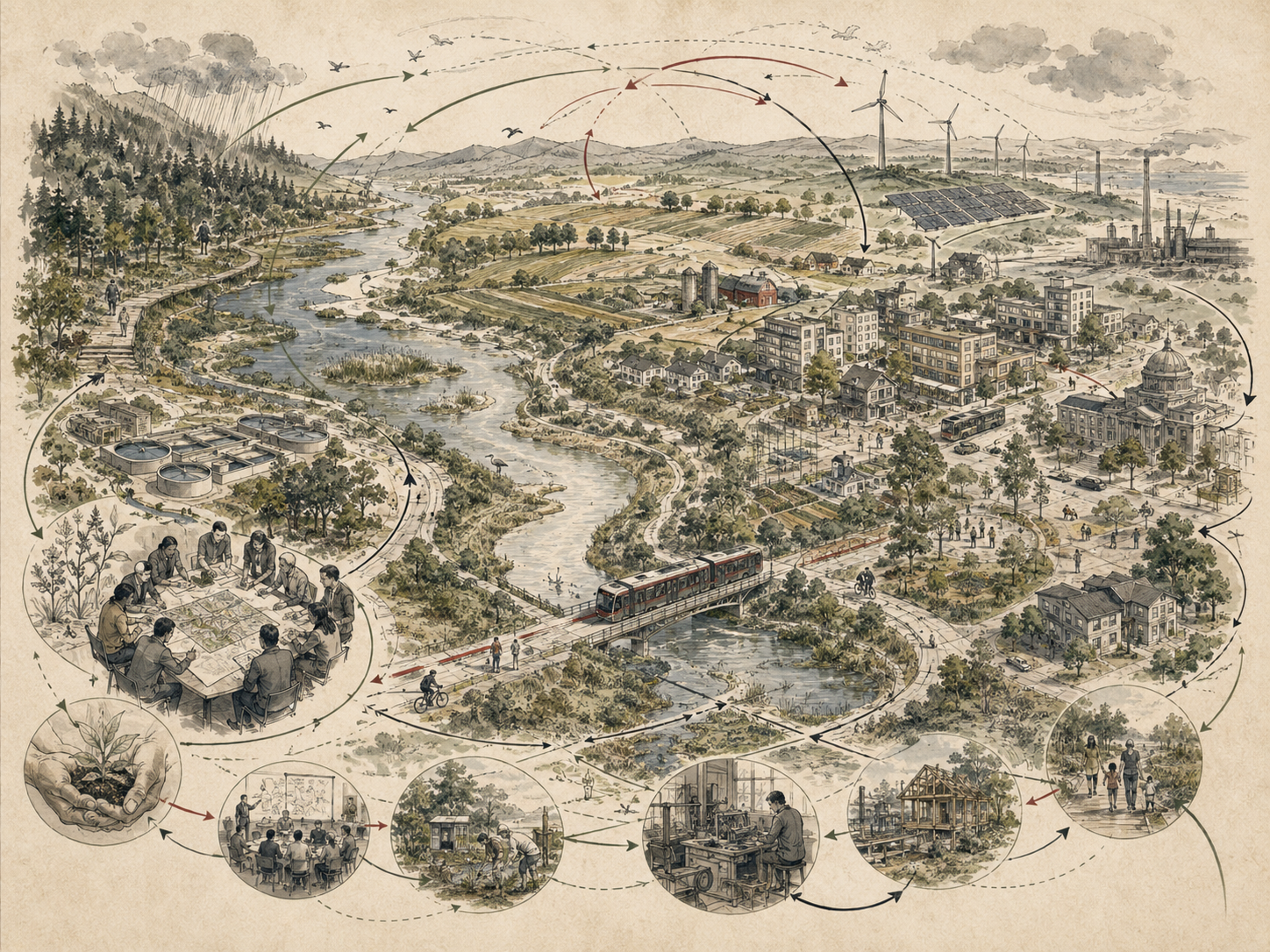
This article explores sustainability through systems thinking. It examines ecological limits, resource flows, feedback loops, delayed consequences, resilience, thresholds, social equity, governance, infrastructure, consumption, production, and system redesign. It shows why sustainability cannot be understood only through individual behavior, isolated technologies, single metrics, or short-term efficiency. It also examines the ethical stakes of sustainability: who benefits from unsustainable systems, who bears their costs, whose knowledge is included, and how responsibility extends across communities, species, and generations.
Why Systems Thinking Matters for Sustainability
Systems thinking matters for sustainability because sustainability problems are not isolated problems. They are produced by relationships among energy systems, land use, production, consumption, finance, governance, infrastructure, culture, technology, inequality, and ecological processes. A policy that reduces emissions in one sector may increase pressure elsewhere. A technology that improves efficiency may lower costs and increase total consumption. A conservation policy may protect one landscape while displacing extraction into another. A city may reduce local pollution while importing goods produced through ecological harm elsewhere. Sustainability requires attention to the whole system, not only the visible intervention.
Many sustainability failures come from linear reasoning. A problem is identified, a solution is applied, and success is measured through a narrow metric. But ecological and social systems respond. People adapt. Markets shift. Costs move across boundaries. Delayed consequences appear. Infrastructure locks in behavior. Political resistance grows. A metric improves while the underlying system continues to degrade. Systems thinking helps reveal these hidden dynamics.
Sustainability also requires systems thinking because many environmental problems involve accumulation. Greenhouse gases accumulate in the atmosphere. Nutrients accumulate in waterways. Plastics accumulate in ecosystems. Debt accumulates in infrastructure systems. Heat accumulates in oceans. Inequality accumulates through opportunity structures. Institutional distrust accumulates through repeated failure. These stocks change slowly, and their effects can appear long after the decisions that produced them.
| Sustainability issue | Linear interpretation | Systems-thinking interpretation |
|---|---|---|
| Climate change | Reduce emissions through cleaner technology. | Transform energy, transport, land use, finance, governance, consumption, and justice systems. |
| Biodiversity loss | Protect individual species or habitats. | Address land conversion, pollution, climate, extraction, food systems, governance, and ecological connectivity. |
| Water scarcity | Increase supply or efficiency. | Examine demand, agriculture, infrastructure, groundwater stocks, pricing, equity, climate, and watershed governance. |
| Waste | Improve recycling. | Redesign production, materials, consumption, repair, reuse, incentives, and responsibility across product lifecycles. |
| Urban sustainability | Make buildings or vehicles more efficient. | Connect housing, transport, energy, land use, infrastructure, public health, affordability, and governance. |
| Food systems | Increase yields. | Balance soil health, water, biodiversity, labor, nutrition, supply chains, resilience, waste, and livelihoods. |
Systems thinking does not make sustainability easier. It makes it more honest. It shows why there are no simple fixes for problems produced by complex structures. But it also reveals leverage: feedback loops that can be changed, flows that can be redirected, incentives that can be redesigned, boundaries that can be expanded, and goals that can be reconsidered. Sustainability is difficult because systems are interconnected. It is possible because systems can be redesigned.
Sustainability as System Continuity
Sustainability is often described as meeting present needs without compromising the ability of future generations to meet their own needs. That definition is important because it connects present action to future capacity. In systems terms, sustainability asks whether the stocks that support life and wellbeing are being maintained, regenerated, or depleted. Those stocks include ecological systems, climate stability, soil, water, biodiversity, infrastructure, public trust, institutional capacity, knowledge, health, community resilience, and social legitimacy.
Sustainability therefore requires more than environmental protection. A society can preserve some environmental stocks while degrading social foundations. It can pursue economic growth while eroding ecological capacity. It can reduce one kind of harm while increasing another. It can achieve short-term efficiency by reducing redundancy, maintenance, and resilience. A sustainable system must support continuity across ecological, social, economic, and institutional dimensions.
System continuity does not mean preserving the status quo. Some systems are unsustainable precisely because they continue too successfully: extraction continues, inequality continues, fossil-fuel dependence continues, habitat destruction continues, administrative burden continues, and short-term incentives continue. Sustainability requires continuity of life-supporting capacity, not continuity of harmful arrangements.
\text{Sustainability} = \text{Maintain or Regenerate Critical Stocks Over Time}
\]
Interpretation: A system is sustainable when the stocks that support life, dignity, resilience, and wellbeing are maintained or regenerated rather than depleted.
Thinking of sustainability as system continuity changes the questions we ask. Instead of asking only whether an intervention reduces one impact, we ask whether it preserves the capacity of the wider system. Does it reduce pressure on ecological stocks? Does it build human wellbeing? Does it protect future flexibility? Does it distribute burden fairly? Does it strengthen institutional learning? Does it reduce vulnerability? Does it avoid shifting costs to other places, communities, species, or generations?
A sustainable system must therefore balance several forms of continuity:
- Ecological continuity: ecosystems retain the capacity to regenerate, adapt, and support life.
- Social continuity: communities retain health, dignity, security, opportunity, and cohesion.
- Economic continuity: livelihoods and production systems operate without destroying the foundations on which they depend.
- Institutional continuity: governance systems preserve memory, trust, capacity, and accountability.
- Intergenerational continuity: future people inherit viable options rather than depleted systems.
Sustainability is not merely the absence of collapse. It is the presence of regenerative capacity, adaptive learning, and responsibility across time.
Ecological Limits and Social Foundations
Sustainability involves both ecological limits and social foundations. Ecological limits refer to the biophysical boundaries within which human systems must operate: climate stability, biodiversity, freshwater, land systems, nutrient cycles, ocean health, air quality, and chemical pollution. Social foundations refer to the conditions people need for dignified lives: food, water, health, education, housing, energy, income, safety, political voice, equality, and community belonging. A sustainable system must respect ecological ceilings while ensuring social floors.
This dual frame matters because sustainability can be misunderstood in two opposite ways. One approach treats environmental limits as the only concern and neglects poverty, rights, and unequal vulnerability. Another approach treats development as the only concern and ignores ecological systems until damage becomes crisis. Systems thinking holds both together. Ecological systems support human wellbeing. Social systems determine how ecological burdens and benefits are distributed. Neither can be understood alone.
Ecological limits are not arbitrary preferences. They arise from the structure of Earth systems. If greenhouse gases accumulate beyond safe levels, climate risk rises. If biodiversity declines, ecosystem functions weaken. If soils degrade, food systems become fragile. If groundwater is depleted faster than recharge, future water security declines. These are stock-flow relationships, not merely policy debates.
\text{Safe and Just Space} = \text{Social Foundation} \leq \text{Human Activity} \leq \text{Ecological Ceiling}
\]
Interpretation: Sustainability requires systems that meet human needs while remaining within ecological limits.
Social foundations are also systemic. People cannot exercise freedom or participate in society when they lack food, housing, healthcare, education, safety, clean water, or political voice. Poverty and exclusion reduce adaptive capacity. Inequality increases vulnerability. Marginalized communities often experience environmental harms first and receive protection last. Sustainability must therefore include justice, not only conservation.
| Ecological limit | Related social foundation | Systems challenge |
|---|---|---|
| Climate stability | Energy, housing, health, livelihoods, safety | Transition energy systems without deepening energy poverty or displacement. |
| Freshwater availability | Drinking water, sanitation, agriculture, health | Balance human need, ecosystem flow, agriculture, industry, and climate variability. |
| Biodiversity | Food, culture, medicine, livelihoods, ecosystem services | Protect ecosystems while respecting Indigenous rights and local livelihoods. |
| Land-system change | Housing, food, mobility, community stability | Coordinate land use, agriculture, conservation, infrastructure, and equity. |
| Nitrogen and phosphorus cycles | Food security, water quality, public health | Improve agriculture without overloading waterways and ecosystems. |
A systems approach rejects the false choice between people and planet. It asks how systems can be designed so human flourishing depends less on ecological depletion and ecological protection does not become a burden imposed on those with the least power. Sustainability is a relational problem: between present and future, humans and ecosystems, local and global systems, production and regeneration, efficiency and resilience, rights and responsibilities.
Stocks, Flows, and Resource Throughput
Stocks and flows are central to sustainability. A stock is something that accumulates or depletes over time: forest cover, soil carbon, groundwater, atmospheric carbon dioxide, fish populations, infrastructure condition, public trust, community health, or institutional capacity. A flow changes a stock: extraction, regeneration, emissions, absorption, investment, maintenance, learning, erosion, waste, or decay.
Unsustainability often occurs when outflows exceed inflows or inflows exceed absorptive capacity. A fishery collapses when harvest exceeds reproduction over time. A groundwater basin declines when withdrawal exceeds recharge. Atmospheric greenhouse gases accumulate when emissions exceed the capacity of natural and technological sinks. Infrastructure deteriorates when wear exceeds maintenance. Trust declines when institutional harm exceeds repair. These are systems dynamics.
Resource throughput refers to the flow of materials and energy through the economy: extraction, production, distribution, consumption, waste, and disposal. Sustainability requires reducing harmful throughput, closing loops where possible, regenerating critical stocks, and shifting from linear take-make-dispose systems toward circular, regenerative, and sufficiency-oriented systems.
S_{t+1} = S_t + \text{Regeneration}_t – \text{Extraction}_t – \text{Degradation}_t
\]
Interpretation: A sustainability stock \(S\) grows or declines depending on regeneration, extraction, and degradation over time.
Stocks and flows reveal why short-term indicators can mislead. A system can appear prosperous while drawing down natural capital. A city can appear financially efficient while deferring maintenance. A company can appear profitable while externalizing ecological costs. A community can appear stable while trust, health, or affordability erode. Sustainability requires looking beneath immediate output to the stocks being built or depleted.
| Stock | Inflow | Outflow | Sustainability question |
|---|---|---|---|
| Atmospheric stability | Carbon removal and natural sinks | Greenhouse gas emissions | Are emissions falling fast enough relative to cumulative concentration? |
| Soil fertility | Organic matter, regeneration, conservation practices | Erosion, nutrient loss, contamination | Is agricultural production maintaining the soil that supports it? |
| Groundwater | Recharge | Pumping, evaporation, contamination | Are withdrawals compatible with long-term water security? |
| Infrastructure condition | Maintenance, repair, renewal | Wear, climate stress, deferred investment | Is the system investing enough before failure occurs? |
| Public trust | Reliability, fairness, participation, repair | Burden, harm, opacity, broken promises | Are institutions building the legitimacy needed for transition? |
Stock-flow thinking is especially important because sustainability transitions often require patience. A flow may change quickly, but the stock responds slowly. Emissions can decline while atmospheric concentrations remain high. Restoration can begin while biodiversity recovers slowly. Maintenance can resume while infrastructure remains fragile. Public trust can be repaired, but only through repeated behavior over time. Systems thinking helps align expectations with stock-flow reality.
Feedback Loops in Sustainability
Feedback loops shape sustainability because systems respond to change. Reinforcing feedback amplifies change. Balancing feedback resists change. Both can support or undermine sustainability. A reinforcing loop can accelerate clean-energy adoption as costs fall, experience grows, infrastructure expands, and political support increases. A reinforcing loop can also accelerate ecological damage as deforestation reduces rainfall, which weakens forests, which causes more degradation. A balancing loop can stabilize resource use through regulation, prices, norms, or ecosystem recovery. It can also resist necessary transition when incumbent systems protect themselves.
Sustainability problems often persist because harmful reinforcing loops are stronger than corrective balancing loops. Fossil-fuel dependence persists through infrastructure, subsidies, political influence, consumer habits, and supply chains. Urban sprawl persists through road expansion, land development, car dependence, and zoning. Food-system degradation persists through yield pressure, soil depletion, input dependence, and market incentives. Waste persists through production design, convenience, consumer expectations, and weak producer responsibility.
\text{Reinforcing Loop}: A \uparrow \Rightarrow B \uparrow \Rightarrow A \uparrow
\]
\[
\text{Balancing Loop}: A \uparrow \Rightarrow B \uparrow \Rightarrow A \downarrow
\]
Interpretation: Reinforcing loops amplify change, while balancing loops resist change or restore equilibrium.
Feedback loops also explain why sustainability interventions can backfire. Efficiency improvements can reduce the cost of using a resource, which may increase total consumption. This is sometimes called rebound. A recycling program may reduce guilt and increase consumption if production remains unchanged. A conservation policy may displace extraction elsewhere. A carbon offset may create the appearance of action while delaying emissions reduction. Systems thinking asks what feedback an intervention activates.
| Feedback loop | How it works | Sustainability implication |
|---|---|---|
| Clean technology learning curve | Deployment lowers cost, lower cost increases deployment. | Can accelerate transition when supported by policy and infrastructure. |
| Rebound effect | Efficiency lowers cost, lower cost increases use. | Efficiency must be paired with absolute resource and emissions goals. |
| Deforestation-rainfall feedback | Forest loss alters water cycles, weakening forest resilience. | Land systems may cross thresholds if degradation continues. |
| Trust-cooperation loop | Trust supports cooperation, cooperation improves outcomes, outcomes build trust. | Just institutions can strengthen collective transition capacity. |
| Infrastructure lock-in loop | Existing infrastructure shapes behavior, behavior justifies more infrastructure. | Unsustainable systems reproduce themselves unless investment patterns change. |
Feedback loops are not only technical. They are social and political. Public trust affects policy compliance. Policy legitimacy affects cooperation. Inequality affects vulnerability and political voice. Corporate lobbying affects regulation. Infrastructure affects behavior. Behavior affects demand. Demand affects investment. Investment affects future options. Sustainability requires changing feedback at multiple levels.
Delay, Accumulation, and Policy Timing
Delay is one of the central reasons sustainability is difficult to govern. Environmental and social systems often respond slowly to human action. Greenhouse gases remain in the atmosphere long after they are emitted. Infrastructure built today shapes emissions, land use, and behavior for decades. Soil degradation can take years to become visible and longer to restore. Biodiversity loss may not be obvious until ecological functions decline. Public trust can be depleted through repeated harm and rebuilt only through repeated reliability.
Delay creates policy timing problems. If decision-makers wait for effects to become obvious, the system may already be close to a threshold. If short-term costs are visible but long-term benefits are delayed, prevention may be politically difficult. If harm is delayed, harmful systems can appear successful for years. If benefits of restoration are delayed, useful investments may be abandoned prematurely.
Y_t = f(X_{t-d})
\]
Interpretation: Current sustainability outcomes \(Y_t\) may depend on actions or pressures from an earlier time \(X_{t-d}\). Delay \(d\) makes cause and effect harder to connect.
Accumulation and delay also produce overshoot. A system overshoots when it exceeds the carrying capacity, regenerative capacity, or absorptive capacity of the system that supports it. Overshoot may not be immediately visible because stocks buffer the system temporarily. A groundwater aquifer can be overdrawn before wells run dry. A fishery can be overharvested before collapse appears. Atmospheric carbon can accumulate for decades before severe effects become common. Infrastructure can deteriorate quietly before failure.
Policy timing must therefore include leading indicators. A leading indicator signals future risk before full harm appears. Examples include soil organic matter decline, groundwater levels, heat stress days, species population trends, infrastructure condition ratings, energy-burden measures, food insecurity, public trust, and administrative backlog. Leading indicators help systems act before delayed feedback becomes crisis.
| Delayed system | Slow-moving stock | Leading indicator |
|---|---|---|
| Climate | Atmospheric greenhouse gas concentration | Cumulative emissions, energy mix, methane leakage, land-use change |
| Agriculture | Soil health | Organic matter, erosion rates, water retention, nutrient balance |
| Water systems | Groundwater and watershed capacity | Recharge rates, withdrawal rates, contamination levels, streamflow |
| Infrastructure | Physical condition and service reliability | Maintenance backlog, failure frequency, climate exposure, asset age |
| Governance | Public trust and institutional capacity | Participation, complaint patterns, service delays, staff turnover, appeal rates |
Sustainability policy must be designed for long time horizons. The question is not only whether an intervention is popular or efficient now. It is whether it changes the trajectory of the system before delay and accumulation make change more costly, harmful, or irreversible.
Resilience, Thresholds, and Regime Shifts
Resilience is the capacity of a system to absorb disturbance, adapt, recover, and sometimes transform while retaining essential functions. In sustainability, resilience matters because ecological and social systems are exposed to shocks: heat waves, floods, droughts, supply-chain disruptions, migration, disease, market volatility, political instability, infrastructure failure, and social conflict. A sustainable system must not only reduce harm under normal conditions. It must remain capable under stress.
Resilience is not the same as persistence. Some systems persist because they are rigid, extractive, or protected by power. An unjust system can be resilient in the sense that it resists change. Sustainability requires resilience of life-supporting and justice-supporting functions, not resilience of harmful structures. Sometimes resilience means transformation: changing the system because returning to the old state would reproduce vulnerability.
Thresholds are points where a system can shift from one regime to another. An ecosystem may shift from forest to savanna, a lake from clear to eutrophic, a fishery from productive to collapsed, a community from stable to displaced, or a public institution from trusted to distrusted. Thresholds are dangerous because change may be nonlinear. The system can appear stable until it is not.
\text{Resilience} = \text{Capacity to Absorb} + \text{Capacity to Adapt} + \text{Capacity to Transform}
\]
Interpretation: Resilience includes absorbing disturbance, adapting to change, and transforming when existing structures are no longer viable or just.
Resilience depends on diversity, redundancy, modularity, learning, trust, buffers, local knowledge, distributed capacity, and responsive governance. Highly optimized systems may be efficient but fragile. A food system dependent on a narrow set of crops, long supply chains, and degraded soils may produce cheap food under normal conditions while becoming vulnerable to shocks. A city with no slack in housing, transport, water, energy, or public health may fail under stress. A governance system with low trust may struggle to coordinate collective action.
| Resilience feature | Why it matters for sustainability |
|---|---|
| Diversity | Reduces dependence on one species, technology, supplier, institution, or pathway. |
| Redundancy | Provides backup capacity when one part fails. |
| Modularity | Prevents failures from cascading through tightly coupled systems. |
| Learning | Allows systems to revise behavior based on feedback. |
| Trust | Supports cooperation during uncertainty and transition. |
| Equity | Reduces vulnerability and increases adaptive capacity across the whole system. |
Sustainability transitions should build resilience deliberately. A transition that reduces emissions but creates fragile supply chains, social exclusion, ecological damage, or public backlash may solve one problem while creating another. Resilience thinking asks whether the system remains capable, fair, adaptive, and legitimate under stress.
Systems Archetypes in Sustainability
Systems archetypes are recurring patterns of system behavior. Sustainability problems often repeat these patterns because the same feedback structures appear across domains. Recognizing archetypes helps sustainability practitioners avoid predictable mistakes and identify deeper leverage points.
Limits to growth appears when growth is initially successful but eventually constrained by a limiting resource, capacity, or ecological boundary. Economic expansion may encounter energy, water, land, climate, labor, infrastructure, or legitimacy limits. The system’s early success creates confidence, but growth slows or reverses when constraints bind.
Fixes that fail appears when a short-term solution reduces symptoms but worsens the underlying problem. Road expansion reduces congestion briefly but encourages more driving. Air conditioning reduces heat stress but increases electricity demand if powered by fossil fuels. Chemical inputs increase yields while degrading soil health if used without regenerative practices. Emergency relief addresses crisis while prevention remains underfunded.
Shifting the burden appears when a system relies on symptomatic fixes instead of building fundamental capacity. Disaster response substitutes for climate adaptation. Food aid substitutes for food-system resilience. Individual recycling substitutes for producer responsibility. Personal resilience substitutes for sustainable work systems. The system becomes dependent on the fix while underlying capacity weakens.
Tragedy of the commons appears when actors draw from a shared resource while the costs of overuse are distributed across the group or future. Fisheries, groundwater, atmosphere, public trust, and institutional capacity can all be commons. Each actor’s use may seem rational locally, but the shared stock declines.
Success to the successful appears when already advantaged actors receive more resources, data, influence, funding, or adaptive capacity, while disadvantaged actors fall further behind. Sustainability transitions can reproduce inequality if benefits accrue to those who already have capital, political voice, or institutional access.
| Archetype | Sustainability example | Redesign implication |
|---|---|---|
| Limits to growth | Economic expansion runs into ecological and infrastructure constraints. | Shift from throughput growth to wellbeing, regeneration, and sufficiency. |
| Fixes that fail | Efficiency lowers resource cost and increases total use. | Pair efficiency with absolute reduction targets and governance. |
| Shifting the burden | Emergency response substitutes for prevention and adaptation. | Invest in root capacity, maintenance, and resilience. |
| Tragedy of the commons | Shared atmosphere, fisheries, groundwater, or trust are overused. | Create rules, monitoring, mutual accountability, and fair allocation. |
| Success to the successful | Wealthier communities access transition benefits first. | Design equity into funding, participation, infrastructure, and capacity-building. |
Archetypes are not rigid templates. They are diagnostic aids. They help ask better questions: Is the system relying on a short-term fix? What stock is being depleted? Who is gaining advantage? What commons is being overused? What constraint is limiting growth? What fundamental capacity must be built? Sustainability practice becomes stronger when it recognizes these recurring patterns before they harden into crisis.
Infrastructure Lock-In and Path Dependence
Infrastructure shapes behavior over long periods. Roads, buildings, energy grids, water systems, ports, digital networks, zoning, housing patterns, industrial facilities, and agricultural systems create path dependence. Once built, they influence what is easy, cheap, normal, and politically defended. Unsustainable systems often persist not because people consciously choose harm each day, but because infrastructure channels choice.
Path dependence means past decisions shape present possibilities. A city built around highways makes car dependence normal. A power grid built around fossil-fuel generation shapes investment, regulation, labor, and political coalitions. A food system built around monoculture, long supply chains, and cheap inputs shapes land use, diets, markets, and farmer choices. Once a system develops around a path, changing direction requires more than individual preference. It requires structural transition.
Infrastructure lock-in creates feedback loops. Existing infrastructure supports existing behavior. Existing behavior justifies further investment in the same infrastructure. Further investment strengthens the system’s political and economic constituency. Alternatives remain underdeveloped, making the dominant system appear inevitable.
\text{Infrastructure} \rightarrow \text{Behavior} \rightarrow \text{Demand} \rightarrow \text{Investment} \rightarrow \text{Infrastructure}
\]
Interpretation: Infrastructure lock-in occurs when existing systems shape behavior and demand in ways that justify further investment in the same system.
Lock-in is not only physical. It is institutional and cultural. Codes, standards, financing models, professional norms, subsidies, procurement rules, business models, consumer expectations, and political identities can all reinforce unsustainable paths. A sustainability transition must therefore address the whole lock-in structure.
| Lock-in domain | What reinforces the path? | Sustainability redesign |
|---|---|---|
| Transportation | Roads, zoning, parking, fuel systems, commute patterns | Transit, walkability, mixed land use, pricing, housing near jobs |
| Energy | Generation assets, grid design, subsidies, regulation, labor markets | Renewable integration, storage, demand response, justice transition |
| Buildings | Codes, financing, materials, heating systems, ownership structures | Retrofits, efficiency standards, electrification, affordability safeguards |
| Food systems | Supply chains, input markets, subsidies, land tenure, processing infrastructure | Agroecology, soil regeneration, regional systems, fair labor, waste reduction |
| Waste | Product design, packaging, disposal infrastructure, consumer norms | Repair, reuse, producer responsibility, material redesign, circular systems |
Sustainability transitions must be timed with infrastructure cycles. Buildings, roads, grids, water systems, and industrial assets last for decades. Each investment either deepens lock-in or opens transition pathways. Systems thinking asks what future behavior today’s infrastructure will make easier or harder.
Equity, Power, and Vulnerability
Sustainability cannot be separated from equity and power. Unsustainable systems do not distribute benefits and harms evenly. Some communities consume more resources and hold more political influence. Others face more pollution, climate exposure, displacement, health burden, labor exploitation, food insecurity, energy insecurity, and infrastructure neglect. A sustainability analysis that ignores power may protect aggregate indicators while leaving structural injustice intact.
Vulnerability is systemic. It is not only exposure to environmental hazard. It includes income, housing, health, mobility, political voice, legal status, discrimination, infrastructure quality, social networks, and access to services. Two communities can face the same climate hazard and experience very different outcomes because they have different adaptive capacity.
Power shapes system boundaries. A corporate sustainability report may count direct emissions but exclude supply-chain labor and ecological damage. A city may count local emissions but not imported consumption. A climate adaptation plan may protect high-value property while leaving low-income renters exposed. A conservation policy may protect land while excluding Indigenous governance. Systems thinking asks who draws the boundary and who lives with what the boundary excludes.
\text{Risk} = \text{Hazard} \times \text{Exposure} \times \text{Vulnerability}
\]
Interpretation: Sustainability risk depends not only on the hazard itself, but on who is exposed and how vulnerable they are because of social, economic, institutional, and ecological conditions.
| Equity issue | Systems dynamic | Sustainability implication |
|---|---|---|
| Energy burden | Low-income households spend larger shares of income on energy. | Energy transition must include affordability, retrofits, and protection from cost shifting. |
| Climate exposure | Historical housing, zoning, and infrastructure decisions shape vulnerability. | Adaptation must address historical and spatial inequality. |
| Pollution burden | Industrial siting and political marginalization concentrate harm. | Environmental policy must include cumulative impact and community authority. |
| Transition benefits | Subsidies may flow first to those with capital and access. | Programs must build capacity for households and communities with fewer resources. |
| Participation | Public processes often favor those with time, expertise, and institutional trust. | Governance must reduce participation burden and share authority. |
Equity is not an optional add-on to sustainability. It affects system behavior. Unequal systems are less resilient because vulnerability concentrates harm and weakens collective capacity. Excluded communities may distrust institutions, reducing cooperation. Policies that ignore distribution may generate backlash. Transitions that deepen inequality may become politically unstable. Just sustainability is not only morally necessary; it is structurally necessary.
Governance and Institutional Learning
Sustainability depends on governance systems that can learn. Ecological and social systems are dynamic, uncertain, and contested. No policy design will be perfect at the beginning. Institutions must be able to monitor feedback, preserve memory, revise assumptions, correct harm, and adapt over time. Without institutional learning, sustainability policy becomes a cycle of delayed response, reform failure, backlash, and crisis management.
Governance for sustainability must handle long time horizons, uncertain thresholds, cross-boundary effects, uneven vulnerability, and conflict over values. It must coordinate across agencies, sectors, jurisdictions, and communities. It must balance mitigation and adaptation, efficiency and resilience, individual behavior and structural change, local needs and global responsibilities. This requires learning capacity, not only formal authority.
Institutional memory matters because sustainability problems recur. Communities may have warned about flooding before a disaster. Scientists may have identified ecosystem risk before collapse. Frontline workers may have reported administrative barriers before program failure. Indigenous peoples and local communities may have preserved ecological knowledge that formal institutions ignored. A learning governance system must remember these signals and connect them to decision-making.
\text{Sustainability Governance} = \text{Feedback} \times \text{Memory} \times \text{Authority to Redesign}
\]
Interpretation: Sustainability governance requires feedback, institutional memory, and authority to redesign systems in response to what is learned.
Adaptive governance does not mean constant improvisation. It means disciplined flexibility: clear goals, transparent assumptions, monitoring systems, participatory feedback, revision mechanisms, accountability, and protection for vulnerable groups. It also requires humility. Institutions must be willing to revise policies when system feedback contradicts expectations.
Good sustainability governance includes:
- long-term goals connected to near-term indicators;
- feedback from affected communities and frontline implementers;
- monitoring for ecological, social, and distributional effects;
- institutional memory across political and administrative cycles;
- participatory processes with real influence;
- coordination across sectors and jurisdictions;
- transparent trade-off reasoning;
- mechanisms for repair when policies create harm.
Sustainability governance is therefore a learning system. It must be able to hear the system, remember what it has heard, and change what it does.
Redesigning Sustainable Systems
Sustainability requires redesign at multiple levels: products, infrastructure, incentives, institutions, markets, land systems, energy systems, food systems, cities, governance, and cultural expectations. Redesign differs from mitigation alone. Mitigation reduces harm inside an existing system. Redesign changes the system that produces harm.
For example, reducing plastic waste is not only a matter of asking consumers to recycle. It may require redesigning materials, packaging, product lifecycles, producer responsibility, reuse infrastructure, repair systems, procurement, and consumer norms. Reducing transport emissions is not only a matter of cleaner vehicles. It may require land-use reform, transit, housing policy, walkability, freight logistics, pricing, and urban design. Reducing food-system harm is not only a matter of increasing yields. It may require soil regeneration, dietary shifts, waste reduction, fair labor, regional resilience, water governance, and biodiversity protection.
Systems redesign often involves changing goals. If the system goal is maximum throughput, sustainability efforts may be absorbed as efficiency improvements that enable more growth. If the system goal shifts toward wellbeing within ecological limits, different design choices become possible. Goals are among the deepest leverage points because they define what the system is trying to optimize.
| System level | Mitigation approach | Redesign approach |
|---|---|---|
| Products | Use less material or improve recyclability. | Design for repair, reuse, modularity, durability, and producer responsibility. |
| Energy | Improve efficiency or switch fuels. | Transform generation, demand, storage, grid governance, affordability, and resilience. |
| Transport | Improve vehicle efficiency. | Redesign mobility around access, proximity, transit, active transport, and land use. |
| Food | Increase yield per acre. | Regenerate soil, reduce waste, diversify production, protect labor, and improve nutrition. |
| Governance | Add programs to existing agencies. | Redesign feedback, capacity, coordination, participation, and accountability. |
| Economy | Reduce impacts per unit of output. | Shift incentives toward wellbeing, sufficiency, circularity, regeneration, and justice. |
Sustainable redesign should be evaluated through multiple criteria: ecological impact, social wellbeing, equity, resilience, feasibility, public legitimacy, long-term capacity, and unintended consequences. A redesign that improves one metric while degrading another may not be sustainable. Systems thinking helps hold multiple outcomes together.
The goal is not perfect control. Complex systems cannot be fully controlled. The goal is to design systems that learn, regenerate, reduce harm, distribute benefits fairly, and preserve future possibility.
Ethics: Stewardship, Justice, and Intergenerational Responsibility
Sustainability is ethical because it concerns responsibility across relationships: between present and future generations, humans and nonhuman life, wealthy and vulnerable communities, consumers and producers, institutions and publics, nations and shared planetary systems. Systems thinking makes these relationships visible. It shows that harm is often displaced across space, time, species, class, race, and political power.
Stewardship means caring for systems we did not create alone and do not own absolutely. It includes ecological stewardship, institutional stewardship, infrastructure stewardship, knowledge stewardship, and democratic stewardship. A steward does not merely extract value from a system. A steward maintains and regenerates the capacity that makes value possible.
Justice matters because sustainability burdens and benefits are unequal. Communities least responsible for ecological harm often face the greatest exposure. Workers may bear the cost of transition if policies ignore livelihoods. Indigenous peoples may see conservation imposed without sovereignty. Low-income households may face higher energy costs if transition policy lacks protection. Future generations inherit consequences they did not choose. A systems ethics must account for these uneven relationships.
Intergenerational responsibility asks whether present systems preserve meaningful options for future people. A society that consumes ecological capacity, defers maintenance, accumulates climate risk, erodes public trust, and weakens institutions is borrowing from the future without consent. Sustainability requires changing that intertemporal relationship.
Ethical sustainability questions include:
- Who benefits from the current system?
- Who bears ecological, social, health, financial, or administrative burden?
- What costs are shifted to future generations?
- What harms are hidden outside the official boundary?
- Whose knowledge is included in defining the system?
- Who has authority over transition decisions?
- Does the intervention repair historical harm or reproduce it?
- Does the system protect nonhuman life and ecological integrity?
- Are resilience and adaptation used to support people or to ask them to endure more harm?
- What would responsibility require if the full system boundary were visible?
Sustainability ethics is not separate from systems design. Ethical choices become real through rules, infrastructure, metrics, budgets, ownership, participation, enforcement, and memory. A system that claims sustainable values but preserves extractive feedback loops remains ethically incomplete.
Examples Across Sustainability Systems
Systems thinking and sustainability apply across climate, energy, water, food, cities, biodiversity, infrastructure, waste, and governance. The examples below show how sustainability changes when systems relationships are centered.
Climate systems
Climate change is a stock-flow problem involving cumulative greenhouse gas concentrations, emissions flows, sinks, feedbacks, delays, and unequal vulnerability. A systems approach examines energy, land use, industry, transport, finance, consumption, adaptation, public trust, and justice together. It recognizes that climate policy must reduce emissions while building resilience and protecting those most exposed.
Energy systems
Energy transition is not only technology substitution. It includes grid infrastructure, storage, demand, affordability, labor, mining, land use, community consent, regulation, finance, and reliability. A systems view asks whether transition reduces fossil dependence while building energy justice, resilience, and public legitimacy.
Water systems
Water sustainability involves watersheds, groundwater, agriculture, cities, industry, ecosystems, climate variability, pricing, rights, infrastructure, and governance. Efficiency alone may not solve scarcity if total demand continues rising. Sustainable water systems require recharge, conservation, equitable access, ecosystem flows, and institutional coordination.
Food systems
Food systems connect soil, water, biodiversity, energy, labor, nutrition, public health, supply chains, trade, waste, and livelihoods. A yield-only model can miss soil degradation, pesticide exposure, labor exploitation, diet-related disease, and ecological loss. Systems thinking supports regenerative, resilient, nutritious, and just food systems.
Urban systems
Cities are systems of housing, transport, energy, water, waste, public space, health, affordability, land values, infrastructure, and governance. A sustainable city is not only dense or efficient. It must be livable, equitable, climate-resilient, accessible, and capable of learning from residents. Urban sustainability requires attention to displacement, heat, mobility, public health, and infrastructure maintenance.
Biodiversity and conservation
Biodiversity loss is driven by habitat conversion, climate change, pollution, invasive species, overharvest, and governance failure. Conservation must include ecological connectivity, Indigenous rights, local livelihoods, land tenure, restoration, and long-term monitoring. Systems thinking helps avoid conservation that protects maps while ignoring social and ecological relationships.
Waste and circularity
Waste is not only a disposal problem. It is a design problem, production problem, consumption problem, responsibility problem, and materials problem. Circular systems require repair, reuse, modular design, producer responsibility, material tracking, consumer access, and infrastructure for recovery. Recycling alone cannot redesign a linear economy.
Public institutions
Sustainability depends on institutions that can coordinate, learn, enforce, repair, and maintain legitimacy. Public institutions must manage long-term risks while responding to present needs. They must preserve institutional memory, include affected communities, and resist short-term incentives that deplete future capacity.
Across these domains, sustainability is not achieved by optimizing one variable. It is achieved by redesigning relationships among variables so systems can support life and wellbeing over time.
Mathematics, Computation, and Modeling
Sustainability can be modeled through stock-flow systems, feedback loops, scenario modeling, sensitivity analysis, network analysis, multicriteria evaluation, lifecycle assessment, resilience indicators, and distributional analysis. Models help reveal delayed effects, cumulative pressure, feedback, thresholds, trade-offs, and uncertainty. They should not replace judgment or participation, but they can improve the quality of sustainability reasoning.
A basic sustainability stock-flow model can be represented as:
S_{t+1} = S_t + R_t – E_t – D_t
\]
Interpretation: Sustainability stock \(S\) changes through regeneration \(R_t\), extraction \(E_t\), and degradation \(D_t\).
Emissions accumulation can be represented as:
C_{t+1} = C_t + G_t – A_t
\]
Interpretation: Atmospheric concentration \(C\) increases through greenhouse gas additions \(G_t\) and decreases through absorption or removal \(A_t\).
Resource overshoot can be represented as:
O_t = \max(0, U_t – K_t)
\]
Interpretation: Overshoot \(O_t\) occurs when use \(U_t\) exceeds regenerative or carrying capacity \(K_t\).
Resilience can be represented as a multidimensional function:
R_s = f(D, B, L, T, E, A)
\]
Interpretation: System resilience \(R_s\) can depend on diversity \(D\), buffers \(B\), learning \(L\), trust \(T\), equity \(E\), and adaptive capacity \(A\).
A sustainability evaluation can use a multicriteria score:
V = \sum_{i=1}^{n} w_i x_i
\]
Interpretation: A sustainability value score \(V\) can aggregate weighted indicators \(x_i\), but the choice of weights \(w_i\) must be transparent and ethically justified.
Distributional sustainability can be represented as:
J_g = B_g – H_g – C_g
\]
Interpretation: Net justice outcome \(J_g\) for group \(g\) can compare benefits \(B_g\), harms \(H_g\), and transition costs \(C_g\), making distribution visible.
| Modeling task | Sustainability question | Example output |
|---|---|---|
| Stock-flow modeling | Are critical stocks regenerating or depleting? | Carbon, water, soil, biodiversity, infrastructure, or trust trajectories. |
| Scenario modeling | How do different interventions change long-term outcomes? | Baseline, efficiency, sufficiency, regeneration, and justice-transition scenarios. |
| Sensitivity analysis | Which assumptions most affect sustainability outcomes? | Parameter rankings, uncertainty intervals, and leverage indicators. |
| Lifecycle analysis | Where do impacts occur across production, use, and disposal? | Material, energy, emissions, water, and waste profiles across lifecycle stages. |
| Network analysis | Where are dependencies, bottlenecks, and cascade risks? | Supply-chain, infrastructure, ecosystem, or institutional network maps. |
| Distributional analysis | Who benefits, who bears costs, and who is exposed? | Equity impacts by income, geography, race, age, sector, or vulnerability group. |
| Resilience diagnostics | How does the system behave under shock? | Buffer, redundancy, recovery, adaptation, and threshold indicators. |
Models should make assumptions visible. A sustainability model that hides boundaries can mislead. Does it count imported consumption? Does it include supply-chain labor? Does it include biodiversity? Does it include future generations? Does it include administrative burden? Does it include distribution? Systems modeling is most useful when it supports transparent inquiry and participatory learning.
Python Workflow: Sustainability Feedback, Stock-Flow, and Scenario Modeling
The Python workflow below turns sustainability systems analysis into a small reproducible systems model. It compares four scenarios: business-as-usual throughput, efficiency with rebound, resilience and burden-aware transition, and regenerative just-systems redesign. It also includes one-at-a-time sensitivity analysis for the regenerative redesign scenario. The script uses only the Python standard library, writes CSV outputs relative to the article folder, and is designed as a clear starting point for companion repository work.
# systems_thinking_sustainability_workflow.py
# Dependency-light workflow for sustainability systems diagnostics:
# stock-flow dynamics, overshoot, rebound, resilience, delayed response,
# distributional burden, trust, governance learning, and redesign scenarios.
# Writes outputs relative to the article root.

from __future__ import annotations

from dataclasses import dataclass, replace
from pathlib import Path
import csv
from statistics import mean

ARTICLE_ROOT = Path(__file__).resolve().parents[1]
TABLES = ARTICLE_ROOT / "outputs" / "tables"


@dataclass
class SustainabilityScenario:
    name: str
    extraction_pressure: float
    regeneration_investment: float
    degradation_rate: float
    efficiency_gain: float
    rebound_strength: float
    policy_delay: float
    resilience_investment: float
    equity_capacity: float
    governance_learning: float
    institutional_memory: float
    public_trust_repair: float
    transition_burden: float
    infrastructure_lock_in: float
    sufficiency_shift: float


def clamp(value: float, low: float = 0.0, high: float = 140.0) -> float:
    return max(low, min(high, value))


def run_scenario(scenario: SustainabilityScenario, periods: int = 64) -> list[dict[str, object]]:
    ecological_stock = 78.0
    social_foundation = 46.0 + scenario.equity_capacity * 12.0
    resilience_stock = 38.0 + scenario.resilience_investment * 16.0
    institutional_learning_stock = 34.0 + scenario.institutional_memory * 16.0
    public_trust = 38.0 + scenario.public_trust_repair * 14.0
    infrastructure_lock_in_stock = 48.0 + scenario.infrastructure_lock_in * 16.0
    cumulative_overshoot = 0.0
    distributional_burden_stock = 38.0 + scenario.transition_burden * 14.0
    rows: list[dict[str, object]] = []

    delay_steps = max(0, int(round(scenario.policy_delay * 10.0)))
    redesign_history: list[float] = [0.0]

    for period in range(periods + 1):
        delayed_index = max(0, len(redesign_history) - 1 - delay_steps)
        delayed_redesign = redesign_history[delayed_index]

        baseline_use = clamp(
            scenario.extraction_pressure * 18.0
            + infrastructure_lock_in_stock * 0.08
            + max(0.0, 65.0 - social_foundation) * 0.05
            - scenario.sufficiency_shift * 8.0,
            0.0,
            120.0,
        )

        efficiency_effect = clamp(
            scenario.efficiency_gain * 18.0
            + delayed_redesign * 0.06
            - scenario.rebound_strength * 5.0,
            0.0,
            100.0,
        )

        rebound_flow = clamp(
            efficiency_effect * scenario.rebound_strength * 0.70
            + infrastructure_lock_in_stock * 0.04
            + scenario.extraction_pressure * 5.0
            - scenario.sufficiency_shift * 5.0
            - scenario.governance_learning * 2.0,
            0.0,
            100.0,
        )

        extraction_flow = clamp(
            baseline_use
            - efficiency_effect * 0.35
            + rebound_flow * 0.45
            - scenario.sufficiency_shift * 6.0
            - delayed_redesign * 0.05,
            0.0,
            120.0,
        )

        degradation_flow = clamp(
            scenario.degradation_rate * 16.0
            + extraction_flow * 0.18
            + infrastructure_lock_in_stock * 0.04
            - scenario.regeneration_investment * 4.0
            - scenario.governance_learning * 2.5,
            0.0,
            100.0,
        )

        regeneration_flow = clamp(
            scenario.regeneration_investment * 18.0
            + scenario.resilience_investment * 10.0
            + scenario.governance_learning * 6.0
            + institutional_learning_stock * 0.04
            - max(0.0, 45.0 - ecological_stock) * 0.04,
            0.0,
            100.0,
        )

        carrying_capacity = clamp(
            48.0
            + regeneration_flow * 0.20
            + resilience_stock * 0.12
            + institutional_learning_stock * 0.08
            - infrastructure_lock_in_stock * 0.08,
            20.0,
            120.0,
        )

        overshoot = clamp(
            extraction_flow + degradation_flow - regeneration_flow - carrying_capacity * 0.10,
            0.0,
            120.0,
        )
        cumulative_overshoot += overshoot

        ecological_stock = clamp(
            ecological_stock
            + regeneration_flow * 0.10
            - extraction_flow * 0.10
            - degradation_flow * 0.12
            - overshoot * 0.06,
            0.0,
            120.0,
        )

        threshold_risk = clamp(
            max(0.0, 55.0 - ecological_stock) * 0.22
            + overshoot * 0.16
            + max(0.0, cumulative_overshoot - 220.0) * 0.02
            - resilience_stock * 0.08
            - institutional_learning_stock * 0.06,
            0.0,
            100.0,
        )

        transition_burden_flow = clamp(
            scenario.transition_burden * 12.0
            + scenario.policy_delay * 5.0
            + threshold_risk * 0.08
            + infrastructure_lock_in_stock * 0.04
            - scenario.equity_capacity * 7.0
            - scenario.public_trust_repair * 4.0,
            0.0,
            100.0,
        )

        distributional_burden_stock = clamp(
            distributional_burden_stock
            + transition_burden_flow * 0.10
            + overshoot * 0.05
            - scenario.equity_capacity * 1.1
            - scenario.public_trust_repair * 0.8
            - institutional_learning_stock * 0.025,
            0.0,
            120.0,
        )

        social_foundation = clamp(
            social_foundation
            + scenario.equity_capacity * 1.2
            + scenario.public_trust_repair * 0.8
            + institutional_learning_stock * 0.04
            - distributional_burden_stock * 0.04
            - threshold_risk * 0.06
            - scenario.transition_burden * 0.6,
            0.0,
            100.0,
        )

        resilience_stock = clamp(
            resilience_stock
            + scenario.resilience_investment * 1.3
            + regeneration_flow * 0.05
            + institutional_learning_stock * 0.04
            - threshold_risk * 0.06
            - overshoot * 0.04,
            0.0,
            120.0,
        )

        feedback_signal = clamp(
            overshoot * 0.16
            + threshold_risk * 0.16
            + distributional_burden_stock * 0.08
            + max(0.0, 60.0 - ecological_stock) * 0.10
            + scenario.equity_capacity * 5.0,
            0.0,
            100.0,
        )

        feedback_acted_upon = clamp(
            feedback_signal * (0.35 + 0.45 * scenario.governance_learning)
            + scenario.institutional_memory * 8.0
            + scenario.public_trust_repair * 6.0
            + scenario.equity_capacity * 5.0
            - scenario.infrastructure_lock_in * 4.0
            - scenario.policy_delay * 3.0,
            0.0,
            100.0,
        )

        institutional_learning_stock = clamp(
            institutional_learning_stock
            + feedback_acted_upon * 0.10
            + scenario.institutional_memory * 1.0
            + scenario.governance_learning * 1.1
            - scenario.policy_delay * 0.6
            - threshold_risk * 0.03,
            0.0,
            120.0,
        )

        public_trust = clamp(
            public_trust
            + scenario.public_trust_repair * 1.1
            + scenario.equity_capacity * 0.8
            + feedback_acted_upon * 0.04
            - distributional_burden_stock * 0.04
            - threshold_risk * 0.04
            - scenario.policy_delay * 0.5,
            0.0,
            100.0,
        )

        infrastructure_lock_in_stock = clamp(
            infrastructure_lock_in_stock
            + scenario.infrastructure_lock_in * 0.7
            + rebound_flow * 0.035
            - delayed_redesign * 0.08
            - scenario.sufficiency_shift * 0.9
            - scenario.governance_learning * 0.5,
            0.0,
            120.0,
        )

        redesign_flow = clamp(
            scenario.regeneration_investment * 9.0
            + scenario.resilience_investment * 8.0
            + scenario.equity_capacity * 8.0
            + scenario.governance_learning * 10.0
            + scenario.institutional_memory * 7.0
            + scenario.sufficiency_shift * 9.0
            + feedback_acted_upon * 0.08
            - scenario.policy_delay * 5.0
            - scenario.infrastructure_lock_in * 5.0,
            0.0,
            100.0,
        )
        redesign_history.append(redesign_flow)

        safe_and_just_score = clamp(
            ecological_stock * 0.18
            + social_foundation * 0.16
            + resilience_stock * 0.15
            + institutional_learning_stock * 0.14
            + public_trust * 0.12
            + scenario.equity_capacity * 8.0
            + scenario.sufficiency_shift * 7.0
            - overshoot * 0.14
            - threshold_risk * 0.14
            - distributional_burden_stock * 0.12
            - infrastructure_lock_in_stock * 0.10,
            0.0,
            100.0,
        )

        rows.append({
            "period": period,
            "scenario": scenario.name,
            "ecological_stock": round(ecological_stock, 3),
            "social_foundation": round(social_foundation, 3),
            "resilience_stock": round(resilience_stock, 3),
            "institutional_learning_stock": round(institutional_learning_stock, 3),
            "public_trust": round(public_trust, 3),
            "infrastructure_lock_in_stock": round(infrastructure_lock_in_stock, 3),
            "extraction_flow": round(extraction_flow, 3),
            "degradation_flow": round(degradation_flow, 3),
            "regeneration_flow": round(regeneration_flow, 3),
            "rebound_flow": round(rebound_flow, 3),
            "overshoot": round(overshoot, 3),
            "cumulative_overshoot": round(cumulative_overshoot, 3),
            "threshold_risk": round(threshold_risk, 3),
            "distributional_burden_stock": round(distributional_burden_stock, 3),
            "feedback_signal": round(feedback_signal, 3),
            "feedback_acted_upon": round(feedback_acted_upon, 3),
            "safe_and_just_score": round(safe_and_just_score, 3),
        })

    return rows


def summarize(rows: list[dict[str, object]]) -> list[dict[str, object]]:
    output: list[dict[str, object]] = []
    for scenario_name in sorted({row["scenario"] for row in rows}):
        subset = [row for row in rows if row["scenario"] == scenario_name]
        final = subset[-1]
        avg_score = mean(float(row["safe_and_just_score"]) for row in subset)
        avg_overshoot = mean(float(row["overshoot"]) for row in subset)
        avg_threshold = mean(float(row["threshold_risk"]) for row in subset)
        avg_burden = mean(float(row["distributional_burden_stock"]) for row in subset)
        avg_ecological = mean(float(row["ecological_stock"]) for row in subset)

        if float(final["safe_and_just_score"]) >= 65 and float(final["threshold_risk"]) <= 35:
            diagnostic = "regenerative redesign is improving ecological, social, and institutional conditions"
        elif avg_overshoot >= 45:
            diagnostic = "resource use remains in overshoot relative to regeneration and capacity"
        elif avg_threshold >= 55:
            diagnostic = "threshold risk is high and delayed action is increasing fragility"
        elif avg_burden >= 60:
            diagnostic = "transition or ecological burden is being distributed inequitably"
        elif avg_ecological < 45:
            diagnostic = "critical ecological stock remains too depleted for durable sustainability"
        elif avg_score >= 55:
            diagnostic = "partial sustainability improvement with remaining overshoot and equity risks"
        else:
            diagnostic = "weak evidence of durable sustainability-system redesign"

        output.append({
            "scenario": scenario_name,
            "final_safe_and_just_score": final["safe_and_just_score"],
            "final_ecological_stock": final["ecological_stock"],
            "final_social_foundation": final["social_foundation"],
            "final_resilience_stock": final["resilience_stock"],
            "final_threshold_risk": final["threshold_risk"],
            "final_cumulative_overshoot": final["cumulative_overshoot"],
            "final_distributional_burden_stock": final["distributional_burden_stock"],
            "average_safe_and_just_score": round(avg_score, 3),
            "average_overshoot": round(avg_overshoot, 3),
            "average_threshold_risk": round(avg_threshold, 3),
            "average_distributional_burden_stock": round(avg_burden, 3),
            "average_ecological_stock": round(avg_ecological, 3),
            "diagnostic": diagnostic,
        })

    return output


def one_at_a_time(base: SustainabilityScenario, delta: float = 0.10) -> list[dict[str, object]]:
    base_score = float(run_scenario(base)[-1]["safe_and_just_score"])
    parameters = [
        "extraction_pressure",
        "regeneration_investment",
        "degradation_rate",
        "efficiency_gain",
        "rebound_strength",
        "policy_delay",
        "resilience_investment",
        "equity_capacity",
        "governance_learning",
        "institutional_memory",
        "public_trust_repair",
        "transition_burden",
        "infrastructure_lock_in",
        "sufficiency_shift",
    ]

    rows: list[dict[str, object]] = []
    for parameter in parameters:
        for direction in (-1, 1):
            current = getattr(base, parameter)
            revised_value = max(0.0, min(1.0, current + direction * delta))
            revised = replace(base, name=f"{base.name} {parameter} {direction * delta:+.2f}", **{parameter: revised_value})
            revised_score = float(run_scenario(revised)[-1]["safe_and_just_score"])
            rows.append({
                "parameter": parameter,
                "delta": direction * delta,
                "base_value": current,
                "revised_value": revised_value,
                "base_final_safe_and_just_score": round(base_score, 3),
                "revised_final_safe_and_just_score": round(revised_score, 3),
                "score_change": round(revised_score - base_score, 3),
                "absolute_score_change": round(abs(revised_score - base_score), 3),
            })

    return sorted(rows, key=lambda row: float(row["absolute_score_change"]), reverse=True)


def write_csv(path: Path, rows: list[dict[str, object]]) -> None:
    path.parent.mkdir(parents=True, exist_ok=True)
    if not rows:
        raise ValueError(f"No rows to write: {path}")
    with path.open("w", newline="", encoding="utf-8") as handle:
        writer = csv.DictWriter(handle, fieldnames=list(rows[0].keys()))
        writer.writeheader()
        writer.writerows(rows)


def main() -> None:
    scenarios = [
        SustainabilityScenario("Business as usual throughput", 0.82, 0.24, 0.78, 0.18, 0.42, 0.74, 0.24, 0.24, 0.24, 0.26, 0.24, 0.58, 0.78, 0.18),
        SustainabilityScenario("Efficiency with rebound", 0.68, 0.34, 0.60, 0.74, 0.70, 0.56, 0.34, 0.34, 0.38, 0.38, 0.34, 0.48, 0.62, 0.28),
        SustainabilityScenario("Resilience and burden-aware transition", 0.46, 0.68, 0.38, 0.56, 0.30, 0.32, 0.70, 0.70, 0.68, 0.68, 0.66, 0.30, 0.34, 0.58),
        SustainabilityScenario("Regenerative just-systems redesign", 0.28, 0.86, 0.22, 0.52, 0.14, 0.18, 0.86, 0.86, 0.86, 0.86, 0.86, 0.18, 0.20, 0.84),
    ]

    rows: list[dict[str, object]] = []
    for scenario in scenarios:
        rows.extend(run_scenario(scenario))

    write_csv(TABLES / "sustainability_systems_timeseries.csv", rows)
    write_csv(TABLES / "sustainability_systems_summary.csv", summarize(rows))
    write_csv(TABLES / "sustainability_systems_sensitivity_analysis.csv", one_at_a_time(scenarios[-1]))

    print("Sustainability systems workflow complete.")
    print(TABLES / "sustainability_systems_timeseries.csv")


if __name__ == "__main__":
    main()
The workflow is intentionally simple enough to inspect. It shows how extraction pressure, regeneration, degradation, efficiency, rebound, policy delay, resilience investment, equity capacity, governance learning, institutional memory, public trust, transition burden, infrastructure lock-in, and sufficiency interact over time. It also shows why sustainability cannot be judged by efficiency alone: an efficient system can remain in overshoot if total throughput, rebound, delay, and distributional burden are not redesigned. The model is synthetic and illustrative; it supports disciplined inquiry rather than replacing ecological science, community knowledge, democratic judgment, or ethical responsibility.
R Workflow: Indicator Visualization, Sensitivity Tables, and Sustainability Diagnostics
The R workflow reads the Python-generated time-series and sensitivity outputs, creates sustainability-system summaries, and exports base R plots for ecological stock, overshoot, threshold risk, distributional burden, resilience, and safe-and-just score. It uses only base R so it remains portable across simple local environments.
# systems_thinking_sustainability_diagnostics.R
# Base R workflow for sustainability-system summary and scenario visualization.

args <- commandArgs(trailingOnly = FALSE)
file_arg <- grep("^--file=", args, value = TRUE)

if (length(file_arg) > 0) {
  script_path <- normalizePath(sub("^--file=", "", file_arg[1]), mustWork = TRUE)
  article_root <- normalizePath(file.path(dirname(script_path), ".."), mustWork = TRUE)
} else {
  article_root <- getwd()
}

setwd(article_root)

tables_dir <- file.path(article_root, "outputs", "tables")
figures_dir <- file.path(article_root, "outputs", "figures")

if (!dir.exists(tables_dir)) {
  dir.create(tables_dir, recursive = TRUE)
}

if (!dir.exists(figures_dir)) {
  dir.create(figures_dir, recursive = TRUE)
}

timeseries_path <- file.path(tables_dir, "sustainability_systems_timeseries.csv")
sensitivity_path <- file.path(tables_dir, "sustainability_systems_sensitivity_analysis.csv")

if (!file.exists(timeseries_path)) {
  stop(paste("Missing", timeseries_path, "Run the Python workflow first."))
}

data <- read.csv(timeseries_path, stringsAsFactors = FALSE)

last_by_scenario <- do.call(
  rbind,
  lapply(split(data, data$scenario), function(df) df[nrow(df), ])
)

avg_score <- aggregate(safe_and_just_score ~ scenario, data = data, FUN = mean)
avg_overshoot <- aggregate(overshoot ~ scenario, data = data, FUN = mean)
avg_threshold <- aggregate(threshold_risk ~ scenario, data = data, FUN = mean)
avg_burden <- aggregate(distributional_burden_stock ~ scenario, data = data, FUN = mean)
avg_ecological <- aggregate(ecological_stock ~ scenario, data = data, FUN = mean)

names(avg_score)[2] <- "average_safe_and_just_score"
names(avg_overshoot)[2] <- "average_overshoot"
names(avg_threshold)[2] <- "average_threshold_risk"
names(avg_burden)[2] <- "average_distributional_burden_stock"
names(avg_ecological)[2] <- "average_ecological_stock"

final_fields <- last_by_scenario[, c(
  "scenario",
  "safe_and_just_score",
  "ecological_stock",
  "social_foundation",
  "resilience_stock",
  "threshold_risk",
  "cumulative_overshoot",
  "distributional_burden_stock"
)]

names(final_fields) <- c(
  "scenario",
  "final_safe_and_just_score",
  "final_ecological_stock",
  "final_social_foundation",
  "final_resilience_stock",
  "final_threshold_risk",
  "final_cumulative_overshoot",
  "final_distributional_burden_stock"
)

summary_table <- Reduce(
  function(x, y) merge(x, y, by = "scenario"),
  list(avg_score, avg_overshoot, avg_threshold, avg_burden, avg_ecological, final_fields)
)

summary_table$diagnostic <- ifelse(
  summary_table$final_safe_and_just_score >= 65 &
    summary_table$final_threshold_risk <= 35,
  "regenerative redesign is improving ecological, social, and institutional conditions",
  ifelse(
    summary_table$average_overshoot >= 45,
    "resource use remains in overshoot relative to regeneration and capacity",
    ifelse(
      summary_table$average_threshold_risk >= 55,
      "threshold risk is high and delayed action is increasing fragility",
      ifelse(
        summary_table$average_distributional_burden_stock >= 60,
        "transition or ecological burden is being distributed inequitably",
        ifelse(
          summary_table$average_ecological_stock < 45,
          "critical ecological stock remains too depleted for durable sustainability",
          ifelse(
            summary_table$average_safe_and_just_score >= 55,
            "partial sustainability improvement with remaining overshoot and equity risks",
            "weak evidence of durable sustainability-system redesign"
          )
        )
      )
    )
  )
)

summary_table <- summary_table[order(summary_table$final_safe_and_just_score, decreasing = TRUE), ]

write.csv(
  summary_table,
  file.path(tables_dir, "sustainability_systems_r_summary.csv"),
  row.names = FALSE
)

if (file.exists(sensitivity_path)) {
  sensitivity <- read.csv(sensitivity_path, stringsAsFactors = FALSE)
  sensitivity_ranked <- sensitivity[order(sensitivity$absolute_score_change, decreasing = TRUE), ]
  write.csv(
    sensitivity_ranked,
    file.path(tables_dir, "sustainability_systems_sensitivity_ranked_r.csv"),
    row.names = FALSE
  )
}

plot_metric <- function(metric, label, file_name) {
  png(file.path(figures_dir, file_name), width = 1200, height = 700)
  scenarios <- unique(data$scenario)
  plot(
    NA,
    xlim = range(data$period),
    ylim = range(data[[metric]], na.rm = TRUE),
    xlab = "Period",
    ylab = label,
    main = paste(label, "by Sustainability Scenario")
  )
  for (scenario_name in scenarios) {
    subset_data <- data[data$scenario == scenario_name, ]
    lines(subset_data$period, subset_data[[metric]], lwd = 2)
  }
  legend("topright", legend = scenarios, lwd = 2, cex = 0.75, bty = "n")
  grid()
  dev.off()
}

plot_metric("ecological_stock", "Ecological stock", "ecological_stock_trajectories.png")
plot_metric("overshoot", "Overshoot", "overshoot_trajectories.png")
plot_metric("threshold_risk", "Threshold risk", "threshold_risk_trajectories.png")
plot_metric("distributional_burden_stock", "Distributional burden stock", "distributional_burden_trajectories.png")
plot_metric("resilience_stock", "Resilience stock", "resilience_stock_trajectories.png")
plot_metric("safe_and_just_score", "Safe and just score", "safe_and_just_score_trajectories.png")

png(file.path(figures_dir, "final_safe_and_just_scores.png"), width = 1200, height = 700)
barplot(
  summary_table$final_safe_and_just_score,
  names.arg = summary_table$scenario,
  las = 2,
  ylab = "Final safe and just score",
  main = "Final Safe and Just Score by Sustainability Scenario"
)
grid()
dev.off()

print(summary_table)
This workflow supports the article’s central methodological claim: sustainability should be evaluated through trajectories, thresholds, burdens, resilience, and system redesign, not through isolated snapshots or single indicators. The R outputs help readers compare efficiency-oriented intervention with regenerative, equity-aware, governance-learning scenarios.
GitHub Repository
The companion repository for this article should help readers model sustainability as a dynamic system of ecological limits, social foundations, stocks, flows, feedback loops, delayed effects, resilience, distribution, and governance learning using synthetic datasets and reproducible workflows.
Complete Code Repository
Companion repository for the article, including sustainability stock-flow simulations, carbon accumulation scenarios, resource overshoot diagnostics, resilience threshold modeling, rebound-effect analysis, distributional sustainability workflows, indicator visualization, sensitivity tables, synthetic datasets, documentation assets, and multi-language scaffolds for systems analysis.
articles/systems-thinking-and-sustainability/
├── python/
│   ├── systems_thinking_sustainability_workflow.py
│   ├── sustainability_stock_flow_model.py
│   ├── carbon_accumulation_scenarios.py
│   ├── resource_overshoot_diagnostics.py
│   ├── resilience_threshold_simulation.py
│   ├── rebound_effect_model.py
│   ├── distributional_sustainability_analysis.py
│   ├── sensitivity_analysis_sustainability.py
│   ├── validation_checks.py
│   └── run_all_sustainability_workflows.py
├── r/
│   ├── systems_thinking_sustainability_diagnostics.R
│   ├── sustainability_indicator_plots.R
│   ├── scenario_comparison_visualization.R
│   ├── stock_flow_summary_tables.R
│   ├── sensitivity_results_tables.R
│   ├── distributional_justice_plots.R
│   ├── resilience_diagnostics_summary.R
│   └── run_all_sustainability_workflows.R
├── julia/
│   ├── nonlinear_sustainability_dynamics.jl
│   ├── resilience_threshold_model.jl
│   └── resource_feedback_simulation.jl
├── sql/
│   ├── schema_sustainability_indicators.sql
│   ├── schema_resource_flows.sql
│   ├── schema_ecological_stocks.sql
│   ├── schema_social_foundations.sql
│   ├── schema_resilience_indicators.sql
│   ├── schema_distributional_impacts.sql
│   ├── schema_policy_scenarios.sql
│   ├── schema_model_runs.sql
│   └── schema_outputs.sql
├── rust/
│   └── sustainability_diagnostics_cli.rs
├── go/
│   └── sustainability_scenario_runner.go
├── cpp/
│   ├── efficient_overshoot_scan.cpp
│   └── threshold_response_solver.cpp
├── fortran/
│   └── recurrence_sustainability_stock_model.f90
├── c/
│   └── low_level_sustainability_feedback_engine.c
├── docs/
│   ├── modeling_principles.md
│   ├── article_notes.md
│   ├── sustainability_systems_framework.md
│   ├── stock_flow_and_feedback_guide.md
│   ├── resilience_and_thresholds.md
│   ├── distributional_justice_notes.md
│   ├── python_workflow.md
│   ├── r_workflow.md
│   ├── diagnostic_questions.md
│   ├── assumptions_and_limitations.md
│   └── responsible_use.md
├── data/
│   ├── synthetic_sustainability_indicators.csv
│   ├── synthetic_resource_flows.csv
│   ├── synthetic_ecological_stocks.csv
│   ├── synthetic_social_foundations.csv
│   ├── synthetic_resilience_indicators.csv
│   ├── synthetic_distributional_impacts.csv
│   ├── synthetic_policy_scenarios.csv
│   ├── synthetic_model_runs.csv
│   └── synthetic_outputs.csv
├── outputs/
│   ├── README.md
│   ├── figures/
│   └── tables/
└── notebooks/
    ├── python_sustainability_systems_walkthrough.ipynb
    └── r_sustainability_indicators_visualization_placeholder.ipynb
This repository structure supports the article’s central argument: sustainability must be analyzed dynamically, with attention to stocks, flows, feedback, delay, thresholds, distribution, resilience, and governance learning. The python/ folder supports simulation and scenario modeling. The r/ folder supports visualization, indicator diagnostics, and distributional summaries. The julia folder supports nonlinear system dynamics. The sql folder defines schemas for sustainability system data. The lower-level language folders provide scaffolds for diagnostics, overshoot scanning, threshold solving, recurrence modeling, and low-level feedback simulation.
A Practical Method for Sustainability Systems Diagnosis
Sustainability systems diagnosis requires moving from isolated impacts to system behavior. The method below can be used to examine environmental, social, economic, institutional, and infrastructure sustainability problems.
1. Define the system boundary
Identify what is included and excluded. Include ecological systems, social groups, infrastructure, governance, supply chains, time horizons, and future generations where relevant.
2. Identify critical stocks
Ask what must be maintained or regenerated: climate stability, soil, water, biodiversity, public trust, infrastructure, health, institutional memory, or community capacity.
3. Map flows
Identify extraction, regeneration, emissions, waste, investment, maintenance, learning, degradation, restoration, and burden-shifting flows.
4. Identify feedback loops
Map reinforcing and balancing loops. Ask which loops amplify harm and which support regeneration, resilience, trust, or transition.
5. Examine delays
Identify where cause and effect are separated by time. Include ecological recovery, climate response, infrastructure decay, public trust, and institutional learning.
6. Look for thresholds and resilience risks
Ask whether the system is near a tipping point, carrying-capacity limit, social breaking point, or institutional legitimacy threshold.
7. Analyze distribution
Identify who benefits, who bears harm, who carries transition costs, and who has authority in decision-making.
8. Test policy scenarios
Compare efficiency-only, mitigation, regeneration, sufficiency, adaptation, and justice-centered scenarios. Include unintended consequences and rebound effects.
9. Identify leverage points
Look for changes in rules, incentives, information flows, infrastructure, goals, ownership, participation, and mental models.
10. Build learning into governance
Preserve feedback, monitor indicators, revise assumptions, include affected communities, and connect learning to authority and accountability.
This method treats sustainability as a dynamic system rather than a checklist. It asks what keeps producing unsustainable behavior and what redesign would change the system’s trajectory.
Common Pitfalls
Sustainability work can fail when it remains too narrow, too technical, too individualistic, or too disconnected from power. Several pitfalls are common.
- Confusing efficiency with sustainability: Efficiency reduces impact per unit, but total impact can still rise if total throughput increases. Sustainability requires absolute pressure reduction where ecological limits demand it.
- Ignoring rebound effects: Efficiency can lower costs and increase use. Systems analysis must examine total outcomes, not only improved intensity.
- Optimizing one metric: A policy can reduce emissions while increasing inequality, displacement, biodiversity loss, or public burden. Sustainability is multidimensional.
- Ignoring delayed consequences: Delayed harm is easy to discount. Sustainability requires leading indicators and long-term responsibility.
- Treating technology as sufficient: Technology matters, but infrastructure, governance, incentives, equity, culture, and behavior shape whether technology produces sustainable outcomes.
- Excluding power and justice: Aggregate improvements can hide unequal harm. Sustainability must examine distribution and authority.
- Neglecting institutional memory: Systems repeat failure when lessons, warnings, and community feedback are not preserved and used.
- Using resilience to justify endurance: Resilience should build adaptive capacity and reduce harm, not ask vulnerable people to absorb more shocks.
The central pitfall is treating sustainability as impact reduction inside existing systems rather than redesign of the systems that produce ecological harm and social vulnerability.
Why Sustainability Requires Systems Thinking
Sustainability requires systems thinking because the systems that support life and wellbeing are interconnected, delayed, adaptive, and bounded by ecological reality. Problems such as climate change, biodiversity loss, water scarcity, infrastructure fragility, food insecurity, pollution, inequality, and public distrust cannot be solved one variable at a time. They are produced by patterns of feedback, incentives, infrastructure, governance, consumption, extraction, and power.
Systems thinking changes the sustainability question. It asks not only how to reduce a visible impact, but how to change the structure that keeps producing the impact. It asks what stocks are being depleted, what flows must change, what feedback loops are reinforcing harm, what delays are hiding consequences, what thresholds are approaching, who carries the burden, and what institutions must learn.
A sustainable system is not merely cleaner. It is more regenerative, resilient, just, adaptive, and accountable. It protects ecological foundations while supporting human dignity. It reduces harmful throughput while building social capacity. It measures what matters over time. It includes affected people in decisions. It preserves memory. It learns from feedback. It changes goals when old goals produce harm.
Sustainability is therefore not a destination reached by isolated improvements. It is an ongoing systems practice: maintaining life-supporting stocks, redesigning harmful feedback loops, respecting ecological limits, strengthening social foundations, and acting with responsibility across generations.
Related Articles
- Systems Thinking in Governance and Public Institutions
- Systems Thinking in Public Policy
- Resilience, Thresholds, and Regime Shifts
- Climate Systems and Feedback Dynamics
- Food-Water-Energy Systems Thinking
- Public Health as a System
- Urban Systems: Congestion, Housing, and Infrastructure
- Leverage Points and Places to Intervene in a System
Further Reading
- Meadows, Donella H. Thinking in Systems: A Primer. Chelsea Green Publishing.
- Meadows, Donella H., Meadows, Dennis L., Randers, Jørgen and Behrens, William W. The Limits to Growth. Universe Books.
- Rockström, Johan et al. “A Safe Operating Space for Humanity.” Nature.
- Steffen, Will et al. “Planetary Boundaries: Guiding Human Development on a Changing Planet.” Science.
- Raworth, Kate. Doughnut Economics: Seven Ways to Think Like a 21st-Century Economist. Chelsea Green Publishing.
- Folke, Carl. “Resilience: The Emergence of a Perspective for Social-Ecological Systems Analyses.” Global Environmental Change.
- Ostrom, Elinor. Governing the Commons: The Evolution of Institutions for Collective Action. Cambridge University Press.
- World Commission on Environment and Development. Our Common Future. Oxford University Press.
- IPCC. Climate Change 2023: Synthesis Report. Intergovernmental Panel on Climate Change.
- UN General Assembly. Transforming Our World: The 2030 Agenda for Sustainable Development.
References
- Folke, C. (2006) “Resilience: The Emergence of a Perspective for Social-Ecological Systems Analyses.” Global Environmental Change, 16(3), pp. 253–267. Available at: https://doi.org/10.1016/j.gloenvcha.2006.04.002
- IPCC (2023) Climate Change 2023: Synthesis Report. Geneva: Intergovernmental Panel on Climate Change. Available at: https://www.ipcc.ch/report/ar6/syr/
- Meadows, D.H. (2008) Thinking in Systems: A Primer. White River Junction, VT: Chelsea Green Publishing. Available at: https://www.chelseagreen.com/product/thinking-in-systems/
- Meadows, D.H., Meadows, D.L., Randers, J. and Behrens, W.W. (1972) The Limits to Growth. New York: Universe Books. Available at: https://www.clubofrome.org/publication/the-limits-to-growth/
- Ostrom, E. (1990) Governing the Commons: The Evolution of Institutions for Collective Action. Cambridge: Cambridge University Press.
- Raworth, K. (2017) Doughnut Economics: Seven Ways to Think Like a 21st-Century Economist. White River Junction, VT: Chelsea Green Publishing.
- Rockström, J. et al. (2009) “A Safe Operating Space for Humanity.” Nature, 461, pp. 472–475. Available at: https://doi.org/10.1038/461472a
- Steffen, W. et al. (2015) “Planetary Boundaries: Guiding Human Development on a Changing Planet.” Science, 347(6223). Available at: https://doi.org/10.1126/science.1259855
- UN General Assembly (2015) Transforming Our World: The 2030 Agenda for Sustainable Development. Available at: https://sdgs.un.org/2030agenda
- World Commission on Environment and Development (1987) Our Common Future. Oxford: Oxford University Press. Available at: https://sustainabledevelopment.un.org/content/documents/5987our-common-future.pdf